A MAN who once talked with a Baptist minister from New England was much impressed with the varied and unusual experiences which fall to the lot of the country preacher. One thing especially appealed to his imagination.
"It isn't an easy life," he said. "You'd be surprised to hear how some country people treat their ministers. Why, this man said that one cold winter night he was hustled out of bed by a woman he didn't know, and ordered to come right away to her house two miles off, because her son was sick.
'But I don't know you,' the minister grumbled. 'Are you a member of my church? Am I your pastor?'
'No,' said the woman. 'I'm a member of Mr. McWade's church. Mr. McWade is my pastor. I don't care about calling him in, too. My son's case is contagious.'"
TWO GENTLEMEN.
ONE gentleman was little and the other one was large. The large one was very tall and very straight. He wore a suit of fine broad-cloth, and in his polished linen shirt front a great diamond sparkled like a star. His boots were of patent leather, and so bright you could almost see your face in them. He had on new brown kid gloves, and carried an elegant silk umbrella, with a silver handle on which was engraved his monogram.
The little one was very short and very crooked, with a hump on one shoulder, and a limp in his gait. His clothes were thread-bare; his cap was ragged; his shoes had holes in them; his little hands were bare, and red with cold. He held a clumsy newspaper bundle in his arms.
The two stood side by side upon the curb-stone of a crowded street, waiting for a chance to cross. The little one looked up at the large one with admiration. "What a fine gentleman!" he thought. Suddenly a poorly-clad old woman, carrying a great basket of clothes, came from the opposite direction. As she neared the sidewalk, she dodged suddenly, to avoid a cart that was passing, and stumbled against the tall gentleman, her basket of clothes knocking out of his grasp the umbrella with the monogram on the silver handle. With an angry glance and a muttered oath, he gave her a rough shove to one side, while he stooped to recover the umbrella. The little one had seen it all.
He threw down his newspaper bundle, while with one hand he caught the old woman, and with the other kept her basket from being overturned in the gutter.
"You're a gentleman—that you are!" she said fervently, putting one of her hands with tenderness on the threadbare coat which covered the poor misshapen back.
But the tall one did not hear. He had crossed the street. And the little one was surprised.—The Outlook.
HEARTLESS CRUELTY.
“ONE of these people, a woman, met another woman, who is elderly, yesterday.
“‘Now this is pleasant,’ said the elderly woman, after a few minutes’ chat. ‘You haven’t seen me for eleven years, and yet you know me at once. I can’t have changed so dreadfully, can I?’
“‘I recognized your bonnet,’ said the first woman.”
The Bank of Mountain View
We pay 3 per cent on ordinary savings deposits; 3½ per cent on six months' time certificates, and 4 per cent on twelve months' time certificates. You can open an account with us beginning with one dollar. Let us tell you about banking by mail.
The Bank of Mountain View
is the old established bank and wants your business and would like to have your name on its books
Mountain View, California
IMPORTANT TO TRAVELERS
The WASHINGTON-SUNSET ROUTE announce the opening of their through line via New Orleans. Personally conducted cars, San Francisco to Washington, D. C., via Coast Line and Los Angeles, tri-weekly. Tickets at lowest rates to Washington, Baltimore, Philadelphia, New York, New England, and all Eastern points. Through the Old South. Quick time. Best service. Write Phil K. Gordon, 1708 Fillmore St., San Francisco, for full information.
Engineering and Nursing Positions
WANTED—A young man to do light engineering work; also two gentlemen and four ladies to take the Nurses' Training Course. Write immediately.
Garden City Sanitarium, San Jose, Cal.
Is your husband proud of your COOKERY?
Likes good things to eat—does he?
Wouldn't it be a pleasant surprise to him in the winter time to set out some sliced tomatoes on a pretty white plate, fixed up just the way he likes them—
Or some sweet corn on the cob, as juicy and creamy as the day it was plucked, or green peas, or— Say—a dish of brook trout— Or some other article of food of which he is particularly fond, but which can not be obtained for love or money, out of season? Well—
The ECONOMY Jar enables you to give him that very surprise. The ECONOMY Jar is a wide mouth, self-sealing, perfectly air tight jar. Nothing else like it.
By its use, you can perfectly preserve fruit, whole or sliced; vegetables, fish, game, or any other article of food, without the use of preservatives or any means except heat and pure water.
No burned or cut fingers when you use the ECONOMY—no rubber rings to contaminate—no dangerous acids to develop.
The next time the man of the house brings in a basket of trout or game, just put up some of them in an ECONOMY Jar. Then, without saying a word to him, set them out for his dinner some day next winter. They will be as sweet and wholesome and appetizing as the day they were put up. The treat will be like a vacation day in the woods or mountains. A single dozen ECONOMY Jars will prove this to you. Get them at your dealers.
Sit down right now and write us your name and the name of your dealer and state whether he sells the ECONOMY Jar, and we will send you (FREE) a booklet of recipes—tell you all about preserving the Economy way—tell you where you may buy the jars, and all about "pleasant ways to surprise the man's palate," without a penny of cost to you or any trouble further than writing us one short letter.
WANTED Housekeeper—Adventist preferred, Must be good cook—Small house—Family consists of man and wife—Good wages to the right person. Address
Mrs. John S. Calkins,
Glendale, Los Angeles Co., Cal.
BULL DOG
50¢
TRADE MARK
50¢
SUSPENDERS
BEST FOR COMFORT, WEAR AND ECONOMY
FOR EVERY PURPOSE, FOR MAN AND YOUTH
Guaranteed to Outwear Three
of the Ordinary Kind
BULL DOG SUSPENDERS
Not a Harness—Do Not Twist or Tangle—Cannot Grow Stiff, Bind, Catch or Sag—Will Not Soil Linen.Are the Standard of True Suspender Economy
Contain more and better rubber and greater elasticity than any other suspender; have non-rusting, silver nickel metal parts and imported, unbreakable Bull Dog Leather Ends, insuring ease and action, longer wear, and better and more uniform trouser support. They give absolute satisfaction that cannot be had in any other make of suspenders.
In light weight lisle or heavy weight twills for man or youth (extra lengths at no extra cost). If they don't prove the Best 50 Cent investment you ever made you can have your money back by asking for it.
If your dealer won't supply you, we will, postpaid.There is no substitute for the Bull Dog
HEWES & POTTER
Largest Suspender and Belt Makers in the World
Dept. 23287 LINCOLN ST., BOSTON, MASS.
Valuable Booklet, "CORRECT DRESS & SUSPENDER STYLES," free on request.
REASONS FOR A MISSION IN THE MOUNTAINS OF INDIA.
By J. L. Shaw
THERE are some important reasons for establishing a mission in the mountains of India, and we are anxious that the readers of the SIGNS OF THE TIMES should know fully why funds are being solicited for such an undertaking. We believe as the reasons are better known a very generous response will follow.
Let us first briefly consider the climatic conditions of India in the different parts of the country. A bird's eye view would reveal the fact that India is divided into three regions which are as follows:
1. The Himalaya region, which includes the southern portion of the lofty Himalaya Mountains and their offshoots.
2. The second comprises the land stretching southward from the Himalayas, and includes the valley-plains of several large rivers which find their rise in these high mountains.
3. The third region is a triangular table-land comprising the southern half of India. It is frequently called the "Deccan."
The Himalaya region lies between 30° and 35° north latitude, and the climate is cool and refreshing. The lofty peaks of the Himalayas, many of which are more than 20,000 feet high and covered with perpetual snow, exert a cooling and invigorating influence over this whole region. Blankets are always acceptable at night in the summer time, and during the day in the house it is always comfortable, while in the winter snow falls in many of the hill towns.
In the river-plain region, where our mission work is almost all located, the climate is in many places very unhealthful, especially in Bengal where the elevation above sea-level is little and the country malarious. About Calcutta the fever districts are many and the climate is such that few missionaries from the north can long endure climatic conditions without a change, and some are not able to endure them at all.
The hot season in the river-plains region begins the latter part of March and continues until the first of November. During this time the thermometer registers anywhere from 90° to 140° and the heat is incessant day and night. So great heat for so long a time is very enervating and depressing to those of northern birth.
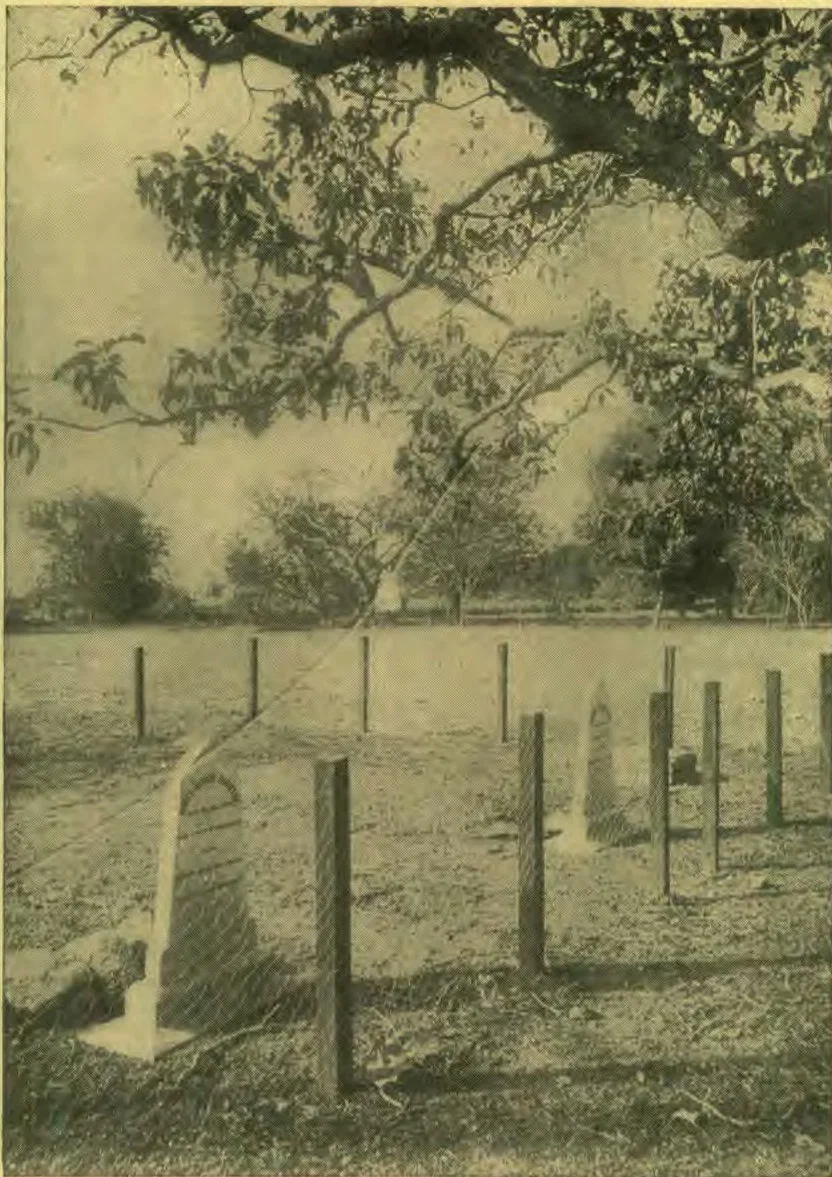
The graves at Karmatar, of Evangelists O. A. Robinson and G. M. Brown, who died in 1900 of smallpox in labor for others in India. If it had not been for long depleting labors, these noble workers might have survived this disease.
Because of these conditions it seems to the Mission Board and the workers in India that a foothold should be secured in the mountain regions, where there are many souls who know nothing of Christ and where climatic conditions are more favorable. There are at least three reasons for locating a mission in the mountains, which are as follows:
1. To carry the Gospel and a knowledge of the principles of present truth to the mountain tribes, of whom many, yea, multitudes, know nothing of Jesus Christ and of salvation through His name and merits.
2. For the benefit of our missionaries working in various parts of India where the heated season is intense and protracted and the climate unhealthful. A mission in the mountains will serve as a retreat for worn laborers to regain health and strength.
3. As a training center where native converts may be trained for work among their own people living in unhealthful districts where our missionaries from the north can not work.
India's sons and daughters, we believe, are to be reached largely through those of kindred tongue and tribe who accept the light and go forth to their own people.
These are, in brief, the reasons for raising funds for a mission in the mountains of India, and we believe as the readers of the SIGNS OF THE TIMES know the purposes of the fund many more will esteem it a privilege to donate. About $3,000 has thus far been raised. Thank God for this and for the generosity it shows.
But more money is required. It will take at least $5,000 to buy land and put up necessary buildings, etc.
For the sake of Christ's work in India, and for the sake of His faithful missionaries, who are now working in the heat and the sun to bring men and women to Christ, this appeal is made. A lighthouse in the mountains will spell progress to the cause of Gospel truth in India. Those who give, and make a sacrifice to give, will be sharers in the reward to be pronounced upon those who have wrought for India and her millions. There are souls at stake. Let us give and give freely.
J. L. SHAW.
13English engineering and enterprise! Another line will soon be constructed in the Sudan which will make in all, over 1,200 miles of railroad in that neglected district. Do the missionary people need a stronger challenge than this? We can not excuse ourselves to the Lord if we carry not the Gospel to every creature. What means this rapid opening of mission territory but that the Lord wills to give these wandering tribes a chance for salvation before He returns to take away His people."
RAILROADS IN AFRICA.
By L. E. Glenn
Under the above caption, Missionary L. E. Glenn, of the Pentecost Band, writes to the Herald of Light as follows:
*“A great barrier to mission work on the Upper Nile and in Central Africa has been overcome by a new railroad just opened in January, from the Red Sea to the Nile. You will no doubt feel that the Lord’s hand is in it when we tell you that this line of 325 miles of railroad was built under a tropical sun and in spite of great obstacles, in just fourteen months. The distance from the Red Sea to the Upper Nile can be covered in a few hours. Heretofore it has been a long, wearisome trip of about five days and nights from Alexandria to Khartoum by way of Nile Valley and part of the distance the trip was made by Nile steamers.
“Now all the great Western Sudan is in close touch with the outside world by this miracle of
KING ALI'S QUEST.
By Annie M. L. Hawes
[Annie M. L. Hawes, in Youth's Companion.]
THERE came a priest into the court one day,
And standing by the throne with unbent knee,
He cried, "Great Allah bade me come and say,
'O king, thy brother hath sore need of thee.'"
"Our brother?" quoth the monarch, wondering,
"Know we are Ali, last of our race."
"Thy brother hath sore need of thee, O king,"
The priest replied, and vanished from the place.
At night the great town slept beside the sea,
But on his pallet restless tossed the king,
And heard, "Thy brother hath sore need of thee,"
Through all the palace chambers echoing.
Till, when gray morning through the window crept,
Forced by the summons pleading at his door,
Ali went forth, while all his sentries slept,
And took a way no king had gone before.
He went through fetid lane and alley dim,
He saw in prison foul the young child lie;
He heard by stake and cross the martyr's hymn,
He saw in lazar-hut the friendless die.
In vain they called him to his crown and throne;
He laughed that such poor playthings yet should be,
And answered all, "I find, at last, my own,
I know the brother that hath need of me."
If tomb King Ali had, it is unknown,
His palace columns razed by Time's rude hands,
For ages lost, his scepter, and his throne,
His ashes mingled with the desert's sands.
Yet down the chill wind of the past is blown
Like breath of roses o'er a wintry sea,
These words of love, "I find, at last, my own,
I know my brother that hath need of me."
OUR WORK AND WORKERS.
By Editor
AN institute for church-school teachers will be held at Maple Plain, Minn., August 14–18.
THE East Michigan Banner notes the baptism of five candidates at Saginaw, by Brother Wm. Ostrander.
THE Welcome Visitor notes the baptism of six candidates at Massillon, Ohio, June 16, by Brother H. H. Burkholder.
ANY of our S. D. A. literature sent post-paid to Eld. H. Clay Griffin, Chester, Ark., will be used to good purpose.
FIVE converts are reported in connection with the labors of Brother C. D. McMoody and Anna M. Jenson, at Sparta, Wis.
IN the Wisconsin Reporter, Brother F. F. Petersen notes the baptism of seven candidates at Eau Claire, Wis., June 9.
THE city churches of both Cincinnati and Toledo, Ohio, have purchased meeting tents for use in those cities by the conference.
THE annual session of the Utah Conference will be held in connection with the camp-meeting in Salt Lake City, August 16 to 25.
THE academy at Harvey, N. D., has secured the services of Prof. N. W. Lawrence, who has been principal of Mount Vernon College, Academia, Ohio, for a number of years.
FROM Chester, Ark., Brother H. Clay Griffin writes of a good interest and several keeping the Sabbath. He was to move his tent to Winslow on the first inst.
IN the Northern Illinois Recorder, Brother F. J. Harris reports the baptism of seven candidates at Aledo, June 2. Four others had commenced to keep the Sabbath, who were to be baptized at a later occasion.
THERE was an addition of two members to the new church at Longview, Texas, at the last ordinance occasion. A half-dozen others have accepted the faith and are keeping the Sabbath, but have not yet united with the church.
IN connection with meetings at Chatham, Ont., June 16 and 17, a new house of worship was dedicated. The sermon was by Brother E. K. Slade, president of East Michigan Conference. Brethren Isaac Sandborn and A. O. Burrill also took part in the exercises.
THE camp-meeting at Oakland, Cal., will commence on the 19th inst., and continue until the 29th. A large outside attendance is expected, because of the large number of fire refugees in and about the city with no special occupation. The camp will be located at Grove and Forty-First Streets.
AT the late session of Minnesota Conference, officers were elected as follows: President, H. S. Shaw; vice-president, J. F. Anderson; treasurer, C. M. Everest; secretary, Wm. Asp; Sabbath-school and mission secretary, Ella E. Merickel; educational secretary, W. W. Ruble; field secretary, F. F. Fry, religious liberty secretary, O. O. Bernstein; medical superintendent, Dr. E. P. Hawkins.
THE office of the Pacific Union Conference has been moved from Oakland to Mountain View, into the new headquarters building. The California Conference office will be moved to the same building after the Oakland camp-meeting, or about the first of August. The presidents of both conferences, Brethren H. W. Cottrell and W. T. Knox, have their homes here. In this connection we also note that the Pacific Union Recorder will be published in Mountain View hereafter.
A PRETTY little booklet recently received, is replete with information about our Paradise Valley Sanitarium, in San Diego County, Cal. It is illustrated with a number of views of the buildings and premises; also of the surrounding country, of the bay, and the Pacific Ocean. A description of the climate is accompanied by a temperature diagram, showing interesting comparisons with other localities. Persons desiring information regarding the sanitarium and its advantages should send for a copy of this little souvenir. Address, Paradise Valley Sanitarium, National City, Cal.
NO ONE should lose sight of the fact that circumstances are accumulating that will make it harder and harder to disseminate the Gospel message. One or two more such disasters in our country as has just befallen California would create a very stringent condition in the money market. We have not yet seen the full result of this calamity. Noting the things that make it necessary to redeem the time while circumstances are comparatively favorable, the Gospel Herald (Nashville, Tenn.) says: "Turning to the financial world, we see indications of changes there that may make it much more difficult to secure means for carrying forward our work than it has been in the past. We can not expect that the prosperity that has attended this country for a number of years past will continue indefinitely. We must, in the very nature of things, pass through a period of financial stringency in the very near future. Only a few days ago, a panic was very narrowly averted in Wall Street, and the reason for it no one could tell. Turning to the industrial world, we find a state of unrest that is a harbinger of serious labor difficulties in the near future, with all the attendant evils which result from such a difficulty."
WANTED FOR MISSIONARY WORK.
(Always prepay postage.)
PAPERS and tracts suitable for distribution in connection with tent work. Address, Mrs. Margaret Wright, Haines Falls, N. Y.
PERSONS who have been sending literature to Mrs. A. T. Squires, Hildebran, N. C., are requested to change the address to Hickory, N. C., R. F. D. 4.
Personally Conducted
Tourist Cars
ON THE
UNION PACIFIC
Operate daily between principal Eastern points and California. The route of the Overland Limited.
S. F. BOOTH, General Agent, San Francisco, Cal.
E. L. LOMAX, G. P. A. Omaha, Neb.
Southern Pacific
Whether going East or coming West, do not fail to take advantage of the most essential features of traveling
Speed,
Comfort,
Safety
Which are given the greatest attention in the equipment of the
Overland Limited
Running over the Southern and Union Pacific. Secure tickets and make reservations for berths from any
Local AgentSouthern Pacific Company
—OR—
City Ticket Office,Ferry Bldg., San Francisco, Cal.
Write Me To-day
Write Me To-day
If you are out of work or not, for a position that will start you in a paying manufacturing business on a few dollars, suitable for either sex. I will give you all information and find all material. You can start on $5. This is a chance for every S. D. A. to be independent of others for work. I can not offer my proposition to any in the following states at present: California, Oregon, Arizona, Nevada, or Washington, but shall be glad to hear from every village and town in the balance of the states and Canada. Don't wait; write to-day. Address,
ALFRED MALLETT, Elkridge Sta., Baltimore, Md.
MILLENNIAL TEXT-BOOK.—Every known reference, over 500 arranged according to events, adapted for instant reference or profound Bible study; result of 12 years' search. Mailed for 10 one-cent stamps, or a dime. Eugene A. Brown, Phœnix, Ariz.
Send Us a Preacher
“Send Us a Preacher.”—Miss Russell tells of a written petition from a city one hundred miles from Peking, to which seventy names were signed, asking for a preacher or teacher. Similar requests from other quarters are coming to our missionaries in China, from cities or villages in which there are now no permanent Christian laborers. These communities have heard something of the truth, perhaps from missionaries while on their tours, and they are coming to know from the light which has been diffusing itself over China within the last four or five years, that the Christian religion, which is allied in their minds with Western enlightenment, is worthy of being studied, even if they have not gone so far as to decide that it ought to be received. This is the day for seed-sowing in China.—Missionary Herald.
GRAND CANYON
OF ARIZONA
"A whole chaotic underworld. Most sublime scene on earth. A mile deep, 13 miles wide, 217 miles long, and painted like a flower."
TICKET OFFICES:
Ferry Building, San Francisco
1112 Broadway, Oakland
40th St. and San Pablo Ave., Oakland
University and West Sts., Berkeley
2d and J Streets, Sacramento
21 So. 1st Street, San Jose, Cal.
Great Fires of San Francisco
The recent conflagration in San Francisco was the seventh of those that have been rated as "great fires." Each was so reckoned at the time of its occurrence. In December, 1849, about fifty houses in the business center were destroyed, with an estimated loss of a million dollars. This was a heavy loss considering the size of the town. The second "great fire" occurred in May, 1850. Three hundred houses were destroyed, entailing a loss of three and a half million dollars. The third fire occurred in June of the same year, when property in the business portion of the city was burned to the extent of four million dollars.
The fourth "great fire" came in September following. More ground was covered, but the houses being of a cheaper order, the financial loss was not so heavy. The fifth in the list destroyed most of the business part of the city, involving a loss estimated at twelve million dollars. It occurred in May, 1851, and brick, stone, and iron buildings deemed fire-proof were swept before the flames. Shipping was saved by cutting away the wharves. Many lives (the number never was definitely known) were lost in this catastrophe. The sixth great fire came in the latter part of June, the same year, and destroyed about five hundred wooden structures, mostly one-story. The property loss was placed at three million dollars. It will be seen by this statement that the Queen City of the West had a long respite (nearly fifty-five years) from extensive fires.
The Call=Chronicle=Examiner
SAN FRANCISCO, THURSDAY, APRIL 19, 1906.
EARTHQUAKE AND FIRE: SAN FRANCISCO IN RUINS
DEATH AND DESTRUCTION HAVE BEEN THE FATE OF SAN FRANCISCO. SHAKEN BY A TREMBLOR AT 5:12 O'CLOCK YESTERDAY MORNING, THE SHOCK LASTING 48 SECONDS, AND SCOURGED BY FLAMES THAT RAGED DIAMETRICALLY IN ALL DIRECTIONS, THE CITY IS A MASS OF SMOLDERING RUINS. AT SIX O'CLOCK LAST EVENING THE FLAMES SEEMEDLY PLAYING WITH INCREASED VIGOR, THREATENED TO DESTROY SUCH SECTIONS AS THEIR FURY HAD SPARED DURING THE EARLIER POSSESSION ENTIRELY DEPATH IN A TRIANGULAR FROM THE START IN THE EARLY MORNING, THEY JOCKEYED AT THE DAY WANED, LEFT THE BUSINESS SECT AND VASTATED, AND SECTIONS TO THE RESIDENCE PORTIONS AS HAD MADE THEIR WAY OVER SECTION AND ED OUT ALONG THE SIFT ORE TTER THE HILL ND ED THY
Democrat-Republican
SANTA ROSA, CAL., TUESDAY, MAY 1, 1906.
San Francisco News
San Francisco, May 1—Street lights at its meeting this morning in Reed Hall passed resolutions aimed to disarm the emp of these go of the first
Supply Train Wrecked
Tucson, A. T., April 30.—A west-bound fast freight on the Southern Pacific was wrecked by a broken rail of Benson last
What the earthquake and fire did for rival papers—temporarily. The Call, the Chronicle, and the Examiner, of San Francisco, have been bitterly antagonistic at times through all the years. The next morning after the earthquake they together issued a four page edition of which the above is a facsimile of the title and scare heads. It was printed in Oakland. The Santa Rosa Democrat and Republican so combined. It is a pity that such comity could not last.
ANOTHER PHASE OF SAN FRANCISCO'S CALAMITY.
Just after the fire in San Francisco, two leading political rivals were said to have agreed that, for the purpose of united action in rebuilding the city, there should be no more politics in connection with the city's administration for ten years. But there are evidently some parties who are not abiding by the dictum of these two "bosses." The millions of dollars in the relief fund now being distributed, and to be handled for the next year or more, is a tempting bait for experts in the manipulation of public funds.
It is now stated that three chief financiers have been appointed with salaries of $6,000 a year each—equal to the salary of the governor of the state; that each of these has an assistant on high salary, at least one receiving $5,000 a year; and many other helpers are being paid at political rates for services requiring only the ordinary political energy. Where there are so many good, capable, trustworthy people in the ranks of those who are temporarily out of employment, it would seem that the people's donations might be handled a little more economically. Such administration, together with the speculative sale of donated flour, and the attempted theft of hundreds of donated blankets by an ex-convict who succeeded in getting a position as chief of a relief camp, is calculated to check the flow of popular sympathy toward the stricken city.
It does seem almost incredible that the avarice of men who move in respectable circles should lead them to prey upon the charities of the public and the donations to the needy at any time, much less in the face of such cumulative suffering and want. But it is a sign of the times, an indication of the downward trend toward a general moral collapse, as "in the days of Noah," and "in the days of Lot," which the Lord cites as samples of the condition of the world at His second advent. See Matt. 24:37-39; Luke 17:26-30. These great calamities are great developers, both of human sympathy and of human cupidity and depravity.
G.
STILL BLIND TO THE LESSON.
A SAN FRANCISCO journal says that New York estimates that by 1920 she will have a population of 8,320,000 within a twenty-mile circle centering at the City Hall. By 1913 San Francisco will have 750,000, is the prediction of the same journal. Thus we see that despite the fact that the cities are the centers of crime, of epidemic, of political corruption, and of disaster, the world's idea of progress and prosperity is phenomenal city-building. There is hardly a degrading, degenerating, demoralizing drawback to true civilization that does not find its chief impulse and cultivation in these great aggregations of extreme wealth and extreme poverty. Every effort is employed to concentrate men into heterogeneous masses to prey on one another, while the millions of fair acres of land in the country are idle or half cultivated.
In summarizing the disasters of the present century, a secular press correspondent says, "The god of disaster seems to have taken demonical delight in laying his blighting hand on our centers of population." Well it could hardly be otherwise; few of the recognized great disasters could have occurred unless there had been abnormal concentration of people and property. But men refuse to learn the lesson, of which the pages of history overflow with examples—from Babel and Sodom to San Francisco.