ALL the mammals are vertebrates, for they have a back-bone. The Pocket Animals, which we studied in our last lesson, are the lowest and queerest of the vertebrates that we shall study.
THE ARMADILLO.
The Toothless Animals are curious creatures, and are thought to have but little sense. They received the name, “Toothless Animals,” because some of them have no teeth at all, while with others the teeth are absent from the front part of the jaw. These creatures are unknown to most of you because they live in foreign lands. They are interesting creatures, however, so we must have a short study about them, even if we may not have the privilege of seeing them. I shall describe only three of the most interesting ones,—the sloth, the ant-eater, and the armadillo.
The sloth is so named because of its lazy habits; and yet if it wants to move, it can get about as lively as most animals. It lives entirely among the trees, passing from tree to tree, hanging on the under side of the limbs by its four legs, instead of scampering about on the top of the limb, as do the squirrels and monkeys. When the day is quiet and calm, it sleeps suspended under a limb; but just as soon as the wind begins to blow, it moves about. Then is the most favorable time; for the swaying of the trees by the breeze causes the branches of different trees to come closer together. The feet of the sloth are so constructed that it can not walk on the ground, for they have no soles, but consist usually of two or three long claws, which are very useful in climbing. If the sloth is placed on quite rough ground, it drags its body along very clumsily. It is no more at home on the ground than a hen would be in the water. The sloth is wholly a vegetarian, living on leaves and fruits. Its home is, for the most part, in the tropical regions, ranging from the southern portion of Mexico to Rio de Janeiro, in South America. The sloth tribe are few in number, and live in gloomy forests, where poisonous snakes take up their abode, and where dismal swamps, with thorny bushes and shrubs, obstruct the steps of civilized man.
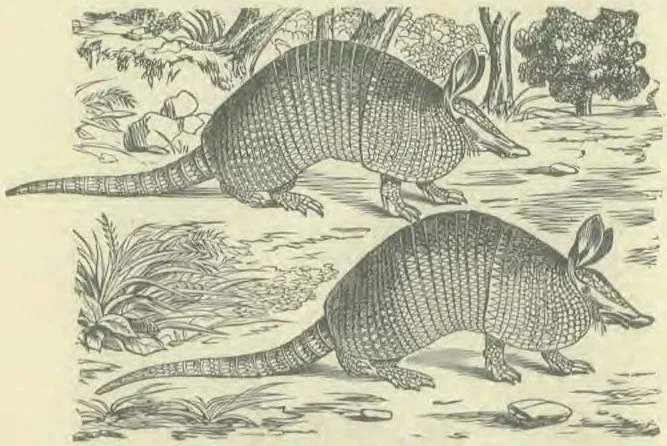
The armadillos are also found in South America, but differ much in appearance and habits from the sloth. The armadillos are burrowing animals, and for this purpose they are provided with strong digging claws. The upper surface of the body is covered with a heavy coat of mail, which is formed of hard bony plates united at their edges. This peculiar covering causes them to look something like a rat running away with a turtle’s shell. Their food consists partly of animal and partly of vegetable substances and fruits. The giant armadillo is over three feet in length, but the others are quite small.
THE ANT-EATER.
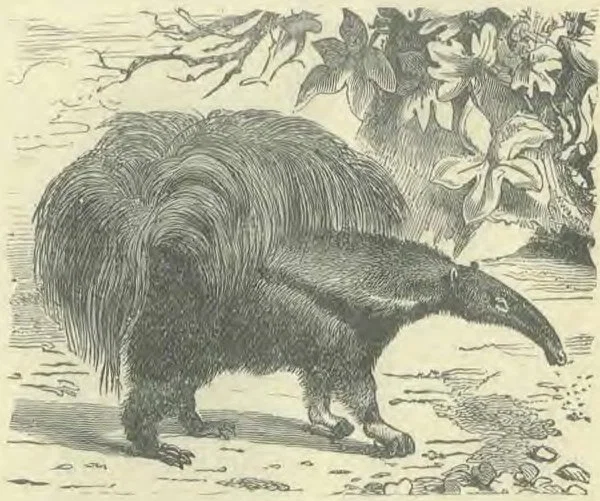
The ant-eater, as the name signifies, is a lover of ants. Most of the ant-eaters have no teeth; if any are present, they consist of a few molars; but they have long cylindrical tongues covered with sticky saliva, which furnishes the means for entrapping the prey. The body is covered with hair, and some of the ant-eaters have long, bushy tails. Their bodies are sometimes three or four feet long. Some of the ant-eaters, when threatened with danger, will roll themselves up like a hedgehog. M. E. CADY.
MAKING HOME PEACEFUL.
By Mrs. L. D. Avery-Stuttle
XV.
“I presume you can get a job over at Mosely’s, after a little. I heard he needed a clerk, and I’ll speak a word for you.”
“Thank you, sir,” replied Tom. But it was with a sinking heart that he opened the little front gate that lonely night, wondering what Maggie would say—poor Maggie.
Tom had been brother, father, and mother,—three in one,—to his delicate sister, who was four years younger than he, ever since the death of their mother.
“Well, Tommie, hurry up! I’ve just outdone myself in generosity, and kept a nice piece of that shortcake you liked so well at dinner, in the warming-oven for you—why, what’s the matter, Tommie? Something’s happened. What is it, brother?”
“O, nothing, Maggie,” replied Tom, feigning a carelessness, for his sister’s sake, which he did not feel. “Nothing—only—” and then followed the whole miserable story.
“I was afraid of this when I told Mr. Beardsley,” he explained. “But I could not endure to have little Tim Mallory bear the blame; and now that the poor child is dead, I should never have forgiven myself if I had refused to tell what I heard, and I knew you’d want me to do it; for you always say, just as mother used to: ‘Do right, Tom, and never mind the consequences.’ I’d have told you before, only I couldn’t bear to worry you over what might never happen.”
The thin cheek of the slender-looking girl by his side grew white, but there was a brave ring in her voice as she answered: “You did right, brother; I’m sure mother would have approved; I—I always test hard questions by that standard. You’ll be sure to find work, Tommie. I know God will never let us suffer because you did what you thought right. Come now, while you eat your supper, let’s talk it all over, and see if we can’t make up our minds what can be done. Harrisburg is quite a large place, and I believe you’ll find something to do, if we both only keep well,” and she tenderly kissed the broad, white brow, from which the shadows were already retreating.
Before they slept, they had formulated their plans so nicely that they felt sure fortune would smile on them; and as Tom crept into bed that night, after saying his prayers, in which thanksgiving and gratitude had a large place, he felt far more hopeful than he had at first thought it possible to feel.
“Maggie’s such an inspiration!” he said to himself. “God bless her. I hope she’ll not get sick; but the dear girl is so slender. Someway I feel as if everything would turn out right. Still I wish I had a little more money saved up; but with Maggie’s doctor bills, and my small wages, it’s been hard to save much. I think Mr. Beardsley would have paid me more this spring if I had stayed; but—it will be all right I’m sure;” which conclusion was but the natural product of youthful spirits, good health, and a clear conscience. But could the brave young heart have felt that night half the sorrows it was destined to feel before many weeks, it would have been a sore trial to the faith which now seemed so firm. But he was trusting in God, and it is written that they who trust in him shall be as Mount Zion, which can never be removed, but abideth forever.
We will not attempt to follow our young hero through the weary days of disappointment and weeks of trial which ensued after his dismissal. More than once he had almost regretted telling Mr. Beardsley who had taken the servant girl’s money. What was it to him, anyway? Why need he to have cared so much, even if the blame was laid on an innocent child, he sometimes reasoned. Then he remembered that God’s word was pledged that he would protect and care for those who make him their refuge; and his heart would once more be filled with that sweet peace that passeth understanding.
The next day after leaving the employ of James Beardsley, Tom visited the office of Mr. Mosely, as his late employer had suggested, only to find that the vacant place had been filled the week previous. Disappointed, though not discouraged, he called on many of his acquaintances, men who had always given him a kind word and a pleasant smile, hoping that some vacant place would offer itself. But poor Tom soon learned the lesson, which is always so hard to learn, and which each must learn for himself, that it is one thing to find an apparent friend in days of prosperity, when skies are sunny, and sweet flowers of hope and cheer are blooming in our path, and quite another to find that true friendship that is indeed “born for adversity,” and which “loveth at all times.” Indeed, he was quite at a loss to understand the averted looks and the cool answers that he so often received from some who had heretofore professed208themselves his friends.
But the mystery was clear enough “after many days,” when he found that the cruel tongue of slander had not been silent, and that cunning falsehood had forged her subtle chain of hypocrisy and deceit, link after link, until every helpful avenue had been hedged up. For Reginald Beardsley had not been satisfied with the obnoxious clerk’s dismissal, but he had been careful to set sundry mysterious stories afloat concerning him, and the reason of his leaving Mr. Beardsley’s employ.
The weeks passed slowly by, and lengthened into months. Finally, one afternoon in early spring, the pitiless tramp, tramp, for employment had come to an end. The hand that the weary boy laid upon the latch of the little front gate as he came home that evening, trembled with exhaustion, and the brow that his devoted sister tenderly and tearfully bathed was hot and burning with fever.
Mr. Beardsley had proved himself a friend all through the weary days, and had been the means of Tom’s securing the little work he had found,—just enough to keep them from absolute want,—and Maggie’s health had been much better than for a long time; so they were just beginning to hope that with the coming of spring, brighter days would be in store for them.
But now Tom threw himself upon his bed, and in utter loneliness and discouragement, gave way for the first time to bitter tears. What to him was the coming of “beautiful spring”? What to him were the songs of birds and the sweet-scented flowers? Weary, discouraged, sick, a burden to his delicate sister, a burden to himself. Thus the weary days passed slowly away.
James Beardsley heard, with a sad heart, of his young friend’s illness, and many little dainties found their way to the sick-room. But if he hoped that his wife’s hard spirit would soften toward the young man, whom he felt sure she had deeply wronged, he was doomed to disappointment. Ellen Beardsley only shrugged her shoulders, and remarked that she didn’t know as she was to be blamed because Tom Willis had been taken sick. She had considered him a deceitful, canting hypocrite—so she considered him still. And she had concluded her remarks by saying that she certainly did not think herself indebted to him after the manner in which he had treated her son.
So deceitful, so unfair, so unchristlike is selfishness. Woe to that human heart in which it takes up its abode. Woe to the life that is affected by its accursed influence. It palsies the hand of charity, and silences the tongue of kindness. It closes the eye of pity, and dries up the springs of tenderness and love in the heart where its accursed presence is found. Shall we cherish it—you and I? Shall we bid it welcome to our hearts? Shall we permit its blighting shadow to fall across our paths to darken our own lives, and to blast the lives of others? Or shall we bid its hateful presence begone, and so fill our hearts with the sweet influence of the blessed Spirit, whose fruits are love, joy, peace, long-suffering, gentleness, goodness, faith, meekness, and temperance, that there shall remain no room in which the throne of selfishness, envy, and malice can be set up, and no foothold for its vile presence?
MRS. L. D. AVERY-STUTTLE.
(To be continued.)
A PLEA FOR SPAIN.
“Come over, . . . and help us.”
SAFE have we reached the shore,
Praise God on high!
But through the tempest's roar,
Hark to that cry!
'Tis from companions brave,
Battling still against the wave;
Hear how for life they crave:
“Help, or we die!”
Shall these our brethren sink—
And we so near?
Can we from danger shrink—
And they so dear?
Haste! ere it be too late;
Souls are drifting to their fate!
Dare we still idly wait,
And give no ear?
Christ, let it not be thus;
Be thou at hand!
Dear Lord, who died for us,
Now by us stand!
Teach us the lost to seek,
Help the strong to help the weak;
Safe through the waters bleak,
Bring all to land!
Then shall fresh anthems rise—
All dangers past!
Nor will despairing cries
Then pierce the blast,
As we, through endless days,
With our dear companions raise
To thee triumphant praise,
In heaven at last! Amen.
POD-AUGER DAYS.
By W. K. Loughborough
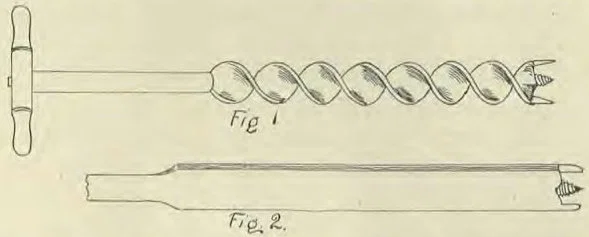
I THOUGHT I would give you a little talk about augers and bits. A great change has been made in this kind of auger before it is twisted. The point is first made on the end, and the cutting part is ground. The steel is then heated hot, and twisted, as you see in Fig. 1. The auger is then tempered, polished, and put on the market. I have a two-inch auger of my grandfather’s, that was among the first twisted augers ever made.
Fig. 1. Fig. 2.
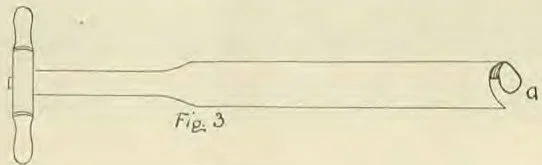
Fig. 3 shows an auger that would be a curiosity to many of you boys. It is called a pod-auger. It is made of a piece of steel hollowed out like a gauge, and having a lip upon the end. See a, Fig. 3. I never saw but one pod-auger. My grandfather had a one-inch auger of that kind.
I remember, when a boy, of hearing an old ship-carpenter say that he used pod-augers in ship-building. He first took a mallet and a gauge, and chipped up a little place to start with, and then he could bore a straight hole.
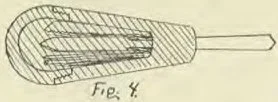
In Fig. 4 you will see a convenient tool. It is a hollow brad-awl handle. The top screws off, and the handle is filled with a number of different awl points, together with a wrench, by which you may screw them into the handle.
I can not resist the temptation to give you a little piece of poetry about pod-auger days. It first appeared in the Rochester, N. Y., Democrat about fifty years ago, and it is more appropriate to the times now than then; for humbugs and trusts are more plentiful:—
“I saw an aged man at work—
He turned an auger round;
And ever and anon he’d pause,
And meditate profound.
‘Good morning, friend,’ quoth I to him;
‘Art thinking when to raise?’
‘O, no!’ said he, ‘I’m thinking on
The old pod-auger days.”
Fig. 3
“ ‘True, by the hardest then we wrought,
With little extra aid;
On honor were the things we bought,
On honor those we made.
But now Invention stalks abroad,
Deception dogs her ways;
Things different are from what they were
In old pod-auger days.
“ ‘Then homely was the fare we had,
And homespun what we wore;
Then scarce a niggard pulled the string
Inside his cabin door;
Then humbugs did n’t fly so thick
As half the world to haze;
That sort of bug was scarcely known
In old pod-auger days.
“ ‘Then men were strong, and women fair
Were hearty as the doe;
Then few so dreadful feeble were
They could not knit and sew;
Then girls could sing, and they could work,
And strum gridiron lays;
That sort of music took the palm
In old pod-auger days.
“ ‘Then men were patriots,—rare, indeed,
An Arnold or a Burr,—
They loved their country, and in turn
Were loved and blessed by her.
Then Franklin, Sherman, Rittenhouse
Earned well the nation’s praise;
We’ve not the Congress that we had
In old pod-auger days.
“ ‘Then, slow and certain was the word;
Now, de’il the hindmost take:
Then, buyers rattled down their tin;
Now, words must payment make:
Then murder-doing villains soon
Were decked in hempen bays;
We did n’t murder in our sleep
In old pod-auger days.
“ ‘So wags the world; ’t is well enough,
If wisdom went by steam,
But in my day she used to drive
A plain old-fashioned team;
And Justice, with her bandage off,
Can now see choice in ways;
She used to sit blindfold and stern
In old pod-auger days.’”
W. K. LOUGHBOROUGH.
SHUT THE DOOR.
By M.
BE careful to shut the door after you, but, while you are shutting it, shut it carefully. Did you ever notice the difference in the way doors are treated in the various households with which you are acquainted? When traveling on railroad trains, have you ever observed how some brakemen throw the car door to with a deafening crash, which threatens to knock the end of the car out on the platform; while others close it so carefully and quietly that those who are not looking are unaware that they have entered the car? Which brakeman would you prefer should have charge of your car? In which household would you prefer to live,—where the doors are slammed, or where every one takes thought to close them quietly?
Have you dined in different restaurants or hotels in large cities, and noticed the money value of elegant quietude and refinement? In some places you have paid for your entertainment perhaps twice as much as in others, and yet your bill of fare was not much different, but the way it was served gave you a far different sensation. In the first place, you felt as if you were taking your meal, feeding, among the scullions in the kitchen, in the midst of slamming doors, and stamping feet, and rattling dishes; while in the other, and more expensive, not a footstep was heard, every door swung on velvet, no two dishes ever seemed to touch. You enjoyed the quiet, the calm, and the peace; and when you looked at your bill, you realized that thoughtful and elegant quietude has a money value. To the proprietors of that hotel or restaurant, and to the waiters and others who serve there, this quiet has a money value; for there are many of those who have money to use who are willing to pay twice the money for the same food when the service is quiet and refined. The proprietor realizes his profit, and the waiters appreciate their higher wages, and the generous “tips” of their pleased and satisfied patrons.
There is a lesson in this. Young people who shut the door with a slam do not realize how far the sound and wind of that banging door may carry until it deafens ears that otherwise might listen to their requests for preferment, and blows away many bright prospects of success which seemed so possible of fulfilment. Boys and girls, young people, shut the door, and shut it quietly. Let that act be indicative of your gentle, thoughtful carefulness through life; and many doors, which you desire to enter, will be opened to you, which otherwise would be locked against you.
M.
ART AS AN AIM.
By B.
“ART for art’s own sake” is the dogma of not a few of its most ardent devotees. Those who hold this view and act in harmony therewith make art the aim of their existence, and will sacrifice all else of value or worth upon the much-adorned altars of this most fascinating goddess. Those who do this sadly fail in comprehending the origin, the nature, and the purpose of all true art. What, then, is the genesis of art? By successfully answering this question may we not also learn the truth both as to its nature and proper end?
No one, however prone to doubt, dissents from the declaration of Scripture that, in the beginning, “the earth was without form, and void”—chaos. Now, as every one knows, we have cosmos, characterized by orderly arrangement, adaptation to its uses, and last, the crowning glory, beauty. But how was this transition effected? The divine record says: “And the spirit of God moved upon the face of the waters.” Thus did the great Master Builder prove himself the great Master Artist of all the centuries. Thus was shown forth the marvelous handiwork and the peerless art of God. But was this transcendent art manifested for art’s sake alone? Was this divine art without object? Let Isaiah, the great prophet-poet, make answer: “For thus saith the Lord that created the heavens; God himself that formed the earth and made it; he hath established it, he created it not in vain, he formed it to be inhabited.”
The exquisite beauties revealed in nature,—the gorgeous sunset; the scintillating, far-distant stars; the high up-rearing mountains, crowned with eternal snows, and the bright-hued and fragrant flowers nestling at their feet; the wide-spreading, verdant valley; the singing of the birds; the lowing of the cattle upon a thousand hills; the gurgling of the forest streamlet; the soughing of the summer breeze; the merry prattle of little children,—all these, through the medium of the senses, find access to the inner sanctuary of the human soul, where impressions more or less enduring are recorded. Man’s successful efforts to give expression to these impressions is the art of man. As God’s object in beautifying this world211was and is to make it a desirable place of habitation for the race, so should man’s object, in making reflections of nature’s manifold beauties, be to make the surroundings of his fellow mortals such as will make them happier and better,—such as will lead them ever onward, through the delightful avenues of the beautiful, up to the good and the true.
The history of art proves that many of its most celebrated adepts have looked upon art as an end, not a means, have not sought to make it a vehicle for the dissemination among the multitude of benefit, blessing, joy, peace, happiness, and inspiration to nobler aspiration and better life. Too often has the fee—“current money with the merchant,” and honeyed words of praise from the favored few—been their only purpose. Even in that period when Italian art was at the zenith of its glory, only the ruling classes shared in its benefits. To the common people art was a sealed book. Truly has a noted clergyman said: “It was an age of marble for rich men, but an age of mud for peasants. It was an era of art for princes, an era of ugliness and squalor for the common people.” Speaking of this time, Frederick Harrison has well said: “They [the masses] were cooped up in walled towns with narrow courts and sunless alleys. They slept in airless, windowless, pestiferous chambers, wearing the same leather garments for successive generations, piling the refuse in the back yard, walking along streets narrow and unpaved, through which man and beast trampled knee deep in noisome mire. Every church was crammed with corpses, and reeked with vile odors, even the banqueting hall of the castle being built above dungeons, where prisoners were reeking in dampness and filth.”
But since that gloom-enshrouded day the spirit of liberty has, in large measure, broken the shackles wherewith the masses of the people were bound. Knowledge has been increased, stagnation has ceased, human ingenuity has been quickened, invention has resulted, the useful arts have been magnified, and thus have the people been brought in touch with the wonderful creations of the great masters. Through the marvelous progress made in the art of pictorial reproduction, we now find in nearly every home copies of the great pictures of Raphael, Angelo, and their contemporaries, portraying to us phases in the earthly life of the great Life-giver, Jesus of Nazareth. Thus, though some of these greatest artists may not have had the loftiest aim in view, God has caused the works of their hands to glorify him and bless the children of men.
In order to make earth a pleasant, happy, and good home for his creatures, God spread over all his works a mantle of beauty. What nobler object then could the art of man have than to make happier and better and sweeter and purer the homes of all the people, and who can be more a benefactor of mankind than he who aids in making home beautiful, without and within,—beautiful in all its environs and approaches,—beautiful in its interior arrangements and appointments,—and above all, beautiful in the lives of love lived therein? In this glorious work all may have a part.
While art, in many ways, may and should minister to human happiness and betterment, yet it is nevertheless a sad fact that its fascinations are often employed by the agencies of evil in alluring men and women away from the straight path of duty into byways of sin and folly. Thus, often do the most beautiful pictures and statues adorn gilded palaces wherein midnight revelers hold high carnival, while most entrancing music lulls the gay throng into a fatal carnal security, from which they may awake only when it is forever too late.
Unfortunately, many well-intentioned people, because art is so often made to subserve evil purposes, condemn all art, and discourage all culture of the esthetic in human nature. They evidently forget that beauty and its expression by man is one of the most powerful agencies God has ordained for the betterment of human beings. All good people should heartily unite with the psalmist in saying: “Let the beauty of the Lord our God be upon us.” He in whose life this beauty, “the beauty of holiness,” is shown forth can not avoid becoming an artist whom the great Master will delight to honor. Such a one finds himself in perfect agreement with these noble sentiments of Emerson: “Art has not come to its maturity if it do not put itself abreast with the most potent influences of the world, if it is not practical and moral, if it do not stand in connection with the conscience, if it do not make the poor and uncultivated feel that it addresses them with a voice of lofty cheer. As soon as beauty is sought, not from religion and love, but for pleasure, it degrades the seeker. High beauty is no longer attainable by him in canvas or in stone, in sound or in lyrical construction; an effeminate, prudent, sickly beauty that is not beauty, is all that can be formed; for the hand can never execute anything higher than the character can inspire.” B.