In company with a friend, I started across the country in Arizona, one bright July day. As we were climbing over the rocks and boulders, up the mountainside, the sun beat down on our heads with unusual strength. When we had gained the height, our eyes wandered across the barren waste, and saw nothing except here and there a bunch of desert-willow, beyond which were the mountain peaks towering high toward heaven. Some of these peaks are very rugged, standing above the rest with a sort of commanding attitude; while others are more regular in formation, and quite feminine in their appearance. One mountain rises to a considerable height, on the top of which is an oblong figure, representing, at a distance, Noah’s ark.
We traveled on, faces radiant with hope, and feet sore from walking. In a short time we found ourselves beside a steep precipice, beneath which was a small stream of water gently murmuring a joyful song as it went on its way to the mighty ocean. We had followed this stream about half a mile when there was discovered a small irrigating ditch, which captured the contents, and made them minister to the productiveness of the soil.
Being anxious to know who had been working in this way so far from the settlement, we followed the marks of civilization until our curiosity was fully satisfied. We soon came to a rude garden spot surrounded by a brush fence, inside of which were a few wigwams. Having never seen the like before, I remarked to my associate, “I wonder who lives in such a place as this?” He213replied that he did not know; so we decided to go through the fence, and get acquainted with the inmates.
After walking through a breach, we went bravely on till, suddenly coming into an open space, we looked to the right, and there saw a squaw, sitting in the shade of a wigwam, making tateumpsia. This dish is made of seed from the century-plant. After the seeds are gathered, they are washed, then placed in a basket over a hot fire to roast; after this they are ground by placing a handful on a flat rock and rubbing with a small stone. Just back of the squaw were two small children, about eight and ten years of age. They were very timid; and as soon as they saw us, they hid themselves behind a blanket hanging from the limb of a tree.
We sat down on a rock, and began to talk to the “lady of the house,” but she was not very sociable, saying repeatedly, “Me no savy.” We found that the squaw was preparing the black-looking tateumpsia for supper; and being somewhat hungry, we did according to the Indian fashion,—helped ourselves. We made quite a lengthy visit among the “Americans,” and soon found them very friendly. They tried to teach us some words in their language; such as, “horse,” “cow,” “beans,” “corn,” “watermelon,” etc.
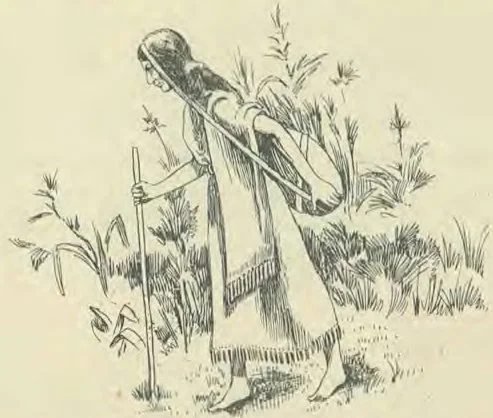
A WATER-CARRIER.
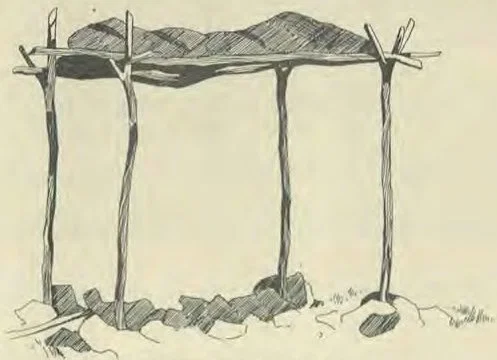
AN INDIAN GRAVE.
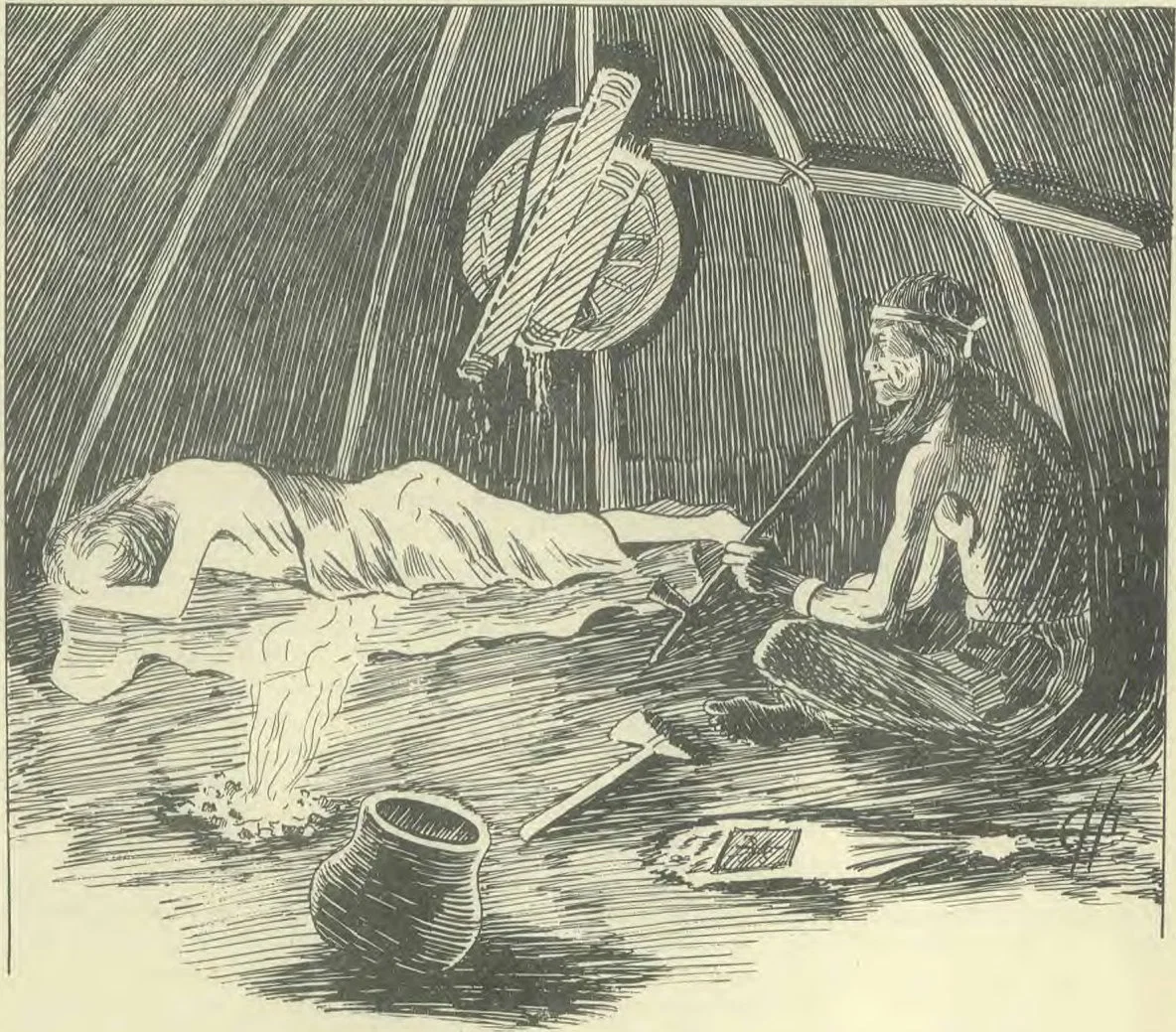
After visiting this family for some time, we went a short distance, and called on their neighbors. Here we found an old gray-headed Indian, who said by signs that he was one hundred and ten years old, and that his squaw was only ninety. They lived in a semicircular dwelling made of poles and brush, covered with rags, canvas, and worn-out pieces of bedclothes. The poor old squaw was sick. Her face was hot with fever, and there in the dirt she lay, with no one to care for her,—no one to give a cool drink to moisten her parched lips. Our hearts were moved to pity as we beheld the scene. There they were, ignorant, down in the very depths of heathenism, while we were living in civilization, under the full blaze of the gospel.
After doing all in our power to relieve the sick one, we were ready to go; and as I gave them my hand, they gave it a grasp that I shall never forget.
We went from this place up a short hill to view the burying-ground, where the braves were laid away with bright hopes of meeting again in the “happy hunting-grounds.” These Indians lay their dead away by wrapping them in blankets, and then placing them on a platform made of poles. With the dead Indian are placed all his belongings; such as, blankets, guns, etc.
The day being far spent, we turned our steps homeward, where we arrived before dark.
CHARLES G. STATES.
TO MYSELF.
By Paul Fleming
LET nothing make thee sad or fretful,
Or too regretful:
Be still;
What God hath ordered must be right;
Then find in it thine own delight,
My will.
Why shouldst thou fill to-day with sorrow
About to-morrow,
My heart?
One watches all with care most true.
Doubt not that he will give thee, too,
Thy part.
Only be steadfast; never waver,
Nor seek earth’s favor,
But rest;
Thou knowest what God wills must be
For all his creatures, so for thee,
The best.
— Paul Fleming.
“STEPPING MOVEMENTS AND THIGH WALKS.”
By M. D. McKee
A good change here would be to introduce the three stepping movements. The first is (with hands on hips) lightly touching the toe of the right foot to the right side on count 1. (Count, one—and—two—and—one—and—two—and, etc.) On count “and,” bring the same foot in front, bearing the entire weight of the body on this foot, rising to position with a lithe, springing motion, preparatory to the same movement with the left foot. Commands for this movement are as follows:—
“Right foot to side—one!”
“In front—and—”
“Left foot to side—two!”
“In front—and—,” and so on until desiring a change.
The second stepping movement is as follows (count 1, 2, 3, 4): cross right foot over the left with easy, free swing (1); swing across to right side, same as previous step, toe touching lightly (2); placing right foot directly in front, body rising to forward-walk position (3); bring left foot up beside the right (4). The left foot on count 1 now swings across in front, over the right, then out to left side (2), directly in front (3), the body springing easily into place for right foot to be placed beside the left on count 4. Take this same movement with the right foot, then the left, and thus alternating, as long as desired. It will be noticed that three movements are made with one foot without change; and the foot that responds to count 4 is always the one to cross over in front.
The third stepping movement is similar, only with a backward swing of the leg. Count 1, 2, 3, 4. Right foot swings lightly across the left foot in front, toe touching (1); swing clear around behind the left foot (2); swing to right side (3); stepping directly in front with right foot, body poised for forward movement, weight coming up firmly on right foot on count 4, at the same time the left foot swings across in front of the right foot on count 1; swing clear around behind right foot (2); side step to left (3); left foot in place directly in front (4); then the right foot is exercised the same way, and so on. This exercise is an excellent “balance” exercise, and develops a good poise, equilibrium, and flexibility of the leg muscles. Hands should be on the hips, chest well up, and head erect. The teacher can order by short commands, as follows: “Right foot, across! behind! side! step! Left foot, across! behind! side! step!” These same movements emphasized are known as the “thigh walk.” Before taking these, however, a genuine “run” might be appropriate. “Class in place,” awaits the order, “Ready to run!” and hands clenched, palms up, on side of chest, elbows well back, chest high, the run being lightly on toes. The arms should not be held so braced that no motion could be possible, but on the contrary, the arms should move forward and backward with the running movement of the feet. The music should be quick—¾ time—and the steps short. The legs should be lifted well behind, the steps being taken on the balls of the feet only. Now for the “thigh walk,” No. 1. Hands on hips, trunk erect. Swing right leg behind, then across front of the left leg, then lift the thigh as high as possible, hitting the chest with the knee if able to do so, but the spine must remain erect. The tendency is to bend forward as the thigh is raised. The value of this exercise is lost if attention is not paid to this instruction. The right leg is dropped after the thigh flection, and weight falls on right foot. Repeat the exercise with the left leg, counting, “Behind, 1! across, 2! up, 3! step, 4!” The teacher should always give the order plainly, taking the movement herself, so the class may understand how to proceed. When the class is in motion, executing a movement, the teacher can observe faulty positions and correct them, as she notes those who need personal attention. This is a principle of the Swedish system especially.
If the teacher is always occupied taking the exercises herself, she can not observe as carefully as might be desired. The conscientious teacher will always be anxious to have each pupil derive the proper benefit from this work, and if unable to “do two things at once,” she should first show the class the movement, giving plain directions, and then notice carefully each pupil and his individual needs.
“Thigh walk,” No. 2. This is also called the “greyhound step.” It is a rather difficult exercise, especially if one is “muscle bound;” that is, has an absence of elasticity and suppleness. Hands on hips, trunk erect, chest well up. The right thigh is lifted so the knee is even with the hip, the lower leg hanging limp; this on count 1. On count 2 extend lower leg straight out, with a slight spring on the left foot. On count 3 step forward on the right foot, bringing the left beside215the right on count 4. Then with the left leg, take the same movement; and then the right, and so on, for several minutes. This exercise may be followed by the “toe step,” which is a simple walk, only rising slowly on each foot, and springing to the very toes, before placing the rear foot ready for action.
There is the “skip step,” which is a side step of the right foot, and a quick step of the left with a second step of the right, all taken quickly. Then the same with the left foot, alternating as desired.
The “double-hop step” is a good exercise, but is not easy to describe. It is a combination of the skip step, thigh movement, and hopping. It should be taken to ¾ time. Doubtless some of our young readers of ingenuity can decipher it.
Then there is the “serpentine walk,” the “statuary walk,” the “clasp-hand march,” the “salute march,” and the “diagonal march.” These will be described in the next article.
MRS. M. D. McKEE.
THE SEVENFOLD SUNSHINE.
By Ruth Gardener
It had been raining all day. The showers had followed one after another in unabating persistency, keeping the children indoors. Aunt Ruth had exhausted her store of legendary lore, and books had become dull, and the children were on the verge of complaining, when suddenly, through a splendid cloud rift, shone forth the warm, cheering rays of the setting sun.
The wondrous verdure of the shrubbery and lawn, touched to a tenderer green by the warm sunshine, the delightful freshness of the evening breeze, and the dripping coolness everywhere, made the earth seem like a new creation. The even warp of the storm-cloud that had veiled the sun so completely all day, was breaking everywhere, and piling up in huge, dome-like peaks, and floating off in the wake of the retreating storm-cloud, like the commissary wagons bringing up the rear of the earthly battalions of war.
The rain was still falling, like a shower of gold lit up by the mellow sunlight, when the children hurried on their wraps, and followed Aunt Ruth to the east veranda, turning their backs on the glories of the setting sun and the beautiful sun shower, that they might behold a grander sight in the rainbow-arched east. And surely a more sublime spectacle could scarcely be conceived than that magnificent bow of blended color, painting the black background of the receding storm-cloud with a glory almost too ethereal to be of earth, and spanning the beautiful valley from bluff to bluff with its buoyant fairy arch.
The children gazed with rapturous awe too deep for aught but subdued exclamations, while Aunt Ruth murmured, “The bow of the covenant; praise God!” Edith crept to auntie, and whispered: “O Aunt Ruth, could the rainbow of God’s throne be more beautiful than that?”
“Children, I had purposed to give you a lesson on color, and here it is, painted on the sky in hues of heavenly light. Walter, take your memoranda, and note the colors of that arch, in just the order of their succession, while Edith names them.”
“I can hardly tell where it begins,” said Edith, “but I think the first faint tint is green. The next I’m sure is yellow, then orange, red, purple, indigo, blue, and violet-blue, and then green216again, and I am sure I see a tint of yellow beyond.”
“Right, Edith. Have you noted them, Walter?”
“Yes, aunt, and I can see every one of those tints in that second arch above the rainbow, which looks like its shadow.”
“That is reflected color. Now, children, come in. The beauty is fading, and I want to make use of the sunshine before it is all gone. I think you understand the rudiments of color, but I will ask Edith to tell us what are the three primary colors, from which all color has its origin.”
“The three primary colors are red, yellow, and blue,” answered Edith precisely.
“And, Walter, what are the secondary colors, which are made by combining these three?”
“The secondary colors are orange, green, and purple,” answered Walter, quickly.
“That is right. Red and yellow combined make what?”
“Orange.”
“Yellow and blue?”
“Green.”
“Blue and red?”
“Purple,” chorused the children.
“Now we have six colors, and the seventh is the deeper blue, or indigo. Now, Walter, look at your memoranda, and tell me how the primary and secondary colors are arranged, and what relation they bear to each other.”
Walter scrutinized his tablet with an expression of shrewd philosophical inspection that made Aunt Ruth smile, and declared: “I find that the primary and secondary colors alternate, with one exception,—the two blues.”
“Now, Edith, dear, tell me what relation the secondary colors bear to the primary colors on either side of them.”
“O Aunt Ruth, they are the very colors that make them. There is the orange between the yellow and red, and the purple between the red and blue, and there is the green between the blue and yellow.”
“Yes, Edith, you have found it. Did you not notice in the beautiful bow how the primary colors seemed to overlap one another, and produce those delicate half-tone shades of the secondary colors between?”
“Now, children, I think that you know that that exquisite bow of seven colors was in some wonderful way born of the sunshine and the sun shower, but how can the sun shining through the rain produce those seven colors on the sky?”
“O auntie, I would so like to know,” cried Edith.
“I will show you, dear, as well as I can, but we must hasten if we have a sunshine lesson. Here is a piece of glass with three plane sides, or surfaces, and two ends. This is a prism, and because of its three faces and three-cornered ends, it is called a triangular prism. This will analyze the sunshine for us.”
As she spoke, Aunt Ruth held the glass prism in the window; and as the level rays of the setting sun touched the sharp edge of the crystal prism, a broad fan-like expansion of seven beautiful color-rays was produced on the shadow side. The children burst into ecstatic “oh’s” at the splendid sight.
“There,” said Aunt Ruth, “is the analysis of the sunshine. Though it looks only golden to our sight, these are the colors that compose it. You see the glass prism breaks each sun-ray up into its seven colors, and scatters them in widely divergent lines, or directions. Name them, and see if they are the same as we found in the rainbow.”
“Green, yellow, orange, red, purple, indigo, violet,” the children replied.
“Now the little rain-drops, like this crystal prism, break the sunbeams into their seven colors, and cast that beautiful reflection on the sky.”
“But, Aunt Ruth, a rain-drop is not a triangular prism. It is a globe, a sphere,” objected Walter.
“Neither is its reflection a fan of color-rays, but a sphere, is it not, Walter?”
“Only a hemisphere, aunt. It is only half a circle.”
“No, Walter, it is a complete circle, if we could see it on the ground as we do in the sky. In the Vernal Fall of the Yosemite Valley, on a bright, sunny day, a circle of the rainbow can be seen in its falling spray. You can make the rainbow with the spray pump any bright morning or evening, and I have often seen its colors in the tears that would gather on my lashes on a cold bright morning.”
“I do not yet understand how those colors are thrown on to the sky in a great arch like the rainbow,” said Walter, with an unsatisfied gesture.
“Walter, have you ever seen the engine of a locomotive come into the station on a foggy or dark night? Have you noticed what a widely divergent shaft of light expands from the concave lens of the bull’s-eye? Can you not see that if that light were powerful enough to reach to the clouds, what a vast circle of light it would make?217You have seen what a large circle of light the small lens of the magic lantern, or stereopticon, throws on the curtain; and the farther away you remove the lantern, the larger and dimmer the circle becomes.”
“O Aunt Ruth, I begin to see,” smiled Walter.
“Now imagine one rain-drop suspended in air. It is a double convex lens of great refracting power. As the sun rays enter the convex side, they are all gathered to a focus in the center of the drop, from which they are scattered, by the concave lens of the opposite side, in every direction within a half circle, in widely divergent lines, which continue to expand and widen, fan-like, in every direction, till they reach the reflector, the clouds, where the reflection is seen as a circle of light. And not only is the bundle of sun-rays focused and scattered, but each individual ray is broken up, or separated, into its seven colors. Hence their reflection on the sky. Of course one rain-drop would not produce a reflection that we could detect at so great a distance; but when many of them are falling, each producing exactly the same reflection at nearly the same distance, the millionfold reflection becomes clear and distinct. Is that more clear to you now, Walter?”
“Yes, indeed, aunt. I have seen that bright focal spot in the center of a large glass marble, but I did not understand what a double-acting lens a crystal globe is before. Thank you for explaining it to us.”
“O Aunt Ruth, it is all so wonderful!” cried Edith. “I will never forget what we have seen and learned this day.”
“God grant it, my child. And remember that if you will open your heart to the sunlight of God’s love, you will find that the light of the Sun of Righteousness is sevenfold also, and that you may be, like the pure, clear rain-drops, not only a receiver but a reflector of the glory of God, which is his glorious sevenfold character. I will leave you with this thought. Good night, and God bless you.” RUTH GARDENER.
THE VIRULENCE OF SIN.
By Rev. Dr. J. H. Barrows
If we care to know any further than our own experience has taught us of what human sin is, we only need to go to Calvary; there we may see it as a base revolt against goodness and mercy, as a savage delights in vengeance; as the ingratitude, that rewards the Redeemer with the cross; as the outcome of God’s patient love, with his chosen people visiting death on Him in whom the Father is well pleased. And we may discover also that our hearts have some kinship with the sins that nailed Jesus to the tree; that there slumbers in each one of us some part of that baseness, that hatred of the truth, that treachery to righteousness, which burst forth in fury on the head of Jesus. Men have sometimes tried to get at God’s thought of sin by peering down into some dungeon of terror and fire, such as Dante saw; but it is far better to look at the cross of Jesus Christ. We belong to a race, we have been smitten with something of the poison in a race, which crucified the Lord of glory. And surveying the wondrous cross that guilty men reared on Calvary, and remembering that Jesus died for us, we may well pour contempt on all our unholy pride.—Rev. Dr. J. H. Barrows.
Lost Opportunities in the Retrospect of Life
HAPPY is the man of whom, in life's evening, this statement is not true: “The retrospect of life swarms with lost opportunities.”
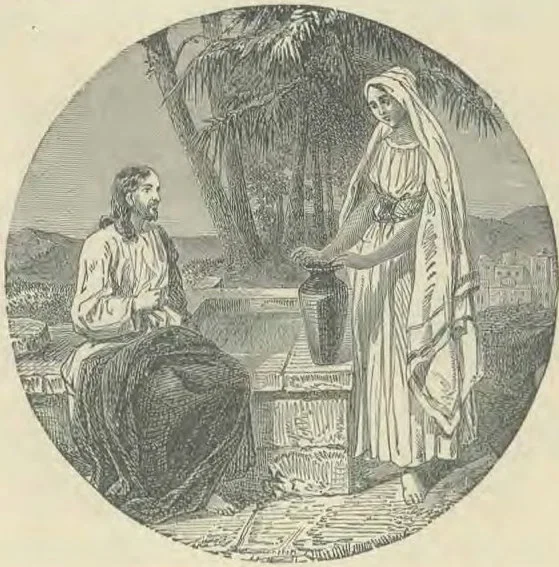
TIME: A. D. 28. PLACE: Shechem. PERSONS: Jesus, disciples, woman and people of Samaria.
QUESTIONS AND NOTES.
1. While Jesus was resting at the well, who came there to draw water? John 4:7. What favor did he ask of the woman? Where were the disciples? V. 8.
2. How did the woman of Samaria look upon this request? What did she say? V. 9; note . Repeat the words of Jesus in reply. V. 10. What objection did she then offer? Vs. 11, 12.
3. Repeat the Saviour’s impressive answer. Vs. 13, 14. Did the woman then comprehend the matter? V. 15.
4. At this juncture, what did Jesus bid her do? V. 16. What did she say to this request? V. 17.
5. What led the woman to perceive that Christ was a prophet? Vs. 17–19. In consequence of this, what question did she raise? V. 20. With what simple words did the Lord then reveal to her the nature of his kingdom and the requirements of true worship? Vs. 21–24; note .218
6. How did the woman confess her faith in a coming Messiah? V. 25. What announcement did the Lord then make? V. 26.
7. Upon their return, how were they affected at finding Jesus talking to the woman? V. 27.
8. Where did the woman go? V. 28. What statement did she make concerning Christ, and with what effect? Vs. 29, 30.
9. While she was gone, what did the disciples desire Jesus to do? V. 31. What was his answer? V. 32. In reply to their questioning, what did he say to the disciples? Vs. 34–38.
10. What effect did the woman’s words have upon the Samaritans? Vs. 39, 40. What led many more to believe? Vs. 41, 42.
SUGGESTIVE REVIEW QUESTIONS FOR QUARTER ENDING MARCH 25.
1. Tell the story of the birth of John the Baptist and his preaching in the wilderness.
2. Give the principal circumstances connected with the birth of Christ.
3. How many times did the angel Gabriel appear to Joseph? What instruction did he give him?
4. Tell what you know of the childhood and youth of our Saviour.
5. Give the story of his baptism and the temptation in the wilderness.
6. Tell about the choosing of the disciples, and the events connected with the first miracle.
7. Give the substance of his discourse with Nicodemus, and also with the woman of Samaria.
Fling Wide the Portal of Your Heart
By Weizel
FLING wide the portal of your heart;
Make it a temple set apart
From earthly use for heaven’s employ,
Adorned with prayer and love and joy.
So shall your Sovereign enter in,
And new and noble life begin.
— Weizel.
Preferring Pleasure to Virtue
MOST unwisely acts he who prefers pleasure to virtue.
REVIEW
INTERNATIONAL LESSON.—NO. 13.
(March 26, 1899.)
REVIEW
Outline.—The advent into the world of the divine Word. Christ calls his first disciples. Christ begins his miraculous works. Christ declares his oneness with God the Father.
TIME: A. D. 27–29,— two and a half years of Jesus’ public ministry. PLACES: Judea and Galilee; the cities of Jerusalem, Capernaum, Cana. PERSONS: Jesus the Christ, John the Baptist, disciples of Jesus, Jewish rulers and people.
QUESTIONS.
1. How did God the Son work upon earth before he came as Jesus? Lesson 1.
2. How is Jesus the Light of the world? Lessons 1, 10, and 11.
3. How is Jesus the Life of men? Lessons 1, 4.
4. How is Jesus the Water of life? Lessons 5, 9.
5. How is Jesus the Bread of life? Lesson 8.
6. How is Jesus the Lamb of God? Lesson 2.
7. What is the crowning proof of God’s love for us? Lesson 4.
8. What was accomplished by Jesus’ first miracle? Lesson 3.
9. What works did God the Father especially entrust to the Son? Lesson 7.
10. How can faith be increased? Lesson 6.
11. How closely united are God the Father and God the Son? Lesson 7.
12. Does Jesus care for the needs of our bodies? Lesson 8.
13. From what bondage does Jesus release? Lesson 10.
14. What causes eternal separation between men and God? Lesson 9.
15. How has Christianity ameliorated the condition of the blind? Lesson 11.
Friday.—The nobleman’s son healed. John 4:43–54. Learn the truths taught in these lessons.
Saturday.—Christ’s divine authority. John 5:17–27. Answer list of questions given.
Sunday.—Christ freeing from sin. John 8:12, 31–36. Recall what evidences and testimonies to Christ’s divinity have been seen in these lessons.
NOTE AND COMMENT
PEOPLE not a few experience theology, but do not experience religion.
WELL advanced on the road leading to the experiencing of true religion is he who has thoroughly learned this truth, beautifully expressed by Ruskin: “There is but one way in which man can ever help God—that is by letting God help him.”
A Great Missionary Convention.—Plans are now maturing for the holding of an ecumenical centennial missionary conference in New York City. All Protestant denominations will be invited to send delegates. The conference will convene April 21, and will remain in session eleven days. No doubt much good will be accomplished at this great convocation of active Christian workers.
To the Pyramids on Trolley-Cars.—Western civilization is certainly making headway in the Orient. The latest advance move is the perfecting of arrangements to introduce trolley-cars at Cairo, Egypt, and later to construct a trolley-car line to connect that city with the pyramids, and also with the city of Alexandria. Negotiations have just been completed by the Westinghouse Electric and Manufacturing Company for the building and equipment, at Pittsburg, Pa., of fourteen electric cars for use in the city of Cairo. As soon as the residents of that ancient town become accustomed to the innovation, the other lines will be built and equipped.
Against Romanism.—Of late years a marked tendency has been manifest in “high church” circles of the Church of England toward the ritualism of the Roman Catholic Church, and not a few priests and bishops of the English Church have joined the Catholics. A positive reaction has more recently set in against this movement. Commenting upon the situation, a contemporary says: “It is fast becoming apparent that in the coming session of Parliament, all issues, even the vital one that is suggested by the discouraging state of British trade, will take a secondary place in comparison with the lusty cause that can be epitomized in the historic cry of ‘No Popery!’”
Against a Polygamist Congressman.—A storm of opposition is arising against the seating of the polygamist congressman-elect, B. H. Roberts, of Utah. In response to aroused public sentiment on this question, Congressman Clark, of Wyoming, introduced a bill late in the last session of Congress providing that no polygamist shall be a senator or congressman. Legislation of this character is in the interests of sound morals, and should be heartily commended by all good people.
Telegraphy.—Great have been the advance strides made during the last quarter century in all departments of business and industrial activity, but it is doubtful if any other line has shown a more wonderful development than has telegraphy, as the following interesting item, from the Popular Science News, proves: “The wonderful growth of the telegraph business is shown in the fact that thirty years ago there were only 3,000 telegraph offices and little more than 75,000 miles of wire strung throughout the length and breadth of the land. At the present there are about 25,000 offices and over 1,000,000 miles of wire. The annual number of messages handled thirty years ago was 5,879,282; to-day it is 80,000,000. The average cost to the sender thirty years ago was $1.047; the average cost to-day is 30.9 cents. At the start the cost to the company was more than twice what it is to-day to the sender.”
Giving the Lord His Own.—God will richly bless and prosper all who will conscientiously give him that which is his own. Thus is his word pledged: “Bring ye all the tithes into the storehouse, that there may be meat in mine house, and prove me now herewith, saith the Lord of hosts, if I will not open you the windows of heaven, and pour you out a blessing, that there shall not be room enough to receive it.” Many earnest Christians have tested this injunction and promise, and have proved beyond all question that God always fulfils his part with “good measure, pressed down, and shaken together, and running over.” An exchange relates an incident of a doctor at Reading, Pa., who, for the last ten years has given all of his income to the Lord. During the previous thirty-six years he gave one tenth of his income. Finding that he had been richly prospered, he decided to give him ten tenths. Should not all boys and girls learn early in life to adopt the tithing principle, from earliest childhood, giving to the dear Lord at least a tenth of whatever of value they may earn?
BRITISH APPRECIATION.
We are in receipt of a letter from Mr. George R. Drew, of 6a Kingsland Road, Birkenhead, England, asking for copies of the YOUTH'S INSTRUCTOR to use in missionary work. Among other things he says:—
“We sincerely hope that you will not fail to send us at least a few copies of your excellent journal for 1899. It is useful for our work, to give to poor children on ships and in the houses of the towns. With kind wishes, we remain, etc.”
It may be of interest to state that the YOUTH'S INSTRUCTOR now visits each week the following foreign countries: Mexico, Central America, West Indies, Brazil, British Guiana, Argentine Republic, Chili, England, Ireland, Norway, Sweden, Denmark Germany, France, Greece, Switzerland, Syria, Turkey, Australia, Hawaii, New Zealand, India, China, Japan, South Africa, Cook Islands, Fiji Islands, Tahiti, and the Tonga Islands.
Those desiring to assist the publishers in sending copies of the INSTRUCTOR to still other parties in these countries, may do so by sending whatever means they can spare to the Missionary Department, YOUTH'S INSTRUCTOR, Battle Creek, Mich.
BOYS AND GIRLS
By Editor
Can earn pocket money, and obtain a practical experience in canvassing by soliciting orders from their schoolmates and friends, for the “New Webster Dictionary and Vest-Pocket Library,” by E. E. Miles, recently advertised through our columns. It retails as follows:— Bound in elegant cloth, red edges, indexed, 25 cents; the same, bound in morocco, gold stamp, gold edges, 50 cents: the same, bound in extra quality morocco, with calendar, memorandum, and stamp holder, 60 cents. For confidential terms to agents, address your State tract society or the Review and Herald Pub. Co., Battle Creek, Mich.
Those who desire to earn a copy of the dictionary for themselves can do so by complying with the following conditions: We give the copy first described above for one new six months’ subscription to the YOUTH’S INSTRUCTOR; the same book bound in morocco is given for one new yearly subscription; the one which retails at sixty cents will be given for one yearly subscription, and ten cents additional.