Your ShelfYour Projects

Signs of the Times, Vol. 28, No. 37.

LESSONS FROM THE MOUNTAINS
Earlier text: OUR LONDON LETTER

BARRENNESS OF INFIDELITY.

In a lecture in Chicago, Mr. Ingersoll boastingly said: “What would the world be if infidels had never been? They have been the flower of all the world; the proud victors on the battle-field of thought; the creditors of all the years to be.” To which a correspondent in the Inter-Ocean very pointedly replied: “The next time the colonel lectures in Chicago, we would like him to name the generous infidels who have founded a hospital for the sick, endowed an asylum for orphans, built a widow’s home, or started a rescue work among fallen women. We would like him to name all the brave and thoughtful infidels who have been generals in the first rank; poets of the first magnitude; painters, explorers, philanthropists. We would like him to name all the great chivalric souls of infidels who have established a waif’s mission, penetrated dark continents to elevate savage tribes, traveled in voluntary exile to ameliorate the wretched condition of prisoners in foreign jails, or changed cannibal isles into a civilized commonwealth.”—Selected.

PROHIBITION IN FINLAND.

A GOOD illustration of the beneficial effects of prohibition is found in the prosperity of that cold and sterile region, Finland, says a writer. Finland has a population of 2,380,000, composed for the most part of Lutherans, with only 416 Catholics, and a few of other denominations. The climate is miserably cold, and about three-fourths of the land is craggy and sterile; but the Russian government has made the Finns an active, thrifty people by prohibiting the sale of liquor. The last government report of exports was 180,000,000 francs (a franc is about 19 cents of our money). Finland is destined to become one of the great pulp markets of the world. Notwithstanding the coldness of the climate and the sterility of the soil, the sober, hard-working Finns manage to support 174 savings banks with money which in this country goes to the saloons. Besides, there is an admirable school system, and only a few people can not read and write.

THE WOMAN WHO WORRIED.

She looked for trouble every day And so, of course, it came her way.
To worry was her dear delight From morn till noon, from noon till night.
The paltry little pin-point things She harped upon like worn-out strings.
She prowled for trouble round the house Much as a cat will hunt a mouse.
Her temper twisted all askew— That is what worry drives one to.
She lived a wretched, nervous life, Her thoughts with petty trifles rife,
Until her face as wrinkled grew As an old cast-off leather shoe.
The great world swung upon its way; She worried till her head was gray.
The birds sang, but she could not hear; Her own complaining filled her ear.
God painted for her wondrous skies; She did not even lift her eyes.
He wove a carpet for her feet And broidered it with blossoms sweet—
And she? Alack, indoors or out She fretted, fumed, and fussed about
She died before she ever knew That she had lived. The mourners drew
A long sigh when she passed away; Grief, or relief? I can not say.
But O, alas! that women choose To look like wrinkled leather shoes! —Lillian Ferguson.

CUVIER ON LACING.

THE great naturalist, Cuvier, was walking one day in a public garden in Paris, with a young lady, who was a victim of tight lacing. A lovely blossom upon an elegant plant drew from her an expression of admiration. Looking at her pale, thin face, Cuvier said, “You were like this flower once; to-morrow it will be as you are now.” Next day he led her to the same spot, and the beautiful flower was dying. She asked the cause. “This plant” replied Cuvier, “is an image of yourself. I will show you what is the matter with it.” He pointed to a cord bound tightly around the stem, and said, “You are fading away exactly in the same manner under the compression of your corset, and you are losing by degrees all your youthful charms, just because you have not the courage to resist the dangerous fashion.”—Washington Republican.

Perhaps.

Perhaps the reason the Lord does not use you, may be that you are not willing for Him to use your money.
Perhaps you would be more effective as a worker if you would try a little harder to be agreeable.
Perhaps you would be more forgiving if you would remember how easy it is for you to stumble.
Perhaps you could lift other people a little higher if you would be willing to get down a little lower.
Perhaps you could be more contented if you would only try to be more thankful.
Perhaps your children would be more obedient if you were only more forgiving to their little offenses.
Perhaps you could be a little kinder to those about you if you knew that Jesus was looking at you.—Ex.

MISSION AND EDUCATIONAL WORK IN PORTO RICO.
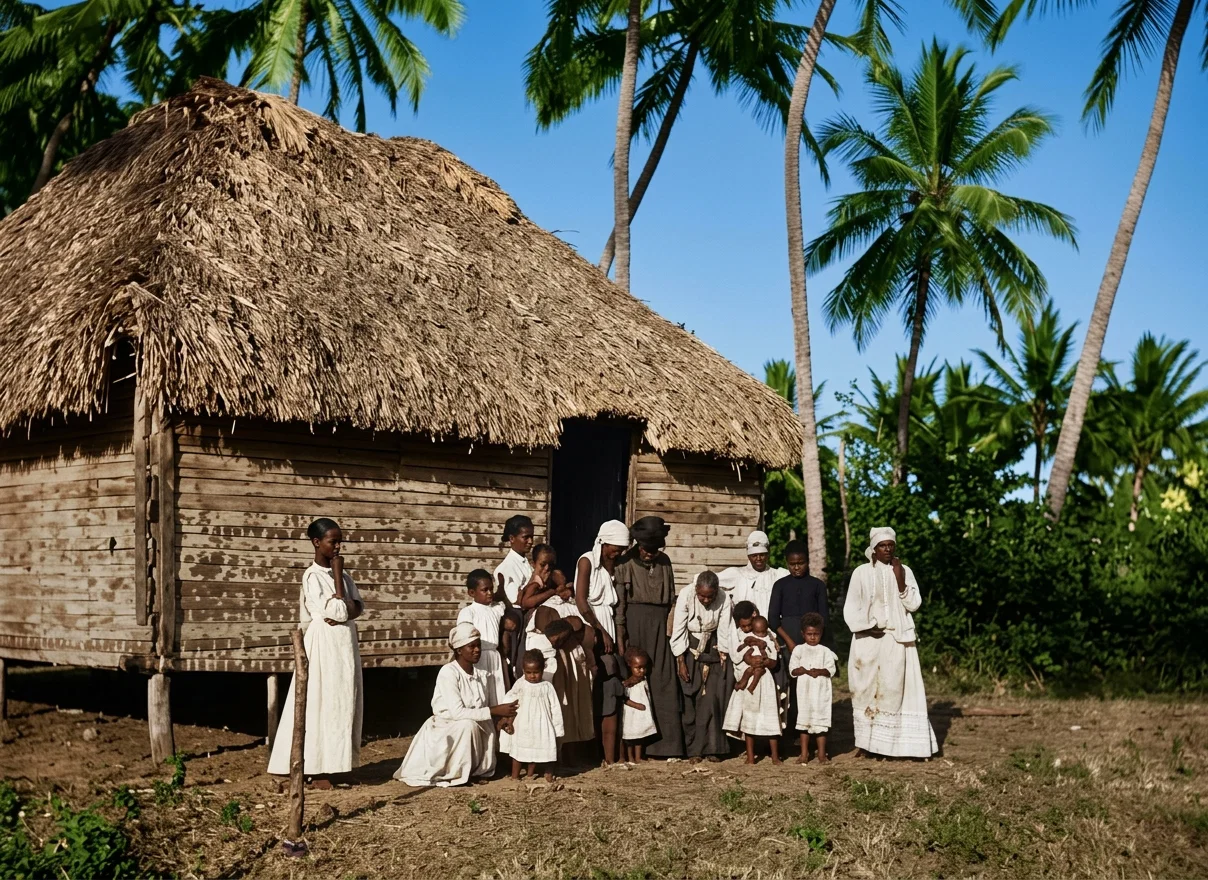
ALTHO recognized by the missionaries as a hard field, much has been accomplished within the past four years in the line of mission work. Missions have been established by the different denominations in all the principal cities, and many souls are rejoicing in the light of Protestantism as the result of the untiring efforts of noble men and women who have devoted themselves to this work.
In some places mission schools have met with success. Not until 1898 was the island opened to missionaries. Practical work was begun in December, 1898. Others have followed rapidly, and to-day the work of evangelizing Porto Rico is moving steadily along.
When we stop to think of the many difficulties in the way of the workers, we are glad for what has been accomplished, and expect it to make further advancement. Up to the present time, roughly estimated, there are about five or six thousand Protestants in this island.
The island has been set off in sections, the Congregationalists holding the eastern, the Methodists the southeastern and a portion of the northern central, the Christians and Independents the northern and a portion of the central, the Baptists the southern and the military road from San Juan to Ponce, and the Presbyterians the western. There are fifty mission stations, including outposts, with thirty-four male missionaries, twenty-six female, and several native helpers. The number of mission schools in Porto Rico is seven. Owing to good government schools and tuition, several other mission schools have been obliged to close.
Two orphan asylums have been established, four churches are under construction, and four others are being planned.
There are three converted priests engaged in missionary work here, one from another country and two residents. One of these is working independent of any denomination. As the people become more enlightened on the true principles of Protestantism, we expect to see many throwing off the bands of Romanism.
Since the island has come under American rule, much has been accomplished in the line of education. Schools under the supervision of good teachers, both Spanish and English, have been established all through the island. The demand for schools is great, so great already that the government can not meet the demand, because it is limited to $500,000 per annum for education. Nearly 50,000 children are being educated and the government plans soon to open two industrial schools. From an educational standpoint the prospects are bright indeed for this island.
When we stop to think that with education the mind expands, and we are more able to comprehend the Word of God, we do indeed rejoice to see such a bright future for Porto Rico. But with education come greater responsibilities, and we know that more will be required of those who receive this education.
A Group of Native Porto Ricans of the Poorer Class.
As far as intellect and brightness is concerned, Porto Rico stands on an average with other civilized countries; all she needs is an opportunity to demonstrate her ability in the educational work.
I do not think that a kinder-hearted people ever lived than we find here. They will put themselves out of the way many times to do you a favor. Altho many unkind remarks have been made about them because of some of their customs and peculiarities, yet they seem to have the kindliest feelings toward us as a nation and as individuals.
While we Americans have made many mistakes in this direction, we are glad to see that there is an effort being made to rectify them; and many noble Americans are seeking to impress upon the minds of the people of Porto Rico that they have only their good at heart.
Wherever we go we have evil to contend with, and so it has been here. War brought its evil, its crime, and influence, but now that the island has been relieved of this, we look forward to an advancement of the light of the Gospel. This alone will fill the hearts and homes with peace.
Prosperity seems to exist in many of the coast towns, but it is claimed that poverty and starvation exist in the interior. Just how to adjust this state of affairs is a perplexing question indeed. Many are anxious to work if they can find work to do; but others do not care to work.
Those standing at the head of the government seem to be fair-minded men, and are evidently trying to work for the best interest of the people.
American laws are now in operation here, and there is an increasing desire on the part of the people for a knowledge of the English language.
Under the direction of competent men wonderful changes have been wrought in public school work, which has been for the advancement of educational work here. This the people appreciate much; the schools are crowded; and the children are learning rapidly. While we have many of the customs of Spain and the superstitions of Rome to contend with, yet Porto Rico, on the whole, is far in advance of many Spanish provinces, and is rapidly becoming Americanized.
We look forward to the time when earthly kingdoms will fall, and the God of heaven will set up His kingdom, a kingdom of righteousness and peace, where all nations will be represented and the Lord Himself will be king.
Ponce, Porto Rico. MRS. IDA M. FISCHER.

AN OUTCAST FOR CHRIST’S SAKE.

Sooboonagam Ammal, formerly daughter of Mr. Vankataramana Pantula, sub-judge of the District of Madura, India, is visiting friends in southern New York. She is no longer the daughter of Mr. Pantula, because she has renounced the superstitions of Brahmanism for the Christian religion. She has thereby become an outcast, and she is staying with her Christian friends in America because she has no home. Worth several millions, the possessor of jewels of fabulous wealth, and a member of the highest of castes, she has renounced them all for the sake of the faith.
The case of Sooboonagam is one of the most remarkable in the history of Christian missions, and reads like an Eastern romance. Her father was the first native Indian to take the double degree in the University of Madras. He possessed great wealth, was the most influential man in the district, and stood high in the confidence of the government. But his greatest wish was for a son to inherit his name and fortune, and when Sooboonagam was born he was deeply disappointed at her sex. However, the soothsayers assured him that his daughter was born at a most propitious time and she was destined to great honors at the hands of the gods. It was determined, therefore, to devote her to their service. She was brought up strictly in the Brahman forms and ceremonies, and a temple was built by the father for the girl’s own use. It was her onerous duty, also, to make offerings to the sacred cobras, which she fed daily with flour and milk, and occasionally she accompanied the priests on expeditions into the jungle, for the purpose of catching the reptiles. Her father grew to be very fond and proud of her. At the age of ten she was married, the bridegroom being a poor man, and being selected because he was the nearest marriageable relative, as custom required. But Sooboonagam had enough wealth for two, for on the death of her father she was to come into possession of a fortune worth millions. There was great feasting and merry making at the nuptials. To her husband was given her weight in silver, she being put on one side of the scales and the precious metal on the other.
Some years afterward Sooboonagam came to know the story of Jesus. Through Christian missionaries in the district, she was persuaded to read the Bible in her own tongue, and they found means to talk to her on the subject. She was delighted with the Gospel, and finally decided to give up her fortunes and her home for the new faith. She knew that if she became a Christian, it would mean that she would be disowned. Despite the pleadings of her friends and relatives, she remained firm. She left home and was sheltered by the missionaries. The Brahmans treat one who apostatizes as dead, and so within a few weeks, notices of invitation to her funeral were sent out, and hundreds attended. The services lasted three days, during which Sooboonagam’s treasures were broken, and everything devoted to her personal use was given away or destroyed. An effigy of the young woman was made with sacred reeds from the Ganges and burned amid great ceremony. To her family and friends, she was now as dead as though actually in the tomb.
This summer Sooboonagam came to Binghamton, N. Y., to visit Miss Fannie Sparks, a returned missionary, who had interested herself in the case. She may return to India herself as a missionary.—Christian Herald.

LET ME BUT LIVE.

Let me but live my life from year to year, With forward face and unreluctant soul, Not hastening to, nor turning from, the goal; Not mourning for the things that disappear In the dim past, nor holding back in fear From what the future veils, but with a whole And happy heart, that pays its toll To Youth and Age, and travels on with cheer.
So let the way wind up the hill or down, Through rough or smooth, the journey will be joy; Still seeking what I sought when but a boy— New friendship, high adventure, and a crown— I shall grow old, but never lose life's zest, Because the road's last turn will be the best.
—Henry Van Dyke, D.D.

OUR WORK AND WORKERS.

TWO MORE Sabbath-keepers have been added to our ranks at Cove Creek, Haywood County, N. C.
BROTHER F. T. WALES, a self-supporting missionary in Memphis, Tenn., reports three converts to the faith, as a result of recent labor.
THE company of Sabbath-keepers at Waterloo, Iowa, was recently organized into full church relationship by Brother L. F. Trubey.
THE Mississippi Conference has chosen the following officers for the ensuing year: President, Rodney S. Owen; secretary and treasurer, W. J. Blake; executive committee—R. S. Owen, H. W. Pierce, F. R. Rogers, J. D. Hendon, J. H. Rhodes.
THE Southern Watchman says: “The office of the Carolina Conference and nearly all connected with it, together with two other families, have moved to Rock Cut, Iredell County, N. C., and are preparing to build homes in the woods. It is expected that a school building will be erected this fall, and a church-school conducted during the winter.”
AS a result of lectures on the prophecies, illustrated by stereopticon views, by Brother J. E. White, in the chapel of the Southern Publishing House, at Nashville, Tenn., fourteen persons have commenced the observance of the Sabbath of the Lord, and, says the Watchman, “each week is adding to the number.” And in addition to this, “a precious revival work has sprung up in the church.”
THE Union Conference Record, of Sydney, N. S. W., notes a letter from Fiji which states that Brethren J. E. Fulton and C. H. Parker had visited the Law District, where three new companies had just begun the observance of the Sabbath as a result of literature distributed among them. The inhabitants of several of the islands in the group are becoming interested through the same means.
J. H. STUCKEY, a First-day Adventist evangelist, traveling with a “Gospel Wagon” in California, says: “There is some prejudice at every place against us, where there are Seventh-day Adventists, because people do not, as a rule, know that there is much difference between the Seventh-day sect and the Advent Christian people. I take the trouble to let people know very soon that we are not Seventh-day Adventists.” Good; that is right.
THE fourth annual announcement of the Cedar Lake Industrial Academy, at Cedar Lake, Mich., is at hand. It is a neat pamphlet, containing valuable information about the school, and a number of illustrations showing views in and around the premises. In addition to Bible and the ordinary academic studies, instruction is given in a number of industrial occupations. The fall term begins October 6. For specific information send for the calendar, to Prof. J. Grant Lamson, Cedar Lake, Mich.
WE have to record the death of another faithful missionary in a tropical field. Brother Frank J. Hutchins died at Bocas del Toro, Colombia, August 4, of bowel trouble, after a few days’ illness. He was aged but 33 years, but, in company with his wife, had been in Central America and Colombia since 1891, as missionaries. He was a native of California, but a graduate of Battle Creek (Mich.) College. A letter from his wife, copied by the Battle Creek Enquirer, says: “The funeral was the largest ever attended in that section of the country, and was conducted by Rev. E. C. Notman, the Baptist missionary at that point. Three launches and a large lighter were required to take the funeral party to the place of burial, the American cemetery at Macca Hill, where the remains were deposited by the side of the late Dr. Eccles, another Adventist missionary, whose death occurred on January 18.”
THE California Medical Missionary and Benevolent Association maintains a vegetarian café at 755 Market Street, San Francisco. It is under the supervision of a board consisting of E. G. Fulton, manager; H. H. Haynes, R. A. Buchanan, M. D., A. Booker, and B. F. Richards. The Helping Hand and Medical Mission is another charge of the association. It is located at 641 Commercial Street, San Francisco, and is under the direction of G. B. Douglass, superintendent; E. E. Parlin, and W. S. Sadler. The association also maintains the San Francisco Union Home at 971 Howard Street. It is under the personal direction of E. G. Fulton, H. H. Haynes, and R. A. Buchanan, M. D.
THE Battle Creek, Mich., Enquirer, of August 18, devotes over a page to descriptions and illustrations of the new sanitarium building now in process of erection in that city, on the site of the buildings that were destroyed by fire six months ago. The principal view shows the main building up to the second story, together with the foundation walls of the gymnasium and bath-rooms in the rear. The view gives some idea of the immensity of the structure, which will be 560 feet long, and the width at the narrowest point will be 50 feet. A pavilion at each end will increase the width to 62 feet. There will be three rear wings, making a total depth of 278 feet. With the present buildings, the managers expect, when the new one is completed, to be able to accommodate 1,000 guests. They are caring for 350 at the present time.
BROTHER WM. COVERT, president of Wisconsin Conference, writes: “I drop you a note in regard to our annual camp-meeting, which was held at Grand Rapids August 14–25. The number of our people in attendance was variously estimated at from 800 to 1,000. I do not think that I ever attended better meetings. Fifty persons were baptized. Seven churches were received into the conference. Arrangements were made relieving the General Conference Association of $6,000 of its indebtedness, by Wisconsin taking the responsibility of the same to its creditors. Donations and pledges were taken as follows: $710 for the work in Scotland; $1,000 toward a sanitarium at Madison, Wis. We voted to continue the salary of Sister Thompson in Hong Kong, China, thus connecting Wisconsin with the Chinese mission field. Plans were made to greatly enlarge the church-school work in the State. All things proposed to the delegates by all committees were carried without a negative vote in any instance. This is quite remarkable, when we consider the various interests that were discussed and acted upon.”

THE SOUTHERN CALIFORNIA CAMP-MEETING AND CONFERENCE.

This meeting will be held September 12 to 21, on Boyle Heights, East Los Angeles.
These meetings, at which plans are laid for the carrying forward of the different branches of the Lord’s work, are always important. And as we are one year nearer the close of the work at each succeeding meeting, they become more and more important. When there are but a few more days to make use of, those few days will be more weighty with eternal interests than any which have gone before.
Efficient laborers have been provided for the meeting, and we shall look for a general attendance of our people.
There will be a special course given during the meeting on the points of faith held by us as a people, and in this way strangers who come to the meeting can become acquainted with these precious truths.
There will be a grocery and dining tent on the grounds.
Tents will be rented on the grounds, or they can be ordered by letter addressed to “Southern California Tract Society,” 516 South Hill St., Los Angeles, Cal.
There will be a good supply of books, tracts, and Bibles at the book tent on the grounds.
From either depot, or from any part of the city, inquire for a “Boyle Heights” car. The “Traction” line will carry you to the side of the grounds, while other cars will leave you two blocks from them. So it will be best to take the “Traction” line from either depot.
All bring checks for baggage to the grounds and this will secure the lowest rates for you.
CLARENCE SANTEE, President.

PUBLICATIONS WANTED.

LATE, clean copies of the SIGNS, Review, Gospel of Health, Youth’s Instructor, Our Little Friend, Good Health, and tracts, for free distribution. Address, post-paid, Mrs. R. McCoon, Sawtelle, Los Angeles County, Cal.
LATE, clean copies of any of our papers for missionary work. Address, post-paid, T. J. Woodall, Archdale, N. C. A continuous supply is much needed.
ANY of our periodicals, tracts, or books, for missionary work, at Tacoma, Wash. Address, post-paid, J. Reid, 1311 North Tenth Street.

THE CALIFORNIA CAMP-MEETING AND CONFERENCE.

OUR State camp-meeting and conference will be held at Fresno, California, commencing September 30. They will be preceded by a workers’ meeting beginning September 25.
The plan is this: The laborers and conference delegates are requested to gather five days before the formal opening of the camp-meeting and conference, to seek God and study His Word, and thus be better prepared to transact the business of the conference harmoniously and promptly. The devotional meetings and Bible study will accomplish much in this direction if the laborers and the delegates are present and enter heartily into the work.
By following this plan it is hoped that the business of the conference can be finished the first week, so that the last week may be devoted to the spiritual uplifting of the people, and a preparation for active service in the Master’s cause. For these reasons the conference committee earnestly request all conference delegates to be present during the workers’ meeting, September 25–30, 1902.
The conference will convene at 10 A. M. Tuesday, September 30, 1902. Each church is entitled to one delegate without regard to membership, and an additional delegate for every twenty members. The churches should elect their delegates at once, and send a list of them to the secretary of the conference, M. H. Brown, 301 San Pablo Ave., Oakland, Cal. There should be no delay in this matter, as the time is very short.
M. H. BROWN, Conf. Secretary.

NOTICE

THE thirty-first annual session of the California Conference of Seventh-day Adventists will be held in Fresno, California, September 30 to October 12, 1902, to elect officers and a board of directors for the California Conference Association of the Seventh-day Adventists for the ensuing year, and to transact such other business as may come before the meeting.
Each church is entitled to one delegate, and one additional delegate for every twenty members. These should be chosen without delay.
A. T. JONES, Pres. M. H. BROWN, Sec.

Another Splendid Opportunity

READ, and see if this does not mean you. The Correspondence School for Nurses, connected with the Sanitarium Medical Missionary Training-School, will begin a new class the first of October. Lessons are sent weekly to students who are unable to leave home duties in order to take a regular course at one of our sanitariums. This is the fourth year this work has been carried on, and hundreds are availing themselves of it. Studies on eleven subjects are given, among which Christian Help Work, and care and treatment of the sick are prominent. Our lessons have recently been revised and enlarged and are in every way improved.
The tuition fee is three dollars, which barely covers the cost of sending out the lessons, correcting the replies and returning the reports to the pupil. The text-books for this work are furnished at actual cost price. We shall organize a new class in October, which will continue one year (some finish in six months), and shall be glad to hear from all who are interested. A descriptive circular giving full particulars, also testimonials from those who have taken the course, will be sent free on application.
Address Correspondence Department, Sanitarium Training-School, Battle Creek, Michigan.

MISSIONARIES’ REST.

A RETREAT, or place of rest, for tired or sick missionaries, of both home and foreign countries, is now in process of building by the International Medical Missionary Society of New York. This society recently received a gift of forty acres of land from Hon. Alvan Barrus, of Massachusetts, on which are being erected the cottages and more spacious buildings which will go to make up the “Place of Rest” for those weary and worn with unceasing labor in the Master’s vineyard.
This missionaries’ retreat is situated in the town of Goshen, Mass., in a most picturesque and healthful locality, 1,500 feet above sea level.
The whole purpose of the institution is not summed up in the idea of rest for worn missionaries. It is to be a place of instruction and training for young missionaries on their way to foreign fields. A regular mission training-school will be maintained for the latter class; and it is the design that they draw much instruction, advice, and encouragement from those who have had long experience in the foreign fields.
The first building completed will be Scudder Hall, named for Dr. John Scudder, the first American medical missionary to sail for a foreign land. The charge for board and room at this institution will be merely nominal. Any information concerning the institution, facilities, courses of instruction, etc., will be cheerfully furnished by the secretary, Dr. G. D. Dowkontt, Lithia P. O., Goshen, Mass.

BIBLE ELECTION.

By M. C. Wilcox. A brief presentation of God's plan and purpose concerning man, showing that the doctrine of election, or predestination, according to the Bible, is full of comfort and instruction. It throws new light on old controversies. Bible Students' Library, No. 67; 24 pp.: price 3 cents. Address Pacific Press Pub. Co., Oakland, Cal.

LESSON 12.—SEPTEMBER 21.—THE DEATH OF MOSES.

Lesson Scripture, Deuteronomy 34, R.V.
1 “And Moses went up from the plains of Moab unto Mount Nebo, to the top of Pisgah, that is over against Jericho. And 2 the Lord showed him all the land of Gilead, unto Dan; and all Naphtali, and the land of Ephraim and Manasseh, and all the 3 land of Judah, unto the hinder sea; and the South, and the plain of the valley of Jericho the city of palm trees, unto Zoar. 4 And the Lord said unto him, This is the land which I sware unto Abraham, unto Isaac, and unto Jacob, saying, I will give it unto thy seed: I have caused thee to see it with thine eyes, 5 but thou shalt not go over thither. So Moses the servant of the Lord died there in the land of Moab, according to the 6 word of the Lord. And He buried him in the valley in the land of Moab over against Beth-peor; but no man knoweth of 7 his sepulchre unto this day. And Moses was an hundred and twenty years old when he died; his eye was not dim, nor his 8 natural force abated. And the children of Israel wept for Moses in the plains of Moab thirty days; so the days of weeping and mourning for Moses were ended. 9 And Joshua the son of Nun was full of the spirit of wisdom; for Moses had laid his hands upon him; and the children of Israel hearkened unto him, and did as the Lord commanded Moses. And 10 there hath not arisen a prophet since in Israel like unto 11 Moses, whom the Lord knew face to face; in all the signs and the wonders, which the Lord sent him to do in the land of Egypt, to Pharaoh, and to all his servants, and to all his land; 12 and in all the mighty hand, and in all the great terror, which Moses wrought in the sight of all Israel.”
Golden Text.—“The Lord spake unto Moses face to face, as a man speaketh unto his friend.” Ex. 33:11.
Special Helps.—“Patriarchs and Prophets,” Ch. 43, pages 469–480.

SUGGESTIVE QUESTIONS.

(1) At the time contemplated in this lesson, where was Israel encamped? To what high eminence did Moses go? What did the Lord there show him? Verse 1. Note 1. (2) What other regions are mentioned? Verses 2, 3. (3) What did the Lord say to Moses concerning this land? What was the limit of Moses’ privilege? Verse 4. Note 2. (4) What then befell Moses? For what reason was Moses thus cut off? Verse 5. Note 3. (5) What is said of the burial of Moses? Verse 6. Note 4. (6) How old was Moses at this time? What is said of his physical condition? Verse 7. Note 5. (7) What token of respect was shown to Moses by the people? Verse 8. (8) Who became Moses’ successor in office? How was he specially qualified for the position? How had Moses recognized Joshua as his successor? How was Joshua received by the people? Verse 9. Note 6. (9) What is said of Moses as a prophet? Verses 10–12. Note 7.

NOTES.

1. “The plains of Moab” lay to the north of the Dead Sea and east of the Jordan River. Israel was encamped there. Nebo (now called Nebo) is the highest summit of Pisgah, in the Abarim range. See Deut. 32:49. One spur on this peak is 3,586 feet high, and commands an extensive view.
2. Moses’ vision of the promised land notwithstanding the altitude of his position, was more extended than was possible with the natural eye. It included the land which the Lord had sworn to give Abraham, Isaac, and Jacob, and that is designated as extending from the “river of Egypt unto the great river, the river Euphrates.” Gen. 15:18. The vision was not only broad from the standpoint of natural sight, but it was a prophetic view. However, the land described in this lesson was the primary objective point of the people under Moses’ immediate command, and it was to this land that he was prohibited from going. In the greater inheritance of Abraham and his spiritual seed (Rom. 4:13) he had an undisputed interest. His resurrection is proof of that fact. Jude 9; Matt. 17:1–8.
3. Moses died because on one occasion, when provoked by the perversity of the people, he failed to do exactly as the Lord had commanded him. Num. 20:7–12; Deut. 32:48–52.
4. Notwithstanding the failure of Moses to give glory to God on that occasion, the Lord honored him with a divine burial. It is well that He purposely records the fact that “no man knoweth his sepulchre,” else there would have been in ancient times, as in more modern days, no end of idolatrous superstitions connected with it.
5. Moses’ condition of health and strength shows that physically he was not disqualified for leading the people into the promised land. Man would have deemed it a dangerous experiment to change leaders at such a critical moment. But there is in this the lesson for us that God is not dependent upon any man, no matter what his experience, or influence, or other apparent qualification. He is always prepared for any emergency.
6. The humble submission of Moses to the will of the Lord showed that he was not grieved at the judgment in his case. He willingly set apart his servant Joshua as his successor in office; he gave his blessing and a most excellent and timely charge. His own dismissal from office did not in the least abate his deep concern for the welfare of his people, nor his confidence that the cause of redemption would finally triumph.
7. The appearance in Israel of Jesus of Nazareth, who was the Prophet like unto Moses, modifies to that extent the declaration that there hath not arisen one like to him. Of course Jesus must be excepted, but He is the only exception. When these words were written, and for centuries afterward, Jesus as a prophet had not arisen in Israel.

Take a Tourist Car

—A Santa Fe tourist car—if you would enjoy your trip across the continent.
The cars are so comfortable, the route so interesting, the people so pleasant, the excursion manager so accommodating, the porters so obliging, and the meals so good, that you simply can’t help being satisfied.
Personally conducted east and west three times a week—Mondays, Thursdays and Saturdays—to Chicago, Kansas City, Los Angeles and San Francisco.
Folder giving full information furnished on request by any Santa Fe Agent.
Continue reading: THE SABBATH SCHOOL INTERNATIONAL SERIES