MANILA, being the capital of the Philippines, is worthy of a little consideration. It is located on the east shore of the Bay of Manila, in the western part of Luzon, the largest island of the group. Its population is about two hundred and twenty thousand. It is located on a low, flat land, which gives poor drainage. Until American occupation the city was indescribably filthy, it never occurring to any one, seemingly, that it was necessary to keep things clean. But in the past few years great changes for the better have been made. The American government is spending vast sums in improving the condition of things, both in the city and in the country.
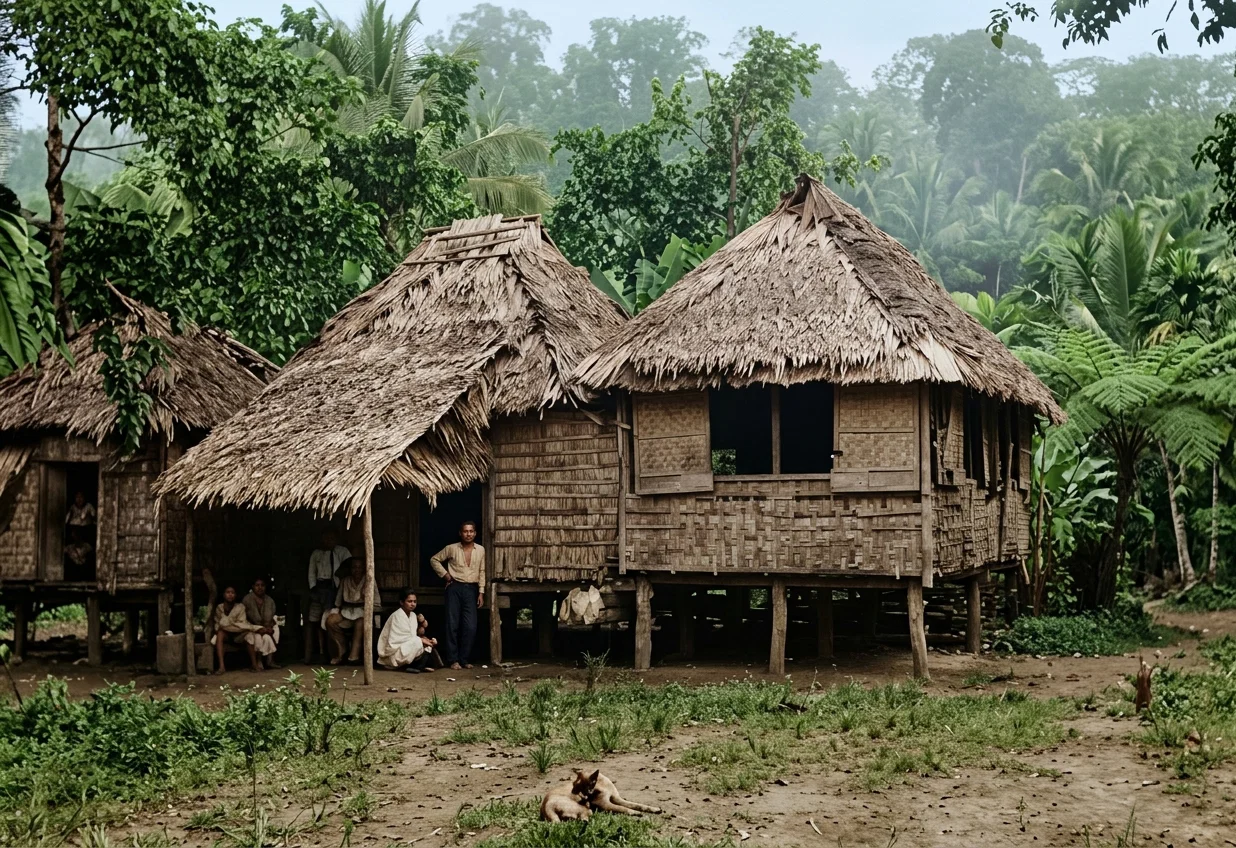
A NATIVE HOUSE
Manila has been the capital of the archipelago for the past three hundred and thirty-five years. From the time of the discovery of the group it was nearly fifty years before anything was known of Manila by the Spanish. In 1571 Legaspi transferred his government from Cebu to Manila, and declared it to be the capital of the Philippine Islands, and proclaimed the sovereignty of Spain over the entire archipelago. At that time the city was governed by two princes bearing the Malay title of rajah, and was a city of considerable size. Legaspi also began the building of the walls of the city, which, however, were not finished till 1590. These walls still stand, apparently as strong as ever. At one time it was decided by the American government to break down these walls, and the work was even begun; but finally on account of the opposition of some because of the historical associations, the work ceased. The moat, however, outside of the walls has been filled up, and in time the space occupied by it will be made a public park and promenade. This will add much to the beauty of the place. Everything pertaining to the walls and the city has a distinctively Spanish and medieval appearance. There are the immense gateways, the draw-bridges, and the sally-ports; for it must be remembered that this city had to be in constant preparation for attack, from Chinese and Moro pirates, as well as from Portuguese and Dutch enemies.
The view to the westward from the walls at sunset is very fine. The sun, as it sinks into the bay, burnishes the sea and sky with great bands of gorgeous color, and forms a picture never to be forgotten. Manila in its restricted sense implies the part known as the Intramuros, or the walled city, which is probably less than half a mile square.
The streets are all quite narrow, and the houses are built contiguous to the street, there being no front yards. On account of the danger of invasion from their enemies, the walls of the buildings are all very thick, with heavy iron bars to the window. They resemble forts more than homes. The prevailing style of architecture is that of the Spanish-Moorish. In order to withstand the typhoons to which they are periodically subjected, the houses are built low, and on account of the numerous earthquakes, they are solidly constructed. The roofs are usually covered with heavy and picturesque tiles, but corrugated iron is being substituted for them to some extent. In the houses of the better classes, a portion of the lower floor is used as a stable and carriage house. In the interior of the houses are small open courts called patios, into which all the rooms open. By this means space was economized, and everything made snug and compact in case of an attack.
The most notable edifice in the city is the Cathedral. The building was first erected soon after the city was founded, but the frequent earthquakes have several times necessitated its entire reconstruction. The present building is built on the site of the one destroyed in 1863. It is a fine building, very heavily built, and cost about one hundred thousand pounds. The archbishop of Manila celebrates mass in this building, and the splendor of the service is equal to anything of the kind I ever saw. The music at the celebration of mass is superior to any music I ever heard in a Catholic church before.
Within the walled city are eleven other churches, one or two of which have stood during the earthquakes that have leveled almost everything else in the city. The palace of the archbishop, many convents and monasteries, the university, a number of schools and colleges, the Palacio (palace), now used for offices of the government as well as of the municipality, are all within the walls of the city. Formerly large numbers of Spanish friars occupied the buildings owned by the church, but many of them have since gone to Spain and Mexico. Much of the property in the city is owned by the friars. These religious orders are immensely rich. Vast sums have been spent in building the immense numbers of churches both within and without the city, for which the people have had to be taxed.
Outside of the walled city I have never seen a city where it is so easy to get lost as it is in Manila. The streets run in any and all directions, and are generally crooked and narrow. Most of the sidewalks scarcely admit of two persons walking abreast. Church buildings are seen every few squares all over the city, and are generally large, massive structures, having been built almost as much for fortresses as for religious uses. One of the most recently built is the church of St. Sebastian, or, as it is usually known, the “steel church.” On account of the liability of earthquakes, this one was built wholly of steel, which was shipped from England in sections. The cost must have been very great.
Scattered through the city are small open spaces hardly large enough to be called parks, which are known as plazas. The streets and plazas generally have names suggestive of Spanish and Catholic influence. The names of some of the streets are as follows: Dolores, Miseracordia, Urdaneta, San Gabriel, San Pedro, Madrid, while among the plazas are Plaza de Cervantes, Plaza de Espana, etc. The city has a small botanical garden, and a fine driveway and promenade along the old sea wall, called the Luneta. Here on pleasant evenings are given army and constabulary band concerts,12which are very popular and largely attended. On the Luneta many tragedies have been enacted, as during the Spanish régime it was used as a place of public execution. On account of the great power of the archbishop of Manila, any one falling under his displeasure could, with no chance of appeal, be taken to the Luneta and shot to death. A few fairly good statues adorn the public places, among them being those of Magellan, the discoverer of the group, Queen Isabella of Spain, and that of Legaspi and Urdaneta on the Luneta.
The houses of the working classes are generally built of bamboo, and thatched with nipa palm. Some of these are very neatly built, and are as comfortable as any other houses. But during the typhoons that visit the archipelago, these light structures go down by the hundreds.
As far as the temperature is concerned, Manila is fairly comfortable. When the time shall come that Manila has good drainage, there is no good reason that Manila may not be a fairly healthful place for our missionaries. All over the city schools are being established where English is taught, and considering the length of time since their establishment, it must be acknowledged that many excellent changes for the better have been made. While a little has been done to teach the students the dignity of honest labor, much more should, and probably will, be done.
If the present plans shall be carried out, within a few weeks we shall have a missionary and his wife in this important center. Brother and Sister McElhaney, of Australia, are expecting to start to-day (March 7) for that field, and I am sure the prayers of many will follow them. Brethren at home, it is no child's play to go into such a field as the Philippines. While we have no fears for their safety, we know there will be difficulties innumerable to meet. But God will give success as he has done in every other field where the truth has been planted in our foreign mission territory. It should be a matter of great rejoicing that we are permitted to occupy one more post, this time almost on the confines of China. While all our brethren and sisters can not go to the front and occupy a position on the “firing line,” the same reward will be given to those who faithfully sustain the foreign missionaries by their prayers and means as is given to the soldiers who meet the enemy on the battle-field. So let your prayers go up unceasingly for those who shall soon be in the thick of the fight in the Philippines.
Opening of the Friends Mission Station
“ON Monday felicitations began in earnest; fine complimentary tablets that (like shop-sign boards) were carried and through the city, and then brought to us, accompanied with what in China passes for a band of music, and followed by a deafening noise of firecrackers. . . . Other presents of strips of red silk, firecrackers, and small sums of money toward the buildings were sent by other officials and the gentry and neighbors.” This is an extract from the letter of a missionary describing, not a great national holiday, but a pleasant popular demonstration of Chinese townsfolk on the opening of the Friends (English) new missionary station at Sui-ling in west China.
An Interesting Document
By L. R. Conradi
Address of Thanks and Homage to His Majesty, Nicolaus II, Emperor and Autocrat of all the Russians, King of Poland, Grand Duke of Finland, Etc.
We, as representatives of the Seventh-day Adventist denomination in all the world, and in a special manner as representatives of their churches situated in the empire of Your Majesty, in view of the difficult situation in our fatherland, take pleasure in most respectfully expressing our deep sympathy by uniting our prayers with the prayers of all loyal subjects in the country, hoping that through the help of the Almighty, peace and prosperity may soon prevail again.
We are filled with gratitude to God, by whose providence the heart of Your Majesty has been moved to grant the long-desired liberty of conscience to all Christian denominations. We herewith submit an expression of our thanks, by expressing the hope that the full blessings of this liberty may be ours to enjoy.
At the same time, we most respectfully submit to Your Majesty the principles of our denomination:—
We acknowledge the Holy Scriptures of the Old and New Testaments as the Word of God. We believe in the God therein revealed, and in Jesus Christ his Son, by whom the world was created, and which he still upholds. We believe in redemption through the blood of Christ, and in his speedy return in glory, as well as in the divine power of the Holy Spirit.
We see in the law of ten commandments, the law of God laid down, with the seventh day as the Biblical, divine, and perpetual Sabbath. We believe in Biblical baptism, feet washing, and the Lord's supper.
We believe in the unity of the faith of the children of God on earth, as revealed in the Bible, and hold to church organization in harmony therewith, having in our midst apostles, prophets, pastors, teachers, elders, and deacons. In order to preach the gospel in all the world, and to sustain the ministry, we observe everywhere the Bible rule for its support.
As to our relations to the higher powers, we believe that the powers that be are ordained of God, and that we are, in accordance with the Scriptures, obliged to render to Cæsar the things that are Cæsars, as taxes, tribute, fear, and honor, and to pray for those in authority; but we also believe that we are to give to God what is his, in obedience to his commandments.
We believe in the Bible doctrine of marriage, and in the Christian education of our children. As we recognize Christ to be the True Physician in things pertaining to the body, we endeavor to follow his counsel with regard to healthful living, and abstain from all intoxicating drinks, as well as from hurtful stimulants. To further these principles, we already possess some fifty sanitariums, conducted on a scientific basis, and located in all parts of the world, as well as a number of flourishing industrial schools for the education of our youth. We also endeavor to enlighten the people in divine things by the publication and circulation of a rich literature.
Our denomination numbers eighty thousand, of whom two thousand two hundred members are loyal subjects of Your Majesty.
We respectfully submit these statements to Your Majesty, praying that God may prosper Your Majesty for a long time, to the good of our fatherland.
Resolved upon at the conference in Petersburg, Oct. 1, 1905, and in Welikoknjaschesk, Oct. 9, 1905.
Your Majesty’s most loyal servants,
L. R. CONRADI, Vice-Pres. Gen. Conf., Hamburg;
O. WILDGRUBE, Petersburg;
F. ANDERSON, Helsingfors;
H. J. LOBSACK, Welikoknjaschesk;
D. P. GAEDE, Riga;
D. ISAAC, Alexandrowsk;
A. M. KAPUSTJANSKI, Armawir;
A. MARTINOW, Petersburg;
A. GONTAR, Newinominsk;
M. DEMIDOW, Taganrog.
This address was set in the Russian language, and printed on a twenty-two-by-fifteen-inch sheet of parchment paper by our Hamburg house, and then bound in the national color (green) Russian-seal leather, bearing the Russian coat-of-arms. It was sent to our representative in St. Petersburg, Brother O. Wildgrube, who waited upon Count Witte in person, and handed the address to him, and he, in turn, placed it before the czar.
As to the effect of the address, the following appears in the government organ, Prawitelstwennу Westnik, No. 17, March 17:—
“There was handed an Address of Thanks to His Majesty by the Christian denomination of Seventh-day Adventists, in which that denomination expresses its gratitude and sentiments of true loyalty in view of the gracious evidences shown in the Imperial Decree of April 17, 1905. On this Address, His Imperial Majesty has condescended to write with his own hand, March 11, ‘Most sincere thanks to the denomination for the sentiments herein expressed.’”
This marks a further step of progress in our work in the eastern portion of Europe, for which we can be truly thankful to God, especially as these principles of the message are being made known even before kings. Rev. 10:11.
L. R. CONRADI.
Hamburg.
He Shall Have Dominion
“HE shall have dominion also from sea to sea, and from the river unto the ends of the earth.” Ps. 72: 8.
Grand Cayman
By F. Hall
F. HALL
The Cayman Islands are three in number, namely, Grand Cayman, Little Cayman, and Cayman Brac. Grand Cayman is the largest, and measures seventeen miles in length, four miles in width at the east end, and seven miles at the west end; with a population of about six thousand, of which one half are white, and the other half brown and black. Its name is derived from Caiman, “the alligator,” which animal it resembles in approaching the east end. It was discovered by Columbus on his return voyage from Porto Bello to Hayti, who named it Las Tortugas, “land of turtles.”
This island, it is said, was the home of ancient buccaneers who preyed upon passing ships, which they boarded at night far from the shore in large armed boats. These marauders protected themselves against attack by means of heavy guns, mounted upon the rocky shore within the coral reef, where they could only be approached in boats. On finding the island untenable, owing to the occasional presence of ships of war, the buccaneers escaped to the shores of the Mississippi, in America.
The education of the people has been much neglected, but under a recently passed educational law, improvement is expected.
The capital is Georgetown. Bodden Town, Prospect, East-end, and West-end are other places of less importance, but are thickly populated. In each of these towns there is a Presbyterian place of worship, hence all the people are followers of that body, with the exception of a few Holiness people, and one man living at East-end who embraced the truth at Honduras under the labors of Elder Hutchins. Of those who embraced the truth under the preaching of Elder Eastman, some have given it up, and others have left the island for other parts of the Lord’s vineyard. Faithful work was done here by Elder Eastman, and the seed is still alive, and will germinate by careful attention and good instruction.
Directed by the Spirit of God and the request of the Jamaica Conference, we—my wife, two children, my sister, and I—gladly responded to the call to leave our native land for this little island, to preach the everlasting gospel. We landed here last November in good spirits. After getting settled, we started open-air meetings, until the Lord saw fit to open other channels. As the way opened, we embraced the opportunity to transfer the meetings to the homes of the people. This led to bitter feeling on the part of the ministers, church leaders, and many of the people.
As a result of these cottage meetings one young woman has kept two Sabbaths with us, and about ten others are interested, but have not the faith to obey as yet. The fear of their ministers and church elders is a great hindrance to the spiritual growth of this people.
The first woman who asked us to hold cottage meetings at her home, whose husband is blind, has dismissed us from her premises by the counsel of her husband and his minister. Being in trouble about the truth, he went to his minister and asked him about the matter. The minister replied that the seventh day is Saturday, but we keep the first day in honor of Christ’s resurrection, and in not keeping Sunday the Seventh-day Adventists are trampling on the resurrection of Christ. This statement settled the whole matter for him. These people have lost sight of Jesus Christ as the Creator of the heavens and the earth, and the fact that he was the one who rested with his Father the first Sabbath of creation.
The whole town is stirred, and ministers and church leaders are barricading their people from hearing the truth. All the defense they are putting up against the third angel’s message will be broken by the Word of God. Although the battle is on, we are of good courage, for we know that Prince Emmanuel is at the front, and to him be the praise and honor.
Georgetown, British Guiana.
A Burman and His New Testament
An interesting account of the work effected by a Burmese New Testament is given in a recent volume, entitled “Among the Burmans,” by H. P. Cochrane. The Testament fell into the hands of a Buddhist, who has himself related the circumstances of his conversion:—
“I kept my New Testament in my jacket pocket wherever I went. When resting from my work, I would take out my Testament, and read a little, slowly going on through Matthew, Mark, and Luke; but I understood nothing of what I read. I read about the birth of Jesus Christ, his teaching, his wonderful miracles; but who Christ was, I did not know.
“Then I came to John. In the first chapter I read, ‘In the beginning was the Word, and the Word was with God, and the Word was God.’ Then a little farther down I read, ‘That Word everything created; and without a Divine creating was not so much as one thing.’ Is that so? I said. Did that Word make me, and not only me, but everybody and everything in all this great world?”
“And then I read that he was the light, and the light shines in the darkness, and the darkness would not receive it. Why, I said, that is just the way it is here. These people are in the dark, and will not believe what the preachers of the Jesus Christ religion say to them. Then farther down I read, ‘The Word took the state of man, and lived among us.’
“And as I read on, I found that the Word that was with God and was God, and created all things, and became flesh and lived on the earth, was the same Lord Jesus Christ that I had been reading about in Matthew, Mark, and Luke.
“I went home, and told my wife that I had become a Christian, and that as the preacher said that all who enter the Jesus Christ religion must receive the dipping ceremony, I am going to get baptism.”
“Were you not afraid your heathen neighbors would make trouble?” I asked him.
“What trouble could they make, teacher? Nearly all of them were in debt to me. But when I told my heathen wife, she was very angry, and said, ‘Very well; if you want to be baptized, be baptized, but I will not be a Jesus Christ wife. I never, never will live with you.’
“Finding that she did not relent, I said, ‘Do not go away. All this trouble is not because of your changing, but because of my changing. If anybody is to suffer, I must be the one to suffer. There are the eleven buffaloes, and six rice-fields, and the house, and the banana garden; take everything, only let me have the thirty rupees in the box, and I will go away. I will go to Toungoo. If they will not baptize me there, I will go to Bassein. If they will not baptize me there, I will go to Moulmein.’ I had taken the Jesus Christ religion with my whole mind, and I was determined to be baptized.”
This was no idle boast. He meant just what he said, and, like Paul, was ready to suffer the loss of everything, that he ‘might gain Christ, and be found in him.’ His example, so unlike his former self, soon softened his wife’s heart, and she now said, ‘Never mind; do as you like. We will live together.’ She, too, soon became a Christian.—Selected.
The Duty of Supporting Missions
The answer to those who find fault with expansion in missions is that Jesus Christ was perfectly aware, when he gave the command to teach all nations, how quickly obedience to it would strain and test the loyalty of his followers. When General Grant ordered the first general assault upon the fortifications of Vicksburg, he knew perfectly what the effect of the order would be upon individual soldiers in his army. An old story of that bloody day illustrates the true spirit of the soldier, and has its application to the relation of individual church-members to the question of duty toward missions. The assaulting columns at Vicksburg drew near to the enemy’s works, but broke under the fierce opposing fire, and found shelter from the storm of bullets by lying flat on the ground. One burly farmer’s boy, a new recruit, who knew no better, pressed on, climbed the parapet, and only discovered that his comrades were not with him when the enemy rushed to take him prisoner. The young giant seized the first man who attacked him, and turned back to rejoin his regiment, dragging his struggling enemy with him. As he reached his comrades, lying helpless on the ground, he cried: “Boys, why didn’t you come on? You might each have got one!”
British Central Africa
By M. C. Sturdevant
BULUWAYO.—Your good and encouraging letter reached our mission in due time. We were truly glad to learn of the progress of the work in the home field. My heart goes out to God this morning in thankfulness to him for a place, yes, any place, in his “most blessed work.” We are glad to be here, and can say to the glory of God, that our health is good. For this we do praise our Heavenly Father. The health of our mission has been very good, notwithstanding the heavy rains of the last two months. The first of the season it seemed that we should have a dreadful famine; the rains held off, rivers dried up, and stock began to die. We lost many of our goats; however, we saved the cattle. No plowing or planting could be done; but before it was too late, our Father turned our captivity, the rains came in abundance, and to-day our crops look as good as they did last year at this time. So now we hope for a fair yield. Truly God is good to us.
Our little church is prospering; the spiritual interest seems good. As for the school work, I think I can truthfully say that the interest never was better; surely the children are taking hold in earnest, and are enjoying their studies very much. Their desire is to learn quickly, to go at once and help finish the work in “this generation.” We keep this thought ever before them in all our work; for, my dear brother, I myself verily believe it is to be done, and we are the ones whom God has entrusted to do it. O, let us awake! I myself want to awake early. Never had I a greater desire to lie low at the feet of the Master and be taught of him.
Yes, we are doing all we can to push the work. Eighty or ninety miles farther north I have started an out-school with two native teachers. Also twenty-five miles north two others are teaching, forty-five miles to the west and north one boy is teaching, two boys are with Brother C. R. Sparrow at Mkupuvula, one is about ten miles from the mission, and three native teachers help me here. Others are in training, and will soon be able to go out to teach also. So you see we believe in progressive work. Two of my English classes now read the English, and then in the class translate it into their own language. I am now getting hold of the language so it does not bother me so much to understand all they say. I freely admit that it has been a hard task for me to learn the language. We teach out of the Zulu books. The children talk the Gentebele and the Makalaka almost entirely, and while it is true that the Gentebele and Zulu are much alike, they are not alike. It has been a hard task for me to wrestle with the three languages at once, but now I hope soon to be preaching to the natives in their own tongue. O, my heart longs to speak to the people in their own tongue, and face to face! I can talk to them in private conversation, and be well understood, but I fear to try to preach in their language.
Pray for us, dear brethren, that the work may truly prosper in our hands, and God may be glorified thereby.
M. C. STURDEVANT.
Barotseland
By William Harrison Anderson; Mrs. W. H. Anderson
It is nearly one year since we left the home land for this field. We were five months on the journey and transporting our goods by ox wagon two hundred miles. As the oxen were not trained, it was no pleasure trip. Several times we heard lions, and once they followed us four or five miles. We kept them off by setting grass fires. Again one passed within thirty feet of the wagon while we were asleep. I believe the angel of the Lord cared for us. We always kept fires around us. Mrs. Anderson and I slept on the ground that mother might have the bed on the wagon. One night our bed caught fire and burned four of our blankets.
Another night we got stuck in a river, and spent most of the night trying to get out. A lion was roaring near us all night, so we did not get sleepy.
At one place we had seven miles of heavy sand. We had to unload the wagon and carry the load, three thousand pounds, on our backs, then go back and bring up the wagon with the oxen. Not much like riding in a chair car on an American railroad is it? I have heard people complain of that. Don’t send them to interior Africa as missionaries. They are apt to get sick and have to go home.
The railroad is near us now, but it is too expensive for missionaries. The fare is twenty-five cents a mile, and the passenger rides in an open truck. Freight is one cent a mile for each pound when shipped by the car-load.
We arrived at our new station September 5. We soon had our house up, and were quite comfortable. The house is built of poles stood on end, and is plastered inside and out with mud. The walls are eight feet high. It is ceiled with muslin, and has an iron roof. Several times since the rains began, the walls have washed down. Of course this lets in the rain, but as soon as it is dry enough, we plaster up again, and are all right until the next rain. This is not conducive to health, but it is the best we can do.
For the natives, we have one building, twelve by twenty-four feet. This is church, schoolroom, study room, dining-room, and bedroom for thirty students. We expect to build more when the rains are over.
On the farm, we have set out several fruit trees and a few ornamental trees around the house. We have planted thirty acres to corn, sweet potatoes, and peanuts. We hope to raise enough to provide our family with food. As I see our few facilities, I am led to ask how many would like industrial school work with our equipment? Our farm tools consist of a wagon, two plows (one is broken), six shovels, six axes, and twelve hoes.
We harrowed our ground with a thorn bush. Did you ever try harrowing prairie sod that way? If you did, you can imagine how well we were able to pulverize the soil. We planted the corn on the grass roots, and have cultivated it with a hoe.
We opened our school September 18. There were ten present. Since that time our numbers have increased to thirty-two. We have had to turn away several who came from a distance, as we had no food for them. Food is very scarce this year. Natives are starving to death around us, and we are unable to do anything for them, as there is no food in the country. When our corn ripens, we hope to be able to accommodate fifty in the home. This I think is all that we can manage at this place.
All have made good progress in their studies. Next month I shall have a class of ten who have learned to read the Bible since we came here. Others are not far behind them. None of these had ever looked at a book before they entered our school. Our studies are Bible, reading, writing, spelling, arithmetic, and geography. We hope to train some workers to give the message to the thousands of villages in this field.15
We organized a Sabbath-school the first Sabbath, and have had regular classes ever since. We are using Bell’s lessons as a guide in class work. The studies are in the native language. The average attendance has been about forty. The donations have been $7.25. Some of the students who have no money are cultivating corn for a donation.
I have a class of seventeen boys who have expressed a desire to serve the Lord. We have special studies on what it is to be a Christian. When they have stood the test of the Word, of time, and of service, we expect to organize a church. We have to move slowly and carefully in this matter.
We are glad to be back again to the work in Africa. We thank the Lord for his care and blessing. Pray for us that we may have wisdom to train workers. O, that we may have power to push the work in this field to the finish!
W. H. Anderson.
MRS. W. H. ANDERSON.
Idaho
By F. D. Starr
WOODLAND.—In company with Brother C. J. Rider it has been my privilege to labor for some time at Woodland and Harrisburg, also to assist him in a series of meetings that he is now holding in a hall in Kamiah, with quite a good interest. Last Sabbath I baptized two of the new converts at Harrisburg.
April 14 I baptized three members at Spalding. We had an excellent meeting on that occasion. F. D. STARR.
F. L. PERRY
By F. L. Perry
Peru
LIMA.—Our health has been uniformly good, for which we feel very grateful. Of course we can do but little public work as yet, but can make ourselves understood in many things. We are now in the midst of our week of prayer. We have just had three or four new believers in Lima, and gradually our circle of friends and acquaintances is enlarging. So we are encouraged to go forward.
A few dollars to provide us with some simple reading-matter for free distribution, and to help one of our number—a qualified man—to spend part of his time in the work, would rejoice our hearts, and help to scatter some rays of light amid this intense moral darkness. But we believe you are doing all you can to help, and so will wait with patience until God shall touch the hearts of some who have means.
Brother Espinoza has recently returned from the south, and brings news of a number of new Sabbath-keepers there. He and Brother Beltran, living here in Lima, are energetic, devoted, God-fearing men, and they seem to fear nothing. I believe that the Lord has gone before us, and raised up these men to be helpers in the work here.