The voyage from Calcutta to Burma was very pleasant, and I had many opportunities to present the truth to the passengers and officers. When we reached Rangoon, two physicians came on board to examine the passengers. With great interest we watched to see if any had smallpox, plague, or cholera. A native man was moved aside for a more thorough examination. I asked the chief officer what was the matter, and he replied that they feared the man had smallpox, and if so, we must all remain on the ship twenty-one days. Of course this made some of us very uneasy, as our plans were all laid, and we were anxious to go ashore. I felt impressed to pray that a further investigation might prove their suspicions groundless, and was glad to learn that the man was not afflicted with that disease.
Brother L. F. Hansen met me at the boat, and took me to Insein, where Elder Votaw and Brother Hansen are living. I found them all well and of good courage. Sabbath-school was held in the hall where they hold their meetings in Rangoon, and all seemed deeply interested. Elder Votaw, Brother Hansen, and I visited some of the Sabbath-keepers. One old lady, when asked how she first heard the truth, said that when Sister Smith was canvassing there, she invited her to attend a meeting. She accepted the invitation, became interested, and although her friends in another church did all they could to keep her away, she saw the truth and decided to obey, let come what would.
In reply to the same question a gentleman said, “I wrote to the Oriental Watchman and inquired about the binding obligation of the law; but instead of receiving a direct answer, the ‘Appeal to Clergy’ appeared in the next number of the Watchman. I took that as an answer to my question, and decided to keep the Sabbath. I was sending my children to a Baptist school, and when I told their teacher that I could not send them any more on Saturday as I had decided to observe that day, he was very kind, and closed his school on the Sabbath.”
Sunday night we held a meeting in the hall, and every seat was taken. The congregation was made up of Europeans, Eurasians, and Burmese. All gave good attention. One man said that he had thought no one could understand the book of Revelation, but now he had changed his mind. Tuesday evening we had another good audience, and felt that the Lord was influencing the people to listen to the truth.
Elder Votaw accompanied me to Moulmein, where we were met by Mg. Maung and some of his friends. We visited the lumber yards to see the elephants at work. This is a sight which I think would interest any one. The elephants would carry large logs on their tusks and drop them in the river. Sometimes they would slide them along on the ground with their feet, but every move they made was very graceful.
We were taken first to the home of Maung Chit Hla, where we were to be entertained, and then took supper with his sister. Here we met Mah May, who was the first Sabbath-keeper in Burma. Five years ago she saw the Sabbath from reading her Bible. She also understood that the kingdom of God is still in the future. She loves the truth of the coming of Christ, and says, “I have no other ambition in this life than to talk of my Lord and prepare for his coming.” Her godly life and her great knowledge of the Bible make her a constant inspiration to all around her. She is now caring for her aged mother, who is one of the four remaining converts baptized by Dr. Judson.
Maung Maung is Mah May’s brother. He has kept the Sabbath three years. His sister showed him that Saturday is the true Sabbath, but he was unable to account for the change until Brother Meyers taught him that Rome was responsible for it. He then accepted the Sabbath at once, gave up a good position, and pioneered the truth among his people for two years at his own expense. He has written and translated three tracts in Burmese, practically bearing the cost himself with what help his people gave. For one edition, however, Brother Chapman, of Nashville, Tenn., took up a collection, and sent sixteen dollars, which paid for five thousand. Mg. Maung’s wife has also united with our people, and is aiding her husband in his labors.
Maung Chit Hla was a Baptist, and, when Mah May and Mg. Maung left that church, he came over to Rangoon from Moulmein to restore them, but, instead, after some days of study he went back convinced of the truth. He did not fully obey until a few months ago, when he took a decided stand. On his trip back to Moulmein he read a tract on tobacco, which Brother Meyers had given him. We will give the result in his own words: “As soon as I saw that it was bad, I threw it in the deep blue sea, and have never touched it since.” He has learned the great secret not to take man’s word for truth in spiritual matters; he always asks for the text.
About the time he took his stand for the truth, he was joined by his sister Ma Thane Nu, who was formerly a Baptist also. She is a true “servant of the saints,” and accompanies Maung Chit Hla on his missionary visits. It was at her home that we were having supper.
We also met Sayat (teacher) David Hpo Hla, a brother of these two. He studied the truth for about three years, and finally yielded to his convictions, and left his position as catechist and teacher in the Church of England. He is a talented man and a splendid interpreter. If he keeps humble, we shall expect to see God use him mightily in reaching his countrymen. His wife and five promising children seem to be in accord with his stand for the truth.
Another sister of these, who all her life had adhered to Buddhism, has very recently taken her stand for the Lord, and has asked for baptism. She is nearly fifty years of age, and though the Baptists labored diligently with her, it seems that God reserved her for a kind of first-fruit from Buddhism. Her experience has been very marked indeed.
We also met Mah May, a niece of these people, who is much interested, and Miss Rena Shawloo, Maung Maung’s niece, whose father makes it hard for her to obey her convictions, as he bitterly opposes the truth. He studied medicine in Cleveland, Ohio. Ko Miya Thum, a brother to Maung Maung, has been a great help to us, especially in reading proof on our new tracts. He has two daughters ready for baptism. Maung Kim, our first candidate for baptism in Burma, was educated a priest. He saw the truth through the efforts of Mg. Maung and his brother.
After supper we had a Bible study and considered Eph. 1:9, 10—The Mystery of God’s Will. We tried to close the study several times, thinking we had said enough for one evening, but they replied, “If you were to remain longer, we would not intrude, but now we must obtain all the light we can.” Mah May said that she had read her Bible through eight times, and had found that nothing in this world could give her the comfort she found in reading her Bible.
Since my return to Calcutta, Brother Hansen has written that Elder Votaw had the pleasure of leading seven of these dear souls into the water for baptism. We all feel much encouraged over the outlook in Burma, and hope to see some of these new converts enter the work and assist in carrying the truth to their people.
W. H. THURSTON
By W. H. Thurston
Ottawa
The committee having in charge the bill for better Sunday observance resumed its work the 24th inst., and the hearing was closed with the third sitting the following day. Many interests were heard in opposition to the bill—the railway, transportation, marine, coal, navigation, steamboat, express, and many other companies, numbering in all about sixty different corporations, and representing practically the whole industry of the Dominion. Strong arguments were made in opposition to the bill, especially by the railway, transportation, and electric companies. While the promoters of the bill tried to maintain that it was not the religious observance of the day which they desired to protect, the bill was referred to by different speakers as being religious, and emanating from a religious body.
At the close of the sitting of the 19th inst., Mr. Shearer, the leader of the Lord's Day Alliance, asked the privilege of replying to the arguments of the Adventists,16Jews, and some others, which was granted, and it was suggested that he reply there and then, as we were all present; but after some questions pro and con he was allowed to defer his reply until the following sitting. In the meantime I filed an application to reply to Mr. Shearer when he was through, but the hearing closed without hearing Mr. Shearer. It was clear that they did not care to have the religious side, the broad side, discussed. After the hearing, we had a brief interview with Mr. Shearer, and he said that personally he had no objections to our people's working on Sunday providing they would work in their houses, barns, or out of sight and hearing. This is a very significant statement, indeed.
Our arguments, both written and oral, were printed in full in the official documents of the House of Commons, with the other arguments presented against the bill. Our position, in brief, was that the bill was religious in its character and make-up, and that the legislation proposed was religious legislation; and this being true, it was unconstitutional and antichristian.
We are very thankful for this privilege of presenting the truth before men in authority, and it was evident that the committee was favorably impressed that we have rights, conscientious convictions, and that we should be recognized. While the minister of justice would not admit that the bill affected the religious liberty of any one, he admitted that we had a very presentable case from the material standpoint, and that he was enlightened by the presentation of our views. Another member of the committee stated that he could see that the bill, if passed, would take two days from us, and we could not expect a livelihood. He said they must let us live in the country.
We can not anticipate the future of the proposed bill, but it will in all probability be reported back to the House next week or early in May, and the House will deal with it. Some think it will be laid over until another session of Parliament, but time will tell. We feel that the Lord has directed in the presentation of the truth, and that much good will result from the efforts made at this time. We will give further reports of the movement as matters develop.
W. H. THURSTON
Where Is Your Pound?
By H. H. Hall
ONE of our missionary campaign mottoes has been, and continues to be: “The liberal circulation of message-filled tracts by every Seventh-day Adventist, using a pound of the Signs of the Times leaflets as an entering wedge.”
Concerning these leaflets a sister says: “The Signs leaflets are grand. A dear sister sent me a sample, and I am very much interested in them. Enclosed please find $1.30 for a thousand copies — two hundred of each of the following: ‘Law of God,’ ‘Sabbath of the Bible,’ ‘The First Day,’ ‘Who Changed the Sabbath?’ ‘The Seal of God.’ I want to give one of each of these to each person with whom I work.”
This is but a sample of many letters being received from tract societies and publishing houses, and shows how earnestly and methodically many of our people are working. How about your number? Which pound of these leaflets, dear reader? Is it lying on the shelf, or are the three hundred numbers which it contains in the homes of your neighbors and friends.
H. H. HALL.
The Third Angel's Message in Palestine
By W. H. Wakeham
AFTER my trip through Syria, I spent a few days with the workers in Jaffa and Jerusalem. Landing at Jaffa, I was met and heartily welcomed by Brother Gregorius, who has charge of our medical missionary work in that city.
Since the closing of our treatment rooms there, nearly a year ago, our nurses have been employed in the Bella Vista Hydro, a new institution combining hotel accommodations with various hydrotherapeutic treatments. This institution is owned by a wealthy English woman, but is under the management of a Mr. Feingold, a converted Jew, whose wife is from Scotland. These are all nominal Sabbath-keepers, so our nurses are entirely free from all duty on the Sabbath; but their Sabbath-keeping is really more Jewish than Christian, and they have so thoroughly imbibed the modern “Anglo-Israel” idea that there seems no room in their minds for any further light concerning the third angel's message.
Our nurses think that it is unwise to remain in their employ after the present contract expires, so we are planning to move them to some other city. The Lord seems to be opening the way for them to locate in Haifa, a growing city, with a prosperous German colony, situated at the foot of Mt. Carmel on the Bay of Acre. To this place our workers will soon go if a suitable location can be secured for treatment rooms. Haifa is a favorable place in many ways. It is a healthier city than either Jaffa or Jerusalem. A recently completed railroad connects it with Damascus, and it will, no doubt, very soon have similar connections with Jerusalem. The harbor is much better than at Jaffa, which has, in fact, no harbor at all, and landing is simply impossible in a heavy sea. Haifa, moreover, seems more enterprising than many other Oriental cities.
The progress of our work in Jaffa, though characterized by Eastern slowness, has been onward. Our nurses have worked with meager facilities. Many difficulties have been encountered. Two years ago a small organization was effected, known as the Jaffa-Jerusalem church. But shortly after, the elder and the deacon, being conference workers, went to other fields on account of their health, and others moved away. The few that remained continued firm, other workers came, and the work went on, and others accepted the truth. At the time of my visit it was deemed advisable to reorganize the church, and elect officers who were permanent residents. This was done, and three new converts were baptized, and then all partook of the ordinances, which had not been celebrated there for nearly a year and a half. The love and unity prevailing among the members of that little company was most refreshing. They all feel now that the message is firmly planted there to continue until the Lord comes. All are of good courage, and we feel sure that the Lord will add to their numbers. The workers now in Jerusalem are comparatively new, but seem to be doing well. Their work is increasing, the receipts of the treatment rooms during last year being more than any preceding year. Two or three persons are favorably impressed with the truth, and seem likely to accept it erelong.
While in Jerusalem I visited the Protestant cemetery on Mt. Zion, where lies the body of our faithful worker, Brother Leschner, who not long ago was cut down, in the prime of life, almost at the beginning of what seemed a career of usefulness. The workers in Palestine are planning to place a small, modest stone to mark the last resting-place of one they had all learned to love.
All in all, the work in Palestine is encouraging. May the Lord give courage and grace to the workers on this, the battle-ground of primitive Christianity.
W. H. WAKEHAM.
A Visit to Boston
By K. C. Russell
I REACHED Boston on Friday afternoon, April 13, where I remained until Thursday, April 19. It had been one year and a half since I left the Boston field to connect with the Religious Liberty Department of our work.
My primary object in visiting New England at this time was for the purpose of attending an important business meeting of the New England Sanitarium and Benevolent Association, of which I was a member. This meeting was held Monday, April 16, at the sanitarium in Melrose. I am gratified to report that the results of the meeting were most satisfactory. Steps were taken to place the institution under denominational control.
Sabbath, April 14, at 11 A. M., I spoke to our church in Everett, Mass., and at 2:30 P. M. I spoke to the Boston church. It was a source of great pleasure to meet those for and with whom I had formerly labored. I was also encouraged to see so goodly a number of new members who, since my departure, had been added to the church through the earnest labors of Elder L. S. Wheeler, the present pastor of the Boston church, and his faithful collaborators. Sunday evening I had the privilege of speaking to a good audience on the subject of religious liberty, in the Universalist church at Everett.
After my arrival in Boston, I was pleased to learn that the dedicatory services of the mission for the Jewish people of Boston was to occur during my stay there. Many of the readers of the REVIEW are aware that for three years or more Elder F. C. Gilbert, who is a converted Jew, has been laboring earnestly for the establishment of such a work in Boston.
The dedicatory services took place Tuesday afternoon and evening, April 17, which was the seventeenth anniversary of Elder Gilbert's conversion to Christianity and his acceptance of the third angel's message. An elaborate and interesting program had been prepared for the occasion, consisting of selections of vocal and instrumental music, and appropriate addresses by our ministers and others.
At both the afternoon and evening services there was a good attendance. Among those present were Elder E. W. Farnsworth, Elder W. J. Fitzgerald,17Prof. Frederick Griggs, Dr. C. C. Nicola, Elders L. S. Wheeler and E. E. Miles. In the afternoon addresses were given by Elders Farnsworth and Wheeler, and the writer; and in the evening Rev. Wolfe, pastor of the Christian church of Haverhill, Mass., and Rev. Heath, pastor of one of the Baptist churches in Boston, gave interesting addresses; also Dr. C. C. Nicola, superintendent of the Melrose Sanitarium, gave an appropriate and interesting address. Professor Griggs, principal of the South Lancaster Academy, offered the dedicatory prayer.
The work of the mission is already opening up encouragingly, and we believe, with the earnest corps of faithful workers who are connected with it, an effective work will be done for this long-neglected people.
My earnest prayer is that God will signally bless this mission, the sanitarium, and the other lines of gospel work in this important field.
K. C. RUSSELL.
Earthquake Notes
THE following paragraph is taken from a letter written by Sister Carrie R. King, of Oakland, dated April 23: “Since the terrible earthquake we have been spending all our time in trying to relieve the sufferings of the afflicted.18We opened our church for them to stay in, and there have been two hundred or more in there, sleeping on the bare floor without covering, after all the beds that we could obtain were filled. We also improvised a kitchen in one of the rooms of the church, and feed several hundred daily. Everywhere is confusion, distress, and dismay. A very heavy rain last night added greatly to the trouble, for all the parks were full of people sleeping out of doors. All our people are safe except three missing, but many, many are homeless and destitute.”
The first news from Healdsburg was received after the REVIEW had gone to press last week. We take the following from a letter written at that place by Brother S. Arthur Wright, dated April 26: “I thought I would write you a note to let you know that the earthquake has caused quite a stir here against the Adventists. Last Sunday the church had some hand-bills printed and scattered throughout the town, announcing a meeting to be held in the church. One of the brethren had his bills taken from him, and he was nearly mobbed. The saloon men of the town threatened to hang the speakers, and sent us word that they would vigorously oppose our having a meeting at all. But the refusal to allow us to have a meeting has caused more people to think than our meeting possibly could have stirred, and some have stepped out boldly and taken their stand for the truth. I do not need to describe any of the scenes following the earthquake shock, as the papers could not overstep the truth if they wanted to. The town of Healdsburg was practically unhurt in comparison with other places, although there was one man killed here; the towns round about suffered very materially. The college buildings and the church were unharmed except, of course, the chimneys and plaster.”
A Report From California
From an interesting letter written by Brother T. A. Kilgore, of Oakland, to Elder W. C. White, dated April 25, we obtain the following news concerning the earthquake experiences:—
“Oakland suffered comparatively little. All our people on this side of the bay are safe, and have sustained but little damage, but we are considerably inconvenienced in the way of discomfort in our homes, having had no fires in our stoves since the earthquake. We have not been allowed to build fires under heavy penalties until our chimneys have been inspected and repaired. What little cooking we have had has been done on camp-fires or stoves set out in the yards or on oil or gas stoves. Our church in Oakland suffered little. Cracking of the plastering is all the damage visible, except the loss of the top of the tall chimney. About forty-five out of fifty chimneys came down.
“So far as I know, all our brethren and sisters in San Francisco are safe, with the exception of three of Brother Fulton's helpers. A Brother and Sister Sain, and Brother Sain's sister, have not been heard from since the earthquake, and grave fears are entertained in regard to their safety. Brother Fulton told me that these persons had their room in an old building, and he was very fearful it collapsed and caught them. His Helpers’ Home, on Howard Street, was badly wrecked by the earthquake, but all in that building managed to get out alive, and are safe.
“Brother Hibbard's home was burned. It would have been saved from the fire had not two miscreants deliberately set a building in that block on fire. These two the soldiers discovered, and after a short pursuit shot them both, but the fire they set burned about four blocks of the town. Brother Figer lost his store, but his home escaped by just one block. Ditto for our Laguna Street church; the fire came up to Octavia Street, and that is just one block from Laguna. Brother Howe's house was badly wrecked by the earthquake, but saved from the fire. It was on the west side of Dolores Street, and the fire burned the houses on the east side. Dr. Sanderson's sanitarium made a like escape. It was on the west side of Van Ness Avenue, and at that avenue the fire was checked. It is a wide street, as you know, and by blowing up all the buildings on the east side of the street they managed to stop the flames there. Dr. Matner's home was saved in the same way, it being on the west side of Van Ness and north of Golden Gate Avenues. It is more than a mile and three quarters in a direct line from the ferry building to the corner of Golden Gate and Van Ness Avenues, the nearest point unburned, and in the other direction north and south, it burned from shore to shore, the city in that part being over four miles wide. The total area burned over is about seven square miles.
“The vegetarian café, the Helpers’ Home, the sanitarium branch, and the health food store are entirely gone. Brother Parlin's office was in the Parrott Building on Market Street, which now stands a gigantic ruin. His home, being on Steiner Street, was beyond the fire line, and was saved. Dr. Lamb's place was swept by the fire. The Crocker building, in which the Pacific Press had their city office, still stands, but the inside is burned out.”
The Earthquake Special of “The Signs of the Times”
By E. R. Palmer
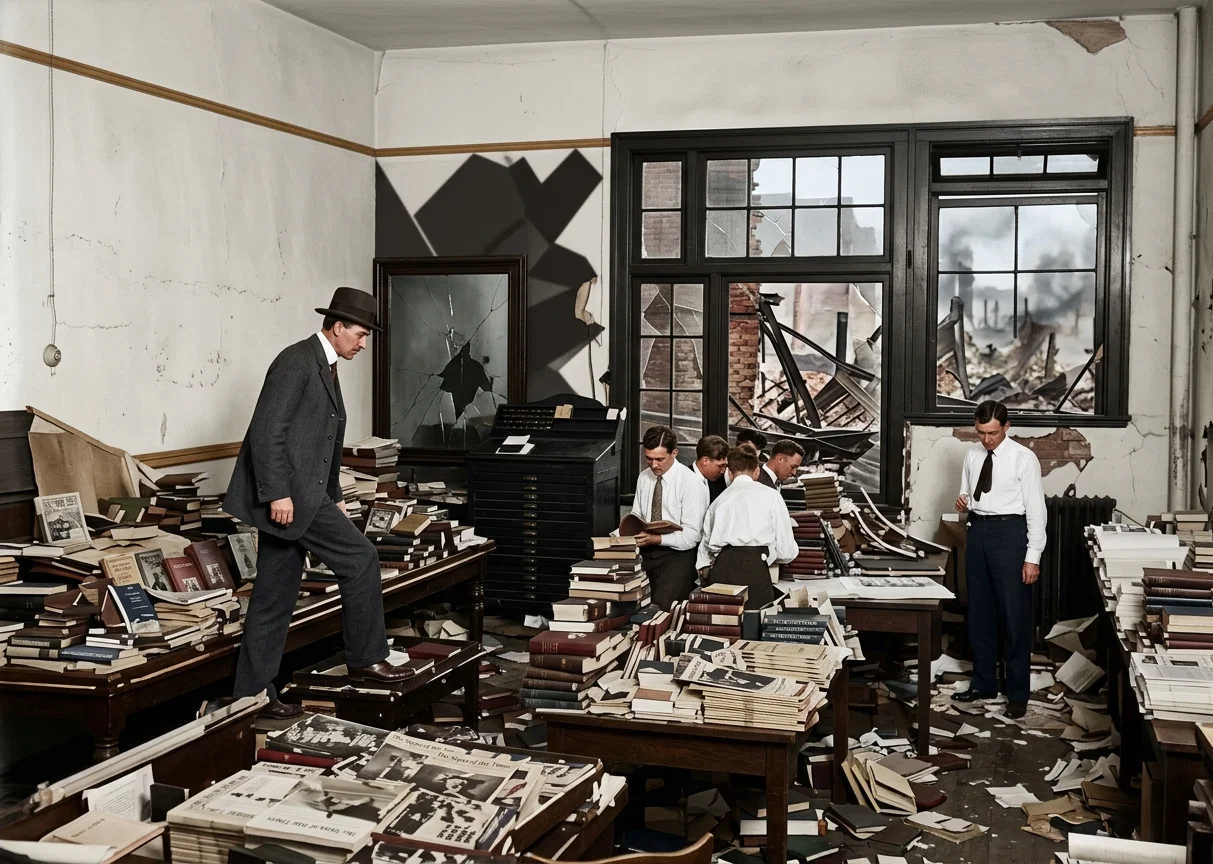
THE great earthquake and fire, which have laid low the proud city of San Francisco and devastated many surrounding cities and towns, have opened a wide door of opportunity, privilege, and duty to the children of God who know the meaning of these things. We thank God that, although the walls of the Pacific Press were wrecked, all the machinery, except the linotypes, was preserved, which enables us to publish to the world the message of warning.
BOOK DEPARTMENT OF THE PACIFIC PRESS AFTER THE EARTHQUAKE
After the earthquake a council of the leading brethren in Mountain View was called in the shattered building of the Pacific Press. A report was given on the condition of the printing plant, and as it was evident that the machinery had been preserved for a purpose, plans were laid at once for publishing an Earthquake Special of The Signs of the Times, in which the world would be told the facts and their meaning by pen and photographs.
The editors, accompanied by photographers, went to the scenes of destruction. They saw the ruins made by earthquake, fire, and dynamite. With their own eyes they saw the fleeing refugees, the homeless thousands in the parks and on the hills, the evidences of martial law, the scattered dead, the crumbled, smoking miles of chaotic waste, and the long, patiently waiting lines of hungry people,—the poor, the outcast, the Chinese, and the millionaire, all in line, seeking bread from the same hand of charity.
With the awful facts burned into their very souls, they returned home, and traced, with hands that had trembled through the earthquake, the truthful story of the most stupendous calamity of modern times.
And not only is the story told; the editors of the Signs are set as watchmen upon the walls of Zion, and faithful to their trust, they have told the meaning of this destruction in the light of prophecy.
Editors, artists, compositors, foundry men, and pressmen agreed together that they would not sleep till the Earthquake Special was running from the big cylinder press. They kept their word, and the greatest number of the Signs ever issued was brought out beautifully and promptly. In fact, the Signs was the first paper that gave a comprehensive, illustrated description of the disaster. It is a thrilling, an inspiring number. No other journal tells the story as this paper does. No other journal has such illustrations. No other journal tells the true meaning of the catastrophe.
The people want this number, and they ought to have it. It sells wonderfully. People run after the agents on the streets, and buy from one to twenty copies. Agents sell two hundred to five hundred copies daily. Several have sold one hundred an hour.
After one town had been thoroughly canvassed from house to house, a little boy six years old sold one hundred and thirteen on the street in half a day. The first day after the people knew that the Special was issued, the Press booked orders for fifty-eight thousand copies.
What an opportunity is this! Will God's people improve it, and spring to the work?—They surely will. They are doing it. For further particulars, see second page of this paper.
E. R. PALMER,
Sec. Gen. Conf. Publishing Dept.
Canvassing in South Carolina
By W. S. Chapman
For the benefit of persons desiring to come South, but who are questioning whether they could earn a livelihood, I want to present some facts and figures, gleaned from the records of a few of our canvassers.
Any Sabbath-keeper with a mind to work, and desiring to help in the advancement of truth, coming here with a determination to honor God in what is undertaken, can fully expect as real a success as that presented in this article.
Now is the time to work, and now is the time to come South, for money is now plenty. One canvasser, Brother Dart, our canvassing agent, is making a good living out of his cash sales alone. With proper precaution the canvasser's health will also improve. Remember, too, that the work will close up first in the South, and so, naturally, we may look for a special blessing upon workers who will come at once, while yet there is a field open for labor. Every consideration now points to the South as the most needy field, and God will surely bless and prosper the humble, consecrated worker who will make this neglected territory his field of labor.
Brother C. F. Dart, canvassing agent for South Carolina, can devote only part of his time to personal canvassing, yet in sixteen days' work, putting in an average of seven hours daily, he sold, or rather took orders for, eighty-eight copies of “Coming King,” and sixty-five copies of “Gospel Primer,” the total value being $104.25, or $6.50 a day, or a net profit of 46½ cents an hour for each hour devoted to the work.
A sister, canvassing near by, worked thirty-four hours in five days, and took orders to the amount of $18, or $3.60 a day. Another sister worked forty hours in five days, and took orders amounting to $13.50, or $2.60 a day. The net profit to these sisters was $9 and $6.75 respectively, a week. How many of our workers or of our people in the North are doing as well? Yet the success of these two workers is not phenomenal. It is possible for any devoted worker to do equally well.
Of course, all is not golden colored, and hardness has to be endured here as elsewhere, and no murmurer should venture into this country; but there is much that is blessed about the work in the South, and very much to encourage the faithful; and no earnest soul will ever regret coming. Let all who are interested in this work and who wish to come South, and any whose heart may be impressed by reading this article, either to come or to otherwise help, write to Brother Dart, R. F. D. 4, Gaffney, S. C., and he will be glad to furnish them with any further or needed information.
W. S. CHAPMAN.
New Quarters of the Southern Publishing Association
By I. A. Ford
Two years ago or more, the question of removing the Southern Publishing Association from its quarters in the city to a country location, began to be agitated. Various stock-holders, when visiting the place, expressed it as their best judgment that the change should be made. Many of the reasons which led them to this conclusion have been given by others in previous articles in the REVIEW and the Watchman.
At the stock-holders' meeting in January, 1905, the incoming board of directors was instructed to take immediate steps to dispose of the old property, select a new location, and erect a suitable building for the business. Many locations were visited by the management, but not until September was a place definitely decided upon.
The location selected was a tract of land containing nearly seven acres, on a high elevation just outside the limits of the city of Nashville. Part of this has been subdivided and sold to our em- ployees, the association retaining three acres for its own use. On the lots that have been sold, several new houses are being erected, and some are already completed and occupied by the workers in the institution.
As soon as the land was purchased, plans were laid for the erection of a building for the manufacturing department. After giving the matter careful study, the management decided to erect a one-story building. This has many advantages. No elevator is required, which saves not only the time required in going from one floor to another, but also frees us from the danger of accident so often happening from the use of elevators.
Being all on one floor, each department has easy access to every other department, and the work of all is more easily directed. Although the building is seventy feet wide, yet there are no posts, the large roof being supported by nine large truss-beams. There is only one partition in the building, and that is around the shipping room; this partition forms the back of the bins for books. The absence of partitions enables the workers to go from one department to another more quickly than could be done if each were in a room by itself.
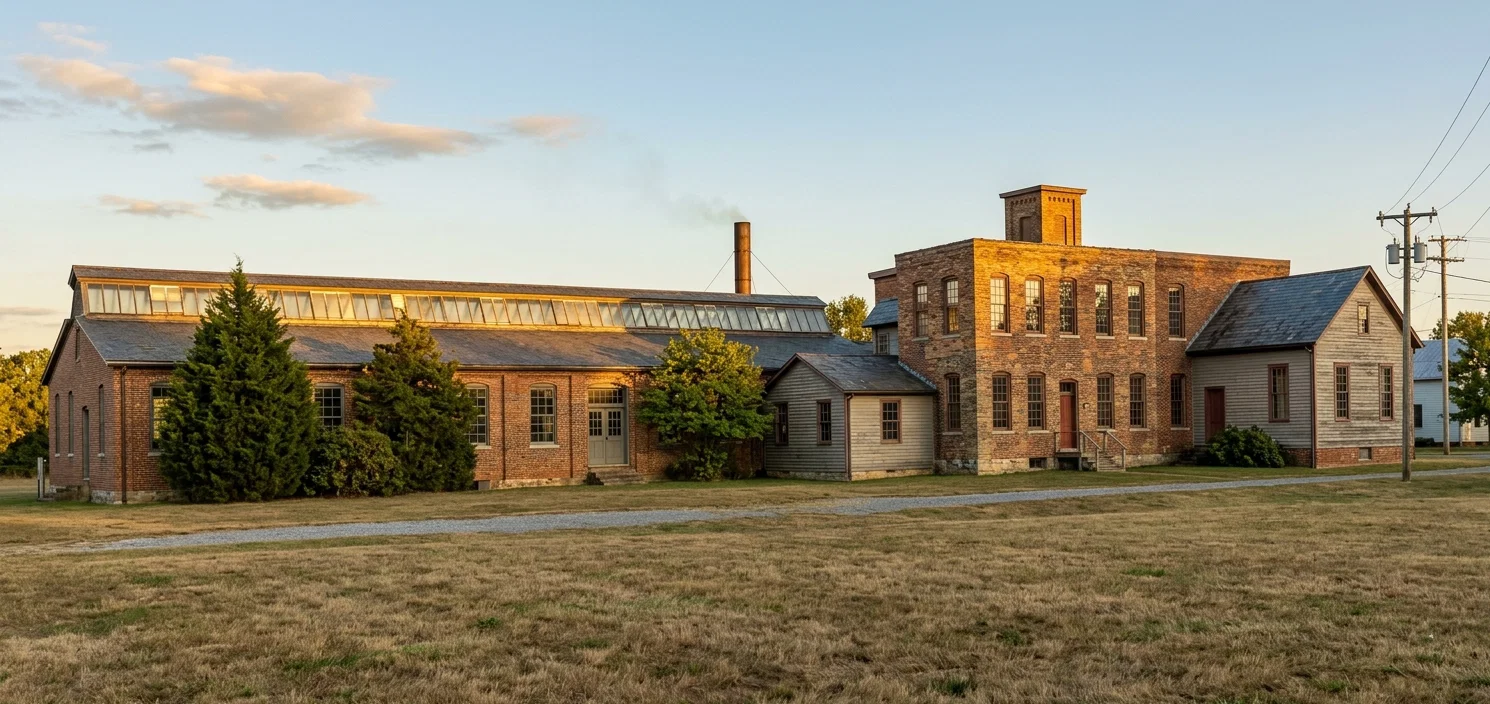
NEW PLANT OF THE SOUTHERN PUBLISHING ASSOCIATION
In planning the location of the various departments, much care was taken to have everything as convenient as possible, realizing that anything which causes extra steps is a loss of time, and consequently a loss financially in the operation of the business. During the last few weeks we have been visited by a number of the leading business men of the city, who have spoken words of the greatest commendation. One gentle- man, who stands at the head of one of the largest firms in the city, stated to the writer a few days ago that he was acquainted with all the leading printing houses in the city, and that he considered ours the best arranged, and upon the whole, the best plant of its size that he had seen. Several of our brethren from abroad have also visited us, and expressed themselves pleased with what they have seen.
Perhaps a more detailed description will be of interest. The main entrance to the building (as seen in the illustration) is near the north end. To the right of this is the desk of the superintendent, who receives all orders, and after entering the same on the record books, passes them on to the various departments. Next comes the composing19department, where the work of nearly all jobs begins. In one corner of it are the proof-readers' desks. Next to the type department, to the west, is the press department, with four cylinder and two job presses. At the side of this is the stock department, near the center of the building, on the west side. A large door in the rear enables us to take stock in or out without inconveniencing any department. Then comes the bindery, which occupies the whole of the south end of the building. The machinery and tables in this department are so located that the sheets coming from the presses are taken by the folding-machine, which stands nearest the pressroom, and from there they go on step by step, until, when they reach the north end of the department, they are finished books, wrapped, ready for the shipping department, which comes next. So by the time a job has gone around the large room, the work is finished, ready to be sent out.
Our machines and tables are close together. We have only eight thousand four hundred feet of floor space, so there is no waste room; yet we have room enough for carrying on our work comfortably. We believe that our work can be done far more economically in this building than in the old one, where we were scattered over three floors, necessitating considerable time in going from one department to another. The business offices are in a frame building which was already on the place.
The outlook before the association is quite encouraging. We are now in position to print large quantities of our books, pamphlets, and papers. And as the canvassing work is rising, we hope that our facilities will be taxed to their utmost to furnish books for the workers.
We are much in need of two experienced printers, and if any reading this article would like to connect with us, we shall be glad to hear from them.
I. A. FORD,
Manager Southern Publishing Assn.
Field Notes
FOUR adults have accepted the truth at Florence, Mo., under the labors of ELDER E. A. MERRILL.
ELDER S. H. LANE in a recent report mentions the organization of a church of nine members at Fultonville, N. Y.
A REPORT from Eldorado Springs, Mo., states that six persons there have recently expressed an intention to obey the Bible Sabbath.
AT a council of Missouri Conference workers held recently in Kansas City provision was made for six tent companies to be in that field the coming20summer, one in each of the five districts and one in Kansas City for the colored people.
A GOOD work has recently been begun among the German residents of St. Joseph, Mo. Brother W. F. H. Schroeder reports seven persons baptized there.
A SERIES of meetings at Winston, Mo., conducted by Brother C. H. Chaffee, led three persons to unite with the church subject to baptism, while two others signed the covenant.
ELDER C. B. RULE says in a report from Virginia: “I have held meetings with the churches at Portsmouth and Norfolk with good results. I baptized seven willing souls while with these churches, and there are more who will follow in the ordinance. A Sabbath-school of twenty-four members was organized at Norfolk. We have two Sabbath-schools at Norfolk, and one at Portsmouth. I held successful meetings in both churches at Newport News. At this place I baptized eleven, and others are waiting for baptism till I can return. I look for large results this tent season.”