The Youth’s Instructor, Vol. 31, No. 8.

BESSIE'S DEAR LOVE
Earlier text: BESSIE'S DEAR LOVE

NEW-TESTAMENT HISTORY SERIES

LESSON 123.—REVIEW: LIFE OF CHRIST FROM HIS BIRTH TO HIS SECOND PASSOVER.

1. What peculiar title is sometimes applied to our Lord Jesus Christ? John 1:1.
2. How long has Jesus existed? Verses 1, 2.
3. What part did he have in the work of creation? Verses 3, 10.
4. How has he been a blessing to mankind? Verses 4, 5.
5. How did he adapt himself to the wants of men? Verse 14.
6. What was the first promise of his coming? Gen. 3:15.
7. To what other promises can you refer? Deut. 18:15; Ps. 89:19; Isa. 9:6, 7; 28:16; 42:5–7; Zech. 3:8.
8. Who proclaimed his coming? John 1:6, 15.
9. What proclamation did he make? Luke 3:5, 6, 16, 17.
10. Where was Jesus born?
11. Tell how on the plains of Bethlehem the shepherds were visited by a choir of angels. Luke 2.
12. Describe his presentation at the temple.
13. Describe the visit of the wise men from the East. Matt. 2.
14. What scriptures seem to foretell this visit? Ps. 72:10; Isa. 60:3, 6.
15. Describe the flight of Joseph and his family into Egypt.
16. What fate did the infant Jesus thus escape?
17. What had been prophesied in relation to the slaughter of these infants? Jer. 31:15.
18. Where did Jesus spend his early life?
19. Give the only incident of his youth that is left on record. Luke 2:41–52.
20. Give a brief account of the ministry of John the Baptist.
21. When Jesus was baptized, what evidence of his divinity was given? Matt. 3:16, 17.
22. What record did John bear? John 1:29–34.
23. Describe our Lord’s temptation in the wilderness.
24. Describe his first miracle, and relate the circumstances connected with it. John 2.
25. Tell how Jesus purified the temple. John 2:13–17.
26. At what time was Jesus baptized?—Some time in the autumn of A. D. 26.
27. When did he purify the temple?—At the Passover, about the middle of the next April.
28. With what noted man did Jesus have an interview at the time of this Passover? John 3.
29. How did Jesus spend the next few months after this Passover? John 3:22.
30. What unjust treatment did John receive about this time? Matt. 14:3–5; Mark 6:17–20; Luke 3:19, 20.
31. Where did Jesus go after John was cast into prison? Matt. 4:12; Mark 1:14; Luke 4:14; John 4:1–3.
32. Describe his interview with the woman of Samaria. John 4.
33. How long did he remain in Sychar?
34. What was the result of his preaching in that place?
35. Where did Jesus next go? John 4:43.
36. What caused the Galileans to give him a favorable reception? Verse 45.
37. Describe our Lord’s second miracle at Cana. John 4:46–54.
38. Tell how he was rejected at Nazareth. Luke 4:16–30.
39. Where did Jesus now take up his abode? Matt. 4:13–16.
40. What disciples were about this time called to leave their fishing and follow Jesus? Matt. 4:18–22; Mark 1:16–20; Luke 5:1–11.
41. What miracle did Jesus perform in the synagogue at Capernaum? Mark 1:21–28; Luke 4:31–37.
42. What occurred at the house of Peter, after they had left the synagogue? Matt. 8:14–17; Mark 1:29–34; Luke 4:38–41.
43. What trouble did the people have in finding Jesus the next morning? Mark 1:35–37.
44. What reply did he make when his disciples said, “All men seek for thee”?
45. What special miracle did he work while on this second tour of preaching in Galilee? Mark 1:39–45.
46. How did this miracle affect the people?
47. Tell how the paralytic was healed at Capernaum. Matt. 9:1–8; Mark 2:1–12; Luke 5:17–26.
48. Tell how Matthew Levi was called to be a disciple? Matt. 9:9–13; Mark 2:13–17; Luke 5:27–32.
49. What answer did Jesus make when asked why his disciples did not fast?
Note.—Those who have learned the regular lessons on the life of Christ will not find this lesson too difficult. Those who have not learned these lessons must do the best they can on this, reading the scriptures, and remembering as much as possible. This review can last only till the other division has completed “Scenes in the Life of Christ”; for then the two divisions are to be united in the study of the acts of the apostles. For this reason these review lessons have to be long. G. H. B.

IN SEARCH OF A BOY.

A GENTLEMAN wanted a trusty boy. A friend came to his office one day, saying, “I've got a boy for you—smart, active, intelligent, just the boy that will please you.”
“Who is he?” said the gentleman. The friend told his name. Just at that minute the boy passed the window, and was pointed out to him.
“Don’t want him,” said the gentleman; “he has a bad mark; I met him the other day with a cigar in his mouth. I do not want a smoker.”
While they were talking, another gentleman entered the office.
“I understand that you want a good, trusty boy, Mr. ——?”
“Yes, sir; have you got one for me?”
“I think I have,” he replied.
“Well, sir,” said the gentleman, “what do you know of him?”
“I don’t know much,” said the other, “he is in my Sabbath-school, always has his lessons, and never smokes.”
“He is the boy for me. The boy who gets his Sabbath-school lesson, and never smokes can be trusted.”

Be in Your Place Before the Boys

If you have a class of restless and mischievous boys in Sabbath-school, and want to keep them up to their busiest work in their line, you would better let them get in their places before you, and take a fair start without their teacher’s being on hand to check them. Ten minutes sooner or later on your part in getting to your place will make a solid hour’s difference in your control of your class for one day. If a teacher is ahead of his scholars in getting into place, he can keep ahead there. If his scholars are ahead of him to begin with, they are not likely to lose their lead till school closes.—Selected.

The Bible as the Best Lesson Helper

In the study of the lessons, let not the best of all lesson-helps be forgotten. The Book has no equal among them all.

A LITTLE BOY WHO WISHED TO KNOW HIS FORTUNE.
“Auntie,” said an earnest little fellow, about nine years old, “I do wish I knew my fortune.”
“Your fortune?” said his aunt, looking at him with surprise and amusement in her face, “what do you want to know about your fortune, little man?”
“Now, don’t laugh, auntie, but I should like to know that some day I am to be very rich, and have a beautiful house to live in, and a grand carriage like the Lord Mayor’s; and then I should buy you lots of nice things, and we would not live in this dull house any longer.”
“I thank you very much for wishing me to share in your good fortune,” said his aunt, “but is there nothing else you wish for?”
“O yes, auntie. I want to know a great many things, and be clever, like the men who build churches, bridges, and railways.”
“Well,” said his aunt, smiling at the eager little face before her, “you are not the only boy I have heard of who wished to know his fortune. I read of a very wise and good man, who, when a boy, paid a visit to the gypsies, for he was foolish enough then to believe that they knew something of the future. When this boy grew up, he was very learned, and much honored, but I am sure that it was not through anything the gypsies had told him. Do you know, Norman, I think I can tell you a little of your fortune myself?”
“Why, auntie! you don’t look one bit like a fortune-teller.”
“Perhaps you’ll excuse my not wearing a red cloak, and staining my face with walnut juice, but I have something much better than the gypsies have to help me,” said his aunt.
“Why, auntie, what can it be? I should so like to see it.”
“Well, Norman, it is something very old, and very precious,—in fact, it is a remarkable book which was written in strange letters by some men who lived a great way off from England.”
“Did it come over in the old box which came from India, auntie? May I just look at it? I won’t hurt it in the least. I shall be so glad if it tells me that I am to be rich and clever.”
“It can tell you something better even than that,” said his aunt, “for it tells you how you may be good and happy here, and enjoy a blessed eternity in heaven.”
“Now, auntie, I know you mean the Bible;” and a look of disappointment passed over the child’s face.
“Yes,” said his aunt, “it is the Bible I mean; and it tells me that if you, my dear, but follow its teachings, you will be heir to ‘an inheritance incorruptible and undefiled, and that fadeth not away.’ Though by it I cannot foretell that you will be rich or great in this world, yet it tells me that ‘eye hath not seen, nor ear heard, the things that God has prepared for those who love him.’”
“And there are also many encouraging promises in regard to this life, which you and I must read together, about riches and honor. But now, my dear boy, go and play, for I must be at work.”
Norman’s hands were soon busy with his playthings, but he did not forget what his aunt had said about his fortune and the wonderful book.—London Children’s Friend.

LITTLE NYAGANDI.

NYAGANDI is a little girl whose home is a hut on the Ogowai River in West Africa. A lady missionary to her people has told a pretty story about her.
Nyagandi has never worn any clothing except a cloth tied round her waist. Only lately has she thought of wearing anything else. Since she has been attending school in the mission-house, and learning to read, she is anxious to wear a dress like her kind friends; and so she is learning to make one out of some bright calico.
She owns a canoe, in which she darts here and there over the rivers, like a graceful, dusky bird.
One day she paddled to the mission-house and sold some bunches of plantain to the ladies.
“Now, Nya,” said one of them, “to-morrow will be Sabbath, and you must come to service.”
“I surely will,” she answered, “if I am alive.”
That night some one stole Nya’s canoe, and on Sabbath morning nobody would lend her another, yet she was in her place in church in time. Her home was on the opposite shore of the river, a third of a mile wide, with a current flowing deep and strong. How had she crossed?
In the simplest way in the world—by swimming. Some of the boys had seen the dark head bobbing up and down in the waves, or it is doubtful whether she would have said a word about what she had done.
But, little girls who sometimes pout at wearing an old dress to church, please think of the African girl so anxious to keep her promise that she swam the Ogowai on Sabbath morning rather than be absent when the good missionaries expected to see her at the Christian worship.—Harper’s Young People.

Letter Budget.

MARY REES writes from Logan, Iowa: “I have written two or three letters for the ‘Budget’ before, but as I have not seen them printed, I will try again. I read the Bible through last year by reading three chapters every week-day and five every Sabbath, from the first day of January until the last of December. I read it through once before by the same plan. We have a Sabbath-school on the same hill we live on, about one-eighth of a mile away. I go to Sabbath-school and recite the lessons in the INSTRUCTOR, headed ‘Scenes in the Life of Christ.’ I have just finished reading the third volume of ‘Spirit of Prophecy.’ I want to be better the coming year than ever before. Pray for me.”
MABEL RICORD, of Ballard’s Falls, Kansas, says: “I am a little girl six years old last September. I have six brothers and three sisters. There are five of us at home besides father and mother. We all keep the Sabbath and go to Sabbath-school. We have a nice school. I go every time, and learn my lesson in the little book, No. 1. I also go to day-school, and try to learn all I can. I cannot write yet, so my brother wrote this for me. I can print some. I am trying to be a good girl, so that God will bless me.”
We hope Mabel will try to print her letter with her own hand next time.
LIZZIE C. BECKER writes from Freeland, Mich. She says: “I have never written for the INSTRUCTOR before, but I always thought I would like to. I go to Sabbath-school and church every Sabbath. We have a large Sabbath-school here. I have a father and mother, five sisters and one brother. We are all Sabbath-keepers. I have kept the Sabbath as long as I can remember. I do not live at home. I live with a Sabbath-keeping family in Freeland. I got the life of Wm. Miller for a Christmas present, and I think it very nice. I am trying to live a Christian life, and hope to meet you in the earth made new.”

WHERE?

Where is the honey-bee? Where has the swallow flown? Only the chickadee Chirrups his song alone.
Where is the bobolink, Bubbling with merriment? What was the road, think, The gadding fire-fly went?
Whither flew the little wings Grown in green forest aisles? Where are the pretty things That blossomed miles on miles?
—Mary N. Prescott.

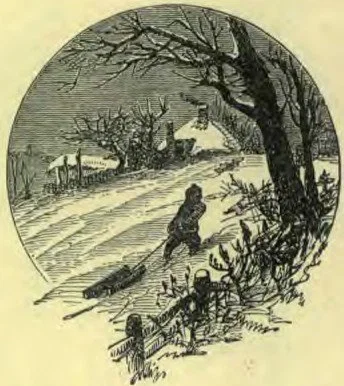
OVER THE ICE AND SNOW.

OVER the ice and snow, With faces all aglow, And shouts that loudly ring, Like birds upon the wing, The merry coasters go Over the ice and snow.
Over the ice and snow, With forms bent snug and low, Like storm-toss’d ships at sea, Mid frowning rocks they flee, As down the course they go, Over the ice and snow.
Over the ice and snow, With lightning speed they go. Tho’ clothes are soiled and torn, And shoes are rent and worn, No fear they seem to know, Over the ice and snow.
Over the ice and snow, While cold the winds do blow, Most gallantly they steer Their sleds in mad career, Across the meads below, Over the ice and snow.
Over the ice and snow, Ah! many years ago, I was as bold as they, As innocent and gay; But that was long ago, Over the ice and snow.
Over the ice and snow, With careful tread and slow, When days of youth have fled, And cherished hopes are dead, These lads some day may go Over the ice and snow.
Over the ice and snow Of this bleak world of woe, Oh! may they learn to steer Their lives as free and clear As sleds on which they go Over the ice and snow.
—David P. Matthews.

You have reached the end of this edition.

The Youth’s Instructor · Feb 21, 1883