The Youth’s Instructor, Vol. 31, No. 8.

BESSIE'S DEAR LOVE

The Youth’s Instructor

Feb 21, 1883

S. D. A. Publishing Association · Battle Creek, Mich. · Feb 21, 1883

“BESSIE'S DEAR LOVE.”
“Come, Bessie, that's all,” said Laura to her little sister, who was peeping anxiously, now under pansy leaves, now behind rose-bushes, sometimes almost lost, mite that she was, in her eager search for more flowers.
“I wish we had a bushel-basket full every day; don't you, sister?”
“Yes, I guess they would all be wanted, pet.”
“We'll plant a great many more seeds next year, won't we?”
“Yes.” The little chatterbox kept on until they reached a school-building, which, during the vacation, was used for the every-day making up of bouquets which went to swell the quantity of country beauty and sweetness sent by kind hearts to the great city's sick poor.
Bessie worked away as industriously as any one, wishing she could go herself and see where her flowers carried happiness, and breathing over every bouquet a hope from the very depths of her tender little heart that a blessing might go with it.
“Look here, sister Laura,” she whispered half shyly, one day, before going. “Would it do any harm if I should put these in my bouquets?”
“What, Bessie?” She looked at some narrow slips of paper on which the little girl had laboriously printed, in scraggy, uneven, but distinct letters,—
“WITH BESSIE'S DEAR LOVE.”
“They won't show, you know,” she went on; “only I thought perhaps some little girl might be looking so hard at her flowers, if she was very fond of them, that she might see that somebody loved her, and it might make her glad.”
“Put them in, Bessie; I'm sure they will.” And the love messages were carefully tied in.
A cheery-faced woman carried a basket into a children's hospital. The glaring rays of the July sun were shut out, and coolness and freshness secured as far as was possible; but still the breath of the city air seemed stifling to the little ones, who turned eagerly to receive each a gift from the ready hand. At every pillow she left enough brightness to bring smiles upon the wan faces, and still plenty remained to go into another room, where were a few of the more seriously ill.
“How are you to-day?” asked the bearer, softly laying her hand on the feverish cheek of the thin-faced girl, whose eyes met hers full of a restless longing.
The only answer was a weary shake of the head. The visitor sat down beside her.
“And is there no light within, poor child? The dear Master—have you no place in your poor heart for him yet? He loves you; he died to save you; he is watching over you; he will keep close at your side, and help you through all you may have to suffer. Cannot you love him?”
“I ain't never seen him, you know,” said the girl, pitifully. “How can I? I love you, 'cos I've seen you, and you're good to me.”
“But he sent me to you, and put the love in the hearts which were moved to send you these. Cannot you love him because he loved you first?”
“I'd like to—I'll try. But if I could only see him!”
More words of comfort and encouragement were spoken, and then the poor girl was left with the flowers in her hand.
The cool faces of the pansies seemed almost to smile in her eyes in sympathy. As she pressed her flushed face against the heliotropes and sweet peas, to feel their freshness and to breathe their sweetness, something less soft than they, touched her cheek. Looking curiously, she drew out a scrap of paper, crumpled, and partly wet with the sprinkling the flowers had received.
If writing had been on the paper, she could not have read it, but smoothing it carefully out, she spelled the words,—
“With Bessie's dear love.”
“Who could'a' put it there?”
The hours dragged heavily, and even so small a ripple of excitement was welcome. She gazed at it with feelings which grew more and more serious. Who was Bessie? Whom did she love, and why? Could it be herself? Bessie must be a child, she knew; grown people did not print letters that way. And as she pictured to herself the little fingers which must have tied in the message at the dictates of such a far-reaching love, the tears came to her eyes. This child's loving thoughts had surely followed wherever her flowers might go. How the sick girl wished the little thing might come to her, so that she could tell her how she loved her!
And then into her softened heart came crowding thoughts of Him who had given her not only a bunch of flowers, but everything—himself—the hope of heaven. How could she refuse to say she loved him?
When her kind friend came to her again, there was a new expression of peace on her wasted face. “I can love him without seeing him,” she said quietly; “but he comes so near to me sometimes that I think I can almost see him.”
Little Bessie continues to write her love-messages to unknown sufferers, taking to herself great comfort in the full confidence that they must sometimes reach some one who will be glad to know that she loves them. And her faith will not be shaken, even though she may never hear again from any of her sweet words until she and those whose sorrowing hearts they have reached shall meet before the throne of Him whom not having seen we yet love.—Selected.

ANTIOCH

On the northeast coast of the Mediterranean Sea, in Syria, lies the noted range of Lebanon, running north from Palestine till it comes in abrupt contact with the mountain chain of Amanus.
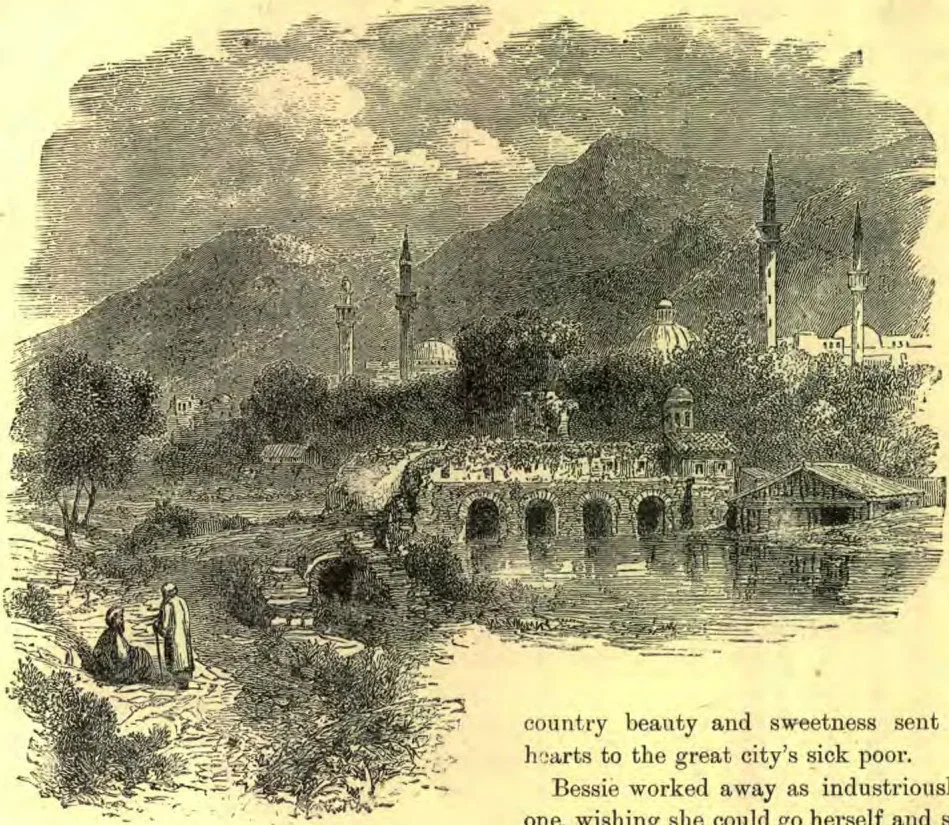
In the rich valley between the two chains of Lebanon rolls toward the north a lordly river, the Orontes. Its course northward is checked by the chain of Amanus, and the river, turning westward, flows through a broad valley toward the sea. In the bend of the river, where it flows oceanward, was founded by Seleucus Nicator, 300 B. C., a Greek city, which he called Antioch, in honor of his father, Antiochus, king of Syria. The city lies on the left side of the river, partly on an island, and partly on the level bank and the mountain-side. It is defended landward by a wall varying from twenty to seventy feet in height, and on the other side the river forms a deep moat. This city had many fine temples and palatial dwellings, and was called by the Greeks “the beautiful Antioch,” and it fully justified the name. During the height of its glory, it was the favorite resort of the wealthy and the learned.
Its inhabitants at one time numbered about 200,000, and it is said that one-half of them were Christians. The people were noted for originating names, and it is thought that through this means the disciples came to be “called Christians first in Antioch.”
In the eleventh chapter of Acts may be found an interesting account of the preaching of the gospel to the Grecians at this place, when Paul and Barnabas tarried a whole year teaching the people; and an account of a missionary journey taken by these two apostles, with Antioch as a starting point, may be found in the thirteenth and fourteenth chapters. Paul afterward made a second journey, starting from Antioch with Silas, and going west as far as Macedonia, where the gospel was introduced into Europe.
Indeed, Antioch was beautiful for situation as far as facilities for spreading the gospel are concerned; for by going down the broad valley of the Orontes, one could sail to any port on the Mediterranean, or by going up the valley and down the Leontes, access could be had to Palestine and from thence to the Euphrates.
But though Antioch was once the favorite resort of the learned, though Jew and Gentile flocked within its borders, though it boasted of magnificent temples and palaces, and was at one time the third city in the Roman empire, yet sword and famine, oppression from rulers, pestilence, and earthquakes have done a disastrous work; and to-day the proud city, once the chief seat of Gentile Christianity, is nothing more than a mean town of some nine thousand inhabitants, and has not a single Christian church.
W. E. L.

THE TWO WORKERS.

Two workers in one field Toiled on from day to day; Both had the same hard labor, Both had the same small pay. With the same blue sky above, The same green earth below, One soul was full of love, The other full of woe.
One leaped up with the light, With the soaring of the lark; One felt it ever night, For his soul was ever dark. One heart was hard as stone, One heart was ever gay; One worked with many a groan, One whistled all the day.
One had a flower-clad cot Beside a merry mill, Wife and children near the spot Made it sweeter, fairer still. One a wretched hovel had, Full of discord, dirt, and din,— No wonder he seemed mad, Wife and children starved within.
Still they worked in the same field, Toiling on from day to day; Both had the same hard labor, Both had the same small pay. But they worked not with one will, The reason let me tell,— Lo! the one drank at the still, And the other at the well. —Selected.

“BORO PRARTHONECO.”

What two strange words! To what language do they belong? and what can they mean? Read the story, and you will learn their meaning, and may you never forget it!
A rich Hindu, who resided at Chinsurah, sent one day to the missionaries to inform them that a very learned Brahmin was staying with him, and that he should like the Brahmin and the missionaries to argue about their religions. It was to be a friendly conversation about Hinduism and Christianity. Two of the missionaries went.
The Brahmin began. He was a cross, ill-tempered man; he evidently spoke under the influence of bad feelings. He said the missionaries were wicked men, and he made out their doctrines to be quite different from what they really were. He said what he knew to be false; but he was angry, and he wanted to set all his friends against the Christian teachers.
The missionaries replied. They showed how their religion was full of love; how God loved the world by sending his Son; how that Son loved sinners by dying for them; and how the same feeling of love had caused the missionaries to leave their land, their friends, their homes, to teach poor Hindus the way of salvation. They added much more; and all was spoken with kind looks and tones of affection, very different from the Brahmin’s sour aspect and angry words.
Every one marked the difference. The Brahmin felt it himself; his countenance changed. He was not convinced by the missionaries’ argument, but he was struck by their earnest love; and he could not help saying, “I am a Brahmin, and cannot allow that I think the Christian religion superior to mine; but I must allow that the temper of these Christians is superior to that of us Hindus.” And then the Brahmin added, turning to the missionaries, “Gentlemen, your temper is ‘Boro Prarthoneco’—that is, greatly to be prayed for.”
A striking remark, indeed, to fall from the lips of a Brahmin, and very full of instruction. It may remind us that if we would prove that ours is the true religion, and that we ourselves are truly religious, we must walk in love; for love, as an old writer expresses it, is the law of Christ’s kingdom, the lesson of his school, and the livery of his family. And the Brahmin points out to us also the only way in which this love is to be obtained. He was quite right when he said it was much to be prayed for; for, like every good gift and every perfect gift, it comes down from above. Love to God and love to man is a fruit of the Spirit, and must by him be poured into the heart.
May you never forget that this heavenly gift is “Boro Prarthoneco”—“greatly to be prayed for!”
—Children’s Friend.

THEY WERE ALL POOR BOYS.

An exchange calls the following historical facts, which should encourage every young man struggling under discouragements and poverty.
John Adams, second President of the United States, was the son of a farmer of very moderate means. The only start he had was a good education.
Andrew Jackson was born in a log hut in North Carolina, and was raised in the pine woods for which that State is famous.
James K. Polk spent the earlier years of his life helping to dig a living out of a farm in North Carolina. He was afterward clerk in a country store.
Millard Fillmore was the son of a New York farmer, and his home was a very humble one. He learned the business of a clothier.
James Buchanan was born in a small town among the Alleghany mountains. His father cut the logs and built his own house in what was then a wilderness.
Abraham Lincoln was the son of a very poor Kentucky farmer, and lived in a log cabin until he was twenty-one years of age.
Andrew Johnson was apprenticed to a tailor at the age of ten years by his widowed mother. He was never able to attend school, and picked up all the education he ever had.
Gen. Grant lived the life of a common boy in a common house on the banks of the Ohio river until he was seventeen years of age.
James A. Garfield was born in a log cabin. He worked on a farm until he was strong enough to use carpenter tools, when he learned the trade. He afterward worked on the canal.

THE LEGEND OF THE BEAUTIFUL HAND.

There were three, and they sat on a mossy mound Where the rippling stream passed gently by, Each claiming to have the most beautiful hand— As the moments passed, the dispute rose high.
One dipped her hand in the crystal drops, Then held it aloft with triumphant air; One gathered the strawberries till their juice Had colored her fingers, tapering and fair.
The other plucked from the violet beds, That were standing near with their wealth of bloom, Until her hand seemed to be but a part Of the delicate flowers' sweet perfume.
A haggard woman was passing by, Weary and old; and she said, “I am poor, Will you give for my need?” but they each refused, Though want was a stranger, and ample their store.
Another, with hand undipped in the stream, Sat apart from the three with a quiet air; She had not resorted to strawberry tint, Nor the violet banks so free and fair.
But she silently gave to the woman's need, Who asked for the cause of the warm debate; And they each reached forth their beautiful hands, Saying, “You shall decide; 't is not yet too late.”
And she said, “Not the hand from the crystal stream, Nor the delicate fingers dipped with red; Not the perfumed hand from the violet banks, But that which giveth to the poor instead.”
The garments so tattered and old fell off; Vanished the staff and the wrinkles too; And a white-robed angel from heaven stood, And looked the reproof words could not do.
Since then the ages have ebbed and flowed, And the mooted question been oft rehearsed; But proof has ever been wanting to show That the verdict of heaven has been reversed.
MARY MARTIN.

HOW A FLY WALKS ON THE CEILING.

To walk head downward on a floor turned topsy-turvy would puzzle a great many, and the wisest men were for a long time unable to explain how the fly walked so easily on the ceiling. Some supposed that the foot of the fly was formed to act like a sucker, which by exhausting the air would enable the insect to attach itself firmly to the ceiling. Others fancied that this foot might be furnished with little hooks to grasp the inequalities of the mortar. A third supposition was that the foot was a sort of gum-bottle, provided with a sticky fluid, and by help of which the fly was kept from falling.
But the best idea of all was to examine this portion of the insect’s limb. By the aid of that wonderful instrument, the microscope, people can now see, instead of being only able to guess, as in olden times. The microscope magnified the leg of the fly so that it appeared as large as that of a horse, and its foot as broad as a horse’s hoof. This little foot was then seen to possess all the good qualities above mentioned. The all-wise Creator had indeed formed the fly’s foot as a sucker, furnished it with a set of hooks, and also moistened with a viscid fluid. Thus is God’s wisdom shown even in such a small thing as the foot of a fly, to say nothing of the same power and tender mercy shown in the formation of other parts of the little creature’s body. And this wondrously formed little insect has its little legs and wings torn from its body by thoughtless boys and girls, and is wantonly crushed by many people, who must surely be ignorant of the care and loving providence that God has shown to these little objects of his creation!—S. S. Advocate.

SCENES IN THE LIFE OF CHRIST.

LESSON 109.—REVIEW.

1. Tell how Jesus was condemned by the Sanhedrim. Matt. 27:1, 2; Mark 15:1; Luke 22:66; 23:1.
2. Where did they then take him? John 18:28.
3. What course did Judas take when he saw that his Lord was condemned? Matt. 27:3–5.
4. How did the priests dispose of the money that Judas brought back to them?
5. Relate the first conversation between Pilate and those who brought Jesus before him. John 18:29–31.
6. What charges did they bring against Jesus? Luke 23:2.
7. Describe the interview between Pilate and Jesus in the Judgment Hall. John 18:33–37.
8. What did Pilate afterward say to Jesus because he would not answer his accusers? Mark 15:3–5.
9. What did he say to the people concerning Jesus? Luke 23:4.
10. How did this cause them to act?
11. How did Pilate try to put upon Herod the responsibility of condemning Jesus?
12. Why was Herod glad to have an interview with Jesus?
13. Tell what happened while Jesus was before Herod.
14. What decision did Pilate give when Jesus was brought back to him?
15. How did Pilate try to get the people to ask for the release of Jesus? Mark 15:6–10.
16. How did his plan succeed?
17. What did they clamor to have done to Jesus?
18. What remonstrance did Pilate make?
19. When he found that all he could say only made the tumult worse, what did he do? Matt. 27:24, 25; Mark 15:15.
20. Tell how the soldiers mocked Jesus when he was delivered to them to be crucified.
21. After Jesus had been scourged, what further effort did Pilate make to save him?
22. Why did he fear to condemn Jesus?
23. Why did he fear to release him?
24. What course did he finally take?
25. What change did they make in the attire of Jesus, before they led him away to crucify him? Mark 15:20.
26. Whom did they compel to bear his cross?
27. Describe the journey to the cross. Luke 23:27–33.
28. Tell how Jesus was crucified.
29. How was his crime made known to all who passed by?
30. What did Pilate say when they asked him to change this accusation?
31. What was done with the garments of Jesus?
32. How was he treated by those who passed by?
33. How did he show his forgiving spirit?
34. How was he derided and mocked by the rulers and the soldiers? Luke 23:35–37.
35. What words passed between Jesus and the thieves that were crucified with him?
36. What provision did Jesus make for the support and comfort of his mother? John 19:25–27.
37. How did nature veil her face at the crucifixion of the Lord of glory? Mark 15:33.
38. In what words did Jesus cry to his Father?
39. How were these words misunderstood?
40. What did the soldiers do and say?
41. Give the last words of Jesus upon the cross, and tell how he expired.
42. What supernatural events took place as Jesus gave up the ghost?
43. What confession did this call forth from the soldiers?
44. What treatment was received by those who were crucified with Jesus? John 19:31, 32.
45. What did the soldiers do with Jesus when they found that he was already dead?
46. By whom was the body of Jesus taken from the cross?
47. What was done with it?
48. Why was it not immediately embalmed?
49. Why did the Jews want to have the sepulchre guarded?
50. How was it made secure?
Continue reading: NEW-TESTAMENT HISTORY SERIES