“Roaches! Not a very interesting subject,” I hear some one say. And, indeed, I would have said so too, when I first met them; but on better acquaintance, I find there are many things to learn about even a roach. I am not talking about the little brown roaches that live in sanitariums and restaurants, but about the great black roaches that live in the warm Southern countries, and grow to be two inches long.
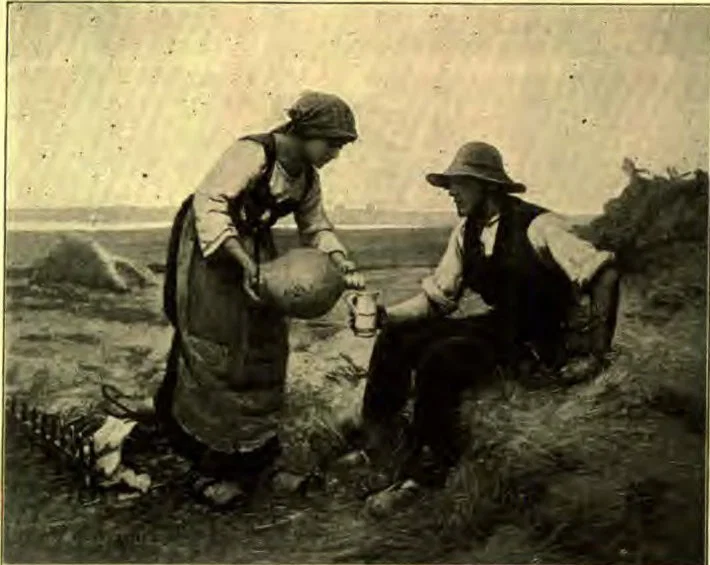
“AND WITH THE NECTAR FILLED HIS WAITING CUP”
My first introduction to this special branch of the Roach family took place on the Island of Ruatan. Our first night was spent at our mission building there, and as there were no beds, we had to lie down on the floor, with only a blanket beneath us.
Mr. and Mrs. Roach, and all the little Roaches, waited respectfully until the lights were out, and then began a parade in the moonlight. It really makes one shiver to see their black eyes shining impudently into his face. I soon found that they were the first occupants of the house, and that they meant to stay there, and would allow no encroachments upon their rights. So, bidding them all good-night, with my shoes on my feet, and my ears well covered, I dropped off into dreamland.
The next day we sailed over to Utila, our destination, and at once furnished each bed with a pavilion,—a thin curtain placed around and above the beds to keep out sandflies, scorpions, roaches, and other insects.
But Mr. Roach is neither discouraged nor conquered easily. Often, after retiring, sleepy and tired from a hard day’s work, I would feel his presence near me; and, looking up, would see a small, dark form approaching. My next move was to get up and light the lamp. By that time, more likely than not, Mr. Roach was safely secreted under the sheet, and more than once I have taken every article off the bed, only at last to see him scurry triumphantly away.
If he were provided only with legs, it would not be so bad. But if you knock him off his feet, he at once spreads his pretty black wings, flies at your face, runs several times around your neck, and vanishes, before you can count three.
Perhaps you would like to know what these insects eat. Well, they are not very particular; for they never diet, and never have the dyspepsia. They feast upon anything, from a lump of sugar to a bookbinding; and I have been told that they eat the skin from the ends of one’s toes and fingers around the nails, but fortunately I have never experienced the truth of that statement myself.
One time a roach, frightened, I suppose, and thinking that a good place of refuge, hid in the ear of a native. Its presence caused great pain; and Dr. Eccles, who was with us, came to remove it. The doctor said if it had remained in the man’s ear much longer, it would have caused the poor fellow deafness or insanity.
The eggs of these roaches are about half an inch long, very dark and shiny, and they like to lay them in one’s dresses. They are sure to choose the best you have, with ruinous results to the garment.
Once I was greatly surprised to see a pure-white roach. On closer examination I found it was just crawling out of its black coat. Carefully placing it under an inverted tumbler, raised upon a tiny stick to give it air, I left it until morning. It had then turned a rich brown color, was smaller, and looked quite like a young roach. And there was nothing left of its former covering except a leg or two, and a small piece of a wing! WINIFRED HOLMDEN.
How Hazel Helped It Rain
ONE day Hazel set a little dish of water out for her pet coon to drink. He didn’t drink it all up, but by and by the dish was all dry. Where do you suppose the rest of the water went?
But the funniest of all was one day when the coon jumped into a big pail of water to take a bath, and got himself, oh, so wet! The fur hung all over him in little dripping strings, but he didn’t stay that way very long. Pretty soon he was as dry as ever. Do you know where that water went?
Another day Hazel’s mama put a kettle of beans on the stove to cook, with lots and lots of water on them, and they boiled and bubbled and bubbled and boiled quite a while till mama said: “Whew! whew! whew! What do I smell? Oh, my beans are burning!”
And, sure enough, when she took the cover off, there were the beans as dry as chips, and the water every bit gone! Where do you suppose it went?
I will tell you where it went. You’ve seen the steam coming out of a hot kettle, haven’t you? Well, that’s the way the water went—’way up in steam, just as dirt goes up in dust when a buggy goes by very fast.
And now where do you suppose this steam went? It flew away up into the clouds; but the specks grew so very, very little when they got away from the kettle, that you couldn’t see them. The window was open, and away they went out of it, up, up, up!
After they left the kettle, they had to change their name. They were not called steam any more, but vapor. When they reached the cloud, they found many, many more little vapors; for you see that’s what the clouds are made of.
Then, we may suppose, the little vapors said to some other little vapors: “How do you do? Where did you come from?”
“We’ll tell you where we came from. The sun shone on us when we were in the coon’s dish, and we just spread our wings and came up here.”
And some said: “Hazel put a whole pailful of water on her garden; but the sun shone on it, and it was soon dried up, and that’s where we came from.”
There were many other little vapors up there, and some said: “Do you see all the clothes on the line down in that yard? We came from there.”
And some said: “See how dry the grass and trees are getting down there by that house. We used to live in that grass and those trees, but we flew up here, and now they look thirsty.”
But the most of them said: “See that little lake down under us? We used to live in it.”
But I forgot to tell you that all these little vapors came up into the cloud because they heard a voice calling them: “Come, little vapors, come up here!” And when they heard that, they wouldn’t have stayed down there for anything.
Well, down where Hazel lived, it began to get very, very dry. The little flowers out in the yard hung their heads when the sun shone hot, and almost cried for a drink. The grass was getting dry, and there wasn’t very much water left in mama’s cistern.
But the same voice that had called the little vapors away from the earth called the wind to come and blow the clouds right over the big, dry fields and dooryards down on the earth. Of course they covered the sunshine up, and Hazel’s papa said: “I’m so glad! I guess it’s going to rain. See that big cloud coming up in the sky?”
Then the wind blew some cold on the little vapors, and my! how they did cuddle up together, and that made them into little drops of water. Soon they heard the same sweet voice saying to them: “Go, little drops, and water the earth.” And down, down, down they came, patter, patter, patter, and washed the dirt off from the dusty trees, and gave a good, cool drink to the thirsty grass and leaves and flowers; and the little flowers just held up their heads to catch as much as they could.
Hazel had to run into the house when the big drops came spattering down upon her little face, but she stood by the window and watched them262running down the outside of the glass, and heard the water drip, drip into the cistern.
The next morning the sun came out as bright as if he had had his face washed, too, and you could hardly see a cloud in the sky. It seemed as if the birds and grass and flowers and trees were all laughing and singing:—
“I feel so good, I feel so good! Thank you, thank you, thank you!”
Hazel said a thank you, too; but it was a long time after that before she knew how she had helped it rain.—Selected.
The Waterdrop's Story
By Elizabeth Rosser
Up from the sea I rose, and helped to fill A misty cloud that sped toward yon hill; Above its crest I hung, where cold winds blow, And fell at last, a dazzling drift of snow.
The summer wind grew warm; the snow was thawed; And down, down, down, I sank, ’neath stone and clod. Long, long I hid, deep in the cold, dark earth, Till in a bubbling spring I found new birth.
And there Eugenie, basket on her arm, With dinner for her Pierre, at noontide warm, Brought down her pitcher to be filled for him, And dipped the water, kneeling on the brim.
Then down the path, and up the dusty road, Out to the hayfield hot she bore her load. There, finding Pierre, she tipped her pitcher up, And with the nectar filled his waiting cup.
With shining eyes he raised his arm, bare, brown, And, at one draught delicious, drank me down. I coursed a moment with his life's red flood; Then on his brow a sparkling drop I stood, Fulfilling God's blest mandate, when he said, “Henceforth with sweating face shalt thou eat bread.”
ELIZABETH ROSSER.
The Truth at All Costs
DURING the French Revolution of 1789, in the “Reign of Terror,” a large cask was placed at the door of the Pastor Oberlin at Waltersbach, and let down into the cellar. When it was opened, a little girl, fourteen years of age, emerged from it, and with tears of joy, threw herself into the arms of the good Father Oberlin. Who she was, and how she came there, we will now relate.
Near the town of Nancy lived a rich count, whose castle was one night attacked by a band of revolutionists who murdered the count and all his family except one little girl, whom an old retainer concealed in the cellar. The murderers, on leaving, shouted that they would return and set fire to the castle.
How was poor old Felix to rescue the sole surviving member of the count’s family? Taking the head out of a large, empty cask, he requested his young mistress to get into it, and closing it, he placed it on a cart with other empty casks. After committing all to the care of Him who is almighty, he started for Oberlin’s district, journeying by night, and hiding in the woods by day. There the child could emerge from her hiding-place and take a little food.
One morning, on meeting some gendarmes, they proceeded to examine the casks. Poor Felix lifted his heart to God to deliver the poor orphan. The soldiers shook and rapped on every cask except the one in which the child was concealed, and went off grumbling at not having found anything. But the heart of poor Felix was full of thankfulness to God for the deliverance granted. At the end of a fortnight of peril they reached the end of their journey, and the faithful servitor deposited his charge at the house of the good Father Oberlin.
But the escape of the count’s daughter got noised abroad, and her father’s enemies sought her everywhere. One morning a violent knock was heard at the door. On opening it, Pastor Oberlin found himself face to face with two gendarmes.
“Citizen Pastor,” said one, “you are accused of concealing in your house the daughter of an aristocrat, who has been condemned to death, and we are ordered to search the house. But we do this unwillingly. We know you always speak the truth, so if you give us your word that she is not in your house, we will retire.”
Oberlin knew that, in the greatest peril, God could succor him, and he calmly replied, “You are ordered to search my house. God would have men do their duty, and you should not refrain from it out of courtesy to me. Come, I will show you the way.”
With his heart lifted unceasingly to God, he calmly conducted them over the house. When they came to the room occupied by the little girl, Oberlin threw the door wide open, saying, “Here is the last room, my friends.”
One of the gendarmes advanced to the threshold, then turned, and said, “Well, there’s nobody here. We beg you will excuse us the trouble we have given you. Farewell.”
With these words they left. But where was the little girl? Had she hidden? Not at all. Emilie was in her room, but being only half dressed, had shrunk behind the door, on hearing footsteps, and remained as quiet as a mouse till the intruder had withdrawn.
How little she dreamed of the marvelous deliverance of which she was the object! We may well understand her deep thankfulness, and that of the Father Oberlin, who rejoiced above all that he had not charged his conscience with an untruth. Before long the Revolution was over, and it was possible to breathe once more in peace.
—Translated from the French.
Black and White Figures (Continued)
By J. Edgar Ross
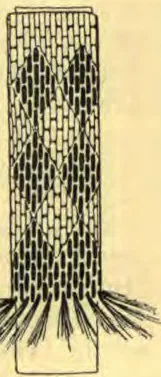
ANOTHER pretty pattern is made by cutting a solid background into diamond-shaped figures with white lines that are each formed of a single thread of wool. Two of these threads, starting together at the point of one of the diamonds, move around the base in an opposite direction, each following a spiral line till they meet the corresponding threads of the next figure. Then the course of each is changed, and they meet to complete the diamond. These lines may be continuous, as shown in Fig. 19, or the figures may be inserted at regular intervals with a space of black between. The method of working in either case is practically the same.
Fig. 19
Two white threads will be required for each diamond in a circle around the base. No matter how many there are of these, you will need a sufficient number of black threads to cover the base without them. These white threads are placed in pairs; and when you are ready to begin the first figure, one of the black threads is skipped, and a white one brought up between the warp and the woven part to take its place, just as you would splice a thread of the wool. When you come to this thread again, take the regular stitch with it, and pass the black thread that it has displaced under the warp. Skip another black one, and bring up the remaining white thread to take its place. So far the work has not been different from what has been described in previous articles; but the next time you come to this point, there is something new. Use the first white thread as usual, then pass the black one that was displaced by the second white one under the warp, and bring the other black one (the one displaced by the first white one) up. Now take a forward stitch (see Fig. 18 in last article) with the second white thread, skip the next black one, and proceed as usual. When this point is reached on the next circle, there will be a black thread between the white ones. Take the usual stitch with this; bring up the thread that was passed under the warp on the previous circle; take the black thread that was skipped, and pass it down between the white one and the first black one used, then under the warp; take a forward stitch with the white thread; skip the next black one; and then go on as before. On the next circle these stitches are repeated, except that there are two black threads to be used between the white ones. To this number, another is added with each succeeding circle till the figure has attained the desired width.
Fig.20
I have here described the making of but one diamond-shaped figure; but unless the article is a flat one, which exposes but one side to view, there should be more. Whatever the number, they should all begin at regular intervals upon the same circle of stitches. When the thread of one figure meets that of the neighboring one, the direction of both is changed by taking the forward stitch with the one that was used in the regular way, and vice versa, till the two threads of each diamond meet again.
You may think this a difficult figure to make if you simply read the directions given. But if you take your work, and with the paper before you, carefully follow instructions, step by step, you will have no trouble.
Another effective pattern for either large or small work is composed of solid black and white diamonds that fit into one another, as shown in Fig. 20. Though this pattern contains no complicated stitches, there is more work about making it than the preceding one. To make it, there must be an equal number of black and of white threads, and sufficient of each to cover the base entirely. Suppose the work is begun with black thread; when you are ready to begin the diamonds, take up one of the white threads that have been previously arranged around the base, and skip a black one as when splicing. Take up these threads at regular intervals around the base, and on the next circle take up a second white thread after the first has been used. Continue till all the black threads have been displaced by the white, and then reverse the process.
(The chapter given as the Lesson Scripture is the lesson to be studied. Read this every day, and think over it until you know just what it teaches. Then the following notes, which should be read several times, will help to a fuller understanding of the lesson. Lastly, go over the questions carefully, and be sure that you can answer each in the words of Scripture.)
When Abram and Sarai his wife obeyed the call of God, and left their home, they had no children to take with them. But God promised them that their seed should be as the dust of the earth. “So that if a man can number the dust of the earth,” he said, “then shall thy seed also be numbered.”
Last week we learned that the Seed which God promised to Abram is Christ, and all who are his. It was a promise that Christ, the Seed first promised to Adam and Eve, should come in Abram’s line, as one of his descendants.
Yet the years passed on, and no little child came to bless the home and gladden the hearts of Sarai and Abram. God kept them waiting a long, long time, to teach them a lesson of patience and trust.
One day Abram reminded the Lord about his promise, and said that he was still childless, and his chief servant, who was born in his house, was his heir. Then God took Abram out into the clear night, and told him to look up into the heavens where the host of stars was shining in the sky. In the clear air of Palestine many more stars can be seen than in this country. God told Abram to look at the stars, which can not be numbered for multitude, and said, “So shall thy seed be.”
And yet the child of promise was not given, and Abram and Sarai were getting old. It was ten years since they came to Canaan, and the promise was first made, and Sarai was already much older than the mothers of little children263usually are. At last she thought that perhaps if Abram had a younger wife, God would give him the promised child. This was why she gave her Egyptian maid Hagar to Abram for his wife, hoping that a child might be given to her.
Of course this was wrong; for it was God’s plan that a man should have only one wife. Sarai ought to have trusted the Lord; but she was so anxious for the promise to be fulfilled, that she tried to help him by giving Abram another wife. After Hagar became Abram’s wife, she was very proud to think that she would be the mother of the child God had promised. She despised her mistress Sarai; for she thought that Abram would think more of her, and love her more, if God should give her the child.
Hagar’s pride brought her into trouble; but although she had acted foolishly, God did not leave her without comfort. He sent an angel with a message for her, and Hagar called the name of the Lord, “Thou God seest me,” because he had seen and helped her when she was alone and friendless in the desert, and comforted her in her trouble.
The angel called Hagar “Sarai’s maid,” to remind her of her position, and take the pride out of her heart. And he asked her, “Whence camest thou? and whither wilt thou go?” to show her the folly of running away from her good home and kind friends, when she had no place to go to.
Ishmael, the son afterward born to Hagar, was not the child of promise. Hagar was not the true wife of Abram, and God did not look upon Ishmael as his son. He came to him again, and said, “Sarah thy wife shall bear thee a son indeed; and thou shalt call his name Isaac.” And “in Isaac shall thy seed be called.”
But when Abram prayed for Ishmael, God said that he had heard him, and that he would bless Ishmael also, and make him the father of twelve princes and of a great nation.
Questions
What did God promise Abram when he was without any children? Gen. 12:2.
As God did not begin to fulfill the promise at once, what did Sarai do to try to bring it about? Gen. 16:3.
Why was this wrong? What was God’s plan?
How long was it since the promise was given to Abram?
When God repeated the promise, how did he show Abram how great the number of his children should be? Gen. 15:5.
What change was there in Hagar’s conduct after she became Abram’s wife? Gen. 16:4.
How did Sarai complain to Abram?
What did Abram tell Sarai to do? How did she then treat Hagar, and what was the result? Verse 6.
Who was watching over Hagar? How did he show his care? Verse 7.
Does the Lord forsake us when we bring trouble upon ourselves?
What did the angel call Hagar to remind her of her humble position?
What did he tell her to do? Verse 9.
What did he name the son that was to be given her? Why? Verse 11.
What did Hagar call the name of the Lord? For what reason? Verse 13.
How old was Abram when Ishmael was born? Verse 16.
What promise did God afterward make to Abram? Gen. 17:19.
When Abram prayed for Ishmael, what did God say? Chap. 17:20.
MEMORY VERSE: “The secret of the Lord is with them that fear him.”
Questions
1. How did Daniel answer Arioch when he sought to kill him?
2. What question did he ask the captain?
3. When Arioch had explained the king’s decree, what brave thing did Daniel do?
4. Why was it brave? Esther 4:11. Note that he went in before a “very angry and furious” king.
5. What thing did he ask of Nebuchadnezzar that the king had refused all his other wise men? Compare verses 16 and 8.
6. What did Daniel promise the king?
7. Why was this not presumption on his part? See note 1.
8. After Daniel left the presence of the king, what steps did he at once take?
9. For what mercies did he and his companions pray?
10. As they were all bowed in prayer that night, what experience came to Daniel?
11. How did Daniel receive the wonderful knowledge which came in answer to their prayers?
12. With what blessing did he bless the God of heaven? (As you study Daniel’s prayer, remember that he had seen the great image,—even the whole history of the world,—and to this, parts of his prayer refer.)
13. What does he acknowledge concerning the power of the God of heaven?
14. How many things does he ascribe to him? In what similar way is God’s character described? Ex. 34:6, 7. Note the sevenfold character of God.
15. With what thanksgiving and praise did Daniel conclude his prayer? Note the form of this prayer: (1) Blessing; (2) God’s power acknowledged; (3) Thanksgiving and praise.
16. With what message did Daniel then seek Arioch? (Evidently the time granted Daniel was granted the other wise men as well.)
17. How did Arioch introduce Daniel to the king of Babylon?
18. What question did the king ask him?
19. In his answer, to whom did he at once give honor and glory for the knowledge which he had?
20. Whose authority did Daniel also repudiate?
21. What did Daniel say that his God could do? What had the other wise men implied that their gods were unable to do? Verse 11. Why were they unable?
22. What was the God of heaven about to make known to Nebuchadnezzar?
23. As the king lay down that night of his dream, about what was he thinking?
Notes
1. Consider for a moment what had been Daniel’s education,—he “had understanding in all visions and dreams.” How did he get this experience? God “made him understand.” Dan. 2:17, margin. When, therefore, Daniel saw the king of Babylon troubled because of a dream, what was more natural than that he should offer to help him if he would give him time? Prayer was the key which unlocked heaven’s storehouse for Daniel. He knew how to pray. He had been taught to pray,—this was a part of his education, and the very means by which he obtained his education. Therefore he was by no means afraid to promise Nebuchadnezzar that he would show him the dream and its interpretation. “It is a part of God’s plan to grant us, in answer to the prayer of faith, that which he would not bestow did we not thus ask.”
2. “The secret of the Lord is with them that fear him.” “Great truths that have lain unheeded and unseen since the day of Pentecost, are to shine from God’s word, in their native purity. To those who truly love God, the Holy Spirit will reveal truths that have faded from the mind, and will also reveal truths that are entirely new. Those who eat the flesh and drink the blood of the Son of God will bring from the books of Daniel and Revelation, truth that is inspired by the Holy Spirit.”—Review, Aug. 17, 1897.
Daniel introduced the Revealer of secrets to the king of Babylon. The other wise men could not depend upon their gods, because they were too far away. Daniel could depend upon his God because he was near by. God is not “far from every one of us; for in him we live and move and have our being.” This is the mystery of godliness,—God manifest in the flesh,—and this is the union of divinity with humanity.
Prayer was the link that connected Daniel with his God, who at once revealed to him the secret. When the book of Daniel was translated into Greek, the word used to translate the Hebrew word for “secret,” was the same as the one rendered “mystery” in the Greek New Testament. Daniel’s revelation, then, was a mystery, and from the experience given him at that time, we see developed in that heathen court the wonderful mystery of God in man. Nebuchadnezzar saw this, and hence the reason the dream was taken from him,—that he might see God working in man, and also that he might lose confidence in his own “wise men.”
Moon River
In addition to the several publications issued by the Grand Trunk Railway System, for the information of tourists and travelers, regarding the many charming districts in the “Highlands of Ontario,” still another comes to hand, just off the press, entitled “Down the Moon River.” The Moon River is connected with the Muskoka Lakes, in fact the outlet of this delightful water-way, and empties into the Georgian Bay, after passing for several miles through some of the most beautiful scenery in that region. This little booklet is a description of the trip by canoe down the river, and is full of sound facts which will interest the tourist and angler. The illustrations give one an idea of the geological features and character of the country. A copy may be had for the asking, by appling to George W. Vaux, A. G. P. & T. A., G. T. Ry. Sys., 135 Adams St., Chicago.
A Vacation Full of Health, Rest, and Enjoyment
To plan a summer vacation that shall bring the maximum of rest, health, and comfort with the minimum of expense and discomfort is not always easy. Fortunately, the opportunities for rest and recreation within the reach of all are becoming more numerous each year through the energetic efforts of some of the leading railway lines to make known the attractiveness of places remote from “the busy haunts of men.”
There is no region in the world which offers so many attractions to the vacationist who loves the untouched beauty of nature as can be found in that extensive tract in Canada known as the Muskoka Lakes District. This region, including within its boundaries more than eight hundred (800) lakes and rivers, is situated in the northern part of Ontario, east of Georgian Bay and north of Lake Ontario. The point of embarkation for the trip on the Muskoka Lakes is one hundred and twelve miles from Toronto, and is reached by the Grand Trunk Railway.
The lakes in this vast region which stand out in more prominence than the others are the Muskoka Lakes, composed of three bodies of beautiful, clear water, their names being Lake Muskoka, Lake Rosseau, and Lake Joseph, all three being connected and giving a continuous steamboat route of more than fifty miles. Being at an altitude of one thousand feet above the sea-level, this region is peculiarly suited by the purity of the air to bring health and strength to those whose physical and mental natures have become exhausted through too close application to indoor work.
Rates at the hotels are unprecedentedly low, and the accommodations excellent.
For full information address G. T. Bell, General Passenger and Ticket Agent, Grand Trunk Railway System, Montreal, Canada. Also Geo. W. Vaux, A. G. P. & T. A., G. T. Ry. Sys., 135 Adams St., Chicago.
SOLID THROUGH TRAINS OF WIDE VESTIBULE COACHES and PULLMAN SLEEPING CARS BETWEEN
Battle Creek and Chicago, Buffalo, New York, Philadelphia, Toronto, Montreal, Boston
For time-tables, descriptive matter, and information, apply to any representative of the company.
A Valuable Series
By Editor
WE wish to call the attention of our readers to a series of articles from the pen of Amos R. Wells, now appearing in the Christian Endeavor World under the title “Help for the Tempted,” and to voice the wish that all who are battling with temptation—“and that means all of us”—might read them. Six numbers of the series have already appeared, but back numbers can be had. In order that they may have the widest possible circulation, the publishers are now making, to new subscribers, the very liberal offer of twenty-five copies for twenty-five cents. The series will be completed during the time covered by this offer. Address the Christian Endeavor World, Tremont Temple, Boston, Mass.
Our young people will find these articles of help not only in their individual experience, but in their young people’s meetings and in their work for others. If you have a friend who is losing in the fight against special temptation, send him these articles with the prayer that he may read them, and listen to the voice that speaks through them.
It may be well to add that this notice is unsolicited, and is given only from the wish that as widely as possible all may share in the help which these articles must certainly bring to those who read them.
The Two Kingdoms of Judah and Israel
THE article on page 1, entitled, “The Two Kingdoms of Judah and Israel,” will be helpful to the teachers of the junior lessons who wish to give their pupils a clear idea of the two lines of kings from the division of the kingdom, after Solomon, to the Babylonian captivity.
The Bible Training School
For July is an excellent number. This little monthly paper is designed to arouse and foster an intelligent interest in house-to-house work. Send for sample copy. A year's subscription costs only twenty-five cents. Address The Bible Training School, 400 West Fifty-seventh St., New York City.
The Instructor Mission Fund
By Editor
THE INSTRUCTOR is pleased to acknowledge the receipt of $1.70 from Wisconsin to be applied on the India Mission Fund. This fund, as most of our readers know, pays for a club of twenty-five copies of the INSTRUCTOR sent to one of Miss Anstice Abbott’s schools in Bombay. The papers are carefully distributed once a month to those who will appreciate them.
Double Lesson Issue and Omitted Sabbath Papers
By Editor
Notice
NEXT week's paper will contain two sets of all lessons, and on the following Sabbath no papers will be given out. This is in accordance with the regular custom of the paper, one number of the INSTRUCTOR always being omitted at the time of the Michigan camp-meeting.
All who study any of the lessons in the INSTRUCTOR will please note this omission,
The Premium Bible
FROM a subscriber comes the following good word: “The INSTRUCTOR Premium Bible came all right and in time for the birthday. I thank you very much for your promptness in sending it, and it is much better than I expected. My father seems very much pleased with it.”