The Youth’s Instructor, Vol. 47, No. 25.

AN ORIENTAL COLONY OF GREAT BRITAIN

The Youth’s Instructor

Jun 22, 1899

Review and Herald Publishing Company · Battle Creek, Mich. · Jun 22, 1899

AN ORIENTAL COLONY OF GREAT BRITAIN.
THE papers have been so full of news about the Philippines, Hong-Kong, Singapore, and other Asiatic countries, during the last year, that it will doubtless be of interest to our young people to know something about the Straits Settlements, a crown colony of the British Empire.
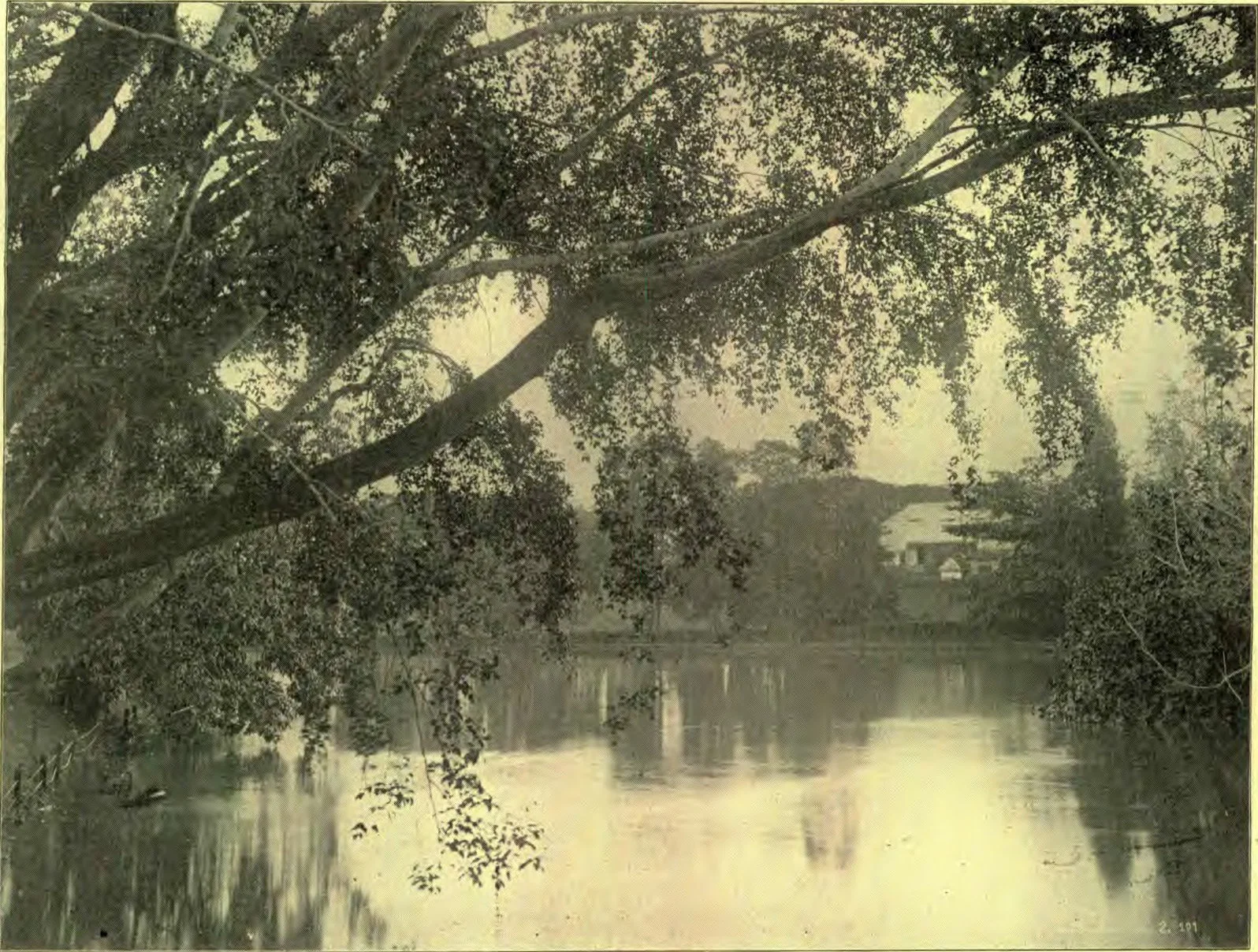
SCENE IN THE BOTANICAL GARDENS, SINGAPORE.
Aguinaldo and his confederates came to Singapore, and endeavored to secure the friendship and co-operation of the American government through our consul-general, and so far succeeded as to involve that gentleman in considerable trouble through the too generous promises that he ventured to make without proper authority for so doing, their object being the overthrow of the Spanish power in the Philippines and the establishment of their own authority.
From a knowledge of the country and the class of people to which Aguinaldo and his associates belong, we are inclined to believe that they were ambitious rather than patriotic men, and therefore did not scruple to resort to any measures that promised them success in their revolutionary enterprise.
The “Straits Settlements” is a name given to a few small strips of land at different points along the West Coast of the Malay Peninsula, beginning with the Prince of Wales Island on the north, and ending with the Island of Singapore on the south, and including between them the district of Malacca and the Dinding Isles. The actual land area of these red-colored portions on the map would not exceed one thousand square miles; yet their importance is so great, from a commercial standpoint, that this colony ranks third in importance, if the different sections of Australia are considered separately. India ranks first, Canada second, and the Straits Settlements third; but the importance of the Straits Settlements is measured also by the fact that the entire Malay Peninsula and a goodly portion of Siam are, actually or tacitly, under the protection of the British crown; and it is only a matter of time when the whole peninsula will be colored red, and Siam will become a mere dependency of the British Empire. This colony was founded in 1819, by Sir Stamford Raffles, who was one of the ablest statesmen that Great Britain has ever produced through her colonial policy.
During the Napoleonic wars in the opening years of the century, the whole of the Netherlands Indies, and the District of Malacca on the mainland, were in possession of the Dutch, but were seized by an expedition in charge of Mr. Raffles. When the settlement was finally made, in 1819, this territory was restored to Holland. Sir Stamford Raffles then proceeded down the Straits of Malacca in quest of a suitable location for the establishment of a colony. He reached the harbor on the south side of the Island of Singapore, and decided to settle there. He pitched his tent ashore, then paid his respects to the t'mungong, brother of the sultan, who represented that dignitary in the island. After considerable parleying, a satisfactory understanding was arrived at; and in a few days, when the sultan himself had been interviewed, a treaty was signed, giving the British government equal authority on the island with the sultan, and guaranteeing to the kingdom of Johore an annual subsidy in consideration of the rights secured to the English. Mr. Raffles, being a wise man, saw that a free port and adequate protection in so favorable a location would undoubtedly attract trade as well as population.
Valuable lessons were learned in the early days of this colony, and some serious dangers averted; but eventually this small ship of state was successfully launched on the high seas of national life. The Straits Settlements has steadily increased in influence and power to the present time; and the little pebble which Raffles dropped into the sea in the harbor of Singapore has sent its wavelets to all the surrounding shores. The population of Singapore is about two hundred thousand, while that of the entire colony would scarcely exceed a million; but including its sphere of influence, it would probably exceed five million.
The policy of the British government here, as in other parts of the world, has been to guarantee protection and equal rights to the native population. This assures quietness and prosperity, and thus quickly secures rich returns in revenue to the government, besides extending her protecting arm of power over the native races. Whatever Great Britain's faults as a ruling power may be,—and that she has faults is undeniable, and some of them are of a serious nature,—her presence has ever contributed to the general uplifting and betterment of the native races over which she has extended her rule. Such, at least, has been the case in India and the Straits Settlements. Her judges are incorruptible, her laws are impartially enforced, and oriental and occidental stand on the same footing before the law. To this I attribute largely the success of England's colonial policy.
Situated as the Straits Settlements are, in the mid-tropics, nature has lavishly bestowed upon the landscape her richest shades and her brightest colors. It is a paradise of beauty. The stately palms, the wonderfully beautiful traveler's-tree, the slender areca-nut, the feathery bamboo, and the crimson “flame of the forest,” together with the exquisite ferns and superabundant vegetation, always in a state of vernal freshness, make this region Edenic in its beauty. The soil is fertile; and beautiful plantations of pineapple, coffee, tea, pepper, and other tropical products are seen on every hand. The forests of stately trees, whose wood is of great value; the jungles filled with the rattan of commerce, not to mention tigers, pythons, and monkeys; and the mineral resources of the peninsula, make it attractive to miner, trader, and hunter. It is a region of the highest value to any state. The tin-mines of the peninsula supply sixty per cent. of the tin handled in the world's markets.
R. W. MUNSON.
(Conclusion in next number.)

COURAGE

Who fails to strike when man's assailed, For fear of selfish pain or loss; Who weakly cowers when right is nailed Upon the proud world's heavy cross; Who fails to speak the splendid word Of bold defiance to a lie; Whose voice for truth is faintly heard When party passions mount on high; Who dares no struggling cause espouse, And loves no paths by martyrs trod; Whose timorous soul no call can rouse To dare to stand alone with God,— That man is coward, and no deeds Of valor, done on fields of strife Can prove his courage. Battle meeds Are naught beside a tested life.
Who dallies with temptation's lure, Nor hurls his tempter to the ground; Who champions not the weak, the poor, Whom power and strength with cords have bound; Who bows obsequious to the strong, And crushes what he knows is weak; Who falters with a deadly wrong, And dares no vengeance on it wreak; Who crouches 'neath opinion's lash, Nor dares his own true thought proclaim; Who never with an impulse rash Ran on before his time—is tame, Is coward, and no work appears Which lasts. God's edict from on high Says, Courage shall outlast the years, But every coward soul shall die.
— Hattie Tyng Griswold.

GOD'S PURPOSE CONCERNING THE YOUTH OF TO-DAY.

I.

GRAVE responsibilities rest upon the youth. God expects much from the young men who live in this generation of increased light and knowledge. He expects them to impart this light and knowledge. He desires to use them in dispelling the error and superstition that cloud the minds of many. They are to discipline themselves by gathering up every jot and tittle of knowledge and experience. God holds them responsible for the opportunities and privileges given them. The work before them is waiting for their earnest effort, that it may be carried forward from point to point, as the time demands. If the youth will consecrate their minds and hearts to God's service, they will reach a high standard of efficiency and usefulness.
This is the standard that the Lord expects the youth to attain. To do less than this is to refuse to make the most of God-given opportunities. This will be looked upon as treason against God,—a failure to work for the good of humanity.
Those who strive to become laborers for God, who seek earnestly to acquire in order to impart, will constantly receive light from God, that they may be channels of communication. If, like Daniel, young men and young women will bring all their habits, appetites, and passions into conformity to the requirements of God, they will qualify themselves for higher work. They should put from their minds all that is cheap and frivolous. Nonsense and amusement-loving propensities should be discarded, as out of place in the life and experience of those who are living by faith on the Son of God, eating his flesh and drinking his blood. They should realize that though all the advantages of learning may be within their reach, they may yet fail of obtaining that education which will fit them for work in some part of the Lord's vineyard. They can not engage in God's service without the requisite qualifications of intelligent piety. If they give to pleasure and amusement the precious mind that should be strengthened by high and noble purposes, they degrade the powers that God has given them, and are guilty before him, because they fail to improve their talents by wise use. Their dwarfed spirituality is an offense to God. They taint and corrupt the minds of those with whom they associate. By their words and actions they encourage a careless inattention to sacred things. Not only do they imperil their own souls, but their example is detrimental to all with whom they come in contact. They are utterly incompetent to represent Christ. Servants of sin, careless, reckless, and foolish, they scatter away from him.
Those who are satisfied with low attainments fail of being workers together with God. To those who let the mind drift where it will drift if not guarded, Satan makes suggestions which so fill the mind that they are trained in his army to decoy other souls. They may make a profession of religion, they may have a form of godliness; but they are lovers of pleasure more than lovers of God. There are youth who have a certain kind of cleverness, which is acknowledged and admired by their associates, but their ability is not sanctified. It is not strengthened and solidified by the graces and trials of experience, and God can not use it to benefit humanity and glorify his name. Under the guise of godliness, their powers are being used to erect false standards, and the unconverted look to them as an excuse for their wrong course of action. Satan leads them to amuse their associates by their nonsense and so-called wit. Everything that they undertake is cheapening; for they are under the control of the tempter, who directs and fashions their characters, that they may do his work.
They have ability, but it is untrained; they have capacity, but it is unimproved. Talents have been given them; but they misuse and degrade them by folly, and drag others down to their own low level. Christ paid the ransom for their souls by self-denial, self-sacrifice, humiliation, by the shame and reproach he endured. This he did that he might rescue them from the bondage of sin, from the slavery of a master who cares for them only as he can use them to ruin souls. But they make the love of the Redeemer in their behalf of no avail to them, and he looks with sadness on their work.
Such youth meet with eternal loss. How will their fun and frolic appear to them in the day when every man shall receive from the Judge of all the earth according to the deeds done in the body? They have brought to the foundation wood, hay, and stubble, and all their life-work will perish. What a loss!
O, how much better is the condition of those who act their part in God's service, looking to Jesus for his approval, writing daily in their account-book their mistakes, their errors, their sorrows, the victories they have gained over temptation, their joy and peace in Christ! Such youth will not have to meet their life-record with shame and dismay.
MRS. E. G. WHITE.

TRUSTING JESUS.

WHEN the Saviour was here on earth, he once took an infant, and set it in the midst of his disciples, and from it taught them a lesson. “Except ye be converted, and become as little children,” he said, “ye shall not enter into the kingdom of heaven.” Surely it is not the whims or caprices of childhood that we are to imitate, but its simple faith. A child has perfect trust in its parents, lying down at night in security, fearing nothing if they are near.
Our Father in heaven is better able to protect us than are our earthly parents, and he is even more willing to do so. Is it not a blessed thought that there is a Hand that controls the smallest affairs of our every-day life? We do not have to work out the problem of existence alone; for He knows what we most need, and will do for us above all that we can ask or think. Shall we not begin now to trust him fully? Why should not this be the turning-point in our experience, when we shall have a richer faith, and know more of what it means to have perfect confidence in our Heavenly Father?
A. R. WILCOX.

CRUMBS OF COUNSEL

“THEY are most unsatisfactory who are most satisfied with themselves.”
THE virtue of prosperity is temperance; of adversity, fortitude.—Francis Bacon.
THE one serviceable, safe, remunerative quality in every study and pursuit is the quality of attention.—Dickens.
DO NOT dare to live without some clear intention toward which your living shall be bent. Mean to be something with all your might.—Phillips Brooks.
I FIND nothing so singular in life as this,—that everything opposing appears to lose its substance the moment one actually grapples with it.—Hawthorne.

STRAWBERRY-BARRELS

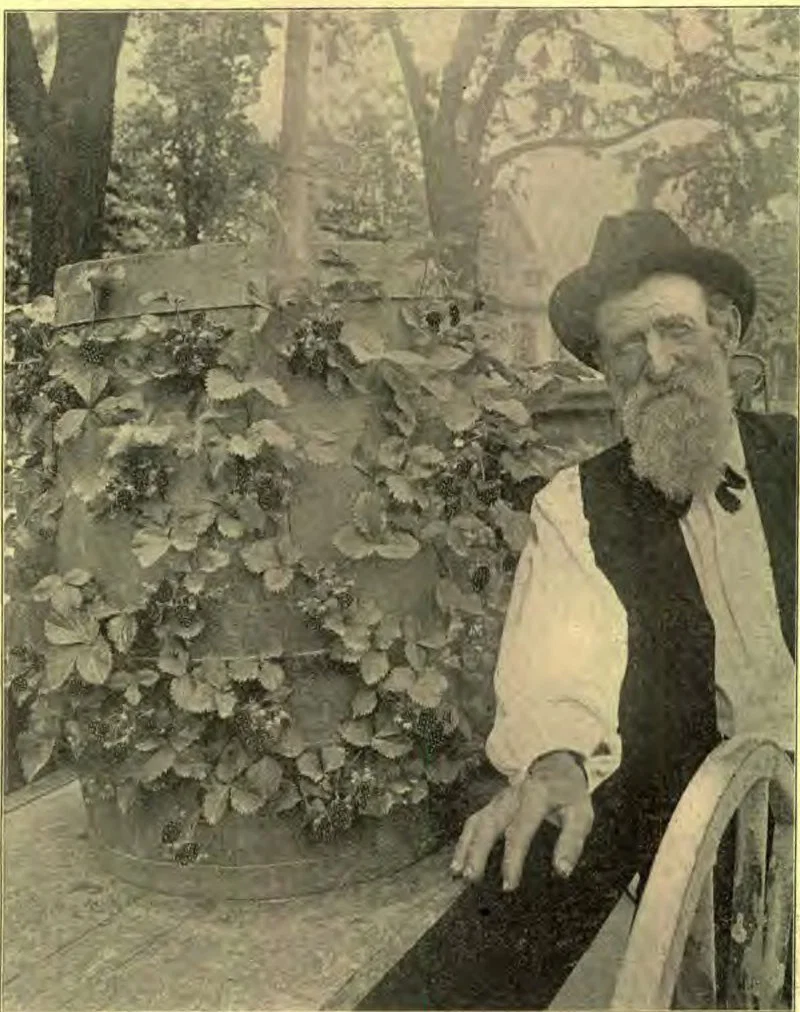
A novel way of raising strawberries has been developed by Mr. J. P. Ohmer, of Dayton, Ohio. He sets the young plants out in barrels instead of in beds, and claims marked advantages for his method over the ordinary way of growing this delightful fruit. He has raised berries in barrels for the last twenty years, adding a barrel or two to his stock each season, so that at present he has a considerable number of them.
MR. OHMER AND ONE OF HIS STRAWBERRY-BARRELS.
In order to make one of these small “hanging-gardens,” take any iron-bound barrel except those that have been used for pickles, vinegar, or sauerkraut, bore four holes in the bottom, and remove all but four of the hoops. There should be five rows of holes around the barrel for the plants, the first eight inches from the bottom, and the last five inches from the top. Each row should have twelve holes, evenly spaced around the barrel, thus providing for sixty plants. In making the holes, bore out two, one above the other, and cut out the wood between. Use a one-and-one-half-inch bit. When all the holes are made, put two inches of clean gravel in the bottom of the barrel to insure good drainage; fill in clay soil, thoroughly mixed with well-rotted manure, about three inches above the first row of holes; then get in, and tramp it down solid. Loosen the soil with a trowel where the plants are to go, and set out the first row, putting the plants as near the top of the holes as possible, to allow for settling. Spread the roots out well. Fill in the soil about half-way up to the next row of holes; take a common drain-tile twelve inches long by three or four inches in diameter, put it in the center of the barrel, and fill with coarse sand; then put into the barrel enough soil to reach about three inches above the second row of holes. Cover the tile, so none of the soil can get in, and tramp again, being careful not to move the tile. After setting out the second row of plants, lift the tile, allowing the sand to settle; fill it again; then put in soil above the third row of holes, tramp, and set out plants, repeating the operation until all the rows are planted. Do not fail to tramp the soil.
After the last row is planted, the soil is put in to reach the top of the barrel; but the tile is left empty, to take the water for the three lower rows; the two upper rows are watered from the top of the barrel. It would be impossible to water the lower rows without the tile and the core of sand. Be careful not to water the plants too much. If the tile is filled once a day, and two quarts of water are poured around it, the plants will have sufficient moisture.
The barrels should be set on bricks, and may be painted some light color before the plants are set out.
In selecting your plants, choose the largest fruiting variety that does well in your section, and a perfect blooming sort if possible. In order to secure the best results, the plants should be set out in August or early in September, although those set out early in the spring will bear fruit the same year. The plants will bear two crops. All runners should be cut off as soon as they appear. In the latitude of Dayton, the barrels will usually need no protection in winter. In all Mr. Ohmer’s experience, no plants were winter-killed until last winter, which was unusually severe.
Berries grown by this method are said to be much larger and finer than those raised in the ordinary way. The fruit is thoroughly ripened all around, and is easily gathered. Each barrel produces half a bushel of berries. At this rate a dozen barrels set four feet apart in a small city garden would supply an ordinary family with this delicious fruit fresh for the table. And there is a vast difference between the travel-worn, half-ripened, jammed, sandy berries of the market and the luscious scarlet fruit, fresh from its shining vines, as every one knows who has been so fortunate as to be “turned loose” among them, and told to help himself.
We are indebted to Mr. Ohmer for directions for planting, also for the accompanying illustration, which shows one of his barrels on a spring-wagon, as it appeared at an exhibition. The plants in this barrel were set out the spring that it was exhibited.
This method of strawberry culture contains a good suggestion for the missionary gardeners, especially those living in cities. Any bright boy can prepare two or three of these barrels; and as the fruit so grown ripens early, and is of superior quality, can get a fancy price for his berries. Try it! May there be many of these missionary barrels started this fall.

THE BLESSING OF GARDENING.

“NOTHING is denied to well-directed labor.”
Keep the soil mellow, and remember that a thorough stirring after each rain will be of great benefit to the growing crops. Many persons are satisfied when they have hoed between the rows; but the vegetables themselves need the effect of stirring, and work should be done as near them as possible without injury to the roots.
There is health in tilling the garden as well as from its products. If we are to preach health-reform principles, we ourselves must be examples of health. If we spend more time in the fresh air and sunshine, we shall have better health, and its bloom will be seen in our faces.
If you can encourage your neighbors to plant a garden, you will do a good work. Invite them to come in and look at your garden; tell them how you rotate your crops; pull up a large radish and give them a taste; show them the luscious strawberries, the growing melons, the raspberries, currants, gooseberries, grapes, etc. I do not know that I can do better here than to quote a few extracts from “How to Make the Garden Pay,” by Mr. Greenier:—
“How I pity the sad-eyed housewife, with the daily questions to answer, “What shall I cook for breakfast, what for dinner, and what for supper?” with nothing but the pork barrel, the flour-chest, and the potato-bin from which to draw material! How I pity the mother whose children are crying for fruit and vegetables, and who is compelled to hand them—worse than a stone—a piece of salt meat.
“Fried meat, fried potatoes, poor bread made from poorly ground flour, greasy pies, and rich cakes,—these, with hardly a variation, are the chief articles of food for thousands of farmer families. Can you draw health from a pork-barrel?—No more than you can gather grapes from a thorn-bush.
“Many a farmer, having sown a small patch of peas, from which his family may have an abundant supply for a whole week, and told them to help themselves to all the roasting-ears they may desire from the corn-field (half a mile away) for another week, thinks his whole duty is done. According to statistics taken in Illinois a few years ago only seventeen per cent. of the farmers in that State had the luxury of a strawberry-patch. Think of it!—only one boy in every six knew what it is to pluck this luscious fruit from the vines, and eat to his heart’s content! Without the cooling, stimulating effect of fruit and vegetables, what wonder that the blood of so many is sluggish and laden with impurities, and that dyspepsia, scrofula, and similar affections are alarmingly common?”
These facts can not be disputed; and we to whom the Lord has given the light of health reform should be in earnest to carry it to others.
A few words on the culture of the tomato will not be out of place here. There is no question but that a better quality and a greater quantity of desirable fruit are obtained when the vines are elevated on frames, as the fruit is thus exposed to the sun and air. Often hoops from nail-kegs are employed for this purpose; any arrangement that will lift them from the ground will answer.
The maturity of the first fruit will be hastened if the tops and the surrounding shoots are pinched off. A good rule is to cut off all side shoots when the first blossom appears. If you wish to train the tomato, drive stakes six or seven feet long near the vines. Tie the plants to the stakes with strips of cloth, and cut off all the side branches, leaving only the central stem; this should be done every week until the last of July. When sufficient clusters have been formed, pick off all inferior ones. By following these directions you will have larger, better formed fruit, besides hastening the ripening period.
If you wish to have late tomatoes, a good plan is to set a plant in each watermelon-hill. The plants will not interfere with the melons; and the tomatoes will ripen later, and are better for canning, than the early ones.
ARTHUR F. HUGHES.

Nature's Price for Health Is Regularity

NATURE’S price for health is regularity. We can not safely bottle up sleep to-night for to-morrow night’s use, nor force our stomachs at one meal because we expect to eat sparingly at the next, nor become exhausted in working day and night, expecting to make it up later. Nature does nothing before her appointed time, and any attempt to hurry her invariably means ultimate disaster. She takes note of all our transactions, physical, mental, and moral, and places every item to our credit. There is no such thing as cheating nature. She may not present her bill on the day we violate her law, but if we overdraw our account at her bank and give her a mortgage on our minds and bodies, she will surely foreclose. She may loan us all we want to-day; but to-morrow, like Shylock, she will demand the last ounce of flesh. Nature does not excuse man for weakness, incompetence, or ignorance. She demands that he be at the top of his condition.—Success.

HOW MARBLES ARE MADE

A LONG, long time ago, before we began to reckon years as we do now, that is, before men began to talk about “the year of our Lord,” games with marbles were played. But the marbles of those days were played with small, water-worn pebbles, picked up on the seashore.
The common gray marble is made from a hard stone found near Coburg, in Saxony. The small pieces, broken from larger ones, are mostly used, so that there is no waste. Men and boys are employed for this purpose, and they break the pieces into small cubes. The little cubes are then put upon a kind of millstone which has a number of grooves in it, in the form of circles, one within another. This stone remains at rest, but an upper stone is placed upon it, and made to revolve rapidly. By means of this “runner,” as it is called, the marbles in the grooves of the lower stone are rolled over and over quickly in all directions. Water is allowed to trickle into the grooves. From one to two hundred cubes are put in at one time; and in about twenty minutes they are turned into perfectly round marbles.
The finer sorts are then put into wooden casks, in which are stone cylinders. These casks revolve; and the marbles, by rubbing against one another and the cylinders, are brought to a very fine surface. They are then polished with emery-powder, or with what is known as “putty-powder.”
Chinese marbles and alleys are often pressed in wooden or metal molds, made to fit closely together so that no ridge can be detected. Afterward they are painted and baked.—Selected.

HOW TO MAKE A BLACKBOARD.

WHEN I was going to school in my boyhood, we had a blackboard made of boards matched together. We also had one put together in the same way for the singing-school. When these boards were dry, they would shrink, leaving a crack about one fourth of an inch wide. This cut the chalk, making bad work. I often wondered if there was not some way to make a board that would not crack.
I have a board in my shop now that I made twenty-three years ago. It is six feet long by four feet six inches wide, and has never shown any signs of coming apart. I will tell you how to make one.
First, decide upon the size you want your board. Then dress your lumber one-half inch thick, which will be heavy enough. Joint up the edges straight. Warm them well, and put them together with good glue. Clamp them up tight. If you have no clamp, take some pieces of scantling, as directed in a former article, and wedge them up tight. When the glue is thoroughly set, glue a piece of strong factory cloth about two inches wide over the back of the joint.
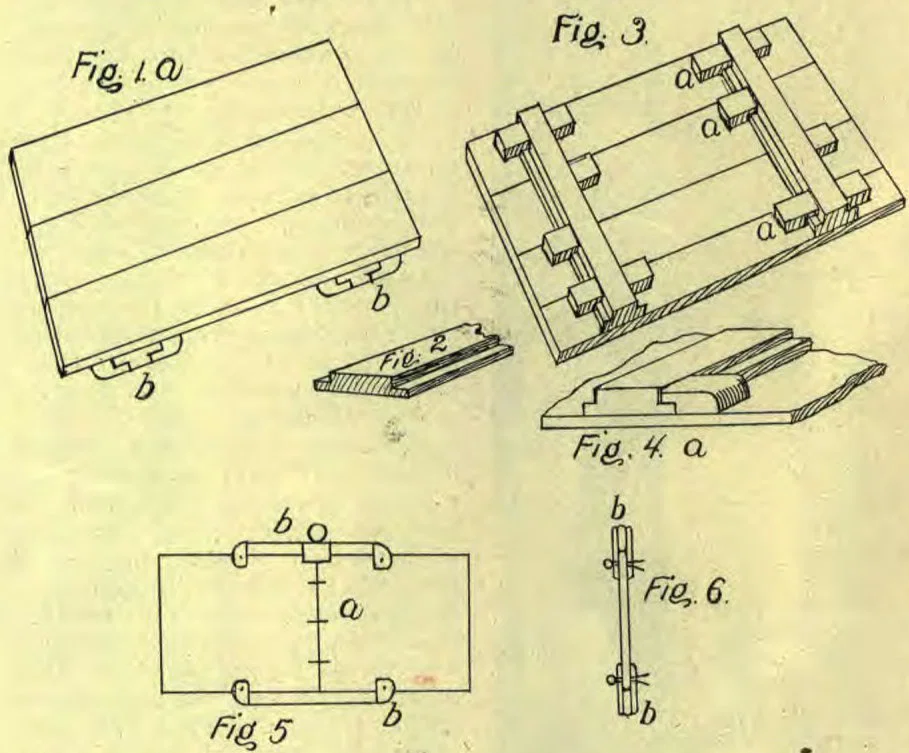
Fig. 1, a, shows the front of a board made with three boards glued together. At b, b, you will see the end of some cleats that are rabbeted out, as shown in Fig. 2. These run across the board, on the back of it, as shown at Fig. 3. These cleats, a, a, are glued to the blackboard. Put two inches of glue on one end of the cleat. Let each end of the cleats come even with the edge of the board.
In Fig. 4, a, you will see one of these cleats with a block against the cleat. Make use of a number of these blocks, as they keep the board from warping and splitting. On a board twelve inches wide it is well to use three or four on a cleat, as seen at a, a, a, in Fig. 3. These blocks should be about two inches long by an inch and a half wide. Cut a notch three eighths of an inch deep and half an inch long. Glue to the blackboard, as shown in Fig. 3. Have these blocks loose enough to slide on the cleats. Be sure not to get any glue on the cleats, to prevent their slipping when the boards shrink and swell. Now make the board smooth, and it is ready for the paint. If you follow these directions, you will have a board that will always keep its place. In damp weather my blackboard is more than half an inch wider than when I have a hot fire in my shop, because it slides back and forth on the cleats.
Fig. 5 represents a small board made to take apart. For this purpose use a board about sixteen inches wide, two feet long, and three eighths of an inch thick. Cut it in two in the middle. After it is all dressed up, put some wire pins, or dowels, in the joint at a. Get out two pieces twelve inches long, as seen at b, b, in the same figure, the thickness of the board and one inch wide. Get out and glue on some small blocks one fourth of an inch thick, as shown at b, b. The same is shown in a section, Fig. 6. Make holes through, into which insert cotter-pins. By taking out these pins, your board can be taken apart, and put into a satchel or shawl-strap; this makes it easy to carry from place to place. Paint over with black paint, using plenty of turpentine, so there will be no gloss. Some use liquid slating.
W. K. LOUGHBOROUGH.

BASTING-STITCH, BACKSTITCH, AND HALF-BACKSTITCH.
THE position of the body while sewing is of great importance: a careless attitude may cramp the arms and hands, and injure the health. The chair should be of a height to permit the feet to rest flat on the floor. The lower end of the spine should be firm against the back of the chair, and the trunk of the body free and erect. The work should never be nearer the eyes than is necessary clearly to see the stitches. The shoulders should be kept well back, to allow the chest full expansion. The head should not be allowed to droop so as to affect the circulation of the blood to and from the brain. The arm should never rest upon the desk while sewing. The light should not shine directly into the eyes, but should come from over the left shoulder.
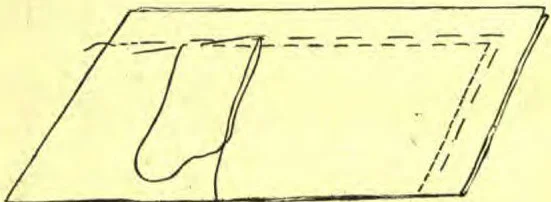
Now we are ready to begin our sewing-bag. Take the piece of outing-flannel, fold it so it will be longer than it is wide, pin it firmly along one short end and along one side; then thread a No. 7 needle with an arm's length of No. 40 cotton, putting into the eye the end that comes from the spool first, to avoid knotting. Make a knot, baste the short end and the side you have pinned, by taking stitches about one fourth of an inch long. Begin to sew from the folded corner, inserting the needle between the edges of the seam, so the knot will not show, and draw the needle through; put the point of the needle back a few threads from where the needle comes through the cloth, and bring it out the same distance beyond; continue putting the needle back each time into the last stitch; make the stitches even, and keep the seam straight, leaving one thread of the cloth between the stitches and the basting. This is called backstitching. Turn the corner, and sew down the side with a half-backstitch, made by putting the needle only half-way back, leaving a space between the stitches. These stitches are plainly shown in the illustration.
We will finish the bag next week.
NELLIE V. DICE.

HE WANTS AN EASY PLACE.

Oh, that’s it; you want an easy place, do you? Oh, yes, I understand you, my boy. I have been right there myself. I traveled over that road many years ago, when I was probably about your age; so perhaps you will permit me to offer a word of advice: Don’t ever think of being an editor, or a lawyer, or a merchant; don’t be a mechanic, avoid all shops and stores; don’t undertake the practise of medicine; all kinds of public speaking and oratory let severely alone; don’t undertake to write for the papers; don’t, don’t, my! don’t you ever think of being a farmer; never do you soil your little hands with work, my boy; avoid all study, don’t read, don’t think: these are all hard.
Oh, you have money and noble parentage, have you? That makes not the slightest difference. You must build up a character of your own, young man.—George K. Edwards.

IN DAISY DAYS.

Oh, fair the earth, and sweet her ways, When dawns the month of daisy days, And bees hum in the clover; The orchard with its sweetness fills The light winds trooping o'er the hills, And birds with song brim over.
'Tis then a blushing orchid's face Peeps out from some neglected place Where ferns unfurl their laces; And not a flower, from daffodil To those which brave October's chill, Can show so many graces.
Oh, sing a song of daisy days, Ripe strawberries in meadow ways, And butterflies in session,— Of days when bobolinks will tell, Above the bindweed's snowy bell, That music's their profession. — Katharine H. Terry.

To-Day Is Beautiful and Blest

“To-day is beautiful and blest, Because it only lives; It holds our joy, and toil, and rest, And all the good God gives; For time that seems to move is time That evermore doth stay, And all in earth’s encircling clime Is kept in God’s to-day!”
Continue reading: THE HORSE THAT CARRIED DOUBLE