Did you ever see a gray horse with a green tail? Although this is a strictly true story, the horse that belongs to it was of those two colors. Now for the story.
On a certain mild afternoon in the early spring you might have seen two little travelers on the Fancy Hill road; and if you belong to our town, you would have known them at once for Susie Pointz and her little brother Daniel. In fact, several persons did recognize them, and one and all stopped to ask what they were doing so far from home by themselves.
Nothing could have pleased the small travelers better. At each surprised question they recognized the lark they were on, and went forward more joyously.
“We are going to meet papa,” was the answer they made, in proud tones. “Mama lets us. He’s coming from the bridge in the sulky, and we’ll ride back with him.”
And on they went in the sweet afternoon sunshine, exploring fence-corners for dandelions, counting the soldier blackbirds with their red epaulets, and pretending to hear lions roaring in the woods.
Somehow papa was longer coming than they had expected; but then, children always do expect things to happen right off. It was not early when they left their own doorstep. It seemed to be getting late very, very fast; and still no sulky with a long-tailed bay horse to it came in sight.
Daniel’s short steps began to lag now. He really had gone a long way for such a little boy.
“I don’t b’lieve papa is ever tomin’,” he whimpered.
“Oh, yes! he is,” said the brave little sister. “Mama said so. I s’pect he’s just round that bend in the road.”
She coaxed Daniel to the bend, but papa was not there; and although they could see a long way down the dim road, there was neither man nor horse on it.
It was quite dusk now, and Susie herself was afraid to venture farther down that dark, empty road. They sat down on the roots of a friendly old oak-tree, and waited. Oh, how late and lonely it was! And a little screech-owl above them howled so mournfully that it made the cold chills run down their tired little backs.
“Come, brother; we must turn back,” said Susie, getting up, resolutely. “Papa isn’t coming, after all. Something has kept him. We must go home.”
But now Daniel howled more dismally than the owl.
“I tan’t walk so far! I’m tired! My legs hurt!” sobbed the baby.
For one bad quarter of a minute Susie thought she was going to break down and cry, too, it was so doleful; but the responsibility for the smaller and weaker one kept her up. The sister-love in her heart, that was kin to the “love divine, all love excelling,” made her strong.
“O Dannie!” she cried, with a womanly pretense of glee, “I’ll get you a horse to ride, and then you won’t get tired.”
Fortunately some wood-hauler had dropped by the roadside a small, light sapling, only a few feet long, with a tuft of leaves at the end. Daniel was persuaded to bestride this “horse y,” which was named Rob Roy, after the long-tailed bay; and Susie set herself to beguile the way with many a treasured bed-time story.
When the story flagged, little Daniel’s legs began to ache; but when it rose again on the wings of tired Susie’s memory, the ground was covered without the child’s knowing it. So they fared along the road, now really very dark.
Do you wonder what had become of papa?—Why, my dears, there are two roads from the bridge, and papa had taken the other one. He stopped on the way, too, and was late getting home, and you may well believe he found mama in a terrible fright about the children.
Rob Roy—the real, live Rob Roy—had never been made to spin over that Fancy Hill road at such a pace as he spun now; but no doubt he knew that something was wrong when there were no children at the gate to rub his nose, and give him an apple.
The two little tramps were half-way home when papa met them. Glad? I don’t know who was the most joyful, papa or the children. Oh, yes! I do, too; for their little hearts could not have held the thankfulness that filled papa’s.
But now Susie broke down and cried.
“How funny!” said Daniel, staring at her; “I cwied when we was lost, and Susie cwies when we is found.”
But papa seemed to think the tears were all right, and he kissed each one as it fell, calling Susie the bravest little woman in town; for Daniel had insisted on taking the gray horse with the green tail into the sulky, too, and papa was hearing from him the wonderful tales that Susie had fed this new horse’s rider on. He saw right down into the brave little heart, and understood all about it.
“Were you very tired, little daughter?” he asked, tenderly.
“No, papa,” she said, smiling away her tears. “The stories kept me from thinking about it; it was so hard to remember ’em all.”
“Ah!” said papa, with another kiss, “the gray horse with the green tail carried double, then. Most unselfish deeds do.”
If you know what he meant, it is a long sight more than Daniel did. But Susie was smiling in a wise way.—Elizabeth Preston Allan.
THE THITHER SIDE.
By Myrta Castle Manson
“I’ve been told,” I said to a little maid I met
on the beach one day,
“There are beautiful shells—wilt thou
tell me where?”—“Oh, yes! just over
the bay!”
“Then where,” I said, “are the agates
rare, which wash in with the tide?”
“O lady, they, like the beautiful shells, are on the
thither side.”
“Wilt thou tell me, maid, where the wintergreens grow,
with their berries, fragrant, red?”
“Thou ’lt find them near by the agates and shells,” the
maiden smiled and said.
I took a boat across the bay. On the beach I met
a child;
“The agates and shells, and the wintergreen beds?—
They’re over the bay,” she smiled.
I sighed; when lo! at my very feet a beautiful agate
lay;
And I marveled much at the shells I found on the
thither side the bay.
And the wintergreen beds, which I longed to find,
with their berries fragrant and gay,—
I found them everywhere I went, on both sides of
the bay.
MYRTA CASTLE MANSON.
THE SWEETEST FLOWER.
A TOAD STORY.
One day my father, sister, and I were out in the garden, watching a little toad.
My father took a little stick, and very, very gently scratched one side of the toad and then the other. The toad seemed to like it; for when he was scratched, he would roll from side to side and blink.
I was so interested that when they went in, I took the stick, and did as my father had done. I thought, If he rolls from side to side as I touch him, what will he do if I run the stick down his back?
I did so, and what do you think happened?—His skin, which was thin and dirty, parted in a neat little seam. There was a bright new coat under it.
Then my quiet little toad showed how wise he was. He gently and carefully pulled off his outer skin. He took it off the body and legs first; and then, blinking it over his eyes, till—where had it gone?—He had rolled it into a ball, and swallowed it.—Adapted from Our Dumb Animals.
I WOULDN'T FRET.
By Florence A. Jones
Dear little lad with flashing eyes,
And soft cheeks where the swift red flies,
Some one has grieved you, dear; I know
Just how it hurts; words can hurt so!
But listen, laddie—don't you hear
The old clock ticking loud and clear?
It says, “Dear heart, let us forget;
I w-o-u-l-d-n’-t f-r-e-t, I w-o-u-l-d-n’-t f-r-e-t!”
Why, little girlie, what's gone wrong?
My song-bird's drooping, hushed her song.
The world has used you ill, you say?
Ah, sweetheart! that is just its way.
It does n't mean to be unkind,
So, little lassie, never mind;
The old clock ticks, “Forget, forget;
I w-o-u-l-d-n’-t fret, I w-o-u-l-d-n’-t f-r-e-t!”
TIME: Spring, A. D. 29. PLACES: Sea of Galilee, desert near Bethsaida, land of Gennesaret, Capernaum. PERSONS: Jesus, apostles, multitude.
QUESTIONS.
1. When the twelve apostles returned from their preaching tour, what invitation did Jesus extend to them? Mark 6:30, 31. To what place did they retire? V. 32. By what was the period of rest interrupted? Vs. 33, 34.
2. What disposition of the multitude did the disciples wish to make? Vs. 35, 36. What did Jesus reply? What unreasonable view of his word did the disciples take? V. 37. How much food had they in store? V. 38.
3. Before beginning his work for the people, in what order did Jesus have them arranged? Vs. 39, 40. By what means was the small supply of food made sufficient for the multitude? V. 41. What part did the disciples act? How abundant was the supply? Vs. 42, 43. How many were fed? Matt. 14:21. What lesson in economy did the Saviour teach his disciples on this occasion? John 6:12.
4. Immediately following the miracle, what did Jesus require the disciples to do? Matt. 14:22. To what place and for what purpose did he retire? Vs. 23. What experience overtook the disciples? Mark 6:47, 48. When and how did Jesus go to them? Matt. 14:25. What were their feelings as they saw Jesus? V. 26. What occurred to give them faith and rest? Vs. 27-33.
5. To what place did they then go? Mark 6:53. How extensive was the interest there? Vs. 54, 55. How many were healed? V. 56.
6. What did Jesus say to the people who crowded around him? John 6:26? For what rather did he say they should labor? V. 27. What did he say concerning the bread of life? Vs. 48-51. What did he afterward say which made plain his teaching relative to eating his flesh? V. 63.
NOTES.
1. The news of John's death doubtless had something to do with suggesting the proposed rest. It was to Christ the warning that his labors in Galilee must also soon terminate through the people's rejection of him, and the shadow of his own violent death as well. There were many things to communicate to his apostles, which could not well be said before the multitude. Besides, they needed a spot for quiet meditation and prayer. The Bethsaida here mentioned as the place of retirement is supposed to have been a place six miles from Capernaum, at the head of the Sea of Galilee, east of Jordan, sometimes called Julias, in honor of Julia, a daughter of Emperor Augustus. It was beyond the territory of Herod Antipas, and in the tetrarchy of Philip, therefore entirely distinct from the place by that name west of the Sea of Galilee.
2. “Come ye yourselves apart,” he bids us. If we would give heed to his word, we should be stronger and more useful. The disciples sought Jesus, and told him all things; and he encouraged and instructed them. If to-day we would take time to go to Jesus and tell him our needs, we should not be disappointed; he would be at our right hand to help us.—“The Desire of Ages,” page 363.
3. Let us look at the precept and example of our divine Lord regarding economy and making the most of the blessings of heaven. When Jesus had worked a notable miracle, and had fed five thousand persons, he said to his disciples, “Gather up the fragments that remain, that nothing be lost.” This command had a double meaning; for it not only showed that every morsel of bread given through the miracle of Christ was sacred, but that those morsels, imparted to others, multiplied and extended the blessing to those who had need. From this circumstance we may learn a lesson in spiritual matters. As the bread was carefully saved to be given to others in need, so we should carefully treasure up all that God gives us, in order that it may again be imparted to those who have need.—Mrs. E. G. White, in Review, 1893.
4. “Rabbi, when camest thou hither?” was the expression of their [the multitude’s] natural surprise; but it was met with perfect silence. The miracle of walking on the water was one of necessity and mercy; it in no way concerned them; it was not in any way intended for them; nor was it mainly or essentially as a worker of miracles that Christ wished to claim their allegiance or convince their minds. Therefore, reading their hearts, knowing that they were seeking him in the very spirit which he most disliked, he quietly drew aside the veil of perhaps half-unconscious hypocrisy which hid them from themselves, and reproached them for seeking him only for what they could get from him. He who never rejected the cry of the sufferer, nor refused to answer the question of the faithful,—he who would never break the bruised reed, nor quench the smoking flax,—at once rejected the false eye-service of mean self interest and vulgar curiosity. Yet he added for their sakes the eternal lesson, “Labor not for the meat which perisheth, but for that meat which endureth unto everlasting life, which the Son of man shall give unto you.”—Farrar.
In what year was the prophecy of the lesson probably uttered? Of which kingdom was Hosea a citizen? To what tribe did he belong? What was the condition of the land in his day? What was Israel exhorted to do? What was Israel’s greatest sin? What are they exhorted to take with them to the Lord? What is meant by the calves of our lips? Who would not be able to save them? What does the Lord promise to heal? What does he promise to be to Israel? How was their growth illustrated? Who are the truly wise? Who are the prudent? What is said of the way of the Lord?
NOTES.
1. “Hosea prophesied for over sixty years, during the reign of the last six kings of Israel (B. C. 782–721). He prophesied before Isaiah in Judah, with whom he was contemporary for a while. In his day the land was full of wickedness; the kings were profligate, the priests corrupt, and the people forgetful of God. He was a citizen of the northern kingdom, probably of the tribe of Issachar.”
2. “Asshur shall not save us.” Asshur was another name for Assyria, with which Israel had been allied. “We will not ride upon horses,”—trust to Egypt, whence horses had come. With renunciation of idolatry is renunciation of all trust in human power, and a realization of the helplessness expressed by the words, “In thee the fatherless findeth mercy.” Compare Ps. 10:14; 68:5.
3. “I will love them freely.” Human forgiveness often has restrictions, and is stinted and provisional. God’s is full, overflowing, unmeasured. He “upbraideth not.” His wrath is against sin, not against the sinner; and when sin is renounced, his “anger is turned away.” With his unmeasured love comes unlimited blessing. The withered, desolate condition of Israel, through returning to divine favor, was to be refreshed, until full vigor and beauty would again indicate the source of prosperity. “I will be as dew unto Israel.” “The refreshing from the presence of the Lord” is symbolized by dew, by rain, and by abundant rivers. This promise is for Israel now.
4. The result of the refreshing is charmingly pictured in the simile of the growing lily. “He shall grow as the lily.” No plant is more beautiful, more fragrant, more productive, than the lily. It is said that the root often produces as many as fifty bulbs. Palestine is very prolific in lilies of various kinds. The white lily is most common here; but in parks and conservatories we often see water varieties in red, blue, pink, and purple; and in the fields are hosts of lilies, from white to almost black, including streaked, mottled, and speckled lilies. Of Christ it is written. “I am . . . the lily of the valleys.” No symbol better presents the character of those who are “holy, harmless, undefiled.”
5. “Cast forth his roots as Lebanon.” In the symbol of the lily is the suggestion of frailty, which the prophet corrects in the casting forth of Lebanon’s roots. Beauty and strength are combined. Without root we wither. Matt. 13:6. The root must be in love. Eph. 3:17.
6. “His branches shall spread.” “True religion will manifest itself in open profession. . . His religion is luxuriant, and his heart expansive. He outgrows the narrowness of a creed and the boundaries of a sect. His sympathies and efforts are world-wide; his outstretched arms afford grace and protection to all. It ‘becometh a tree, so that the birds of the air come and lodge in the branches thereof.’”
7. “From me is thy fruit found.” “Without me,” says Christ, “ye can do nothing.” It is the life-sap of the vine that causes the branch to flourish and bear fruit. Where, then, is boasting?—It can not exist in the heart where the Spirit abides, bringing forth love, joy, peace, long-suffering.
The Russian Calendar.—
At the opening of the twentieth century, the Russian calendar will be changed to conform to that of all the other countries of the civilized world. The government is already taking steps to that end. It is impossible to estimate the results that would follow if, with this forward step, Russia would grant to all her subjects a greater degree of civil and religious liberty. But this seems to be the last thing likely to happen.
The Boy King of Spain
is said to be anything but popular in Madrid, where his presence on the street arouses no enthusiasm. “At times when the guard is changed at the royal palace, his troubled face may be seen at a window, gazing out; but no one cheers, and he remains almost unrecognized. No hat is raised, or other obeisance paid him by his sullen subjects, when he rides abroad in melancholy state. Among a more generous people, his youth, his misfortunes, and a consideration of the troubled future which awaits him would at least awaken pity.”
Negro Colony on Long Island.—
The deplorable increase of “lynch law” in the South has given rise to a desire among the better element of the colored people to come North; and this many of them would gladly do if they were sure of employment. This has led to the formation of a company whose purpose is to establish a negro colony on the eastern end of Long Island, where it has secured several thousand acres of land. One thousand negroes will settle on this tract within a few months, and an exclusively negro town will be founded. No white person will be permitted to hold property within the limits of the colony. If this enterprise succeeds, similar colonies will be formed in other Northern States.
The Philippine Situation.—
Notwithstanding the frequent reports that the end of the war is in sight, and that it will all be over in a few days, except, perhaps, some guerrilla warfare, General Otis cables to Washington that he must have more soldiers to take the place of the volunteers about to be sent home. He says he must have thirty thousand men, in order to deal successfully with the situation. He now has that number, but it will be reduced somewhat by the return of the volunteers. The message making this call for additional men, was received June 1, but was not made public. It is thought that the number of men required can be made up from the regulars in Porto Rico and Cuba without recourse to a call for volunteers, although such a call may have to be made in a few weeks.
A New Trial for Dreyfus.—
Ever since the degradation and exile of Dreyfus, officer of the French army, accused of betraying official secrets, the world has looked on with increasing interest at the developments in this famous case. Many believed the prisoner to be the victim of a military plot, declaring that he was convicted only to shield his superior officers; and subsequent events go to show that this idea was not without foundation. Count Esterhazy, abandoned by the chiefs of the French army, has lately signed a confession in which he declares that he himself wrote, under orders, the famous bordereau (memorandum) that resulted in the arrest, trial, and conviction of Dreyfus. While the prisoner has been until recently cut off from all communication with the outside world in his lonely prison on the French Guiana coast, his friends have worked unceasingly to prove his innocence, and to have it acknowledged by France. For a long time everything appeared to go against them; but on June 3 the Court of Cassation, which for some time has had the matter of revision under consideration, ordered that a new trial by court-martial be granted; and the decision was placarded in every town and village of the republic. Dreyfus will be brought to Rennes, where the new trial will be conducted, and for the present his military rank and titles will be restored to him. The fact that M. Zola, the novelist, who last year was prosecuted, convicted, and obliged to leave the country, on account of his zealous advocacy of the Dreyfus cause, has returned, and is to be reinstated in the Legion d'honneur, is a straw that shows the revulsion of popular feeling in France. It is said that the government will take action against all the army officers guilty of “illegalities” in connection with this case. The outlook at present indicates that it will have its hands full for some time to come.
Chapter II
By Sarah M. I. Henry
From Sinai to Olivet
Chapter II.
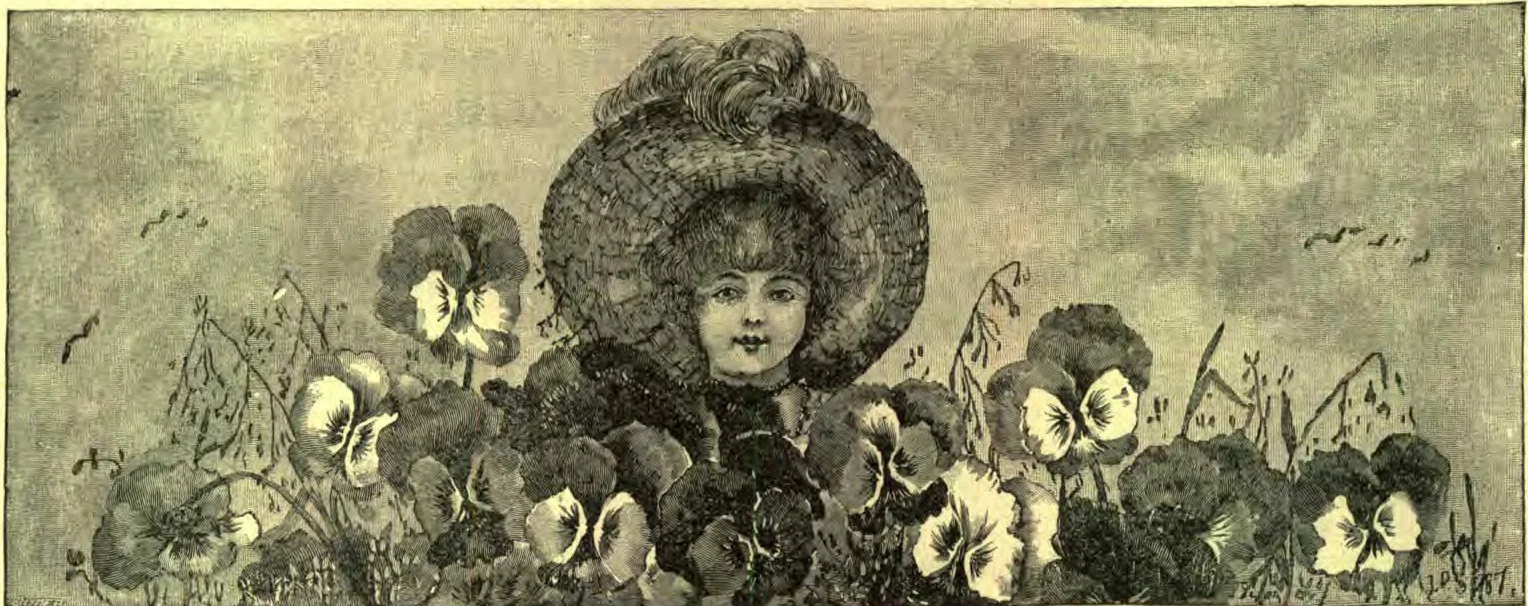
SHE did not put on her white apron after supper, and loiter, sweetly unconscious, under the great maple, until Seth should join her, this spring; she was not ready for a frolic or a stroll; she wore no pansies nor spring daisies; she fished for no compliments; she cared for nothing.
Seth was glum, her mother fearful and peevish, and her father angry.
Mr. Goss was noted for having ways of his own about everything. He posed as an “original,”—“the only and original Goss,” as he had been styled by a facetious neighbor, and afterward by the community.
His farm, which, by the way, he had “inherited from his wife,” was managed according to notions of his own,—not altogether bad, as farming goes; in some things, better than the average. He had some little triumphs over his laughing neighbors, and had been able to retort, “Let him laugh who wins,” as he came home from the county fair with a prize badge. He had acquired some celebrity as a progressive farmer, not afraid to try new things. He had even fortified his reputation as an “original” by producing a seedling potato that bore the family name, and was acknowledged to be “quite a good potato.”
“Goss’s way” had come to be a sort of proverb, even among those who laughed at him; for since it brought prosperity to the Gosses, it seemed, after all, to be a very good way indeed, even if it was a “freak.”
Shirley was as nearly like her father as a girl could be, but she had had no opportunity to develop a way of her own. It was in her, however,—a positive, dominating force, struggling for expression; and the time was at hand when it could no longer be suppressed.
If her father could only have understood! Her mother knew; but she had long since come to keep her thoughts to herself. “Goss’s way” had been too much for the gentle woman. She had been quickly brought under its spell, and had learned silence.
Benjamin Goss would have been astonished had he been told that either his wife or daughter was in need of anything. He provided liberally everything that “heart could wish,” he was sure. Neither of them had ever been burdened with the responsibility of a purse, never had to go through the weariness of shopping. They were well-dressed by his forethought and providence. Shirley had never known the want of a pair of gloves, never been left to plan and deliberate about the choice of a dress, never even felt the need of a dress: everything she could use came to her without her care, as if she had been a bird or a squirrel,—and yet she was not happy.
Mr. Goss did not intend to be arbitrary. He did not know that he was. He was simply the “head of his own house,” and turned the whole body accordingly. His will was so strong that in its operation it amounted to a blind force. He had settled the plan of his crops in regular rotation for years to come, and in the same way had fixed the destiny of his daughter. It was his boast that his word was law in his house.
“We have no whipping at our house,” was one of his pet expressions; “when I say a thing, that is the end of it,”—which accounted for the fact that he was ignorant of all that was smoldering in the breast of his daughter and weighing upon the heart of her mother.
He had no confidence in a woman’s ability to mark out a way of her own and follow it; to have a conviction of duty, and answer alone to God for it; to recognize a personal right, and seek to obtain it. These things were altogether outside the life of a woman, as he recognized it; hence, with the utmost care, and all of fatherly love of which he was as yet capable, he was holding to a course with Shirley that would, he thought, keep her safely, and bring ultimate happiness; while Shirley, utterly discontented with this hedged-in life, which left no scope for the use of her own powers, was watching for, she knew not what, but something, anything, that promised a change.
She had been slowly approaching the crisis of her discontent; and on this warm, humid spring day, with the house full of work, everything had conspired to precipitate it.
There was to be a May musicale at which she was expected to sing; for she had a fine voice, and with her sweet, fresh face had always been one of the chief attractions at every “Children’s day,” and at all Sabbath-school “doings,” from her earliest days; but now she had no interest in any of the neighborhood plans. She had refused to sing; and when at last her father had demanded the reason, had answered: “What have I to wear?—nothing that any other girl would wash dishes in.”
Then had followed an angry retort from her father, in which he had again tried to place his unselfish providence and her ungrateful discontent in their strongest light.
She had listened in the usual sullen silence, but steadily refused to furnish her accustomed share of the musical program. At last Mr. Goss, whose pride in his child was his great passion, had said, desperately, “Well, if it’s a dress, of course you can have a dozen; but you will have to sing.”
Shirley had been once on the point of saying, “I will sing if you will give me the money, and let me buy my own dress;” but she had brooded so long over her discontent that she had neither the interest nor the courage to make even this little struggle for independence, and without a word saw her father ride away to the country village to get one more dress which she knew perfectly well she should loathe at sight.
When he returned with it, he did not bring it to her, but threw it on the bed in her mother’s room, where Mrs. Goss found it, and with many misgivings opened it out, calling Shirley as cheerfully as she could, with the result already narrated.
Shirley had not expected any change in her father’s absurd taste in colors; but the morbid outlook of her life on that tiresome, vexing day had made this latest purchase seem positively bilious to her sight, hungering as she was for something dainty, fresh, and crisp in which to clothe herself in something like harmony with the season. And besides, she was tortured with the knowledge that everybody was displeased with her because she would not sing,—because she could not be gay, and sweet, and bright, as of old.
Even Seth had begun to be sarcastic and look crossways at her; he could not tolerate that sour face; she had no right to be anything but lovely. Her mother was more peevish and pathetic than ever,—tears always ready to ooze out at the corners of her eyes, and such a tiresome droop to her mouth,—and now Shirley herself was like a bunch of fagots waiting only the proper conditions to break into flames.
Her father supplied the conditions. He was both spark and bellows. Such had been the habit of acquiescence in Shirley all her life that there could be no sudden flash. It was rather a process of slow kindling by which she was to be fired. But Mr. Goss did not for a moment relax the necessary fanning to produce the undesirable result.
In spite of the cautionary suggestions that his good angel had whispered to him, he went on, and uttered the one word too much, considering that he was dealing with a conscious soul instead of with a machine.
As she stood silent, sullen, motionless, with her hands still down in the dishwater, his will grew tense and rigid as iron, his anger fierce and relentless; and at last, seizing her by the arm just above the elbow, he exclaimed, “Do you hear me? Speak! Answer me, or I will whip you, if you are as big as your mother.”
At the touch of his fingers on her arm, and the tone even more than the words, all the latent energy of her nature was aroused; and springing out of his grasp with the lightness of a cat, she leaped the low sill of the open window, and ran.
She was still conscious enough of her father not to do battle; she could not fight him, but she could run from him; and not caring who saw her, she made her grand dash for liberty.
Benjamin Goss was not the man to run after any woman, much less his angry daughter. The moment she flung herself away from him in that manner, and flew from the window, she put herself so far outside his life that for the time being she might have been a stranger.
“Very well, madam,” was his cold, quiet comment, as he watched her scudding across the lawn, and out to the road, “You can go until you are glad to come back; I can stand it as long as you can.”
Mrs. Goss did not take the matter quite so philosophically, but any “fuss” which she might make was entirely useless. She was aroused by her fears to one outburst of remonstrance; but after that she could only cry in secret, and trust to Shirley’s good sense, or the hard ways of the world, to bring the child back speedily. She must come back at once,—for what would her home be to that lonely, weary mother without the presence of her only darling?
She quickly forgot all but Shirley’s sweetness, the dimples, the laugh, the skipping step, the snatches of song, as they used to be before that cloud of discontent settled over them, and hushed and darkened all. The helpful hands of former days alone were remembered, not the hindering listlessness of the recent past.
How she needed those helpful hands now! What could she do, alone, with all this unfinished work, and these hungry men to feed?
MRS. S. M. I. HENRY.
(To be continued.)
To Reach BATTLE CREEK
FROM
CHICAGO, BUFFALO, DETROIT, OR TOLEDO,
Purchase Tickets Reading over the MICHIGAN CENTRAL
“The Niagara Falls Route.”
A First-class Line for First-class Travel between Chicago and New York and Boston. Elegantly equipped through trains pass Battle Creek in each direction daily.
R. N. R. WHEELER, Ticket Agent, Battle Creek.
O. W. RUGGLES, Gen’l P. and T. Agt., Chicago, Ill.
Grand Trunk Railway System
By E. H. Hughes; A. S. Parker
Time Card in Effect February 5, 1899.
C. & G. T. DIVISION.
WEST-BOUND FROM BATTLE CREEK.
LEAVE.
No. 11, Mail and Express, to Chicago — 12.00 M.
No. 1, Chicago Express, to Chicago — 9.00 A. M.
No. 3, Lehigh Valley Express, to Chicago — 2.40 P. M.
No. 5, Pacific Express, to Chicago, with sleeper — 12.55 A. M.
No. 75, Mixed, to South Bend — 7.30 A. M.
Nos. 11 and 75, daily, except Sunday. Nos. 1, 3, and 5, daily.
EAST-BOUND FROM BATTLE CREEK.
LEAVE.
No. 10, Mail and Express, to Pt. Huron, East, and Detroit — 3.45 P. M.
No. 4, Lehigh Express, to Pt. Huron and East — 8.27 P. M.
No. 6, Atlantic Express, to Pt. Huron, East, and Detroit — 2.25 A. M.
No. 8, Lehigh Exp. to Saginaw, Bay City, Pt. Huron, and East — 6.50 A. M.
No. 74, Mixed, to Durand (Starts at Nichols) — 7.35 A. M.
Nos. 10 and 74, daily, except Sunday. Nos. 4, 6, and 8, daily.