SALT is one of the most common and useful compounds in nature, and is prepared for our use by several methods. It is found in abundance in ocean water, in large deposits underground, and even in some places on the surface of the earth. It is a white crystalline solid composed of two chemical elements: sodium, a soft, gray metal so active that it readily decomposes water; and chlorine, which is a poisonous gas. Both of these elements are harmful to the body when alone, yet when combined to form salt, this product becomes harmless in moderate quantity, and even seems to be necessary to the health of animals living on a vegetarian diet. It is useful also for preserving foods, as it prevents the growth of bacteria ; for curing hides, and in chemistry for the production of chlorine and the soda products. Salt is readily soluble in water, a saturated solution containing 27 per cent of it, and unlike most compounds, it is nearly as soluble in cold as in hot water.
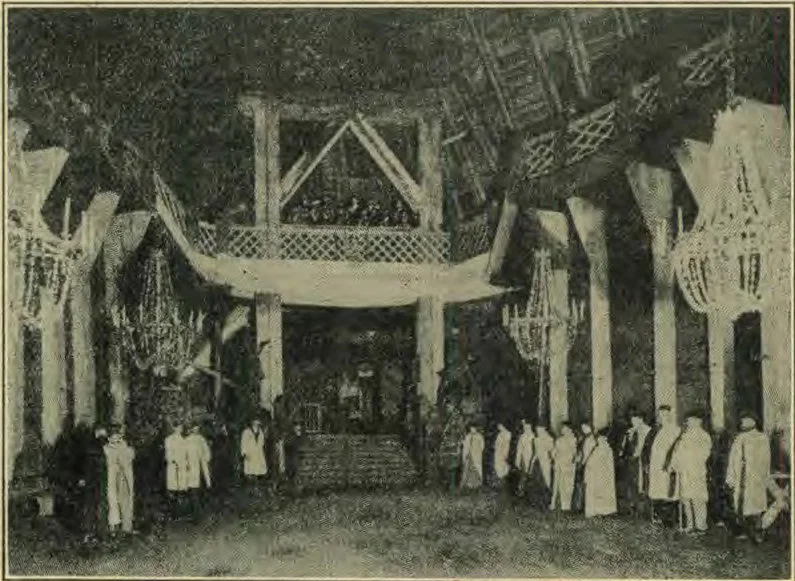
The Letow Ballroom, Cut in Salt, in the Rock-Salt Mines of Wieliczka, Austria-Hungary
Originally, the salt of commerce was obtained from the ocean, or salt water lakes, and it is still so obtained in some countries. Such water is salty because, for centuries, the streams have been dissolving this substance out of the earth and carrying it to the sea, but on returning, through evaporation they must leave the salt behind. Now the ocean water contains three and one-third per cent salt. Men obtain it from the water through evaporation by the sun’s heat, in large open vats. These are built near the shore, and the salty water is stored in the highest one until somewhat concentrated by evaporation, then it is run over into the next one for further reduction, and so on until, in the last pond, the salt becomes dry and may be gathered up. By regulating the time of changing the liquid from one pond to another, some of the other compounds dissolved in the water are removed in part, and the salt is left purer. At best there are some of these present in the final product. It is only in the laboratory that chemically pure salt is made. This will not gather moisture from the air as common table salt does, but remains dry. The presence of calcium (lime) chloride in table salt accounts for its becoming moist and stopping the holes in the shaker. The deposits of salt on the surface of the earth, which are found in some dry sections, came, doubtless, from the evaporation of bodies of salt water.
The best commercial salt, however, is obtained from the underground deposits. These are layers sometimes 250 feet thick and 2,000 to 3,000 feet below the surface. It is here in a hard, crystalline form, called rock salt. Sometimes it is mined like coal, but more often in these deep deposits it is dissolved by water, and forced through to the surface as brine. Wells, similar to oil wells, are sunk into the bed of salt, and within the large casing is placed a smaller iron pipe. Water is forced down the outer pipe under a pressure of perhaps 200 pounds per square inch. It returns up through the inner pipe after having dissolved some salt, against which it presses with enormous force at the bottom of the well. Then this brine stands in large tanks for a time to allow any solid impurities to settle, though it looks as pure and sparkling as water can, when it pours out of the well. Near salt wells, a favorite dish is potatoes boiled in this brine before paring. Sometimes several wells are sunk some distance apart, and operated separately until the enlarging cavities in the salt bed meet and form one large lake of brine. After this, all must be worked in unison or else plugged. The whole subterranean lake bears a pressure sufficient to raise the brine to the surface.
From the large tanks the brine is drawn and evaporated. Several methods are employed to accomplish this; as, the sun’s rays beating upon vats, or fires under open pans, or steam pipes through either an open tank or the vacuum boiler. Only the last method need be described, as the others are self-explanatory. In the vacuum system, the brine is heated by steam pipes running through it, but instead of being in an open vessel, it is in a closed boiler, perhaps ten feet across.
The pressure of the air or steam above the liquid, is so reduced by an air pump that the boiling point of the brine is made as low as 100° F., or very little above our body temperature. This enables the water to evaporate very rapidly. New brine is fed in as needed, and the precipitated salt settles to the funnel-shaped bottom, at the lower extremity of which it is removed. It is then elevated and run into bins to dry if it is to be used only as barrel salt, but if fine table or butter salt is desired, it is artificially dried. First it is rapidly revolved in a centrifugal drier by which most of the moisture is thrown off, then it goes slowly through a hot drum perhaps five feet in diameter and twenty feet long. This drum revolves, and as one end is higher, the salt is moved along toward the lower end. Inside this is a smaller drum heated by steam, over which the salt falls as it drops from the ribs of the revolving drum. It is removed at the lower end perfectly dry, and is elevated to bins there to await the sacking. This is sometimes done by hand and the sacks sewed by hand. Women sew up the tops of the little sacks at the rate of six or eight a minute. Sometimes an automatic machine9
(Concluded on last page)
The Manufacture of Salt
(Concluded from page eight)
is used to place a certain quantity of salt in each sack, then, as an attendant holds it in position, the top is sewed up by a machine. These small sacks are then packed in barrels or bags for shipment.
In the production of this commodity, the United States leads the world. The output in 1914 was nearly thirty-five million barrels. New York, Michigan, Ohio, Kansas, and Louisiana are the chief salt States, though many others scattered over the country produce some also. And nearly every nation in the world has some salt works.
J. NORMAN KIMBLE.
Mouseland Law
By Little Folks
Pussy caught a mouse for dinner,
But the mouse was wise and old,
“Wait a bit,” spoke he unto her;
“Have you never yet been told
That there is a law in Mouseland
That pronounces it disgrace
To begin to eat your dinner
Ere you go and wash your face?”
Pussy felt ashamed. “A cat should
Do as well’s a mousie can!”
Loosed her claws—and in a jiffy
Off the wise mouse lightly ran.
Very vexed, the pussy scolded:
“Mouseland laws would work disgrace!
This shall be the law in Catland—
‘After eating wash your face!’”
—Little Folks.
A Doctor’s Downfall
By Edith Penberthy White
I
“HERE, old chap, have another glass?”
The young man addressed tilted his chair, and raised a flushed face to the speaker.
“No, think not, old chap—must be going.” He rose unsteadily to his feet. “Think I’d better not.”
His companion laughed. “Oh, another glass won’t do you any harm; the occasion warrants it; besides, I know you want it.”
Pouring out a glass of wine, he handed it to his friend.
“It’s a poor heart that never rejoices. Remember, we’re celebrating an event of importance; you can afford to go home drunk tonight. None of the fellows will be surprised when they know you’ve come out top in the kingdom.”
The other fellow drew himself up to his full height, and there was a note of indignation in his voice.
“Drunk!”
“Well, you are not so far off. Come on, I’ll see the conquering hero home.”
“Look here—I—I’m going to give it up.”
“Give up what?”
“The drink.”
“What for?”
“A surgeon ought to be a steady chap.”
“But you can take it in moderation, can’t you?”
“Don’t know—’fraid not.”
“Oh, bosh! Michael, of course you can.”
Gilbert Lister laughed as he surveyed his friend; then, donning his hat and coat, piloted him home.
The two had been friends from their youth, and Gilbert, the elder, was not a little proud of his brilliant friend; and, while his own ambitions soared no higher than the life of a general practitioner, he well knew that fame lay within the reach of Michael Hurst.
The following evening Michael Hurst found his way once more to the little room where his friend studied, and Gilbert eyed the younger man with twinkling eyes.
“Better?” he asked. The other flushed all over his fair, boyish face.
“Oh, I say, don’t—I—I—why did you let me, Gil?”
“Oh, I don’t know! We were celebrating your latest success, you know.”
The flush deepened on Michael’s face. “Didn’t I say something last night about giving it up? I fancy I did.”
“Yes; but you did not mean it, I suppose.”
“I—I—think it would be wise, Gilbert, if I signed the pledge. In our profession so much depends—do you remember Jerry?” he asked suddenly.
“Oh, the gardener chap at school—he had a jolly little kid—one of the prettiest youngsters I ever saw!”
“Little Bessie—you remember her?”
“I should think I do—used to be awfully fond of her.”
“I don’t think I told you I went back to the old place, and, of course, I looked up Jerry.”
“You did?” replied the other, with sudden interest. “And how did the old place look?”
“Oh, much the same! But poor old Jerry was awfully down—he always thought such a lot of the child. She hadn’t been well for some time, and the doctors advised an operation—”
“And she died?”
“She had every chance, and she might have been alive today, but—” He paused a moment, looking his friend full in the face. “The chap who performed the operation was clever enough, but—he was drunk.”
“Monstrous! Didn’t they make a stir about it?”
“I don’t know—that wouldn’t bring the child back. Don’t you think every surgeon should be a total abstainer, Gilbert?”
“I don’t see why a man need give up his glass of wine; let him learn to take it in moderation.”
“But some of them can’t.”
“You can, Michael; take my advice and enjoy your glass of wine. You are not of the weak-kneed sort, who find it impossible to keep sober without being bound down by a pledge.”
He walked over to the sideboard, and, reaching out his hand, filled two glasses.
“Here’s to the future of a great surgeon,” he cried, and both men drank the toast.
II
It was toward the end of January, and as Dr. Lister walked swiftly along, wrapped in a heavy overcoat, he cast a pitying glance at the scantily clothed children of the poor neighborhood through which he was passing. A patter of bare feet just then attracted his attention. A child came flying toward him, terror in the tiny, pinched face, and a rosy apple clutched tightly in the small hand, while in hot pursuit came the enraged coster from whose barrow the child had stolen the fruit.10
Without a moment’s hesitation the man laid a heavy hand on the child’s thin shoulder, and, looking down into the scared, pinched face, a lump rose to his throat.
“All right, little man, you shall have it, but you shouldn’t steal.”
“Couldn’t ’elp it—I wanted somefink to eat.”
“All right, eat your apple—I’ll square the old lady.” He turned to the infuriated woman, and, having appeased her with a coin, gave his attention once more to the boy.
“This your way home?” The child nodded. “Then, we can walk together. Got a father?”
Once more the boy nodded his head.
“And what does he do—what is he?”
“A gentleman, muver ses.”
A puzzled look came into the man’s kindly eyes. “A gentleman? Oh! And is your mother a lady?”
The boy hesitated for a moment. “She’s a scrubber,” he explained, at length. “It’s offices what she scrubs—cleans ’em; but she didn’t go today, farver ’urt ’er—she can’t move—she’s in bed—is muver.”
“Your father hurt her! Is she alone?”
“I’ve been wiv ’er nearly all day; didn’t go to school, I didn’t; then she told me to go and find somefink to eat, ’cos she ’adn’t anyfink for me—an’ I did,” cried the boy, putting the last of the apple into his mouth.
The big man’s hand tightened on the little hand he held. “Where do you live? Take me to your mother.”
Together they turned down a dingy side street and entered a narrow door. The boy led the way up four flights of stairs, and, pushing open a door, peered round cautiously. The man and his guide passed into the room, poor, bare, comfortless—and the doctor shivered as his eyes wandered round the dreary place in search of its occupant.
He walked straight up to the rickety bed—the only piece of furniture the room contained—and bent over the woman who lay there.
“The usual story, I suppose,” he muttered, speaking more to himself than to the boy. “Drink, of course.”
The child had crept closer to the bed, and was gently stroking the thin face. “Wake up, muver.” And in response the eyes opened slowly, and she smiled faintly; then, catching sight of the man, she tried to rise.
“Don’t move,” cried Lister, “the little lad brought me to see you. I’m a doctor; perhaps I may be able to do something for you. What’s the trouble?”
Instinctively, her eyes wandered round the room—eyes full of terror—as if searching for some one. The man, divining, hastened to reassure her.
“We are quite alone—your husband is not here. Now, what is the trouble?”
“Oh, Doctor, I have been sadly ill-used—my—my—husband drinks—and—I suffer!”
There was no trace of the cockney accent in her soft voice, and the doctor made a mental note.
“A lady, as her husband is—or was—a gentleman.”
He examined the poor, ill-used, mutilated body, and the shadow deepened on his face. “The vile cur!” he muttered between his clenched teeth.
“It’s the drink, Doctor—the dreadful drink. Michael was a good fellow once, tender and kind—and clever too: he would have made his name—a great name,” she added, with a flash of pride, “but for the drink.”
“Michael—a great name—the drink?”
Lister’s thoughts went back to a man who had borne that name—the friend of his youth—the man who had climbed so far, and then had fallen. The man he had lost sight of for years. And he looked once more at the woman who lay dying in that wretched attic, by the brutal hand of a man whose name was Michael—a clever, brilliant man, who might have made a great name for himself. He sat down on the edge of the poor bed, and took the girl’s hand in his.
“What was your husband’s profession?”
“He was a doctor—a surgeon,” she answered, faintly.
Lister sat very still for some minutes, holding the cold hand within his own; then he turned and bent over her with a long-drawn sigh.
“There isn’t much I can do for you, my poor girl,” he faltered.
“I know, Doctor—it’s the end.” Her head turned slowly, and the troubled eyes rested on the child, who had fallen asleep across the foot of the bed.
For an hour Gilbert Lister sat, watching the changing face of Michael’s wife, and a flood of bitter thoughts assailed him.
The friend of his youth a miserable drunkard; the woman before him dying of want and brutal ill-usage; and the child—Michael’s little lad—an outcast!
No! that should never be. He bent suddenly over the woman.
“Will you trust your boy to me?”
“To—to you—would—you—”
“Bring him up as my own, adopt him, educate him, keep him from the drink—teach him to hate it!”
She said no word, but he felt the thin fingers tighten on his own, and a wealth of gratitude beamed from her eyes.
Half an hour passed, the child slept peacefully, and the man waited, with a sickening dread, for the return of his boyhood friend.
It came at last,—that uncertain step upon the stairs,—and as it drew nearer, the doctor decided that the man was not drunk. With a strange nervousness he moved toward the door; the next moment it was pushed slowly open, and the two men stood looking into each other’s eyes.
“Michael!” The poor wreck started.
“Who are you?”
“Lister—Gilbert Lister.” He laid his hand on the shabby sleeve and pointed toward the bed.
“She’s dead, Michael—you’ve killed her.”
Michael Hurst gave a low cry, and, wrenching himself free from the detaining hand, crept toward the bed and stood for a moment looking into the peaceful face, then he slowly raised his eyes and fixed them upon Lister.
“Did you say I killed her?”
“Yes, I did say so.”
“You’re wrong, then—you’ve killed her.”
Lister’s eyes fell suddenly.
“Should I have done it if I’d been sober? Should I have harmed a hair of her head but for the drink? And wasn’t it you who put the cup to my lips—who bade me drink when I would have shunned it—when I would have thrust it from me? You are her murderer as much as I.”11
Gilbert Lister bowed his head. “God knows I would give my right hand to recall the advice I gave you. But, Michael, I’ll take the boy—I promised her I would bring him up—educate him—”
“And then put a glass into his hand and tell him to drink!” sneered the other.
“I’ll teach him to hate the drink—to loathe it.”
“You will?” There was an intense eagerness in the man’s face as he turned toward his old friend.
“I will, Michael—I swear it.”
“Ah, well! It’s the least you can do.”
He went over to the bed and stood for a moment, looking down at the quiet sleeper, then slowly crossed the room and was gone.
And Lister never again saw the friend of his youth. But that night Michael’s ill-used little son slept serenely in a comfortable bed, and Mrs. Lister, as she stood looking down at the little sleeper, dropped a tear on his dark head, and, bending, imprinted a mother’s kiss on the thin little face.—Edith Penberthy White, in the London Pioneer.
How to Display the National Flag
Our governments, national and State, have made laws to prevent the desecration or commercialization of the flag, and the display of the flag in the service of the government is rigorously provided for by official regulations.
But there are no laws or regulations governing the display of the flag by citizens generally. Hence such use of the flag must be governed largely by common sense and politeness, consistent with the regulations for official display of the flag.
For your guidance the following suggestions have been prepared in official quarters. They represent what those in the actual service of the flag feel is its due from citizens generally:
The flag, when displayed outdoors, should be permitted to fly with the breeze, preferably from a pole or a staff.
The flag should be hoisted and lowered by hand.
The flag should never at any time be allowed to touch the ground.
The flag should never be hoisted before sunrise, nor should it be allowed to remain up after sunset.
The flag should not be fastened to the side of a building, platform scaffolding, or window, or where anything can be placed upon the flag, or where any one can sit or stand upon the flag.
The flag should always be placed high enough to be above the heads of the people, wherever displayed, and should be uppermost in any scheme of decoration.
The flag is flown at half-mast, or half-staff, as a symbol of mourning. In displaying the flag at half-mast it should first be raised to the top and then lowered to the half-mast position. On Memorial Day the flag should be flown at half-mast until noon, and at full staff from noon until sunset.
All flags on a single building should be raised and lowered at the same time.
At United States military posts, naval stations, and on board naval vessels all flags are raised and lowered at appointed hours. Every community, by common consent, should also agree on fixed hours for the raising and lowering of the flag by citizens of that community.
When the flag of the United States is carried with other flags, it should always have the position of honor of the top flag or be given the position on the right.
When the flag is suspended as a banner, the union (the starred section) should fly to the north in streets running east and west, and to the east in streets running north and south.
When the flag is carried on parade, men should remove their hats.—Ladies’ Home Journal.
How I Found the Truth
By Manuel Mendey
Although I called myself a Christian, I never stopped to think of the blessed promises in the Bible. The world appeared to me as a place where we were to struggle for an existence, and where no man was safe. My friends gave me no encouragement, pointing to this earth as a dark spot in the universe. Trained from childhood under American teachers, I hoped only to win success. I always aspired to become a man of influence.
Very soon I became a teacher in the public schools in my country, and began to climb the first step in life. I worked in that position for several years, and felt very happy. My only ambition was along educational lines, and I never felt inclined to attend church services. I thought myself good enough without the aid of religion.
MANUEL MENDEY, OF PORTO RICO
It was a sunny day in January that I met Pastor Clarence Moon from the Seventh-day Adventist Church, with a Bible in hand, and he showed me the way to a better world. I studied the book of Daniel, and became so interested in those revelations, that I began to study the Bible more thoroughly. My acceptance of the doctrine of the second coming of Christ was the turning point in my life. The fellowship of Brother Moon was dear to me. I learned to study the Bible prayerfully, and so I grew in faith, especially when the books of Mrs. E. G. White came into my hands.
I began to keep the Sabbath, and at last on a beautiful morning, in the blue waters of the Atlantic, I was baptized by Pastor William Steele, superintendent of the Porto Rican Mission. Now I am a new man. The old man forever is buried. Now I do not want anything in this world of sin, but a place in the kingdom of God. I have placed all upon the altar for service, and my one desire is to see this message go to my fellow countrymen. MANUEL MENDEY.
A Monkey’s Curiosity
By Elizabeth P. Askew
MISSIONARIES are often called on to do many things besides their stated duty, and an African missionary, Mr. Martin, had for a while to serve as a doctor, though he was not meant for one.
Now Mr. Martin had a pet monkey, a very inquisitive little beast, which tried to copy all his master’s doings. Often, as the missionary tasted and smelled and tested among the bottles in his small medicine closet, the monkey would watch and imitate him. Mr. Martin was afraid that his pet might get hold of poison some day when he was unwatched, but no amount of punishment or persuasion could keep the monkey out of the medicine closet. So, for safety’s sake, Mr. Martin had a spring lock put on the door.
Once, however, he went out for the day and forgot to shut that door. Master Monkey soon discovered that his favorite haunt was once more accessible, and began his imitation experiments among the bottles. Presently he came to a bottle of aqua fortis, the strongest kind of ammonia. He took out the cork, took a generous sniff, and down went the bottle, smash! Over went the monkey. crash! In five seconds that room was a confusion of chemical odors, broken bottles, and one small distracted monkey shut in by the spring lock, which had clicked fatally when the animal fell against it from the first ammonia shock.
There were no other inhabitants of the missionary’s cottage, for Mr. Martin was a bachelor then, so there the poor monkey stayed, chattering and jabbering wildly, and frantically trying to free himself.
When late in the tropical afternoon, Mr. Martin came walking homeward and neared his little cottage, sounds greeted his ears which should have come from the jungle instead of the civilized mission compound; a whole tribe of monkeys might have been jabbering within a few hundred feet of him. He quickened his steps, and entering the house, searched it from one end to the other, except the medicine closet; that never occurred to him, for he supposed he had left it locked. However, the sounds undoubtedly came from there. He took out his key and opened the door. Past him rushed a wild, bleeding creature, while the odor of a combination of conflicting chemicals almost knocked him over. He ran after the monkey and found him, limp, exhausted, in fact almost dead, in the yard behind the house. He picked him up, carried him into the house, and bandaged him with what materials he could rescue from the wreckage.
The smell of aqua fortis was by far the strongest among the many other smells, and there could be no doubt in Mr. Martin’s mind as to what had happened.
Never again was lock and key required to keep that monkey out of Mr. Martin’s medicine closet.— Elizabeth P. Askew, in Everyland.