Brief Notes on Science, Industry, and World Events
Page 2
The Youth’s Instructor
Aug 7, 1917
Review and Herald Publishing Assn. · Takoma Park Station, Washington, D. C. · Aug 7, 1917
Brief Notes on Science, Industry, and World Events
The French government has opened special colleges to aid maimed soldiers in becoming school-teachers.
Sheet-metal splints, adjustable to various sizes, have been patented by a Virginia surgeon for temporarily dressing broken limbs.
An observatory in Berlin claims to have the world’s most accurate clock, which is kept in an airtight glass cylinder in a basement.
A telescope with two parallel barrels, to enable two persons to see the same object at the same time, has been built by a Swiss optician.
The government of Chile has taken steps to encourage the domestic raising of chinchillas, heretofore only a wild animal in that country.
Life-size paper images of horses are burned at the graves of ancestors in China, so that their spirits may ride in the next world, also that the devil may be carried in ease, and, accordingly, leave the dead in peace.
The “Scientific American” states that old newspapers, soaked thoroughly in water, rolled into soft balls, and then allowed to dry in the sun until hard, will make perfectly good fuel for burning in stoves, fireplaces, and furnaces.
The government has taken over the entire steel industry of the nation. A board of four men will direct the distribution of the entire product of the steel mills, and will set the price which the manufacturers will receive for their material.
Messina, the Silician city that was so completely ruined by earthquake, is now nearly rebuilt, and almost all the new buildings are of reënforced concrete. Experience has shown that this is the best material for resisting earthquake shocks.
Lord Northcliffe, together with a small party of English army officers and their wives, recently guests of Theodore N. Vail, president of the American Telegraph and Telephone Company, listened to the roar of the Pacific and Atlantic Oceans at the same time through double sets of telephones.
The War Department is planning to save the young men who are exempted from war duty the embarrassment of having to explain why they are not fighting the battles of their country, by having all exemption boards issue to such persons a small, round metal badge on which will be written, “Exempted U. S.” Every man freed from the duty of bearing arms will be given one.
In South Dakota a startling attempt to cripple the resources of the nation is reported. Certain leaders of the syndicalist labor union, the Industrial Workers of the World, according to the Independent, have mapped out the grain fields of the State with the intent to burn crops. A number of grain elevators in the Middle West have recently burned down under suspicious circumstances, and Food Administrator Hoover has approved plans for the protection of grain elevators by guards, barbed-wire fencing, lights, and the identification of all persons entering the premises.
Dr. Ludwig Zamenhof, author of Esperanto, died recently at Warsaw. He was born at Bielostok, in 1859, and published his first book in the new language (Esperanto) in 1887. Dr. Zamenhof chose the roots of Esperanto from existing languages, mainly European. There are 2,642 roots in his dictionary, and the chronology is said to be simple. The grammar, like Volapük, which has succeeded as an international auxiliary language, is partly borrowed from existing languages.
Boston has recently celebrated the fiftieth anniversary of its night schools. At first they were very crude, with only $1,000 or so to support them. Then they were allowed to be held in the schoolhouses, ample money was provided, and they now teach all grades from the primary to the high school, and practical arts as well. They have greatly blessed the poor, and aided in Americanizing the foreign population.
The weekly report of shipping losses issued by the British government shows that fifteen ships of over 1,600 tons were sunk, and five ships of smaller tonnage. Sixteen vessels were unsuccessfully attacked. During the same period arrivals at British ports were 2,745, and sailings 2,846. No week since that ending June 3 has shown so few losses, and only twice since February have fewer large ships been destroyed.
Cleveland H. Dodge, of New York, chairman of the Finance Committee for the Red Cross campaign to raise $100,000,000, has just announced his own personal subscription of $1,000,000 on the condition that twenty-four other persons or corporations subscribe a similar amount. It is understood that this magnificent start will be followed by the other twenty-four.
A statue of liberty is to be given to Russia by the United States. It is to be designed from the statue given us by France, which stands at the entrance to New York harbor. Prof. Paul N. Milukoff, minister of foreign affairs in Russia, has said Russia is ready to accept the gift. The plan is to raise $250,000 by small subscriptions to make it a gift from the people.
Out of 537 graduates from Union College, Nebraska, 197 are in active missionary service, 97 are engaged in home service, 61 in school work, and 24 in work not directly connected with the message. Union has furnished ten principals of academies, four college presidents, and seven for Missionary Volunteer work.
Religion as Armor: A Quotation from Bunyan
RELIGION is the best armor in the world, but the poorest cloak.—Bunyan.
Korea and Her Children
By E. J. Urquhart
E. J. URQUHART
THE sun and moon behold strange pictures out here in Korea, and wind and forest listen to sad stories. The pictures that greet the sight every day and night, and the stories that are wafted out upon the air are not common to the people of America. So I am going to pass along a few of them that the readers may get a better idea of the conditions that prevail in this land.
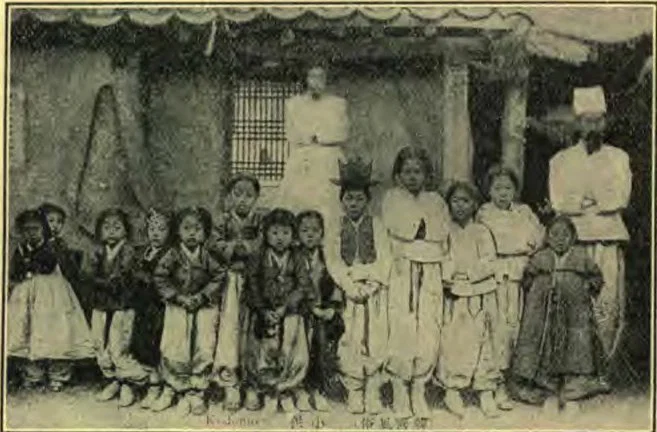
A GROUP OF KOREAN CHILDREN
Scene One
It was an autumn day, not the dry dead autumn so common in most parts of the world, but one that was filled with growing grass and flowers; the very air held the breath of life just as does early spring in California. The sun looked down with more warmth, but upon a sadder picture. The children of Korea were sporting over a thousand hills and fields, for summer’s extreme heat was over, and two of the best months of the year were before them. The cruel winter that lay beyond held no terrors for them, for their young minds had almost forgotten the pangs of the last one, and today they had life and warmth. Why should they worry for the future when today was theirs, theirs with its green grass and flowers and life? And so they ran over the hills and fields, free and happy as the birds, the majority of them unencumbered even with clothes.
But those who were older in years realized that beyond those two months of warmth was winter, cold, relentless, austere, and they were busy preparing for it. On a thousand hills the sun beheld them at their work, cutting grass, stripping branches from the trees, and even cutting the trees themselves where it was allowed. They were gathering fuel for winter. They were doing this work now because the harvest would soon claim them, and some day before the harvest was all gathered and threshed, with the suddenness of a thunderstorm, the bitter Siberian winds would sweep down from the north, and Korea would be folded in the arms of winter.
Then there were other children, but the sun never beheld them; still their moans and dying whispers were heard by the autumn breezes that passed through the village lanes and into the mud huts of the dwellers. These were the children that had failed in the great game of life; the hot summer with its tainted water, unnourishing food, and other unfavorable conditions, had left them with fevers and disease. Hid away in the dark, dismal houses they spent their days of misery, and upon this autumn day the sun seemed to lose his cheery smile as he beheld these little ones carried forth to the hillsides and laid to rest on the bosom of mother earth. The fresh little mounds among the thousands made in former days, told their sad story as the sun dropped from sight beyond the western horizon.
Scene Two
It was late winter. The snow lay in patches over the ground, for the north wind had been blowing for weeks and had swept the ground bare in places. The bright, warm sun came up over the eastern hills, but even his warmth could not absorb all the frost that was in the air. However, as he looked down into a hundred valleys, he did his best to bring hope to the people as he smiled his good cheer. He saw as he glanced down on the network of villages that his warm smile enticed the children from their hiding. He saw them slip out through a hundred thousand doorways, and glide along the sunny sides of the walls. For days they had been huddled under the tattered bedclothes on the floor, for Jack Frost had been busy. He had crept into the rude huts and had made them more drear and cold; even the fires under the floors had failed to drive him away.
In some cases Jack Frost not only entered the houses, but penetrated the forms of the children themselves, and their stiff little bodies had been carried forth and laid to rest on the frozen hillsides, while the moaning of the north wind mingled with the moans of the mourners.
Scene Three
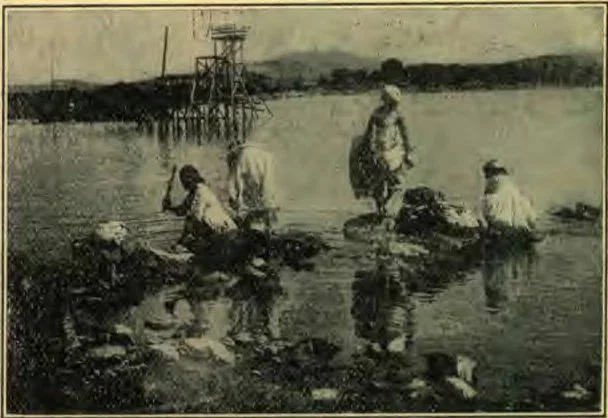
NATIVE LAUNDRY, KOREA
The fury of the winter was spent, and the fresh sunshine of spring flooded the world, and the wind that had blown from the north for months had ceased. In its stead a gentle south wind came from the tropics, carrying with it the breath of flowers. As the sun looked down, he saw the hills and fields covered with purple violets. The breezes listened to the songs of birds, and loath to lose their sweetness, bore the songs4along on their wings. The hum of bees mingled with the songs of the birds, and butterflies danced from flower to flower. The houses that had been sealed from light and air for many months were at last thrown open.
Every brookside was lined with women doing their washing, which the cold months of winter forbade, for even the natives would imitate the spirit of nature and put on clean, fresh garments in springtime. The sun looked down upon the little graves on the hillsides, and spread over each a carpet of green, and then dropped over the western hills, leaving a scene of peace behind him.
Scene Four
It was a summer’s night, and the moon, almost at her full, slowly rose over the eastern hills and majestically wended her course across the heavens, flooding the watery rice fields with glory and beauty. She glanced into the small doors of the mud huts of Korea, and beheld parents and children sleeping on the floor. She saw fewer children, two or three or less in a home; the others were under the little green mounds on the hillsides. And the sad, patient moon knew a story of poverty and ignorance, of vice and false religion; but the children in the rude huts slept on. They could not realize, they could not comprehend, the mists were so thick about them.
However, hope was mingled with sadness, for as the moon told off her cycles she had seen improvements. The sunshine of the Son of God had shined into some homes and some hearts, and others would see the light.
The Books You Read
By M. V. D.
Books! books! books!—gliding from the press like a mighty stream flooding the home, the school, the world. Truly “of making many books there is no end;” and that there is no greater force for good or evil is each year becoming more apparent.
We are correctly told that “good literature is as necessary to the growth of the soul as good air to the growth of the body.” The oft-repeated phrase, “As a man thinketh . . . so is he,” is equally true, and as thinking is largely controlled by the literature read, it is safe to assume that “people will not be better than the books they read.”
Next to the joy of doing good to those whom we can help, the greatest pleasure in life may be derived from good reading. “It is chiefly through books,” said Dr. W. E. Channing, “that we enjoy intercourse with superior minds. . . . Books are the true levelers. They give to all who will faithfully use them, the society, the spiritual presence, of the best and greatest of our race.” A book is a friend and companion in so vital a sense that it often does more for us than teacher or comrade. It slips softly into our silent hours, and leaves with us a spiritual uplift that fills our minds with the perfume of heaven. It matters not how isolated or poor a young man or woman may consider himself or herself to be, he need not pine for want of intellectual companionship, with all the opportunity which good books afford to associate with the best men and women who have lived.
Falling in Love with a Book
“To fall in love with a book is one of the greatest events that befall us,” writes Henry Drummond. “It is to have a new influence pouring itself into our life, a new teacher to inspire and refine us, a new friend to be by our side always, who, when life grows narrow and weary, will take us into his wider and calmer and higher world.”
One peculiar value of a good book is its power to uplift the mind from the daily grind, and to make the beaten track pleasanter and cheerier. This will have the beautifying result of transforming a sad and doleful countenance into a radiance which follows the clear shining of heaven’s light, and cause those who come within the circle of this radiance to covet acquaintance with the Source of all wisdom, in whom there is “no darkness at all.”
Sheep and Goats
But it is good books to which reference is made. “Books, like companions, should be carefully chosen. We cannot always have the choice of our companions, but we can choose the books we read.” “Readers are not aware of the fact,” says Carlyle, “but a fact it is of daily increasing magnitude, and already of terrible importance to readers, that their first grand necessity in reading is to be vigilantly, conscientiously select; and to know everywhere that books, like human souls, are actually divided into what we call ‘sheep and goats’—the latter put inexorably on the left hand of the Judge; and tending, every goat of them, at all moments, whither we know; and much to be avoided, and, if possible, ignored, by all sane creatures.”
The task of selecting the “sheep from the goats” is a problem of more complex nature for twentieth-century readers than of any previous age, due to modern printing inventions which produce such a great variety. Just how to accomplish this division in a sure and safe way is a debated question.
Reading to Discriminate
Some may argue, “But how am I to know that a book is bad unless I read it myself and find out what is in it?” To all such let D. L. Moody reply. When asked if he had read a certain book, he said: “No, I believe there is poison in it, at least I have heard so on good authority.” The friend said, “But wouldn’t it be well to read it for yourself?” “No,” said Mr. Moody. “If I take poison into my stomach, the doctor has to come with a stomach pump and take it out. Why should I take poison into my mind? I might never be able to get it out.” Another writer states: “One may as well touch poison ivy, or walk into a tainted atmosphere, as deliberately to read a bad book and expect to receive no harm.”
The Test of a Book
“If a book is of such a character that one cannot get one’s own consent to lay it aside when health, other work, or the comfort of other people demand it, then it is usually of an unworthy character.” “The world is flooded with novels of every description. Some are not of so dangerous a character as others. Some are immoral, low, and vulgar; others are clothed with more refinement; but all are pernicious in their influence. O that the young would reflect upon the influence that exciting stories have upon the mind! Can you, after such reading, open the Word of God and read the words of life with interest? Do you not find the Book of God uninteresting? The charm of that love story is upon the mind, destroying its healthy tone, and making it impossible for you to fix your mind upon the important, solemn truths which concern your eternal interests.”—“Testimonies for the Church,” Vol. II, p. 236. “In every book we read,5the author hangs some new picture on the wall of our mind. Whether good or bad, it will remain forever. It is for us to decide which it will be. Before we read a book, let us ask ourselves the question, Can I afford to spend my time that way? Is it worth while?”
Food on Dining Table vs. Food on Library Table
Intelligent parents are aware of the fact that food on the dining table must be wholesome for the young folks, but of the food on the library table, many have little knowledge beyond the labels. The books the school-teacher or the city librarian recommends, or the neighbors talk about most, are accepted without serious consideration.
Calling at the home of a Sabbath school pupil, an exceptionally bright girl of twelve years, who had been absent from her class for several weeks, the teacher found her snugly settled among the divan cushions, intensely absorbed in a book, the covers of which bore the appearance of having had constant use. After a few words of pleasant greeting and welcome, the child slipped back into her corner, while the teacher chatted pleasantly with the mother. No reference was made to books or reading, but erelong the child approached and broke into the conversation, by saying, “See, Miss D, this is a good book I am reading, for it has some Bible in it!” and she pointed to some texts of sacred Scripture sandwiched in between paragraphs of an exciting love story. When asked if it was in search of Bible texts that she was reading the book, a look of conscious shame spread over her face, and she laughed at the absurdity of the suggestion. The mother seemed to consider this a very cute expression of childish conviction of wrongdoing, and laughingly referred to the book as one “all the girls are reading,” and that, although she had not read it herself, it was considered standard literature. No wonder the child’s interest in her Sabbath school lesson had waned, and that the mother’s Christian experience was lukewarm. Such cases are not rare, and they afford abundant opportunity to reveal the hidden danger in pernicious literature, and in many cases to bring about a permanent reform and lasting benefit to the character. Parents and teachers, be alert to your duty in this respect, and by precept and example watch for souls “as they that must give account.”
“Gird Up the Loins of Your Mind”
To young people, the inspired suggestion, “Gird up the loins of your mind,” is especially significant, and implies that judgment and reason should rule inclination and feeling. To some this process of “girding” the mind may not be an easy matter. You may have proved the truth of the fact that “a mind educated to feed upon trash” becomes weak and unable to readily retain solid things, and you may find yourself in the grip of a habit as relentless as the chains which bind the opium user. How many bitterly exclaim, “O that I had not ruined my mind by indulging in literary knickknacks which were good for nothing!” Many find just here a battle field of victory or defeat. But victory is assured through absolute surrender—not to your enemy, but to the Captain of your salvation.
None Secure from Temptation
Many a young man and woman confidently assert, “This reading problem does not trouble me. I read what I choose to read, and will stand the consequences.” Be not deceived. Startling is the statement, “Books affect character, and you can as little neglect duty in respect of this as you can safely neglect any other moral duty that is cast upon you.” “Four fifths of the sin and crime in the world today is caused by what men and women read. . . . More people will be shut out of the kingdom of God by the kind of literature they read than from any other cause.” “Satan is constantly leading both the young and those of mature age to be charmed with worthless stories. . . . None are so confirmed in right principles as to be secure from temptation.”
The Telltale Bookcase
Pause a moment to consider the literature menu from which you have been making your daily or weekly choice. What is the nature of the book tucked under your pillow or conspicuously confronting you from bookcase or table? “Our books tell tales of us. Those who look at the books we read may learn from them the true meaning of our lives,” says Margaret E. Sangster. The following interesting personal experience is related by her in the book “What Shall a Young Girl Read?”
“One winter’s day, several years ago, I happened to be a guest in a New England college, and was entertained by a girl who very kindly gave me her room. It was a characteristic room, and, as rooms do, revealed a good deal that belonged to its owner’s personality. The divan with its heaps of gay cushions, the etchings and the photogravures on the walls, the college colors of the girl’s brother, and the dainty equipment of her desk, told their story of one who was away from a dear home, but had carried home’s atmosphere with her. The bookshelf interested me most, and as I ran over the titles of the volumes my young hostess loved I felt as well acquainted with her as if we had crossed the ocean together. A girl’s favorite books very subtly express her tastes and define her culture. Another occasion came when I was a guest in a college, and again a girl gave me her room for a resting place. This was in the West, and in an institution which had little wealth, and where many of the students worked hard to pay their way. My girl hostess here was a heroine who by brave daily toil was earning her expenses and costing her home people not one cent. Her room, too, had its revealing touches, and in her few precious books I saw what manner of girl she was, and discerned what manner of woman she would be.”
Freedom of Choice
The only permissible rule to govern the Christian’s reading is that given by Paul to the Corinthians: “Whether therefore ye eat, or drink, or whatsoever ye do, do all to the glory of God.” Each individual is a divinely appointed free moral agent, and has an equal right to choose mental food and physical food. It is always a wise precaution, however, to give careful consideration to the suggestive whys and wherefores of scientific dietitians, and profit by their extensive research and investigation. It is equally true that the suggestions of those who give much time and thought to literature are of inestimable value to those who want only the best. The literary department of the Young People’s Missionary Volunteer movement is constantly giving most conscientious and painstaking thought to selecting books which are free from objectionable features and which will be thoroughly enjoyed by young people. A suggestive list of nine books is announced for the 1917-18 Reading Courses. No young person, or any one wanting “a book to read” should fail to take advantage of this means of pleasure and culture. The books cannot be recommended6too highly. In addition to the immediate pleasure they bring, they will be a suggestive guide for further selection.
A Resolve
“Say firmly: ‘I will not spend precious moments in reading that which will be of no profit to me, and which only unfits me to be of service to others. I will devote my time and my thoughts to acquiring a fitness for God’s service. I will close my eyes to frivolous and sinful things. My ears are the Lord’s, and I will not listen to the subtle reasoning of the enemy. . . . My body is the temple of the Holy Spirit, and every power of my being shall be consecrated to worthy pursuits.’—“Testimonies for the Church,” Vol. VII, p. 64. M. V. D.
Items from Porto Rico
By Mrs. D. A. Fitch
A SUMMER school for workers is now in session in Cayey, one of the inland towns, with about twenty present. This school will be a great help to the church recently raised up there.
Knowing that the people here need to learn more about our denominational history, and realizing that it is practically impossible from a financial viewpoint for the members to own the books necessary for such study, there is being gathered from J. N. Loughborough's book, “The Great Second Advent Movement,” some of the most important points, which are made the basis of the studies with the Missionary Volunteers.
On a Sunday evening the pastor took occasion to illustrate to the people the ill effects of sleeping with closed windows and doors, as is the almost invariable custom here. A tiny house was improvised from a five-gallon tin can, with doors and windows the same as any real house would have. Lying on its side, it quite well represented a native dwelling house. The family consisted of four candles which, according to size, represented father, mother, and two children. It was then explained that the oxygen of the air is required to support the human organism the same as to keep the candles burning, and it was noted what would follow if the principles were violated.
Having lighted the candles, all openings were closed, and now what happened? The lights became dimmer and dimmer, and soon all went out. Again they were lighted, and an opening left on each side for the free admission of air, when lo, the candles continued to burn, while the speaker proceeded to exhort the hearers to make large use of air.
The people here are very responsive to the admonitions and advice of those in whom they have confidence. The night following the lecture referred to, the writer observed that the dwelling of one of the new converts had its door and window wide open, whereas such had not been the case before. Another one is well aware that fresh air at night is adding much to her efficiency.
One who had left another church and identified herself with us, was chided by a member of the other church as being a dove who left the ark and failed to return. The reply was pertinent indeed: “Why did not the dove return?—Because she found a solid place for her feet.” It certainly expressed a truth which all realize who have come to the light of the third angel's message. This same sister, though not obliged to do so, spent much time on Friday in cleaning the premises. When asked why she did so, replied, “The angels are coming to see us tomorrow.”
One of our church members has worked for the San Juan gas company six years, and is the only man of all the different ones employed who has been retained all that time. One of his sons is also employed by the company. When the manager was asked how he could get along with these men being off on Saturday, he replied, “The — are always to be depended upon.”
In this as in other tropical countries, books and many leather articles are likely to mold, especially in the rainy season. One bright day we had the books from our library opened and airing on the sunny porch. One who was learning a few words of English called, and in course of the visit asked why the books were there. Being told it was to keep them from molding, he said, “I think there are some little germans [germs] in them.”
Our church school closed with appropriate exercises. Two earnest boys were graduated from the eighth grade. One is in attendance at the summer school for workers. MRS. D. A. FITCH.
Secret Prayer or Praying a Secret
By T. E. Bowen
“WHEN thou prayest, enter into thy closet, and when thou hast shut thy door, pray to thy Father which is in secret; and thy Father which seeth in secret shall reward thee openly.” This is secret prayer. It means that what one prays is secret. No one but God hears what you pray.
But this is quite different from the fact that no one knows that you pray secretly. Secret prayer does not mean that your secret prayers are a secret. How often is this recorded of Jesus, “He went up into a mountain apart to pray.” “He withdrew himself into the wilderness, and prayed.” His disciples knew that he had gone to secret prayer. And usually people have a way of knowing today whether or not Christians pray in secret.
Usually one can find a spring. Paths lead to it. Paths are formed by constant travel to and from some given spot. It is said that Phebe H. Brown, who wrote,
“I love to steal awhile away from ev’ry cumbering care, And spend the hours of setting day in humble, grateful prayer,”
had a place in a grove near her home where she daily resorted to pray in secret, and that that path was known by her friends to lead to her secret place of prayer.
It is told of a native Christian in Africa, whose life gave evidence by frequent spells of impatience that he was losing ground spiritually, that a fellow Christian7gently chided him with, “Brother, the grass must be growing on your path.”
In the Christian Union appeared the following:
“Two pastors’ wives were visiting together. One said, ‘I don’t know what we shall do—my husband is so discouraged. Somehow his people do not care to hear him preach, and our salary is far behind. My husband feels so blue that he does not like to visit the people and pray with them, and so he sits around at home nearly all the time.’
“The other sister said: ‘We are getting along fine. My husband spends much of his time visiting, and the people like to have him kneel and pray with them in their homes. Our congregations are always good, and our salary is paid promptly.’
“While the two wives were talking they were mending their husbands’ trousers. One was mending them at the seat, while the other was mending them at the knees.”
A Christian business man of considerable repute had a secret place of prayer in his establishment. And his employees knew both the place and the time. He let no business engagement encroach upon that hour. He left instructions with his office clerk not to call him during this time of secret prayer. One day a man pressed the clerk to take his card to his employer, as he had a very urgent business proposition for him to consider. The clerk then told the gentleman where his employer was, and that under no circumstances would he disturb him.
Which is it with us, secret prayer or praying a secret? T. E. BOWEN.
ELSIE VETTER
By Elsie Vetter
Thankfulness
How is it there is so little
In life that we're thankful for?
We've blessings too numerous to mention;
We could not be given much more.
How is it we can't see the sunshine,
The dew and the morning glow,
The cool of the woods with their shadows,
The song of the breeze, sweet and low?
Oh, why don't we look for the sunset,
Soft colors that blend in the west;
The gleam of the evening starlight,
The world settling down to its rest?
And, oh, there's so much if we'd only watch,
So much of the good and true;
And if you yourself will be full of good cheer,
You'll scatter it all around you.
ELSIE VETTER
For the Finding-Out Club
By Max Hill
A Tale in Nomenclature
DEAR reader, write in as you go,
And fill the blanks to rhyme and scan
With names of writers all should know—
All English and American.
Wise Will it was who asked, “— in a name?”
And we may answer either grave or —:
A — much within the hall of fame
For him whose torch — some pilgrim’s way.
’Tis as we make it in this — world,
As — the — of time is slipping by;
As autumn leaves by foaming — are whirled,
So are we tossed about—now far, now —.
— jocund does he drive his team a—
Who turns with joy the — sod to the rain!
But — to him is every sky revealed
Upon whose foot a — gives him —.
The — are types, as he who runs may —,
And pity ’tis that — learn not the truth;
What — and cries, what cross and weary —!
What galling loads we — from our youth.
Ofttimes hard — may undes— fall,
The — foe a wicked — may be;
Or train of circumstances may enthrall,
And put a fellow under — and —.
And thereby hangs a tale, as poets say,
The story of a wild, unhappy youth;
“Approach and read (for thou canst read) the lay”
That I shall sing, and every word the truth.
’Tis said a cross old lady ’—
Who quite refused to eat a bite of —;
“—,” she said, “I know it is well done,”
The while she watched with ready hand to grab.
Out from the door he shot, with — of fear,
The — old lady too, with shaking fist;
And soon a noisy band had gathered near
With —tatious offers to assist.
The — had left his forge to smolder low;
The — quite forgot the waiting grain;
The —, too, let hoops and staves all go;
With web unbleached, the — ran amain
A canny — was there his part to take;
A —, with his goose as weapon true;
Their — deserted for their neighbor’s sake,
And each advised the wisest thing to do.
The boy sped on; to — and — ran,
Down to the — whose — stream o’erflowed.
“—, come across!”—This to the ferryman,
Who o’er the stream his little boat soon rowed.
And soon the woman and her helpers six—
She had to — all to — the search—
Raced to the stream; but he was up to tricks,
And nimbly hid and left them in the lurch.
Said he, “The folks — cross the stream,
And this old ferryman might join the —;
To — them, I, to hide would safest seem;
They’ll — nigh,” he said with chuckling grunt.
Long time they sought, but found no — there—
Like — bridge, they were all fallen down;
And so through forests — they sought with care
To find some hunter’s —, or little town.
Down through the meads where long-eared — fed—
A —haps—a bleating —, —;
Each filled with fear as on their footsteps led,
Each hoping soon the runaway to see.
A — stretched across they found at length,
From it a little boat by pulley tied;
Though — seemed, and slight her skill and strength,
She hoped ’twould — safe on yonder side.
They tried to — of the dangerous stream,
But she would go, despite the warning shout;
Far out she swung, then sank with piercing scream;—
She hadn’— to help her out.
A mighty shout arose; an answering —
Came o’er the raging waters’ roar and —;
The boy appeared, too late to help—The tale
Should be a lesson to all wayward boys.
O wilful youth and scolding age, take heed,
The moral of my story do not spurn,
But — all the means that upward lead
If you the way of happiness would learn.
Though hard may be the course of mortals here,
Let every — be brave to do and dare;
Be true as —, nor ever sink in fear;
Success awaits; yield not to gloomy care.
Be — in each task that comes to you;
— in your mind the truth each wise man learns;
Be not a — that when a meal is due
Stands dreaming till the — — —.
“—” there comes a day amidst the strife
When each must, though he — on the —
Whereon is written every deed of life,
What — was, in childhood, youth, or age.
Then humble names may rise to halls of fame,
And be the day or short or weary —
— of man, on high shall ring your name
Eternal in the notes of living song.
MAX HILL.
A Book for Juniors
“THE White Queen of Okoyong” is the title of an unusually interesting book which sketches the work of Mary Slessor among the natives of Calabar, Africa. Mary Slessor was a young Scotch woman who spent more than a score of years evangelizing and civilizing the heathen African. The story of her almost incomprehensible influence over, and work for, the natives, is charmingly told in this book, by Mr. W. P. Livingstone. Price, $1. A larger volume, written for adult readers, entitled “Mary Slessor of Calabar,” sells for $1.50. Order of the Review and Herald Publishing Association, Takoma Park, D. C.
“Bible Picture Cards Free”
By Editor
THE notice which appeared in the INSTRUCTOR of July 3, offering free Bible picture cards, has brought in so many requests that our stock of these old cards is entirely exhausted. We are therefore unable to fill all requests which have come to us. Do not send stamps for cards unless you see another statement in the INSTRUCTOR.