Your ShelfYour Projects

Review and Herald, Vol. 93, No. 41.

The Voice of Infinite Love
Earlier text: Statement of Twenty-Cent-a-Week Fund for Six Months Ending June 30, 1916

T. E. BOWEN

Nearing the End — No. 1

T. E. BOWEN

“Yet a little while, and he that shall come will come, and will not tarry.” Heb. 10: 37. This text of assurance is thrown in between others of earnest exhortation to those who shall be living at a time when the church is waiting for the return of her Master. Some will be giving up hope, for we read, “Cast not away therefore your confidence, which hath great recompense of reward. For ye have need of patience.” “Now the just shall live by faith: but if any man draw back, my soul shall have no pleasure in him. But we are not of them who draw back unto perdition; but of them that believe to the saving of the soul.” Verses 35, 36, 38, 39.
To entertain doubt; to disbelieve that the coming of the Lord is really nigh at hand; to unite with worldlings in their pleasures, their ambitions, their follies, is to draw back unto perdition. To believe “to the saving of the soul” is life everlasting. The Lord intimates that patience will be needed by those who look for him; that the danger will be that the waiting ones will cast away their confidence; and he assures them that he will come in “a little while, . . . and will not tarry.”
As those looking for our Lord, we certainly do need often to assure our hearts by rehearsing the evidences of his coming, lest we become weary and faint in our minds.
The great signs hung out in the heavens have come to pass just as Jesus foretold. The sun has been darkened, the moon has failed to give her light, and the stars have fallen from heaven. Each passing week the conditions among nations tell us that it is to be only “a little while” that the saints are patiently to work and wait. Events in the Near East point unmistakably to the last event given us in the Word to take place among nations before Christ stands up for the deliverance of his people. In a general way, we all believe that the coming of the Lord is near.
The personal coming of Jesus on the cloud, attended by all the angels of glory, will be preceded by another event of very great importance to the world, for it is at this time that Christ will lay down his mediatorial work, and when he does that, every person’s destiny is sealed, sealed for life or death to all eternity. The time, therefore, between the present and this important future event, is weighty with possibilities for weal or woe. Eternal destinies hang upon the outcome of the choice men and women make now. After the passing of this period of time, whose limit is known only to the Father himself, there will be no further opportunity to obtain eternal life. Then the harvest will be past, the summer ended, and the work of the gospel finished.
Let us examine the events to take place at this particular time in question:—
1. Jesus’ priestly work ends. Rev. 22: 11, 12.
2. The Son of God is summoned by the Father to come near before him to receive his kingdom—the whole earth. Dan. 7: 13, 14, 27.
3. The time of trouble such as never was since there was a nation begins upon earth, involving the whole world (Dan. 12: 1), and the seven last plagues, described in Revelation 16, fall upon a lost world.
4. The third angel’s message, the last gospel message to the world, closes.
5. The terrible world famine for hearing the Word of God begins. Amos 8: 11, 12.
6. The door is closed, shutting the saved in and the lost out, as when the mighty angel from heaven descended and slowly closed the ponderous door of Noah’s ark. Matt. 25: 10.
7. This event comes suddenly upon all—the remnant church and a lost world. Mark 13: 32-37.
By these events here outlined, it is evident that the time thus spoken of in the Word should stand out prominently before the mind’s eye, especially to us who look for the coming of the Lord Jesus, and who entertain the blessed hope of becoming subjects of his kingdom. It is very important that we let no man deceive us, and that we have our eyes upon the right event, clearly discerning the signs of the times taking place all about us.
Takoma Park, D. C.

A Visit to Swatow and Amoy, China

J. E. FULTON
I LEFT Hongkong by the steamship “Haitau,” in company with Pastor B. L. Anderson. After one stormy night at sea on this small steamer, we arrived about breakfast time at Swatow, where we were met by Pastor J. P. Anderson, who is in charge of this district, and Pastor T. K. Ang, our native evangelist. We did not have very long to stay at this place, so we tried to spend the time well by using the few hours in visiting the points of interest in our work centered here.
First we went to see the new piece of property which has been purchased, and upon which our brethren desire to build soon. Land in good locations is very expensive in the large cities of China, and the Swatow property has had to be filled in to a depth of several feet to make it suitable for building purposes. It is upon a branch of Han River, and will make a very convenient location. On account of the war, building materials have greatly increased in price, and it seems impossible to erect the buildings with the amounts allotted for them.
We visited the girls’ school conducted by two of Pastor Ang’s daughters. They have about one hundred pupils. We wish many of our readers might see this school. The girls are bright, well dressed, and clean, and the school is a real credit to the denomination. Students are coming to us from other schools, but we must turn them away, for more cannot be admitted because of the limited accommodations.
We had dinner at Brother Ang’s pleasant home. Everything was neat and clean, and prepared in Chinese style. All but myself ate with chopsticks. I tried, but as it was so awkward for me, I was provided with knife, fork, and spoon.
We wish all might see Brother Ang and his interesting family. There are five girls and a son. The son is away from home at present, but we saw the others. They seemed to us a model family, and we were informed by our missionaries who have long known themthat they are always as we saw them—wonderful examples of what the grace of God has done.
All will be sorry to learn of Sister J. P. Anderson’s sickness, which makes it necessary for her and her husband to leave the country for the present. Sister Anderson had been failing for some time, when it was at last discovered that she had sprue. They are now in America to regain her health. This is a great loss to the work, as Brother Anderson had charge of both the Swatow district and the Hakka field during the furlough of Brother S. A. Nagel. Brother and Sister Anderson have labored faithfully in China, and their services are greatly needed. Pray that God may restore her to health speedily.
Amoy is the headquarters for our work in south China. Here is the home of Pastor B. L. Anderson, the superintendent of the South China Mission. Brother W. C. Hankins and Brother Floyd Bates also live at this important center. We were glad of the opportunity of visiting at the homes of these brethren. Pastor Anderson has a beautiful home on the very top of the hill on the island of Kulangsu, right against some immense rocks. Their house commands a fine view of the harbor, and later as the steamer passed out of the harbor, we could see Sister Anderson waving to us from the veranda. Brethren Hankins and Bates live in most pleasant quarters nearer the water.
On the same island, and not far from where our missionaries have their homes, the training school building is now nearing completion. The brethren are to be commended for the neat and attractive appearance of this building. It is expected that it will accommodate about sixty young men. There is great need for such a school here where young men can be trained for the ministry and other lines of Christian endeavor.
In building, the brethren have found that the cost of building material has risen very much, and it will be necessary for them to call for some additional appropriations for next year.

Six Nations’ Reservation, Ontario, Canada
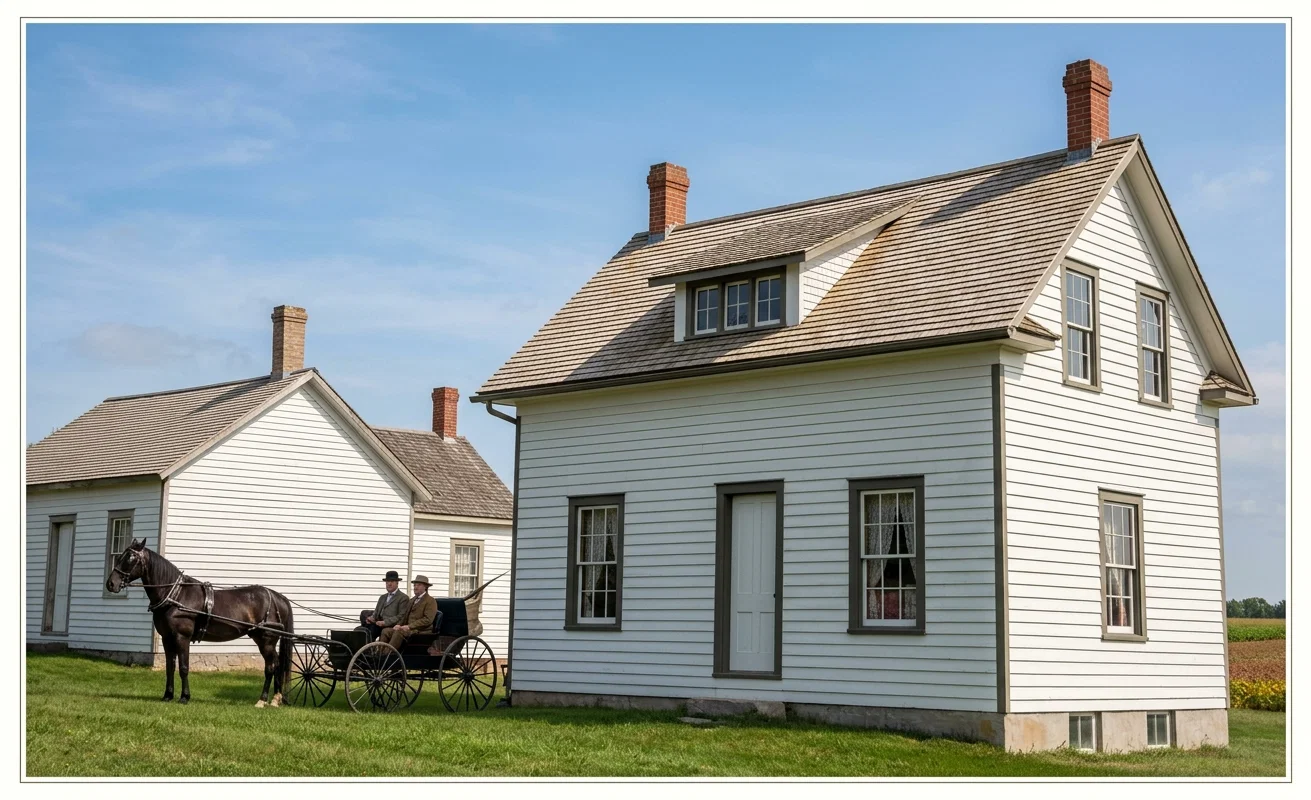
B. E. MANUEL.
THIS reservation is south of Grand River, and seven miles east of the city of Brantford. It has an area of about one hundred square miles, and a population of five thousand. The principal occupation of the Indians is farming.
SIX NATIONS' MISSION HOUSE, HAGERSVILLE, ONTARIO
There are seven tribes, speaking as many dialects. Most of the people, however, have some understanding of English, which is the only language taught in the schools, and some can speak no other.
About two thousand of these Indians still cling to their pagan rites and ceremonies. They have no books, and are opposed to schools. This makes it difficult to reach them with the gospel.
We began work among these Indians a number of years ago, and two churches were raised up. They were left, however, without a worker, and as the result quite a number dropped out. Some have remained faithful, and are doing their part to give the message to others.
Our great need at present is a school where we can teach the children and youth right principles. Remember this work in your prayers.

Somabula Mission, Rhodesia, South Africa

H. M. SPARROW
HAVING just returned from visiting the Shangani outschools, I will relate one or two experiences which may be of interest to the friends in the homeland.
The first Sabbath was spent with our first outschool, twenty-five miles from Somabula. The morning service was turned into a revival meeting, and the Spirit of God worked miracles among us. One of the first to bear a testimony was the head chief. This chief at first would do anything but grant us a school site. He was quite bitter, until at last Brother J. N. de Beer, our superintendent, approached him. It happened that there were quite a number who wanted teeth drawn. Brother de Beer's success was more than can be credited to human skill alone; God blessed his efforts in extracting every tooth. This softened the old chief's heart, for he saw that we were here for the good of his people.
Today he feels that he cannot do enough for us. There has been a very severe drought in his territory, and if it were not for the wonderful way God is working for the heathen, the government would have to feed them. In one forest there is such an abundance of honey that the natives in the vicinity have taken their families and gone to live there, to subsist on honey and herbs. The chief's own words in his testimony were these:—
“Almighty God, you have placed me here to rule these people. Now give me wisdom as you did the leaders of the children of Israel, that your work may prosper.”
It did our hearts good to hear those words from a man who was once so bitter. Can you imagine their coming from a heathen chief's lips? It is only the gentle touch of the quiet Spirit working upon his heart.
Our work in Shangani has now a good foothold. The message is making rapid progress among the heathen kraals. Already the fruit is budding, and soon we expect to see some accept the truth.
I will tell you about one old native and his wife. When a little girl, their daughter, who is now the wife of an outschool teacher at Glendale Mission, began going to our school in Shangani, against her parents' wishes. They forbade her and beat her, and then she ran away from home and came to our main station at Somabula. Here she learned to read the Bible and was converted. She returned home and began reading the Bible to her parents.
The result was they were converted, and today they are faithful Sabbath keepers, although they cannot read a word of their own language. That is certainly strong faith. It means much for an old couple such as they to leave their tywala (beer) and smoking. The other natives simply marvel at it. Their faithfulness has awakened an interest in the neighborhood, and there is now a call for a school. So the good work is going, and the living God is working in a wonderful way. We are of good courage to press on with new zeal as we pass through these experiences.

Good News from a Far Country

PETRA TUNHEIM
During my twelve-month furlough I have had quite a number of letters from my far-away mission field. They have brought great joy to my heart, and hoping they will bring as much to you, I give some of the contents of a few.
Brother F. A. Detamore, the superintendent of our Malaysian Mission, writes me of the great awakening in Borneo, where he had been visiting recently. He says it is wonderful how the message is going. “We can hardly keep pace with it. At Sarawak, the place where Brother R. P. Montgomery was not able to work on account of his health, there are about forty who have begun to keep the Sabbath. We are urging a Chinese dentist to go there and practice. His wife, who is a Bible worker, can instruct the believers, so they will become established in the faith. Then I will go over and baptize them.”
At another place not so very far from Singapore there are fifteen or twenty who have begun to obey the message.
We have in Singapore a young Chinaman who has gone around to many different islands with our literature, especially taking subscriptions for the Chinese Signs of the Times. The result is that there are many Sabbath keepers in the different places where he has faithfully sown the seed.
Sister G. A. Wood writes me from the East Java Mission: “A boy came here about a month ago from Timor, who has been receiving the Messenger of Truth from you. He was a teacher in a government school, but left his position, as he could not keep the Sabbath. He came here in a small boat, for the purpose of learning more about the truth. His plan was then to go back and tell his people what he had learned. He has been staying with us, and has shown himself a bright and earnest pupil. Now he has decided to go to school, so he will leave for Singapore, all being well, next Friday. Just now he is busy making some clothes for himself, so you see he is quite handy. He wants to work his way through school. That is what usually makes men out of boys; but we shall be glad to help him some, if he should need it. It will rejoice your heart to hear that the paper is doing some good, and I know you will unite with us in praying for this boy, that he may be sincere, and be able to return to his own land to give the message there.”
Will not you who read this good news unite in prayer for this young man?
Before I left Java I had several letters from him, stating that he wanted to obey the truth. Now we see that the seed was sown in good ground and has sprung up. Oh, what a precious message!
When it first enters the heart, with its sweet, convincing influence and impressive power, it brings a perfume of heavenly joy and love, and an atmosphere of peace. When such a message comes to a man or woman, whether the skin is black or white, brown or yellow, the first thought is to give it to others.
Let us seek the Lord earnestly, that we may be brought back to our “first love.”
Sister Pauline Hoeke, one of our first Sabbath keepers in eastern Java, writes me: “Sister Wood and I canvass the people twice a week. In many homes they accept the literature. We also lend them tracts. It was through such work as this that I was brought into the truth. We also canvass Grisseesche Weg, the place where we were living when you came and lent us tracts and held readings with us. We also have Bible studies in the home of one of my friends, and now we have begun to study the Sabbath question. This lady says she tries to keep that day holy. Dear Sister Tunheim, remember us in your prayers.”
If you could have seen Pauline when I first went to that home, and see her now, you would say, with the prophet of old, “What hath God wrought!” Pauline’s mother had been a Spiritualist medium for years, and constantly held communication with the spirit world, until finally the power of God’s Holy Word convinced her that it was all Satan’s work. Pauline was a stubborn girl, and had no desire for anything religious, or for anything that pertained to godliness. Her parents made her come in to the studies, and in anger she would turn her back to me while I gave the reading. We prayed earnestly for the power of the Holy Spirit to touch and melt this hard heart, and our prayers were quickly answered. Pauline attended school in Australia for five years, and now she has a part in the work.
Sister Duckworth, of western Java, sends a message of joy and courage: “You will be glad to hear that Brother Tan Ek Yoe has gained a complete victory over the opium habit. He was very ill one day last week, and they really thought he would die; but his faith was strong, and he was quite well the next day, and now looks the picture of health. He came to Sabbath school last week, and we all joined in thanking God for his goodness to the returned prodigal.”
This man is sixty-eight years old; and another one, Nicodemus, at the age of sixty-three, has also gained the victory over opium. These two old men have spent nearly half their lives in the opium dens, but now, through divine power, they have gained a victory which has given them comfort, joy, and hope.
Sister Tan Ek Yoe writes me about a heathen man who was a slave to opium. She helped him to get into a hospital for opium slaves. He gained the victory over the habit, and his gratitude to Sister Ek Yoe for helping him led him to study the Bible with her, and he finally accepted the whole message with earnestness and joy. The last mail brought the news that this man had just been baptized.

Baptismal Service in San Pablo

ANOTHER baptismal service took place in San Pablo, P. I., Sabbath, June 10, writes Brother L. V. Finster, at which time forty-one candidates followed their Lord into the watery grave. This makes, in all, one hundred and seventy-one accepting the truth at this place as the result of a series of tent meetings. Often audiences of one thousand attentive listeners have heard the message presented by one of the Filipino evangelists.

Encouraging Reports from Nigeria

Brother Babcock writes from Ilorin, Nigeria, that he recently visited two outstations. At one, Ipoti, he found 78 believers. Of another he says, “We had 130 believers present. I counted 53 bright young men in that company, and most of them read their own language. We had excellent meetings.”

Humility Before Exaltation

“Whom God would greatly exalt he first greatly humbles; and when he has an especially bright crown for a soul, he first imparts an equally heavy cross.”

Why Our Children Should Go to Church School

The children of the church are its most precious asset. They are its hope, its promise. Properly instructed, surrounded by holy influences, they grow up to carry the burdens that must be laid down by older hands.
The church that fails to hold its children, though it moves heaven and earth to win men and women to its fold, must ultimately fail.
The churches of America realize this, and within the last decade a movement has sprung up having for its object the winning and holding of the boys and girls. Thousands of children, and of youth in their teens, now flock to the Sunday school, where hundreds went before; and earnest men and women are putting forth every effort in their power to make churchgoing and Bible study a habit with them. Boys as well as girls are interested; and in village and suburb, as well as on the congested streets of our biggest city, it is no unusual sight on Sunday morning to see groups of boys from ten to sixteen years of age going churchward with their Bibles under their arms.
Every movement that tends to make the children familiar with the Bible is to be commended; but with one notable exception most of the churches drop their responsibility in this matter when the Sunday school and the Junior Pulpit hours have passed. The Catholic Church, however, never lets go of its own children, gathering them into its church schools, and instructing them daily in its doctrines, polity, and worship. Not only so, but thousands upon thousands of the daughters of Protestant parents have been won to Catholicism through the influence of its schools and teachers. “So true is this,” says the president of a woman’s college, “that in their schools for girls in particular there is no need for proselyting effort, because the all-prevailing presence of the Catholic worship, to which they must conform, inevitably accomplishes its task.”
All this goes to prove, if proof were needed, that the daily influences surrounding a child during its foundation-laying school years determine in large measure the course of the later life. If we choose the worldly school because of its convenience, its lack of expense, its popularity, and commit our children to its care, can we wonder if they form their friendships with the children of these schools, and are more or less, even perhaps unconsciously, drawn away from the truth by worldly influences?
The years from eight to twelve are called by one writer “a plateau in the life of the child.” What is thoroughly learned during those years can never be entirely lost. “The child’s mind receives peculiar impressions at this time. Drill, habituation, tables, even dates, and to some extent statistics and vocabularies that are essential, can be indelibly stamped on the mind, so that when the child later comes to years of maturer age and intelligence, it will rejoice to find itself in secure possession of fundamental acquisitions that are indispensable for the conduct of its life.”
If it is important—and many wise and good men are declaring that it is—to send young men and women to denominational colleges, is it not likewise doubly essential that during these early formative years the children shall be taught in the home school and the church school? Moses, taught by his godly mother, never forgot the God of his fathers nor lost sight of the promised deliverance; and dare we, standing in this later day of deliverance, neglect the means provided in the church school, not only to give spiritual development to our children, but also to prepare them for future usefulness in giving the message to others? “For children who are receiving a Christian education will be witnesses for Christ. As Jesus in the temple solved the mysteries which priests and rulers had not discerned, so in the closing work of this earth, children who have been rightly educated will in their simplicity speak words which will be an astonishment to men who now talk of ‘higher education.’ As the children sang in the temple courts, ‘Hosanna; Blessed is he that cometh in the name of the Lord,’ so in these last days, children’s voices will be raised to give the last message of warning to a perishing world. When heavenly intelligences see that men are no longer permitted to present the truth, the Spirit of God will come upon the children, and they will do a work in the proclamation of the truth which the older workers cannot do, because their way will be hedged up.” “Testimonies for the Church,” Vol. VI, pp. 202, 203.
In a few weeks thousands of children from Seventh-day Adventist homes will reenter school or begin it for the first time. Shall we carefully weigh the question of where they shall go, and for whose service they shall be trained? If the church school needs help, are we willing to sacrifice for it? Shall we not pray for it and for all who bear its responsibilities? And having done all we can to help it, shall we not send our children there to receive the blessing of daily instruction in the things that pertain to righteousness? MRS. I. H. E.

A Chapter from Life

L. A. S.
NEARLY fifty years ago the lives of two young people were blended into one, and a new home was started. They were poor in this world’s goods, but rich in love and health and happiness. They left their native State, and came by “prairie schooner” to the Middle West, and settled on a homestead.
When they left their parental homes, each father had given them a good horse and cow; and packed away in a large chest was a new “feather bed,” and for those days an ample supply of homemade bedding, which had been prepared by the bride and her mother. They were cozy and comfortable in their neat little sod house. At once they began to plant corn, potatoes, pumpkins, melons, and all kinds of vegetables, and their labor was rewarded with a good crop.
In the fall the wife was engaged to teach the district school for twenty-five dollars a month. This seemed like affluence, and helped greatly in providing tools and farming implements, also a few comforts for the home. The next year a baby boy came to add to their happiness, and a few months later the family moved into a new frame house of two rooms, of which they were justly proud.
There was not much shopping done in those days, as the nearest trading point was twenty-five miles away; nor was there any such thing as a charge account. A load of wheat or corn from the farm, with perhaps some butter and eggs, was taken to town, and exchanged for what was needed in the house. Ina few years railroads were built through the country, and little towns and villages sprang up almost in a night. This change enabled the family to drive into town and do their trading, and be back home at noon. Still there was very little real money handled, and of course only one purse was needed; but the kind husband always said, “It is just as much yours as mine,” and when the wife asked for money, she always received it. She knew what they could afford to buy, and was just as anxious to live within their means as was he.
Sometimes she used to wish she could earn a little money of her own, so she would not have to ask her husband for it, although he was always willing to give it to her. But there were other babies by this time, and household duties were many, including the work of taking care of the milk, making butter, raising chickens, etc., so she banished the thought from her mind.
After twenty years on the farm the family moved to the city, that the children might have better school privileges. Up to this time the husband and wife had always gone together on their little shopping expeditions, and really there was no need of two purses. Often he had said, “I think it much nicer to have just one purse, and both use it; for husbands and wives often have misunderstandings over that very thing. One will say, ‘Now you buy this with your money, and I’ll buy this with mine;’ but the other will say, ‘You ought to pay for this or that.’ Now this would not happen if there were only one purse, and both felt free to draw from it.”
If there was a call for charity or for church or missionary work, they always talked it over, and decided what they could afford to give; but the wife used sometimes to think it would be a real pleasure to have a little money all her own, and decide all by herself whether she should spend it on herself or deny self and give it to some worthy cause. However, so closely did John and Mary agree in almost everything that the things they did not see alike were not worth talking about.
After the children were grown, the daughter was overheard remarking to a friend, “We children can never remember hearing our father and mother argue or dispute over anything. They always seem to look at things just alike.”
A few days before John’s birthday in a certain year, several dollars came very unexpectedly into the possession of the wife, and it was such a pleasure to buy him a nice birthday present. When the morning came, she was so happy over his words of appreciation, and when evening came, and they were sitting alone, he thanked her again. With tears of happiness in her eyes and voice, she said, “Do you know this is the first birthday present I ever gave you?” He said, “Why, what do you mean? You always give me something, perhaps not quite so nice as this, but always something that I appreciate.”
“But I mean this is the first present that I ever really gave you. Always before I have gone to your purse and taken the money (for of course I wanted it to be a surprise), and I always felt like a thief, and thought I might as well leave the money there and let you buy your own present.”
Then the tears were in his eyes, and he exclaimed, “Why, mother, do you feel that way about it?”
“Every woman feels the same way,” she answered, quietly.
They sat together and talked it all over. She told him she did not want to be “independent,” and buy all her own things; she would much rather the arrangement remain as it was; but she would like to have a certain small amount each month to regard as her very own, and spend or save just as she pleased. Quickly this was agreed upon, and when John saw how happy it made her, they were both sorry they had not talked it over long before.
This little chapter from life is related in the hope that it may help some good husband to realize that although his wife may love him better than her own life, and have implicit confidence and trust in him, yet it would add greatly to her happiness if he would trust her with ever so small an amount of money each month, not because she wishes to be independent or have any secrets from him, but because she could plan many pleasant little surprises for him and the children. Just try this plan, and see how much it will add to your own happiness. You will never want to go back to the old way.

Home Life Department

Conducted by Mrs. I. H. Evans, Takoma Park, Washington D. C.
Assisted by Miss Lora E. Clement
Through the columns of this department, hints will be given on all matters pertaining to the home life. Short articles and letters are solicited from home makers, telling of their everyday experiences,—their joys and sorrows, their failures and successes.

Prayer for the Children

FATHER, our children keep! We know not what is coming on the earth; Beneath the shadow of thy heavenly wing, Oh, keep them, keep them, thou who gavest them birth!
Father, draw nearer us! Draw firmer round us thy protecting arm; Oh, clasp our children closer to thy side, Uninjured in the day of earth's alarm!
Them in thy chambers hide! Oh, hide them, and preserve them calm and safe, When sin abounds, and error flows abroad, And Satan tempts, and human passions chafe!
Oh, keep them undefiled! Unspotted from a tempting world of sin; That, clothed in white, through the bright city gates They may with us in triumph enter in. — Horatius Bonar.

“Diet Hints from the Seventh-day Adventists”

N. Z. TOWN
In these days when we hear and read so much about the high cost of living, it is interesting to see that some writers find a solution of the problem in the dietary principles and practices of Seventh-day Adventists.
The Pathfinder, a weekly newspaper published in Washington, D. C., in its issue of July 29, calls attention to this matter in the following article, under the heading “Diet Hints from the Seventh-day Adventists.” We are glad to see others recognizing the value of right ways of living, and we hope that the influence of those principles which have done so much for us may continue to extend. Here is the article:—
“In this day of high-priced foodstuffs—especially meat—it is interesting to see how the diet problem is solved by the Seventh-day Adventists, who make a specialty of these things. Hand in hand with their religion goes their creed of health, which forbids the use, as far as possible, of all injurious elements in their food.
“To begin with, they eat no meat, because a large percentage of it is diseased. Meat is also more expensive, for the nutritive value, than vegetables; it is largely stimulative, and it is harder to digest.
“In place of meat, these people use other nitrogenous foods, such as peas, beans, lentils, and nuts.
“The Adventists serve no tea, because of the theine it contains, and they use a cereal coffee in place of the ordinary coffee, which contains caffeine.
“For seasoning, they use salt, cooking oil, onions, sage, and thyme, avoiding condiments such as pepper, ginger, cloves, and others of the same type, which stimulate the stomach. Water in which rice or potatoes is cooked, is saved because of the starch it contains, and this is used in soups and gravies.
“A seaweed called agar-agar is soaked, washed, cooked, and substituted for gelatin. Cereals and fruits, milk and eggs, play an important part in the dietary. On the whole, it is remarkable how little difference there is in the taste of the food, compared with the ordinary menu.
“Here are some sensible suggestions from the Adventists’ dietetic creed:—
“Good digestion depends as much on the condition of the mind as on the nature of the food or the condition of the stomach.
“The best preparation for good digestion is a good appetite, with a keen relish for simple foods.
“For many persons, two meals are better than three. If the last meal is eaten late, there is less appetite for breakfast.
“It is well to use daily some uncooked foods, such as nuts, fruits, or salads. There appear to be in uncooked foods certain principles of importance in the animal economy that are destroyed by heat.
“It takes courage to wait for a good appetite, but the consequent pleasure and the improved health are worth the effort. If there were less eating without an appetite, there would be less digestive disturbance.
“Eating between meals or at irregular times is a sure way to spoil the appetite and make it necessary to add artificial flavorings to the foods in order to make them palatable. ‘Hunger is the best sauce.’
“Take time to eat. Food carefully masticated is half digested. More digestive trouble is caused by swallowing the food hastily than by any other one thing.
“Use sweets sparingly; be moderate in the use of salt; avoid the use of condiments and pungent foods.”

The Life that Counts

THE life that counts must toil and fight, Must hate the wrong and love the right, Must stand for truth by day, by night— This is the life that counts.
The life that counts is linked with God, And turns not from the cross, the rod, But walks with joy where Jesus trod— This is the life that counts.
— The Gateway.

Honoring God in Times of Trial

“HE who is willing and anxious to honor God will some day have the opportunity, even if it takes a lion’s den or a fiery furnace to help him out.”
Continue reading: Another Pioneer Laid to Rest