THERE is one God, and one Mediator between God and men, the Man Christ Jesus. 1 Tim. 2:5. It is He that “maketh intercession for us.”
“Now a mediator is not a mediator of one.” Where mediation is, there must be two parties—usually at variance. And the mediator always seeks to reconcile; never the opposite.
Says the Holy Spirit: “Your iniquities have separated between you and your God, and your sins have hid His face from you.” Isa. 59:2. “The carnal [natural] mind is enmity against God.” Rom. 8:7. Hence the need of mediation.
Our Mediator is our “Advocate,” our “Intercessor.” He condemns no one (John 3:17); accuses none (John 5:45). Another party has that matter in charge.
A Priesthood
Christ, in His office as mediator between God and men, is the “Apostle and High Priest of our profession.” A detailed account of this priesthood may be found in the book of Hebrews—mostly in chapters two to ten.
In this narrative two priesthoods are found, the priesthood of Melchizedek, and the Levitical order. And while Christ was made a priest forever, after the order of Melchizedek, yet all the Aaronic priests served “unto the example and shadow of heavenly things.”
Melchizedek was a priest-king. So also is Christ. In his priesthood, Melchizedek had no predecessor or successor. Neither has Christ; for “He ever liveth to make intercession for us.”
In none of these particulars did the Levitical order represent Christ; yet the minutest detail of their service was “a shadow of good things to come.”
That He might be adapted to His work, Christ partook of human nature; “for verily He took not on Him the nature of angels; but He took on Him the seed of Abraham. Wherefore in all things it behooved Him to be made like unto His brethren, that He might be a merciful and faithful High Priest in things pertaining to God, to make reconciliation for the sins of the people. For in that He Himself hath suffered being tempted, He is able to succor them that are tempted.” Heb. 2:16-18. “And He was numbered with the transgressors; and He bare the sin of many, and made intercession for the transgressors.” Isa. 53:12.
A Friend of Sinners
On earth, He was sneeringly called a “Friend of sinners;” was crucified “between two thieves;” and “made His grave with the wicked.” All this, “that He might be a merciful and faithful high priest.”
And so it is written that “every high priest being taken from among men, is appointed for men in things pertaining to God, that he may offer both gifts and sacrifices for sins; who can bear gently with the ignorant and erring, for that he himself also is compassed with infirmity.” Heb. 5:1, 2, A. R. V. The authorized version says: “Who can have compassion on the ignorant, and on them that are out of the way.” The marginal reading is “can reasonably bear with,” etc.
Nothing short of this can fitly represent a compassionate Redeemer, our Advocate at the Court of Final Appeal. Nothing less could possibly be the priesthood in type.
A Great Human Type
Such an advocate was Moses. Throughout that forty years they were murmuring, transgressing, accusing him of perfidy; and yet his patience never failed but once.
After the idolatry at Sinai, “Moses returned unto the Lord, and said, O, this people have sinned a great sin, and have made them gods of gold. Yet now, if Thou wilt forgive their sin;—and if not, blot me, I pray Thee, out of Thy book which Thou hast written.” Ex. 32:31, 32. Here was a typical advocate.
Such also was the work of Aaron and his sons when they had been installed as priests. Such was the office of the family priest; as Abraham, who erected his altar wherever he pitched his tents; as Job, who continually sacrificed and interceded in behalf of his children. Such is the attitude of every converted parent toward his family, and sinners in general. “The Spirit itself maketh intercession for us with groanings which can not be uttered.” Without this, no one can plead; with it, who can refrain from pleading?
Lacking the Spirit, priesthood becomes priestcraft, and all their ministry a hollow form, a blasphemous mockery. Thus it was in Jeremiah’s day (Jer. 5:31); so also it was to be when Christ first appeared: “And He saw that there was no man, and wondered that there was no intercessor; therefore His arm brought salvation unto Him; and His righteousness, it sustained Him.” Isa. 59:16.
“There is one God,” means there is only one. “One Mediator between God and men,” as naturally means, there is one only. The Spirit intercedes, mediates; and He is the source of the Spirit. It is therefore the Spirit of Christ in men which pleads for sinners, and that is “Christ in you, the hope of glory.” “There is one Mediator.”
Such was Abel. Not so was Cain.
In Israel
At Sinai the twelve tribes were offered the priesthood; but only one received it. Said the Lord, “If ye will obey My voice indeed, and keep My covenant, . . . ye shall be unto Me a kingdom of priests, and an holy nation.”
Every man among them might have been a priest, a mediator between God and the heathen; but they were not fitted for such a place. Therefore one tribe, and one family in that tribe, alone must act. Aaron and his sons, interceding for the rest of Israel, when all might have been, should have been, priests for the rest of mankind.
So of Christians: “Ye are a chosen generation, a royal priesthood, an holy nation” (1 Peter 2:9), just as Israel might have been. Every real Christian is this, because Christ is; for “Christian” means like Christ. Wherein we lack the Spirit of mediation and intercession, we lack the Spirit of Christ. Wherein we have the spirit of condemnation and censure, we have the spirit of Satan, and can be no part of the royal priesthood.
Those who shall inherit the earth redeemed are recorded as saying to Christ: “Thou . . . hast redeemed us to God by Thy blood out of every kindred, and tongue, and people, and nation; and hast made us unto our God kings and priests; and we shall reign on the earth.” Rev. 5:9, 10.
“Unto Him [then] that loved us, and washed us from our sins in His own blood, and hath made us kings and priests unto God and His Father; to Him be glory and dominion forever and ever. Amen.” Rev. 1:5, 6.
San Francisco, Cal.
The Coming of Christ
By John Calvin
THE Scripture uniformly commands us to look forward with eager expectation to the coming of Christ, and defers the crown of glory that awaits till that period.—John Calvin, “Institutes,” book 3, chapter 25.
THE CLOSING WORK OF OUR HIGH PRIEST
By W. N. Glenn
THE 2,300 DAYS
THE mystery of God is the sacrifice of Christ and the work of the Gospel. 1 Cor. 4:1; 1 Tim. 3:16. Some day this mystery will be "finished." Rev. 10:7. A time will come when the Lord will say: "He that is unjust, let him be unjust still; and he which is filthy, let him be filthy still; and he that is righteous, let him be righteous still; and he that is holy, let him be holy still. And, behold, I come quickly; and My reward is with Me, to give every man according as his work shall be." Rev. 22:11, 12.
Of Christ's priesthood in heaven, and the closing of the work of the Gospel, we may learn more specifically from the typical system of the Aaronic priesthood. That was an object-lesson for the instruction of men throughout probationary time. The earthly tabernacle was after the pattern of the heavenly, and its service was illustrative of the service of Christ in the heavenly sanctuary. Heb. 8:4-6. See also Rom. 15:4.
In the typical system the whole plan of salvation was worked out in type every year, and the last day of the year was a special closing service. It was called the Day of Atonement, and the service was called the cleansing of the sanctuary. It was in fact a day of judgment. Lev. 16:29-31; 23:27-30.
During the Babylonian captivity the Lord revealed to the prophet Daniel in visions a general outline of the world's history down to the "time of the end." In connection with the vision of chapter eight, in answer to a question of time, he was told, "Unto two thousand and three hundred days; then shall the sanctuary be cleansed." Verse 14.
The Sanctuary—The Time
What sanctuary? It could not have been the earthly, typical sanctuary, for two reasons: (1) The Jews were then in exile, and their sanctuary had been destroyed. Neither at that time nor at the end of 2,300 literal days (less than seven years) was that sanctuary or its service in existence. (2) Counting the 2,300 days as prophetic days, or literal years (Num. 14:34; Eze. 4:4, 6), the time would extend far beyond the period when the typical sanctuary would be abolished, and the antitypical, or heavenly, sanctuary opened, with Christ as ministering High Priest.
As this vision and its explanation was a matter of prophecy, the time was prophetic time, and the sanctuary to be cleansed must be the heavenly sanctuary. But Daniel sought for the explanation concerning the time, and was shown definitely when it should begin, and certain events during the time by which we may be assured in its computation. See Dan. 9:20-27.
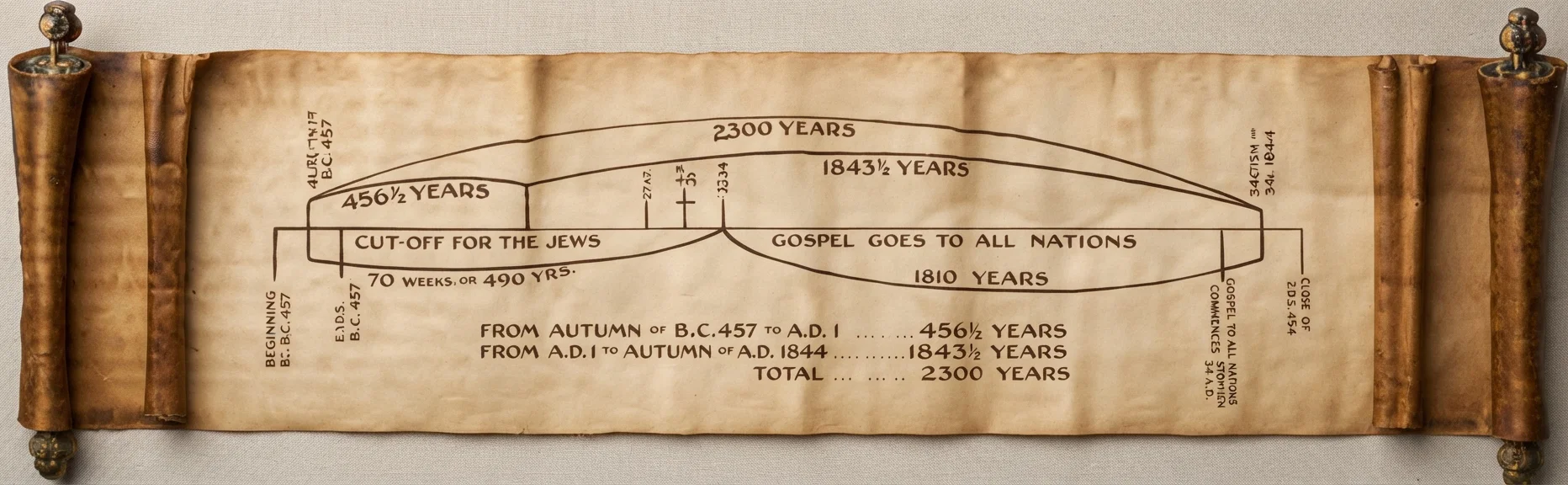
From this explanation we may learn that the 2,300 days began with the commandment to restore and to build Jerusalem. This commandment, or decree, was issued B.C. 457 (Ezra 7:11-26), at least eighty years after the vision was given to Daniel.
Of the 2,300 days (or years), seventy weeks (490 prophetic days, or literal years) were allotted to the Jewish people. Of this period sixty-nine weeks (483 years) were to reach to the anointing of the Messiah, which took place at His baptism (John 1:32, 33), in A.D. 27.
In the midst of the seventieth week (or seven years) the Messiah was to be "cut off;" so three and a half years after His baptism (spring of A.D. 31) Christ was crucified. Three and a half years later (autumn of A.D. 34) the Jews emphasized their rejection of Christ by the murder of Stephen (Acts 7) and a general persecution of Christians. Up to this time Gospel evangelization had been confined to Judea; but the persecution dispersed the Christians, and they "went everywhere preaching the Word." Acts 8:4.
The Year-Day Theory Proved
Thus ended the seventy weeks (490 years), or that part of the 2,300 days (or years) that had been allotted to the Jews as the recognized people of God. By this we have the proof that the year-day mode of reckoning prophetic time is correct—at least in this instance.
Taking 490 years from 2,300, we have left 1,810 years, which, added to A.D. 34, reached to A.D. 1844, when the cleansing of the heavenly sanctuary—the Day of Atonement and final investigative judgment—should begin. Therefore it is now in progress. When it will end, no one knows either the day or the hour. But when it closes, probation will have ended, and the door of salvation will be forever shut.
Even for the people of God this should be a period of special humiliation and confession of sin; of a closer walk with God personally, and of a special solicitude for the salvation of those who know not the truth. "For the time is come that judgment must begin at the house of God; and if it first begin at us, what shall the end be of them that obey not the Gospel of God? And if the righteous scarcely be saved, where shall the ungodly and the sinner appear?" 1 Peter 4:17, 18.
LOVING HIS COMING
We have not time to mention all the bright expressions of hope as the patriarch or prophet looked forward to the coming of Christ. The saints of New Testament times, while instructed that Christ was not coming in their day, yet looked forward to His coming as the time of life and joy and glorious reward. The crown will then be given (1 Peter 5:4; 2 Tim. 4:8); the reward will be bestowed (Rev. 22:12; Matt. 16:27); this mortal will then put on immortality (1 Cor. 15:51-55); and the volume of the book closes with the prayer of the church (as "Thy kingdom come" has been its prayer through the centuries of tribulation), "Even so, come, Lord Jesus" (Rev. 22:20).
One of the strangest things connected with the whole subject is the indifference and apathy manifested on the part of the greater portion of the professed church of Christ. Many ministers are either utterly indifferent or openly hostile to the doctrine of Christ’s soon coming. They profess that they love Christ, but can we truly, heartily love an individual unless we love his personal presence? Can we separate the two—the love from the person?—Nay, we can not; if we love a person, we love his presence. If a wife devotedly loves her husband, she loves and longs for his presence; and just so with the husband. And even so, dear reader, if we love Christ, we will love His presence, we will long for His presence; we will rejoice when His coming is near.
This hope purifies the heart of him who truly holds it. This is expressly declared: "We know that, when He shall appear, we shall be like Him; for we shall see Him as He is. And every man that hath this hope in him purifieth himself, even as He is pure." 1 John 3:2, 3.
It could not be otherwise than this. We will seek to please those we love unless we love self better. The wife who loves her husband will seek to please her husband. She will endeavor to make home pleasant when he comes. She does this almost involuntarily. So it will be with that Christian who loves his Lord. He will not scoff at His coming, he will rejoice to know that Christ will return. He will search the evidences to know whether that coming is near at hand. As evidences multiply, his heart will rejoice as he sees his redemption draw nigh. Luke 21:28.
He will watch for that coming. He will prepare himself to entertain such a guest. As a loyal subject would renovate, repair, cleanse, and beautify his house, and furnish his best rooms for guest-chambers, if he expected a visit from his prince, so will the Christian prepare his character who looks for his Lord. As he contemplates His coming, his heart will grow purer in his contemplations. The hope of that coming will hallow his joys, and sweeten his cups of trial; and his every fiber will thrill with joy and life at the anticipated meeting.
Weary pilgrim in life’s weary way, let thy heart be cheered, thy Lord is coming. Soldiers on the battlefield, fight on, thy King will soon appear. Not "distant hope nor dim" is thine. The rays of coming morn already streak the east; the Sun of Righteousness is about to rise with healing in His beams. Does the world—worse, does a worldly church—laugh at thy faith, and mock thy hope? hold it fast. Believe still, hope on, love on. In "a little while" "thine eyes shall see the King in His beauty," thy Friend, Redeemer, Lord. Happy those who can say at that time: "Lo, this is our God; we have waited for Him, and He will save us; this is the Lord; we have waited for Him, we will be glad and rejoice in His salvation." Isa. 25:9.
BEFORE THE SUPREME COURT
By F. C. Gilbert
The Day of Atonement and the Judgment
IT should ever be borne in mind that the whole economy of Israel was typical, as well as prophetic, of the work of Christ and His ministry of the Gospel for sinners. There was no one part alone that could or would illustrate this work; it was necessary to have many things given, many illustrations drawn, that the church should understand the whole and complete work of the Saviour of the world. He was not only to be a type of Moses and the work that he did, He was also to be a type of Aaron and the work that he performed. John 5:45-47; Acts 3:22; 7:37; Heb. 3:5, 6; 5:1-5. His life and death was not only illustrated in the daily offering of the lamb; it was also illustrated in the slaying of the Passover. Isa. 53:4-7. 1 Cor. 5:7. His work of atoning for sins was not only to be seen in the daily sprinkling of the blood by the priest in the holy place, before the veil; it was also to be illustrated in the blood and atonement on that especial day set apart for this purpose; namely,—The Day of Atonement. It was necessary that all these objects and similes should be given to Israel in order that they, at that time, and the people later, should know and understand the different features of the work and ministry of Christ. Rom. 15:4; 1 Cor. 10:11; Heb. 4:1, 2, 11.
It is the purpose of this article to consider the work on the Day of Atonement in the type, what it meant to the people then, what it was designed to teach the church to-day.
Origin of the Day of Atonement
The great work of the priests in their daily ministration has already been considered, and the reader has learned much precious, up-to-date Gospel truth from the reading of these articles. But the Day of Atonement, its work and its lessons, means everything to the generation living to-day. The first intimation in the Bible that such a day should exist is found in Ex. 30:10, and was given to Aaron in connection with the purifying and cleansing of the altar of incense. The text reads thus: "And Aaron shall make an atonement upon the horns of it once in a year with the blood of the sin-offering of atonements; once in the year shall he make atonement upon it throughout your generations: it is most holy unto the Lord." And the further and fuller accounts of this day and its work will be found in the following scriptures: Lev. 16:2, 3, 5, 7-10, 15-34; 23:26-32; Num. 28:7-10.
The substance of these scriptures is that on this special day the high priest was not only to enter into the holy place as on other days, but was to enter within the most holy place within the veil. Ex. 26:31-34. After having offered special offerings for himself and his household, he was to take of the entire congregation of Israel two goats. Lev. 16:5. These two goats were to be presented alive before the Lord at the door of the tabernacle of the congregation.
Casting the Lots and Sprinkling the Blood
When this was done, the priest was to cast lots upon these animals, one of which was for the Lord (Jehovah) and the other for the scapegoat, or, as the margin renders it, Azazel. This term is a proper name, and is used even to the present time to represent the evil one, or Satan.
The goat of the Lord was to be offered up for a sin-offering, or, as the Hebrew renders the word, chatos. The priest himself was to take the life of the animal, and the blood was to be carried into the most holy place of the sanctuary. In this sacred apartment the priest was to sprinkle the blood seven times on the mercy-seat, and before the mercy-seat. He was also to take in his hands a censer full of burning coals from off the altar, and in the censer was to be placed the sweet incense, and a cloud was to arise from this fire to cover the mercy-seat, while at the same time a beautiful, fragrant odor would be transmitted. Lev. 16:13.
Sanctuary Cleansed
The sprinkled blood which was placed on the mercy-seat and before the mercy-seat, was to cleanse the congregation of Israel and make an atonement. Verse 17. It was also used to cleanse and make an atonement for the sanctuary itself, for after this was done the priest was to sprinkle the tabernacle of the congregation and the golden altar of incense. Ex. 30:10; Lev. 16:18. When this was finished, then the sanctuary itself was cleansed from all uncleanness of the children of Israel which it contained. Lev. 16:16. In other words, this blood was to cleanse the sanctuary where the sins of the children of Israel had been kept during the entire year. Hence this day comprehended the cleansing of the sanctuary.
A Solemn Day
During this day God had given command that the whole people should abstain from labor, should come up to the sanctuary, and should afflict the soul. The person who did not fulfil this command was cut off from his people. In other words, the man who refused to carry out God's command during the Day of Atonement was a lost man, and had finished his probation. This day, therefore, comprehended the work of judgment, and of sealing; for men's cases were decided by the course they pursued on that day.
The Writing and the Sealing
During some of the festivals and holy days of the year, especially the New Year's Day, and the early part of the Day of Atonement, there are many prayers repeated by the people. Among these prayers are found the following: "Our Father, our King, write our name in the book of life." "Our Father, our King, write our name in the book of remembrance." "Our Father, our King, write our name in the book of success and prosperity." But as the Day of Atonement draws to its close the form of the prayers is changed. "Our Father, our King, seal our name in the book of life." "Our Father, our King, seal our name in the book of remembrance." "Our Father, our King, seal our name in the book of success and prosperity." And when the solemn service has been brought to a close by the repetition of this word, "The Lord, He is God," seven times, and the benediction of the Kadesh, the men will grasp the hand of their fellows and give them the following salutation, "I hope you have a good seal." It can thus be understood what a solemn time this day was to be to the people of Israel—the whole to be devoted to heart-searching; to confessing of sin, to laying aside of every worldly project and prospect, to righting one's self with his neighbor, to feeling that he is to prepare himself to meet his God.
People Interested in Most Holy Place
At the same time the interest was centered in the work of the high priest in the most holy place of the sanctuary. Was the priest still ministering before the Lord? Had every Israelite fulfilled every obligation according to the command of God? Was God pleased with the work of the priest and the people? Was the priest still alive in that glorious yet sacred shrine filled with the cloud of incense and the presence of God? O, how they would listen to the movements of the priest; for as long as the sound of the bell and the pomegranate could be heard the people were assured that there was yet hope for them, and that the priest was interceding for them. Ex. 28:33-35.
Cleansing the Holy Place and People
When the work in the most holy place was finished, the high priest gathered up all the sins of all the camp of Israel, taking them to himself, so to speak, and started on his way out to the door of the sanctuary. Entering the holy place, he took of the blood of the sin-offering and cleansed the altar of incense by sprinkling this blood upon its horns seven times. When this was done, the priest's household, the whole people of Israel, the sanctuary, and the entire holy place was cleansed, and sin in figure was now removed from the holy places of God and from all the people of God. Lev. 16:15-20.
Sins Confessed
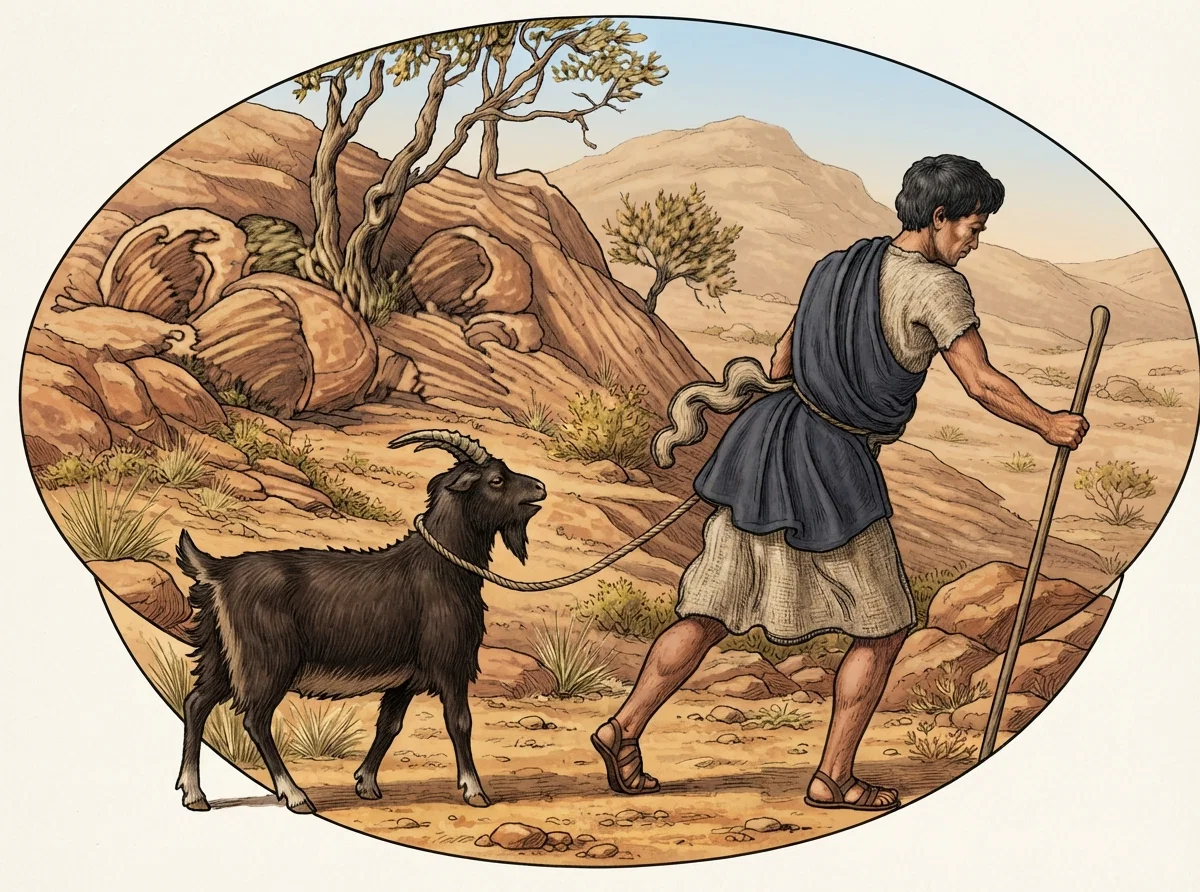
When the priest reached the door of the sanctuary he called for Azazel, or the scapegoat, which was brought to him by a man appointed for that work. The minister of God would then place both of his hands upon the head of the live goat and confess8upon him all the sins of all the people of Israel. These sins were not the sins of sinners; they were the confessed and forgiven sins of saints. These were the sins that had been forgiven during the year when the people confessed them; and now the record of them was removed from the sanctuary and placed upon the head of Azazel. The man appointed would then lead the goat bearing the sins of Israel away into the wilderness or desolate place, and there the goat would remain in the wilderness. There is, however, a tradition which says that the man led the goat to a precipice and threw him over and his neck was broken. Thus the atonement once a year was performed, and Israel and the sanctuary was cleansed from sin and its record. Lev. 16:20-22.
The Lessons in the Type
To summarize, then, the work of the Day of Atonement, we find that the lesson it taught in the type was as follows:
The cleansing of the sanctuary; the removing and blotting out of sin; the day of judgment and sealing of the people; the placing of the sins of Israel upon the head of Azazel. Could Israel have seen its lessons then, how much more it would have meant, and would still mean to them! What precious and blessed instruction they would have received from these truths, and how significant they would have been to them! But they had become merely a form to the people, and thus lost the power of the truth.
Scape-goat being led into the wilderness
Yet we should remember that all of this was but a shadow, a type, an object-lesson, to the church of God to-day. Rom. 15:4; 1 Cor. 10:11; Heb. 4:1, 2.
Message of the Sanctuary and the Judgment
Since the great message of God was proclaimed to the world in the years 1836-44, based on Dan. 8:14, and Rev. 14:6, 7, we have been living in God's great antitypical Day of Atonement, when our great High Priest began His finishing work for the Israel of God in October, 1844. Even now He is performing the work of judgment, is cleansing the heavenly sanctuary, is blotting out the sins of the people of God, is sealing the church with His own seal. Acts 3:19-21; Rev. 7:1-4. Soon He will leave the most holy place of the heavenly temple; and then the sins of all the church of Christ which have been forgiven and blotted out will be placed upon the head of Azazel, the real scapegoat, upon Satan himself, who will then be placed in the separated, banished, lonely, chaotic wilderness of this earth, which has been returned to its original state of chaos by the seven last plagues and the appearance of Christ; and for 1,000 years he shall remain in this state with all of the evil angels, bearing the sins of the Israel of God. Revelation 16:6:14-17.
The camp of the people of God will be cleansed, the record of sin in the heavenly sanctuary will have been removed; all the sins of God's children will have been blotted out, and the church is with her Lord, enjoying the blessed presence in heaven for 1,000 years. Rev. 20:1-6.
Dear reader, have your sins gone to the sanctuary before you? Is your case clear before the Supreme Court of the universe? May God grant that so it shall be.