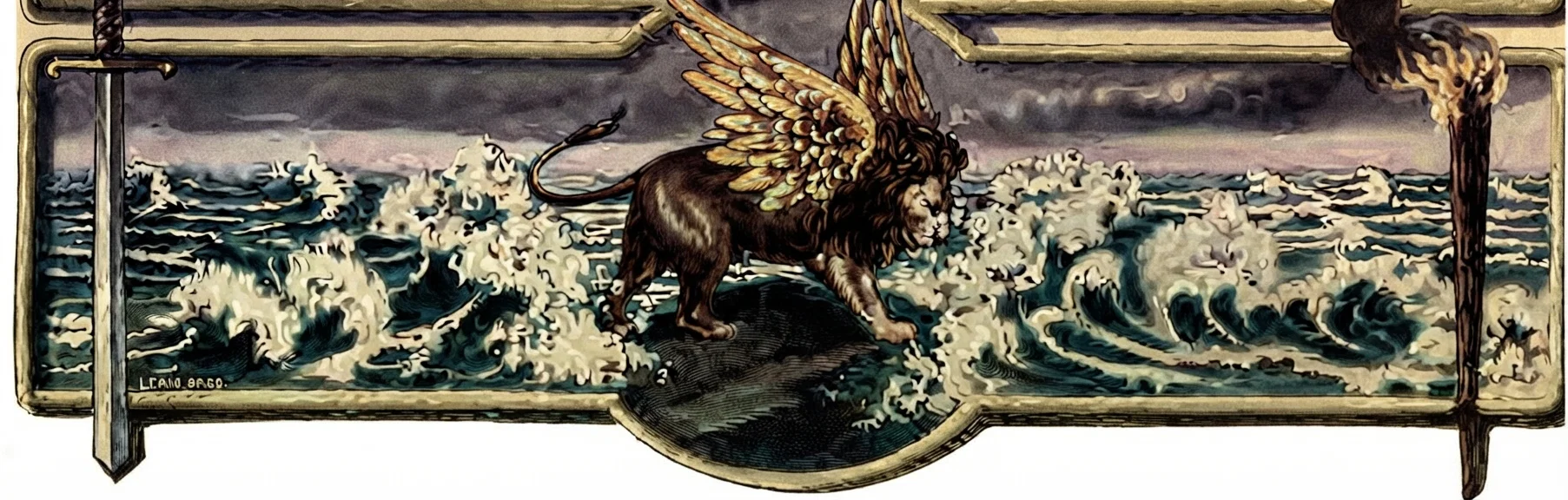
AT the opening of the twelfth chapter of the Revelation, there is seen "a woman clothed with the sun, and the moon under her feet, and upon her head a crown of twelve stars;" and "she brought forth a Man-child, who was to rule all nations with a rod of iron; and her child was caught up unto God, and to His throne."
And there stood before the woman "a great red dragon" ready "to devour her child as soon as it was born." This "dragon" in its own proper person is declared to be "that old serpent, called the Devil, and Satan." Rev. 12:9. Satan, therefore, is really the one who was ready to destroy Christ as soon as He was born.
How Satan Works
But in this world Satan works through instrumentalities. His instrumentalities here are men; and, chiefly, combinations of men in world-powers.
What man, then, was it by whom Satan made his attempt to destroy Christ as soon as He was born?—Herod, in his decree for the slaughter of the babes of Bethlehem. But Herod was more than merely a person; he was king of Judea. Indeed, he was more than only king of Judea; for he became king only by a decree of the Roman Senate upon the special advocacy of Octavius Cesar and Mark Antony—two of the Triumvirate who at that time ruled the Roman world.
Herod could not have been king for a day in Judea if he had not been supported by the mighty power of Rome. Therefore Herod, in his place of power, was only the creature and the representative of the Roman Government. Therefore, in and through the person of Herod, it was the Roman power in the world that was the instrumentality that Satan used to destroy Christ as soon as He was born.
In that attempt, however, Satan failed of his purpose. Yet he never rested until he had, so far as possible, and so far as himself and the power of this world could go, destroyed the Lord Jesus—until he had by the authority of Pilate the Roman governor crucified Him on a Roman cross, and buried Him out of sight in a tomb sealed with the Roman seal.
But even in this final effort, Satan failed. For, from death and the sealed Roman tomb, the Man-child "was caught up unto God, and to His throne." Yet, tho these attempts of Satan's were failures, as far as his purpose was concerned, the facts demonstrate beyond all question that the Roman power was the instrumentality of Satan in his aims to destroy Christ; and therefore that the Roman power, under Satan, is that which is symbolized in the "great red dragon having seven heads and ten horns."
Against the Church
After all Satan's efforts to destroy Christ had been defeated, and the Man-child "was caught up unto God, and to His throne," Satan next turned all his endeavors, still through his world-instrumentality, the Roman Empire, against "the woman," which is the church, and "persecuted the woman which brought forth the Man-child." "And they overcame him by the blood of the Lamb, and by the word of their testimony; and they loved not their lives unto the death."
This persecution Satan continued as long as the Roman power stood. But the Roman Empire fell, and there was a change—not a change in spirit, for it was still the same spirit of the same "old serpent," not a change in the persecution, for it was only intensified—it was a change in the power, the instrumentality, that Satan used in the persecution. When the Roman Empire, that had been such an excellent instrument of Satan's will, had fallen and perished forever, in the anarchy of the times, he was for the moment without any efficient power to make his wrath felt against the church and the saints of God. Therefore "he stood upon the sand of the sea," waiting. Rev. 13:1, R. V.
A Beast
But he had not long to wait; for presently "a beast" rose up "out of the sea, having seven heads and ten horns, and upon his horns ten crowns, and upon his heads the name of blasphemy." This beast was most gladly welcomed by Satan; for it was so exactly what he had been waiting for, that he immediately gave to it his own "power," his own "seat," which he had so long held in Rome and his own "great authority" or "a wide-spread dominion." Rev. 13:2, 4; 2:13.
The beast was well adapted to this great Satanic gift; and immediately it was all alive as the most thoroughly efficient instrumentality that had ever yet fallen to Satan's lot: "He opened his mouth in blasphemy against God, to blaspheme His name, and His tabernacle, and them that dwell in heaven." Indeed, it only opened its mouth to blaspheme God, to blaspheme God Himself and His tabernacle; that is, all who dwell in His tabernacle in heaven. "And it was given unto him to make war with the saints, and to overcome them; and power was given him over all kindreds, and tongues, and nations." Rev. 13:5-7.
With such an agent as this ready to do his will, Satan was again all activity, and poured out a perfect flood of persecution against "the woman" "that he might cause her to be carried away of the flood." But "to the woman were given two wings of a great eagle, that she might fly into the wilderness, into her place, where she is nourished for a time, and times, and half a time, from the face of the serpent." Also "the earth helped the woman, and the earth opened her mouth, and swallowed up the flood which the dragon," "called the Devil, and Satan," "cast out of his mouth." This was the time when, for twelve hundred and sixty years, Satan, through the instrumentality of the Papacy, poured out his wrath against the church of Christ and upon the saints of God, "to kill with sword, and with hunger, and with death, and with the beasts of the earth;" "by flame, by captivity, and by spoil;" even for "many days." Rev. 6:8; Dan. 11:33.
This "time, times, and an half," "forty and two months," twelve hundred and sixty years, in which "the beast," the Papacy, "was empowered to work its will," ended in A.D. 1798. At that time the beast was "as it were, wounded to death;" the power of the Papacy was broken, her dominion was taken away, she was left as a widow and sorrowful, and Satan's power was again crippled, and his wrath seriously hindered.
Another Instrument of Satan
But, lo! help was coming; for just then there was seen "another beast coming up out of the earth;" and tho "he had two horns like a lamb," yet "he spake as a dragon." And this one, tho strong on his own part, uses his power to revive and restore the power and working of the beast. For "he exerciseth all the power of the first beast before him, and causeth the earth and them which dwell therein to worship the first beast, whose deadly wound was healed. And he doeth great wonders, so that he maketh fire come down from heaven on the earth in the sight of men, and deceiveth them that dwell on the earth by the means of those miracles which he had power to do in the sight of the beast; saying to them that dwell on the earth, that they should make an image to the beast, which had the wound by the sword, and did live. And he had power to give life unto the image of the beast, that the image of the beast should both speak, and cause that as many as would not worship the image of the beast should be killed. And he causeth all, both small and great, rich and poor, free and bond, to receive a mark in their right hand or in their foreheads, and that no man might buy or sell, save he that had the mark, or the name of the beast, or the number of his name." Rev. 13:11-17.
A Warning Message
Thus this beast and the first beast unite in compelling all to worship the first beast. But against all this God sends a great threefold message of warning to all the people of the earth, pleading with them that they worship not the beast neither his image; and "if any man worship the beast and his image, and receive his mark in his forehead, or in his hand, he shall drink of the wine of the wrath of God, which is poured out without mixture into the cup of His indignation." Instead of their worshiping the beast, God calls them to "worship him that made heaven, and earth, and the sea, and the fountains of waters," and to "keep the commandments of God, and the faith of Jesus." Rev. 14:7-12.
Through all the time of this later interval Satan's wrath had been against the church of God as much as before, but there was no power by which he could make it effective. Now, however, in this combination of the beast and his image he finds again the power that for a while he had lost; and again he is active as before. Now "the dragon" is not only "wroth with the woman," but, with his restored power in the instrumentality of the union of the beast and his image, he goes forth anew "to make war with the remnant of her seed, which keep the commandments of God, and have the testimony of Jesus Christ." Rev. 12:17.
Wrath of Satan
In this his last war, his wrath is especially "great;" because "he knoweth that he hath but a short time." Rev. 12:12. But still he does not prevail. Still they overcome him by the blood of the Lamb, and by the word of their testimony. But his wrath is so great, and, even tho he has all the allied powers of the beast and his image, his case becomes so desperate, that in very person he appears and takes command of his forces. But lo! presently heaven is opened, and there appears also in His very person One "called Faithful and True," sitting upon "a white horse," and "the armies of heaven" follow Him, also "upon white horses," "and in righteousness He doth judge and make war."
Victory of God's People
"And I saw the beast, and the kings of the earth, and their armies, gathered together to make war against Him that sat on the horse, and against His army. And the beast was taken, and with him the false prophet that wrought miracles before him, with which he deceived them that had the mark of the beast, and them that worshiped his image. These both were cast alive into a lake of fire burning with brimstone." "And I saw as it were a sea of glass mingled with fire; and them that had gotten the victory over the beast, and over his image, and over his mark, and over the number of his name, stand on the sea of glass, having the harps of God." Rev. 19:11-20; 15:2.
The persecution is ceased. The conflict is ended.9(Continued on page 13.)
The Great Apostate Powers
(Continued from page 8.)
The war is over. The saints are triumphantly victorious.
Thus it is seen that at the birth of Christ, Satan entered upon a war that, with but two short intervals, he keeps up until the very world's end. There are employed as his instrumentalities in this war, three mighty world-powers: the dragon, the beast, and the false prophet, or the image of the beast. This war is in three great stages, according to the three mighty world-powers that are the earthly agents in it—Pagan Rome, to A.D. 476; Papal Rome, A.D. 538-1798; and apostate Protestantism allied with the revived Papacy, as the beast and his image, at the last and till the end.
These three stages are marked in the twelfth chapter of Revelation, in (1) the attempt to destroy the Lord Jesus, and the persecution of the woman immediately after the Lord's ascension to heaven; (2) in the flood of persecution poured out against the woman in "the wilderness;" and (3) in his wrath and war against the woman in "the remnant"—the very last of "her seed." In the first stage he used the dragon, or Pagan Rome, as his instrumentality. In the second stage he used the beast, or Papal Rome. And in the third and final stage he uses the image of the beast, or apostate Protestantism, in alliance with Papal Rome. This final stage is the most desperate, for he has the full use of his two mightiest powers.
But throughout the whole war, from the very beginning to the very end, there is victory to Christ and His people; for—
"Thy saints, in all this glorious war,
Shall conquer tho they die."
But in the final stage His saints obtain their triumphant victory without dying; for just as "the beast and the false prophet" go from this earth "alive into a lake of fire;" so in their victory over the beast and the false prophet, the saints of God go alive from this earth to the "sea of glass."
"O joy! O delight! should we go without dying;
No sickness no sadness, no dread, and no crying;
Caught up through the clouds with our Lord into glory—
When Jesus receives His own."
A MESSAGE OF PREPARATION
By L. A. Phippeny
To a People Unprepared
"PREPARE to meet thy God, O Israel," is the startling word placed in the mouth of the herdsman-prophet of Tekoa by the high authority that ordained him a messenger of reproof and warning.
The message was not given to a prepared people. It was given to a people who had despised the law of God and had not kept His commandments, in whose lives the spirit of perversity, injustice, inconstancy, was manifested continually. They were wholly unprepared to meet God, except for punishment for evil deeds. And yet they were the chosen church of God, and professed His name, and called themselves His children.
Again and over again the Lord sought to reclaim them, using the means which it has seemed necessary to use in all ages when children go astray—punishment—and yet punishment in love, to save if possible. Famine, drought, blasting, mildew, the palmerworm, sword, fire—they were a rebellious and stubborn people—were their portion, yet they "returned not," tho some were plucked as firebrands from the burning. Then came the end. There was nothing left but direst measures to bring them to their senses. Hence the message.
Warned in Time
But before the infliction of the chastisement in its severest form, the Lord delineated His dealings with them, and recounted the history of their crooked ways. Thus was the conviction of sin, and of righteousness, and of judgment forced home to them. Then, in harmony with His character of love and mercy mingled with justice, the Lord gave them opportunity, as individuals, to repent before the stroke fell upon the nation. This was all involved, indeed, in the words of the warning. Note the significance of the message, and the call to return.
"Therefore thus will I do unto thee, O Israel; and because I will do this unto thee, prepare to meet thy God, O Israel. For, lo, he that formeth the mountains, and createth the wind, and declareth unto man what is his thought, that maketh the morning darkness, and treadeth upon the high places of the earth, the Lord, the God of hosts, is His name . . . For thus saith the Lord unto the house of Israel, Seek ye Me, and ye shall live; . . . seek Him that maketh the seven stars and Orion, . . . that calleth for the waters of the sea, and poureth them out upon the face of the earth: The Lord is His name. . . . Hate the evil, and love the good, and establish judgment in the gate; it may be that the Lord God of hosts will be gracious unto the remnant of Joseph." Amos 4 and 5.
Mark again the revelation of the character of love and long-suffering in the recital of this chapter in the history of Israel. It would seem that the veriest skeptic must recognize and acknowledge the divine element in the proceedings. But it is not new, neither out of date. The relation of God to His church and to the world and the manner of His dealing with them have ever been the same in principle. This is perhaps only another way of stating the point that with the Father of lights there is no variableness neither shadow of turning. He is the same yesterday, and to-day, and forever. "I am the Lord, I change not; therefore ye sons of Jacob are not consumed." "And account that the long-suffering of the Lord is salvation."
For Our Learning
The history of the past is written for our admonition who live in after ages, because human nature repeats itself generation after generation. The conflict of the ages between righteousness and sin is about ended; what are the conditions of the professed church to-day? Is the condition spiritually similar to the condition spiritually in the church in the days of Amos and Isaiah, the days before the great captivity? If so, has God sent a message of warning like unto that of old?
The Word of God is so plain that it seldom requires lengthy argument to demonstrate the truth even when men endeavor to establish counter claims. It is very plain with reference to the questions just asked. Note a few statements.
The One True Church
"There is one body, and one Spirit, . . . one hope of your calling; one Lord, one faith, one baptism, one God and Father of all." This is the ideal, embracing one body, the one true church, with its ideal characteristics. This church existed in Paul’s time, and his words indicate that it has existed ever since, exists to-day, and will be in existence when Christ returns at the end of the age. Where is it? Which one is it of the many churches calling themselves Christian? It surely is not all of them—a kind of composite of many doctrines and creeds. It surely is not expressed in the lives or the beliefs of all the members of any one church organization that may be named in particular.
"That they all may be one." Here is diversity in unity. Can it mean a union of churches upon some particulars of belief common to all?—Hardly. May it not mean the oneness of Spirit that frequently seems to characterize union services for revival efforts?—To the extent that the Spirit of Christ is present. But the true church embraces more, as already noted. And after all unions are effected, after revival efforts pass, there is still diversity of doctrine in the churches as separate organizations. But does not Christ work with and through the churches professing His name?—Just the best He can, assuredly. But can He work with all? Can all be equally right and still hold diverse beliefs? Can all be one in all the requirements of the "one body," and still all or part hold differing views as to these requirements and use differing methods to express them?—O no! Therefore division, confusion, not oneness of the one body, one Spirit, one baptism, one hope. Somehow, at some time, the clear view of the one faith, one baptism, one hope, has been obscured, and corrupted doctrine has taken their place. Are the professed churches of Christ prepared to meet Him when He comes?
God’s Call—the Church’s Need
"Come out of her, My people, that ye be not partakers of her sins, and that ye receive not of her plagues." Ah, here is a call to "My people," the true church, and the time of the call is the last days. It is a call to come out of confusion, as the context shows. It is a call to come out of sin; for in whatever system confusion is found there is sin, be it church organization or character organization. It is a call to you and to me; for "God is no respecter of persons," and His invitation is extended to every soul. We may be—can be, if we will—individual members of the one body. But is it possible that the condition of the professed churches—we must write the plural in view of present-day conditions—is like the sinful condition of God’s ancient church, when there was no remedy but casting away? Is not such a view pessimistic? Listen:
"Unto the angel of the church of the Laodiceans [the last church condition preceding the second coming of Christ] write: . . . I know thy works, that thou art neither cold nor hot; I would thou wert cold or hot. So then because thou art lukewarm, and neither cold nor hot, I will spue thee out of My mouth. Because thou sayest, I am rich, and increased with goods, and have need of nothing; and knowest not that thou art wretched, and miserable, and poor, and blind, and naked; I counsel thee to buy of Me gold tried in the fire, that thou mayest be rich; and white raiment, that thou mayest be clothed, and that the shame of thy nakedness do not appear; and anoint thine eyes with eyesalve, that thou mayest see."
These are the words of the Head of the church. They are not commendatory. They do not depict a church prepared to meet her Lord. Is it the condition of the churches to-day? Is it not? Honestly, as a candid observer, can you do otherwise than frankly assent that it is? It is a terrible condition, doubly so because the professed followers of Christ do not realize their fearful condition and the proximity of calamity. They are asleep, and worse than asleep. Is not God as truly forgotten now as He was by Israel of old?
The Message
But is there not some awakening message, some cry of alarm, some warning of impending judgment, of punishment?—There is, even as there was of old. Read it, comparing the first portion especially with the message given through the prophet Amos:
"And I saw another angel fly in the midst of heaven, having the everlasting Gospel to preach unto them that dwell on the earth, and to every nation, and kindred, and tongue, and people, saying with a LOUD VOICE, Fear God, and give glory to Him; for the hour of His judgment is come; and worship Him that made heaven, and earth, and the sea, and the fountains of waters. And there followed another angel, saying, Babylon is fallen, is fallen, that great city, because she made all nations10drink of the wine of the wrath of her fornication. And the third angel followed them, saying with a LOUD VOICE, If any man worship the beast and his image, and receive his mark in his forehead, or in his hand, the same shall drink of the wine of the wrath of God which is poured out without mixture into the cup of His indignation." Rev. 14:6-10.
Here is the warning, the most solemn ever given to the children of men, of the final day of judgment at hand; the declaration of punishment most fearful upon unrepentant transgressors; the call to all men to return to God their Maker, and the implied offer of a glad salvation. Indeed, the counsel of the Faithful Witness is in the highest degree optimistic, for it points to salvation for every individual who will accept it. The message says to the church, the churches to the world, "Prepare to meet thy God."
SIGNS IN THE HEAVENS
By Prof. George W. Rine
A Simple Question and Its Answer
A FEW days before His passion and crucifixion Jesus, with His disciples, repaired to the Mount of Olives. In behalf of the universal Christian church, the disciples asked Him this simple but momentous question: "What shall be the sign of Thy coming, and of the end of the world?" Matt. 24:3. The gist of the Master's answer is pointedly recorded by Luke, as follows: "And there shall be signs in the sun, and in the moon, and in the stars." Luke 21:25.
Here the disciples address to their divine Teacher a simple, sensible question. He, in turn, honors their question with a simple, pertinent answer. How clearly this fact shows that Jesus did not regard their question as at all irrelevant or uncalled-for. The very clearness and directness of the answer prove that our Lord must have regarded the information it conveys as of supreme moment to His church.
The Prediction
"There shall be signs in the sun, and in the moon, and in the stars"—signs of His coming and of the end of the world—the Master explicitly affirms. He who is Light does not leave His children in the dark as to the nature of these celestial signs. Signs of such transcendent meaning must be recognized and identified when given, by those for whose benefit they were ordained. The Saviour's vivid word-picture as to the character of these signs is given in verses 29 and 30 of Matthew 24, and is as follows: "Immediately after the tribulation of those days shall the sun be darkened, and the moon shall not give her light, and the stars shall fall from heaven, and the powers of the heavens shall be shaken; and then shall appear the sign of the Son of Man in heaven."
That these awful celestial phenomena would be divinely given as "signs" of our Lord's coming in His glory and in His kingdom, was foretold by the Spirit of Christ through the prophet Joel, in these graphic terms: "The sun shall be turned into darkness, and the moon into blood, before the great and terrible day of the Lord come." Joel 2:31. After Christ ascended to the Father, He declared in respect to the same "signs," in His revelation given through the beloved disciple John: "The sun became black as sackcloth of hair, and the moon became as blood; and the stars of heaven fell unto the earth, even as a fig tree casteth her untimely figs, when she is shaken of a mighty wind." Rev. 6:12, 13. The context shows indisputably that these sublime phenomena are harbingers of "the glorious appearing of . . . our Saviour Jesus Christ."
The Fulfilment
With great precision our Lord foretold just when the signs in the heavens should be given. Note again His words: "Immediately after the tribulation OF THOSE DAYS shall the sun be darkened," etc. In the same discourse Jesus had already told His disciples that "the elect" would be subject to unprecedented tribulation during a period of specified "days." These are His words: "For then shall be great tribulation, such as was not since the beginning of the world to this time, no, nor ever shall be. And except those days should be shortened, there should no flesh be saved; but for the elect's sake those days shall be shortened." Matt. 24:21, 22.
Observe that Christ repeatedly speaks of the tribulation of "those days." He unmistakably refers to the days of that long period of persecution inflicted upon His true worshipers, by the Papacy during the Dark Ages and after, extending over a period of more than 1,200 years. All who have a knowledge of the history of the Christian era, know that the most terrible persecution that the saints ever suffered was that inflicted by the Church of Rome, from about the middle of the sixth century to near the close of the eighteenth century. Under the benign influence of the great Protestant Reformation in the sixteenth century, the rigors of the papal persecutions gradually softened, until after the temporary suppression of the Jesuit Society, in 1773, when physical persecution ceased entirely.
Now, there is no fact more widely and better known than that the sun was supernaturally darkened, and that the moon was turned into the appearance of blood a few years "after the tribulation of those days." These miraculous phenomena, exactly fulfilling our Lord's circumstantial prediction, both as to character and time, did occur on May 19, and the night following, 1780. Historical testimony corroborative of this fact is overwhelming in mass and unimpeachable in kind.
The Great "Dark Day"
Referring to the 19th of May, 1780, the eminent English astronomer, Herschel, wrote: "The dark day of North America was one of those wonderful phenomena of nature which will always be read of with interest, but which philosophy is at a loss to explain." Here we have a deliberate admission from the greatest astronomer of his time that the most advanced knowledge and science of this world is powerless to account for this extra-normal solar phenomenon.
In a work entitled, "Our First Century," Dr. R. M. Devens says: "Almost, if not altogether alone, as the most mysterious and yet unexplained phenomenon of its kind in nature's diversified range of events, during the last century, stands the dark day of May 19, 1780—a most unaccountable darkening of the whole visible heavens and atmosphere in New England—which brought intense alarm and distress to multitudes of minds, as well as dismay to the brute creation, the fowls fleeing, bewildered, to their roosts, and the birds to their nests, and the cattle to their stalls." He further informs us that thousands of the people of that day were fully convinced that the end of all things terrestrial had come. He says, too, that the extent of this darkness was so great that the exact territorial limits could never be positively ascertained.
Mr. William Perrine recently made a thorough and methodical investigation of the original records of the "Dark Day," and gave a summary of his findings in the Ladies' Home Journal, for July, 1905. He tells his readers that where the darkness was seen in the full effect, it was appalling. In some places all the light of day seemed as if it had been blotted out. At other places only a few rays were discernible, and these imparted to the trees and grass and houses a murky, yellow hue. The unnatural darkness began to creep in about ten o'clock in the morning; it soon deepened into an oppressive gloom, and hour after hour, and long after the time for the setting of the sun, the blackness continued to envelop a vast region. Schools were dismissed, and men and women stopped working, for it was impossible to tell the time on the clocks or to move about without danger of collision. In every house and shop candles were lighted, yet a sense of half-suffocating gloom weighed upon the people and filled them with awe or terror. In some towns people who went on the streets were lost at the noonday hour in trying to find their way home.
At the hour of nightfall the darkness assumed the shade of pitch. "A sheet of white paper could not be distinguished from the blackest velvet." Dr. Samuel Penny, when several years later he wrote a description of the unearthly phenomenon, declared: "The darkness of the evening was probably as gross as has ever been observed since the Almighty's fiat first gave birth to light." Mr. Perrine naively confesses that "the causes of the phenomenon appear never to have been satisfactorily explained."
There is, however, one explanation, and only one; it is this: Our Lord, in fulfilment of His explicit promise, shrouded the sun in unnatural blackness at the very time that He said He would, as a sign—as one of the promised pledges that His glorious appearing is near, "even at the door." Ah, yes, the phenomenon was the effect of a very definite cause—of the Great First Cause, tracing in the very skies the answer to His own promise that "there shall be signs in the sun, and in the moon, and in the stars."
In respect to the moon's being darkened and, at intervals, having the appearance of blood, Dr. Adams testifies: "The darkness was as uncommon in the night as it was in the day, as the moon had fulled the day before. . . . And whenever on this memorable night the moon did appear, as at certain times it did, it had, according to the prophecy, the appearance of blood." Note again: The moon was full that night, yet she yielded no light. Ah! with what startling exactness were the very words of Jesus fulfilled: "AND THE MOON SHALL NOT GIVE HER LIGHT."
"The Stars Shall Fall from Heaven"
There are still living thousands of persons who have the distinction of having been eye-witnesses of the unique and unparalleled star-shower on the night of November 13, 1833. Regarding that memorable night, Mr. Perrine significantly declares: "It may be said to hold the same relation to nights as the Dark Day does to days." During the first hours of the night all was peace and quiet. But suddenly a ray of brilliant light shot across the heavens; before it vanished there came another more dazzling; instantly there began to rush forth, as if from the central part of the heavens, a myriad of flaming stars. With swift and tumultuous onset, darting, swirling, bursting, blazing, the countless streams of light swept through the sky expanse in wild and superb splendor. So intense was the stellar blaze that sleepers who were suddenly awakened sprang to the windows, believing that a conflagration was raging in the neighborhood. Those who went out of their houses found it as easy to read a newspaper as in daylight.
Professor Olmstead, of Yale College, who had the good fortune to be a witness of those stellar pyrotechnics, declared them to be the greatest display of celestial fireworks that has been known since the creation of the worlds. Henry Dana Ward, who with his wife was another eye-witness, said that they felt in their hearts "that it was a sign of the last days." He adds that the stars actually "fell unto the earth, even as a fig tree casteth her untimely figs, when she is shaken of a mighty wind." Rev. 6:13. The language of the prophet, Mr. Ward emphatically declares, was that night literally fulfilled.
"And how did they fall?" he asks. His answer is: "Were I to hunt through nature for a simile, I could not find one so apt to illustrate the appearance of the heavens, as that which St. John uses in the prophecy before quoted." Mr. Ward takes special pains to impress his readers with the suggestive fact that the stars did not come as if from several trees shaken, but from one. And they did not fall as ripe fruit falls. Far from it; but they flew, they were cast, like unripe fruit, which at first refuses to leave the branch, and when, under a violent pressure, it does break its hold, it flies swiftly, straight off.
Professor Burrit affirms that the phenomenon of the falling stars covered no inconsiderable part of the earth's surface. "They fell thick as the flakes in the early snows of December."11
Did not these signs in the sun, moon, and stars, dear reader, begin to come just when Jesus declared they would appear—"immediately after the tribulation of those days"? Have not scientists and scholars generally confessed that these phenomena are not susceptible of explanation by any facts of science known to man? Must we not then, if we believe the prophecies of Jesus, accept these phenomena as the "signs" of the imminence of Jesus' coming and of the end of the world?
Note the special pains which Jesus took to make it easy and certain that we should recognize these "signs" and accept them for the very purpose for which they were given; namely, that we might "know that He is near, even at the doors." It was for the express purpose of enabling us to know these things, that He gave the strikingly-apt parable of the fig tree putting forth its leaves. See verses 32 to 34 of Matthew 24. Then, as if to make it impossible for "this generation" to doubt the genuineness of these signs, He adds: "Heaven and earth shall pass away, but My words shall not pass away."
May He grant us all grace to believe, to watch, to pray, to look for Him, and to receive Him with the joyful acclamation, "Lo, this is our God; we have waited for Him, and He will save us." Isa. 25:9.
SIGNS IN THE HEAVENS
The End of Persecution
By Editor
The period of persecution began by decree, that of Justinian, which became operative in 538. The persecution of that period is specially marked by two noted events: (1) "The earth helped the woman." The United States, then colonies, in 1776, declared themselves free and independent states, a home for the oppressed of all nations. (2) That very year, Maria Theresa, Empress of Austria, one of the strongest European rulers, decreed that all Christians should be tolerated throughout her realm. Thus ended the persecution of those days. It could no longer be general.—Ed. S. of T.