Your ShelfYour Projects

Signs of the Times, Vol. 33, No. 31.

With Our Inquirers
Earlier text: The Story of The Hague Conference

Studies in the Christ-Life at Brother Eldred's

Mrs. L. D. Avery-Stuttle

Thirteenth Evening's Study.

It is quite needless to say that Mr. Allan was present the next Friday evening at Brother Eldred's, as well as Mr. and Mrs. Field and family. The truth was, Mr. Allan's heart was touched, and already he was under powerful conviction. Mr. Field was of an entirely different nature. He had so long cherished doubt and unbelief that to him it was hard to exercise saving faith. The subject of the evening was a study of the miracles of Christ.
"Beth, will you tell us something about the very first miracle which Jesus performed?"
"Yes, papa, I think I can, for Tillie read the whole story to me from the Bible. Mama said it was just a little while after Satan had tempted Jesus in the wilderness. Some one was going to be married in the little village of Cana. Jesus and His disciples were there, and so was Mary, Christ's mother. After a while Mary heard that the wine was all gone, and she told Jesus, and He asked the servants to fill some great water-pots with water, and they did."
Beth stopped to take breath for a moment.
"Don't forget to tell us where this story is found, little sister," interrupted Tom, "if you'll inform us, we'll look it up and see if you're telling it right."
"I forget, Tom, but Tillie knows, don't you, Tillie?"
"You'll find it in the first part of the second chapter of John," said Tillie, as she helped Florence to find the place.
"Blanche, suppose you continue this recital," suggested Brother Eldred.
"Well, after the vessels were filled with water, Jesus commanded that it be drawn out and taken to the man that had charge of the ceremonies, and, behold, instead of water, there was wine in the vessels."
Mr. Field looked up from his Bible and a quizzical expression came into his face:
"Don't you think, Mr. Eldred, that this story is rather hard on you temperance workers?"
"Not at all, Mr. Field; if we all had opportunity to drink of such wine as our Lord made, I assure you, we would be none the worse. Why am I sure of this?—Just turn to Prov. 20:1, and remember that Jesus Christ Himself inspired the writing of that sentiment. Mr. Field, please read."
"'Wine is a mocker, strong drink is raging; and whosoever is deceived thereby is not wise.'"
"Now, please turn to Prov. 23:31, 32."
"'Look not thou upon the wine when it is red, when it giveth its color in the cup, when it moveth itself aright. At the last it biteth like a serpent, and stingeth like an adder.'"
"So," continued Brother Eldred, "we are sure that the wine which Jesus made must have been pure, sweet, and healthful."
"Father," remarked Tillie, "do you know that Blanche Field has a little poem to recite on this subject?"
"I am very glad, indeed. Perhaps this is the best time to listen to it."
At once Blanche arose, and standing beside her father, repeated:
"There was a marriage feast in Galilee, The festal board was spread with viands rare; The joyous guests had met in commune sweet, And He—the Man of Nazareth—was there.
"Yes, He was there, that marriage, Eden-born, Might share the sanction of His presence sweet, That round this holy ritual He might throw A sacred halo, glorious and complete.
"'The wine has failed; the murmuring word is passed, And soon from lip to lip is borne to Him; Then sweeter far than music sounds His voice, 'Fill ye these water vessels to the brim!'
"'Tis done; wine, rare, purple, rich, and sweet, Th' astonished servants, smiling, bear away; The while methinks the wondering guests repeat, 'Ah, we have seen strange things—strange things to-day.'
"New, unfermented wine, the Master made, Not the mad wine that fills the drunkard's cup, But such as He, the Bridegroom, gives His guests Who at the marriage of the Lamb shall sup, And drink it new within the kingdom fair— His Father's glorious kingdom over there.
"E'en thus it is along life's rugged path; Ofttimes it seems the wine of life is spent, And we have nought to offer those we love But empty vessels, tears, and discontent.
"O let us fill these empty vessels full With flowing sap, fresh from the living Vine, And we shall find, before the feast is done, That He has turned life's water into wine.'"
"Very well done," said Brother Eldred; "now I think Jack will repeat a short poem on the Cleansing of the Temple, which, altho it has never been numbered among the miracles of Christ, still, in its wonderful results might almost be called one."
Jack had made careful preparation, and rendered the poem very well:
"Again the Paschal feast has come, And strangers throng the busy street; While in the temple's sacred courts The buyer and the seller meet, Shrill, babbling voices, wild and rude, The shouting of the multitude, The lowing cattle from the fold, The coo of doves, the clink of gold, The money-changer's greedy cry, Loud, eager voices, fierce and high, Discordant sounds from far and near Are borne upon the startled ear. 'Take these things hence!' above the din There sounds a voice of stern command; The while the awe-struck throng behold A Godlike Presence, firm and grand, With scourge of cords within His hand.
'Then, like a mighty torrent rushed The surging mass from pen and fold; The drivers with their cattle fled, The money-changers with their gold, The screaming throng, the bellowing herds The bleating sheep, the frightened birds— All, all, in one vast rushing tide, From that stern Presence flee to hide, In wild dismay they flee in fear, As tho the Avenger's sword were near.
'E'en thus 'twill be in that day when He comes to judge the sons of men; In robes of vengeance then He stands, The scales of justice in His hands. The crown of thorns upon His brow Gives place to regal glory now. The clamoring throng that mocking cried, Now bid the mountains 'fall and hide.' Yet still our Advocate He stands With pierced side and bleeding hands, And gently sweetly calls to thee, 'Ye heavy-laden, come to Me.'"

The Girl Who Pays Her Way.

“You probably have no conception of your importance as a unit. Few of us have,” writes Margaret E. Sangster in Woman’s Home Companion for July. “Yet society is so constructed that we depend on one another, and, without quite understanding it, we constantly assist in molding the opinions and shaping the conduct of people whom we may never meet, and who apparently never approach our neighborhood. For instance:
“I knew intimately a young girl who was born in a tenement house on the East Side of New York, who scrambled up as best she could thru a meager and poverty-stricken childhood, working as a cash girl in a department store when she was fourteen, and later earning her livelihood in a tobacco factory. Her work when she first became one of my girls was very hard and unwholesome. Her face was pale, her fingers were stained, her hours were long, and her weekly wage, most of it given to her mother, was a sum that many girls in well-to-do families spend on candies and chiffons without a thought of economy. But she had a dainty air, was fastidiously neat, arranged her hair very prettily and was gentle and attractive in speech and manner. She had the sweet and refined air of a lady.
“How to account for it would have been a puzzle had I known girls of only one condition and training. I asked no questions, yet I found out without much trouble what I wanted to know. My little friend was spending a Sunday with me, and she said, incidentally, ‘When I was a “Fresh Air,” the year I was ten, I saw a young girl who must have been fifteen. She was the loveliest thing you could imagine. She used to drive down the road past the farm where we were staying, and I knew she was going to the train to meet her father. Often she stopped with her mother and visited a little with us, and I made up my mind that I would be like that girl. I tried to talk as she did. I made her my pattern. Afterward, when I was a “cash,” I sometimes saw her in the store, and O! what a joy it was when at last she came to the Settlement and sang for us in the evenings. That girl has been my ideal.’ *
“ ‘Did you ever tell her about it?’ I asked.
“ ‘I have never spoken a single word to her,’ was the reply. ‘I don’t want to. I like better to think of her as a star or a beautiful flower. She belongs to me and I belong to her, and if we were acquainted maybe it wouldn’t be so perfect.’ ”

His Glorious Appearing

His Glorious Appearing. New edition. An exposition of Matthew 24, revised, enlarged, and illustrated. The book contains 114 pages, with 20 full-page illustrations. It takes up Christ's great prophecy of His own second coming, and the signs of the times are clearly pointed out in their relation to that greatest event. Just the book for the times. Attractive, interesting, timely, and instructive. Board, 25 cents; bound in fine English cloth, embossed covers, lemon edges, 50 cents. Pacific Press, Mountain View, Cal.

UP TO DATE

MISSIONARY AMMUNITION

TO BE USED ON THE FIRING LINE
Let them be sown as deep and scattered as widely as the leaves in autumn.
We refer to the compact, truth-filled Signs Leaflets.
This series of Leaflets covers vital phases of Bible truth for this time, and is condensed to the last degree. Each Leaflet has an especially engraved heading, and consists of two well-filled pages of matter. The titles are as follows:
  1. The Sure Word of Prophecy.
  2. Prophetic History of the World.
  3. Second Coming of Christ.
  4. Signs of Our Times.
  5. The Sanctuary.
  6. The 2,300 Days.
  7. The Law of God.
  8. The Sabbath of the Bible.
  9. The First Day in the Bible.
  10. Who Changed the Sabbath?
  11. The Great Threefold Message.
  12. The Seal of God and the Mark of the Beast.
  13. Church and State.
  14. Life and Immortality.
  15. The Great Judgment Day.
  16. The Home of the Saved.
Sold only in full packages of 100 of a kind, or in pound packages containing about 18 of each of the 16 kinds. The prices are as follows: 100, all one kind ........................$0.15 post-paid 1,000, 100 each of the ten kinds ........ 1.30 " " 1,600, 100 each of the sixteen kinds .... 1.95 " " 1 lb., about eighteen of each kind ........ 50 " "
Address your Tract Society or the Publishers, Pacific Press Publishing Company Mountain View, California 285 Salmon St. Portland, Ore. 1109 East 12th St. Kansas City, Mo. Review & Herald Publishing Co. Takoma Park, Washington, D. C. Battle Creek, Mich.

COOPERATION CORNER.

Perhaps you read in a recent number of the SIGNS OF THE TIMES the earnest appeal from Elder R. D. Hottel, President of the Virginia Conference, for tracts and papers to distribute at the Jamestown Exposition. The following is from his letter:
"We are planning to use a good many SIGNS this summer in our tent work and in our work at the Jamestown Exposition. We are trying to get workers for all these places. I wish to say that the General and Union Conferences have supplied us with a man for the Jamestown Exposition, but you know that we are a small conference and not able to carry much work outside of our regular conference work. Therefore, if we do very much, we must have assistance from other sources. We believe that we could interest a number to take up this SIGNS work at the Exposition if we could furnish them with from one hundred to two hundred copies each week. But as we said, we are not able to pay for them. But if you can help us in this matter we will be very glad.
"At the Jamestown Exposition the circulation of our literature will be of general interest, and I feel as tho there are many of our people in all the conferences who would help us in this work. The General and Union Conferences are doing perhaps all they can in paying the wages and expenses of this man. There may be those who have on hand tracts or clean periodicals which they would be glad to furnish us free for free distribution at the Exposition. All such matter should be sent to G. A. Stevens, 24 Willow St., Hampton, Va. It should be sent prepaid. We are now planning to get a strong force of workers in there to work with the SIGNS, Watchman, Life and Health, and Liberty."
In response to this we have received donations enabling us to forward Elder Hottel and his associate workers several thousand copies of the SIGNS OF THE TIMES. From a letter just received from the workers there we learn that many more copies can be used to good advantage. Those desiring to assist in this good work will please send their donations to the SIGNS OF THE TIMES, Mountain View, California, and papers will be promptly sent.

The Hague Peace Conference

Of more than ordinary interest are the reports from our special correspondent at the Hague Peace Conference. The delegates to that important assemblage are no doubt imbued with the highest ideals for the betterment of humanity. The efforts that good and true men and women are putting forth to counteract the mighty impulses for war in these times should be applauded and encouraged. All such efforts are, without doubt, supported and used by the Spirit of the divine Father to prevent the awful devastation of a world-wide war. For it must be conceded that if war should break out between two of the great nations of Europe, or between the United States and any other leading world power, that all the world would be more than likely to become involved and modern methods and modern weapons would cause literal rivers of human blood to flow. The prophecy shows that such a universal and bloody war will be the final act in the world's career of sin; but there is a Gospel work of telling everywhere that the Lord's coming is right at hand, and we should pray that these bloody scenes may be held in check while the work of the Master is being finished.

Russia's Decadent Condition.

ROBERT CROVIN LONG, writing to the Hearst papers from Russia, declares that following her `economic decay,'' Russia is declining in civilization and is reverting to savagery.'' This is the result in places `of hunger, neglect, disease, and ignorance.''
``Savagery is the only word to describe the present state of hundreds of settlements which a generation ago enjoyed prosperity and civilized instincts.''
He quotes Dr. Bilinsky, who has been traveling on the Volga and in Western Siberia:
``Of religion there remain only rudimentary ideas which have no relation to Christianity. Their huts, ill built, undecorated, without chimneys or furniture, are just enough to keep out the winter cold; their bread, which contains as much bark and weeds as rye, is sufficient to keep them alive, but not sufficient to keep them in health, and often a whole family possesses only one sheepskin, so that in winter only one member is able to go out of doors.
``Of domestic life and of morals no conception has survived. Marriage is almost obsolete, because the people can not pay the priest's fees. Children are not considered as human beings until they reach the age of six or seven; the infant mortality is so high that no child is supposed to have a claim on life until it has survived to at least that age; no pretense of grief is made over the death of younger children, who are buried without coffins or ceremonies. Often the villagers, in order to avoid the trouble of burial, carry their dead a few miles out of the village and leave the bodies naked in the woods.''
Now is the time, even tho there must be met the persecution of a decadent, perverted priesthood, to carry the Gospel to Russia. These fearful conditions are omens of the coming King.

CONTENTS

CONTAINED IN THIS ISSUE

WITH OUR INQUIRERS

Questions Nos. 2164 to 2172 . . . . . . . . . . . . . . . . . . . . . . . . . . . . . . . . . Page 2

MAN AND HIS DESTINY, SYMPOSIUM

Eternal Life and Immortality . . . . . . . . . . . . . . . . . . . . . . . . . . . . . . . . . 3
The Resurrection to Life and Death . . . . . . . . . . . . . . . . . . . . . . . . . . . . . 4
What Shall We Have? . . . . . . . . . . . . . . . . . . . . . . . . . . . . . . . . . . . . . . 5
Deprivation of Life the Punishment of the Wicked . . . . . . . . . . . . . . . . . . . . 6

EDITORIAL

The Resurrection and the Life . . . . . . . . . . . . . . . . . . . . . . . . . . . . . . . . . . 8
Training Forces for the Conflict . . . . . . . . . . . . . . . . . . . . . . . . . . . . . . . . 8

GENERAL

Prayer . . . . . . . . . . . . . . . . . . . . . . . . . . . . . . . . . . . . . . . . . . . . . . . . . . 9
Everlasting . . . . . . . . . . . . . . . . . . . . . . . . . . . . . . . . . . . . . . . . . . . . . . 9

OUTLOOK

The Story of The Hague Conference . . . . . . . . . . . . . . . . . . . . . . . . . . . . . 10

MISSIONS

Political Situation in Korea . . . . . . . . . . . . . . . . . . . . . . . . . . . . . . . . . . . 12

THE HOME

Studies in the Christ-Life at Brother Eldred's . . . . . . . . . . . . . . . . . . . . . . 14

POETRY

No Sorrow There . . . . . . . . . . . . . . . . . . . . . . . . . . . . . . . . . . . . . . . . . . . 3
The Latter Days . . . . . . . . . . . . . . . . . . . . . . . . . . . . . . . . . . . . . . . . . . . 4
The Day the Sons of God Shall Stand Revealed . . . . . . . . . . . . . . . . . . . . . 5
The Master's Call to Action . . . . . . . . . . . . . . . . . . . . . . . . . . . . . . . . . . . 6
A Little While . . . . . . . . . . . . . . . . . . . . . . . . . . . . . . . . . . . . . . . . . . . . . 16

Pacific Union College

Pacific Union College.—We have just received the calendar of the Pacific Union College, Healdsburg, Cal., formerly known as Healdsburg College. The past year has demonstrated the standing of this institution, and those interested would do well to send for the illustrated calendar. Address, Pacific Union College, Healdsburg, Cal.

Convention Meetings at Mount Vernon

The senior editor, who, as announced a short time ago, is attending some important meetings in the East, and at the same time gathering a lot of important matter for the paper, writes from Mt. Vernon, Ohio, that they were having very interesting meetings at the convention there. The young people's work and the Sabbath-school work were having very earnest and careful attention. He has been so pressed for time that he has not been able to send a report, but we hope to have something from him next week.

The Christian Endeavor Convention

The Christian Endeavor Convention.—The readers of the SIGNS will remember the interesting reports that our special contributor and correspondent sent us of the Peace Congress that was held in New York, preliminary to the international one that is now being held at The Hague. Mr. Wightman has been in attendance at the Christian Endeavor Convention in Seattle, and next week we will have a full report from him of this significant gathering.

A Little While.

It is so natural that we fall asleep Like tired children when the day is done, That I would question why the living weep When Death has kissed the laughing lips of one. We do not sigh when golden skies have donned The purple shadows and the gray of night, Because we know the morning lies beyond, And we must wait a little while for light. So when, grown weary with the care and strife, Our loved ones find in sleep the peace they crave, We should not weep, but learn to count this life A prelude to the one beyond the grave; And thus be happy for them, not distressed, But lift our hearts with love to God, and smile, And we, anon, like tried ones will rest, If we will hope and wait—a little while. —Ella Bentley.

The Next Week's Paper.

THE paper next week will be the first of two issues on the question of the "Sabbath." The Sabbath is one of the very oldest of God's institutions. It has been transmitted to us by an unbroken chain from the Garden of Eden, and is the great memorial and reminder of the Lord's power and work in creation. This is one of the most helpful and important subjects in all the Bible.
The articles upon this subject next week will consider the necessity of the Sabbath, that it was made for man, which day of the week is the Sabbath, its meaning as memorial and sign, and the relation and attitude that Christ sustained to the Sabbath.
This symposium series of the paper that we are running thru the summer months of this year is receiving very earnest support from our patrons, and we have constant evidence that a vast amount of good is being done. Let us be encouraged to keep pushing the work right along. Some of the most important topics are still to be treated in the series.

Society and Sunday Laws.

THE California Christian Advocate has this to say:
"California has the ignominious infamy of being the only State in the union that has no laws recognizing and protecting the Sabbath [Sunday] in any way."
And notwithstanding the fact that California has no Sunday law, she still has a population that shows the same regard for Sunday observance that is given to it anywhere in the country. Men and women go to church here very much in the same way that they do in the states where there are Sunday laws; and another class of men and women seek various kinds of amusements on Sunday about the same as they do in the other parts of the country where we have visited, and it has been our privilege to spend more or less time in quite a representative portion of the various states of the union.
Sunday laws have proven a dead letter wherever they have been enacted, except in the cases where they have been enforced thru religious spite or bigotry. Sunday laws are one of the institutions of a Church and State regime that the fathers of this country failed to get rid of when they were laying the great corner-stones of religious freedom that have made of this nation one of the freest and happiest peoples on the face of the earth. And the tenacity with which this bit of religious legislation holds to the minds of some men would seem to augur that it will yet be the medium thru which the world will be swung backward to the general old-time plan of making laws to try to compel men to act religiously, whether they are religious or not.

The Sunday Question.

FROM all over the field comes news of the constant agitation in one form or another for more rigid Sunday laws or their stricter observance.
Canada's Sunday law is a good example of the inequalities of such legislation. What is "crime" in Ontario is not crime in Quebec. Quebec can have its sports, and even theaters on Sunday, but in Ontario they are prohibited. On one side of the provincial line a man may be a criminal, on the other side a good citizen. Verily, "the legs of the lame are not equal." No exemption is given to those who observe another day.
The recent Presbyterian Assembly at Columbus, Ohio, discussed the subject for a whole half day, and recommended giving their custom to those who closed their shops on Sunday—a form of boycott.
Massachusetts has also modified her Sunday law. One can fish in salt-water, not in fresh. What is a crime on land is legitimate at sea.
St. Louis has closed its dram-shops tight on Sundays; but Wellston just outside does a thriving business, while others cross to Illinois. Many lay in a supply the day before. Why not close up seven days?
In Portland and other cities in Oregon, the Sunday question is still in agitation, mostly as a saloon measure. Sunday-closing is not a temperance measure. It is almost wholly in favor of religion, not temperance. It is the thin end of the wedge to further religious legislation. The same power which could close saloons one day could close seven days, but that is not what is wanted nor asked. It is for Sunday that recognition is demanded.
All these religious combinations to effect a political purpose are, in the words of Congress in 1829, "always dangerous." Even so entered Church and State in the fourth century of the Christian era. Even so it is entering now, and blind indeed is he to religio-political conditions who can not see it.

Office Subscription and Bible Version Notice
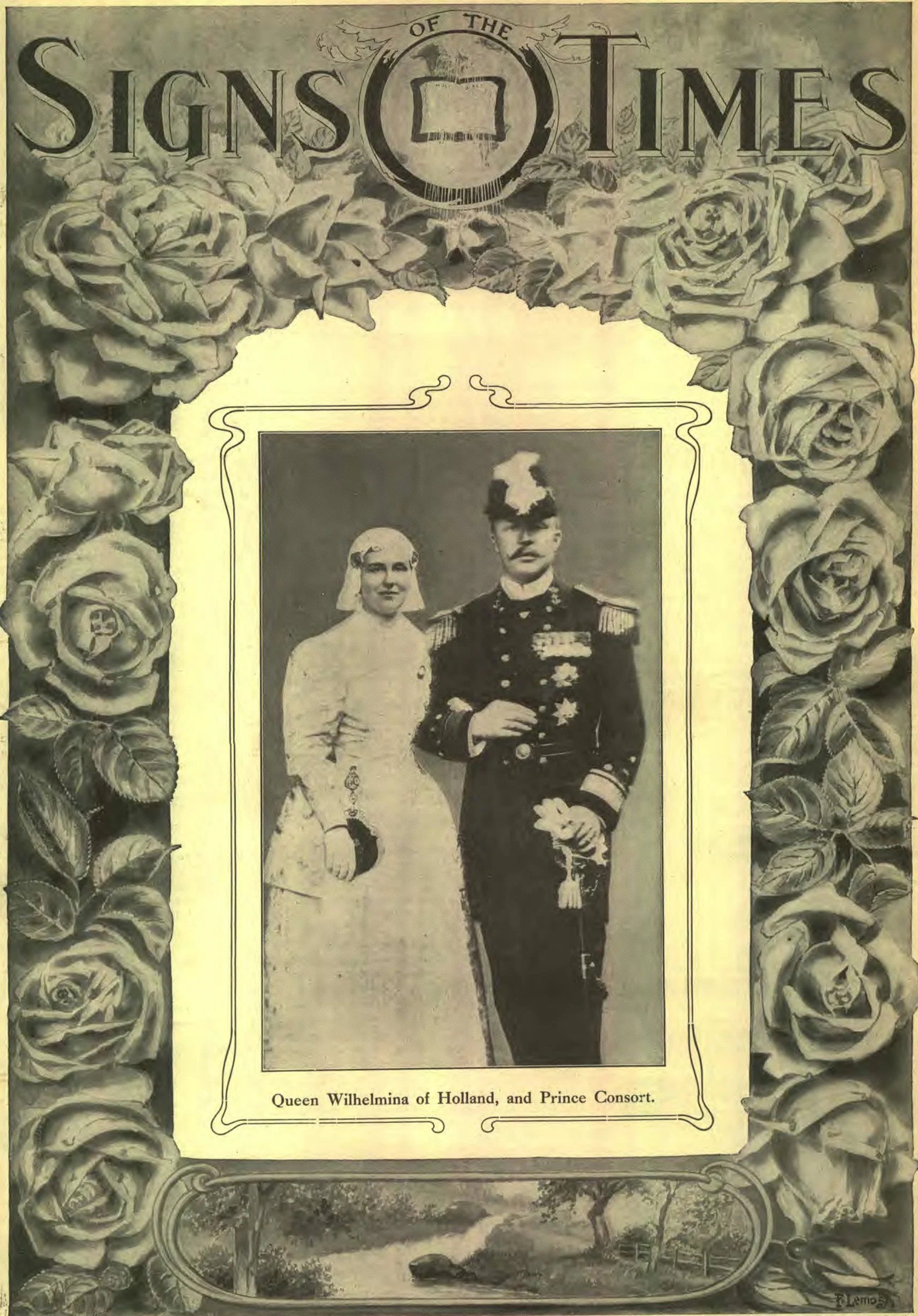
We send no papers from this office to individuals without pay in advance. When persons receive copies without ordering them, they are sent by other parties, and we can give no information in regard to them. Persons thus receiving copies of the SIGNS are not indebted to the office, and will not be called upon to pay for them. Please read the papers you may receive, and hand them to your friends to read.
Our authority is the Bible, the Holy Scriptures of the Old and New Testaments. When the Common ("King James" or "Authorized") Version, or the American Standard Revised Version is used, quotations will not be designated in reference. Any Bible quotation in this paper, therefore, differing from the Common Version, unless otherwise indicated, will be almost invariably from the American Standard edition of the Revised Bible, copyright 1901, by Thomas Nelson & Sons.
Pacific Press Publishing Company, Mountain View, California

You have reached the end of this edition.

Signs of the Times