THE family were at the supper table when John came in with his skates. After supper father said to him:—
"John, you have been gone all the afternoon. You did not get your work done. It must be finished to-night, you know."
John went out into the shed with a gloomy brow. It was not long, however, before the tones of his voice came in very cheerfully through the closed door into the sitting-room.
"Is that Nan out in the shed with John?" asked Janetta.
Her mother smiled and nodded.
Janetta was almost grown up. She felt herself to be wise, and often liked to give her mother advice, as most of us have liked to do in our time. She gave her some now.
"I think, mother, that you ought not to let Nan help John so much. She will spoil him. It is no girl's work for her to be carrying wood for him down into the cellar. She never seems to mind what she does, if it will make things easier for John."
"He pays her for it pretty evenly, I think," said Mrs. Neville, quietly.
"Pays her!" repeated Janetta in surprise, looking doubtfully at her mother. "How?"
"Keep your eyes open, and see," said Mrs. Neville. She would give no hint of what she meant.
"John," said Nan, when they had come back into the house, and were warming themselves luxuriously, "Eva Hastings can't go to the singing class, because she hasn't anybody to take her home. We could walk just that little distance round the corner with her, couldn't we?"
"Where's her brother Jim? Why can't he go for her?"
"He'll not be bothered, he says. You always come after me, anyway. So I thought it wouldn't be so very much farther to take Eva on home."
"I suppose it wouldn't," said John. "All right."
Janetta looked across to her mother. But Mrs. Neville's head was bent over her work.
The next day at noon John was full of a plan which the boys were making at school.
"We are going to get up a sleigh-ride—just we ourselves. We are going to pay for the big sleigh amongst us boys. Then we will invite the young ladies to come with us."
Janetta condescended to show a little interest. She usually felt herself much above John and his friends, but if it was a question of having a sleigh-ride, when sleigh-rides were few, perhaps she might forget her dignity for once to advantage. John noticed this. He was divided as to whether to feel flattered or to grumble.
"Yes, of course, some of the fellows want you, Janetta," he said. "They know that generally you don't remember that they are alive; and it is just possible that now and then you slip out of their memory for a minute or two at a time. But on an occasion like this we can make believe all round. You see it adds something to the style to have girls on board with long skirts, and their hair put up."
Nan was listening wistfully. Her skirts were not long, and her hair was braided. Still she oughtn't to be selfish; it was nice for John and Janetta, and her turn would come, by and by.
"In my own case, tho," John continued, "I didn't choose my girl for style. I have more sense. She is young; she may fall asleep during the proceedings, but she is the nicest girl in town, for all that, of any size—except mother—Nan is."
"O, John, you didn't!" cried Nan, joyfully. "How perfectly lovely of you."
Janetta thought of several things, of which the11sleigh-ride was only one. Meantime Dr. Neville had come in for his dinner.
"John," he said, "I hope you have not been making friends with those two Barbour boys."
"I haven't," said John; "Nan wouldn't let me. I couldn't see anything bad in them; and they are very entertaining. But Nan made such a fuss that I had to give in."
"Well, you may be very thankful to Nan," said his father. "They have got themselves into a miserable scrape. They were picked up on a back street drunk last night, and put in a common jail!"
While the others exclaimed and questioned, John was uncommonly silent. Finally, before he started back to school, he said soberly:—
"A fellow doesn't lose much by taking Nan's advice. Maybe if Harry and Phil Barbour had had a deacon for a sister, they never would have got into such bad ways."
In the course of the afternoon Janetta drew her chair close up to her mother's.
"Mother," she said, "I have watched, and I see. Nan gets high pay from John for hewing wood and drawing water—the highest."
"I knew that you would see it before long," said her mother. "A girl can not do better work than build little fences of kindness and love and goodness about her brother, that will help to keep him safe. Even if she roughens her hands a little at it, and works rather more than her share, it is well worth her while. Isn't it?"—Forward.
THE HOME
IS IT ALL A "HAPPEN SO"?
By Laura C. Hutchins
BY LAURA C. HUTCHINS.
It is wondrous queer, as from year to year,
While the seasons come and go,
How the grass is grown, and the stars move on,
If 'tis all a "happen so."
While a watch that's planned by a skilful hand
Of its maker's skill will tell,
Doth creation grand, so wisely planned,
Speak its Maker's name as well?
Ah, better than mirth, or the wealth of earth,
The treasures God's words unfold!
Take time, then, to look in His sacred Book
For the home amid pearls and gold.
O, worship the One who upholds the sun,
The earth, and the rolling spheres,
Who careth for grief, and bringeth relief,
And drieth the mourner's tears!
THE U. S. SUPREME COURT.
By Henry Carlton Lewis
[Henry Carlton Lewis, in the Pilgrim for January.]
THE court opens at twelve o'clock each day during its sessions. Precisely at that hour the crier, well groomed and dignified, rises and announces in measured, stentorian tones: "The Honorable, the Chief Justice and Associate Justices of the Supreme Court of the United States." This is the signal for all present to rise. When the crier finishes the announcement, a door to the left of the Bench opens, and the Justices, robed in black silk gowns, enter in single file and march in solemn procession to their places, the Chief Justice leading. When all have reached their chairs, the bar bows reverently and the salutation is returned by the Court. The Justices then seat themselves, the bar and spectators doing likewise. The crier then steps forward and opens the court by announcing: "Oyez! Oyez! Oyez! all persons having business with the Honorable Supreme Court of the United States are admonished to draw near and give attention, as the Court is now in sitting. God save the United States and this Honorable Court." The last words are emphasized by a vigorous pound of his gavel.
Chief Justice Fuller, whose long white hair always commands admiration, asks if there are any candidates for admission to the bar of the Court. If there be any, they qualify and are sworn in. He then nods to the members of the bar that the Court is ready to hear them. His countenance is not that of the conventional, stern Justice; it is one of smiles. His speech is soft and suave.
The arguments are conducted in moderate tones. The style is conversational. Thundering invectives and declamations are rarely heard. The lawyers well know that this Court is to be convinced only by solid argument and unanswerable logic.
Boys from twelve to eighteen years of age act as pages. They stand back of the Bench and at the slightest suggestion from a Justice of a desire to be served in any way one of them is at his side to receive the command.
Seniority of service on the Bench is rewarded by seats near the Chief Justice. The two oldest in the service are seated on either side of, and next to him, and then follow the others in proper order, so that the two junior Justices are on the extreme ends of the bench. When a new member of the Court is to be sworn in, the Chief Justice announces the receipt by the Court of the commission, and calls upon the clerk to read the document. The oath is then administered by the clerk. The new Justice kisses the antique Bible which has been in use in the Court for more than a century, and he is then escorted by the marshal to his place on the Bench, where he is received by the other members of the Court standing. He bows to his fellow Justices, and receives bows from them in return. He then bows to the bar and takes his seat on the Bench.
SUNSHINE AND MUSIC.
A LAUGH is just like sunshine,
It freshens all the day,
It tips the peaks of life with light,
And drives the clouds away;
The soul grows glad that hears it,
And feels its courage strong—
A laugh is just like sunshine
For cheering folks along!
A laugh is just like music,
It lingers in the heart,
And where its melody is heard
The ills of life depart;
And happy thoughts come crowding
Its joyful notes to greet—
A laugh is just like music
For making living sweet!
ANNUAL MEETING NOTICE.
The Second Annual Meeting of the Pacific Union Medical Missionary and Benevolent Association, for the purpose of electing seven directors and transacting any other business that may properly come before the meeting, will be held on Wednesday, March 9, 1904, at 12 o'clock M., at room 203 Parrott Building, San Francisco, Cal. W. R. SIMMONS, President,
E. E. PARLIN, Secretary.
It is expected that the meeting will be called to order and duly adjourned to Monday, March 28, 1904, the day following the adjournment of the meeting at Healdsburg, Cal., of the Pacific Union Conference.
RIPE OLIVES.
By A. E. Crist
I STILL have some of those delicious, ripe, pickled olives. Orders will be filled, while they last, at the following prices:— In lots of 16, 30, 50, or 60 gallons, at 40 cents per gallon. In 4, 5, 8, or 10 gallon lots, at 45 cents per gallon. Marysville, Cal. A. E. CRIST.
Three Times a Day to CHICAGO
THE ONLY DOUBLE TRACK RAILWAY between the Missouri River and Chicago.
THREE TRAINS DAILY via the Southern Pacific, Union Pacific, and Chicago and Northwestern Railways.
OVERLAND LIMITED, Vestibuled. Leaves San Francisco at 10.00 a. m. The most luxurious train in the world. Electric lighted throughout. Buffet smoking cars with barber and bath, Booklovers' Library, dining cars, standard and compartment sleeping cars and observation cars. Less than three days to Chicago without change.
EASTERN EXPRESS, Vestibuled. Leaves San Francisco at 6.00 p. m. Through Standard and Tourist sleeping cars to Chicago. Dining cars, free reclining chair cars.
ATLANTIC EXPRESS, Vestibuled. Leaves San Francisco at 9.00 a. m. Standard and Tourist sleepers.
Personally Conducted Excursions
WEDNESDAYS, THURSDAYS and FRIDAYS
The best of everything
R. R. RITCHIE, G. A. P. C.
CHICAGO & NORTHWESTERN RY.
617 MARKET ST. (PALACE HOTEL) SAN FRANCISCO
OR S. P. COMPANY'S AGENT
E-Z WASHING TABLETS
MAKE WASHING EASY
Superior to all other preparations
## The Tablets DO THE WASHING while YOU LOOK ON
"The E-Z Washing Tablets are the best sellers I ever saw. Every one who took fifty cents' worth for trial came back for more."
Mrs. P. A. Flower,
Warner Lake, Oregon.
WE WANT AGENTS EVERYWHERE
Write for Terms Two Samples 5c
# ALFRED MALLETT
907 Second Ave., Baltimore, Md.
TOURIST CARS EAST
VIA
S. P. LINES
Personally Conducted Quickest Time
Cheapest Rates
Your choice of a dozen routes
Through cars to—
Portland Los Angeles Salt Lake City
Omaha Denver Kansas City
St. Paul Minneapolis Chicago
St. Louis Louisville Cincinnati
Memphis El Paso San Antonio
Houston New Orleans Montgomery
Atlanta Washington, D. C.
Remember these cars run through to above named cities without a change from Oakland or San Francisco. Our fast limited trains in connection with the above mentioned service. . . .
G. T. FORSYTH
Div. Pass. Agent
12 San Pablo Ave., Oakland, Cal.
PHONE MAIN 543
ANIMAL INTELLIGENCE.
A MALDEN physician had an adventure some time ago which he does not care to repeat, although it gave him a much higher appreciation of the intelligence of his pet driving horse than he had previously entertained. He was returning home from visiting a patient late at night, in company with a clergyman, when the horse stopped short at one of the most dangerous grade-crossings within the city's limits. Absorbed in lively conversation with his clerical friend, and seeing no gate down, he mechanically touched the horse with the whip and urged it by his voice to go forward. But the spirited animal, for once, would not respond, and instead of obeying stepped briskly aside and turned his head as far as possible from the train which just then whizzed by at the rate of forty miles an hour. It was a close call for the occupants of the carriage, who sat breathless through the moments of that terrible suspense, but the horse maintained its attitude of a half-circle until the danger was past. It seems that the gatekeeper was asleep at his post, and had neglected his duty, but the delicate ears of the horse had detected the sound of the coming train, and had rightly interpreted it as the signal of a danger to be avoided. Both men were firmly convinced that they owed their lives, under Providence, to the intelligent use the animal made of its former experiences with grade-crossings, and nothing but a farm "down east," with a radium mine on it, would now tempt its owner to part with it.—Boston Transcript.
PROGRESS OF BIBLE CIRCULATION.
THE centenary of the British and Foreign Bible Society is to be held March 6 of this year. Referring to this fact, Dr. John Fox, one of the corresponding secretaries of the American Bible Society, draws a comparison of the work of the two societies, the American being eighty-seven years old. The receipts of the British organization are about three times as much as those of the American society. The British society has issued, in round numbers, 180,000,000 copies of the Scriptures, and the American, 72,000,000. For the past year the figures reported are, 6,000,000 for the British, and 2,000,000 for the American. The British society has issued translations, in whole or in part, in 370 languages; the American, in 100. In some of these translations the two societies have united, so that the total is 436.
"Each society," says the secretary, "must sometimes draw from the other for translations needed in its own specific field. For instance, the Zulu version, extensively used in South Africa, is issued in New York, having been made by American Congregational missionaries. Certain Philippine versions are published by the English society. The foreign immigrants, now arriving in such immense numbers on our shores, must be offered Polish, Hungarian, Italian, French, Lithuanian, and other Bibles from London presses. But, in reckoning by languages, the elder society is still leading her younger sister nearly in a tripple measure, even when the 'time allowance' is made for 100 versus 87 years."
Concerning the outlook for the American society, and the aggregate of work yet to be done in the world, Dr. Fox adds this significant comment and statement:—
It has been publicly stated that the American Bible Society is facing the old and dismal alternative of13debt or severe retrenchment, unless welcome relief shall come before spring. This matches ill with our national pride in commercial progress and our hopes of financial supremacy in the nations of the world. Yachting contests aroused the pride of nations year after year. If the things of the Spirit were duly considered, there would be a just and noble emulation in this matter. The magnitude of the task yet to be done will tax both societies and all others besides. In Britain's Indian empire, for instance, there are still 108 languages, spoken by seventy-four millions of people, untouched by the Bible conquest. In our own Philippines fifty or more languages are without Bibles, and there are thirty-six European languages which only have a partial Bible. There are 2,500 languages, at least, spoken under heaven and among men, of which a scanty 100 have complete Bibles, 100 or less full New Testaments, and less than 250 more a few books, a gospel or two, while all the rest are without a syllable of those words whose Spirit and life have put Britain and America in the van of human progress. Both societies may, therefore, fully unite in the commemoration of the natal day of this great modern movement, which, quite as much as steam or electricity, has made the great world spin forever down the ringing grooves of change.
The American Bible Society has been officially invited to send a representative to the British centenary. This will be celebrated in London, also in subsequent meetings in various other English cities, including a week or more. The American Bible Society is also asking all the churches of the United States to join in "Universal Bible Sunday," March 6, in some appropriate services.
FROM THE SOUTH PACIFIC.
By B. J. Cady
BY B. J. CADY.
I HAVE just returned from a visit to the Gambier Islands and Pitcairn. This is my second visit to these islands, my first being eleven years ago, when we came out on the Pitcairn from the United States. Pitcairn is about 1,300 miles from Tahiti, and as we have no regular transportation service, but have to depend on trading schooners and other vessels that may happen to be going between here and Mangareva, it seemed like quite an undertaking to go so far, not knowing when I might have an opportunity to get back again. But I felt that the Lord called me to go, and that He would guide and keep me, and also have a watch-care over the interests I left behind. It seemed necessary for Mrs. Cady to remain in Tahiti to look after the interests of the work here, as the conditions were such that we could not both leave at once. Tho this was not a pleasure trip, yet I had the satisfaction of feeling that I was in the path of duty, and received much of the blessing of God. I spent about four weeks on Mangareva, and eight weeks on Pitcairn.
At Mangareva, I held meetings in both the English and Tahitian languages. Brother and Sister Jones did considerable work at this place at the time when he was sailing the Pitcairn cutter, and one white man accepted the truth. Some others are interested. Mangareva has only about 200 inhabitants, and most of these are Catholics.
The cutter Pitcairn carried us from Mangareva to Pitcairn Island in six days. I enjoyed my stay on the island. We held meetings nearly every day. I took my stereopticon lantern with me, and used it some in illustrating Bible truths. I received from the people over $300 in tithes and offerings, most of it being tithes, and they have quite a lot of their tithe of arrowroot and other produce still on hand. I had the privilege of baptizing eight of the young people just before coming away. We have quite a flock of children and youth on Pitcairn, and if we need a church school anywhere, I think we need one there. There are at least forty who ought to be in such a school, so it would require the services of two teachers. A man and wife who are devoted Christians and not extremists, and who are willing to give up all for Christ, might do a good work there.
After I had been away from home two months and a half, I began to feel that it was about time to be getting back to Tahiti; but, so far, no way had opened for me to get away from Pitcairn, either to go to the United States, or to return to Mangareva. The Pitcairn cutter was at Mangareva, laid up for repairs. One day a schooner was sighted, and it was found to be the missionary schooner of the French Protestant Mission of Tahiti. It had started for Mangareva, and the captain had lost his bearings, so they went some 420 miles beyond Mangareva, and were going on toward South America, which was some 2,000 miles away. They were without water for three days and a half, and were almost out of food, when they providentially met an American ship, which gave them some food and water, and advised them to steer for Pitcairn, which was the nearest place. They did so, and reached there safely. As the Pitcairn people were very kind to them, and did all they could to help them by carrying out food, water, and fuel to their ship, they gave six of the people and myself a passage to Mangareva. But they would not take me any farther. However, the Lord was providing a better way of transportation for me, and one by which I might reach home much sooner. A French man-of-war arrived just then, and they gave me a passage to Tahiti. As this was a large steamer, it was much more comfortable than the small schooner would have been. They charged nothing for transportation, but only for board, so it did not cost quite $5.00 for me to come to Tahiti, while it cost me about $38 to go to Mangareva from Tahiti. I was treated very kindly on board, and felt thankful for such a good passage home. We stopped at five of the Tuamotu Islands on our way back, so I had an opportunity of getting somewhat acquainted with the conditions in these islands, and we hope to enter these fields in the near future.
South Sea Islanders. The natives are beating the hollow logs which serve in the place of church-bells.
Our six Pitcairn friends are coming to Tahiti on the missionary schooner which brought us to Mangareva. They were to call at several islands south of us, and have not yet arrived here.
Traveling in the south seas is attended with many inconveniences and usually with much discomfort; for, in order to reach the different islands in the field, we must do considerable traveling at sea in all sorts of boats and in all kinds of weather. It is very different from traveling in the States, where one can know just what hour the train is to leave, and plan accordingly, and can also learn from the time-table just when he will reach his destination. Here we seldom know just when a boat is to come or go; and, unless it is a steamer, we can never know when we shall reach land, for that depends entirely on the winds. But there are thousands of islands in the Pacific Ocean, and many of them have never been reached by the Third Angel's Message. We are glad for the privilege of having a part in this work of carrying the truth to them, that "the isles, and the inhabitants thereof" may learn to sing the praises of our God.
Papeete, Tahiti, Jan. 22, 1904.
JESUS STILL HEALS AS AT CAPERNAUM.
By Myrtle Patchett
BY MYRTLE PATCHETT.
At even, ere the sun was set,
The sick, O Lord, around Thee lay;
O, in what divers pains they met!
O, with what joy they went away!
Once more 'tis eventide, and we,
Oppressed with various ills, draw near;
What if Thy form we can not see?
We know and feel that Thou art here.
O Saviour Christ, our woes dispel!
For some are sick, and some are sad,
And some have never loved Thee well,
And some have lost the love they had;
And some have found the world is vain,
Yet from the world they break not free;
And some have friends who give them pain,
Yet have not sought a friend in Thee;
And all, O Lord, crave perfect rest,
And to be wholly free from sin;
And they who fain would serve Thee best,
Are conscious most of wrong within.
O Saviour Christ, Thou, too, art man;
Thou hast been troubled, tempted, tried;
Thy kind but searching glances scan
The very wounds that shame would hide.
Thy touch has still its ancient power;
No word from Thee can fruitless fall;
Hear in this solemn evening hour,
And in Thy mercy heal us all.
Galt, Ont.
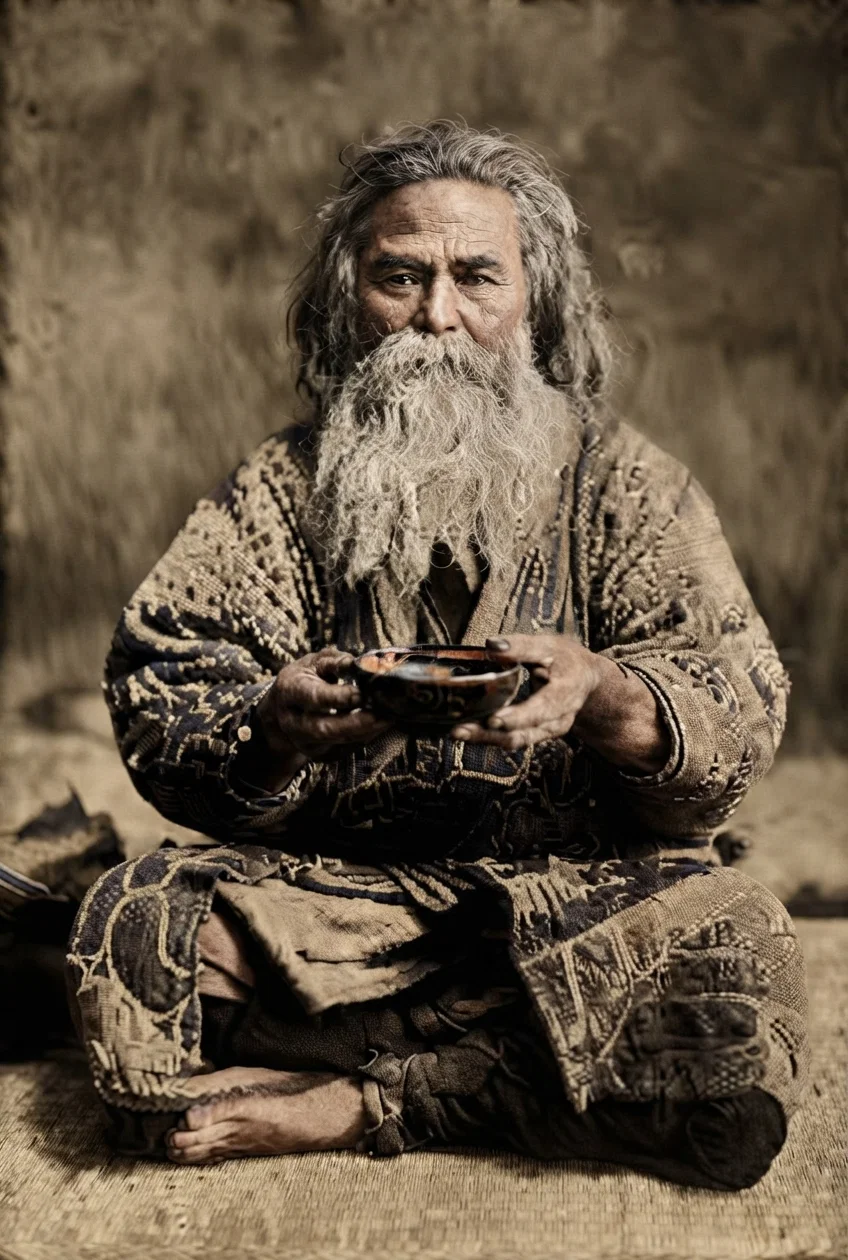
THE AINU OF JAPAN.
By Rev. C. A. Clark
[By Rev. C. A. Clark, Miyazaki, Japan.]
TURN to your map of Japan and you will notice that the northernmost of the large islands is called Yezo on the map. But in Japan it is called "The Hokkaido." It was my privilege to make a tour in this island this last summer, and among the many interesting things which I saw were the Ainu.
The Ainu are the people who were in Japan when the Japanese people came, long, long ago. They are to the Japanese what the Indians are to the other people of America. They used to be in other parts of Japan also, but they live now only in Yezo and some other of the northern islands. There are only about 17,000 of them left, and they are decreasing in number all the time on account of drunkenness, unsanitary living, and other causes.
Some of them are fine-looking men and women. Most of the men wear their hair and beards very long and do not comb them often; neither do they keep themselves very clean generally, so they do not appear as well as they might. Then, too, they have been easy victims of liquor-sellers, and this has, of course, done much to destroy their manly beauty and strength. The women are nearly all tattooed around the mouth. They think this is ornamental.
The roofs and sides of their houses are thatched with straw or grass. The houses have only one room besides the entry way. A large space for a wood fire occupies the middle of the room. The east window is counted as the sacred place. In front of this they worship, and, of course, next to this are the most honorable places. Between it and the fire the honored guests are seated, and on the south side of it such guests sleep. In the northeast corner are kept the large, round, lacquered treasure boxes and the sacred things of the family. Outside the window, and separated a little distance from it, posts are set in a row, to which they fasten one or more skulls of deer or bears, and before which they set their offerings, consisting of willow sticks whittled into long shavings, with the shavings left on the sticks (some of these are seen over the treasure boxes). This is their holy place and all they have for a temple.
On the east side of the house, also, is the bear cage. They consider the bear a sacred animal, and bears are taken when young and kept till they are grown and fat. Then they have a gathering of all the neighborhood, and the bear is killed and eaten with great religious festivity, in which all become very drunk.
They think that there are many gods, great and small, and one god supreme over all. But the greater the gods, the less they have to do with men. They do their work through the lesser gods. So the gods with which men have direct relations are not the great ones, but the gods of rivers and fields and winds and other gods of common things. These they try to pacify in various ways, so that they will not harm but help them. Fire is one of the gods which they worship and which, as they think, reports their conduct, and through these lower divinities they make known their requests to the upper gods. The favor of the fire god is secured sometimes by threats that they will not make offerings to him if he does not secure what they wish.
The Japanese Government now provides schools for the children, but these children have not, like American children, inherited the power to think hard and long, or the power to learn easily, and they are not able to keep up with the Japanese children in school, and so have to be taught differently. They excel in copying what they see, and writing and drawing are easy for them.
Much work is being done among the Ainus by the English Church Missionary Society, and a goodly number of them now profess to be Christians. The difference in their lives appears plainly, tho it is very hard for them to conquer their habit of drinking and the temptation to be like their non-Christian neighbors.—Missionary Herald.
HOW WE GIVE.
THE women of America spend far more for artificial flowers and kid gloves than the church does for missions.
Christians "lay up" annually, above all their comforts and luxuries, one hundred times the amount they give to foreign missions.
Many times as much money is puffed away in tobacco smoke by the men in America in one year as the church gave in a century to evangelize the world.
The church, as a whole, gives less for the evangelization of the world than is expended in idolatrous worship at a single heathen shrine in India—that of the goddess of cruelty.
The average gift of each church-member for foreign missions is about forty cents a year, or one-ninth of a cent a day. Is this the price we place on the redemption of the world?
One year, when $18,000 was spent for the raising of a crew, $150,000 in connection with a football game, $70,000 for a banquet, and $600,000 for a wedding, our mission boards were left groaning under a heavy debt.
One church spends twenty times as much for its choir as for missions; in another the printed programs cost more than they give to this great cause; in another the soprano costs enough to support two missionaries and a hundred native preachers in the field.
A ten-cent piece will buy a cigar, or preach the Gospel a whole day through native lips. A dollar will furnish an evening's amusement, or keep a boy in a mission day school for twelve months. With such possibilities in money, how can we waste even a penny?—Selected.
OUR WORK AND WORKERS.
By Editor
The church-school building at Mankato, Minn., was dedicated January 10.
The baptism of four candidates at Milwaukee, Wis., is reported by Brother N. P. Neilsen.
The baptism of two candidates at Youngstown, Ohio, is reported by Brother C. C. Webster.
In the Wisconsin Reporter, Brother J. B. Locken notes seven candidates for baptism at Clear Lake, with an increasing interest.
At Camden, Ohio, where Brother W. E. Bidwell has been holding meetings, four young candidates for baptism are reported in the Welcome Visitor.
From Williams, A. T., Brother Walter Harper writes that in one week, covering about two hundred miles, he had taken over one hundred orders for books and helps, amounting to over two hundred dollars.
We congratulate our Review and Herald brethren upon the increased circulation of the paper since the removal to Washington, D. C. We learn that it has a larger permanent subscription list than ever before in its history. For this let us all thank God and take courage.
The quarterly-meeting of the church at Battle Creek, Mich., was held January 30, when over five hundred brethren and sisters participated in the ordinances. The West Michigan Herald says that "it was indeed an inspiration to see so many young people present."
Concerning church-school work in Nebraska, Prof. C. R. Kite writes as follows to the Central Advance:
"We now have twenty-four teachers at work in the conference, and I have just arranged for the twenty-fifth one to go to Nebraska City and teach a three months' term. We have enrolled in our church schools about three hundred and twenty-five children. Our teachers are sending in good reports. One teacher writes: 'Eight of my pupils have just been baptized.' At another place nearly all of the young people have given their hearts to God. At several places where we have church schools the young people have been organized into bands, and plans are being laid for them to do a good work."
Following is an extract from a letter in the Welcome Visitor, from Dr. H. W. Miller, of Sin Tsai Hsien, China:
"This is a walled city, having a wall thirty-five feet high and two and one-half miles in circumference surrounding it. It has a population of about 15,000 inhabitants, and is located in the center of 'The Great Plain,' which is the most fertile, as well as the most densely populated, region in the world, there being 850 inhabitants to the square mile. The city has a good reputation, as during the recent Boxer movement the people here had no feeling of hatred towards the missionaries, and still say that they will never take part in any such affair, even if asked to do so by the officials. Previous to our coming here no foreigner has ever come to this city. We are now trying to secure a place in the city for a training school for the native Christians, and also for training the young men and women from the home land. Here is the place to get the training for missionary work in China. We have good teachers to teach them the language, and native evangelists, who can teach them the best ways to work among the people. We will soon be printing our tracts and pamphlets in the Chinese language, and we have native canvassers selling portions of the Bible. We are the only physicians in this province, with 22,000,000 people around, and a large percentage of them sick of some curable disease who need help. If the people in the States could only see the situation as it is, they would quickly raise money and laborers for the poor heathen in China. They are all willing to learn better ways. I can not write a letter in the day time without having a half dozen of them around me to see how this machine works, and they learn very readily. It is surprising to see the difference between the Christian Chinaman and those that are not Christians. I consider it the greatest opportunity I have ever had, to teach this needy people."
WANTED FOR MISSIONARY WORK.
By Editor
(Always prepay postage.)
SIGNS, Review, Instructor, Little Friend, Life Boat, Good Health, and tracts. Address, F. S. Bailey, Dunkirk, N. Y., Route 10.
LIFE BOAT and Pacific Health Journal. Address, Dan Jordan, Corinth, Miss.
ANY of our denominational literature suitable for depots or jails. Address, Mrs. E. A. Goss, 1723 West Maple Street, Enid, O. T.