WHEN Rome perished every form of government and every device as to government had been tried, and had failed, all but one; that one form, that remaining device was government wholly by the church—ecclesiastical government. The last stage of the Roman Government had been a government in which the church was united with the State, in which the church worked hand in hand with the State, and traded church support for State favors. But the State, not the church; the emperor, not the bishop; was the ruling power.
The bishops had promised to the imperial power, and even to themselves, that that system should be the very kingdom of God come on earth. But that bow of promise was most rudely dispelled when it was found that ruin rode swiftly in every element, and from every direction. Yet, in the face of all this, the bishops would not acknowledge themselves mistaken, except in the matter of time and order. They still insisted that they were right as to the coming and the reign of the kingdom and city of God; but that there must be a cleansing and an overturning that would clearly give to the church alone full and undisputed sway. For this the church of Rome aspired and conspired to take to herself the power and the dominion over the earth, and demonstrate that the perfection of government on earth was the church of Rome. The ruling power in this church was the bishopric of Rome, and the only thing contemplated by Rome's prelates was that this new order of things, this new form of government in the world, would be, in substance and vital principle, only the government of Rome continued. Through Rome, cleansed by the divine judgments, ruined, revivified, and glorified by the divine presence, benediction would come to bless the earth with perfect peace. Thus would original Rome reach its true goal, and its original purpose in the world be truly fulfilled.
Leo the Great, Bishop of Rome (440-461), lived and exercised his bishopric in the very midst of the whirl of events that brought ruin to the Roman Empire. And it was he who conceived and prophesied this grand future for the church of Rome. He declared that the former Rome was but the promise of the latter Rome; that the glories of the former were to be reproduced in Catholic Rome; that Romulus and Remus were but the precursors of Peter and Paul, and the successors of Romulus, therefore the precursors of the successors of Peter, and that as the former Rome had ruled the world, so the latter, by the see of the holy blessed Peter, as head of the world, would dominate the earth.
This conception was never lost by the Papacy. And when, only fifteen years afterward, the Roman Empire had in itself perished, and only the Papacy survived the ruin and firmly held place and power in Rome, this conception was only the more strongly and with the more certitude held and asserted.
This conception was also intentionally and systematically developed. The Scriptures were industriously studied and ingeniously perverted to maintain it. By a perverse application of the Levitical system of the Old Testament, the authority and eternity of the Roman priesthood was established; and by perverse deductions "from the New Testament, the authority and eternity of Rome herself was established." First, taking the ground that she was the only true continuation of original Rome, upon that the Papacy took the ground that wherever the New Testament cited or referred to the authority of original Rome, she was meant, because she was the only true continuation of original Rome. Accordingly, where the New Testament enjoins submission to the powers that be, or obedience to governors, it means the Papacy, because the only power and the only governors that then were, were Roman. "Every passage was seized on where submission to the powers that be is enjoined; every instance cited where obedience had actually been rendered to the imperial officials; special emphasis being laid on the sanction which Christ Himself had given to Roman dominion by pacifying the world through Augustus, by being born at the time of the taxing, by paying tribute to Caesar, by saying to Pilate: 'Thou couldst have no power at all against Me except it were given thee from above.'"—Bryce. And since Christ had recognized the authority of Pilate, who was but the representative of Rome, who should dare to disregard the authority of the Papacy, the true continuation of that authority to which even the Lord from heaven had submitted?5
Sustained by Forgery.
The power that was usurped by the church and her popes upon these perversions of Scripture, was finally confirmed by a specific and downright forgery. This "most stupendous of all the medieval forgeries" consisted of "The Imperial Edict of Donation," or "The Donation of Constantine." "Itself a portentous falsehood, it is the most unimpeachable evidence of the thoughts and beliefs of the priesthood which framed it." It proceeds to tell how that Constantine the Great, having been cured of leprosy by the prayers of Sylvester, bishop of Rome, resolved, as a reward of gratitude, that he would forsake Rome, and found a new capital, "lest the continuance of the secular government should cramp the freedom of the spiritual." It declares that "Constantine found Bishop Sylvester in one of the monasteries on Mount Soracte, and, having mounted him on a mule, he took hold of his bridle rein, and, walking all the way, the emperor conducted Sylvester to Rome, and placed him on the papal throne." Then the forgery makes Constantine decree as follows:—
We attribute to the see of Peter, all the dignity, all the glory, all the authority, of the imperial power. Furthermore, we give to Sylvester and to his successors our palace of the Lateran, which is incontestably the finest palace on earth; we give him our crown, our miter, our diadem, and all our imperial vestments; we transfer to him the imperial dignity. We bestow on the holy pontiff in free gift the city of Rome, and all the western cities in Italy. To cede precedence to him, we divest ourselves of our authority over all these provinces; and we withdraw from Rome, transferring the seat of our empire to Byzantium; inasmuch as it is not proper that an earthly emperor should preserve the least authority where God hath established the head of His religion.
It was strictly in the exercise of this power, conceived by Leo the Great, and systematized by his successors, that the Papacy exercised the prerogative of restoring and re-establishing the Roman Empire, in the proclaiming and crowning of Charlemagne as emperor, and Augustus; and then of asserting supreme power over emperor, empire, and all, and using this as the means by which she herself would attain to that supreme height of worldly ambition and priestly arrogance; where she herself would assume entirely to herself all the power and prerogative of that enormous assumption, and, "arrayed with sword and crown and scepter," in the sight of the assembled multitude, would shout, "There is no other Caesar, nor king, nor emperor, than I, the sovereign pontiff, and the successor of the apostles."
One of the bases of her claim of right to rule the world was that she was the sole embodiment on earth of the principles of the Prince of Peace, and that the bishop of Rome was the very vicegerent of the person of the Prince of Peace, and, therefore, she would assure the reign of peace to the full extent of her recognized dominion. But the fact proved that at every step of the way in her climbing to that pinnacle of world power, and in maintaining herself there, she kept kingdoms and nations, and even all Europe, and beyond, in a constant turmoil of war and anarchy. And in order to save their own kingdoms from sheer anarchy, and to preserve even society itself from annihilation by the anarchism of the Papacy, the heads of the nations of Europe, the secular powers, were compelled to assemble in a general council, specifically "for the reformation of the church in its head and members," at which council they took her down from her high throne of universal supremacy, and seated her upon a stool of submission and subjection. In complete and horrible measure, there had been demonstrated to all the world that the essence of the Papacy and the ultimate of her rule is only anarchy.
Such was the result to the nations of Europe, and to Europe as a whole, with respect to government itself. But the real dominion claimed by the Papacy is of the heart and life—the soul—of man. As essential to the proper demonstration of this dominion, she claims that the temporal power of the world must be absolutely subject to her will; that power she had surely gained, and the universality of her rule had been recognized, so that she had a fair, free, and open field to demonstrate exactly what she would do. And as respected the temporal power, and even her own power in government, the result was only anarchy.
Speculation in Crime.
And the result of her rule in her own peculiar claim of dominion over the soul of man, demonstrated universally in her dominion over those who were become her own, and who acknowledge themselves her own—in this dominion, the result was in nowise different from that in the other. Her whole power to the full extent of her recognized dominion was devoted to the seducing, and even the compelling, of mankind to sin. She actually speculated in human corruption. Pope John XXII., regularly listed, and set a tax upon, the sins of men. The list of taxes drawn up by John XXII., as levied upon the licentious practises of ecclesiastics, priests, nuns, and the laity; on murder and other enormities, as well as lesser crimes and breaches of monastic rules and church requirements; is sufficient to cover almost every sin that mankind could commit. Yet, all these sins were regularly taxed at a certain rate, down to the single "sou" (cent), and even to the "denier." So that it is literally true that no inconsiderable portion of the revenues of the Papacy were derived from a regularly assessed tax upon the sins of men. Well did the abbot of Usperey exclaim:—
O Vatican, rejoice now, all treasuries are open to thee; thou canst draw in with full hands! Rejoice in the crimes of the children of men, since thy wealth depends on their abandonment and iniquity! Urge on to debauchery, excite to rape, incest, even parricide: for, the greater the crime, the more gold will it bring thee. Rejoice thou! Shout forth songs of gladness! Now the human race is subjected to thy laws! Now thou reignest through depravity of morals and the inundation of ignoble thoughts. The children of men can now commit with impunity every crime, since they know that thou wilt absolve them for a little gold. Provided he brings thee gold, let him be soiled with blood and lust; thou wilt open the kingdom of heaven to debauchery, Sodomites, assassins, parricides. What do I say? Thou wilt sell God Himself for gold!
The truth of this is abundantly confirmed by the latest historian of the Papacy, referring to the Papacy in the time when she held undisputed sway and unlimited power over people and nations: "No more unexceptionable witness as to the church of the twelfth century can be had than St. Bernard, and he is never weary of denouncing the pride, the wickedness, the ambition, and the lust that reigned everywhere. When fornication, adultery, incest, palled upon the exhausted senses, a zest was sought in deeper depths of degradation." The bishop of Lincoln declared in the presence of Pope Innocent IV. and his cardinals that "the clergy were a source of pollution to the whole earth." And when the earnest inquisitor of Passau, about 1260, undertook to explain the stubbornness of the heresy, which he was vainly endeavoring to suppress, he did so by drawing up a list of the crimes prevalent among the clergy, which is awful in the completeness of its details. A church such as he describes, was "an unmitigated curse, politically, socially, and morally."
Such was the church of Rome; such she demonstrated herself essentially to be; when she had full power and undisputed sway to reveal herself exactly as she would. And it has been truly observed that "those who know what Rome has once been, are best able to appreciate what she is." And even in this our day of the twentieth century, the truth of this is abundantly confirmed by the oft and gladly repeated boast of Rome's chiefest advocates that "Rome never changes"! It is the truth.
It was Paul’s great joy as he neared the end of his life that he had "kept the faith." But he did not keep it by putting it away in the safe deposit vault of his own inner consciousness. He kept it by telling it to everybody he met on the street, by carrying it from land to land and preaching it under every conceivable circumstance, unto all sorts and conditions of men. And so the only way we can keep that kind of faith and trust in God that will be a fountain of good cheer and song in our hearts is by serving our fellow men with unselfish love.—Rev. Louis Albert Banks.
"NATURE helps every man to become what he desires to become. If you put forth no effort, nature assumes that your wish is to be nobody, and she grants your prayer."
History of Government BY ALONZO TREVIER JONES AUTHOR OF "TWO REPUBLICS," "EMPIRES OF THE BIBLE," "GREAT EMPIRES OF PROPHECY," ECCLESIASTICAL EMPIRE," ETC.
How They Became Convinced
By Editor
[Believing it would be of interest to our readers, the editor of the Signs of the Times has asked Sabbath-keeping ministers and evangelical workers to tell in a few words the scripture or scriptures, the truths and principles, which constrained them to accept the unpopular truth of the seventh-day Sabbath. These testimonies must not exceed 500 words. Let us hear from all.]
XXXIV.
I WAS brought up on the east side of the Bay of Wigton, nearly opposite the point where Margaret Wilson and her two companions were tied to stakes when the tide was out, and drowned when it came in, because they would not conform to the practises of the Church of England, in the reign of Charles the Second.
My father was an earnest man and my mother a devoted Christian. When I was about fourteen one of my sisters said she thought the teaching of the United Presbyterian Church was nearly right, except on the subject of baptism. I never had heard it questioned, nor had I ever met a Baptist, but she saw that John was baptizing at Enon “because there was much water there,” and that the Lord did not go to Jordan to be sprinkled, altho we knew nothing of the meaning of the word “baptize.”
Some sixteen years afterwards, when whip-sawing lumber upon the slopes of Salmon River, my partner used to go down to White Bird, gamble all Sunday, and get back Monday afternoon. So I resolved to read the New Testament; and when I came to the account of our Lord’s baptism, I saw plainly that the Lord was not sprinkled in Jordan.
In 1877 I read a long article on baptism, and, believing Jesus Christ was my Saviour, I was baptized in Portland, Oregon. When in Montana, in 1890, some one sent me a pamphlet, entitled “Elihu on the Sabbath,” and I saw that the teaching of the Presbyterian catechism was right when it said that “from the beginning of the world to the resurrection of Christ God appointed the seventh day to be the weekly Sabbath;” but that it was wrong when it said that “ever after to the end of the world the first day of the week was to be the Christian Sabbath.” There is no “Christian Sabbath” mentioned in the Book. “God is not a man that He should change.”
"The truth at all times firmly stood,
And shall from age to age endure."
So I obeyed, and have great comfort thereby.
ROBERT GRIERSON.
LIFE ETERNAL.
JESUS says, in praying for His disciples: "And this is life eternal, that they should know Thee the only true God, and Him whom Thou didst send, even Jesus Christ." John 17:3.
There are those in the modern theologies who would have us believe that we possess this eternal life ourselves, whatever our moral attitude; and that the real essential thing is not that we should know God, but that we should know ourselves and know that God, the very Fountain of eternal life, dwells within us. They would picture us as a householder, who is dying of starvation while plenty of food is in his cupboard; nay, worse than this, we are feeding upon it all the time, but we do not know it.
Not so are we taught in the Gospel of Jesus Christ. There we are told that those who are living in sin are dead spiritually, "alienated from the life of God," "separate from Christ," "without God." Of these Jesus said, "I am come that they may have life, and may have it abundantly." John 10:10. But to them He said, "Ye will not come to Me, that ye may have life." John 5:40. And the Scriptures put the matter as strong and clear as this, "He that hath the Son hath the life; he that hath not the Son of God hath not the life." 1 John 5:12. "He that believeth on the Son hath eternal life; but he that obeyeth not the Son, shall not see life, but the wrath of God abideth on him." John 3:36.
This last text is an illuminator of the one at the head of this article. He who obeys not the Son, shall not see life; while he who knows the Father and Son finds in the knowing the life. The disobedience is the negative of the knowing, or the result of not knowing.
Now, to know God is not to know of Him, or to hear about Him. There are many who read of President Roosevelt, who have heard of him from others, who may have met him and spoken with him, but who do not know him. They have never come into harmony with his life.
There are many who know a little about music, who have heard of, or actually heard, Gounod's "Redemption," Handel's "Messiah," or Mozart's "Requiem;" but they do not know these great productions till they have come into harmony with them, and the music itself is their own, and has brought into harmony with itself every fiber of their being.
So no one knows God until he is in harmony with God, until all rebellion is banished from heart and soul, until will and body, mind and spirit, are submitted to God. Then man knows God; then God knows man. For the one important thing of human experience is to be "known of God." Gal. 4:9; 1 Cor. 8:3. Adam "knew his wife," and the result of that knowing was the bringing forth of a son. It was a knowledge of life-union. "The Lord knoweth the way of the righteous." Ps. 1:6. Of all the nations, Israel only was known of God. Amos 3:2. No other nation to that time had known His power, His life, His presence. "If any man loveth God, the same is known by Him." 1 Cor. 8:3. But he only loves God who has the Holy Spirit. Rom. 5:5. Knowing God, therefore, is harmony with Him,—is life-union with Him.
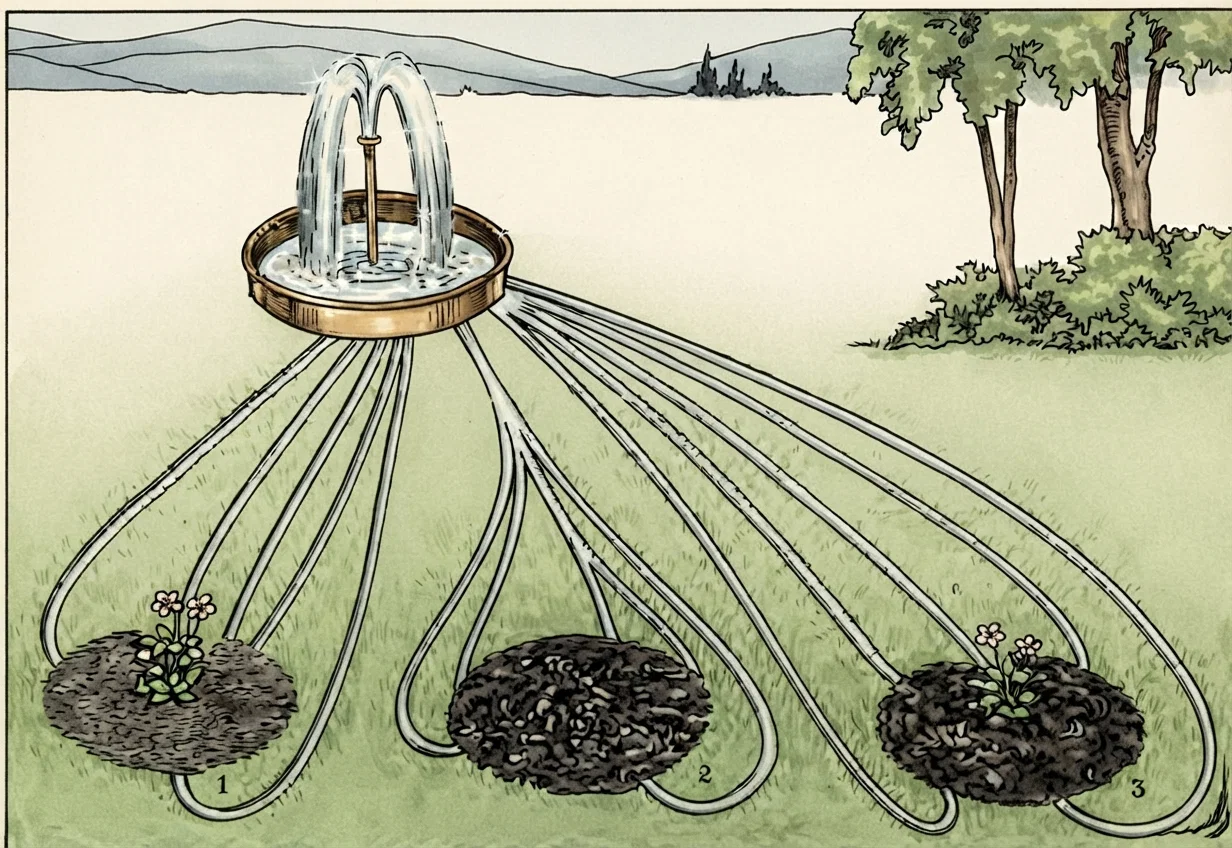
The little diagram will bring to us anew the illustration used last week. The fountain represents the Source of all life. The little patches of soil represent man in three conditions. The spiritual man is represented by the little plant in the midst of the plot of soil; the physical man, by the soil outside. The whole man receives life through two general channels: (1) Direct from the Fountain in harmony with God's spiritual law, summarily comprehended in the Decalogue; (2) through the food, air, and water, in harmony with the law of his physical being.
Before man sinned, represented by figure 1, his condition was that of a perfect, developing being, in harmony with perfect, unperverted law.
When man sinned (figure 2) he closed the avenue of God's life direct to the spiritual man, and the whole man could receive life only through his lower nature. But even this lower nature, the carnal man, became corrupted; sin became infleshed, and the laws of man's physical and spiritual being both became perverted, and so perverted the inflow of life, resulting in the death of the spiritual man, and finally of the whole man. Sinful men are to-day living after the flesh, the life perverted, and themselves subject to sin and death. "For they that are after the flesh do mind the things of the flesh. . . . For the mind of the flesh is death; . . . because the mind of the flesh is enmity against God; for it is not subject to the law of God, neither indeed can be; and they that are in the flesh can not please God." Rom. 8:5-8.
But when the carnal man yields all to God and His law, and lets Christ in by His Spirit, the hedge is broken (figure 3), and the spiritual man comes once more into direct connection with the Fountain of life. It flows in upon the drooping plant. The water of life revives the thirsty soul, and flowing out into the physical man and the deserts of sin, it vivifies and heals and strengthens the whole man. Isa. 44:3, 4. Then the spiritual man is no longer held by the bondage of sin. The body may be counted dead, but "the spirit is life because of righteousness." Rom. 8:10. And then if that creative Spirit of God is cherished in the heart and life, so that it dwell there, life shall also be given to the mortal, dying body, through the now dominant spirit. Verse 11.
It is not the Gospel of Christ, it is not the Gospel of righteousness and salvation, to tell sinful and sinning man that he has the life of God—eternal life—now. He alone has divinity within who is in harmony with the divine. He only has the Spirit of God, whose heart is open by faith to receive it. He only has the life of God who is known of God and Christ Jesus our Lord.
But Christ has come that all may have the life; not the soulical life of the flesh, living—or dying—on the low plane of the flesh, but the life everlasting.
O soul, bound in the fetters of sin and death, give up the fleshly, carnal life and let the life of God in the heart! Let it purify your affection. Let it cleanse away the sin. Let it illuminate and lead the way. Let it cleanse spirit and soul and body, and so fit you for the last great change to immortality, God's seal of an incorruptible character.
IN WHOM ARE YOU TRUSTING?
WITH two of the world's great powers in arms against each other; with two of the other great powers so allied with the belligerents that they are each supposed to see that neither of them helps either of the contending parties; with one of these powers pushing an expedition into territory which one of the belligerents regards as under her sphere of influence; with the power last referred to protesting against that move, and by her protest virtually calling upon her ally to see that the invasion of this territory is stopped; with Germany openly declaring her interest and sympathy with the Russian, and therefore seeming to notify the world that what interferes with Russia's interests interferes with hers; with Turkey and Bulgaria on the brink of war, while Russia's hands are tied from preventing the conflict; with Finland threatening a revolution against Russia's rule; with America leading a "concert of the powers" in representations to the two powers already at war; with China quivering in the balances, hardly knowing whether to strike Russia now and rise again against foreigners or remain neutral and peaceful; and, besides, with all the accumulation of conflicting interests among these nations, it is not to be wondered at that the whole world is stirred at the present time. One writer some months ago likened the condition of the world to that of a great boiler with a roaring fire underneath and no safety-valve. If that was a proper representation then, how much more fitting now! The flaming brand is ready to be hurled into the magazine; and when it does fall, the explosion will reach around the world; and this the world knows—and fears.
While everything is now at high tension and the world is quivering with suppressed apprehension, it is well for the child of God to turn to the Word of7God, where is assurance of a peace which even the roar of cannon and the clash of sabers can not disturb. Men are to-day trusting altogether too much to man. Nations are trusting, not in righteousness, but in armies and navies. How vain and fickle is the object of that trust was shown a few days ago at Port Arthur when Russia's right arm of defense and offense fell stricken and withered by her side. There is no certainty in such trust on either side. So while the fear and the dread of war are prevalent in the earth to-day, it is no time for the Christian to be looking to the power of man or to any of the military inventions of man to put his trust in them.
The admonition of the Lord is, "In all thy ways acknowledge Him, and He shall direct thy paths." Prov. 3:6. Again: "Put not your trust in princes, nor in the son of man, in whom there is no help." Ps. 146:3. The true and trusting Christian can have peace and happiness in the midst of the strife and turmoil of the powers of earth. "Happy is he that hath the God of Jacob for his help, whose hope is in Jehovah his God." "Blessed is he that maketh the Lord his trust," says the psalmist; and again he says: "Stand in awe, and sin not; commune with your own heart upon your bed, and be still. Offer the sacrifices of righteousness, and put your trust in Jehovah." Ps. 4:4, 5. The Lord declares that "He is a shield unto them that take refuge in Him" (Prov. 30:5), and that "whoso putteth his trust in Jehovah shall be safe" (Prov. 29:25).
There is no safety, there is no trust, that is worthy the name, in anything outside of Him; but in Him is peace, and hope, and trust, and safety, and everlasting life. He is worthy of all confidence. Trust Him, and find rest and joy in that trust.
The Prayer-wheel
The Prayer-wheel.—In Tibet a quite common instrument of devotion is a wheel worked by water-power, in which prayers are placed, and the constant turning of the wheel is supposed to be continual offering of prayer. This is extreme ritualism, or formality in worship. Commenting on this and other forms of ritualism not so crude, the Examiner (Baptist) says:—
But the lesson from the prayer-wheel comes home to all of us, and we can not wholly turn the application upon our neighbor. Who has not attended social religious services, in any of our churches, where the prayers, the hymns, the exhortations were empty of meaning, perfunctory, tedious, not at all calculated to commend spiritual and personal religion to the hearers? . . . Beware of setting up a prayer-wheel in your prayer-meeting, and thus putting yourself to shame before the heathen devotees of Tibet.
THE RIGHTEOUS AND THE LAW.
"We know that the law is good, if a man use it lawfully; knowing this, that the law is not made for a righteous man, but for the lawless and disobedient, for the ungodly and for sinners, for unholy and profane," etc. See 1 Tim. 1:8-10.
Many people construe this scripture as teaching that righteous people are under no obligation to observe the law of God. Therefore, assuming to be righteous, they hold themselves to be independent of the law's requirements. Now the truly righteous man (having by faith the righteousness of Christ, whose obedience is imputed to the man of faith) is immune from the penalty of the law, not because he is not under its jurisdiction, but because his faith has brought him into harmony with it. "Do we then make void the law through faith? God forbid; yea, we establish the law." Rom. 3:31. Dr. Adam Clarke, in his commentary on 1 Tim. 1:9, remarks as follows:—
It [the law] was, therefore, not made for the righteous as a restrainer of crimes, and an inflicter of punishments; for the righteous avoid sin ["the transgression of the law," 1 John 3:4], and by living to the glory of God, expose not themselves to its censure. This seems to be the mind of the apostle; he does not say that the law was not made for the righteous man; but ou keitai, it does not lie against a righteous man, because he does not transgress it. But it lies against the wicked, for such, as the apostle mentions, have broken it, and grievously too, and are condemned by it. The word keitai, "lies," refers to the custom of writing laws on boards, and hanging them up in public places, within reach of every man, that they might be read by all; thus all would see against whom the law lay.
As the law is truth and righteousness (Ps. 119:142, 172); as Christ is truth and righteousness (John 14:6; 1 John 2:1); as the judgment of God is in righteousness and truth (Ps. 96:13; Rom. 2:5), and as the Gospel reveals the righteousness of God (ch. 1:16-18) it follows that there is an inseparable connection and logical harmony of God, the law, Christ, the Gospel, and the judgment. Therefore the righteous man does not ignore the law of God; for in so doing he could no longer be accounted righteous. The righteousness of Christ consisted in His perfect obedience (John 15:10; Rom. 5:19; Phil. 2:8, 9), and His counsel is, "Follow Me."
"Know ye not, that to whom ye yield yourselves servants to obey, his servants ye are to whom ye obey; whether of sin ["the transgression of the law"] unto death, or of obedience unto righteousness." Rom. 6:16.
“DECEIVING AND BEING DECEIVED.”
STRANGE to say, it is a Baptist paper, the leading Baptist paper (the Examiner), that calls it “wise legislation” to enforce Sunday observance by State law; and this, too, “whether it be based upon the written law of God as declared in the fourth commandment of the Decalogue, or on the unwritten law, equally divine, which makes a hebdominal rest-day essential to man’s physical and intellectual well-being.”
Basing a Sunday law on the fourth commandment is not very good Baptist doctrine, unless Baptists are prepared to abandon their old-time watchword, “Thus saith the Lord,” and are also prepared to abandon their whilom antagonism to religious legislation by the civil power. The fourth commandment could not more explicitly declare that “the seventh day is the Sabbath of the Lord thy God; in it thou shalt not do any work.” There is a “Thus saith the Lord” for a weekly rest day; and it is not the divine purpose to make it merely “a hebdominal rest day, essential to man’s physical and intellectual well-being.” That is merely incidental; for it is “essential to man’s physical and intellectual well-being” to keep all the commandments of God.
The purpose of the Sabbath is primarily a day of spiritual rest, a commemoration of God’s rest (which was a spiritual rest) after His six days of creation. He sanctified that day, that ever afterward, on its weekly recurrence, it should be observed as His memorial. Man’s physical rest did not come into the question at all. He was not to labor on that day, because it was a “holy day,” and he was to “keep it holy.” To make that a basis for setting apart another day by State law, on which all men should be compelled to rest whether they want to or not, whether they need to or not, is not only illogical from the standpoint of the commandment, but it is absurd from the standpoint of man’s physical needs.
As far as the physical argument goes, men do themselves ten times as much harm by excessive, intemperate work on the six working days and nights as they would in seven days of temperate work in the hours allotted by nature for work. Nature designed that men should work by day and rest by night; but they insist on turning night into day, and many times the day into night. Then instead of reforming in the way that would prove a real physical benefit, some misguided people imagine it would be a good reformation to have the State add something to the law of God. They would substitute another day for the Sabbath, add to it the idea of an essential for physical rest, and compel everybody to rest on it.
If men want a day of rest, all they have to do is to obey the law of God. “Remember the Sabbath day to keep it holy,” and there is the rest that God has provided; for if they do this through the week they will live temperately every day, and be benefited temporally and spiritually. If they will not obey God, they can not be benefited by imposing upon them the formality of an imposed rest. If the “reformers” really want to give merely a physical rest to laboring men, and to curb the evil of the saloons to the minimum without destroying them altogether, they could accomplish ten times as much by having work restricted to the daytime, and having the saloons wholly closed all night, than they can by any semi-religious Sunday laws.
But all these Sunday-closing propositions are simply schemes for enforced Sunday observance. While their champions talk about “physical rest” and “civil Sunday,” they have put on record the doctrine that “if you take religion out of the day, you take the rest out.” The same principle is promulgated in this form: “You will in vain endeavor to secure the enforcement of a day of rest unless you enforce it as a day of worship; and unless it be founded on religious reasons, it can not be long maintained.”
These sentiments indicate unmistakably the ultimate expectation of those who are leading out in the matter of Sunday and other religious legislation. In the course of this movement, its advocates have also cautiously taken the ground that “in this thing you must not ask for too much at first. Ask just what public sentiment will bear, and when you get that, ask for more.”
Also, in advocating a national Sunday law, a leader of the campaign, who is still foremost in the persistent effort to commit the general government to the principle of religious legislation, said: “We will take a quarter of a loaf, half a loaf, or a whole loaf. If the government should do nothing more than forbid the opening of the post-offices at church hours, it would be a national tribute to the value of religion, and would lead to something more satisfactory.”
In face of these avowed purposes, really papal in principle, yet advocated by professed Protestants, it is almost alarming to hear the organ of a people noted in time past as the standard-bearers of religious liberty referring to Sunday enactments as “wise legislation.” Surely it is an evidence that the terrible deceptions and delusions predicted of the last days are already doing their deadly work.
TRUE AND FALSE TOLERATION.
By Editor
THE Sunday School Times well says on the above subject: "Many people confuse tolerance and indifference. They think they are tolerant in their feeling, when, as a matter of fact, they do not care enough to have any feeling. How often will a man who is interested in politics speak and act most bitterly toward those whose political principles are not his own, and yet think himself tolerant because he does not care enough about matters of religion to mind differences of opinion there! Matters of truth and faith are worth feeling about. They are so much worth feeling about that it is better to be bigoted because we feel strongly about them, than it would be not to feel about them at all. The old Puritan who has written as his epitaph in the ancient Massachusetts churchyard,
Let men of God in church and nation watch
'Gainst such as would a toleration hatch,
is more honorable in our eyes than the modern dilettante who feels very strongly about the color of his cravats, but has no feeling about errors in religious truth. Yet there is a Christian and genuine toleration which is not indifference. It consists with the most deep and serious feeling. This toleration cares about truth, and cares about what seems errors of truth in its teaching; but it rests confidently in faith that truth will win its own victories in God's good time; and consistently on the knowledge that love is greater even than truth, and must break the path in places where truth has not yet appeared. This is the tolerance of faith and charity, which a man shows in places where he feels deeply, whether those places be in politics or in religion." But this is the charity, the love of perfect truth. So, while love may seem greater than truth, after all love is the fruit of truth; it is the truth of God in operation. More than this, the Christian grants more than mere tolerance; he grants, nay, he demands, freedom for his opponent, for he knows God will care for His truth, and only in free minds can truth hold a place.