The Youth’s Instructor, Vol. 34, No. 16.

THE NAME UPON THE WINDOW PANE
Earlier text: THE NAME UPON THE WINDOW PANE

An Electrical House.

According to an exchange, Dr. Wm. Hammer, of New York, an associate of Mr. Edison, lives in a house that is so full of electricity, batteries, Leyden jars, etc., conducted by a system of wires, that it cuts up all sorts of antics and practical jokes upon new comers, and completely eclipses the marvelous magical performances of the Arabian Nights. Here is a partial description of this novelty in electrical architecture:—
“You enter the gate, and the house appears dark; but as your foot touches the lower step, three electric lights blaze out, and the number of the house appears in bright relief. The next step sets a bell to jingling, and the third throws open the door and lights the gas in the hall, by electricity transmitted by the pressure of the foot. Inside the hall there is an odd-looking foot-rest attached to the hat-rack, and by pressing a button, a pair of brushes comes out and shines your shoes. Upstairs, where you remove your wraps, there is a bedroom that would be worth a fortune to a lazy man. By touching your head to the pillow, the gas, fifteen feet away, is extinguished, and by pressing a knob at the foot of the bed it is lighted again. Outside the door a clock-work attachment sounds a drum at the proper time, and if the occupant does not get up after fifteen minutes’ grace, the bed rises on its hind legs, and dumps the sleeper on the floor.”—Good Health.

TOLLING BELLS AT MOUNT VERNON.

It is the custom for all boats to toll their bells on passing the tomb of Washington; and an exchange says the origin of the custom was given at a meeting of the Washington Literary Society, by Dr. Toner, as follows:—
“This token of regard, it is said, originated on a French merchant vessel which had been to Alexandria for a cargo. In going down the river, after Gen. Washington’s death, but before his interment, it placed its colors at half-mast, and tolled the bell continuously while passing the house of mourning. This special testimony of respect impressed every person as becoming and appropriate, and it was at once taken up and practiced by all river crafts. Ever since then, the bell is tolled on vessels of every character and nation which pass the tomb of Washington. It may then be claimed to have grown into a custom of impressive, reverential respect, observed by all vessels sailing up and down the Potomac River.”

Largest Unpillared Room in the World at St. Petersburg

The largest room in the world under one roof and unbroken by pillars is at St. Petersburg. It is six hundred and twenty feet long by one hundred and fifty in breadth. By daylight it is used for military displays, and a battalion can completely maneuver in it. Twenty thousand wax tapers are required to light it. The roof of this structure is a single arch of iron, and it exhibits remarkable engineering skill in the architect.—Christian Advocate.

THE LANDES SHEPHERDS.

EDDIE was a little boy ten years old, and he had got his first geography. You can hardly imagine how proud he was over his green-covered book. He carried it with him almost everywhere he went, and even put it near his pillow at night so that he could see it the first thing in the morning.
He learned in his geography a great many things that he never knew before. He found why people know the earth is round, and he learned that most of its surface was covered with water, and only a part of it was land.
He had thought all the world must be like the great rolling prairies, that stretched miles and miles away from his father's door. But in his geography he found that there were many, many mountains, some so high that from their tops the winter's snow was never melted; that between these mountains lay beautiful valleys, where little villages nestled.
There were many pictures in this new book,—one of the great plains, or prairies, of the West, where Eddie himself lived, and where the land stretched miles and miles away, without a single tree or high hill. In the background of the picture was a low line of flame and smoke that showed that the long prairie grass was on fire. Eddie had seen these fires himself, glowing red in the night, and rushing nearer and nearer until at one time they came so close to the house, that they all had to work very hard to save their home.
There was another one, of the prairies of South America, called pampas, covered with tall, rank grass, on which a herd of wild horses were feeding.
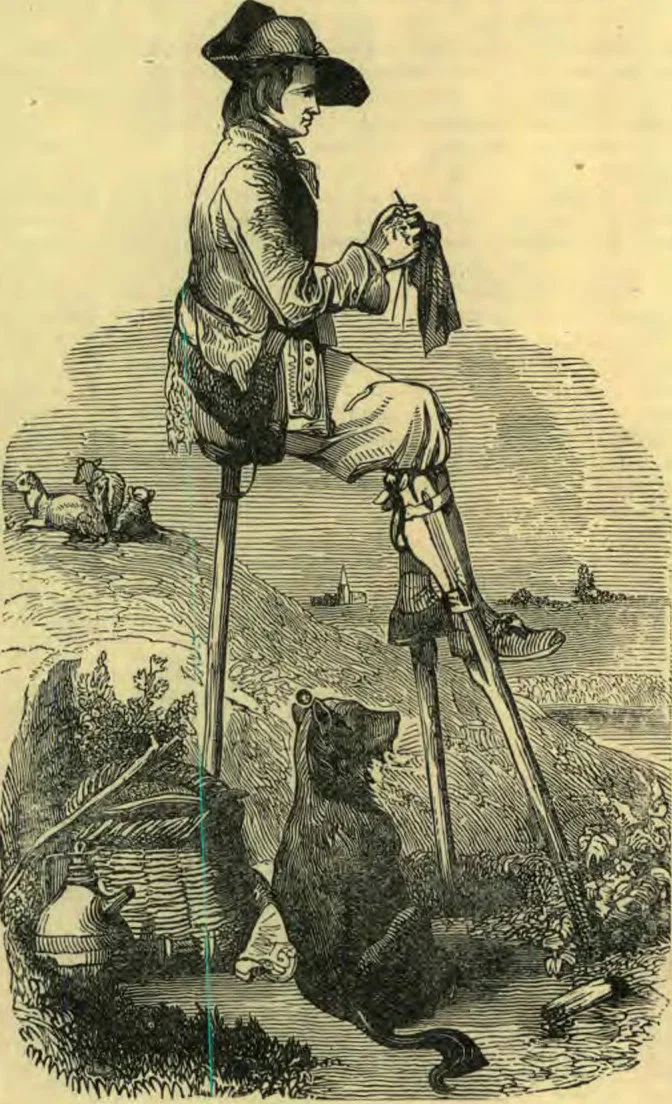
But there was another that he especially liked to look at, and that was of a man walking on stilts. He had read over and over again what his book said about it, till he could tell you that in the southwest part of France there are great sandy plains, or barrens, called the Landes, and that these plains are often covered with water, not deep enough to float a boat, but with enough so that no one could walk around on them. Then, too, the plains are covered with thorny bushes, that would make walking difficult.
There are many dry places where the sheep may browse; and the shepherds, in order to get around, walk on high stilts. Eddie had a pair of stilts, but these were not just like his. They were strapped to the shepherd's legs, so as to leave his hands free.
The shepherd has a pole to aid him in walking; and on the top of the pole is a cross-piece like the head of a crutch. On this he can sit and rest, as you see a shepherd doing in the picture on this page. He looks like a three-legged stool. Women as well as men take care of the sheep. They carry their knitting and their dinner with them, and stay all day in the dreary fields. They put their stilts on in the morning, and do not take them off till night; they are used to wearing them, and do not get tired.
One would think these shepherds must be very unhappy in such a desolate country; but they have never tried any other kind of life; this is their home; they think it is a pleasant place, and are content to stay. W. E. L.

GRANDPA AND THE BOYS.

WHEN I tell you that grandpa was a minister, I suppose you will think we boys had a very dull time when we went to the old parsonage. But you are very much mistaken. We hurried off the very day our vacation began, and the only hard thing about it was the coming back to the city and our books. You see grandpa liked boys. He liked to have as many as he could get about him, and he found such nice things for us to do. He always had a cask of old nails which needed straightening out, and we all worked at them by turns. Then we had a work-bench and tools for rainy weather. We helped grandpa make frames for the rose-bushes, and a picket fence for the hen-yard, and he helped us rig our boats and make our kites and balls.
He always seemed to know, too, when we were tired of work; and how eagerly we responded to the cheery call, “Come, boys, jump in and ride with me over to the office. Be quick, now; remember the verse I read this morning: ‘Seest thou a man diligent in his business? he shall stand before kings; he shall not stand before mean men.’”
As we rode along grandpa would ask us the name of every tree we passed, and of every bird we heard singing in their branches. Sometimes he took us into the dwelling of some poor, sick man.
“O Mr. Grey,” said one of them to him one day, “I fear I am not a Christian.”
“Well, John,” said grandpa cheerily, “I can give you one test. The Bible asks, ‘Will he always call upon God?’”
“Ah, I do indeed do that, for I have no other helper.”
“Well, then, be comforted. He will not despise the prayer of the destitute.”
It is many years since I heard grandpa repeat these verses, but I have never forgotten them.
But at length we had to leave our city home and go West to live. We made our last visit at grandpa’s. I remember so well the day papa came for us to start. Our trunks were packed and standing in the hall, the carriage was at the door, and grandpa and papa in their shirt sleeves were nailing on the directions. Then grandpa threw down the hammer, and said, “Well, let us have a word of prayer before you go.” So we stood around the trunks and he prayed for us all with the tears streaming down his face, most of all for dear papa, who was starting anew in life. We always remembered that tender and beautiful prayer, for papa never came back to the old parsonage again.—The Child’s Paper.

THE CHILDREN'S MITE.

Little hands, be free in giving; Little hearts, be glad to serve; Each unselfish act of living God fails never to observe.
Give not only gold and treasure, Give your sympathy and care; Love that knew no stint or measure, Jesus scattered everywhere.
—Selected.

Better Budget.

Those little boys and girls who are earning and saving money to help in the missions will like to hear what is being done with their money. You remember Eld. Haskell went last summer away to the island of Australia to start a mission. Well, here come two letters from there, and when you have read them, you will feel more than paid for all your efforts. But the good is not all done yet; for these new ones will reach others, and they in turn others, and thus the work will continue to grow, and the result of that first effort and your small donations, who can tell? Surely you will be encouraged to more than double your efforts in the future. The first is a private letter from a Sabbath-school teacher; but we will print some extracts from it. It is from JEANIE FRASER, of Victoria, Australia, who writes: “One of our boys having written for the INSTRUCTOR, I thought you would like to hear about our Sabbath-school in Australia. We have quite a large school, and the interest is good. The church has fifty-five members, and nearly all come to school. It seemed strange at first, to see grown people attend Sabbath-school, as it is not the custom here; but now it seems all right, and we can see wisdom in it. We like the lessons very much; they are quite new. Indeed the Bible seems like a new book to us all. I, for one, never saw half its beauty before. We all like the INSTRUCTOR very much; and we thank the children who helped to send the truth to these shores. We, in our turn, hope to give it to somebody else. We have some young missionaries already in the school. Two of our scholars take six copies each of the Bible Echo every month, and pay for them by setting type for their brother who is a printer. One of them is in my class; he studies lessons in Book No. 4. Eld. Haskell will leave us to-morrow, and we are all very sorry. Some of us may never see him again here, but we have a better hope—that when days and years are past we may meet again where there shall be no more partings. I mean to try to live so that I may be one of the 144,000, which will follow the Lamb whithersoever he goeth.”
The second letter was written for the Budget by ALFRED MILLER, of Victoria, Australia. He says: “This is the first time I have written a letter for the INSTRUCTOR. My teacher asked me to write, and I do so. I keep the Sabbath with mamma and two brothers. My oldest brother is twenty-one years of age, and my other brother is twelve. Bertie and I are in Book No. 4. We go every Sabbath to school, which is not very far from where we live. I like the school very much. I am trying to be a good boy. I like to read the INSTRUCTOR, which I get nearly every Sabbath. We are doing what missionary work we can. Mrs. Israel was telling mamma the kinds of fruit that grow in America. My brother and I wished we were there. I hope you will pray for us all, that we may meet the INSTRUCTOR family in the new earth. I think my brother Bertie will write a letter next time.”
We are glad to receive letters from these distant friends, who, although separated by oceans of water, are made nigh by the blood of Christ and “present truth.” May we all be faithful in the Master's work.
Two sisters, LAURA E. and KATIE SANDERS, wrote letters a long time ago, from Mendocino Co., Cal. Laura writes: “I am fourteen years old. I am trying to be a good girl. I have five sisters; one is a little baby three months old, and we love her dearly. We do not have day school here in the winter, nor Sabbath-school, as the Sabbath-keepers are far apart, but we study our lessons at home. We live in a valley, among the mountains known as the Coast Range. The valley is long and narrow. The mountains which surround it are high, and are covered with many kinds of trees, among which are the pine, the fir, the oak, and several other kinds, also several kinds of bushes which are green the year round. We live about twenty-two or three miles from the ocean, and we can often hear it roar just before or after a storm. We went to see the ocean; it was a grand sight. I will close, wishing you all a happy New Year.”
Katie says: “As my sister Laura has written a letter for the Budget, I thought I would write one too. I am ten years old. I keep the Sabbath with mamma and my sisters. I am trying to be a good girl. I help my mamma wash the dishes, and hold my little sister Maud. One of my sisters is out in the mountains on a visit. I learn my Sabbath lessons in Book No. 3. I love to read the INSTRUCTOR, especially the Budget. I wish you all a happy New Year.”
EDNA L. ROWE, of Somerset Co., Maine, writes her first letter. She says: “I am nine years old. I like the INSTRUCTOR, and I like to read the letters. We live eight miles from Sabbath-school, but I go most of the time. I learn my lessons in Book No. 3, and my sister six years old studies in Book No. 1. We live with our grandparents. My parents are very kind to me, and my little sister and I have good times together. I am trying with grandpa, grandma, and mamma to keep God's commandments, and I hope to meet the INSTRUCTOR family in the new earth.”

APRIL'S TRICK.

WHEN April still was young, And full of her tricks and wiles, Sometimes frowning and sad, Again all grace and smiles, One day young April said, “I will feign that I am dead.”
“The sun and the wind will mourn, For they love me well, I know; I will hear what they say of me In my drapery of snow.” So, silently, in the night, She clothed herself in white.
“The sun rose up in the morn, And looked from east to west, And April lay still and white; Then he called the wind from his rest. “Sigh and lament,” he said, “Sweet April, the child, is dead.
“She that was always so fair, Behold how white she lies! Cover the golden hair, Close down the beaming eyes. One last time let us kiss thee, Sweet April; we shall miss thee!”
The sun touched his lips to her cheeks, And the color returned in a glow; The wind laid his hand on her hair, And it glistened under the snow, As, laughing aloud in glee, Sweet April shook herself free.
—Selected.

You have reached the end of this edition.

The Youth’s Instructor · Apr 21, 1886