The Youth’s Instructor, Vol. 34, No. 16.

THE NAME UPON THE WINDOW PANE

The Youth’s Instructor

Apr 21, 1886

S. D. A. Publishing Association · Battle Creek, Mich. · Apr 21, 1886

THE NAME UPON THE WINDOW PANE.

In the old Scottish inn we met, A motley group from every land, Scholar and artist, peer and priest, And many a traveler browned and tanned,— All pilgrims waiting for an hour, Chatting in idle courtesy; And yet, amid the drifting talk, A little message came to me.
It happened thus: a restless boy Unto the dripping window went, Whose glass, scarred with a thousand names, His mind to the same fancy bent. He sought and found a vacant spot, And took the diamond from his hand; But ere a letter had been formed, A voice accustomed to command Cried, “Philip, stop; before you write, Consider well what you're about.”
“Father, why should I hesitate?” “Because you cannot rub it out.” These words fell on my idle ear; I said them o’er and o’er again, And asked myself, oh, who would choose All they have written to remain?
Unto a loving mother oft We all have sent, without a doubt, Full many a hard and careless word That now we never can rub out; For cruel words cut deeper far Than diamond on the window pane; And oft recalled in after years, They wound her o’er and o’er again.
So in our daily work and life We write and do and say the thing We never can undo nor stay With any future sorrowing. We carve ourselves on beating hearts. Ah, then, how wise to pause and doubt, To blend with love and thought our words, Because we cannot rub them out.
—Harper’s Weekly.

THE FIG-TREE THAT GREW ONLY LEAVES.

It was near the close of our Saviour’s ministry, in the spring of the year, probably about April, that an incident occurred in a fig orchard near the Mount of Olives, by which a most impressive lesson was taught to the twelve disciples, and to all the Lord’s people since that time.
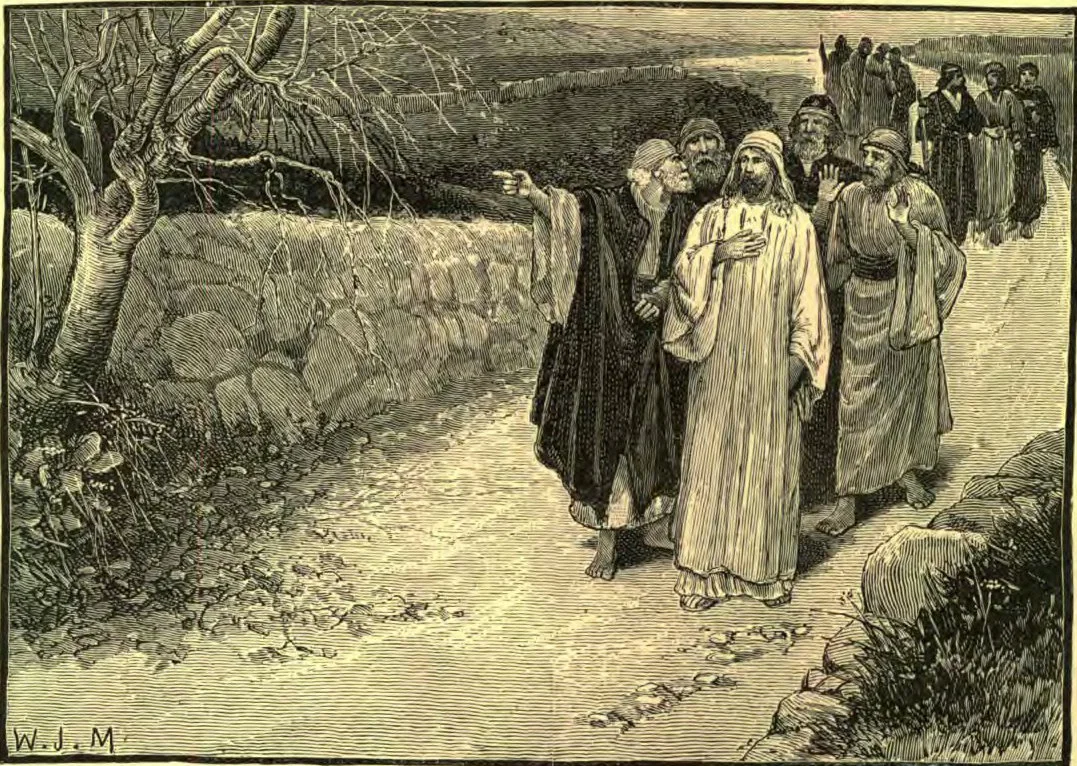
The great Teacher had spent the night at Bethany, and in the morning, with the twelve, went on his way to Jerusalem. On their journey, they came in sight of a cluster of fig-trees. The Master was hungry, having, as we may well believe, spent the entire night in prayer. Approaching the group of trees, the Lord’s attention is attracted to one particular tree, which, by its luxuriant leafage, leads him to expect to find plenty of fruit; for fig-trees put forth their fruit first, and their leaves afterward. But a close inspection of the tree reveals the fact that it is deceitful in its appearance, that there is no fruit weighing down its branches, and that it bears “nothing but leaves.”
The Saviour, then, in a voice which his disciples could hear, said, “No man eat fruit of thee hereafter forever.” The next morning, as the same company again pass that way, they see the fig-tree “withered and dried up from the roots.” Peter now quickly calls attention to the blighted appearance of the tree, and in seeming surprise says, “Master, behold, the fig-tree which thou cursedst is withered away!” Jesus replies to this remark, and, as if to teach a great object-lesson from nature herself, he says, “Have faith in God.” He then continues to enlarge upon this same thought, and adds: “Therefore I say unto you, Whatsoever things ye desire when ye pray, believe that ye receive them, and ye shall have them.”
It was a most important lesson which the Saviour would teach his disciples, and all his followers in after time, by the history of the pretentious fig-tree.
By the symbol of this tree which bore nothing but leaves, we may understand the Jewish nation, and especially the Pharisees, whose religion was a great show and a mere sham. Instead of the peaceable fruits of righteousness, there was nothing but the leaves of an outward profession. Boasting of their goodness and knowledge, the Jewish nation in the time of our Saviour was full of hypocrisy and cruelty. In this they were well represented by the pretentious fig-tree, which stretched out its leafy branches, and yet yielded no fruit.
By permission of Cassell & Co.
In speaking of this miracle of our Redeemer, a good man once said, “The Lord’s miracles of mercy were many, and always on men; his miracles of judgment were but one, and that on a tree.”
The history of the fruitless fig-tree should teach all, old and young, this one important truth,—never to pretend to be what in reality we are not. This is hypocrisy, something disgusting to all sensible people.
Shall we learn a lesson from the barren fig-tree?
G. W. A.

FRED'S LESSON.

MAMMA was quite sick, and cousin Kate had run over to help her for the day. She had made the beds, washed up the breakfast dishes, straightened the rooms, had seen to it that mamma was all right in a quiet, darkened room, and then left her to get better; while she beguiled the two young ones into the kitchen, where stood a large basket of clean clothes waiting to be ironed. Every one liked Kate. She was so willing and generous with her time and strength, and withal did everything so thoroughly, that mamma said she'd “be sure to be well by to-morrow, now that Kate had come.”
Fred had become tired of his book, and now sat kicking his heels and whistling; then he started up suddenly, picked something from off the floor, and seizing his cap, went out; and by the time Annie had tired of the doll she was dressing, he had returned, with a suspiciously strong smell of molasses peppermint about him.
“O Fred, I want some,” said Annie.
Fred looked annoyed, but gave her a small piece, muttering, “Don't let mamma know.”
“All right, I won't,” she replied, and turned again to her doll.
But Kate was disturbed. She had seen something that she never before suspected. That Fred could be dishonest—that he should ever say, “Don't let mamma know,” shocked her. What should she do? She waited for an opportunity when they should be alone. It came that afternoon before the ironing was finished. They had talked of many things. After awhile she turned the conversation. He blushed and stammered a little, and then said that was nothing; the money was lying on the floor, and he found it, and so it was his. “Do you often find money that way?” she asked. “Not very.” But he stopped to think, and remembered that he had found two cents in his mother's bedroom the day before, and a dime the last week.
“What did you do with them?”
“Oh, spent them.”
“For what?”
“Oh, I bought pea-nuts last week, and candy to-day.”
“Did you eat them all yourself?” she asked.
“No, indeed. The fellows were plaguing me so for them I had only a few myself, and Rob Smith (he did my sums for me the other day) was mad because I did n't give him enough, and said he'd tell teacher I copied, and so I had to give him nearly all the candy I bought to-day.”
“Then it has n't paid you at all, has it, to be a thief?”
“A thief!” he said angrily; “that isn't stealing. It was only mother's.”
Kate quietly reached the Bible, and turned to the twenty-eighth chapter of Proverbs, and gave him the verse to read:—“Whoso robbeth his father or his mother, and saith, It is no transgression, the same is the companion of a destroyer.”
“O Kate!” he said; but the words clung to him; he had never before stopped to think what he really had done. But now his eyes were suddenly opened, and he saw the danger he was in.
How it came up before him that night, all the odd cents he had taken, and how, when especially urged by Rob Smith, he had, when sent on errands by his mother, bought cake or pie to keep him quiet and prevent his revealing his dishonesty in the matter of lessons, inventing a story of goods being higher priced than expected, or else taking refuge in the fact of his mother's being too busy to count the change. And he saw to-night how fast the habit was growing upon him, and how little chance of escape there really seemed from the net he had wound around himself.
“A companion of a destroyer! A companion of a destroyer!” rang through his thoughts all night. He could not sleep; so alone in the darkness he kneeled and asked God for Christ's sake to forgive the past, and help him in the future. In the morning, with a beating heart, he went to his mother, and told her of his temptations.
She did not scold nor blame him as he expected. She was grieved, but said quietly, “I did not know of my boy's temptation. I am glad you told me.” That was all. But always after she was careful to allow him, once in awhile, a small amount.
Some years after, when Fred had grown to be quite a young man, he said to Kate one day, “Kate, do you remember the talking you gave to me that time mother was sick? It was well you stopped me just in time. But you know Rob Smith, I used to go with? Well, he kept it up, and of course as he got older, his expenses increased in proportion, and he had to get more than his honest wages to do it with; and I saw in yesterday's paper that he was found helping himself from the store where he was engaged, was tried and sent to jail. I don't know what he'll do when he gets out either, for his character will be all gone, and nobody'll want him. Isn't it awful? And Kate, it might have been just the same with me!”—S. S. Advocate.

HOME EDUCATION.

CHILDREN and youth should cultivate habits of thoroughness in the matter of education. The college course does not embrace all the education which they are to receive. They may be constantly learning lessons from the things they see and hear. They may study from cause to effect, from the surroundings and the circumstances of life. They may learn every day something they must avoid, and something they may practice, that will elevate and ennoble them, giving solidity to the character, and strengthening in them those principles which are the foundation of noble manhood and womanhood.
If they enter upon their education with careless purposes, well content to pass along without any particular effort on their part, then they will not reach the standard God would have them attain. They will not be prepared to give to the Lord that perfect service which he requires. The character which Jesus, who has redeemed us, expects us to exemplify before the world by right principles and correct action, requires constant effort on our part to attain. The work is to begin at home in the family circle. Here is where the discipline of self is to be entered upon.
Gird up the loins of your mind, says the apostle; then control your thoughts, not allowing them to have full scope. The thoughts may be guarded and controlled by your own determined efforts. Think right thoughts, and you will perform right actions. You have, then, to guard the affections, not letting them go out and fasten upon improper objects. Jesus has purchased you with his own life; you belong to him, therefore he is to be consulted in all things, as to how the powers of your mind and the affections of your heart shall be employed.
You will not find it profitable to think much of yourself; to esteem yourself will be to think less of others than they deserve. You will not find it profitable for growth in grace to select a few favorites whom you shall love, and to whom you will give special attention, while others even more worthy shall be neglected. There should be principle in all you do. There are those around you whom you can help if you will not be constantly studying how you can choose those things that will administer gratification to yourself. Bear in mind every day that you are not your own, you are bought with a price; you must, then, glorify God in your body and spirit, which are the Lord’s. Your affections must center in Jesus Christ; then you will set the Lord ever before you, and know that he is at your right hand to help you. He will guide you continually with his counsel.
The controlling influence of the Spirit of God will direct the affections, that they shall not be placed upon improper objects. Will our youth bear in mind that this world is a training school, where they are to be fitted for the future immortal life? therefore their habits, their temper, their disposition, should have careful attention. Every wrong tendency may be, through the grace of Christ, repressed, not in a languid, irresolute manner, but with firmness of purpose, with high resolves to make Christ the pattern. Let your love go out for those things that Jesus loved, and be withheld from those things that will give no strength to right impulses. With determined energy seek to learn, and to improve the character every day. You must have firmness of purpose to take yourself in hand, and be what you know God would be pleased to have you.
Cultivate affection for your parents; seek to make them happy. This is the duty that God has enjoined upon you. “Honor thy father and thy mother, that thy days may be long upon the land which the Lord thy God giveth thee.” I have seen children who seemed to have no affection to give to their parents; no expressions of love and endearment, which are due them, and which they would appreciate; but they lavish an abundance of affection and caresses to select ones for whom they show preference. Is this as God would have it?—No, no. Bring all the rays of sunshine, of love, and of affection into the home circle. Your father and mother will appreciate these little attentions you can give. Your efforts to lighten the burdens, and to repress every word of fretfulness and ingratitude, show that you are not a thoughtless child, and that you do appreciate the care and love that has been bestowed upon you in the years of your helpless infancy and childhood.
Neglect not the little as well as the larger attentions in the home life. Cultivate tenderness, affection, and love, that have expression in little courtesies, in speech, in thoughtful attentions. Always remember that you are forming a character that will admit you as a member of the family above. Let the love of home be cherished; put away restless, dissatisfied feelings. If you have high aims, and purpose to reach an elevated standard, the home life is the very best discipline you can have. If you are wrong at home, you will be wrong in every aim and endeavor. Begin there to perfect a character that God will approve, that will make you a blessing at home; and when away from home, you will not fail to be a blessing to those you are brought in contact with. Religion practiced in the home will reflect beyond the home circle. The simple home lessons in a correct experience will become natural, will be lasting; and the best of all, these acts are registered in the books of heaven, admired by the heavenly angels, and will bring the reward when the Judgment shall sit and the books shall be opened, and every one rewarded as his works have been.
Idle dreaming, good purposes never carried out, will not benefit yourselves or any one else. But if you put yourselves to task to be right, to be useful, to be a blessing in the home and among the school associates, leading them by your example to right doing, your influence will extend beyond the school associations to all who come within the sphere of your influence. How much better to lead such a life than to be constantly weak in moral power, practicing evil, and leaving on the minds of others impressions that will not help them in the path of righteousness. May God help you, dear children, to build, through the grace of Christ, a symmetrical character, that you may secure the reward of eternal life. MRS. E. G. WHITE.

THE GLEANERS.

But few of the INSTRUCTOR readers, I suppose, have ever seen the gleaners at work. Some may ask, “What do you mean by gleaners?” I will try to tell you.
In England, where so many people live, and so little grain is raised to furnish them food, are many who have hard work to earn enough to provide themselves food and clothing. While the readers of this piece are enjoying the comforts of a beautiful home, provided with plenty, there are thousands in this country who do not know where their living for the next week is to come from.
When harvest time comes, all seek to earn what they can, as they may not have much work in the winter. The father, the mother, and the children that are large enough, go out and work in the harvest field from six in the morning until a late hour at night. For this, they get but a small sum. Perhaps the father will receive fifty or sixty cents per day, while the mother and the children receive less. Out of this they must furnish their own provisions, as the workmen in the harvest fields of this country do not get their board, as in America.
After the grain is all cut, the farmer has his men go over the field with large rakes to gather up the heads that are left. There are no standing bunches left in the fence-corners, as we see in the fields in America, but all is carefully gathered and stacked. Now the fields are open for the gleaners.
Every morning you may see large companies of women and children leaving the villages to spend the day in the stubble-fields, picking up the heads of wheat or barley that have been left on the ground. This work is called gleaning, and the workers are called gleaners. Each gleaner wears a large apron, containing a very large pocket, in which she puts the heads of grain she finds in traveling over the fields. It is nothing uncommon to see forty gleaners at work in a field of ten or fifteen acres. They walk a few feet apart, and look like an army marching.
At night all they have gathered can be tied up in a piece of cloth a yard square. They place their bundle of gleanings upon the head, and march for their homes in the villages. A company of gleaners coming from their work reminds one of the pictures of oriental customs.
Perhaps some reader will wish to know what is done with the gleanings. The straw is used to make a bed for the pig, kept by nearly every family. The grain is threshed from the heads and sent to the mill to be ground into flour, which will furnish a cake for extra dinners on Sundays.
The gleaners have the benefit of pure air in the fields, while the walking gives them good exercise, and thus they improve their health, while they get the benefit of the grain that would otherwise be lost.
As I have passed by the fields that looked almost bare, and have seen the gleaners picking up here and there a head, I thought how pleased they would be to have the privilege of gleaning in the fields of some of our Western States, where bushels of grain go to waste every year. If the boys and girls of the INSTRUCTOR family would become gleaners in their father's fields every year, and sell their gleanings, they might in this way save good sums to help in some worthy enterprise. Besides earning money, you would be getting red cheeks, that cannot be had at indoor work.
But, dear readers, there is another harvest field that needs gleaners. When Jesus was here, he said, “The harvest truly is great, but the laborers are few: pray ye therefore the Lord of the harvest, that he would send forth laborers into his harvest.” We can all be laborers in this great harvest. If we cannot be reapers, we can be gleaners. To glean means, “to collect with patient labor.” The gleaner in God’s great harvest field will need patience in his work. If he cannot gather handfuls like the reaper, he can bring in the stray ones here and there. May God help the INSTRUCTOR family to labor in the great harvest field. If you cannot be a reaper bringing in a large number of sheaves, seek to be the Lord’s gleaner. When Jesus comes, the reapers and the gleaners will be permitted to rejoice together and sit at the great harvest feast in the kingdom of God, and Jesus will serve them.
J. H. DURLAND.
Harrold, England.

APRIL

TEARS in a maiden's eyes! Little enough they deceive us; little enough do they grieve us; Well do we know that beneath them the joy of young life smiles and glows; Soon into dimples and gladness will break the thin mist of her sadness, As out of the showers of April springs upward the bloom of the rose!
Rain in the April skies! What do we care for its falling? Thousand faint voices low-calling tell that behind it the sunshine waits, in a passion of light, To set the glad wild bird a-singing, to set the wild flower-bells ringing, To make the red rose of the morning burst out of the gloom of the night.
—Wide-Awake.

THE YOUNG MAN OF PRINCIPLE.

A YOUNG man was in a position where his employers required him to make a false statement, by which several hundred dollars would come into their hands that did not belong to them. All depended on this clerk's serving their purpose. To their vexation, he utterly refused to do so. He could not be induced to sell his conscience for any one's favor. As the result, he was discharged from the place.
Not long after, he applied for a vacant situation, and the gentleman, being pleased with his address, asked him for any good reference he might have. The young man felt that his character was unsullied, and so fearlessly referred him to his last employer.
“I have just been dismissed from his employ, and you can inquire of him about me.”
It was a new fashion of getting a young man's recommendations, but the gentleman called on the firm, and found that the only objection was that he was “too conscientious about trifles.” The gentleman had not been greatly troubled by too conscientious employees, and preferred that those intrusted with his money should have a fine sense of truth and honesty; so he engaged the young man.
“A good name is rather to be chosen than great riches.” Even unscrupulous men know the worth of good principles.
A gentleman turned off a man in his employ at the bank, because he refused to write for him on Sunday. When asked afterwards to name some reliable person he might know as suitable for a cashier in another bank, he mentioned the same man.
“You can depend upon him,” he said, “for he refused to work for me on Sunday.”
A gentleman, who employed many persons in his large establishment, said, “When I see one of my young men riding for pleasure on Sunday, I dismiss him on Monday. I know such a one cannot be trusted. Nor will I employ any one who even occasionally drinks liquor of any kind.”
Honor all the teachings of the Bible, and you will not fail to find favor with God, and with man also.—Illustrated Temperance Tales.

SACRED

In writing of the Dyaks of Borneo, Mr. Hornady tells of the sacredness in which animal life is held, and the Dyak’s forbearance forms a marked contrast to the wanton destruction of harmless animals in America.
At the hotel I met one day an educated native who spoke English perfectly, and whom I immediately began to question about localities in which I might find certain animals, particularly crocodiles, since the native was acquainted with Kurrachee and the sacred crocodiles of Mugger Peer. He was talking rapidly, and I was busily jotting down notes, when he suddenly stopped and asked,—
“Sir, why do you require to know about these animals?”
“Why, I wish to find them.”
“Why do you require to find them? Do you wish to kill them?”
“Yes, for their skins and skeletons.”
“Ah,” he replied, instantly dropping my map, “then I cannot inform you where any of the animals are. I do not wish anything to be killed, and if I tell you where you can find any animals, I shall do a great wrong.”
“Did you never kill an animal?” I asked.
“Never, sir, never; not purposely. It would be a great sin for me to do so.”
He then went on to tell me of a certain caste of Hindoos, the members of which are so conscientious about taking the life of any living thing that they always eat before sunset to avoid making a light, which might be the death of some moth or gnat.—Church and Home.

GIVE HIM ROOM TO WORK.

THERE is one who will make your lives as beautiful as you can wish, if you will only let him. But suppose the frescoer comes to-morrow to decorate the walls of my house, and I tell him he must stay in one little corner and do all his work there, that I cannot move the furniture out of his way; could he make the walls beautiful all over?—No, indeed! Then if we want our lives made beautiful all over, must we not remove everything wrong from our hearts—everything that is in the way—and open the door wide, and let Jesus come in and have all the room to do as he pleases, and not as we please? Turn out-of-doors that thing that you know he hates, and let him come in and cleanse and beautify you.—Selected.

IMPORTANT BIBLE SUBJECTS.

LESSON 3.—PERFECTION OF THE LAW.

[NOTE TO THE STUDENT.—Do not consider the lesson learned until you can give at least the substance of every text, with the correct reference for each. The references in black letters indicate those texts that should be committed to memory. A little diligent application each day will enable you to learn them, although this need not be considered a test of scholarship.]
1. Under what circumstances were the ten commandments spoken?
2. What steps were taken for their preservation?
3. Where do we find them recorded?
4. In what two precepts are these ten commandments summed up? Matt. 22:35-40.
5. In making this statement, did Christ utter a new truth? Lev. 19:18; Deut. 6:5. He quoted from the law. See Matt. 22:36.
6. Can there be any duty outside of what we owe to God and our fellow-creatures?
7. Then what may be said of the ten commandments? Eccl. 12:13.
8. What does David say of the commandments? Ps. 119:172.
9. What does the Lord, through one of his prophets, say of his own righteousness? Isa. 51:6.
10. Who are they who know (or have) this righteousness? Isa. 51:7.
11. Then what is the law of God?—The righteousness of God.
12. Since the law of God is his righteousness, what may truly be said of it? Ps. 19:7.
13. Quote other statements from the Psalms concerning the nature of the law. Ps. 111:7; 119:86, 138, 142, 151.
14. What did Paul say of it? Rom. 7:12.
15. Since the commandments are an expression of the righteousness of God, is it possible to speak of them in too exalted terms?

NOTE.

Since the law of God is “the righteousness of God,” or the expression of God’s character, it is evident that every epithet which is applied to the character of God, may with propriety also be applied to the law.

TO PRIMARY TEACHERS.

If you are a primary-class teacher, do not expect too much of yourself. Perhaps you doubt your ability, but if your work has come to you “opportunity-end foremost,” to quote Dr. Vincent, take that as a hint that God meant to fit you for it by putting you in it. Do not be discouraged by the repeated assertions that yours is the most important and responsible class and work in all the school, and other like statements on the requisite qualifications. They are true, but they are overwhelming, and morbidly dwelt on, are thoroughly disheartening. That you are in the position does not prove that you think yourself efficient, proficient, or sufficient for these things. Do not forget that you sit at the feet of the Great Teacher, and may learn of him.
Do not expect too little of yourself. Exact the uttermost portion of time and labor needed for your high calling.
Do not expect too much of your class in the way of order, attainments, interest, or improvement. Remember that they are little children. Do not undertake to teach too much.
On the other hand, do not expect or exact too little of your class. Do not imagine, because they are such morsels of humanity, that there is no room in their hearts for solemn and earnest lessons. We often underrate the capacities of children. The mothers can tell you what the little ones bring home, and how they imitate your voice and manner in the telling of it, too.
Do not forget that you are giving your scholars a part of your very self, while, with every faculty alert, your chief conscious thought may be to keep them decently in order, and give them some definite idea of the lesson. Therefore do not fail to be what you would wish them to see.
Do not fail to have your lesson well in hand. Distinct, definite preparation and a clear conception of the points to be taught, greatly help in any teaching; but a primary teacher, of all others, is liable to be thrown off her guard, or disconcerted, by unforeseen incidents, inopportune visitors, and things of such sort, and needs to be certain of her lesson. It is true that happy thoughts and illustrations often come at the moment, like inspirations; but they are more likely to spring lightly from a well-poised lesson, than to be sent to supplement imperfect preparation.
Do not be afraid to use the blackboard, or slate, even if you cannot draw a straight line or a respectable crooked one. You can hold attention by very crude dots and marks. You will not venture very elaborate work, unless you have eyes in the back of your head, to serve you while thus engaged. Do not be disconcerted or disturbed if when making a square, for instance, to represent a king’s palace, a boy, with cheerful confidence, volunteers the information that he “can make a much better one than that.” You might let him try. It is sometimes well to let the older children make the marks and dots, but such experiments must be kept within bounds.
Training as well as teaching is a part of primary work. Little children should be trained in Christian work suited to them,—in bringing in new scholars, and in systematic, intelligent giving. (Oh, for a dozen lines of emphasis under this last!) Standing, as you do, near the beginning of young lives, your opportunities are priceless, and you are not likely to overvalue them. When the characters are formed, the touch and trace of your hand may not be distinctly evident; but if it is there, in living, lasting influence, can you be thankful enough for your “recompense of reward”?
We have none of us reached even our own standards. At best, we stumble along the path, though we have discerned the warnings and the way-marks. We may have learned what we should or should not do, but how to perform, or avoid, we “find not,” to our own satisfaction. Nevertheless, with love and longing, in hope and trust, by “the good hand of our God upon us,” we would “press forward” evermore.—Julia H. Johnston.

SAND-SPOUTS ON THE DESERT.

The wilderness and the desert are dismal places when the elements are peaceful; but when tropical storms pass over them, they must become terrifying abodes either for man or beast. Travelers portray such storms as terribly appalling, reminding one of the great day of God’s wrath, when the “foundations of the earth shall be shaken.” One who has journeyed in Africa describes in the Home Journal, a sublime scene he witnessed in going through Nubia to Darfoor. He writes:—
“I had gained an isolated hillock some two hundred feet above the level of the surrounding desert. Away to the west, about two miles distant, I descried seven lofty pillars of sand moving swiftly over the undulating plain. The center one of these was vertical, and those surrounding it, at a distance of two hundred or three hundred yards, leaned slightly toward it. A smaller eighth column, about half a mile behind the others, was inclined toward them at an angle of forty-five degrees, and was fast overtaking them. The sand at the base of the columns was lashed by the furious whirlwind into a surging sea; trees of the hardest wood were torn up with their roots, and hurled hundreds of yards away and high up into the air; even the grass that grew in the path of that terrible storm was shorn clean away from its roots. The summits of the seven columns at length joined; and then burst forth from their united tops a yellow, gigantic cloud of sand of such magnitude and density as to darken as in a total eclipse the face of the bright afternoon sun. The sand-spout, called by the natives, ‘zobahah,’ shortly after subsided, but the cloud of sand and grass, which had been raised high in the heavens, continued to darken the setting sun for more than another hour. The smaller column behind traveled, increasing until it reached the site of the break-up of the other, and then added its mite to the universal destruction and confusion.”
“With my sextant, as I stood in security, I measured the height of the center column of sand; it was 850 feet. The others round it rose, during the time I observed them (about a quarter of an hour), from 600 feet to a height equal to or greater than that of the center column. When the junction of them all took place, the sudden eruption of sand and leaves and grass reached to a total height of over three thousand feet.”
“Storm sand-spouts are rarely so severe in any part of the desert as that which I have described; isolated ‘zobahahs,’ more or less clearly defined, reaching to the height of 1,000 feet, are, however, very common, and woe betide the tent that happens to stand in their way. Ten yards from the column the air may be perfectly calm; but within the small circumscribing circle there rages such a tempest as will carry a tent, however firmly fixed in the ground, into the regions of the upper air as easily as an ordinary gust of wind will blow away a piece of paper. An Arab will always know whether one of these approaching ‘zobahahs’ is likely to come upon him, and will take down his tent or temporary house to meet its convenience. Its usual movement is in the arc of a wide circle, and the direction of the center of the circle is almost invariably from south to north.”

MOUNTAIN-FARMING IN NORWAY.

In our youthful days we recollect hearing it said that the hills on some of the New England farms were so steep that the grain was necessarily shot into the soil. Of course it was not expected the statement would be taken literally. It was only meant that farming among the New England hills is attended with many difficulties.
A writer in the St. Nicholas says of mountain farming in Norway, that on account of the many inlets from the sea, which they call fjords, and the many high mountains, every bit of grass is cared for. Peasants build little farmhouses way up the sides of the mountains two or three thousand feet above the sea, and there live the year round, although it is so cold and snowy in the winter, just to have a little patch of grass a small part of the year. He says the land is so steep that the cattle have to be tethered while they feed, and the children fastened by ropes to stakes while they play, to prevent their falling down hill.
In the Popular Science Monthly for April, the editor gives some further particulars of Norway-mountain farming which may be of interest to our young farmer boys. He writes:—
“Farming in the mountain-regions of Norway is carried on under difficulties which would discourage an agriculturist bred on our prairies. The steep hills and rocks leave no broad spaces for fields; and the mountaineer, to winter his stock, has to make hay out of the grass that grows on the narrow ledges and in the crevices. If he manages to get a considerable crop off a hill, he will store it in sheds till winter, when he will send it down into the valley in bundles along a strong wire which he has stretched from the foot of the mountain to the top. To dry the hay, poles are planted near the patches, between which ropes or long sticks are laid until a sort of six-barred railing is formed. On these bars the hay is laid, and dried in a most effective manner. Corn is tied in small bundles and fixed on poles placed at intervals in the field. The potato crop is farmed on a like small scale. The seeds are dropped here and there wherever there is a possibility of their taking root. At one place potatoes were noticed growing on a bowlder, where a soil about eighteen inches deep had gathered or been placed, the whole field being a triangle the sides of which were each about twelve feet in length. Small patches from twenty feet to as many yards square are common; while not unfrequently the corn-fields are but a name, for they meander like a stream in all directions among the huge bowlders and bare, rocky hillocks which compose so great a part of the surface of a farm land. The lands are usually very light. Manuring is not resorted to as a regular part of the routine; but the fields are left from time to time for three or four years, by rotation in grass. In the summer months, female servants, or the daughters of the farmer, tend the cattle high up in the fjeld, living in sæters or cabins, where they prepare cheese and butter.”

TOILERS IN THE STREAMS.

If any order of creatures is born to a life of ease, and is exempt from the performance of a daily task, it might be thought that the fishes in the water form that order. They need no shelter from the rain or protection from the wind. They live under a transparent roof, that makes their home more splendid than a crystal palace. Their board is always spread at just that level that they may recline at their meals with all the luxuriousness of Greek and Roman gentility. The same restful couch upon which they take their meals serves equally well for repose. No beings occupy a home in which more comforts have been secured, and yet, even these are intent upon making improvements.
A Scotch naturalist writes pleasantly of some building operations which he saw going on at the bottom of a ditch. One summer day he was amused by watching the singular proceedings of two lampreys in a small ditch of clear, running water near his house.
They were about six inches in length, and as large round as a pencil. The two little creatures were most busily and anxiously employed in making little triangular heaps of stones, using for the purpose irregularly shaped bits of gravel the size of a large pea.
When they wished to move a larger stone, they helped each other in endeavoring to roll it into the desired position. Occasionally they both left off their labors, and appeared to rest for a short time, and then they returned to the work with fresh vigor.
The object of their building this observer did not venture to guess, but he had a good opportunity of watching them, as the water was quite clear and shallow, and they were so intent upon what they were at, that they took no notice whatever of him.
He had intended to examine the little heaps of stones which they had made, but going from home the next day put it out of his recollection, and he lost the opportunity. It seems, however, so singular a maneuver on the part of fish to build up regular little pyramids of gravel, bringing some of the stones from the distance of two feet against the current, and rolling them to the place with evident difficulty, that the lampreys must have some good reason which leads them to take the trouble.—Youth's Companion.
Continue reading: An Electrical House