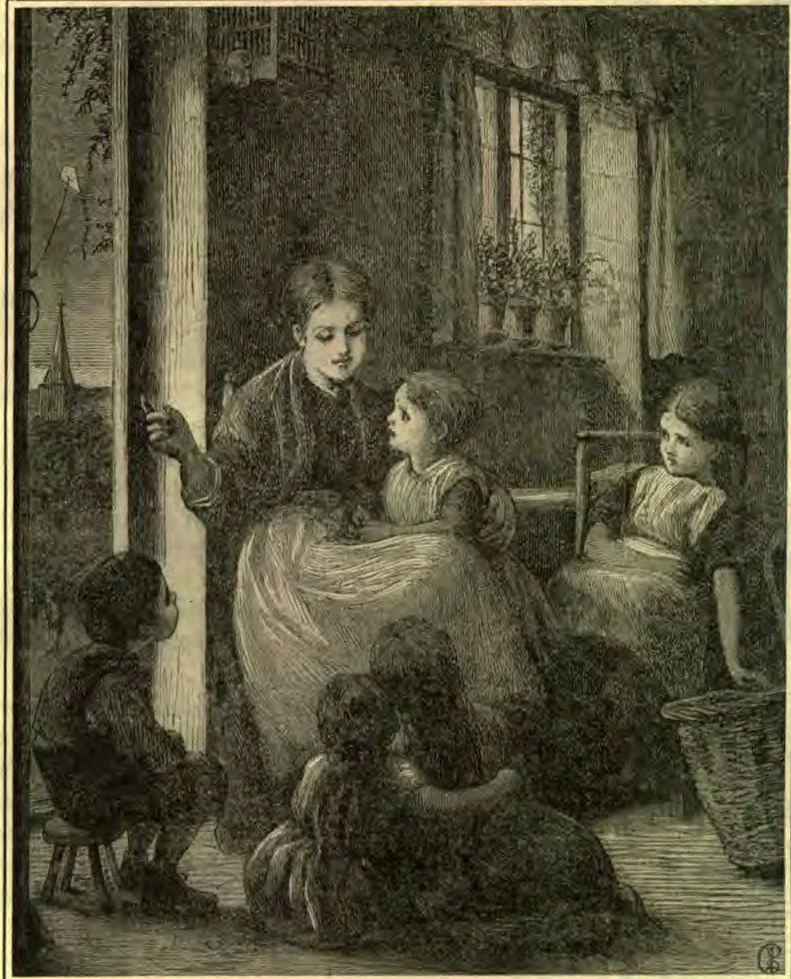
THERE was held in Hartford, some years ago, a convention of the colored Baptist Association of New England. I was invited to address one of the sessions. To show what those converted in early life are sometimes enabled to endure by God's grace, I related the following story:—
J. D. Husbands, a lawyer of Rochester, N. Y., assured me that the facts were perfectly true. It was in the days of Southern slavery, when Willie, the master's son, brought home a spelling-book. A little slave boy, Jack, asked:—
“What's dat, Willie?”
“That's a spelling-book, Jack.”
“What's de spellin'-book for?”
“To learn how to read.”
“How's you do it?”
“We learn those things first.”
And so Jack learned A, B, C, etc., mastered the spelling-book, and then learned to read a little, though the law forbade any colored person to do it.
One day Willie brought home a little black book, and Jack said:—
“What's dat, Willie?”
“That is the New Testament, that tells about Jesus.”
And ere long, Jack learned to read the New Testament, and when he read that “God so loved the world, that he gave his only begotten Son, that whosoever believeth in him should not perish, but have everlasting life,” and that he really loved us and died for us, and that “if we confess our sins, he is faithful and just to forgive us our sins,” his heart went out in love to Jesus. He believed in him, his sins were forgiven, his heart was changed, and he became a happy Christian.
Though a mere child, he at once began to tell others of Jesus' love. When he became a young man, he was still at work for the Lord. He used to go to the neighboring plantations, read his Bible and explain it to the people.
One day the master said to him, “Jack, I am told that you go off preaching every Sunday.”
“Yes, mas'r, I must tell sinners how Jesus died on de cross for dem.”
“Jack, if you go off preaching on Sunday, I'll tell you what I'll do on Monday.”
“What will you do on Monday, mas'r?”
“I'll tie you to that tree, take this whip, and flog all this religion out of you.”
Jack knew his master was a determined man, but when he thought of Christ's sufferings for us, and heard his Lord saying unto him, “Be thou faithful unto death, and I will give thee a crown of life,” he resolved to continue his work for the Lord, next Sunday.
With his New Testament in hand, he went down to the plantation and told them his master might whip him half to death the next day, but if he did, he would not suffer more than Christ had suffered for us.
The next morning his master said, “Jack, I hear you were preaching again yesterday.”
“Yes, mas'r. I must go and tell sinners how Jesus was whipped that we might go free.”
“But, Jack, I told you if you went off preaching, Sunday, I should whip you on Monday, and now I will do it.”
Blow after blow fell upon Jack's back, while oaths fell from the master's lips, and he said, “There, Jack, I don't believe you will preach next Sunday. Now go down to the cotton field and go to work.”
When the next Sunday came, Jack could not stand straight, his back was so covered with scars and sores. But with his Testament in hand, he stood before the people of the plantation and said, “Mas'r whip me mose ter death last Monday, an' I don't know but he will kill me to-morrow, but if he does, I shall not suffer more than Jesus did when he died on the cross for us.”
Monday morning the master called him and said, “Jack, I hear you have been preaching again.”
“Yes, mas'r, I must go an' tell sinners how Christ was wounded for our transgressions, how he sweat drops of blood for us in the garden, an' wore that cruel crown of thorns that we might wear a crown of joy when he comes.”
“But I don't want to hear your preaching. Now bare your back, and take the flogging I told you I should give you if you went off preaching.”
Fast flew the cruel lashes until Jack's back was covered with wounds and blood.
“Now, Jack, go down to the cotton fields and go to work. I reckon you'll never want to preach again.”
When the next Sunday came, Jack's back was in a terrible condition. But, hobbling along, he found his friends in the neighboring plantation and said:—
“Mas'r whipped me almost to death last Monday, but if I can only get you to come to Jesus and love him, I am willing to die for your sake to-morrow.”
If there were scoffers there, do you not think they were led to believe there was a reality in religion? If any were there who were inclined to think that ministers preach only when they get money for it, don't you think they changed their minds when they saw what wages Jack got?
Many were in tears, and no doubt some gave themselves to that Saviour for whose sake Jack was willing, if need be, to die the death of a martyr.
Next morning the master called Jack and said, “Make bare your back again; for I told you that just as sure as you went off preaching, I would whip you till you gave it up.”
The master raised the ugly whip, and as he looked at Jack's back, all lacerated, he could find no new place to strike, and said, “What do you do it for, Jack? You know that as surely as you go off preaching on Sunday, I will whip you most to death the next day. No one pays you6anything for it. All you get is a terrible flogging, which is taking your life from you.”
“Yer ax me, mas'r, what I'se doin' it for. I'll tell you, mas'r. I'se goin' ter tak all dos stripes an' all dos scars, mas'r, up to Jesus, by an' by, to show him how faithful I'se been, 'cause he loved you an' me, mas'r, an' bled an' died on the cross for you an' me, mas'r.”
The whip dropped, and that master could not strike another blow. In a subdued tone he said, “Go down in the cotton field.”
Do you think Jack went away cursing his master, saying, “O Lord, punish him for all his cruelty to me”?
No! No! His prayer was, “Lord, forgive him, for Jesus Christ's sake.”
About three o'clock, a messenger came down to the cotton field, crying, “Mas'r's dyin'! Mas'r's dyin'! Come quick, Jack, Mas'r's dyin'!”
There in his private room, Jack found his master on the floor in agony, crying, “O, Jack, I'm sinking down to hell. Pray for me! Pray for me!”
“I'se been prayin' for you all de time, mas'r. You mus' pray for yourse'f.”
“I don't know how to pray, Jack. I know how to swear, but I don't know how to pray.”
“You mus' pray, mas'r.”
And finally they both prayed, and God revealed Christ on the cross to him, and then and there he became a changed man.
A few days after, he called Jack to him and said, “Jack, here are your freedom papers. They give you your liberty. Go and preach the gospel wherever you will, and may the Lord's blessing go with you.”
While telling this story at the convention, I noticed a man, perhaps sixty years of age, with quite gray hair, who was deeply moved. When I had finished, he sprang to his feet, and with a clear but tremulous voice, said, “I stand for Jack. Mr. Hammond has been speaking of me. He has been trying to tell of my sufferings, but he can not describe the terrible agony I endured at the hands of my master, who, because I was determined to preach the gospel on the plantations around us, every Monday morning for three weeks called me up and laid the cruel lash upon my back with his own hands until my back was like raw beef. But God helped me to pray for him, until he was forgiven and saved through Christ. And, thank God, Jack still lives.”
I have given you only a few of his burning words, but I can tell you there were many eyes filled with tears during this touching scene, which will not soon be forgotten by those who witnessed it.—E. Hammond.
Mother's Story
By Elizabeth Rosser
God planted for us a beautiful garden
Of roses and lilies and sweet mignonette;
How fair are the acres of wheat and of barley!
How sweet is the clover, with morning dew
wet!
And yet in that garden the sharp thorns are
growing,
With weeds ’mid the flowers and tares in the
wheat.
’Mid bright, living blossoms, the dying are
scattered,
And everywhere bitter is mingled with sweet.
God painted for us a beautiful picture
Of mountain and valley and forest and stream:
They sleep ’neath the white mantle winter throws
o’er them,
And wake in the warmth of the sun’s golden
beam.
And yet on that picture the trail of the serpent
Has blotted the scenes once so stainless and
fair;
Where verdure should clothe it, and blossoms
adorn it,
Its fields oft are desert, its mountains are bare.
God spread out for us a beautiful curtain
Of deep stainless blue, lighted up with the sun.
With delicate beauty the rainbow adorns it,
The stars in their courses do over it run.
And yet, o’er that curtain come thick clouds and
darkness;
The sun, moon, and stars are eclipsed from our
view:
Its winds are appalling; its lightnings affright us,
And great hailstones fall from that vault, once
so blue.
God builded for us a beautiful mansion,
And tenderly guards it while far we must
roam;
Until he shall come in a bright cloud of glory,
And bid us, with all of his children, “Come
home.”
And there, in that garden, are no thorns nor
thistles;
And over that picture no serpent-trail lies;
And heaven’s blue curtain holds no clouds nor
darkness;
For sin ne’er shall enter that fair paradise.
Elizabeth Rosser.
Marvels of Memory
Some good instances of remarkable memories are to be gathered from the records of Greece and Rome. Themistocles, a famous Greek general, is said to have known every citizen in Athens. No doubt Otho, the Roman emperor, owed much of his success to a remarkable memory. He learned the name of every soldier and officer in his army, and this, among other things, rendered him so popular that he was at length acclaimed emperor.
Hortensius, the Roman orator, is said to have been able, after sitting a whole day at a public sale, to give an account from memory of all things sold, with the prices, and names of the purchasers.
Coming to later times, the following anecdote affords an instance of wonderful powers of memory: An Englishman went to Frederick the Great of Prussia for the express purpose of giving him an exhibition of his powers of recollection. Frederick sent for Voltaire, who was then residing at the Prussian court. At the king’s request, Voltaire read a long poem which he had just composed. The Englishman was present, and was in such a position that he could hear every word of the poem, though he was concealed from Voltaire’s notice. After the reading of the poem, Frederick observed to the author that the production could not be an original one, as there was a foreign gentleman present who could recite every word of it. Voltaire listened in amazement to the stranger as he repeated, word for word, the poem which he had been at so much pains in composing, and, giving way to a momentary outbreak of passion, he tore the manuscript in pieces. He was then informed how the Englishman had become acquainted with his poem, and his anger being appeased, he was willing to do penance by copying down the work from the second repetition of the stranger, who was able to go through it as before.
An instance of a wager’s being won by a feat of memory was that of a person who repeated an entire newspaper, advertisements as well, after a single reading.
Another instance of a wager’s being won by a feat of recollection was that of Mr. Futter, who, several years ago, was a well-known tithe collector in Norfolk. He wagered that he could recollect every word of a sermon that was to be preached, and afterward write it out verbatim. He was not seen to take notes, and at the close of the sermon retired to a room and wrote out the sermon. On comparison with the manuscript, which the preacher had been asked to bring for the purpose, it was found to vary in one instance only, where a synonym had been used, but in that Mr. Futter was proved to be correct, for the clergyman had a distinct recollection of substituting one word for the other in his delivery.
When reporting was forbidden in the Houses of Parliament, and any one seen to make notes was immediately ejected, the speeches, nevertheless, were published in the public press. It was discovered that one Woodfall used to be present in the gallery during the speeches, and, sitting with his head between his hands, actually committed the speeches to memory. They were afterward published.
Lord Macaulay had a marvelous facility for remembering what he read. He once declared that if by accident all the copies of Milton’s “Paradise Lost” were destroyed, he would be able to write out the whole of this long poem without a single error. In fact, he once performed the marvelous feat of repeating the whole poem, making only one omission.
Charles Dickens, after once walking down a street, could remember the names of all the shopkeepers and their businesses.—London Spare Moments.
Many Kinds of Clocks
By Julia Wright
How many kinds of clocks does the world tell its time by? “Oh, many kinds,” do you say? Eight-day clocks and one-day clocks; tall clocks which have long, heavy weights, and small, round clocks like watches. There are great tower clocks and little mantel clocks; cheap clocks, in tin, or wooden, or nickel cases, and elegant clocks in hand-painted china vases, in malachite, or rolled gold, in alabaster, or silver—no end of clocks. Bide a wee, my readers; I shall tell you of stranger clocks or timepieces than those.
First there is the great clock, high in the heavens, made of stars. The sun, which is really a great near star, marks the time for our earth, and by that all clocks and watches are set. From very early ages people have watched the great clock of the skies, the rising and setting of the various stars telling the hours. Joseph and Moses, watching their flocks by night, counted time by the stars in the sky; and the shepherds “in the solemn midnight when the Christ-child was born,” were also counting the hours until daylight, by the clock of the sky.
A sun-dial is a clock-like face, or disc, with hours duly marked upon it, and a central pin or bar to cast a shade along the disc, as the sun moves higher or lower in the heavens. Sun-dials were much admired in gardens long ago, before town clocks were plenty.
Once I saw a flower-clock. It was a great, round bed in a garden; it was divided into twelve parts, by low, closely clipped rows of box-plants. It had a peg in the center, with two hands upon it, but they were only for show. Each of the twelve parts was divided in the center by a line of red coleus, and two divisions thus made were for day and night plants. Then the spaces were filled with plants which open at different hours of the day or night. Thus, there were poppies for five in the morning, and dandelions for six, and a tub of water-lilies for seven, pimpernels for eight, marigolds for nine, and so on. On cold, wet, or cloudy days, the flower-clock did not work very well; the flowers would not open on time.
What would you say to a water-clock? Little Greek and Roman boys told time by those, long ago, before our Lord was born in Bethlehem. A very simple water-clock was a globe with some fine holes in the bottom, or part on which it rested; through these holes the water slowly stole away. When the globe held just as much water as would drip out in an hour, one third marked twenty minutes, one fourth a quarter of an hour. A very pretty water-clock was a glass globe, with hours and parts of hours marked on it; within, on the water, floated a little figure with a wand, resting on this line of time marks. As the water sank, the wand moved down, so telling the hour.
When I was a child, I was often set to study my lessons by a sand-clock. What was that?—Just a little frame holding a wasp-shaped glass; there was enough fine sand to fill one of the halves of the glass, and it took just an hour for the sand to run from one to the other portion. The half and quarter hours were marked on the glass.
Who invented clocks such as we have now, which move by machinery, and can strike the hour?—Nobody knows. When were they invented?—That also no one knows. There is a story that a preacher named Pacificus, living in Verona, Italy, a thousand years ago, invented a clock, but there is no evidence that there was anything like a real clock until about six hundred years ago. I suppose, like other inventions, there was a very simple, crude beginning, and constant improvements.
Six hundred years ago people had in their church towers, clocks that would strike the hours. A little over six hundred years ago, the sultan of Egypt sent a clock to Emperor Frederick II. It was round, with the sun, moon, and stars upon it in gold. There were weights and wheels inside, which caused these gold planets to move on the surface of the globe, and so indicate the hour. The machinery of old-fashioned clocks was moved by weights, called pendulums. Now most clocks, especially of moderate size, are moved by springs, which are wound up tight, and then slowly unroll themselves, turning the wheels of the machinery, and so the hands of the clock move, pointing out the hour on the face. Watches are merely little clocks, and move by springs.
The machinery of clocks and watches is constantly made finer and more delicate and accurate. A watch-spring now is almost as fine as a hair, but the spring of my grandfather’s watch, when I was a little child, was at least half as wide and thick as a strip of ordinary whalebone.
A cuckoo clock was once a very popular piece7of furniture or ornament. It was a clock with a little steel bird, beautifully made like life, and which, by means of machinery within it, could call, “Cuckoo! cuckoo!” just like a live cuckoo bird. The machinery of the clock worked the motion and voice of the cuckoo, along with the hands of the clock, so that at each hour, or at a certain hour, a little door opened in the clock, and out hopped the bird, crying, “Cuckoo! cuckoo!”
Many clocks have been made to move figures of some kind by machinery. One of the most famous clocks in the world is the great town clock of Strasburg. At noon the face of the clock opens, and the twelve apostles march out. These figures are so large that they can be plainly seen from the street, although the clock is high up in the church steeple. Beside the apostle figures, there are figures of time and angels, all of which are moved in various marchings and other performances by the works of the clock. A crowd of people is generally in the street below, waiting for the hour to strike and these evolutions to begin.—Julia Wright.
MEMORY VERSE: “Now I Nebuchadnezzar praise and extol and honor the King of heaven, all whose works are truth, and his ways judgment: and those that walk in pride he is able to abase.” Verse 37.
When Daniel had heard the king’s dream, he was greatly troubled. At last the king spoke to him, and said, “Belteshazzar, let not the dream, or the interpretation thereof, trouble thee.” Then Daniel told the king the meaning of his dream.
“The tree that thou sawest,” he said, “which grew, and was strong, . . . it is thou, O king, that art grown and become strong: for thy greatness is grown, and reacheth unto heaven, and thy dominion to the end of the earth.
“And whereas the king saw a watcher and an holy one coming down from heaven, and saying, Hew the tree down, and destroy it; yet leave the stump of the roots thereof in the earth, even with a band of iron and brass, in the tender grass of the field; and let it be wet with the dew of heaven, and let his portion be with the beasts of the field, till seven times pass over him; this is the interpretation, O king: . . . That they shall drive thee from men, and thy dwelling shall be with the beasts of the field, and they shall make thee to eat grass as oxen, and they shall wet thee with the dew of heaven, and seven times shall pass over thee, till thou know that the Most High ruleth in the kingdom of men, and giveth it to whomsoever he will.”
Daniel urged the king to turn from his sins, and to show mercy to the poor, and it might be that his reign would be lengthened in peace. But the king seems to have kept on in his pride of heart. At the end of twelve months he was walking in his palace, and looking out over the beautiful city that he had built; and as he looked, his heart was filled with pride. “Is not this great Babylon, that I have built . . . by the might of my power, and for the honor of my majesty?” he asked.
But while the word was yet in the king’s mouth, “there fell a voice from heaven, saying, O king Nebuchadnezzar, to thee it is spoken; The kingdom is departed from thee. And they shall drive thee from men, and thy dwelling shall be with the beasts of the field: they shall make thee to eat grass as oxen, and seven times shall pass over thee, until thou know that the Most High ruleth in the kingdom of men, and giveth it to whomsoever he will.”
“The same hour was the thing fulfilled upon Nebuchadnezzar: and he was driven from men, and did eat grass as oxen, and his body was wet with the dew of heaven, till his hairs were grown like eagles’ feathers, and his nails like birds’ claws.”
At the end of the seven years, the king’s understanding returned to him, and he lifted up his eyes to heaven, and praised the Lord. “I blessed the Most High,” he declares, “and I praised and honored him that liveth forever, whose dominion is an everlasting dominion, and his kingdom is from generation to generation. . . . At the same time my reason returned unto me; . . . and I was established in my kingdom, and excellent majesty was added unto me.”
The king closes this wonderful story as he begins it, with words of praise to the Lord. He says: “Now I Nebuchadnezzar praise and extol and honor the King of heaven, all whose works are truth, and his ways judgment: and those that walk in pride he is able to abase.”
Questions
1. When Daniel had heard the king’s dream, how did he feel? What did the king say to him?
2. What did Daniel say was represented by the tree? Tell what the watcher said, in the king’s dream. What did Daniel say was the meaning of these words?
3. For how long a time would the king eat grass with the beasts of the field? What lesson would he learn by this experience? What did Daniel urge the king to do?
4. At the end of twelve months, what was the king doing one day? What did he see? How did he feel when he saw it? What boastful words did he speak?
5. What spoke to King Nebuchadnezzar, while the words of his boasting were yet in his mouth? What did this voice say?
6. What happened to the king that same hour? As the years passed, how did he look?
7. At the end of the appointed time, what returned to the king? What did he do? In what was he established? What was added to him?
8. How does the king close his story? What do his words show that he had learned?
VIII—The Law of God
(November 19)
MEMORY VERSE: “So speak ye, and so do, as they that shall be judged by the law of liberty.” James 2:12.
Questions
1. Where do we find the law of God recorded? Ex. 20:2-17.
11. How much of the individual life will be measured by it? James 2:12; note .
12. To what law does the apostle refer? Verses 10, 11.
13. Where did the revelator see the law of God? Rev. 11:19; note .
14. How extensive is its jurisdiction? Ps. 103:19; note .
15. In view of this, what is the duty of each individual? Eccl. 12:13.
16. What gracious promise is made to those who have broken its precepts? 1 John 1:8, 9.
Notes
Scripture Riddle on Bible Characters and Places
“Who sold a field with all that it contained? Where, by St. Paul, was sacrifice restrained? The second name of him who sold his Lord? Who, in a storm said, ‘Cast me overboard’? What woman's prayers went up by day and night? City where Caleb did with giants fight?”
Foundations Beneath Castles in the Air
If you have built castles in the air, your work need not be lost; that is where they should be: now put foundations under them.—Thoreau.
Some D's for Boys
By Maud C. Cook
Do respect your father and mother, and give them their proper titles at all times.
Do learn to respect women. Never speak slightingly of their worth, nor trifle with their name. Learn the lesson now, and you will find its value in your manhood.
Do treat your sisters and your girl schoolmates in a gentlemanly manner. You have no idea how much it will add to your own appearance.
Do guard against a profusion of slang.
Do keep your lips from uttering coarse or unclean things. More than this, do not listen to them from the lips of another.
Do take care of your belongings.
Do close the doors without slamming.
Do be neat in personal appearance.
Do use three brushes every day—the toothbrush, the clothes-brush, and the blacking-brush.
Do not yawn in another’s face.
Do not lounge in your chair.
Do not scratch your head or clean the fingernails when others are present.
Do remember to remove your hat when you enter a house.
Do lay these “do’s” up in your memory, and practise them in your life.—Maud C. Cook, in The Twentieth Century Hand-book of Etiquette.
Conscience and the Peace of Virtue
“CONSCIENCE never can betray, Peace of mind is Virtue’s sure effect.”
Growth of Mission Work in Africa
In Africa there are now 6,838 preaching stations and 3,051 missionaries.
Early Stage-Coach Travel Between Boston and New York
A HUNDRED years ago two stage-coaches bore all the travel between Boston and New York.
Belgium's Annual Egg Exports Worth $6,500,000
THE faithful hen serves Belgium generously; for that country exports annually $6,500,000 worth of eggs.
Bamboo's Remarkable Rate of Growth
The bamboo rivals “Jack’s bean” in growth; for it has been known to extend its length two feet in twenty-four hours.
Camphor Trees and the Artificial Camphor Market
THE recent discovery of a forest containing 120,000 camphor trees fails to excite the attention that it would were not German chemical factories supplying the market with artificial camphor.
A Novel Butterfly Farm in England
A NOVEL farm is found in England. Half an acre of land has been planted with shrubs and trees for the purpose of providing home and food for thousands of butterflies of all varieties. Scientific men from all parts of the world are supplied with specimens from this farm.
Missouri Students Petition for Two Meals Daily
STUDENTS at the University of Missouri petitioned the faculty to be allowed to eat only two meals a day, omitting the noon meal. The results of the experiments, conducted by six of the students, show that one has better health and spirits and greater mental vigor when living on two meals rather than on three. The football and baseball teams also favored the change.
Children on the Way to School
A PRETTY sight it was—a group of little people on their way to school, each carrying a blossoming plant, the frank, sweet, innocent, child-face, however, making the fairest flower of all. The heights of knowledge have no halo of glory for the little ones, and hence they should be lured on in the difficult path by pictures, songs, birds, flowers, and trees until they have climbed far enough to catch some beams from the heights beyond.