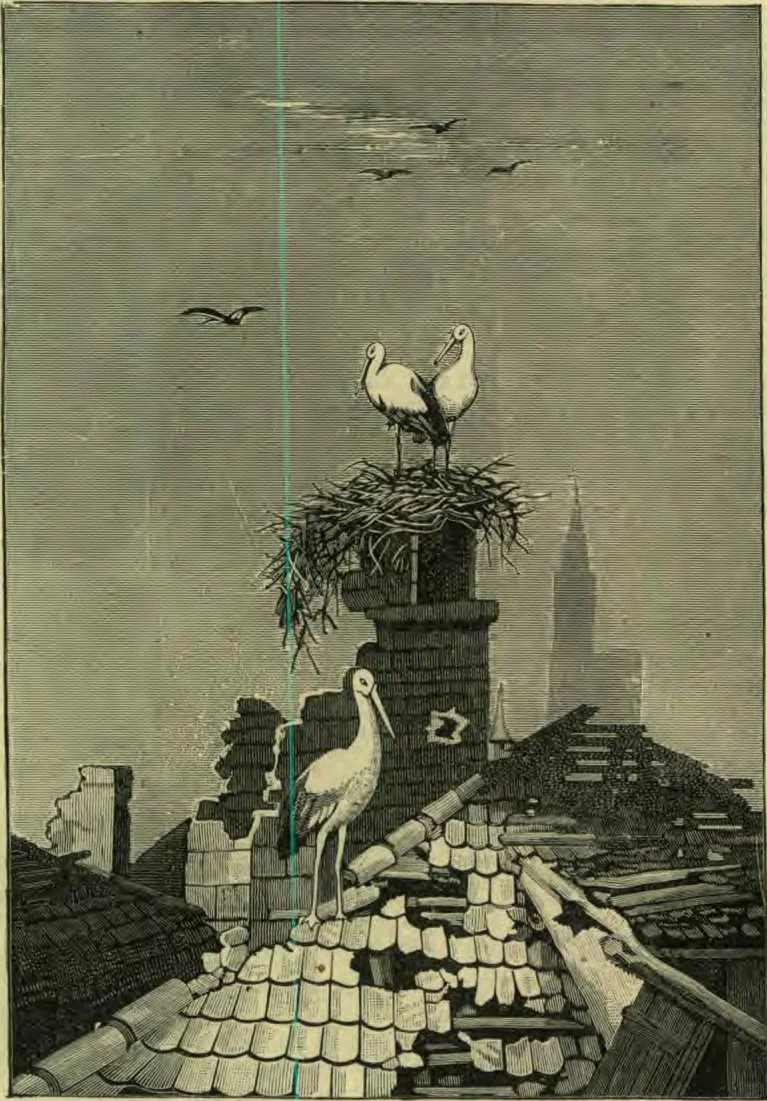
Over across the ocean, in the beautiful country through which the Rhine River flows, you may find some very large birds, such as you could see nowhere else, perhaps, in the wide world. They live in the greatest numbers in the city of Strasbourg. The Germans are glad to have them there; for they believe these birds bring good luck, and happy indeed is the man whose chimney these storks select for their home.
The birds even venture to build their nests up on the great cathedral; and any day you can see them sailing with a stately, solemn motion around its great, high towers. The guides take as much pains to point out the storks’ nests to strangers, as they do any other object of interest in this wonderful, quaint city.
Sometimes the people put boxes on their roofs, to coax the storks to build nests on these foundations. The nests are coarse, and made of sticks and straw, hollowed out just enough to hold three or four eggs.
The little storks look homely enough as they lie curled up in these rude nests, with their great beaks open for food. Their parents take the very best care of them. One always stays with them when the other goes off in search of food; and if it should see a stranger coming too close, it would tread around on its little ones to keep their heads down out of sight.
The storks think as much of their little ones as your papa and mamma do of you; and the Germans tell many wonderful stories of their love for one another. One time a fire broke out in the city of Delft, in Holland. On one of the burning buildings a stork had had her home. She tried in every way to save her little ones, but they were too young to fly; and so, instead of flying away and leaving them, she stayed by and perished in the flames.
At another time, when a fire broke out, the storks saved their home and their little ones by bringing water in their beaks and sprinkling it over the nest.
Once the Germans and the French had such a terrible, terrible war, right by the beautiful city of Strasbourg. All day the great cannons roared and thundered at the gates of the city, and bomb-shells from the camp of the enemy flew right over the walls, and set fire to the costly buildings. But the brave storks did not go away; they stayed right on amid the smoke and flames and falling buildings, just as you see them in the picture; and when the enemy gained the victory, and took possession of the town, the storks set quietly to work to rebuild their nests, that had been torn down.
In the autumn the storks get together and fly south to Africa, where they stay during the winter. They do not go away for fear of suffering from cold in the Rhineland, but because they can get nothing to eat in the winter time. Storks live on frogs, eels, snakes, and food of that kind; and in cold weather these all go to sleep in the ground, and do not wake up till spring, so the birds would have a hard time to get along if they did not go away to some warm country.
But wherever they go, no matter how far away, they always come back to the same old nest every year. The old birds keep the home, driving the young ones off to build new ones elsewhere.
If they have been kindly treated by the people on whose house they live, they act overjoyed to see them again. They frolic with the children, and plague the dogs and cats, and sometimes come into the house at meal-times, helping themselves to food from the table. Once in awhile they will stay year after year, never flying south when winter comes.
The Hebrews were acquainted with the storks; and if you look in the book of Psalms and in Jeremiah, you will find them mentioned. The Hebrew name means bird of mercy, or piety; and if half the things told about this bird are true, it well merits the name. It has been said that when the storks are too old to stand the long flight from one country to another, the younger birds take the old ones on their backs, and bear them on. And when the parents grow too feeble to hunt for food, the young ones place them in the old nest, and feed them. Is it not to be hoped that the INSTRUCTOR boys and girls will be as thoughtful and kind to their parents as these noble birds?
“The stork’s an emblem of true piety;
Because when age has seized and made his dam
Unfit for flight, the grateful young one takes
His mother on his back, provides her food,
Repaying thus her tender care of him
Ere he was fit to fly.”
W. E. L.
BE FAIR.
“See what a good trade I made to-day!” said Lucius to his uncle. “I traded my old knife with Jamie Neil for his nice two-bladed one that cuts twice as well. One of the blades of my knife was broken, and the other would not hold an edge two minutes. But Jamie took a fancy to it because of the handle, and I was glad enough to make the trade.”
“I am sorry, Lucius, if you have cheated him,” said his uncle, “but more sorry for you than him.”
Lucius hung his head a little and asked, “Why so?”
“Because one success of this kind may lead you to try it again, and nothing can be worse for a boy’s prospects in life than to get into the habit of overreaching.”
“But, uncle, in all trades, don’t each try to get the best bargains, and don’t all merchants make their fortunes by being sharp in trade?”
“No trade, Lucius, is sound that does not benefit both parties. Were you cheated in a trade by your playmate, you would feel very angry about it, and probably quarrel over it. Now, don’t trade any more unless the trade is fair all round.” —Sel.
Letter Budget.
Do you see the signs of spring; and do they remind you that you should begin right away to calculate how you are going to earn that missionary money? If it is to be done by gardening, you should lay your plans now; if by raising poultry, you have no time to lose. Look up the scripture that reads about those that do the work of the Lord negligently.—Here we have come upon a whole nest of letters, and so will say the rest some other time.
LITTLE JOSIE FENNER, who once lived in Battle Creek, tells her mamma, who is writing to the INSTRUCTOR, to say: “I am a little girl four years old. I know some of my letters. I am learning to count. Mamma is teaching me the ten commandments. Papa gives me a penny a week to give to the Lord. I am trying to keep the commandments and the Sabbath with papa and mamma. I want to be a good girl, so I may have a home with Jesus.”
JIMMIE MARKS, of Calhoun Co., Mich., writes: “I am a little boy eleven years old. We take the INSTRUCTOR and like it very much. I was much interested in the Russian’s famous coasting. I wish we had such a coasting place; but I should not like the seven weeks of fasting after the ‘butter week.’ I had five sheep, and sold one for a Christmas gift to the European and Scandinavian Missions. I am trying to be a good boy, that I may be saved when Jesus comes.”
ELNORA VAN HORN writes from Jackson Co., Mich. She says: “I am nine years old. I go about three quarters of a mile to school. I study spelling, writing, and arithmetic, and read in the fourth reader. I also go to Sabbath-school, and learn lessons in Book No. 4. I am learning about Elijah’s being taken up to heaven. I think Elisha must have felt lonely after his master was taken away from him. I want to live so I can be taken up to heaven when the Lord comes.”
ELVA RIGGS and her cousin WILLIE NORWOOD write from Mc Pherson Co., Kan. Elva says: “Willie is eleven years old, and I am twelve. I have never written for the INSTRUCTOR before, but Willie has. I am staying at my Uncle George’s now, and going to day school. My parents live twenty-five miles from here. We have just come from Iowa. The nearest Sabbath-school is nine miles away, so we do not go; but we would like to. My parents, uncle, aunt, and cousins all keep the Sabbath. We learn lessons at home in Book No. 3; just one more lesson and we will be through it. We are trying to be good children so we can meet you all in the earth made new.”
ISAM C. DORSEY, of Franklin Co., Ohio, writes: “As I have been looking over the INSTRUCTOR, I thought how much good one small letter would do, so I thought I would like to write and tell you what we are doing. I go to Sabbath-school sometimes. I am nearly fourteen years of age. I go to school every day, and read in the sixth reader, and study physics, grammar, arithmetic, music, and spelling. I have two sisters who attend school, and a brother-in-law who is a school-teacher. He is a Methodist. My mother is an Adventist, and my father believes it is the truth, but he works on the Sabbath. He is a barber, and I have to help him on Sabbath and Sunday, and I don’t like it at all. I hope it will not be long before a change of some kind will be made. My brother-in-law has two small children, named Gracie and Ray Guy. We moved here from Coshocton, Ohio, three and one-half years ago. This is my first letter to the Budget.”
EDGAR N. WASHBOND writes from the Albany Mission, New York. He says: “We moved to this place from the northern part of the State last spring, to work in the mission. The Capitol building is only a few rods from our house. It is about two-thirds done. When it is finished, it will be 350 feet from the ground to the top of the central tower. It will be one of the largest and nicest buildings in the world, should time last until it is finished. I have been through it several times. I sold and gave away tracts on the river steamers last summer. Five people have begun to keep the Sabbath here since the mission was opened, and we are in hopes more will soon. We have a Sabbath-school every Sabbath. I study Lesson Book No. 5. I was baptized at the Syracuse camp-meeting last fall. I want to be prepared to meet the INSTRUCTOR family in the new earth.”
FANNIE H. BRANSTETTER, of Metcalf Co., Ky., in renewing her subscription for the INSTRUCTOR, writes: “We cannot get along without the paper. There is only one Sabbath-keeper besides our family near here. Once there was a church of several members, but we are left almost alone, and seldom see a Sabbath-keeper. It is nearly two years since a minister has visited us, so you can imagine the help the good Review and INSTRUCTOR are to us. We have a grandpa and grandma living within a few yards of our house. They are nearing their threescore years and ten. Grandpa is perfectly blind, and grandma is afflicted. We are trying to take good care of them. I do most of their work. They do not keep the Sabbath. I was baptized four years ago. I am now in my fifteenth year. I send love to all. Pray for the lonely ones.”