“Not one of them is forgotten before God.” Luke 12:6. When we consider that these words were spoken of a tiny bird, our hearts should indeed rejoice; for we are assured, “Ye are of more value than many sparrows.” Does Jesus mean what he says? If he does, why not trust fully, instead of fretting and worrying over temporal affairs? After doing the best we can, why not rest our every care upon him who careth for us?
What comfort in the thought that God knows all about us! “Even the very hairs of your head are all numbered.” And this is not all; he counts all our steps. Job 31:4. He knows our thoughts; he knows our every need. He is able and willing to help us. He is a very present help in time of trouble. Why should we fear? God never forgets us, though we forget him, and wander from his side. Are we ever tempted to doubt God’s love and care over us? Let us do so no more, but rather sing,—
There’s a word of tender beauty
In the sayings of our Lord;
How it stirs the heart to music,
Wak’ing gratitude’s sweet chord;
For it tells me that “our Father,”
From his throne of royal might,
Bends to note a falling sparrow,
For ’tis precious in his sight.
CHORUS:
In my Father’s blessed keeping
I am happy, safe, and free;
While his eye is on the sparrow,
I will not forgotten be.
Though I’m least of all his children,
So unworthy of his love,
Yet for me there’s kind remembrance
In the Father-heart above;
He will ever save and keep me;
He will guide me on the way,
For my Saviour gently whispers,
“Are ye not worth more than they?”
O, the wounded hands of Jesus
All the springs of life control;
Is there any ill can harm me
While his blood is on my soul?
Let me, like the little sparrow,
Trust him where I can not see,
In the sunshine and the shadow,
Singing, He will care for me.
O, the tender, loving care of our Father! How our hearts should rejoice in praises to his holy name when we think of his many precious promises to those who trust him. Cast away your unbelief, dear tempted one, and trust him where you can not see, for he will not forget you. Why forget him who is able to do so much for you?
Grand Ledge, Mich.
Weed or Posy
By Hilda Richmond
The rain was pouring down outside, and indoors the weather was just about as gloomy. Aunt Helen knew that grandma was not feeling very well, and the noise disturbed her, so she proposed all the quiet games she knew, but the children would not be persuaded.
“I know a new game,” she said at last. “It is called ‘Garden.’ I will be the gardener, and you may be the plants.”
“I want to be a rose,” said Mabel. “Roses are so lovely.”
“I won’t play a silly game like that,” said Ned. “It’s no fun.”
“You can be a thistle,” said May, quickly. “Every garden has a few weeds.”
“I’ll be a nettle,” said Agnes. “I don’t feel a bit like being good this horrid afternoon.”
So the gardener went all around naming the plants, and in a few minutes everything was as cozy and comfortable as could be. The thistle and the nettle grumbled a little, but the other plants behaved so nicely that no one paid much attention to them. The flowers in the garden are always prettier than the weeds, so the two lonely weeds had rather a hard time of it in the new play.
“We are playing a new game, mama,” cried Mabel, when her mother came in to see why everything was so quiet. “Aunt Helen taught it to us, and it’s lots of fun. We are all plants in a garden. Can you guess our names?”
“I should say this little girl is a touch-me-not,” said mama, laying her hand on Agnes’s head. “She doesn’t look like a violet or a rose.”
Even Agnes had to laugh. “I’m tired of being a nettle,” she said. “I’d like to be something nice, too.”
Mama did not guess very many of the names, but she thought it a very nice game, and said it was time to water the garden. Instead of the big watering-pot, filled with warm rain-water, she brought in a tall glass pitcher filled with pink lemonade, and the children did not drink as plants do, but they enjoyed the shower very much.
“The thistle has turned into a sunflower,” said Aunt Helen, with a smile. “I wish all the weeds in my garden would turn to flowers after a shower, for I don’t like to have them in my nice beds.”
“I’m never going to be a weed again,” said Agnes. “It isn’t half as nice as being a posy.”—Hilda Richmond.
Old Times
CHILDREN are greatly interested in the events of their parents' early lives. “Distance,” in such cases, “lends enchantment to the view.” The grandmother often renders important service to the children by telling stories of old times. Those early days have romantic fascination to the little ones whose life has but recently begun. If the story be one of pioneer life in the olden time, children appreciate it intensely. They become linked to the past by weaving the chain of memory for them, and they gain a sense of solidarity with their ancestors. The family traditions, ideals, and sentiment are conveyed to them, and perpetuated in their thoughts and actions. It uplifts children to be brought into the line of heroic men and women, who stand out on the distant horizon in ideal and beautiful figure. We can not estimate the effect on the character and standards of children when their ancestors are exalted before them. It is true that such may have been ordinary men and women, but when idealized, they become in a certain sense the “saints” by whose deeds children are impressed and elevated for life's struggle.—The Watchman.
He Was So Busy
ONE year ago to-day I sat at my desk busy with the month's bills and accounts, when a bright-faced, starry-eyed lad of twelve rushed in and impetuously announced, “Say, pa, this is your birthday; you are fifty-five years old, and I am going to give you fifty-five kisses, one for each year.” And he began to make good his word when I exclaimed, “O Andrew, don't do it now, I am so busy!” His silence attracted my attention, and, looking up, I saw his big blue eyes filled with tears, and apologetically I said, “You can finish to-morrow.” He made no reply, but was unable to conceal his disappointment, his face wearing a grieved expression as he quietly walked away.
The same evening I said, “Come and finish the kisses now, Andrew,” but he did not respond to the invitation.
Two months later, in consequence of an accident, the waves of the Fox River closed over his body, and we carried him away to sleep near the village where he loved to spend his summer vacations. The robin's note was never sweeter than his voice, and the turtle-doves that coo to their nestlings where he sleeps could not be more gentle than my little boy who never finished his love-imposed task.
If I could tell him how much I regret the thoughtless word spoken; if I could be assured that he understands and knows how my heart is aching because of the unkind request, there would be no man in all this wide world so inexpressibly happy as the one who sits to-day and thinks how he prevented an act that love inspired, and grieved a little heart as tender as the mercy of God.
“And be ye kind one to another, tender-hearted.”—Selected.
To Lengthen Thy Life, Lessen Thy Meals
To lengthen thy life, lessen thy meals.
The General Meeting for China
By J. N. Anderson
J. N. ANDERSON
The long-hoped-for meeting of our mission workers in the Chinese field was held in the city of Shanghai, February 10-20. From almost every consideration, this great commercial center, the New York of the Orient, was the natural place for such a meeting, since it was the most accessible to our workers from the different mission groups, and at the same time it afforded the best possible point from which to study the entire China field. Through this port nearly all the great currents of Chinese life flow.
In addition to Prof. W. W. Prescott, we were privileged to have with us Elder E. H. Gates, secretary of the Mission Department of the Australasian Union Conference, whose long experience in mission work enabled him to contribute very largely to the interest and success of the meeting. Elder Prescott’s Bible studies and counsel in the organization of our work in this field were very helpful, and were appreciated by all. This kind of help was greatly needed at this particular time, and we all feel confident that our work now is on a basis that will insure permanent success.
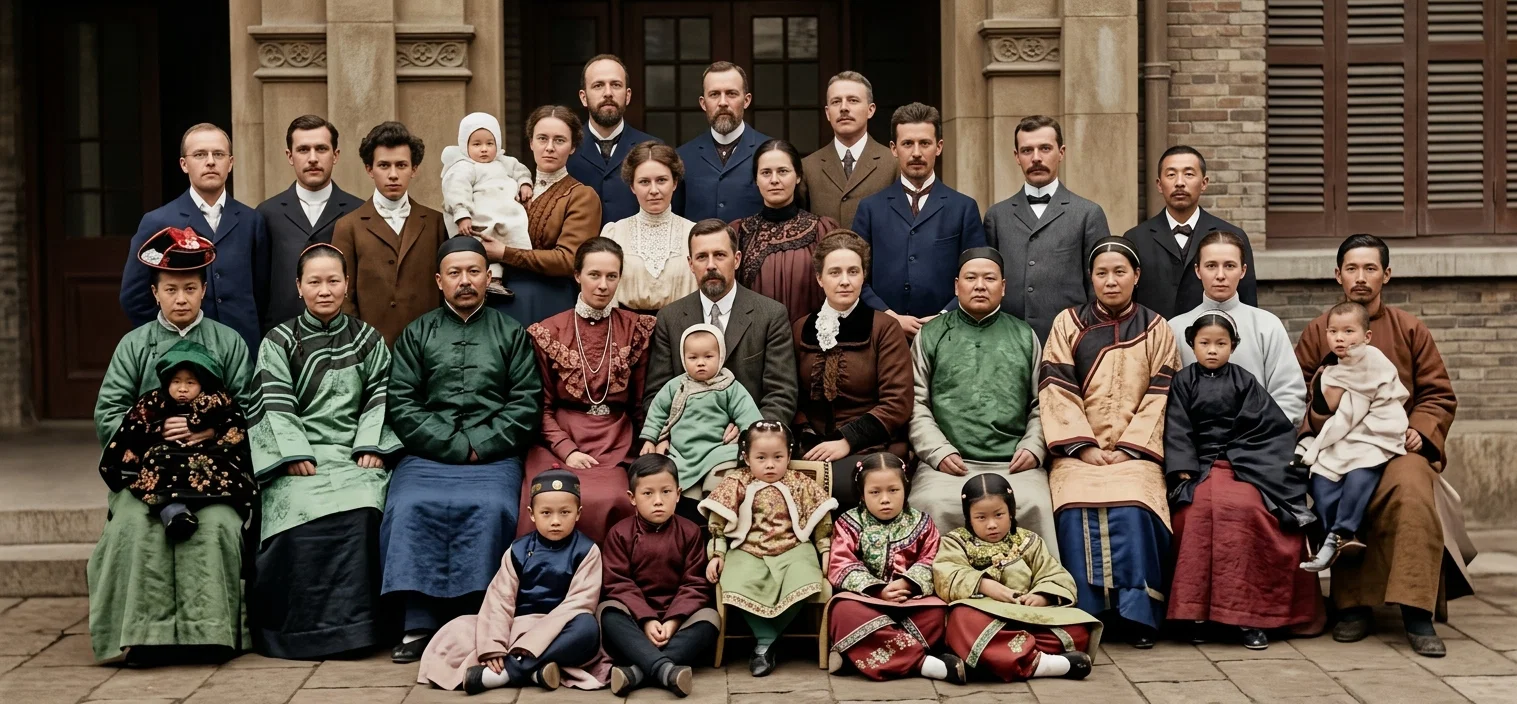
Beyond our most sanguine hopes it was possible for nearly all our workers to come together at this meeting. All our regularly employed foreign workers in the provinces of Honan and Fukien were present. Of those stationed at Canton all but four were present. It was most unfortunate that Brother and Sister Laird, who are located at Changsha, Hunan, were not able to be with us on this important occasion, for the reason that steamboat communication between that place and Hankow is interrupted during that part of the year when the water is low. The whole delegation present at the meeting, including the ten children, was thirty-two.
As we have not yet opened work in Shanghai, we were under the necessity of renting a house, which answered the double purpose of home and place of meeting. The matter of renting the house and the little furnishing that was absolutely necessary was attended to by Brother R. A. Caldwell, from Australia, who has been in these parts for some time canvassing for our books, and chanced to be in Shanghai at the time of our meeting. In this way we all were made comfortable notwithstanding the fact that we had some heavy rains and a snow-storm during the time of the gathering. In many ways the occasion reminded us of the camp-meetings we all used to attend before coming to China. Many of our workers were strangers to one another until this meeting called us together as one band of workers to pray and plan for the work in this empire. It afforded us the much-needed opportunity of viewing this great field as a unit, and to effect such an organization and recommend such measures as we hope will contribute to the upbuilding of the message in this land. Many of the perplexing and difficult problems peculiar to this field are quite clearly illustrated by the recommendations passed at this meeting, which follow:—
We recommend,—
1. That the general headquarters for all China be located at Shanghai.
2. That each local committee give special attention to the subject of language study, and arrange a course of study to be followed by workers coming into the field, and, further, that this committee provide suitable language teachers for all workers during the first two years (in consultation with workers themselves), and give special aid and encouragement by way of suggestion and examinations.
3. That all arrangements for new workers to enter the field be made through the regular organized committees; and that all donations to the work, made either through the regular channels or directly to the individual, be reported to the China Mission Treasurer and used in the regular approved lines of mission work, and, in case of special interest, all such funds be expended under the advice of the regular committees.
4. That all our gospel workers, native and foreign, be urged to teach carefully all inquirers repentance toward God and faith in and obedience to the Lord Jesus Christ as a personal Saviour from sin; and, further, that all candidates for church fellowship give evidence of a new life and a sincere love of God’s Word; and, in particular, that they abstain from idolatry in any of its many forms, including ancestral worship, also from polygamy, gambling, opium, tobacco, and wine.
5. That as foreign workers engaged in missionary work under special treaty rights, we scrupulously abstain from interference in disputes and litigations among Chinese subjects, and that we do our utmost to prevent our Chinese helpers and church-members from giving encouragement to, or having any connection with, this evil.
6. That each local committee arrange for the training of evangelists, Bible women, and teachers; and that all Chinese gospel helpers be employed subject to the approval of the local committee.
7. That no new enterprise involving the expenditure of over one hundred dollars, Mexican, be entered upon by any local committee without the consent of the general committee; and, further, that the total of such expenditure in any local field without the consent of the general committee shall not exceed three hundred dollars, Mexican, within the calendar year.
8. That all local work not specifically placed under the direction of a local committee be considered as reserved to the direction of the general committee.
9. That the following-named persons constitute the China Mission Committee: J. N. Anderson (Chairman), W. C. Hankins, H. W. Miller, A. C. Selmon, E. H. Wilbur.
10. That the Home Mission Board be requested to send out as soon as possible, a suitable man to act as secretary and treasurer of the China Mission to locate at Shanghai.
11. That the following-named persons constitute a publishing committee to act for this field: H. W. Miller (Chairman), F. A. Allum, J. N. Anderson, W. C. Hankins, A. C. Selmon.
12. Owing to the lack of sufficient funds to complete the erection and equipment of the printing house in Honan, we, therefore, recommend,— (1) That the Home Board be requested to assist in funds to the amount of one thousand dollars gold for the completion of the new building. (2) That we present an urgent request to said Board for funds to equip the new building with machinery, type, and supplies to the amount of one thousand dollars gold.
WORKERS IN ATTENDANCE AT THE SHANGHAI GENERAL MEETING
13. We recommend that the publishing committee as part of its duty examine and pass upon all manuscripts that are to be published in this field. This shall not be so construed as to delay new editions of previously published tracts, nor the publication of manuscripts that have been satisfactorily examined.
14. That in preparing literature in the Chinese language an effort be made to so present every phase of the third angel’s message that it will be a development and application of the principles of righteousness by faith, the central principle of the gospel of salvation through Jesus Christ.
15. That the Mission Board be requested to take into consideration the question of providing funds for the publication and circulation of literature in China, either by making an appropriation or by inviting special donation for the purpose.
16. That a depository for Chinese and foreign publications be established at Shanghai in connection with the headquarters of the general mission committee.
17. That urgent appeal be made to the Mission Board to fill the several openings in this field, as follows:— (1) For a man and his wife to connect as soon as possible with the work at Changsha, Hunan. (2) For two men and their wives to connect with the work in Fukien, in the Amoy dialect.14(3) For a married man to take up educational work at Canton. (4) For two men and their wives to connect with a worker of experience already in the field, to be located at some important center in the north of China. (5) For a family to locate at Shanghai and open up the work in that city, the commercial center of the Orient. (6) For a family to connect with Elder J. J. Westrup at Shang-tsai, Honan. (7) For a man of large experience and ability to locate at Shanghai and have general oversight of this field without attempting to learn the language, with the understanding that if it be agreeable to the Japan Mission, he might take a similar oversight of that field. (8) For a married man to take up work in the Hakka dialect, in South China.
18. That a permanent series of Sabbath-school lessons covering one year’s study on the book of Genesis be prepared in English and translated into Chinese in the different languages, and, further, that the following-named persons be invited to write these lessons: Mrs. J. N. Anderson, B. L. Anderson, J. J. Westrup, F. A. Allum.
19. That Ida Thompson, Mrs. A. C. Selmon, W. C. Hankins, and Mrs. J. N. Anderson constitute a Sabbath-school committee to develop and carry forward this branch of the work in China, the first-named to act as the department secretary.
G. A. IRWIN
By G. A. Irwin
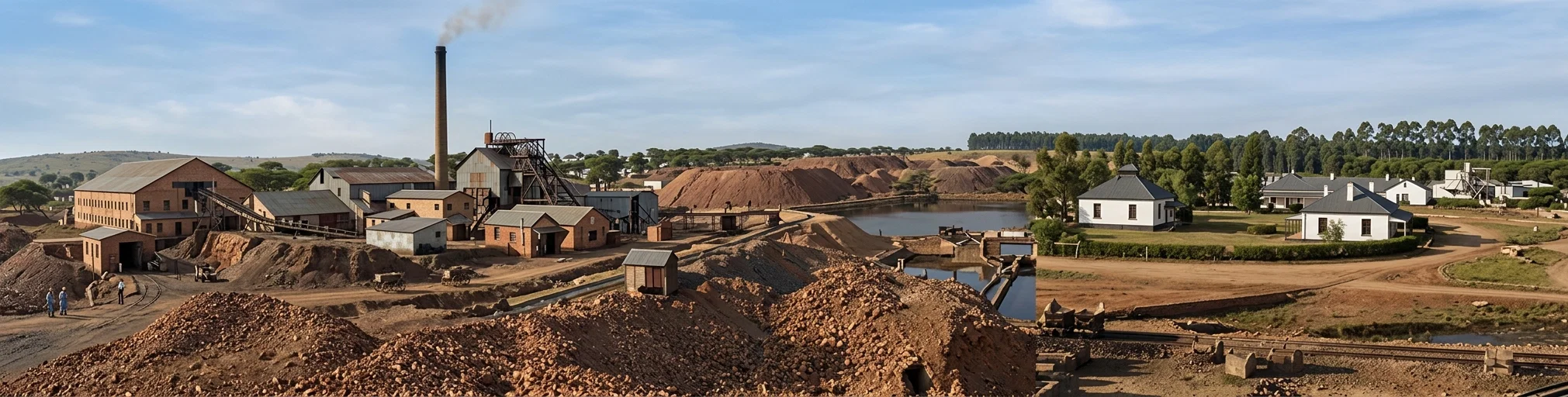
GOLD-MINES IN JOHANNESBURG, SOUTH AFRICA
From Cape Town to Kimberley
G. A. IRWIN
On Sunday, February 3, at 11:30, in company with Brethren Anderson, Chaney, and Willson, I left Cape Town for Johannesburg, in the Transvaal Colony. The day was quite warm, but as there was a good breeze, we did not suffer much inconvenience when the train was in motion. We reached the karoo, or desert—the dreaded part of the journey—just at nightfall, thus escaping the heat of the sun during that portion of the journey. Monday was cloudy, with occasional showers, which laid the dust and cooled the air, so that the trip, which had been dreaded, was made in comparative comfort. About noon, next day, Brother Chaney took leave of our company at De Aar Station, where a branch road leading to Basutoland—the location of his mission—leaves the main line.
All along the way from Cape Town to Kimberley there are blockhouses, rifle pits, and occasional graves, as reminders of the late Boer War. Near the point where the railroad crosses the Modder River was the scene of the desperate engagement between the Boers and the English, where the Scotch Highland Regiment was so nearly annihilated, and General McGregor was killed. A monument erected on the top of a kopje near the place of the conflict, in memory of the fallen heroes, can be seen from the car window. Farther down this same river was where the Boer General Cronje was surrounded and captured by the English troops under command of Lord Roberts.
The South African veldt bears a strong resemblance to the rolling prairies of Kansas and Nebraska. Much of the land is fertile, and would produce excellent crops were there sufficient rainfall. The large numbers of ostriches seen running at large upon the farms along this route attract the special attention of foreign travelers. Ostrich raising and farming are said to be the most profitable at present of all farm ventures. They live and do well upon the grasses and plants growing on the veldt, and require but little care. A male bird of a good breed will bring thirty dollars. They are picked three times in two years, and the feathers from these three pickings usually bring as much as the first cost of the bird. Counting their average life at twenty years, the owner has a good per cent of profit from the small original outlay.
The railway trains in this country do not carry special sleeping coaches, such as are in use in the United States, but provision is made in each compartment, in each of the three classes, so that one can rest quite comfortably, and that without extra charge, unless one hires blankets from the porter.
At 6:30 Monday evening we reached Kimberley, where Brethren Anderson and Willson left the train, while I proceeded, after a few moments’ delay, on my way to Johannesburg. At a siding named Content, forty-five miles out from Kimberley, and near the home of Brother Honey, I was joined by Elder Edmed, and together we journeyed on to Johannesburg, where we arrived Tuesday forenoon, and were met and welcomed by a number of the brethren, and later taken to the home of Sister Strachan, where we were entertained while staying in the city.
Pretoria
On Wednesday, February 6, Elder Edmed and I made a trip to Pretoria, the capital of the Transvaal, a city of forty thousand inhabitants, located forty miles north of Johannesburg. Pretoria was the home of Paul Kruger, formerly president of the Transvaal republic, and leader in the late Boer War. President Kruger was a minister of the gospel as well as a statesman and ruler. The large Dutch Reformed church in which he preached, stands on the opposite side of the street from his private residence. A modest monument, supporting a bust and profile of this remarkable man, marks the spot where his remains lie at rest in the Pretoria public cemetery.
Brother Edmed and his company of workers labored for a time in Pretoria, and left a company of twelve keeping the Sabbath, some of whom we visited while there.
Johannesburg
Returning to Johannesburg in the evening, I spoke to a few of our brethren who had gathered in Sister Strachan’s home, upon the origin and sacred character of the church of Jesus Christ and what membership in it implies. The church in this city had never had the privilege of thorough instruction on organization, and for this reason I continued the subject of the first evening in the Friday night and Sabbath forenoon meetings that followed. The afternoon was devoted to a talk from the missionary map of the world, showing the past progress and present status and needs of the work. At the conclusion of this service, the officers recently elected were ordained by Elder Edmed, and set apart for the respective duties to which the church had called them. This church is very much in need of a place of their own in which to worship. A proper hall for divine service is hard to find in the city, and the heavy rent charged is just so much taken from the amount that ought to be put into a place of their own. They own a lot only two blocks removed from the street-car line in one of the rapidly growing suburbs, and a strong effort will be made by the brethren this coming season to raise sufficient funds to erect a neat and comfortable house in which to hold Sabbath and special meetings when a minister is present with them. The size and importance of this city should be sufficient justification for a call for help from our brethren outside. Johannesburg is the largest and most enterprising city in South Africa. The large gold-mining plants, which are seen in every direction as far as the eye can reach, draw to this city people not only from all parts of Africa, but from all parts of the world as well. The total15output of gold from the Johannesburg mines during the month of January, 1907, was 537,638 ounces, which is equivalent to £2,283,741. The opportunity for employment in and about the mines has brought thousands of natives from the Zulu, Kafir, and other tribes south, and there is scarcely a tribe south of the equator but has a representative in the city. Its total population is 160,017, 84,113 of whom are white, and 75,904 colored. With the right kind of person established here, it would no doubt become an important center for the spread of the message among the native people.
Kimberley
I left Johannesburg Sunday morning, February 10, and arrived in Kimberley, three hundred miles away, at midnight, and went at once to the Kimberley Baths, located at No. 7 Cheapside. Prior to the time that Brother and Sister Willson took charge of the place, some eight years ago, it had been run by our people as an industrial home. It had proved a losing enterprise, and was heavily in debt, besides having lost caste with the people. After Brother Willson took charge, the nature of the business was changed, the industrial features were abandoned, and the place was fixed up as bath- and treatment-rooms for both sexes, and put in shape to commend itself to a different class of patrons. The conference paid some on the indebtedness, and private parties rendered assistance. Thus by shifts and turns in various ways, Brother Willson succeeded not only in holding the property intact and paying off most of the indebtedness, but in improving it, and at the same time building up a good reputation and patronage. The property as a whole consists of several lots, but so located that it is all connected, although having a frontage on three different streets. Every foot of available vacant ground has been thoroughly dug up, and converted into a beautiful flower garden. Even the walls and roofs of small buildings are utilized by being made trellises to carry grape-vines, which are loaded with luscious fruit. The flower garden is not only a thing of beauty, but a source of income as well. The profit on the garden alone last year was £150. Most of the work that produced this result was done by Brother and Sister Willson mornings and evenings, and at slack times in their bath-room work. Thus by consecration and steady, persevering effort upon the part of two persons, a property that a few years ago was bankrupt several hundred pounds, has been reclaimed, and stands to-day with its debts all paid except £300, and with present worth above this of £3,520.
Costa Rica, Central America
By H. LOUIE MIGNOTT
SINCE my return from the West Indian Union Conference, I have been laboring at Cimarrones, Jimenez, and Zuacimo. The Master has greatly blessed the seed sown, and here and there are to be seen plants of righteousness springing up into life eternal, for which we praise the Lord. Israel is on the march to the promised land.
We have for a long time been trying to get an entrance into the little town of Guacimo, but were unsuccessful, as we could not rent a room in which to hold our meetings. But in his own time the Lord helped us, and we were able to hire a little house with two small rooms, about half a mile from the town. We held our first meeting in the open air, on the last evening of March. We had a good hearing, and the people began to feel more kindly toward us than at the first. We then invited them to our little house; the first attendance was good, but owing to a very dangerous bridge over which they must cross in the night, our attendance became very small. We then went over into the town and held our meeting every night under a large bread-fruit tree. This we could not do but for the heavy drought which now prevails here. My wife played the organ, while I played the violin. The Lord brought great crowds of people every night to listen to the message for this time. They were a well-behaved people, paid good attention to the truths presented, and so became deeply interested. A Baptist church is at this place. It is also the stronghold of one of the organizations that is “endeavoring” to crown Christ king of this world, and to compel all men by human laws to become Christians. They are our greatest opposers here. Many of the church leaders were present at some of our meetings. One of them, after listening to the discourse one evening, made the following remarks: “These are solid gospel truths. If we do not take heed to these things, it will be to us as it was to the people in Noah’s day.” It was not long before the wrath of the dragon was aroused against us. Some of these leaders, blinded by ignorance and prejudice, summoned their people together and warned them against us. They also told them that the Holy Spirit fell on the disciples on Sunday, so it was made the Sabbath. But such sophistries did not lessen the interest already manifested by the people. They come more and more every night.
The work is onward. It must prevail. This modern Jericho must fall before the word of the living God. There are many “Rahabs” at this place, who will be seen in the kingdom, by the help of the Lord. “The weakness of God is stronger than men.” As a result of our labor during the past two months, seventeen precious souls have enlisted under the banner of the mighty Prince Emmanuel. I have had the joy of burying seven of these with their Lord in baptism.
While relating to my people some of the proceedings of the conference in Kingston, Jamaica, I mentioned to them how Pastor Strickland, of the Kingston church, and his congregation had asked the Lord for an addition of one hundred to the church, and how the Lord heard their prayers, just a few days afterward, in the same way that he heard and answered the prayers of Paul and Silas in the Philippian jail, by the preaching of an earthquake. Some time after, a brother suggested that we follow the example of the Kingston church, and ask the Master for an addition of twenty souls to his cause here. This was agreed to by the whole church here at Pacuarito, and a half hour every Sabbath evening was set apart for that purpose. We can all rejoice that in direct answer to our prayers we have already seen seventeen out of the twenty accept the truth. We are still praying.
The work is moving onward in Limon. Brother E. N. Rogers, the leader of that company, has by earnest labor brought ten into the light of present truth since the beginning of this year. Some of these have been baptized, while the others are preparing for the same rite. Brother Rogers is a tailor, but uses his spare time in the work. Pray for us.
H. LOUIE MIGNOTT.
Turkey
By Claude D. AcMoody
CONSTANTINOPLE.—While we are trying to make a fresh assault upon the bulwarks of Mohammedanism, Satan is awakening anew. We have been brought to sadness over the death of Dr. A. W. George, whose years of hard labor built up what medical work we have started. I know Elder Conradi has appealed to America for help. It does seem that if relief is not secured from some source erelong, the results of Dr. George's labor will in a great measure be lost. Dr. Hoenes, from Friedensau, on a trip through the Orient, passes through here next week, and will give some time to help in counsel regarding our situation here. A man must know French to practise medicine in Turkey, for the government examinations are given in that language.
On this northwestern edge of Asia Minor I have seen some victories for the truth. You of course have learned of the false doctrine that got a glowing start in Egypt. A pamphlet on this has been translated into Armenian and Turkish, and has been freely distributed by mail throughout this whole field. It is taking diligence and tactfulness to stem the tide. I had a ten-days' struggle at one place against this error. A good victory was gained, however. The struggle we passed through in America has been and is being reported to these people by private mail, etc., by our enemies, and they hear erroneous reports. From a letter received a few days ago from a company I have not yet been able to reach, I find they are all confused, and have stopped paying tithe.
So far in my travels, where confidence16had been broken, it has been restored. I am thankful for some strong hearts among the believers, who are firm as a flint to all the message. I never was of better courage, for some great victories have been won. I am only setting forth some of the real situation here. Aggressive work in positive evangelical effort and otherwise for the general people has thus been retarded. I superintended the getting out of the Lesson Quarterly on Ezra in Armenian, a hektograph edition of fifty-five copies, translated by my interpreter. In this move we have the Sabbath-school work going forward. A hektograph edition of every Quarterly will be put out.
CLAUDE D. ACMOODY.
A Visit to Changsha
H. W. MILLER will soon visit Changsha, one of the prominent cities in the province of Hunan, China, where Brother P. J. Laird and wife have begun pioneer work with the message. Brother and Sister Laird are looking forward with much anticipation to Brother Miller's visit.
Cuba
By E. W. SNYDER
Some time has elapsed since we last reported concerning the work in this field; this has not been, however, because there were no interesting experiences to report. On the contrary, we have seen that the message is bearing the same good fruit in the lives of some of these poor Cubans that it does among others of more favored lands.
The brother referred to in a former report continues faithful; and like Andrew of old, he has a burden to take the truth to his own kin. Through his efforts the way was opened for meetings in the home of his sister, where for several months we have held one service a week. The result is that four have begun to keep the Sabbath, and in all, we now have eight or nine Cuban Sabbath-keepers. About one half of these have come directly from the Catholic Church, and it is interesting to note their progress in the truth step by step as their prayers to the Virgin and saints have given way to supplication directed to the Heavenly Father, while wall text cards have been substituted for their Catholic pictures and images. Having taken the Bible as the infallible word of God, a single text in proof of any doctrine is sufficient for them. This has been shown by their readiness in accepting tithing, healthful living, and the spirit of prophecy. As a class, we find the Cubans to be liberally disposed toward the cause with the little means they have.
Nearly all are now paying tithe, and one brother, a barber, testified that before he paid the tithe, his work went hard, and his earnings scarcely sufficed to meet his needs from day to day, but the first day after he paid the tithe, his earnings amounted to three pesos, and recently he informed me that his tithe for one day amounted to seventy-six cents. Another brother has just lost his position for the truth's sake, and although he has a family of six dependent on him, he remains firm. His request to his employer that he be allowed to continue in his employ, having Sabbath free, was not granted. The faith of this brother is therefore still being tested, but he is confident that a change for the better will soon come.
We are told that under Spanish rule a Cuban without the influence or backing of some Spaniard could have no admittance to the schools, therefore it is not unusual to meet with Cuban adults who do not read or write. The school system of the present is rapidly changing this situation among the rising generation; however, the prevailing illiteracy renders work with the publications difficult. We have found that the most favorable way to begin work is to open meetings in as many places as we can; but this requires means with which to pay for rents, lighting, and seating; and while the Cubans are liberal, they are poor; therefore we must look to our more favored brethren at home for help.17
Are there not those who will feel it a privilege to come to our aid? To any one having means for this field we would say that at any money-order office in the United States a money-order may be purchased payable in Havana or Marianao; therefore we request that any money for Cuba be sent direct to the order of the undersigned, and a receipt will be sent by return mail.
For the benefit of any brethren intending to come to Cuba, we would say that in order to avoid paying duty on your goods, you must make a manifest and secure a consular certificate for the same, otherwise on all goods not brought as baggage you will have to pay the maximum rate of duty. This also applies to any goods, new or old, sent by bill of lading to this country. The maximum duty applies to all goods whose origin is outside of the United States, while all United States goods enjoy the minimum tariff; but in order to get this low rate, a consular certificate must in every case accompany the goods. All goods that have been in use for a year or over come in free, but if not brought as baggage, they must have the consular certificate. The immigrant in order to bring in his goods free must be here in Havana to sign in person. If he is away in the country and can not do this, he must pay the duty. For this reason it is better to bring all possible as baggage, or to ship it so it will arrive with the owner of the same. Thus loss of time and railway expense are avoided. At every point of departure along the coast of the United States there are Cuban consuls who will issue the above certificates gratis. Confidence in the country is being restored, and we see the steady, onward march of development. Many Americans have come to share in this prosperity, and we trust that some of our brethren at home whom the Lord calls may also come. Those who come with a burden for souls and the spirit of the Master will receive a warm welcome.