None but those who have been in the midst of Indian living can imagine the privation and hardship to which the great mass of poor people must submit themselves in order to live. It is true that these poor souls do not have many expenses; but this is not because they would not like to have many other things. The only way they get along cheaply is by going without the many little things that go to make up the life of the average American or European. No one enjoys being well-dressed better than the native of India, but he simply can not get the pice (money). They like bright colors in clothing, and to have plenty; but the father who labors early and late for a salary of from sixteen to thirty cents, and supports a large family, pays rent, and buys food, must necessarily not waste his pennies. One thing all must admire among this unfortunate class is that they never murmur, never grumble, and are always willing to share their sorrows or joys alike with any one who is their neighbor.
Naturally they are not very well acquainted with American taste in food. A little incident which happened in our experience near Bombay may help to illustrate how embarrassments and joys may mingle in the missionary's experience in India. Our servant's wife had suffered a great deal from malaria and other disturbances, and through the help of one of our nurses and the remedies we prescribed, the woman improved nicely, and, to show their appreciation, what did they do but present me with a large, heavy, thick pancake, made of flour and water (no yeast or saleratus), and baked over a little fire? Now came the embarrassment—what should we do with the cake? Knowing just how it was made, we felt that we did not wish it ourselves. But I would not refuse it, and so told my wife to tell the mollie (gardener) that it was good; he would not need to know that I did not eat it. But next day came another cake, and soon a third, and then the other neighbors brought us cakes. Now what to do with all these was quite a problem: to throw them out would surely anger the poor native, to burn them would be sin; but disposition had to be made of them all in some way, and it was just then the happy thought came to me that down the street a little way lay two or three blind people and lepers. And so after dark I gathered my little satchel full of cakes, and hastened down to the spot, where the cries of a hungry soul always meet the passer-by. Now I had the privilege of placing in outstretched hands large, heavy cakes, to hear from these poor people, in return, “God bless you.” Happy were their hearts; and so was mine, having thus solved one more of the problems of every-day Indian life.
C. A. HANSEN.
Ecuador
By Thos. H. Davis
AMBATO.—Last month I made a trip by train to Riobomba. On arriving, I found it was the first of the three days of carnival. Those who have been in Ecuador or northern Chile can testify to the horror of these three days of revelry. Although it is not safe to be out on the streets, especially during the afternoons, I went about my work, and prayed the Lord to protect me. A few bombs were thrown at me; but as I was walking fast, they fell behind me. The people were painted in different colors. During the two days I was able to sell a large number of Señales and small books. While returning on the train, I sold several Testaments and tracts to the second-class passengers. Soon after, two young men set fire to a Testament they had bought. This is the first time I ever saw the Bible burned. The priests have full power over the minds of the majority of the people here, but we are thankful to see a few resisting their power.
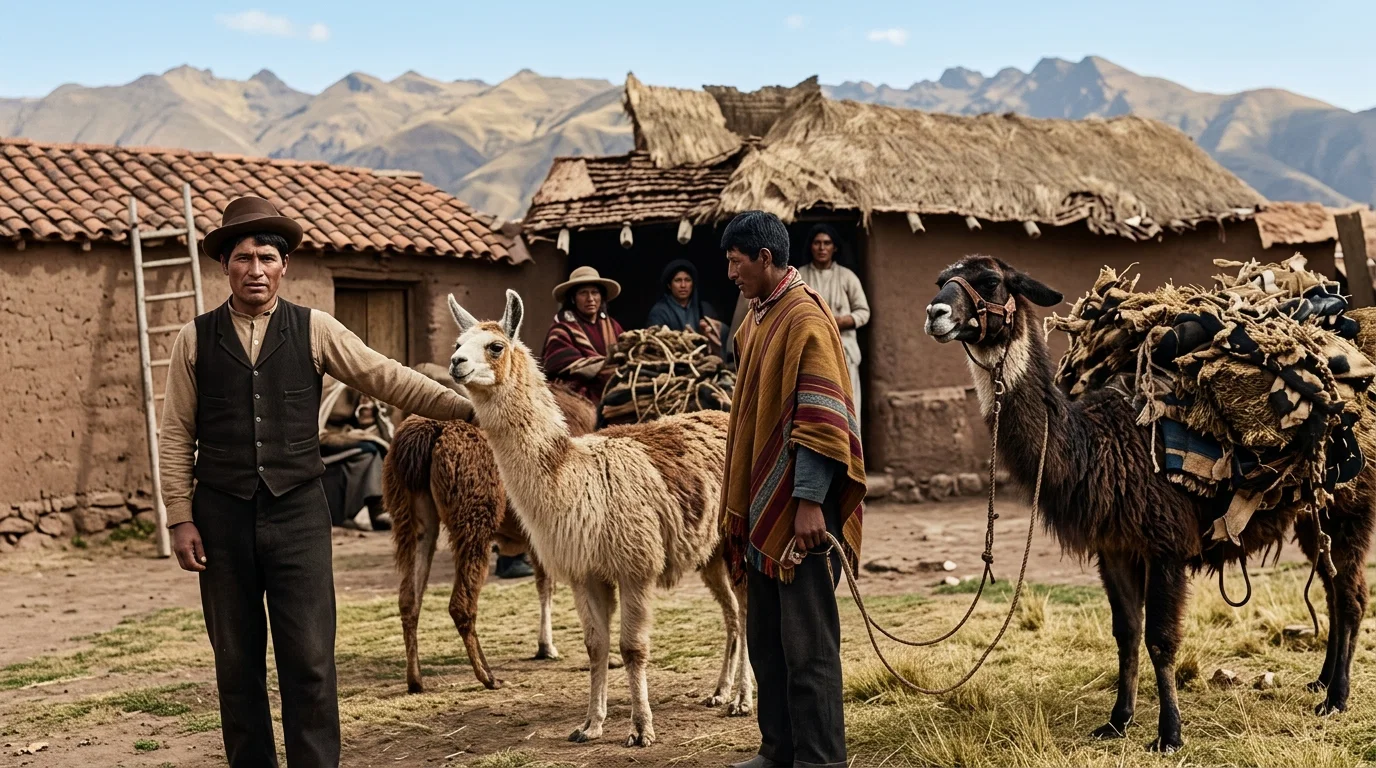
LLAMAS AS BEASTS OF BURDEN
Here in Ambato we are trying to teach the truth to a few. Our little Sabbath-school is becoming more interesting all the time. Elder Casebeer's English school is getting along very well, for a beginning. Just lately the director of the high school of Ambato put his son in our school. The professor of English in the high school for boys has been coming to our services lately, and is much interested in the Bible readings we are giving him. Especially is he interested in health reform; so much so that he is preparing to start a health journal. He is anxious to do something for his people in Ecuador.
We are much in need of one or two small tents, in which to live here in Ambato. On the outskirts of town plenty of cultivated land can be had at a very reasonable price; and as there are only Indian huts on them, if we had a good tent or two, the family could live in them until a small house could be put up. I will invite any one who wishes to donate a tent with fly, to correspond with me. Do not send the tent before corresponding concerning the same.
THOS. H. DAVIS.
Apartado 3, Ambato, Ecuador, S. A.
The Late K. G. Smith
By A. T. ROBINSON
BROTHER KIMBLE G. SMITH, who died at Madrid, Neb., May 30, 1906, after making liberal provision for his three brothers who survive him, left the rest of his property to the Nebraska Conference Association, by a will dated March 7, 1906, just fifty-three days before his death occurred.
The estate has been fully settled, and everything turned over to us. Our brethren and sisters everywhere will be pleased to know that when the securities in our hands are all realized upon, we shall have turned over the following amounts to be used in carrying forward the great world-wide missionary operations of the third angel’s message:—
Foreign missions .......... $20,000.00
Atlanta (Ga.) Sanitarium ... 1,000.00
Jewish work in New York City . 1,000.00
Northwest Canadian field ..... 1,000.00
International Publishing Assn. 3,000.00
Elevator for Nebraska San.... 3,000.00
To be appropriated later ..... 5,713.38
Total ....................... $34,713.38
The board of trustees of the Nebraska Conference Association feel deeply grateful to God for the privilege of helping to carry out the dying wish of our departed brother. Brother Smith had been keeping the Sabbath about a year and a half before his death, and during this time he made liberal donations to the cause. So far as we know, he was the only Sabbath-keeper within a radius of one hundred miles of where he lived. The court officials, the executors of the will, and all with whom we have had business relations in connection with this matter have treated us with the utmost courtesy. The estate was settled several months earlier than the law requires, and no unreasonable charges were made for services rendered.
Who will doubt that when our deceased brother awakes in the morning of the first resurrection, he will greet those who will have been saved in the message as the result of his liberal gifts? May He whose Spirit prompted this gift watch over its distribution and use.
A. T. ROBINSON,
President Neb. Conf. Assn. of Seventh-day Adventists.
Our Work in England
By W. H. Wakeham
Undoubtedly the readers of the REVIEW will be glad to hear of the progress of our work here with reference to the “Sunday” campaign. The forces operating in behalf of Sunday legislation received something of a check in the government when a motion in the House of Lords toward a stricter observance of the day was met with a positive refusal from the leader in the House of Commons.
While we know, of course, that this is only a temporary check, yet we are thankful that the Lord is thus holding the winds of strife, that our people may get this special truth before the world. The agitation for a better observance of Sunday is rapidly spreading in every direction. Especially is it being urged on by the non-conformists.
Our people are doing good work with the little paper, Sunday Notes on the National Campaign, which has recently been published at the office here. Nearly one hundred and fifty thousand of these papers have been sold during the past few weeks, and we know that many are reading them, and we believe that they are being influenced thereby. We are grateful to God for these opportunities that he is giving us of sounding this message.
The following is a resolution which was unanimously adopted by the South England Conference of Seventh-day Adventists on March 12, and forwarded to the members of the British cabinet, together with a publication dealing with the Sunday institution and the dangers of Sunday legislation:—
“Resolved, That this conference of Christian observers of the seventh-day Sabbath has seen with pleasure and thankfulness the attitude of His Majesty’s government toward the Sunday legislation asked for by Lord Avebury’s motion.
“They wish respectfully to express their conviction that no institution of a religious character should ask for or receive the support of the state, but should stand or fall by its own intrinsic worth, and should rely for its promotion on spiritual methods alone.
“This conference, recognizing that ‘the powers that be are ordained of God,’ prays that by his help and blessing, the government may be strong to accomplish all needed reforms and to stand firmly against any proposal that is contrary to liberty of conscience and religious equality.”
Responses to these letters have been received from six members of the cabinet, including the prime minister, the chancellor of the exchequer, and others in high official position in the government.
W. H. WAKEHAM.
South Africa
By J. F. Olmsted
PORT ELIZABETH.—The work still moves steadily on, here and in Uitenhage, and we are encouraged to see souls accepting the third angel's message in this difficult field, where the gospel seems to have but little effect on the hearts of men.
At the close of the Sabbath service yesterday, in the baptistry in the Port Elizabeth church, the writer baptized three adults, who after long years of wandering, returned to the Father's house. Our hearts are greatly cheered as we see those for whom we labor leave the world, popularity, good wages, and influence, to join those who are willing to suffer for Christ and give all that they are or hope to be that his work may be advanced and his name glorified.
We had a spiritual feast together, and it was a Sabbath that will long be remembered, especially by those who, like the prodigal son, left their Father's house. One brother and his wife were church-members for five years, but became discouraged at the condition of18some things that unfortunately existed, and for fourteen years they wandered in and out, searching a better way. Finally the way became so dark and difficult to travel that they turned back and forsook even the Lord's holy Sabbath. But the Lord in his Fatherly kindness permitted affliction to overtake them, which brought them again to the fold of Christ, and to-day the sunshine of his love is unmistakably written on their happy faces. What a change when the Lord sets the sinner free!
We rejoice that we have a small part in the glorious harvest, which now is nearly finished; but our earnest prayer to God is that we may always prove ourselves worthy before him and before men, and that he may be pleased to seal our labor with his approval, and that we may be the means of leading many to the knowledge and acceptance of the truth. We ask our brethren to remember us at the throne of grace, that our work in this distant land may prosper to the glory of God.
J. F. OLMSTED.
The Work in Mobile, Alabama
By Sydney Scott
According to the advice of the Alabama Conference Committee, I came to Mobile to hold a series of tent-meetings. This city had a small effort three years ago; but work was not so effectual as it might have been, on account of excessive rains and other hindrances.
This city has a population of forty thousand, of which half is colored. There are some wealthy negroes here. One third of the colored people own property, and live in good houses. The great negro national fair will be held here this fall. This fair will bring some of the best colored people of the South to this city. A peaceful relation exists between the two races, each respecting the other. One half of the laborers in the government service here are colored men. In the post-office, one third of the help are colored men. The dove of peace seems to spread its wings over this city for prosperity.
One mile from the heart of the city the Confederate soldiers had their fort. The mound and trenches are plainly seen, as when first made. The Union soldiers camped to the south about two miles. The two camping grounds were in rifle-shot sound of each other. The influences here are all but good, especially during the Mardi Gras season.
There are only a few Sabbath-keepers in the city, though at one time there were two churches. We shall begin meetings May 1 in a tent located six blocks from the Confederate fort, but our purpose on this ground is to bring peace and happiness to those who desire to do God's will. Christ is the leader, directing his soldiers, and our warfare is not carnal, but spiritual, designed to bring liberty to the slave-bound captives.
SYDNEY SCOTT.
Barcelona, Spain
By Walter G. Bond
THURSDAY, April 18, just at noon I boarded a steamer in the Barcelona harbor, and started for the city of Valencia. All the afternoon the weather was exceptionally fine, but about sundown we met a severe storm, which lasted all night, and caused almost every one on board to have the unpleasant experience of being seasick. We landed in Valencia the next morning about five o’clock. I was glad to find my brother and his family well and nicely located. They have been laboring in that city since the fifteenth of last September, and God has blessed their efforts. The evening of my arrival we had a good meeting, after which several who had begun to obey the truth manifested a desire to be baptized.
Early Sabbath morning we all met on the shore of the Mediterranean, in whose waters six dear souls were buried with their Lord in baptism—three men and three women. There were, perhaps, no less than one hundred congregated to witness the scene; but all were orderly, and gave the best of attention. Several others were anxious to be baptized, but it was thought best for them to wait a little longer.
Immediately after the baptism the ordinances of the Lord’s house were celebrated. God’s presence was manifest in a marked manner, and all seemed deeply impressed. In the afternoon twenty-five gathered at my brother’s home for Sabbath-school, all of whom seemed to enjoy the study. We hope and earnestly pray that the work started in this city may develop a zealous company. We are thankful for the privilege of being co-laborers with Christ, and for his kind, protecting care over our lives.
WALTER G. BOND.
Canvassers’ Convention
By F. E. Painter
THE canvassers’ convention at South Lancaster, April 19-21, was an unqualified success, and I believe it has proved a real stimulus to the work of circulating our publications in this part of the field.
This convention was not a bookmen’s convention in the usually accepted sense of that term. The subjects were arranged with the view to being of interest and benefit to our people in general, and the canvassers in particular, rather than being especially adapted to the needs of those who hold places of responsibility as leaders in the work.
This convention being somewhat local in its nature, no attempt was made to call in many workers from a distance to attend it. However, Elder Westworth, president of the Southern New England Conference, and Brethren Boardman, Manry, and Webster, field missionary agents of the Vermont, Western New York, and New York Conferences, were present. Nearly all the conference workers and many of the canvassers of the Central New England Conference were in attendance. Most of these were assigned to places on the program, and almost without exception they responded with papers that were listened to with interest, and were pronounced excellent by those who heard them.
The convention was designed to serve as an introduction to the canvassers’ institute, which was held at the academy. This was, I think, in every respect the best institute I have ever attended at the academy. More than fifty persons united with the canvassing classes, and prepared for active service in the field. About forty of these were students at the academy, and the others were persons who came in from the near-by conferences to take the special course and attend the institute.
The offer of a year’s scholarship to those who will sell two hundred and fifty dollars’ worth of books, turning in the entire proceeds to the conference in which the books are sold, was an encouragement to the students, and doubtless led some to enter the work who would not, perhaps, otherwise have done so. But there was the clearest evidence of a strong, healthy interest in this work on the part of the students, aside from this offer. I think this is very largely due to the influence of Professors Machlan and Cottrell, and Elder Ketting, president of the Central New England Conference. These brethren are practical, thoroughgoing bookmen, who have had an experience in this work themselves, and realize the advantages to our young people of gaining an experience in it. From the time that the canvassers’ institute was arranged, Professor Machlan never allowed the students to forget that it was coming, and that they ought to improve the summer vacation by active work in the canvassing field.
He kept it before them so constantly that after a time a smile would go round every time he arose to speak, as they expected that he would give them something more on canvassing, and he usually did. I am very sure that the young people who go out into the canvassing work this year from the South Lancaster Academy will make a good record, and that the results of their work will be seen in eternity. The assistance of Brethren H. C. Wilcox, F. C. Webster, and E. A. Manry in the institute work was greatly appreciated, by both the students and19myself. These brethren promise to look after these young people carefully when they enter the work in their respective conferences, and to give them all the assistance necessary to get them rightly started, and to make a success of their work. We believe they will, and we are trusting that these students will have such a good degree of success that their influence will lead others to unite with them in pressing the work onward to final victory.
F. E. PAINTER.
Georgia
By Arthur L. Manous
ATLANTA.—After laboring in Dalton for some time, and having the pleasure of seeing eight or nine souls begin to keep all the commandments of God, directly or indirectly under my labors, I located just outside of Atlanta proper, on one of the city car lines. This situation makes it very convenient for me to do Bible work in this large and thriving city of the South.
I wish to extend thanks to those who have kindly sent me literature while at Dalton, and also now to extend to all the opportunity to assist the work here by donations of good Seventh-day Adventist literature, post-paid. I can use a little in various languages.
Another way whereby some may help in the work here is this: If any of our brethren and sisters have relatives or friends in this city who are interested in present truth, or who might become so, and would be pleased to have me visit them, let such write me, giving as much information as they may deem necessary, and I shall be pleased to call on those whom they wish me to visit. In such cases, let earnest prayer be offered for those on whom I am to call, and for me, that I may have much of God's wisdom and Spirit to guide me in his work.
My post-office address is Decatur, Ga., R. F. D. 3. ARTHUR L. MANOUS.
Portugal
By C. E. Rentfro
LISBON.—As yet our work does not show a great number of openings. Our meetings are attended by a few. Now and then a stranger comes, and disappears. We can not tell how far the seed goes.
Not long ago a woman saw our advertisement in the paper, and came to see if she could not attend here, as it was quite near her home. Three years ago she was induced to leave Catholicism by a friend. This same friend called her attention to our meetings. She felt quite ashamed not to be able to find the texts in the Bible, but said she was very well practised in the prayer-book. Yet she believed she could learn to open her Bible, which she had read a few times in three years. Her daughter of fourteen or fifteen accompanied her. They desire to keep the Sabbath.
The professor and wife, of whom I wrote before, are desirous of keeping the Sabbath. As he is a teacher in a college, it will take some time for him to arrange affairs, and he may have to take up private work. At present these four are the only ones manifesting any interest.
The first of February, while on the way to Oporto, for a counsel with Elder Schwantes, I was much impressed by seeing a young man taking firewood from an old eucalyptus stump along the railway. He had no modern appliances, such as stump-puller, mattock, auger for boring a hole to put in powder, etc., but with an old ax, which looked like an iron wedge; with a crooked stick for a handle, was at work taking away the stump bit by bit. It surely would take a long time to break up such a large stump.
I thought, This resembles us. While it seems we can not reach thousands at one time, yet we expect to keep at our task, picking away with the appliances we have,—where an ax will not do, going at it with our hands,—until the stump of difficulty may be lifted and placed in the fire.
Yesterday we received about fifty dollars, which I suppose goes to pay for our organ, for which we had already negotiated. We thank God and the friends of the truth for this help.
C. E. RENTFRO.
Field Notes
BROTHER A. T. ROBINSON reports the baptism of three persons, and the organization of a church of ten members at Bartley, Neb.
SUNDAY evening meetings have been held in Potter Hall, Boston, Mass., by Brethren H. F. Ketring and L. S. Wheeler since January 6. They report that about twenty have begun to obey the truth.
BRETHREN S. T. Hare and A. Whitehead report five members added to the church at Redlands, Cal., as a partial result of the recent meetings held by them in that place. They expect four more to be added to the church in the near future.
AT Brigham City, Utah, Brethren A. G. Christiansen and H. G. Gjording have been holding meetings for some months. They have now baptized twelve, and three others are keeping the Sabbath, and the Sabbath-school numbers twenty-two.
FROM Capron, Okla., comes the word that a church of twelve members was organized there May 4, by Brother J. R. Bagby. Nearly as many more were prevented by sickness or other causes from uniting at that time, but will do so at the first opportunity.
AN excellent interest to hear the truth for this time is manifest at Canton, Kan., where Brother A. S. Bringle is holding meetings in a schoolhouse. Several have already begun keeping the Sabbath, with good prospect that others will come out fully into the truth, as the interest is unabated after six weeks of meetings.20
DURING the winter Brother V. W. Robb has been holding meetings Sunday evenings in Kansas City, Kan., while he and others have been giving-Bible readings and visiting the people at other times. By the combined efforts of the workers, eleven have been added to the church, and several others expect to join soon.
A New Experience
By WALTER HARPER
I AM now in Hickory, N. C., near the Blue Ridge, about eighty miles east of the far-famed health-resort city of Asheville, N. C. The country all through this part of the State is beautiful,—plenty of foliage and a variety of soil. Fruits, vegetables, cereals, etc., do well; in fact, the country produces enough of the necessary things of life. Land is cheap, and the climate in these hills and mountains is healthful, with plenty of good water. Railroads are almost everywhere, and after July 1 the fare is to be two and one-quarter cents a mile in North Carolina.
I began canvassing here last week with that priceless volume of truth, “Great Controversy.” The idea seemed to prevail that this book could not be sold in the South. I came to demonstrate that, with the help of the Lord, it can be placed in the homes of the people. Our sufficiency, our success, our all, is of God. Let us lean heavily on the everlasting arms, having faith that God will work in our behalf, and then work as earnestly and perseveringly as if all depended upon our efforts. This combining of human effort with divine aid will accomplish marvelous results. I have seen it in North Carolina, in Tennessee, in Kentucky, and in States in the West.
It does one's soul good to meet these dear people in the South. There is an almost universal respect for religion and the Bible. Nearly all belong to some of the popular churches, but there are only a few Catholics. I have found none so far. In this thriving city of six thousand inhabitants there is no Catholic church. Very few canvassers are seen here, and seldom an agent for books. Doors are open everywhere, not only in this State, but all over ten or twelve States in the South, with their millions of people. One has no trouble in getting a hearing, is seldom refused, and then not rebuffed. It is a pleasure to see such uniform courtesy and kindness of heart and liberal hospitality.
The South is noted for these traits, and one has but to come here to prove its truthfulness. What a contrast in this part of the United States to see such regard for God's Word and any theme you may discuss out of the Bible, as compared with the infidelity, scoffing, open blasphemy, and profanity one meets in the West, far West, North, and East. I can not recall an oath that I have heard since I reached this town. These latter-day delusions, such as evolution, spiritualism, free thought, new thought, Christian science, Mormonism, and a host of others, are almost unknown, likewise trade unions, labor strikes, etc., in these parts. Times are the best ever known, business prosperous, labor scarce and insufficient to meet the demand, wages far better than in the past. To me this seems like a new world, a new experience. There is a large amount of territory here in North Carolina, and other States are ready and longing for workers. Large counties have never been touched.
Those who think of locating in North Carolina should first correspond with Elder T. H. Jeys, Spero, N. C., for further information; and if they wish to canvass, should write also to Horace G. Miller, Gastonia, N. C.
WALTER HARPER.
China
By A. C. Selmon
SIANG CHENG HSIEN.—Our work here is more promising than it has been at any time since we opened it up. But with the small force in the field, we must try to occupy some of the strategic places in the empire. The effort here can be looked after very well by Brother Westrup, since he is at the station next to us. We will labor this summer to become established on a good basis, and get a church organization, and some trained for the work, so they can in a measure be independent, and not require so much oversight.
It is more and more evident that the natives must take an important place in giving the message here; and we are beginning to see some of them develop, so that we have great hopes for them. The greatest ambition I have is to be used of the Lord in the training of a few men who will be of use in giving the truth. The usefulness of the native depends almost entirely upon the training he receives. Without training he could not do much in the way of preaching this gospel.
Mrs. Selmon's health is not very good; in fact, it has not been for over a year.
We have greatly appreciated the Bible studies we had with Professor Prescott. They will be a great help to me in giving the message in China. It was always a question with me how we could ever handle the prophecies in a way that these people, who know nothing about history, would be able to grasp. I feel now that I have a clue to handling the whole Bible in a way that seems much simpler and easier to be understood.
A. C. SELMON.
Central America
By Mahlon Woods
RUATAN.— For a long time an effort has been made to build a Seventh-day Adventist church in this place. We are glad the time has come when there should be delay no longer. The work was started here by the late Elder F. J. Hutchins, in a store that he fitted up with his own hands. Since that time, which was about the year 1894, meetings have been held in private houses; but before this reaches its readers, we hope our little church will be in process of erection. Funds are being raised in all the churches for this work, and our faith is that in a few weeks this house of God will be ready for dedication. We realize that the Lord has his time, and that when his time is come, circumstances can not stay his work. This is a needy field, but as God's power is over all the earth, we look for a good work, and the gathering in of precious sheaves, even in this field.
Since Elder E. L. Cardey has taken charge of the field, he has started a paper, the Central American Herald, which we believe will be a help in establishing the work in Central America and the Bay Islands.
MAHLON WOODS.
North Brazil Mission—Another Baptism in Rio
By F. W. Spies
SABBATH, February 9, was another good day for the Rio church, when we had the privilege of burying with their Lord in baptism three precious souls. The day was a pleasant one, and although those members who live farthest away had about twenty-two miles to come, and one brother had a good share of this distance to walk, most of the members had put in their appearance quite early.
A study on the subject of baptism was held. Its importance, and its blessings, if received by faith, were dwelt upon, as also the preparation required by the Scriptures in order that its blessings may be ours. Then, after examining the candidates before the church (they had already been examined before the church committee), we repaired to a small river several miles away. We enjoyed the presence of the Lord’s gentle Spirit as the rite was being administered, and all were glad that our number had again increased. And as we write their names in our church book, may these also be entered in the Lamb’s book of life, never to be erased, but to be confessed before the Father, and found at last among the overcomers.
F. W. SPIES.
The Midsummer Offering
By I. H. EVANS
For several years a midsummer offering for the support of missions and other enterprises fostered by the General Conference has been made by our people. This offering has always been a great help, and has come as a Godsend to those who are managing the work. This offering has varied from year to year, from $4,500 to $20,000. The last two years it has averaged about $9,400. This midsummer offering has often been the only source of supply that has kept our missionaries from suffering until other funds could be secured. It need not be said that this fund has been greatly appreciated by the officers of the General Conference and those in charge of the work, and has been sent on its mission of soul winning to all parts of the wide harvest-field. We have no doubt that stars will shine in many crowns throughout the eternal ages as the result of these offerings.
The midsummer offering, however, has not always been used solely for the extension of our evangelistic work. In 1897 and 1898 the receipts from this donation were given to help the General Conference Association in its financial needs. Again, when the Christiania Publishing House was in its financial embarrassment, this offering was appropriated to the relief of this institution. Nearly $20,000 was thus raised to help that institution. Wherever it has gone, and for whatever purpose it has been appropriated, it has proved a sort of emergency relief fund that has shed comfort and light on its way.
Our brethren are well aware that during the last few months strong efforts have been put forth to raise what is known as the $150,000 fund. At this writing, May 14, nearly $50,000 has already been raised. Several of our conference workers who have been actively engaged in raising this fund have requested that the midsummer offering this year be applied on the $150,000 fund. Most of the enterprises to be benefited by this money are really missionary enterprises. The South is to have $50,000; the British school is to have $10,000; while the Skodsborg Sanitarium, the publishing house in Chile, South America, the publishing house and the school in the West Indies, and the school in the Maritime Provinces are all real missionary undertakings. A portion of this fund is to go to the Washington Sanitarium, for the erection of suitable buildings at the national capital to represent our denominational health work; also the Review and Herald and the Pacific Press publishing companies are both to be helped by a part of this fund. It will be readily recalled by our people that both of these institutions have suffered such severe losses by fire that the working capital has been nearly consumed. These institutions to be helped by this fund are not money-making corporations, but are enterprises established by the denomination, and constitute a very substantial part of the working and training forces for promulgating the third angel's message in all parts of the world.
The council in session here in Gland, Switzerland, which is composed of members of the General Conference Committee, together with a large representation from the European workers, has taken this petition under consideration, and unanimously adopted the following:—
“Whereas, It has been suggested by some of our conference presidents and other leading brethren, that the midsummer offering for 1907 be applied on the $150,000 fund; and,—
“Whereas, Our conference officers and laborers have been making earnest efforts to raise this fund at an early date; therefore, we recommend,—
“1. That the midsummer offering for this year be taken in behalf of the missionary enterprises to be helped by the $150,000 fund, and applied on this fund.
“2. That the date for taking this offering be Sabbath, June 29, 1907.
“3. That we invite our people everywhere in the States and Canada to make a general rally on this occasion, and raise as large a donation as possible.”
It would be an effort worth while if this midsummer offering could only wipe out the remaining portion of this large fund. Perhaps this is more than can be hoped for. One thing, however, is certain: we can do our best, and come as near to lifting the fund as possible. Why should not all our people, those who have already paid, and those who have not done their share, come forward and make a liberal offering on this occasion? If some give more than their pro rata share, it will help to make up what others can not or will not give.
It will be asked how the Mission Board can get along without this donation. In answer we would say that several of the State and union conferences have already promised to contribute from their tithes to carry the Mission Board through its shortage, if this donation can be turned into the $150,000 fund. While there may be some other way preferred by some, is it not wise for us all to take hold of this offering and do our best to make it a large and liberal one? Plans should be laid at an early date, that each member of the family may have an offering to bring on this occasion. A united effort means a strong effort. Sixty thousand people all pledged for the accomplishment of a specific work, with God as their leader, are sure of success.
The walls of Jericho could keep back the heathen enemies of Israel; but the shout of victory from the people of God, without a blow from battering rams or engines, brought the walls to the ground. Nothing is more sure than that when God is with his people, they will succeed. Only when we forsake our Leader, and fail to do his bidding, do we need to expect failure. Again and again has the Lord commanded his people to go forward and do the work which they have undertaken. Many of these institutions have had specific Testimonies from the Lord, commanding that they be erected, and that the work be started at once.
We hope our people will rally on this occasion, and make this midsummer offering the largest in the history of our work.