The best, handiest, easiest running, cheapest, and most durable
FLY SHUTTLE CARPET LOOM
In the world,—100 yards a day. Catalogue free.
EUREKA LOOM CO. 5018 Main St., Battle Creek, Mich.
When you write, please mention the SIGNS OF THE TIMES.
VIRGINIA HOMES.
You learn all about Virginia lands, soil, water, climate, resources, products, fruits, berries, mode of cultivation, prices, etc., by reading the Virginia Farmer. Send 10 cents, for three months' subscription, to Farmer Co., Emporia, Va.
THE TALENTS.
By Milton C. Wilcox
By M. C. Wilcox. A brief essay on "The Parable of the Talents," showing that the talents represent the various gifts of the Spirit which God bestows as he will upon those who are consecrated to him, with the duties and blessed privileges involved therein. Bible Students’ Library, No. 77; 16 pp., price 2 cents.
OUR EDUCATIONAL WORK IN THE SOCIETY ISLANDS.
By B. J. Cady
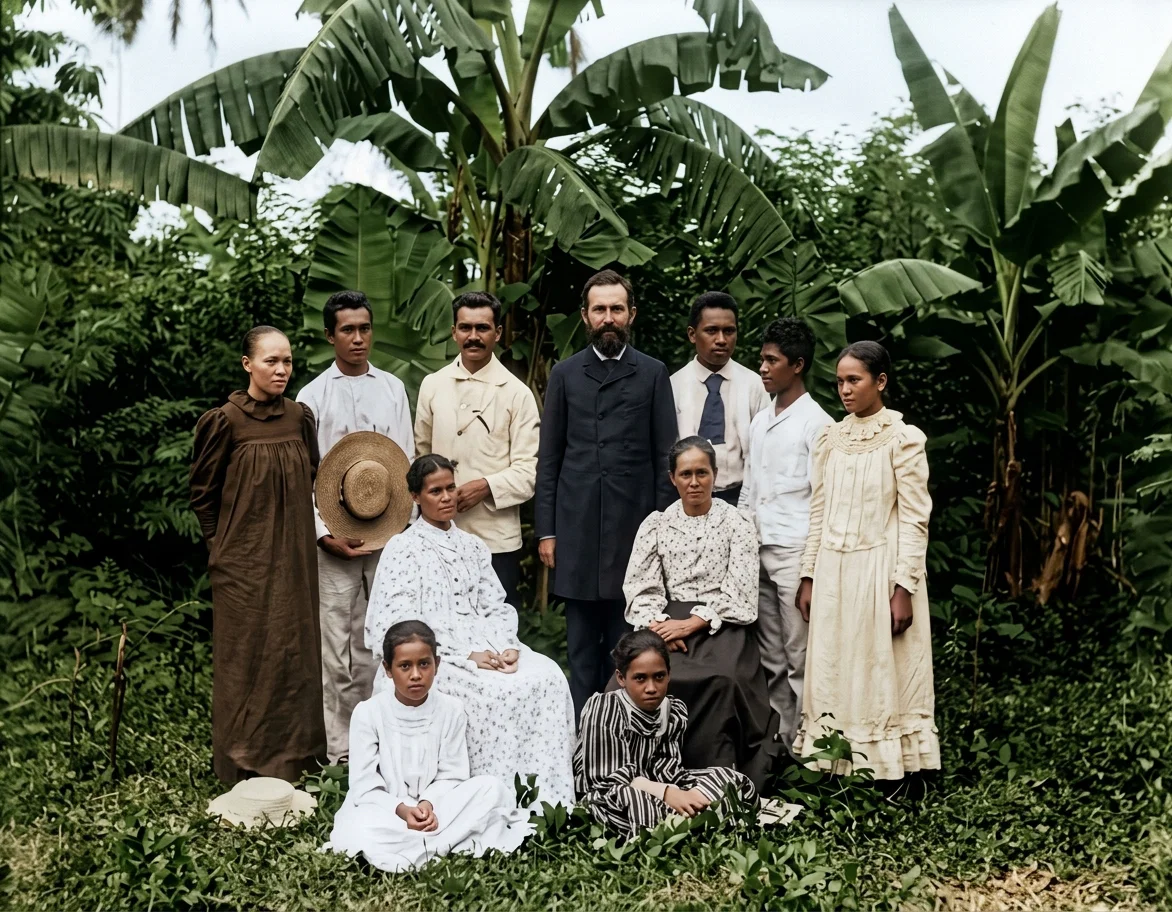
We have a very good system of education in our public schools here in the United States; and we have besides many church schools where our children may receive a practical education in the Scriptures. The people of this country usually appreciate the importance of giving their children an opportunity to acquire an education. But it is not so everywhere. In the islands, where a few years ago the people were heathen and had no written language, they are unable to appreciate the true value of knowledge. Most of the people can read and write the Tahitian language, and we occasionally meet one who has a very limited acquaintance with the English or French, but all are very much lacking in education.
Missionaries with Their Pupils.
The parents are glad to have the children taught if it does not cost them anything, and they take great pride in a child who is unusually clever and intelligent. But they are easily satisfied in this line. When the child has learned to converse a little in English or French, the parent often thinks that he must know as much as his teacher, and has learned all that is necessary.
The home influences are very detrimental to the proper development of the children. Since the parents themselves are ignorant, they can not be expected to know the needs of their children. They train them as they themselves were trained by their parents. The children are allowed to do as they please, provided they do not stir up the wrath of the parent. If he should become angry, they have to suffer, whether they have done wrong or not, unless they are able to run away and keep out of his reach. But they can tell falsehoods, steal, and break most of the commandments, and the parent will not object; for he is ready to do the same things himself if he thinks he can do them without being found out.
But we find that the children are susceptible to good influences, and that they are naturally bright and quick to learn. We have followed the plan of taking them into our family and teaching them, with quite satisfactory results. They readily pick up the English, since we usually converse in that language in our home. Besides learning English, some have become quite proficient in music, and two of our boys have learned the printer’s trade. Although the natives are considered to be naturally disinclined to exertion, the children can be trained so that they will enjoy work as well as their white brethren do. We have had, in all, nineteen young people in our home since we first went to the islands. All of them are doing well, and the majority of them are endeavoring to live Christian lives.
As we believe that much needs to be done for the children and youth, we are planning to start an industrial school, where we can take young people and surround them with Christian influences, and teach them such things as will fit them for usefulness in their island homes. We have already bought a lease of about 200 acres of land on the island of Raiatea, and consecrated it to the Lord to be used in His service as a school home for these youth. The place has about 3,000 coconut trees and 5,000 vanilla plants. We must furnish for the students employment which will keep both their minds and their hands busy, and at the same time help to pay the expenses of their schooling. The school is to be made self-supporting as far as possible, for there will be no other regular source of income.
The natives themselves do not sufficiently appreciate the value of a proper education to make much of a sacrifice to gain it. They expect everything in that line to be free, and prefer to use what little money they have in other ways. So we shall have to meet them where they are, and do what we can to lift them up.
The school-farm is somewhat isolated, as a school of such a nature should be. It is better for the students to be separated from the influence of their people as far as possible, and to be where they can not see and hear all the evil that is transpiring from day to day. They should have nothing to distract their minds from their studies and work.
An intellectual education alone would not be useful to them. They need to be taught how to work as well as how to study. So our aim is to give them a practical education that will make them well-balanced Christian men and women.
So far, our school enterprise has moved slowly. We have sacrificed all that we have in its interests, but still there remains much to be done. We have some small buildings, but more are needed. The buildings need not be as expensive as ours are in the United States. The climate being warm, much less lumber is required. But the lumber is more expensive there, as it must all be shipped from this country. If we had the sum of $1,000 to assist us in erecting buildings, it would give us a good start.
Not a part, but all of us, owe a duty to our fellow-men to work to uplift them from the depths of ignorance and sin, and to lead them to Christ. In striving to do this, we are walking in His footsteps. Surely, we are our brother’s keeper, no matter what his color may be, whether black, white, or brown.
B. J. CADY.
A PERSONAL EXPERIENCE.
By Loman A. Ferris
About 1895, while having charge of “Farmers’ Exchange Bank,” of Cleveland, N. Y., I received a tract entitled, “What We Owe, and How to Pay It,” or a treatise on tithing, with testimonials from some who had tried it. The idea of giving away one-tenth at that time seemed too great a test. In 1896 I went to Europe for my health, but did not recover; so on my return I gave up my position, and bought our present home. Later my attention was called to Mal. 3:10: “Bring ye all the tithes into the storehouse, that there may be meat in Mine house, and prove Me now herewith, saith the Lord of hosts, if I will not open you the windows of heaven, and pour you out a blessing, that there shall not be room enough to receive it.” Considering this text and the tract before mentioned, I resolved in the spring of 1898 that I would for a time deduct from any salary I might receive one-tenth for religious, charitable, or worthy purposes, calculating, from a worldly standpoint, that if the promise were fulfilled, I would eventually gain financially.
Making Copra; Scene on Industrial Farm at Avera, Raiatea.
During October of 1898 I took charge of a bank during the cashier’s absence, and from my wages deducted one-tenth. In a few weeks a man came for me to keep books, and as I had recovered my health, I began Jan. 1, 1899, and continued for more than a year, carefully deducting one-tenth of my salary; but owing to lack of business, this position gradually slipped away from me.
Another Forgotten Truth.
Not having steady work, I read some ancient history, tracts, the Bible, etc., and looked up references. I wished to determine for myself if the observance of the seventh day as the Sabbath is really correct, as is taught in the commandments of God, or if there is as good authority for keeping Sunday. I wanted to find as much as possible favoring Sunday, but to my discomfiture I found nothing that seemed reasonable to me, except what was overwhelmingly in favor of the seventh day, as plainly taught in the commandments, and indorsed by noted and eminent scholars.
What to do next was a query; for I did not like to break the fourth commandment every week, neither did I want to give up Sunday, having been taught to observe it strictly. To keep the seventh day seemed equivalent to giving up almost any position that might be offered me, besides the attendant inconvenience and loss, so I set about finding something in favor of Sunday that would ease my conscience. Being a subscriber to the New York Tribune, I sent in some questions on this subject.
About this time on Saturday I attended a quarterly meeting. Tho there were but few present, it was a very affecting meeting, and I came home despondent and gloomy. This meeting and the Sabbath question made quite an impression on my mind. I recalled the story of a prisoner whose life was to be saved or lost, according as two children might each select at random a verse from the Bible. So I opened my Bible at random, and the first verse I saw was Isa. 41:13, “For I the Lord thy God will13hold thy right hand, saying unto thee, Fear not; I will help thee.” Could I have found anything more pointed and direct?
Finally my questions with the answers appeared in the Weekly Tribune of May 24, 1900. My first questions were about church statistics, and I had already found answers; but the fourth was, “Is there any real Scriptural authority for observing the first day of the week as the Sabbath, instead of the seventh day?” Answer: “None whatever. Neither Christ nor His apostles nor the first Christians celebrated the first day of the week, instead of the seventh, as the Sabbath.” The next one was, “Is not the seventh day as the Sabbath really correct, as taught in the Bible?” Answer: “It would seem so.” Instead of favoring Sunday, all was in favor of Saturday.
Quarterly-meeting time drew near again, and still I worked Saturday, but did not feel right about it. I disliked to attend the meeting, neither did I want to stay away; for I had had a good lesson about absenting myself from meetings when it seemed plain I should be present. I had learned that it never pays to run from God’s messages; for how helpless are we in His hands. Quarterly-meeting time came; but as my wife said nothing about my going, as I had expected she would, and as I was reluctant anyway, I remained at home and worked. I was disappointed and miserable, and working on that day seemed worse than ever.
I looked in the Bible for the verse found before, and found Isa. 41:10: “Fear thou not; for I am with thee; be not dismayed; for I am thy God. I will strengthen thee; yea, I will help thee; yea, I will uphold thee with the right hand of My righteousness.” Here I had another message which seemed direct from heaven, and for me individually. I pondered over these things; and at night Scripture passages would hit thru my mind. Finally on Tuesday morning I awoke at about two o’clock, with this text ringing in my ears, “Choose you this day whom ye will serve.” I think I did not sleep any more, but arose early; and as I was going out to the barn, my wife called me, and said, “I want you to decide the all-important question to-day.” We had had no conversation about my thoughts and feelings; for I had tried to conceal from her that I was troubled, and she knew nothing about this passage being given me until days afterward. After breakfast I went into the parlor, and our little girl followed me, and clinging to me said, “Papa, do you want to go to heaven? If you do, papa, I want you to keep the Sabbath. Will you, papa? Will you, papa?” This was her own request, made with no prompting from any one. First a message from heaven, then one from my beloved wife, and lastly one from our dear little girl, all in one morning. Here I was, seemingly, having but just one day in which to decide the momentous question.
I tried to work; but my thoughts were busy, and wakefulness and mental anxiety were telling on me, so that before night my head seemed to reel while I worked. It was a day of bitter conflict; but I finally decided I would keep the next Saturday as the Sabbath; and when the decision was made, I felt better. I had a praying mother, and was taught to pray when small, and had made it a practise, and during my later years, had the example and influence of a Christian companion. While I knew that I was not a Christian, I found some satisfaction in prayer, and felt that it kept me from drifting too far from good influences.
On Friday night I prepared to keep the Sabbath as never before, and it seemed sacred, as Sunday usually had. I attended Sabbath-school and a Bible-reading. When I returned, I felt worse than before I went, and realized that there was something more than merely keeping the Sabbath, and that I needed divine help. I prayed for peace of mind and comfort, and opened the Bible again at random, and found Psalm 37, which seemed full of precious promises, and the words, “Rest in the Lord, and wait patiently for Him,” seemed especially for me. On Monday I was as despondent as ever, or even more so, and it seemed I had done all I could to get peace of mind. On Tuesday morning I awoke again at about two o’clock with such a feeling of relief as I never experienced before, and I knew at once that all this had not been in vain. I was indescribably happy. I had not felt just right toward a certain person; but all this old feeling was gone. The birds seemed to sing so sweetly, altho I had seldom noticed them before, and there was joy for me in all nature. This text came to me: “As far as the east is from the west, so far hath He removed our transgressions from us.” Ps. 103:12. To say I was satisfied and happy does not express it to any one who has never experienced such feelings. Could I have kept the wrong Sabbath, or any except the one God wanted me to keep? Most decidedly no. Tears of inexpressible joy flowed from my eyes, and I thought, Truly what a wonderful Book! What “wonderful words of life.”
It was Tuesday morning, July 3, at about 2 A.M., when I received the message, “Choose you this day whom ye will serve,” and the Lord took till the following Tuesday, at about the same time, to assure me of my salvation, or just seven days. The experience of this day, July 10, was a wonderful one for me. Tears were expressive of what I felt so intensely that words will ever fail of describing it. As expressed in Mal. 3:10, was not the Lord proving Himself, and pouring me out a blessing that there should not be room enough to receive it? Hymns of praise, that before I had never realized the significance of, went thru my mind that day, with a perfect understanding, and I whistled, and sang, and worked, as never before. That evening a Christian neighbor came to our home, and I was impressed I ought to tell her what a wonderful day I had experienced; but as I was not accustomed to speak of such things, I did not, consequently felt a twinge of conscience, and not quite so joyful as before. I told her the next morning, and received words of comfort and good cheer, besides the satisfaction of having done my duty, and learning my first lesson in being ready and willing to witness for my Master.
The great joy I experienced at the first has given place to a calm, quiet peace of mind and comfort, such as the world does not give. This two-fold evidence, or verified assurance, that I now enjoy, is more than I could have expected or hoped for. I can recognize divine guidance, step by step, all the way along, and can see the wisdom and loving-kindness manifested in my behalf, altho I was struggling constantly against it.
When I accepted the seventh day as the Sabbath according to God’s command, that seemed to be the key to the whole situation, and I found “the peace of God, which passeth all understanding.” Phil. 4:7. If this my experience could only be the means of helping some of my dear friends and relatives to a knowledge of our Saviour, how pleased I would be. Even tho we seemingly can do nothing, if we only have a willing mind, and let the Saviour work with us, if we are obedient, and do not harden our hearts or feelings, He will show us the way, which is peace and comfort, and joy eternal; and this is something to look forward to for all time, something far better than the shifting and fleeting joys of this life. God has indeed proved Himself to me, both spiritually and financially. LOMAN A. FERRIS.
NOT ALONE.
By M. D.
Say not, O trembling heart;
“I walk alone,
Stretch out my hands in vain;
Help there is none.”
Lone tho thy path appear
To mortal view,
Close beside walketh One
Tender and true.
Lo, thru His love to thee
Calvary’s choice;—
Changeless, eternal love,
Loved one, rejoice!
M. D.
A RARE OPPORTUNITY.
In consequence of a business transfer, we are prepared, temporarily, to furnish “Coffarine” to SIGNS OF THE TIMES readers at one-half of retail price, which has been 25 cts. per 1½ lb. package. We will fill orders received at once at $3.00 per case, each case containing 24 packages. “Coffarine” is so well known as a pure, delicious, healthful, and nutritious beverage that many will undoubtedly avail themselves of this liberal offer. Therefore order early. Special prices for larger quantities. Helping Hand Mission, 641 Commercial St., San Francisco, Cal.
NOTICE
We can furnish accommodations to a limited number of visitors to the Pan-American Exposition. The price for lodging will be 25 and 50 cents; breakfast 15 cents. We will also furnish lodging in private families at the regular rate—$1 for lodging, 25 cents for breakfast. Write us as early as possible, stating about when you expect to come, and for how many accommodations are desired. The Mission is located but a short distance from the depots. Address Star of Hope Mission, 67 Washington St., Buffalo, N. Y.
Living by Faith
Living by Faith. (Spanish.) A translation of Bible Students' Library No. 75; 16 pp.; price, 2 cents. Address, PACIFIC PRESS PUBLISHING CO., Oakland, Cal.
OUR WORK AND WORKERS.
From the Missionary we learn that five persons have accepted the faith in Glennville, Cal.
Three recent additions to the church in Portland, Oregon, by baptism, are reported by Brother D. T. Fero, in the Visitor.
Three candidates were baptized in San Diego, Cal., by Brother George A. Snyder, just before his departure for General Conference.
In Los Angeles, Cal., five members were recently added to the church by baptism. The rite was administered by Brother R. S. Owen.
An encouraging increase in the financial receipts of Montana Conference was reported at the recent session. There was an increase in all the funds.
A teacher’s institute will be held in Graysville, Tenn., during the month of June. It is expected that this institute will organize, and give a new impetus to the church-school work in the South.
During the past two years sixty-three ordained ministers and sixty-seven licentiates have been added to the ministerial force of the denomination. Two hundred and thirty-eight new churches have been organized.
Nine sanitariums have been established by the denomination in the past two years,—one in Germany, two in Australia, one in New Zealand, and five in the United States. There are now twenty-four such institutions under the auspices of Seventh-day Adventists.
The Montana Conference has voted to conduct bath and treatment rooms in Butte, and to carry on medical missionary work in Christian-help lines from house to house among the poor and sick. This work is to take the place of the lodging-house mission, which has been operated for some time.
Here is a word of encouragement for the young who are looking about for enjoyment: “Young men, young women, there is a work for you to do. Just as surely as you do this work will you see the salvation of God. Close the windows of the soul earthward, and open them heavenward, and you will receive the rich blessings of heaven, and will at last gain a crown of immortality.”
A report of the Portland, Ore., Medical Mission, in a recent number of the Visitor, says: “Some seventy or eighty men and five to ten women lodge with us nightly. From five to ten are daily treated in the bath-room for various ailments, such as rheumatism, morphine habit, alcoholism, a sprained joint, or a broken bone. From five hundred to six hundred dishes of pure food are served each day. This in addition to the general Gospel work.”
April 6, the first Sabbath of the General Conference at Battle Creek, Mich., services were held simultaneously in four different places,—the tabernacle, the college chapel, Review office chapel, and the Sanitarium chapel. The speakers were Mrs. E. G. White, W. W. Prescott, E. J. Waggoner, and J. O. Corliss respectively. The topics were Tithe-paying, the Sanctuary and its Service, the Temple of God, and Christian Growth. The four audiences aggregated about 5,000 people.
In the Atlantic News is a letter from Brother W. J. Tanner, missionary in Jamaica, which shows some of the difficulties under which it is sometimes necessary to labor: “Our church work is being hindered just at present on account of lack of rain. The water supply of this part of the island is derived from the clouds. Large tanks or cisterns are made, and rain-water caught in these and used for all purposes for which water is used. We have not had any rain for three months, and consequently water is too scarce to use for mixing mortar. However, we have the sills, uprights, rafters, and some lumber, besides much stone and lime on the ground. When a rain comes, we can go on, if we are not hindered by a dearth of means. We had another baptism yesterday (March 23). We had to go nine miles down the mountain to find a place for the ordinance. One of the candidates walked thirty-two miles in order to be baptized. Surely the argument of ‘inconvenience’ did not have much weight with him. This man used to be one of the worst drunkards in the district before the tent came.”
PERIODICALS WANTED.
For a new field, papers and tracts, English or German. Address, postpaid, O. Glass, Shive, Texas.
PRAYER
By A. T. Pierson, will bring new life and light into your church, missionary society and home. Price, $1.00 per 100
PACIFIC PRESS PUBLISHING CO.
New York City Oakland, Cal. Kansas City, Mo.
LESSON 7.—MAY 18.—TABLE OF SHOWBREAD AND GOLDEN CANDLESTICK.
[Note to the Student.—These lessons are not designed to be exhaustive, but suggestive. In references to the “Desire of Ages,” in the lessons, the subscription edition is referred to. Those who have only the trade edition will find the matter in chapters 1, 4, 11, 27, 71, 77, 78; also read “Patriarchs and Prophets,” chapters 5 and 30. “Christ Our Advocate,” Bible Students’ Library No. 120 (price, 10 cents), and “Looking unto Jesus” (price, $1.00) will be found a great help. The SIGNS OF THE TIMES will have an article on the subject of each lesson this quarter by J. O. Corliss. Read these articles in connection with the study of the lesson. We have not space to print all the scriptures. Let the student study them carefully from the Bible. Those printed are from the Revised Version.]
SUGGESTIVE QUESTIONS.
1. Into how many apartments was the sanctuary divided? What was the size of each?
“Now even the first covenant had ordinances of divine service, and its sanctuary, a sanctuary of this world. For there was a tabernacle prepared, the first, wherein were the candlestick, and the table, and the showbread; which is called the Holy place. And after the second veil, the tabernacle which is called the Holy of holies.” Heb. 9:1-3. (Ex. 26:31-33. Note .)
2. What articles were placed in each apartment?
“And he took and put the testimony into the ark, and set the staves on the ark, and put the mercy-seat above upon the ark, and he brought the ark into the tabernacle, and set up the veil of the covering, and covered the ark of the testimony; as the Lord commanded Moses. And he put the table in the tent of meeting, upon the side of the tabernacle northward, without the veil. And he set the bread in order upon it before the Lord; as the Lord commanded Moses. And he put the candlestick in the tent of meeting, over against the table, on the side of the tabernacle southward. And he lighted the lamps before the Lord; as the Lord commanded Moses. And he put the golden altar in the tent of meeting before the veil; and he burnt thereon incense of sweet spices; as the Lord commanded Moses.” Ex. 40:20-27 (Ex. 30:1-6; 37:24, 35.)
3. Where was the table of showbread located?
“And he put the table in the tent of meeting, upon the side of the tabernacle northward, without the veil.” Ex. 40:22.
4. For what purpose was it used?
“And he set the bread in order upon it before the Lord; as the Lord commanded Moses.” Ex. 40:23. (Ex. 25:30.)
5. Of what was the showbread made? How many loaves were made each week?
“And thou shalt take fine flour, and bake twelve cakes thereof; two tenth parts of an ephah shall be in one cake.” Lev. 24:5.
6. How were they arranged on the table?
“And thou shalt set them in two rows, six on a row, upon the pure table before the Lord.” Verse 6.
7. What was done with the showbread?
“And it shall be for Aaron and his sons; and they shall eat it in a holy place; for it is most holy unto him of the offerings of the Lord made by fire by a perpetual statute.” Verse 9.
8. How often was it placed before the Lord?
“Every Sabbath day he shall set it in order before the Lord continually; it is on the behalf of the children of Israel, an everlasting covenant.” Verse 8. (Note .)
9. Where was the golden candlestick placed?
“And he put the candlestick in the tent of meeting, over against the table, on the side of the tabernacle southward.” Ex. 40:24.
10. Of what was it made?
“And thou shalt make a candlestick of pure gold; of beaten work shall the candlestick be made, even its base, and its shaft; its cups, its knops, and its flowers, shall be of one piece with it.”
“Their knops and their branches shall be of one piece with it; the whole of it one beaten work of pure gold.” Ex. 25:31, 36. (Num. 8:4. Note .)
11. What instruments were used in connection with the candlestick?
“And the tongs thereof, and the snuff-dishes thereof, shall be of pure gold.” Ex. 25:38.
12. What care was to be taken of the lamps? Were they ever to be extinguished?
“And thou shalt command the children of Israel, that they bring unto thee pure olive oil beaten for the light, to cause a lamp to burn continually. In the tent of meeting, without the veil which is before the testimony, Aaron and his sons shall order it from evening to morning before the Lord; it shall be a statute for ever throughout their generations on the behalf of the children of Israel.” Ex. 27:20, 21. (Ex. 30:7, 8; Lev. 24:1-4. Note .)
13. What is said of Christ’s work?
“A bruised reed shall He not break, And smoking flax shall He not quench, Till He send forth judgment unto victory.” Matt. 12:20. (Ps. 18:28.)
16 “But the eleven disciples went into Galilee, unto the mountain where Jesus had appointed them. And when they saw Him, they worshiped Him; but some doubted. And Jesus came to them and spake unto them, saying, All authority hath been given unto Me in heaven and on earth. Go ye therefore, and make disciples of all the nations, baptizing them into the name of the Father and of the Son and of the Holy Ghost; teaching them to observe all things whatsoever I commanded you; and lo, I am with you alway, even unto the end of the world.”
Golden Text: “Lo, I am with you alway, even unto the end of the world.” Verse 20.
SUGGESTIVE QUESTIONS.
(1) Where did the eleven disciples go? Verse 16. (2) When had Jesus so appointed? Note 1. (3) How did the disciples manifest their feelings toward the Lord? Verse 17. (4) What did Jesus say to them of His authority? Verse 18. Notes 2 to 5. (5) In the strength of this authority and power, what were the disciples to do? Verses 19, 20, first part. Notes 6 to 8. (6) What gracious promise did He give them? Verse 20, last part. Note 9.
NOTES.
1. The appointment of Jesus to meet His disciples in Galilee had been made twice. (1) While in the Passover room on the night of His betrayal. Matt. 26: 32. (2) On the morning of the resurrection He sent the women from the sepulcher to repeat the appointment. Ch. 28: 7; Mark 16: 7.
2. “All Authority.”—The Common Version says “all power.” Dr. Abbott remarks: “The English language contains no adequate equivalent for the word rendered ‘power’ in the A.V., and ‘authority’ in the R.V. It embraces the ideas of both.” And he might have added, it embraces all of both.
3. “In Heaven.”—Jesus occupies the throne in heaven conjointly with His Father. Mark says, “So then after the Lord had spoken unto them, He was received up into heaven, and sat on the right hand of God.” And when Jesus afterward revealed Himself in vision to the apostle John, He said, “To him that overcometh will I grant to sit with Me in My throne, even as I also overcame, and am set down with My Father in His throne.” Rev. 3: 21. “The Father judgeth no man, but hath committed all judgment unto the Son; that all men should honor the Son, even as they honor the Father. He that honoreth not the Son honoreth not the Father.” John 5: 22, 23.
4. “In Earth.”—The power and authority in heaven is extended to earth. “When the Comforter is come, whom I will send unto you from the Father, even the Spirit of truth, which proceedeth from the Father, He shall testify of Me.” John 15: 26. “When He, the Spirit of truth, is come, He will guide you into all truth; for He shall not speak of Himself; but whatsoever He shall hear, that shall He speak; and He will show you things to come. . . . All things that the Father hath are Mine; therefore said I, that He shall take of Mine, and shall show it unto you.”
5. Christ is “King of kings, and Lord of lords” (1 Tim. 6: 15), so there is no limit to His jurisdiction. It is no more for Him to say, Go into all the world (Mark 16: 15), than it was to send them throughout the province of Judea. In this matter of jurisdiction lay the expediency of His going away (John 16: 7), in order that the Comforter might come. While He was here in person, the disciples would deem His visible presence an essential in the Gospel work. But by His Spirit He can be omnipresent, and the work is a work of faith in His presence and help rather than of sight.
6. “Teach All Nations.” (A.V.)—God “hath made of one blood all nations of men for to dwell on all the face of the earth.” Acts 17: 26. Therefore all nations are subject to death, which is “the wages of sin,” and are also proper subjects of Gospel labor; for God is not a respecter of persons. The everlasting Gospel is to be preached “unto them that dwell on the earth,” and to make it emphatic, it is added, “to every nation, and kindred, and tongue, and people.” Rev. 14: 6. And this is what the first disciples did. Within one generation they had preached the Gospel to every nation in the then known world. (See also editorial article entitled “Go,” on page 7 of this paper.)
7. Baptism.—The disciple is baptized in (or into) the name. It is a putting on of Christ. It is a public profession of Christ, of faith in Him and allegiance to Him. It signifies a death to sin and a resurrection to a new life in Christ. It signifies a stepping out from the world and a union with Christ and His people. We can not safely neglect a duty so plainly enjoined. Christ not only commands it, but He deemed it essential in Himself as our example, and as one bearing the sins of the world. “Thus it becometh us to fulfil all righteousness.” Matt. 3: 15.
8. “Teaching Them to Observe.”—Note that the teaching is not merely that men may know, but also that they may do, the things the Gospel enjoins. The knowledge of the Gospel without the obedience only adds to one’s condemnation. The preaching of the Gospel has a twofold purpose, namely, to save those who will obey its invitation, and to be a witness in the Judgment against those who will not obey. “If ye know these things, happy are ye if ye do them.” John 13: 17. “If ye keep My commandments, ye shall abide in My love; even as I have kept My Father’s commandments, and abide in His love.” Ch. 15: 10.
9. Christ’s presence is continuous with His people. This was typified by the showbread in the sanctuary. It is always, “I am with you.” When Moses was returning from Midian to Egypt, he said to the Lord, “When I come unto the children of Israel, and shall say unto them, The God of your fathers hath sent me unto you; and they shall say to me, What is His name? what shall I say unto them?” And the Lord answered, “Thus shalt thou say unto the children of Israel, I AM hath sent me unto you.” Christ is as verily present by His Spirit with those who do His will to-day, as He was with the children of Israel in the wilderness—in the pillar of cloud.
CHEAP BUT GOOD.
By Editor
We are selling 125 copies of Our Little Friend of as many different issues, no two alike, for 25 cents. These contain a thousand pages of choice reading for little folks and hundreds of nice illustrations. It is a source of much pleasure and profit to any child old enough to appreciate a good story or be interested in a picture. Has the reader a little friend to whom he would like one of these packages sent? Twenty-five cents is all it costs. Address Our Little Friend, Oakland, Cal.
HOMES IN OLD VIRGINIA.
It is gradually brought to light that the Civil War has made great changes, freed the slaves, and in consequence has made the large land-owners poor, and finally freed the land from the original holders who would not sell until they were compelled to do so. There are some of the finest lands in the market at very low prices, lands that produce all kinds of crops, grasses, fruits, and berries, fine for stock. You find green truck patches, such as cabbage, turnips, lettuce, kale, spinach, etc., growing all the winter. The climate is the best all the year around to be found, not too cold nor too warm. Good water. Healthy. Railroads running in every direction. If you desire to know all about Virginia, send 10 cents for three months subscription of the Virginia Farmer to Farmer Co., Emporia, Va.