IN a little out-of-the-way place called Black Swamp, in South Australia, there are fourteen young persons who formed themselves into a Young People's Society about a year and a half ago. Since that time they have been much interested in doing all they can to sell and distribute our papers and tracts. Nearly all the families within a radius of one or two miles are Sabbath-keepers, so there is not a missionary field as near at hand as would be convenient.
Four members of the Society are children. They are as much in earnest as the older ones in trying to do their part. One little boy about eleven years old started out one day, taking his dinner with him, to try to sell the Australian Signs. The first house he came to was three miles from his home; he went to two or three other houses about three miles farther, but sold only one copy, and gave away some copies of the Little Friend. But no one can tell how much good that one copy may do. Another little fellow about nine years old sold a paper to a neighbor. The lady asked him what he did with the money. He replied, “Buy more papers.” She said, “I thought you would buy lollies [candy]. I would if I were you.” But he was not to be deterred from his missionary purpose by such a suggestion.
A nine-year-old girl goes with any of her family who have occasion to go to the railway station, and gives papers to the passengers on the train. One of the members is working in the home of a family sixteen miles away. She takes a club of Signs, and when she has an opportunity, sells her papers.
God will certainly water the seed sown by these faithful youth, and in his own good time will bring forth fruit to his honor and glory.
L. Flora Plummer.
Walking in the Steps of Jesus
We need not go to Nazareth, to Capernaum, or to Bethany in order to walk in the steps of Jesus. We shall find his footsteps beside the sick bed, in the hovels of poverty, in the crowded alleys of the great city, and in every place where there are human hearts in need of consolation. In doing as Jesus did when on earth, we shall walk in his steps.—Selected.
The Athlete on Duty
By Will Tenbrook
“GET on your mark! Get set! Go!” Such is the command familiar to the ears of the sprinter. He knows that to win his race he must obey that command quickly and completely. Alacrity is the athlete’s watchword. It is because of his interest and zeal that his body grows stronger with the games.
We have been upon the athletic grounds, and let us say that we have picked our favorite athlete. Very well, the games are over, and we find our young athlete at home. But his training for the day is not yet at an end! There comes to his ears another familiar summons to the mark. To his trained ears this summons has a certain, well-defined meaning; namely, “There’s another chance to give my body some exercise.” Listen! What is that summons? Some of you may laugh when you see it in print:—
“John, some wood, please.”
Oh, the dear voice of the starter! How different that request from the deep, gruff command of the referee on the athletic grounds. What an opportunity is offered! It’s on your mark again, John. But there is no need to tell him that. John is an athlete. He is there at the word every time.
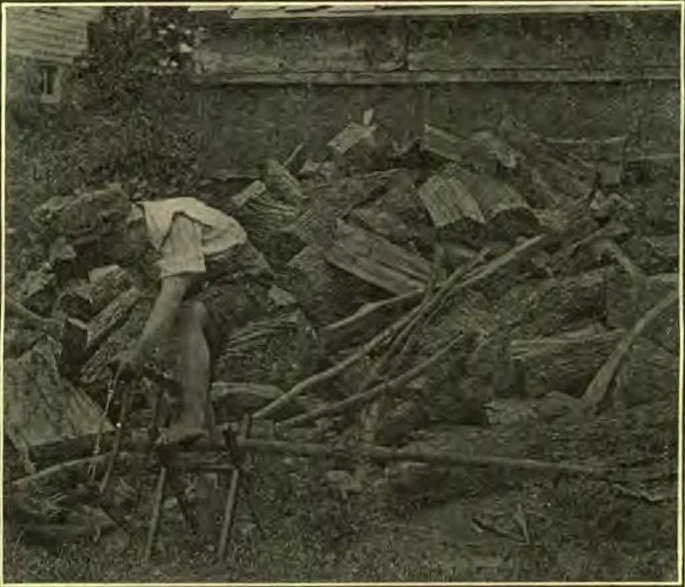
See him now at the wood pile! He does not consider that filling the wood box is a task dreadful to think about, and horrible to accomplish. Not he! Why, here is just another exercise for his back, and one of the best known. Every time John raises the ax, the muscles in the small of his back are brought into action. Although John can not fully explain the inside workings of those muscles, he knows by the feeling back there, nevertheless, that something is taking place to awaken them and make them grow. When he raises the ax, he feels those muscles tighten, and pull, and when the ax falls, he knows they relax, as the physiologist would say. By and by a pain, more or less sharp, creeps across the small of John’s back. He straightens up, and looks about him, and lo! he beholds a pile of wood large enough to keep a fire blazing in his mother’s cook-stove for a day or more.
“Oh, my back!”
From what source came this wail? Surely not from the lips of John.
On the other side of the fence lives William, John’s neighbor. William’s people also have a wood pile.
The dusk of evening is now settling down over land and wood piles. John’s work is finished.
From the vicinity of the neighboring wood pile he has heard the wail of William. Hastily climbing to the top of the fence, he views the disconsolate one. He is curious to find out how large a pile of wood his young neighbor is able to split before he, too, begins to feel that ache in his back. But wonder of wonders! he discovers William sitting upon a chunk of wood, his ax by his side, and not a stick split!
“Hello, William! Does your back ache much?” asks John, sympathetically.
“No!” answered William with a snort.
“What’s the matter, then?”
“It ached last night.”
“Oh, that’s nothing!” laughed John. “You keep right on splitting wood and you’ll find out that you can split a lot more wood next week than you can this, without your back getting an ache in it.”
Thereupon John jumped to the ground and helped his neighbor work up as big a pile of wood as his own.
If the truth were told, you would know that William is one who dreads home tasks. On the school ground he is fairly good at play, but he is far from being a good athlete. He takes no enjoyment in the performance of useful bodily feats, such as splitting wood, or running upon errands. John, on the other hand, takes huge delight in mixing up in such affairs, for through them he finds a means of building up his body. Nor should we call John selfish; in the doing of these things he is only too glad to please others. Whether he knows it or not, John is a living definition of the word athlete.
The word athlete has been defined as one who overcomes. We have a right to extend this meaning to cover many things. Thus, we may say that an athlete is one who overcomes bodily weakness; an athlete is one who overcomes bad habits and disease; an athlete is one who overcomes a distaste for a cool sponge bath; an athlete is one who overcomes laziness; an athlete is one who overcomes a wood pile. John is an athlete!
Splitting wood is the king of sports—when you look at it from the right point of view; namely, the athlete’s. After splitting the wood suppose you try this exercise: Bend down and fill your arms with the wood which you have split; now stand erect, take a full breath, and while walking toward the wood box, maintain a good posture, holding the head and body erect, the chest well raised, and the shoulders back. Breathe strongly, filling the lungs completely at each inhalation. Advance boldly toward the wood box, and quietly deposit the wood therein. This simple exercise will tend powerfully to urge the blood into the lungs, and the blood, thereby being charged with oxygen, will flow throughout the body, quickly removing all waste products therefrom.
By the way, John, just tell them how the muscles of your arms and back fairly cry out with joy, when, on a frosty morning, you make the old pump screech in its eagerness to give up its sparkling treasure.
Some day John is going to have a workshop of his own. Already he is in possession of a small tool-chest. He has made a bench for the summer kitchen, a house for his St. Bernard, and a pair of bobs. He will tell you that his6biceps have grown an inch since he began using a buck-saw. He has discovered that the mallet and chisel are superb developers of the muscles of the wrist and forearm.
A wonderful effect is produced upon the body by shaking a few rugs every day. Such simple exercises as beating a carpet, or raking leaves, are especially recommended. Just for variety, try pushing a lawn-mower. The body requires an all-round development, you know. Really it would be hard to find a better employment for developing a boy’s calves and thighs than lawn mowing. Do not strive to cover the whole lawn in one swathe, however. Be modest in your endeavors, and do not breathe through your mouth.
Though it is rather late in the year to talk about gardening, it is not too late to become convinced of the value of the hoe and spade as promoters of good shoulder and back muscles.
As to the matter of running errands, the aforesaid John and William have conflicting opinions. William is improving somewhat of late, but it has been his custom, when sent anywhere, to “laze” along with his head and shoulders drooping, as he kicks the pebbles, the while, from his pathway. John, on the other hand, is training his ankles for the high jump, and considers a trip to the corner grocery store as the best time to walk on tiptoe for part of the way, at least. In this way he is also developing a sturdy pair of legs.—Will Tenbrook, in the Friend for Boys and Girls.
“Not Passed!”
By M. Katherine C. Cushing
“THEY say I didn’t pass at school,
I’m sure I don’t see why;
I answered every question right,
And then — did not half try.
“I put ‘phalanges’ in the head,
The ‘stomach’ in the chest,
The spine I knew ran up my back,
Oh! ’twas an easy test!
“A hundred ‘ribs’ I said we had,
Piled up along the side,
The ‘tendons’ were the little strings
To which our ‘lungs’ were tied.
“The ‘muscles’ stay in legs and arms,
And make us strong to fight,
I couldn’t find my ‘cerebrum,’
So put it ‘out of sight.’
“The ‘di-a-gram’ and ‘soph-a-gus’
‘Were dago-things,’ I said;
‘And seldom found in any one,
Exceptin’ when they’re dead.
“For in the posty-mortem times,
The doctors cut and tear,
And find a lot of spooky things
They didn’t know were there.
“And so you scarcely would expect
For me to know it all
When doctors have to guess so much
At things both great and small.
“My ‘brain’ I put inside my head,
My ‘liver’ in my back;
But when it came to ‘ver-te-bræ,’
Ah, me! alas, alack!
“I’d clean forgot I had the things,
But I fixed ’em in the shin,
For that was just a tip-top place —
For got-ups to be in.
“And yet, with all these answers straight,
‘Not passed,’ they do declare.
It’s dreadful! and shows very plain
The teacher wasn’t fair.”
— M. Katherine C. Cushing.
Whistling for Jesus
By The Boys’ Friend
Boys, how many of you would like to know what you can do for Jesus? Let me tell you of one thing you can do for him.
One dark night I lay on my bed. I felt lonely and sad. Everything was dark inside as well as outside.
All at once a sound was borne in through the open window. Nearer and nearer it came, and at last I discovered it was a song of Jesus. As that boyish voice rang out in a clear, joyous whistle, my heart grew lighter. A sweet peace filled my soul, and I felt refreshed and strengthened. As the tones died away in the distance, I fell to thinking.
All boys whistle. They love to. They feel happier for it. Instead, then, of wasting time whistling the light, trifling music of the day, which does not elevate the performer or those who hear, why not whistle for Jesus?
You can not tell the good you might do. That boy never knew the message of hope and cheer he brought to me that night, but it helped me just the same. It was not forgotten in heaven either. Try it, boys. THE BOYS’ FRIEND.
Two Ears and One Mouth
“Two ears and only one mouth have you;
The reason, I think, is clear;
It teaches, my child, that it will not do
To talk about all you hear.”
HENRY W. ROSE
By Henry W. Rose
Chats on Letter-Writing — No. 6
A LETTER to be pleasing should not give evidence of carelessness, untidiness, nor lack of system and order. We need therefore to give attention to the appearance of what we write, as well as the substance of the letter. Even though well composed, correctly spelled, and filled with interesting and entertaining matter, a letter can yet be marred by inattention to details. For example, the look of a page is spoiled if between every few lines there has been written some omitted word or phrase which with care would have been inserted originally. Some persons seem unable to write three consecutive lines without leaving out some necessary word. These omissions, afterward supplied, detract greatly from the neat and artistic appearance of the page.
Again, it is important that attention be given to the correct division of words according to syllables. Frequently writers do not allow space enough at the end of a line to write the entire word, yet do not divide the letters as the syllables demand. Hence, words are incomplete, and only one or two letters, not in themselves a syllable, are carried forward to the next line; this arrangement shows a lack of foresight and care. Unless really necessary, it is much better not to divide any word. Judicious spacing will usually make this unnecessary; but when actually called for, it is well to divide a word only into its proper syllables.
The practise of beginning “Dear Friend,” or whatever the salutation may be, in the middle of the page, or even at the right-hand side, is not commendable, nor does it add to the artistic look of a page. The better plan is to place the salutation at the left-hand side, and then begin the substance part of the letter on the next line about where the salutation ends. Some prefer to start immediately after the salutation on the same line; but whatever reasons may be offered for this practise, certainly they do not include the “artistic” plea.
Many persons adopt the plan of writing on but one side of the paper. This is unnecessary waste, and needlessly increases the bulk of a letter. When writing for publication, or for reading to an audience, it is proper to use only one side of the paper; but as a general rule, it would appear that there is virtually nothing to be gained by leaving one side blank, and using double the paper needed. Economy, however, is not the factor here considered.
The order of the pages is a point not unworthy of consideration. The most sensible plan is to write the pages in the order in which they are printed in a book. This mode of giving the pages in natural and systematic sequence means much to the reader, both as regards time and patience. Finally, when written, the letter should be folded about twice, and placed in an envelope of such size as to admit of its being readily taken out, and replaced.
HENRY W. ROSE
“Making Heart Mellow Was His Business”
“He carried a hod for a living, but making hearts mellow was his business,” was said of a colored man in a Southern city, who used to ride on the front step of a street-car and sing the quaint negro melodies and hallelujah songs with such cheerfulness and pathetic sweetness that it touched the hearts of all the passengers. He was called “a black diamond in the rough;” but he did not need any polishing. His great lumbering body welled over with happiness. As he sang, he touched a responsive chord in the hearts of his hearers, and the brotherly feeling seemed to float out in the air.—Selected.
If a Man’s Religion Is of the Right Sort
By Success
It will sharpen his faculties. It will quicken his energies. It will heighten his self-respect. It will give solidity to his character. It will enhance both his usefulness and his prospects of success.—Success.
A New Kind of Lamp
IN Alaska is found a kind of fish that makes a capital candle when it is dried. The tail of the fish is stuck into the crack of a wooden table to hold it upright, and its nose is lighted. It gives a good, steady light of three candle-power, and considerable heat, and will burn for about three hours.—Selected.
“Don’t You Wish You Could?”
It is said that a lady looking at one of Turner’s pictures delineating some scene of nature, said to the artist, “Mr. Turner, I can not see in nature what you put in your pictures.” The artist’s quiet answer was, “Don’t you wish you could, madam?” Men of the world observe the raptures of Christian faith, and say with a sneer, “We can not see any such joys as these, in religion.” It takes the artist’s eye to see the glory of nature; it takes the opened eye of Christian faith to see the glories of God’s spiritual kingdom.—Selected.
Cost of a Vacation
EMPLOYEES of great corporations, like other persons, naturally want a vacation, and most of them get it. To the individual, his little two weeks’ rest, “with pay,” seems a small affair for the corporation or firm to debate about. He does not always consider what the aggregate of all the vacations costs. This year for the first time the rural free delivery carriers throughout the country are to have a vacation of fifteen days. They deserve it, and every one will rejoice with them; but the cost to the government is eight hundred thousand dollars.—Selected.
None of Those Things for Me
OTHERS may drink of the poison glass,
Cider or wine or gin,
At first a little, then more and more
(For they do if they once begin);
But they will have headaches and shaking hands,
And poor they will some day be;
So they may drink, if they think it best,
But never a drop for me.
Others may think that to smoke a pipe
Or a cigarette is fine,
But I know fellows that smoke are small,
And fail on many a line.
I know I should have a “tobacco heart,”
And my brain befogged would be;
So others may smoke if they think it best,
But no tobacco for me.
Others may take God’s name in vain,
And think it a manly thing,
But I have noticed the manliest men
Are reverent toward their King;
And swearing and smoking and drinking go
Together, I plainly see;
So others may swear, if they think it best,
But never the oath for me.
—Exchange.
Students and Tobacco Using
WHEN Syracuse University (New York) opened for the fall term of study, Chancellor J. R. Day surprised the students by issuing an edict concerning tobacco using and theatergoing. He said all those students with a fondness for these things must pay full tuition, arguing that young men who can afford to pay for such needless luxuries and indulgences can afford to pay their tuition. He stated that no concessions would be granted them from the faculty. “Such students need not expect to be given scholarships,” said Dr. Day. “A young man who smokes is a fool, at least in that particular. He ought to take better care of his nerves, and present a cleaner exhibit of himself.”
Such a stand as this is to be commended. Young men in school have no business to be smoking and carousing around. What do they go to college for? Is it not to learn how to live a clean, honorable, useful Christian life? The things put under ban by Dr. Day are universally conceded not to be conducive to the highest type of mental and moral development. It would be a blessed thing if the use of tobacco was positively forbidden in every school in the land. We need among the great educators of the day some men of conviction and courage who will lead the educational institutions up to such a position. Of course, such a stand would necessitate the reform or removal of many tobacco-using professors. But if they would not reform for their own sake and the sake of young men in the formative period of life, they show they are not true lovers of youth, and hence unfit for instructors. Then they ought to be removed. How disgusting it is to see an educator, a trainer of young people, puffing away at a stinking pipe or cigar, or making things filthy around him with his tobacco-spittle!
Through expert and reliable testimony we know that the use of tobacco is specially injurious to young people. If the study of geometry was known to be detrimental to young people physically, mentally, and morally, it would be forever banished from the curriculum. Why not prohibit the use of tobacco in like manner for the sake of our boys? Following the prohibition of its use among students, let the professors and educators of the nation abandon its use, purge themselves from its filth, and stand before their classes true instructors—teaching by word and example.—The Friend for Boys and Girls.
ISABELLE OLDS
MERCED, CAL., Sept. 23, 1906.
DEAR INSTRUCTOR: I thought I would write you a letter because I like your stories very much. I am ten years old. I am taking the fourth-grade work in a public school. There is no Sabbath-school here, so I study my lessons from the YOUTH’S INSTRUCTOR at home. I find the lessons very instructive. There are six in our family, four brothers and one sister. My youngest brother takes the Little Friend, and enjoys it very much. I enjoy reading the letters, and I am very fond of reading the Bible.
ISABELLE OLDS
VANCOUVER, WASH., Sept. 3, 1906.
DEAR EDITOR: We have taken the YOUTH’S INSTRUCTOR as long as I can remember, and we all enjoy reading it so much. When we get through reading the paper, we pass it on to the neighbors. We live three miles north of Vancouver. I have two sisters and one brother. Praise the Lord, we are all in the truth. Brother is canvassing for “Heralds of the Morning,” and the Lord is greatly blessing him. One day he took twenty orders. If the Lord wills he and I are both going to the Meadow Glade Industrial Academy near Battle Grounds, Washington. Brother Geo. E. Johnson will be our teacher; about forty scholars are expected this winter. This is my first letter to the INSTRUCTOR, so please excuse mistakes. ESTHER WHEELER.
IX — Coming of the Lord
(December 1)
MEMORY VERSE: “And if I go and prepare a place for you, I will come again, and receive you unto myself; that where I am, there ye may be also.” John 14:3.
REVIEW.—After the first heaven and earth pass away, John saw —. He saw — coming down out of —. In that new earth there will be no more —. Around the New Jerusalem is —. It is made of —, and has twelve —. The city is, — on each side. The — flows through the main —, and on its banks grows —, bearing — kinds of fruit. The city will be lighted by —. The animals will be —. The leopard shall lie down —, the calf — together. The lion shall eat —. None will hurt nor —. The — blind —. The lame will —. The dumb will —. From one Sabbath to another —, — they shall inherit the earth. Blessed are they that do —.
Questions
1. Why should our hearts not be troubled? John 14:1, 2. What did Jesus say he would prepare? What cheering promise does he give? Why will he come for his children?
2. How did Jesus go to heaven? Acts 1:9-11. What hid him from sight?
3. While the disciples were looking upward, who stood by them? What question did they ask? What promise did the angels make? In what way did they say Jesus would return?
4. Unto whom will Jesus appear the second time? Heb. 9:28.
5. With what will he come? Rev. 1:7. How many will see him? What special ones are mentioned? Will they be glad to see him? What will the kindreds of the earth do? Why?
6. What will the righteous say as they see Jesus coming? Isa. 25:9. How will they feel?
7. How does Matthew describe the coming of the Lord? Matt. 24:27.
Jesus said, “Let not your heart be troubled: ye believe in God, believe also in me. In my Father’s house are many mansions: if it were not so, I would have told you. I go to prepare a place for you. And if I go and prepare a place for you, I will come again, and receive you unto myself; that where I am, there ye may be also.”
And while the disciples beheld, “He was taken up; and a cloud received him out of their sight. And while they looked steadfastly toward heaven as he went up, behold, two men stood by them in white apparel; which also said, Ye men of Galilee, why stand ye gazing up into heaven? this same Jesus, which is taken up from you into heaven, shall so come in like manner as ye have seen him go into heaven.”
“So Christ was once offered to bear the sins of many; and unto them that look for him shall he appear the second time without sin unto salvation.”
“Behold, he cometh with clouds; and every eye shall see him, and they also which pierced him: and all kindreds of the earth shall wail because of him.”
“And it shall be said in that day, Lo this is our God; we have waited for him, and he will save us: this is the Lord; we have waited for him, we will be glad and rejoice in his salvation.”
All will see the Lord when he appears, “for as the lightning cometh out of the east, and shineth even unto the west; so shall also the coming of the Son of man be.”
“And then shall he send his angels, and shall gather together his elect from the four winds, from the uttermost part of the earth to the uttermost part of heaven.”
“And, behold, I come quickly; and my reward is with me, to give every man according as his work shall be.”
A Precious Treasure
THEY were passing along a dusty road on a hot July afternoon. It had been a tiresome journey from grandma's. Freddie was very thirsty, so also were sister and papa, but no opportunity offered to get water.
“I wonder whether there is a cup at the spring,” said Mary, as they came near the well-known place. “If there is, papa will get you a drink, Freddie. It is only a little distance. I can see the old tree now by the roadside.”
Soon the horse stopped under the shade of the oak tree, and papa went down the steep bank to the edge of the brook. Out of the bank just above the brook flowed the cool spring-water. Papa returned in a moment with a little earthen jar full of the pure water. Freddie did not stop to think about the jar, but eagerly drank the water.
Mary was very thoughtful for a few moments after they started on, and papa asked, “Mary, what are you thinking about?”
“I was just thinking about the text grandma taught us: ‘But we have this treasure in earthen vessels, that all the excellency of the power may be of God, and not of us.’ Grandma said we were to be like cups to carry the living water, or in other words, the truth as it is in Jesus, to those who are thirsting for it.
“The little brown earthen jar which some one left at the spring did not even attract Freddie’s attention, but he drank the water. So though but ‘earthen vessels,’ if we are pure and clean from sin, we can make others know of Jesus’ love, and of his power to save from sin, and that he is soon coming to take his children home.” — Selected.
Be Not Too Busy With Thy Work
“Be not too busy with thy work and care
To look to God, to clasp thy hand in his;
Miss thou all else, but fail thou not of this;
Thou needst not all alone thy burdens bear;
Listen and wait, obey and learn his will,
His love and service all thy life shall fill.”
Bible Problem
By Celia C. Tichenor
THE number of years the oldest man lived, multiplied by the number of books in the Bible, multiplied by the number of days in which the earth was made, divided by the number of the tribes of Israel, multiplied by the number of chapters in the book of Ruth, plus the number of cattle, sheep, and other animals that Job had at the beginning, plus the number of people that Christ fed with five loaves and two fishes, minus the number of Gideon's army that put the Midianites to flight, minus the number of years Joseph lived, plus the number of his sons, will give the number of people that will be redeemed from among men at Christ's second coming. CELIA C. TICHENOR.
IX — The World to Come
(December 1)
MEMORY VERSE: “Eye hath not seen, nor ear heard, neither have entered into the heart of man, the things which God hath prepared for them that love him.” 1 Cor. 2:9.
How weak is our conception of what God has prepared for his children? 1 Cor. 2:9.
How will the world to come compare with the present? Rom. 8:18.
What forms one essential part of the Christian’s life? Acts 26:6-8; note 1.
In connection with what great event will this hope be realized? 1 Thess. 4:16, 17.
What is this promised inheritance called? Rev. 21:1.
What is the capital city? Verse 2.
Describe the conditions in the new earth. Isa. 33:24-35; note 2.
Who will have a right to these blessings? Rev. 22:14.
Law of Sympathy or Syntony
Wireless Telegraphy — No. 2
Law of Sympathy or Syntony
EACH tone in the musical scale has a different wave length, the higher the tone the shorter the wave length. Two strings or wires on two musical instruments will give forth the same tone if they produce, when touched, the same number of vibrations per second. And it is well known to musicians that if a violin and a piano be in the same room, and if they are tuned to each other, as if about to be used in a duet, a note sounded on the violin will find a response in the piano from the wire that vibrates at the same rate, if the dampers be raised from the wires by putting down the pedal. Get two tuning forks that are in perfect unison, and place them several feet apart. Sound one, and observe its pitch. After a second or two touch the prongs to stop their motion. It will be found that the second fork has been set in motion by the vibrations of the first, and is giving forth a sound of the same pitch as that produced by the first fork. If the forks are not in unison, no such effect will be produced by the sounding of the first. These illustrations give the idea of sympathetic vibrations in music.
It is just as possible to produce illustrations of syntony in the electrical field as in the musical. Two wires of the same caliber and insulation when placed in a parallel position give exhibitions of electrical unison or syntony.
The connection between magnetism and electricity is very close. Electricity will make a magnet of a bar of iron, and a magnet will generate a current of electricity in a wire.
FIG. 1
The action of a compass needle brought anywhere near a wire through which a current of electricity is passing, shows that there is a magnetic field surrounding the wire. When the direction of the current is changed, the direction of the lines of force is changed. These lines of force spread out from a wire carrying an increasing current much like the ripples on a pond moving outward from the center of disturbance. These magnetic ripples never return to the conductor that generates them, but continue on through space like the waves of light. If another wire or instrument attuned to the one in use is brought into this field, a current will be induced in it.
Experiments in Syntony
Mr. Tesla led a small cable around the walls of a room forty by eighty feet in size, and connected its ends to the terminals of his electrical machine. In the middle of the room he placed a coil-wound resonator—an instrument for taking up the electrical waves—three or four feet high, and provided with two adjustable condenser plates. These plates stood on edge above the end of the coil and facing each other, much as if they were cymbals resting upon the head of a bass drum. Neither the cable around the room nor the machine connected with it were in any way connected with the resonator containing the electrical plates in the center of the room. But when a current of electricity was sent through the cable, powerful sparks poured in dense streams across the space between the cymbal-like plates of the attuned condenser in the middle of the room.
Electric lights held in the hand unconnected with any wire were lighted from the electrical field caused by the current in the cable.
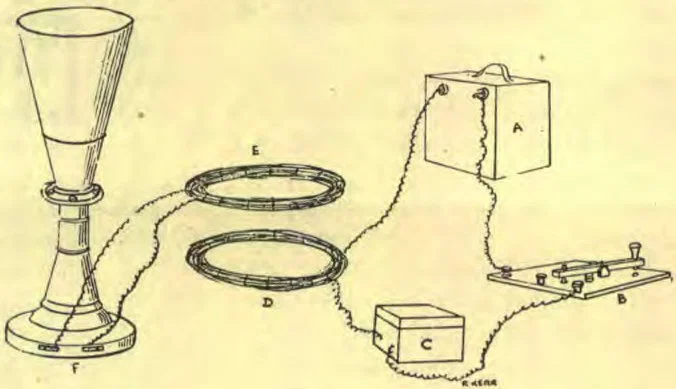
One more illustration will perhaps be sufficient to show that a current in one wire will induce one in another, though they may be separated by considerable distances. Fig. 1 illustrates the idea of induced currents handsomely. A supplies the current; B is a Morse key; C is a buzzer as used in field telegraphy; D is a roll of one hundred and fifty yards of insulated wire. All these are connected, so that when the button of the Morse key is pressed, these instruments and wires are placed in circuit. E is another roll of wire similar to the other in every respect, but not connected with it. This roll is attached to a telephone trumpet F. As the button of B is pressed, the current passes through the wire at D, and so influences the buzzer that it can be heard distinctly for quite a distance. If the buzzer should now be removed from the room, so that it would not be heard, keeping its wire connections intact, the telephone trumpet, if the coil E is held parallel to the other as in the illustration, will give forth the sound of the removed buzzer. This would not be possible if electrical waves had not been produced by coil D, in the space between the two wires, and these had not induced a current in coil E. Here in a nutshell is the principle underlying wireless telegraphy. Electrical waves of such energy are generated at the sending station that they traverse a distance of many miles, finally reaching a receiving station where they are taken up by an instrument attuned to the one that sent them out.
Instead of using, however, in wireless telegraphy the magnetic waves generated in the ether by an electric current flowing in a conductor, the electro-magnetic waves produced by disruptive discharges of static electricity are used. The idea is given by a discharge of a Leyden jar, or an electric machine that gives sparks between metal knobs. Such discharges produce electro-magnetic waves in the ether, which go on and on through space.
One of the first significant demonstrations of the existence and passing of these electric waves in space was made by Prof. Joseph Henry, of the Smithsonian Institution, Washington, D. C., who by means of disruptive spark discharges from a frictional electrostatic machine on an upper floor of his house, succeeded in magnetizing needles in the cellar thirty feet below, in spite of the two floors and ceilings intervening. The definite discovery of these radiations came much later, however, and was made in 1888 by Heinrich Hertz in Germany.
No one has yet been able to limit the distance traversed by these waves. Messages have already successfully journeyed across the Atlantic, and Mr. Marconi hopes to establish communication between England and New Zealand, a distance of ten thousand miles.
Wireless train telegraphy depends also on electro-magnetic or electrostatic induction for the transmission of signals. Special apparatus installed in the signaling station sends currents at a high rate of pulsation over wires paralleling the track along which the train moves. These impulses are transmitted to the passing train by means of either coils of wire wound lengthwise around the car, or, preferably, a metallic roof or side on the car. This metallic surface thus acts as one large plate of a condenser. The signals sent are readily received, and messages can be sent in like manner from the moving train to the parallel circuits along the track. Messages have been sent through the air in this manner between a fixed circuit and a moving train through a distance of six hundred feet.
Always and Forever True
UNDER no circumstances can the straight, clear path of right be turned aside from with safety. Sometimes when it has seemed that no possible harm could result from a slight deviation from one’s usual upright course, it has been found that the yielding would have decided forever the destiny of a human soul.
A group of clergymen were once discussing the thought whether it was ever right for ministers to drink wine. One said: “I am never asked to take a glass of wine without recalling an incident in my early ministry when I came very near yielding with, as I found out later, fatal results. When I left the seminary, I determined to be, not a temperance man, but a total abstainer. I had been at my first charge for only a few months, when I was invited to celebrate the eightieth birthday of one of my most honored parishioners. As the champagne was passed around the table, the thought came to me, ‘Surely, this is one place where I should break my resolution. Will it not look churlish to refuse to drink the health of this noble woman?’ But before the butler reached my plate, I determined to adhere to my usual custom, and simply turned down my glass. Imagine my joy, a few hours later, when one of the ladies present told me that her son, just about entering college, had said to her that day: ‘I haven’t quite made up my mind about signing the pledge before I leave for Yale. I am just going to let it depend on what Mr. Brown does to-night. If such a good man as he takes liquor, there can be no harm in it.’”
This incident is not the only one that might be cited to show the importance of perfect fidelity to the cause of right.