The Youth’s Instructor, Vol. 65, No. 36.

Two Birthdays

The Youth’s Instructor

Sep 4, 1917

Review and Herald Publishing Assn. · Takoma Park Station, Washington, D. C. · Sep 4, 1917

Two Birthdays

A GENTLEMAN went to call on a friend. He was entertained for a little time by a young daughter in the home. Presently she brought him a birthday album and asked him to write in it his name and birthday. He did as requested, and handed it back. He had scarcely placed it in the girl's hands when he asked to have it again. He turned its pages, and coming to the proper place, wrote his name and birthday again. The girl could not understand this, and asked how he could have two birthdays. Then he explained that the first one was the day upon which he was born into the world, while the second was the day upon which he was born into the kingdom of God. Some weeks later a woman called to make a visit. She too was given the album, and asked to enter her name and birthday, which she did, returning the book. The girl saw she had written but one date, and inquired of her why it was that she had only one birthday, while a gentleman who had called before said he had two birthdays. She replied that she had only one birthday, and there the matter closed. But the childish question hit the mark, and was not easily got rid of. In three or four days the woman returned and asked for the album, saying as she took her pen to write, that since her former visit she had had a second birthday, and desired to enter it also in the album.—Lutheran Young People.

“Christ Liveth in Me”

A MISSIONARY in Burma went out into the country to see a Christian man. Not knowing exactly where to go, he stopped a little girl and asked where Ko Po Ka lived. She answered, “You mean Jesus Christ Ko Po Ka? He lives over there.” She knew him and his house and directed the missionary to it.— Missionary News.

Masterly Self-Control as the Key to Character

THE key to all noble character is masterly self-control.— J. R. Miller.

Mississippi Manacles

THE Mississippi River drains all or part of thirty-one States. It carries to the Gulf the rainfall of forty per cent of the United States, no less than 1,240,000 square miles. The control of the vast Mississippi floods is a problem that only the nation can solve, and the nation has at last entered upon the task.
Since 1882 the States bordering the great river have spent $91,000,000 on levees to check its raging waters, while the nation has spent only $30,000,000. Now, however, Congress has appropriated no less than $30,000,000, on condition that the Mississippi States shall raise $15,000,000.
It is purposed to erect along the Mississippi, from Rock Island, Illinois, to the Gulf, a great bank consisting of 150,000,000 cubic yards of earth. It will be a barrier surpassing the Chinese wall in magnitude, and will rank as one of the engineering wonders of the world. Five years, it is thought, will see the completion of the task. We hope that the result will be not only the preservation of the 16,000,000 acres of rich land now exposed to desolating floods, but also a return of the Mississippi to its former importance in transportation.—Christian Endeavor World.

Miscellaneous Current Events and News Items

Stock of the Distilleries Securities Corporation is selling as low as $14 a share, par being $100.
The newest automobile device sands slippery roads just as a locomotive puts sand on slippery rails.
Of British invention is a mirror marked with feet and inches, to enable persons to measure their own height by facing it.
Now that the war is on, let us forbid any grain of corn being used in the manufacture of intoxicating liquors.—Theodore Roosevelt.
At certain places in Korea, great placards are placed at the crossroads, on which is written this request: “If any of the Jesus people come this way, let them stop and tell us the story.”
Obregon, the chief military leader of Mexico, is a mixture of Indian and Irish blood. His Irish grandfather, whose name was O’Brien, was a political exile who settled among the Indians of Sonora.
Miss Hansa Browning, who built the John T. Browning Memorial Normal Building at South Lancaster, Massachusetts, the commodious church at Rochester, New York, and furnished funds for a new annex to the New England Sanitarium, Melrose, Massachusetts, passed away on July 24, at the New England Sanitarium, where she had lived for more than a year. Miss Browning had the pleasure of seeing the means she consecrated to God used to build up his work during her lifetime rather than after her death.
In New York City not only are gas and electricity supplied through street mains from a central station, but many of the new office buildings in the financial district now get their steam from underground pipes that relay it from a distant generating plant. The buildings, says the Scientific American, have no furnaces or boilers, but the basements have, instead, simple valve mechanisms for turning on steam from the high-pressure street mains, and meters that measure the volume of steam consumed. In that way the occupants of the building can have at any moment all the steam they need for heat and power, and pay only for what they really use. The plan has been so successful that one company has had to add a new power plant to its system in order to meet its rapidly growing business. The plant occupies four floors of a building one hundred and fifty feet high, which has six great smokestacks, twelve feet in diameter, that tower one hundred and seventy-five feet above the roof. It uses nine hundred tons of coal a day. Unless the cost of heating by electricity becomes very much less than it is now, most city residences may eventually get steam for heating from underground pipes, and get it at a great saving in comparison with the present cost of fuel and labor.

God's Abundant Giving

CARRIE MAY NICHOLS
God knew the wants of human mind, How hard it is to try to bind Our growing wants to earth's supplies, And so he gave us worlds of skies, And clouds that measures will not hold, And sunsets trimmed in mines of gold, The shining gold that heaven has, And every ray a bright topaz.
And cooling breezes, boundless air, For everything and everywhere, And waters scattered o'er the earth, Too great for men to tell their worth; The lovely sunshine coming down, Like sparkling jewels from his crown, And wrapped in brilliant blessing power, For man and beast and bird and flower.
Man deals in things so very small, That measures must be had for all; But God in wisdom deals supplies Whose numbers daunt the worldly wise. And as these gifts we do receive, All we can do is just believe He loves to give; his love he's shown,— There's no good gift kept from his own.
His love is best of all he's given, It reaches down to man from heaven, And then expands o'er all the earth, And points the lost to Jesus' birth. Though still by man he's often slighted, Love points the way things can be righted; For godly, lasting, holy love Is shown mankind from God above.

Eccentricities of Celebrated Men

J. O. CORLISS
The ancient saying that distance lends enchantment to the view, has never been more fully demonstrated than in the general consideration bestowed on historical heroes. The glamour attending these famous celebrities often fades materially by a study of their habits in private life. Take for example the far-famed Napoleon Bonaparte, whose remarkable genius not only startled the world in the days of his greatest activities, but has continued to be the marvel of many, even to the present time.
But according to Bonaparte’s own analysis of his mental standing, his public successes were due simply to the exercise of abilities which are native to the average man. He merely maintained continuity of purpose. This secret is revealed in a letter to his brother Joseph. Said he: “I am accustomed to think three or four months in advance of what I do, and I make arrangements for the worst.”
As a sample of this confessed preoccupation of mind, his brother Joseph relates that on a certain occasion when journeying on horseback with him to meet in convention, where Joseph was to deliver an address, “Napoleon was continually occupied in studying the positions which troops of different nations had occupied on certain battle grounds,” without paying the least heed to the singular beauties of scenery abounding on every hand.
From just such persistent studies were gathered the plans by which this renowned man drew success on the battle fields of Europe. In one of his reminiscent moods while a prisoner on the island of St. Helena, he said, as related by General Gourgaud, his personal attendant: “To tell you the truth, the thing that made me gain so many battles was that the evening before a fight, instead of giving orders to extend our lines, as was commonly practiced, I tried to converge all our forces on the point I wanted to attack. I massed them there. Thus I overcame all before me; for of course I aimed at some weak point.”
After his defeat at Waterloo, he was free to admit that his personal ability was only of the ordinary kind. Referring to Mohammed’s personal successes as an illustration of his own, he said: “I repeat, a man is only a man. His power is nothing if circumstances and public sentiment do not favor him.” To confirm this thought he continued: “Do you suppose that it was Luther who brought about the Reformation? No; it was public opinion, which was in opposition to the popes. It was not Henry VIII who broke with Rome. It was the sentiment of the nation which favored and willed it.”
But a prominent element of success with Napoleon was, after all, his unrivaled dominating spirit, which was the outgrowth of a confident sentiment, summed up in this expression: “When a general invades a country he must not be afraid of giving battle. He must follow up his enemy until he can attack him. Soldiers should never count their enemies. Moral force, rather than numbers, may decide a victory.”
In an attempt by General Gourgaud on one occasion to offer the island prisoner comfort in his mournful situation, he said: “But Your Majesty has made history.” Said Napoleon in reply: “What is the use of working hard, and being in difficulties all your life, that you may figure in history after you are dead? Cæsar himself cannot be said to have succeeded. He was assassinated. Look at the great Gustavus! In eighteen months he won one battle, lost another, and was killed in a third! His fame was assuredly gained at a cheap rate. History is no better than a romance.”
Notwithstanding the utterance of these and other equally impressive sentiments concerning mind vigor, yet it seems that Napoleon himself exercised little or no mind control in his diet habits, or table manners. He is said to have had the habit of eating very hastily, rarely remaining at table more than ten minutes. This custom induced slovenly habits, one of which was to dispense with the use of knife and fork at his own plate. Moreover, as told in the “Life of Josephine,” by John S. Memes, LL. D., he would help himself with his fingers from near-by dishes, and dip his bread in the general sauce dish.
Of course such irrational habits in diet were bound to bring on severe attacks of distressing indigestion, when, as Memes says, the emperor would fling himself at full length on the carpet of his bedroom, and display the most indiscreet lack of composure. These attacks becoming more frequent in Napoleon’s later career, is said to have given rise to the suggestion that he was subject to epileptic fits.
These experiences caused the great sufferer to draw one sensible conclusion concerning them, even though the sentiment expressed was in defense of his theory that there was no guiding divine Providence. Said he: “If a man can think, it is because his nature is more perfect than that of a fish. When my digestion is bad, I think differently from what I do when I feel well.”
Would that every one might draw the same conclusion and act accordingly.

A Narrow Escape From Death

SOME time ago we announced the sad death of Miss Prayer Meeting, eldest daughter of Mr. and Mrs. Church, of Laodicea, State of Neglect.
Since that time, the dread disease consumption has affected other members of the family, so that not only the other children, Miss Sabbath School and Miss Missionary Society, but Mr. and Mrs. Church themselves suffered the results of the disease, and were in danger of losing their lives.
With the coming of spring’s bright days, when the situation had become so grave that the stricken family were in despair, Miss Missionary Society, for whom no hope had been entertained for several weeks, revived. It was feared by the family that this improvement was only temporary, as was the case of Miss Prayer Meeting, who had died but a few weeks previous.
However, the patient took a little nourishment, and was thereby strengthened. But all things seemed against her. Father was nigh unto death, mother was declining rapidly, and her sister, Miss Sabbath School, had apparently lost all interest in life.
Surrounded by those who were dying, lonely, discouraged, and ill, she cried unto God, “My God, why hast thou forsaken me?” But God answered, “My child, I have not forsaken thee, for I will never leave thee nor forsake thee. Go, my child, and bid thy loved ones come. Tell them all things are now ready, and I will tell them how they may be healed; for I desire above all things that they may prosper and be in health.”
As Miss Missionary Society had a mind to work, she aroused her parents, and called the various members of her family to join her in seeking God’s will. Her parents, though weak and emaciated, appeared anxious to help their suffering daughters, before their death should occur. A few of their relatives who had strength to come, also responded to the call.
A stranger who was without God joined the small family meeting. As the various members of the family united in prayer, all felt impressed to pray for this stranger whom the Lord had sent to meet with them.
As Mr. and Mrs. Church were praying for the stranger in their midst, they were led to realize as never before the dying condition of themselves and their children. In their desperate need they cried out to God for salvation from sin and death, pleading his promises: “All things, whatsoever ye shall ask in prayer, believing, ye shall receive.” Matt. 21:22. And also: “Is any sick among you? let him call for the elders of the church; and let them pray over him, anointing him with oil in the name of the Lord: and the prayer of faith shall save the sick, and the Lord shall raise him up; and if he have committed sins, they shall be forgiven him. Confess your faults one to another, and pray one for another, that ye may be healed. The effectual fervent prayer of a righteous man availeth much.” James 5:14-16.

A Remarkable Recovery

The effect was wonderful. That little meeting which opened with earnest prayer for a stranger, resulted not only in his conversion, but in the salvation of the afflicted family. Their prayers were answered, the sick were healed, and new life and power were given to those who, in earnestness and faith, sought salvation. The house of mourning was turned into a house of praise.
We are glad to be able to report that, at this writing, all members of the Church family are fully restored to health and strength.
The family altar that had long been thrown down, has again been erected. In the place of hatred there is love; in the place of sorrow, joy. There is peace where once there was strife, and long-suffering in place of wrath. Gentleness has replaced unkind words. There is goodness instead of wickedness, faith instead of unbelief, meekness instead of pride, and temperance instead of impatience.
My brethren, what is the spiritual condition of your church?
MORAL.—If you wish your church to prosper and be in health, begin working and praying for others.
MORRIS LUKENS.

Questions Many Ask

WHY impoverish our own country by sending wheat to Europe?
“This is because fifty per cent of a Frenchman’s food in peace time consisted of white bread. It is not easy to change the diet of a nation, even in normal times; it becomes almost impossible to change it when that nation is engaged in a life-and-death struggle. It certainly is no time then to try experiments with new flours. Hence it is that every woman should, when she can, conserve wheat so that it may feed the hungry across the waters.”
Why not send corn instead of wheat?
“The men and women abroad are not used to corn, or maize, meal. They do not understand its preparation; they regard it with distrust. It is, again, not the time, in the midst of the terrific war upon them, to teach these people across the sea American cookery.”
How does our food administrator wish the people of the country to coöperate with him in his problem of food conservation?
Mr. Hoover, food administrator for the United States, says:
“Stop, before throwing away any food, and ask, ‘Can it be used?’”
“Order meals so as not to have too much.
“Have a proper balance of the most nutritious foods.
“Stop catering to different appetites.
“No second helpings.
“Stop all eating between meals.
“Stop all four-o’clock teas.
“Stop all refreshments at parties, dances, etc.
“Stop all eating after the theater.
“One meatless day a week.
“One wheatless meal a day.
“No young lamb; no veal; no young pigs or ducklings; no young meat of any sort.
“No butter in cooking: use substitutes.
“Personal marketing instead of by telephone.”
What are some of the definite ways in which the German people seek to conserve food and money?
Ambassador Gerard says:
“When I left Germany only two ounces of fats or oils per head a week were allowed. Only one egg in two weeks was rationed out.
“No sudden stoppage of expenditure in Germany was made, but gradually the sale of articles of luxury was cut down. It soon became not ‘good form’ for a woman to appear in public in a new dress or to vie with another in the giving of entertainments.
“Women, too, gave up their motor cars; at first doing it from patriotism, and later because the government allowed no private automobiles to remain in commission. It was necessary that rubber and gasoline be saved.
“Even bicycle riders were allowed to use their machines to and from business or school only where no trolley route was available.
“When the war first broke out, all the theaters were closed and all dancing was stopped. Later the theaters reopened, but when I left Germany they were required to close at ten o’clock.
“All cabarets were sternly forbidden, as was also all dancing in private houses. The Germans felt not only that frivolity was out of place, but that the young soldiers should be protected from the temptations of cabarets and similar dance places.”

How to Read the Bible

Study It Through. James 1:25

As early as possible after rising, turn to the Bible, and be the passage ever so short, read it carefully through, feeling that through it God’s message may come to you for that day. At some time in the day read more fully.

Pray It In. James 1:5

We should never forget that the truths of His Book are spiritual and must be spiritually discerned, and the heart that is uplifted in prayer will find an incoming of God’s light, illuminating the Word.

Write It Down. Ps. 139:17

Make a little entrance on the margin of the Bible, or, better still, have a book called “Precious Thoughts,” and in that enter just a sentence or two telling the precious thought that came to you through the scripture for that day.

Live It Out. James 2:17, 18

As we go forth in the spirit of the Master to live out the precepts of his Word in thought and word and action, we will make our lives radiant with good deeds done in his name and for his sake, and his Word will become a living reality.

Pass It On. Mal. 3:16, 17

“A word spoken in due season, how good is it!” If we have received a helpful, uplifting, or precious thought from the Word, it will be made doubly so by passing it on to another. Clouds are vanished, burdens are lifted, aching hearts are cheered, faltering faith is strengthened, and the peace of God is given by passing on some precious thought of God’s Word. —Salem D. Towne.

Conquered

TEMPTATION came to me today, And oh! I felt that I must stray Down primrose paths, forgetting all. The city’s fevered, siren call Spoke to my soul; its whispered cry Said, “Live, for Youth too soon will die.”
So all alone, when work was done, I sought the park. The setting sun Had left a bit of warmth for me. I found a bench beneath the tree, And sat and thought, “My life is hard; Sometimes my heart seems battle-scarred With longings keen and bitter fears, And want and suffering and tears.”
Temptation spoke, and Youth spoke back; The night seemed cold and dark and black, And every light was like a star That cleft the sky, they were so far, So very far away! and I Was lonely there beneath the sky.
And softly in the darkness there I breathed my little childhood prayer. Do prayers have answers? As I prayed, A Presence came, and gently laid A hand upon my arm. I knew That some One kind and good and true Was very near. Upon my soul A peace swept down, and left it whole. I felt a calm steal over me, That same that stilled the troubled sea Where Jesus walked. My fears were laid; Temptation left me unafraid. And, as I smiled, there in the park, A Voice spoke through the fragrant dark. “Be of good cheer!” the words rang out Above the city’s groan and shout. And all the lights that I could see Were stars of home agleam for me.
—Selected.

How One Boy Helped His Own Promotion

A CERTAIN boy was a clerk in a department store, with a small salary and no present prospect of getting anything better. It was a wet, gloomy day, and very few customers in the store. A number of the clerks were bunched together talking over baseball games and teams, and most of them did not notice an elderly woman who came into the store, wanting to be served. But this boy saw her, and although he was one of the youngest in the crowd, he promptly left his companions and went to wait upon the woman who had entered. She wanted to look at a number of articles, and he gave her the most careful and courteous attention. He politely answered all her questions and showed her all the different pieces of goods she wanted to see. The other boys kept on talking baseball and such matters and having a jolly time among themselves, but he was carefully and faithfully attending to business.
Not long afterward the same woman sent a request to the head of this department store, asking that she might have the assistance of this young clerk in making her selection of a very large order of goods.
“We shall be very glad to accommodate you,” answered the head of the firm, “but this boy is one of the youngest and least experienced of all our clerks. May we not send you one of the older and more experienced young men? Such a one might be able to serve you more efficiently than the one for whom you have asked.”
“This may all be very true,” answered the lady, “but I want none other than the one who waited on me the other day.”
It turned out that this woman was none other than Mrs. Andrew Carnegie, and she had come to make selection of goods that were to be used in redecorating and fitting the famous Skibo Castle, which is known everywhere as the home of the Carnegies in Scotland.
Mr. Schwab, in relating this story, says that this was the beginning of the promotion of this boy. His employer found out how valuable his thoughtfulness and courtesy were to him, and gave him better chances to use these qualities. Today he stands very high in the line of business in which he is engaged.—Selected.

The Conversion of Old Newspapers and Candle Ends into Fuel
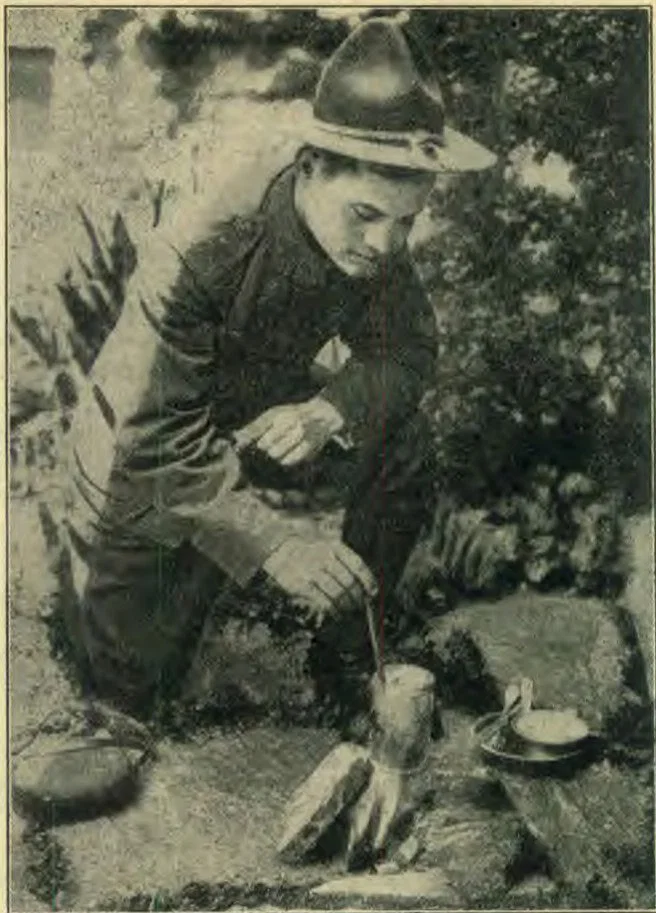
IN Italy and France women and children are rolling old newspapers into tight rolls, pasting down the edges with glue or paste, and boiling them in paraffin to make ration heaters (scalda-rancio) out of them for the use of the soldiers in the trenches in the high Alps, where coal cannot be sent. They are making them by the million. The Italian National Society furnishes one and a half million a day to the government, and the old newspapers are being used up for this purpose so fast that they are becoming scarce, and paraffin has become very expensive.
In America there are still millions of candle ends and thousands of tons of newspapers scattered over the country, and it would seem to be well worth while for the thousands of willing hands in the homes to convert them into these most useful ration heaters for the boys at the front, or for their use next winter in the training camps, or even for use at home, where they can take the place of the more expensive solid alcohol or replace kindlings in the kitchen stove.
A Soldier Boiling His Ration Over the Homemade Ration Heater
Cutting the Newspaper Rolls and Melting the Candle Ends
It is the easiest thing imaginable to make ration heaters, or scalda-rancio, as they are called in Italy, if one follows the directions of the Italian National Society.
Spread out four newspapers, eight sheets in all, and begin rolling at the long edge. Roll as tightly as possible until the papers are half rolled, then fold back the first three sheets toward the rolled part and continue to wrap around the roll almost to the first fold, then fold back another three sheets and continue to wrap around the roll again up to the last margin of the paper. On this margin, consisting of two sheets, spread a little glue or paste and continue the rolling, so as to make a compact roll of paper almost like a torch. If six of the sheets are not turned under, there will be too many edges to glue.
While the newspapers may be cut along the line of the columns before rolling and the individual columns rolled separately, as is done in the making of the trench candles in France, it is easier to roll the whole newspaper into a long roll and then cut it into short lengths. A sharp carving knife, a pair of pruning shears, or an old-fashioned hay cutter will cut the rolls easily. These little rolls must then be boiled for four minutes in enough paraffin to cover them, and then taken out and cooled, when they are ready to be put into bags and sent to the front. If there are more newspapers than candle ends, block paraffin can be bought for a few cents at any grocery or drug store.
Little children and grown-ups in Italy and France are rolling, gluing, and paraffining these ration heaters by the million, and their fathers and husbands in the high Alps and other places where wood and coal cannot be sent are cooking their rations over them.—National Geographic Magazine for June, 1917.

Ministering to the Hunger of the Lord Jesus

A MISSIONARY was invited to go into an interior place, by a lone Christian, who said, “Oh, brother, come; we are so hungry!” When the journey was all arranged, a voice asked him, “What if they are not hungry after all? Your journey will be in vain.” But a deeper voice answered: “What if they are not hungering for the Bread of life? There is One hungering to give them that Bread. Go and minister to the hunger of the Lord Jesus.” He went, and as he encountered dangers and trials deep and sore, the precious thought upheld him, “You are ministering to the hunger of the Lord Jesus.”

For the Men Who Wear the Blue (and the Khaki, too)

BROTHER W. R. BEATTY, one of our Missionary Volunteers at Seattle, Washington, is busily engaged in the book work. But he takes a little time from his regular work each week, and invests it in bettering the social life of some of the boys around Seattle who wear the blue. With the help of our attractive and stirring magazines and small books, he has recently interested several of the marines and navy officers in the message for today. Our Missionary Volunteers will be interested in reading a recent letter from Brother Beatty to the Signs of the Times office. It follows:
“I have been thinking recently how fine it would be to get copies of the Signs of the Times aboard the monitor ‘Cheyenne,’ the mother ship of our Pacific submarine flotilla, and this morning I met Mr. Chappelle, one of its young officers to whom I sold a copy of ‘The World War.’ When I suggested the idea to him of having copies of the Signs of the Times sent to his ship, he expressed his readiness to receive bundles of the paper, and said that he would be very happy to distribute them among the two hundred and seventy-five men with whom he was associated. . . . I think this will be a splendid opportunity to place the message in a channel we otherwise would find hard to reach, for Mr. Chappelle will personally look after the distribution of the papers among the men of the entire flotilla.
“Another matter. There are hundreds of marines stationed here, also hundreds of sailors and many fine mechanics and yeomen in the navy yard at Bremerton and aboard the several ships in dry dock. I shall be glad to have copies of the Signs of the Times to use here at the yard and aboard various ships. They have advertised up here for the citizens to furnish literature for the boys to read, and all we need do is to carry the papers to the gate and hand to a marine stationed there. By the way, Mr. Chappelle told me he had sold two copies of ‘The World War’ to some associates, and hopes to sell more.”
Acting on the suggestion in the first paragraph of Brother Beatty’s letter, the brethren at the Signs office sent some bundles of magazines and papers to the “Cheyenne.” A few days ago the following letter from Mr. Chappelle reached the office:
“SOMEWHERE ON THE PACIFIC, U. S. S. CHEYENNE, “Signs of the Times, June 27, 1917. Mountain View, California.
“GENTLEMEN: I received the Signs of the Times June 22, and distributed them among the crew. They were kept and read by more of the crew than I expected. It is hard, as a general rule, to introduce any reading matter of a religious nature to the men who do not have special regard for the spiritual life, but they all seem to enjoy these magazines, and in many cases I observed discussions between the men, referring to the articles. I thank you and Mr. W. R. Beatty for your help in interesting the men who wear the blue, in spiritual things. I, of course, have them at heart, for I am in the service too, and see and know the everyday life of the enlisted men. (Signed) CHAPPELLE.”
Interesting and encouraging, isn’t it? Here is a good field for Missionary Volunteer service. On board ship and in army camps and barracks there is ample time for reading, and there are many minds in such places that are eager for the best literature. Are we doing what we can to supply marines and soldiers with our magazines and papers? Seattle is not the only city calling upon “the citizens to furnish literature for the boys to read.” On every coast there are opportunities to furnish reading matter to the marines, and throughout the country army camps welcome it. If, because of your situation, you are not able to carry on literature work among marines or soldiers, perhaps you would like to assist the Signs Coöperation Fund in its work of supplying battleships and army camps and other public efforts with both the Signs monthly and Signs weekly and other literature that may be requested. Any help you may wish to give this fund should be sent through your conference office.
ERNEST LLOYD.

For the Finding-Out Club

Answers to Questions in “Instructor” of July 31

Part I

1. The National Geographic Society states that the United States owns just 8,000 islands.
2. When Porto Rico came under the control of our government fifteen years ago, there was only one schoolhouse on the island; today there are 1,200. Good roads have been extended from 40 miles to 1,000 miles. The output of sugar has increased from 65,000 to 365,000 tons a year.
3. Alaska cost the United States $7,500,000. The canned salmon of a single year, from that territory, now amounts to more than the original purchase price.
4. Rain in Egypt is very rare. One might almost say that it never rains. The country lies in a latitude so far south that frost is rarely known. These two conditions have united to preserve the ruins of many ancient buildings in a state of perfection that is rare in other countries.

Part II

1. Bezaleel, of the tribe of Judah, and Aholiab, of the tribe of Dan, are the first professional embroiderers mentioned in the Bible. Their work was in connection with the building of the tabernacle in the wilderness. Exodus 38.
2. The Lord was the first engraver. He wrote his law on tables of stone for Moses. Exodus 31.
3. The first woman merchant was Lydia, a seller of purple, of the city of Thyatira. Acts 16: 14.
4. Benjamin was the first motherless babe, or orphan. Gen. 35: 16-20.
5. Rehoboam is credited with having “twenty and eight sons, and threescore daughters.” 2 Chron. 11:21.
6. Jehoshaphat, in the third year of his reign, sent his princes to cities of Judah to teach the book of the law of the Lord. 2 Chron. 17: 7-9.
7. The result of this instruction was that the “fear of the Lord fell upon all the kingdoms of the lands that were round about Judah, so that they made no war against Jehoshaphat.” Verse 10.
8. The Athenians are mentioned in Acts 17: 21 as confirmed gossips.

Dewey’s Delight

At the close of his autobiography, Admiral Dewey wrote a characteristic paragraph: “A gratifying feature of the rank of Admiral of the Navy, which Congress had given me, was that I was to remain in active service for life. While I lived, there would be work to do.”
This gallant desire of the admiral’s was fulfilled. He was kept at work—worthy and honorable work, work suited to his tastes and to his great abilities. An idle life would have killed him.
How many there are who, far from sharing Dewey’s delight in “active service for life,” look forward to nothing else so eagerly as to a life of inaction! When duty is all done, their pleasure will be begun.
Of course we know that it is not so. The primal curse is not the curse of labor, but of drudgery. Labor, of proper kind and in due measure, is one of man’s greatest blessings. Dewey was right.— Selected.

A Rough Diamond Is of More Value

“A ROUGH diamond is of more value than many smooth counterfeits.”
Continue reading: THE EARTHLY SANCTUARY A TYPE