The Youth’s Instructor, Vol. 65, No. 36.

Two Birthdays
Earlier text: THE EARTHLY SANCTUARY A TYPE

The Wolves of Bixby's Hollow

It was the anniversary of the first settling of their town, and they had just returned from the afternoon's celebration, where Mrs. Bonney had been one of the speakers, in fact the only speaker whose address bore direct testimony concerning the event celebrated. With infinite care she had prepared a paper, admirable in brevity, pungent in wit, teeming with historical data, and then — she had been shunted to the very end of a long program, and a general exodus of hungry, hurried people had taken place before she rose to speak. Elizabeth, her daughter, could not keep back tears as she watched the diminishing audience. Mrs. Bonney, however, delivered her speech with animation to the friendly remaining handful, and received hearty applause.
“I wouldn’t have blamed you if you had refused to speak,” said Elizabeth, later. “Anyway, I don’t feel so bad now over your refusal to tell about the wolves of Bixby’s Hollow.”
“That was too personal an anecdote, Elizabeth.”
“I should think anybody would want to hear about those wolves,” Elizabeth insisted. “I am sure that strange man on the front seat would have. He applauded roundly when you finished.”
“He did seem interested, didn’t he? I wonder who he was,” said Mrs. Bonney.
The next morning, while Elizabeth was still nursing her disappointment, the doorbell rang, and when she answered it she saw the enthusiastic stranger of the previous afternoon.
When Mrs. Bonney, who was kneading bread, appeared, he revealed himself as Edward Harris, chairman of the program committee of the widely advertised State semicentennial celebration, to be held in a few weeks at the old State capital.
“The evening program, Mrs. Bonney,” said he, “is of especial importance. We were greatly upset to learn, just a few days ago, that our chief speaker is ill with typhoid fever, so ill that there is no possibility of his appearance. That necessitated the search for some one to fill his place, and learning that you were to give an address of like nature, I came here to hear it. I was charmed with your speech. I have telegraphed to the rest of the committee, and their unanimous response is, ‘Get her, if you can.’”
Mrs. Bonney was too astonished to reply. Mr. Harris continued:
“The president of the State historical society will make a brief speech — truly brief, Mrs. Bonney, for I know his way. Then you will be the second and chief speaker, and the governor of the State will close with a general résumé. Your expenses, naturally, will be paid, and your daughter’s, in case she accompanies you.”
Mrs. Bonney accepted joyously, and asked Mr. Harris if he had any suggestions to make.
“I wish your speech might be ten or fifteen minutes longer. Of the subject matter I have no suggestions to offer.”
“O mother, do tell about the wolves of Bixby’s Hollow!” exclaimed Elizabeth.
“What about the wolves of Bixby’s Hollow?”
“It’s a story that I wanted mother to tell yesterday, but she wouldn’t, because it is about herself.”
Mr. Harris begged to hear it.
“Just the thing for closing!” he said enthusiastically, when Mrs. Bonney had briefly sketched it. “I sign my name to the petition asking you to give it.”
The intervening weeks passed swiftly. Mrs. Bonney rewrote her story, and rehearsed it daily; Elizabeth with nimble fingers evolved a gown for her mother, from an old silk dress which she ripped up and by mysterious processes redyed.
“Mother, I am going to mend the lace fichu that father gave you on your fifteenth wedding anniversary; it will give just the right finishing touch to your costume.” So said Elizabeth, and so she did, patiently darning and catching the threads in the dainty lace. Then she took an old-fashioned cameo brooch to the jeweler, and for a trifling outlay had it made as good as new. Next she remodeled a bonnet, and, lastly, bought a pair of cream-colored gloves.
“Elizabeth,” said Mrs. Bonney reproachfully, “you shouldn’t have been so extravagant for me.”
Elizabeth laughed: “Mother, I got more pleasure through the purchase of those gloves than the money could have brought me in any other way.”
The great night came, and found Mrs. Bonney once again on a platform, with Elizabeth in the audience. There was not a vacant seat in the house. Elizabeth had a little secret from her mother; she had stolen out from the hotel and ordered a bunch of pink sweet peas and ferns, all her purse allowed, to be sent up to her mother after her speech. Her mother should know that there was at least one appreciative person in the audience.
Elizabeth was uneasy until Mrs. Bonney was introduced as one of the pioneers who had made “our State what it is.” Elizabeth’s heart beat fast, but not so fast that she forgot to see whether the speaker’s skirt hung all right, and whether the hand of the amateur dressmaker and dyer was too apparent. But her mother looked what she was, a gentlewoman of the old school, whom age had made beautiful both by inward and outward grace. The applause, spontaneous tribute to her winsomeness, astonished even Elizabeth’s gratified heart. Then Mrs. Bonney began her address with the familiar phrase:
“Backward, turn backward, O Time, in your flight: Make me a child again just for tonight.”
The words were a magic spell; from the moment of their utterance the audience listened, enthralled. As her memory evoked incidents and deeds long forgotten and wove them into an enchanting story, no word, no phrasing, no playful turn, escaped her captivated listeners. When she reached the closing anecdote she said, “Mr. Harris has asked me to relate this tale, and that is my apology for introducing a personal anecdote.
“When I was about nine years old we lived on the Sharon Church road. Our nearest neighbor to the south was half a mile away, and to the north three fourths of a mile, and three fourths of a mile west lived the Bixbys. The Bixbys were looked upon with envy by the rest of us because they had raised a lot of sorghum cane, and had therefore a good supply of sorghum molasses.
“My mother discovered one cold winter afternoon that our supply of sorghum molasses was low, and as she needed some for supper, I volunteered to go over to the Bixbys and get a gallon of the precious sweetening and return in time for supper. I had often made the trip; so, bucket in hand and warmly wrapped, I started forth on my expedition alone, as the dogs were off with our men folk.
“I reached the Bixby home in good time, and Mrs. Bixby promptly and graciously gave her consent to my request for a gallon of molasses. But it proved to be much easier said than done.
“In those days every well-regulated farmhouse had as a necessary adjunct what we called a smokehouse, and the Bixbys, being extremely well regulated, had a good smokehouse; in this smokehouse they kept the molasses. I don’t know why, except that it was an unwritten law that molasses as well as smoke belonged in the smokehouse.
“On this particular afternoon, when Mrs. Bixby tried to open the smokehouse door, it refused to open. Mild persuasion, jerking, pounding, and pushing were of no avail. The door refused to open wider than one inch. After trying all sorts of ruses to take it unawares, and after much gluing of our eyes to the inch-wide crack, it developed that a beam of wood, which had been stored on the rafters above, had fallen down in such a position against the door that much force must be applied to move the heavy barrels which held the beam in place. A good half-hour elapsed before the door was willing to act like a door, and then the molasses, true to its nature, acted exactly like molasses in cold weather.
“So when I was ready for my homeward journey it was considerably later than I had planned, and much nearer supper time. Mrs. Bixby urged me to stay for supper, promising as an inducement that some of the men folk would drive me home in a sleigh. But my promise to mother and the need of molasses for home consumption made me regretfully decline her attractive suggestion.
“‘I guess you’ll be all right,’ Mrs. Bixby called out after me as I left, ‘but I do hear that the wolves are bad over the western ridge.’”
“I was not the least bit interested in wolves, and sturdily started out, considerably weighed down by my gallon of molasses. As it was so late, I decided to cut through the hollow that ran from the Bixby road to our Sharon road, saving a great deal in distance, but the going was not so good, except at the Sharon road end of the hollow, where the wind had swept away the snow.
“I had not traversed much more than two thirds of the distance through the hollow when some instinct made me look over my shoulder. At the same instant a mournful howl came over the hill. What I saw on looking backward was four gaunt wolves loping with great easy leaps down the hillside several rods away, and even while I glanced, a fifth, larger and more gaunt, came over the brow of the hill. I was not certain that they were pursuing me. I did not wait to make sure. I turned and ran. Terror added wings to my footsteps, for I had heard many gruesome tales of lonesome travelers attacked by famished beasts. But even as I ran I did not lose my head. I was near enough to the Sharon road to hope that I might reach the old hickory tree that grew just beyond the rail fence at the roadside. If I could get there first, I could with a flying leap make the top rail and climb the tree out of reach of voracious jaws.
“I seemed to have looked upon the molasses as a sacred trust, for it never entered my head to drop the bucket. Besides its weight I had the disadvantage of running uphill, and, also, I had only two feet while the wolves had four to carry them along. I was not yet absolutely certain that the wolves were following me, for if they made any noise with their soft padded feet it was absorbed by the sound of my own heavy footfalls on the frozen ground, and I was afraid to look around again for fear of a misstep or a fall. So, on and on I ran. I touched only the high places as my goal drew nearer. Then, in final effort, I mustered all my strength for the flying leap to the fence top.
“I made the leap and caught the lower limb of the tree. As I leaped, the foremost wolf, with an angry snarl, jumped and caught my skirt in his gleaming teeth, and for a second I hung ’twixt sky and earth, one hand grasping the stout hickory limb and the other the molasses, and the powerful wolf pulling me backward. I looked around, and, quicker than my tongue can say it, I raised my heavy pail and smote him with all my might upon the jaw. With a howl, he turned a somersault in the snow, and I drew myself into the tree barely in time to escape the onrush of the other four. They leaped back and forth from ground to fence rail, and snarled and snapped, but without result. I had escaped them by a second’s time.
“It was so late that darkness was upon us almost before I realized it, and I began to think over my situation. I could tell that the wolves were standing guard below, because any movement I made was reflected in their uneasy actions. My predicament seemed very much like that of those misguided mariners who ventured between Scylla and Charybdis. If I descended, the wolves were waiting for me. If I stayed up in the tree, a slow death awaited me unless I could keep in motion, and an old hickory on a dark night does not offer much room for locomotion or Delsarte. The Bixbys would think that I had arrived at home safely. My family would think I had decided to stay at Bixbys, and in the meantime —
“Anyway, it fell out just as I supposed. Mrs. Bixby related the tale of the molasses and my departure for home. When I did not arrive at home in time for supper, my absence caused no anxiety, for all concluded that the Bixbys would bring me home later.
“It must have been well on toward eight o’clock when my mother, with secret uneasiness because I had not arrived, opened the door for the twentieth time, and then, turning toward my father who sat reading, said:
“‘I hear wolves howling in Bixby’s Hollow.’”
“‘What?’ said my father, not fully comprehending.”},{
“‘I hear wolves howling in Bixby’s Hollow,’ repeated my mother.
The result was instantaneous. With one spring my father seized his coat and cap off the nail.
“‘Have Phoebe ring the dinner bell loud and long and fast,’ he shouted. ‘Get out the lanterns and light them. See that the guns are ready as we come past. Send the men to the barn as they come, and tell them not to wait to saddle!’”
“As he gave the last order he was running to the barn. Phoebe, strong of limb and stout of heart, seized the rope and rang with all her might a loud, mad peal that sent a thrilling cry for help for miles around. With steady fingers my mother did her part, and handed up the lanterns and the guns as husband, sons, and farm hands rode by after mounting in hot haste; and there was rapid riding forth that night, while my mother stood watching at the window and Phoebe heated water and replenished the deserted fire.
“In the meantime, you will be glad to know that I hung my molasses bucket on a limb, and then was free to slap my hands together and stamp my feet. I found myself getting desperately sleepy, so I recited all the ‘pieces’ I knew. Then I tackled Marmion’s ‘Defiance,’ which I had heard the fifth reader scholars reciting, and excited such intense rage in the wolves that they started up a rivalry of sounds, and quite eclipsed me for a while. When they had subsided and I was so sleepy and cold that I was afraid I would fall out of the tree, I tried my tongue on what I could remember of the meeting of King James and Roderick Dhu.
“I had just recited with all the energy that my chilly lips could command the fetching lines,
‘Come one, come all! this rock shall fly From its firm base as soon as I!’
and without the slightest thought of the difference between King James’s ‘firm base’ and my hickory tree, when across the wooded road came the peal of a madly ringing bell. I knew that bell. I have lived sixty-six years since that night, but in all those years I have never heard a sound that has brought me such a joyous thrill as Phoebe’s message saying, ‘Help is coming! Help is coming!’
“Suddenly, far down the road, I caught a gleam of light, and then another and another. They were faint and distant, but they told me rescue was near at hand. From that moment I have known how a shipwrecked sailor feels when he cries, ‘A sail! A sail!’ but my cry was, ‘A light! A light!’”
“I almost lost my balance in my cry of joy, but caught myself in time. Quickly, yet it seemed long to me, I heard the barking of the dogs, and then there was an awful uproar underneath the tree as dogs and wolves met in deathly struggle! At the sound of men and horses and as the lights drew nearer the wolves retreated, except one, and, then, oh joyful sound, my father cried out:
“‘Where are you, Sally?’ And I replied — what do you think I said? I almost hate to tell it, but I said:
“‘I’m up in the old hickory with the molasses.’”
“I need not detail my rescue further. The lights showed one dead wolf, held down in a death throttle by our biggest dog. The others had escaped.
“‘Call back the dogs,’ cried my father, as he held me, stiff with cold, in his arms, ‘and one of you ride like mad to tell her mother she is safe.’”
“So mother was waiting for me with open arms when we rode up, and I, with the obsession I had had all afternoon, greeted her with the words:
“‘O mother, I’m so sorry that I didn’t get the molasses home in time for supper!’”
“But mother didn’t seem to care as she folded me in a warm embrace and murmured, ‘Dear little daughter!’”
“When we had family prayers later, father read the ninety-first psalm, and in reading the words, ‘For he shall give his angels charge over thee to keep thee in all thy ways,’ he looked at me in a way that made the message a personal one, and for the first time I felt and understood that there was an all-loving and all-powerful heavenly Father whom I must love and glorify, and that feeling abides to this day.”
Mrs. Bonney ended. There was a momentary pause. Then the audience rose as one man in wild and prolonged applause. Elizabeth’s eyes were full of tears, as they had been at Mrs. Bonney’s last public appearance, but for a very different reason. Then down the aisle came an usher bearing Elizabeth’s sweet peas. The audience applauded wildly again. Then came

The Wolves of Bixby's Hollow

(Concluded from page thirteen)
another usher with some big pink chrysanthemums, and the audience enjoyed those, too. Then a third usher walked down with a big bouquet of pink roses, and the audience thought she deserved those also. Lastly, a fourth and most dignified usher bore down the aisle and presented to Mrs. Bonney an enormous bunch of American Beauty roses which bore the governor’s card, and the audience showed that they liked that the best of all. The governor himself was so busy telling Mrs. Bonney how much he enjoyed her speech that he forgot he was to make the closing remarks.
Elizabeth watched everything with breathless interest, and later her mother, while admiring the flowers, said, “I like your sweet peas best of all.” Then, after a pause, “But, dear, you must be sick and tired of hearing my paper so often!”
“Sick of it! Tired of it!” gasped Elizabeth, “I was dreadfully scared for fear the wolves would catch you this time, mother!” — Lucy Shelton Stewart, in American Magazine.
(Concluded on last page)

Missionary Volunteer Society Programs for Week Ending September 15

The programs for this date, with notes, illustrations, and other helpful material, will be found in the Church Officers’ Gazette for September.

The Bible Year

Senior Assignment

September 9. Ezekiel 39 to 41: Victories and restoration of Israel.
September 10. Ezekiel 42 to 44: Divine glory; laws and ordinances.
September 11. Ezekiel 45 to 48: Ordinances of justice and worship.
September 12. Daniel 1 to 3: The great image; the fiery furnace.
September 13. Daniel 4 to 6: Dream of the great tree; Belshazzar’s feast.
September 14. Daniel 7 to 9: Visions and their interpretation.
September 15. Daniel 10 to 12: A vision and its explanation.
For notes on this assignment, see Review for September 6.

Junior Assignment

September 9. Mark 1: John’s ministry; Jesus baptized.
September 10. Mark 2: Palsied man healed.
September 11. Mark 3: Jesus heals the people.
September 12. Mark 4: By the seaside.
September 13. Mark 5: In the country of the Gadarenes.
September 14. Mark 6: The five loaves and two fishes.
September 15. Mark 7: The Pharisees reproved; the deaf man healed.

The Youth Who Turned Back

In a home of wealth and refinement there lived long ago a lad named John Mark. His father was dead, and he lived with his mother, who was a sincere Christian woman. They had plenty of money, and servants to help with the work. Their comfortable home with its pleasant surroundings was always open to the workers who came to Jerusalem, just as today we heartily welcome our ministers when they come to our homes. John became acquainted with many of the principal brethren in the early church, and grew familiar with the Christian faith, which he learned to love very much.
One day the sad news came that Peter, one of the leading workers in the church, had been put in prison. Only a short time before this, James, another worker, had been beheaded, and now the church in Jerusalem feared that the same fate awaited Peter.
But these Christians had learned to pray, and oh, how fervently they prayed that night for Peter’s deliverance, as they were gathered together at the home of Mary, John’s mother! Did God hear them?—Yes! and how wonderfully he answered their prayers; for while they were kneeling a knock came, and when the door was opened, who should be standing there but Peter himself!
This answer to prayer was a great blessing to John, for it strengthened his faith in God. When he became a young man, he was asked to go with Paul and Barnabas on their first missionary journey, to be their assistant. He understood the gospel, and they thought he would be just the one to help instruct the new converts who would be coming into the truth as the apostles preached from place to place. Barnabas was John’s uncle, and no doubt they were very fond of each other.
But what a disappointment was in store for Paul and Barnabas! After having gone only a short distance, John refused to stay with them any longer. He gave up, and turned back home. You can imagine how Mary felt when her son returned home. She had brought him up for the work of the Lord, and then to have him turn out this way! But there is a bright side to the story; in this case “all’s well that ends well.”
Two years later John had learned his lesson, and was again ready to start out in the work of the Lord. His Uncle Barnabas was willing to give him a second trial, and this time he “made good.” By his useful life he brought joy to the hearts of his friends and associates. He was a comfort to Paul in his declining years, and a blessing to the work of God.
The intensely interesting gospel story which we are beginning this week, the book of Mark, was written by this same “youth who turned back.” John Mark did not know Jesus personally, but doubtless through his long association with the apostle Peter he learned the wonderful things recorded in his gospel.
The book of Mark was written in Greek, and was probably completed about A. D. 70. It is a gospel of deeds, and Jesus is represented as a worker whose life was full of strenuous activity. He hastens from one task to another, and that little word “do” seems to characterize his life from beginning to end. “Do” is a good word for boys and girls, too.
ELLA IDEN.

Praise and Thanksgiving

(Texts for September 9-15)
“Praise ye the Lord;” these are the closing words of the last psalm. That command is for you and me. The psalmist calls upon us to praise God—upon all that hath breath to praise him. But why should we praise God?
Because he has “dealt bountifully” with us; Because he hath given us counsel; Because he hath lifted us out of trouble; Because his “loving kindness is better than life;” Because he “holdeth our soul in life;” Because he “suffereth not our feet to be moved;” Because his “mercy endureth forever;” Because “whoso offereth praise glorifieth” God; Because “it is a good thing to praise God.”
These are some of the reasons the psalmist gives for calling upon us to praise our heavenly Father. He knew his God; he knew that for his own sake he ought to praise him; and so he made the strong resolutions we find in Ps. 63: 3, 4, and 71: 14, 15. Shall we not make these resolutions our own? It is good for us to praise God. It will strengthen our courage; it will deepen our joys; it will broaden our view of life; it will help us to get better acquainted with him whom to know is life eternal.
Try to count the blessings you are receiving today; then look back; let your memory pick up some of the disguised blessings of the past. What bitter disappointments they were at first; but, somehow, time extracted the bitterness, and made them sweet, precious, and helpful. Today you can look back and say: “Yes, Lord, they were all blessings.” Then thank him for them; thank him for the blessings seen and unseen that he is sending you today. Often through the day think of his goodness to you, and occasionally say thank you so loud that your own ears can hear it. Try this, and see if you will not have something to say at the next social meeting. You should never let pass an opportunity to praise God in a social service, and if you live the thank-you life from day to day, I think you will never want to.
Not only in social service, but at all times it is appropriate to speak of our gratitude to our wonderful Friend. It is always time to praise him. Praise and thanksgiving should be the unbroken attitude of our hearts; for, “Perpetual blessings from thy hand demand perpetual songs of praise.” Then let us praise God when the sunshine of happiness and prosperity surrounds us.
“For grief unsuffered, tears unshed; For clouds that scattered overhead; For pestilence that came not nigh; For dangers great that passed us by; For sharp suspicion soothed, allayed; For doubt dispelled that made afraid; For fierce temptation well withstood; For evil plot which brought forth good; For weakened links in friendship’s chain That, sorely tested, stood the strain; For harmless blows with malice dealt; For base ingratitude unfelt; For hatred’s keen, unuttered word; For bitter jest, unknown, unheard; For every evil turned away. Let’s give unmeasured thanks today.”
And it is time to praise God when the clouds of sorrow and trouble hang low and seem to shut out every friendly face. When the frost gathers your corn, and the hail devours your fields of waving grain; when prices go up and profits go down; when bills stare you in the face that you know not how to meet; when dangers threaten on every hand; when health and income ceases; when friends fail and slander silently saps your lifeblood; when your own mistakes and shortcomings depress you; yes, and even when the cruel hand of death lays a loved one low, it is time to praise God. Praise him because for all these things his “grace is sufficient;” thank him because he has always supplied “all your need according to his riches in glory.”
Persons whose hearts are ever overflowing with praise and thanksgiving disperse good cheer, comfort, and courage wherever they go. They are to the home what sunshine is to the landscape. They chase away the shadows and make everything look brighter. We enjoy having such persons around, only sometimes a jealous thought suggests that they are shallow, mercurial, and do not sense the serious side of life. But they do; they know life has hard experiences, but they also know their God, who has sustained them in trials, made them victorious in conflicts with the enemy, and brought them safely out of furnaces of affliction. So they trust him; and with hearts full of gratitude, they try to praise him continually, “who hath delivered, who doth deliver, and who will deliver.”
Yes, it is good to praise God. It not only cheers and strengthens our own hearts, but the hearts of others as well. Then let not the stream of your life be a murmuring one, with bitter waters standing along the edges of the channel. But let it be a pure, sparkling stream singing songs of praise and thanksgiving all along the way. Then your life itself shall praise your Master, and it shall give others a desire to know him.
M. E.

XI — Signs in the World and Among the People

  • (September 15) *
MEMORY VERSE: “Watch ye therefore, and pray always, that ye may be accounted worthy to escape all these things that shall come to pass, and to stand before the Son of man.” Luke 21:36.

Questions

  1. Where besides in heaven will signs of the coming of Jesus be seen? Luke 21:25, 26. Note 1.
  2. What will many people say in the last days? Isa. 2:3, 4.
  3. At the same time what will the nations do? Joel 3:9, 10. Note 2.
  4. What did Jesus say would appear in the last days? Matt. 24:23, 24. Note 3.
  5. What is said of the wealth of the people in the last days? Isa. 2:7.
  6. What warning of coming trouble is given to the rich? James 5:1-3. Note 4.
  7. What will the rich do with their money when Jesus comes? Isa. 2:20, 21.
  8. What would Jesus have each one do who has more than his actual need? Luke 12:33, 34.
  9. What other sign of the end of the world is given? Matt. 24:14. Note 5.
  10. In the last days what sins will be common even among professed Christians? 2 Tim. 3:1-5. Note 6.
  11. What will some who profess to be looking for the Lord say before he comes? Matt. 24:48.
  12. What do such begin to do? Verse 49.
  13. At what time will Jesus appear to such servants? Verse 50.
  14. What admonition comes to us with special force in view of the signs of the times? Memory verse.
  15. How is this warning repeated? Matt. 24:42.
  16. How is the necessity for continuous watching illustrated? Verses 43, 44.

Notes

1. The signs here predicted consist of violent commotions on earth which cause trouble and distress among nations, and in the hearts of men. “The sea and the waves roaring,” may refer to great disturbances in the way of storms and tidal waves. Volcanic eruptions and earthquakes bring disaster and ruin. Men are filled with dread, not knowing what calamity will come next.
Satan “will bring disease and disaster, until populous cities are reduced to ruin and desolation. Even now he is at work. In accidents and calamities by sea and by land, in great conflagrations, in fierce tornadoes and terrific hailstorms, in tempests, floods, cyclones, tidal waves, and earthquakes, in every place and in a thousand forms, Satan is exercising his power. He sweeps away the ripening harvest, and famine and distress follow. He imparts to the air a deadly taint, and thousands perish by the pestilence. These visitations are to become more and more frequent and disastrous.”—“The Great Controversy,” pp. 589, 590.
2. We see both these scriptures fulfilled at this very time. Never was there so much talk about peace, and never such great preparations for war as now. Destructive guns, mammoth warships, every device that can be used to kill men, is being prepared; and the armies of the world are getting ready for the last great conflict. Even the boys in school, in some countries, are forced to practice military drill, that they may be trained as soldiers.
3. Even now we hear of men claiming to be Elijah or some other prophet, and some have claimed to be Christ, and to perform wonders. Many have been led astray by such false teachings. But none other than Jesus can come on the clouds, shining with glory, accompanied by all the angels, and with every eye beholding him.
4. It is the rust of the gold and silver that witnesses against the rich. That which is hoarded away rusts and cankers. That which is in constant use is bright and shining.
5. Already the message that Jesus is soon coming has been preached in nearly every country on the earth. By giving our means, and by our prayers, we may help in this work of carrying the message to all the world, and thus hasten the coming of Jesus.
6. Where are the most people found, at the church services and prayer meetings, or at the various places of amusement? Which is read the most, the Bible and helpful books, or the light, evil literature of the day? By their actions many are now saying unto God: “Depart from us; for we desire not the knowledge of thy ways. What is the Almighty, that we should serve him? and what profit should we have, if we pray unto him?” Job 21:14, 15.

Polly’s Guest

PUSHING the damp hair from her forehead, Mrs. Hosmer stared in astonishment at her caller.
“You look as if you were just starting for a garden party,” she cried, “and it’s only eleven o’clock in the morning!”
“Don’t blame me—it’s Polly,” her caller returned gayly. “But if you’ll lend me an apron, I’ll help you pick over those currants.”
Mrs. Hosmer went into the house, promptly reappearing with the apron. “You needn’t expect me to refuse an offer like that, with preserving to do and the thermometer at ninety,” she declared. “Are your currants all done?”
“I suspect they’re overdone, but I haven’t investigated,” Mrs. Stanford returned.
Mrs. Hosmer looked at her helplessly.
“I wish you’d explain!” she cried.
“I gave you the key. It’s Polly. The child overheard the doctor say something foolish about my needing a vacation, and got worried. I explained that I couldn’t possibly afford to go anywhere, and besides, I’d be so homesick that it would do me more harm than good.
“‘I wish I could take a vacation at home!’ I said.
“I didn’t half mean it, but Polly jumped at it, and the end of it all is that I’m doing it—for two weeks. I am sleeping in the guest room, and wearing fresh dresses, and having little spreads brought out to me on the piazza, and reading books I haven’t had time to read for years, and doing fancywork, and calling on my friends at eleven in the morning. And I’ve no idea what I’m going to have for dinner. Polly is nothing if not adventurous. Anything’s likely to happen.”
“But the work! And seeing Polly do it! And your preserving!” Mrs. Hosmer gasped.
A shadow crossed Mrs. Stanford’s face, followed by laughter.
“For three days I was nearly wild, especially when Polly and Maggie did the currants. Maggie is a good maid, but she cannot make jelly. And Polly boiled them too long; I had the clock before me. I nearly spoiled things that morning. I actually started for the kitchen; then something held me back, and I went to my room and had it out with myself. As if ten quarts of jelly compared for one moment with my little daughter’s joy! If the currants worried me, what was that in comparison with her worry if I got overtired and spoiled all her dear plans? I put it down in dollars and cents—doctors’ bills versus currant jelly; then I put down all the Polly of it that couldn’t be reckoned in money terms.
“Well, I kept my hands off, and I’ve been paid a thousand times over by my little daughter’s joy. Polly is working terribly hard over all sorts of things—some because she hasn’t learned how to do them, and some sheer, frivolous, ‘company’ extras. But she is learning, and so am I.”
Mrs. Hosmer drew a long breath. “It’s very nice that you can take it so,” she said.—Youth’s Companion.
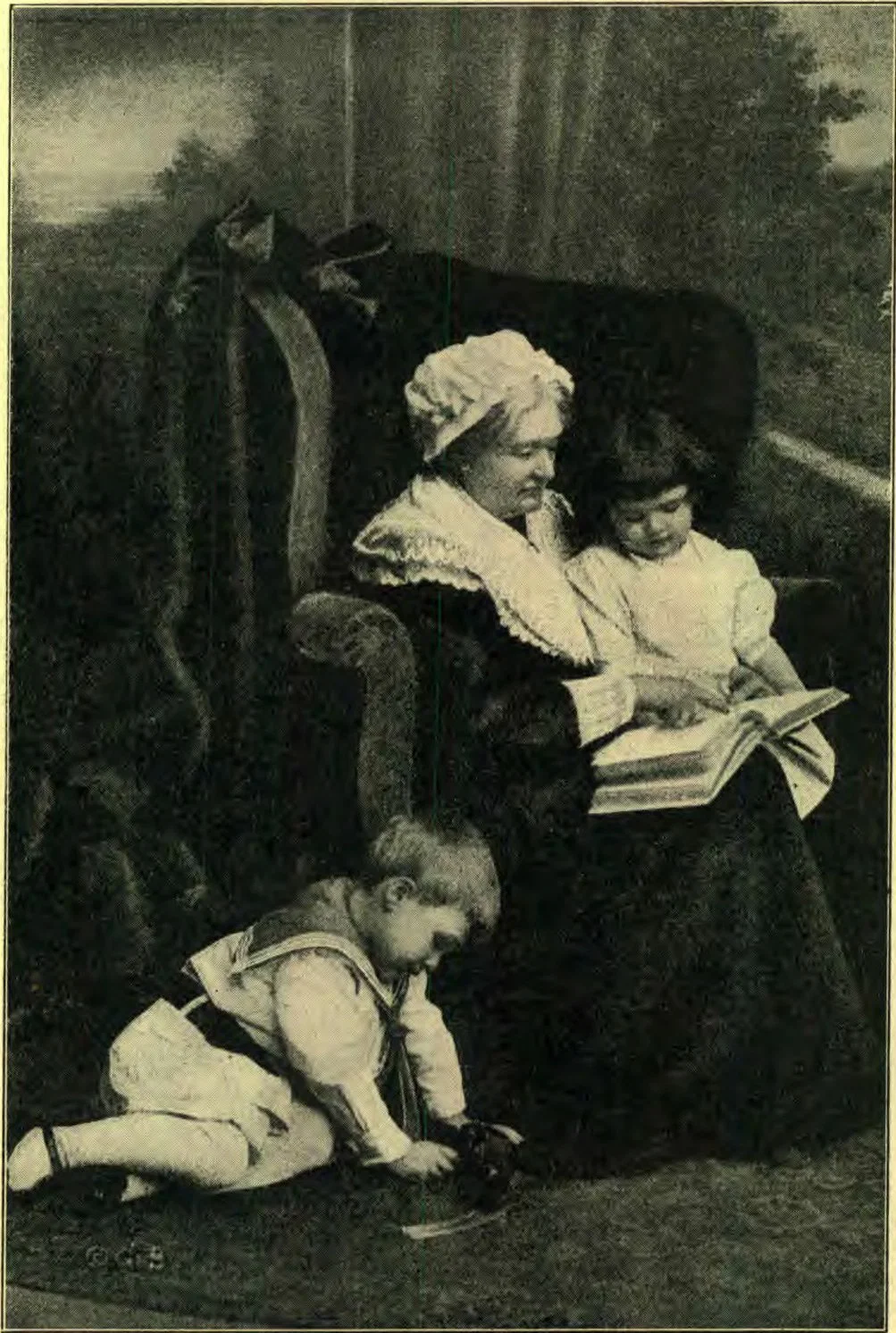
VISITING GRANDMA
VISITING GRANDMA

You have reached the end of this edition.

The Youth’s Instructor · Sep 4, 1917