The message given by the third angel of Rev. 14:9 is the latest warning the world will ever hear. It is immediately followed by the coming of Christ. Verse 14. In this last quoted verse the same scene is described as in Matt. 24:30 and Rev. 1:7. In Matthew this coming of Christ takes place after the signs of his coming have been given. Then it must be that when the third angel utters his warning, these signs have taken place, and they have something to do with the message. The coming of Christ is referred to in Rev. 1:7 in an ejaculatory manner, because it was the most important thing which John had seen; but this same coming is placed in its natural order of events at the close of the third angel's message of Revelation 14. From this scripture it is absolutely certain that before Christ shall come, there will be a world-wide warning against the worship of the beast and his image. This message will be proclaimed by the servants of God. The Lord will not come until such a work is done. The fact that such a message is now being proclaimed is an additional evidence that the day of the Lord is drawing near. The third angel's message threatens the “wine of the wrath of God” upon those who worship the beast and his image. It is stated that this wrath is to be “poured out without mixture.” This cannot be done as long as there is a mediator between God and man. Hence the message must be given in the closing days of time, and when Christ's mediatorial work is drawing to a close. All the wrath of God is contained in the seven last plagues, “for in them is filled up the wrath of God.” Rev. 15:1. So it is clear that the third angel threatens upon those who reject the warning the infliction of the seven last plagues. Notice that they are the last plagues. The third angel's message relates to the last things.
Worship consists of obedience to God. Said Jesus, “Why call ye me, Lord, Lord, and do not the things which I say?” Said Samuel, “Behold, to obey is better than sacrifice, and to hearken than the fat of rams.” I Sam. 15:22. The last message to the world is a call to repentance and true worship. The measure of success which will attend this work may be seen in two ways, (1) from the statement, “Here are they that keep the commandments of God, and the faith of Jesus.” Rev. 14:12. True worship is then restored, and under this message the commandments of God are kept; (2) Rev. 14:1 describes a company which come out from under the power of the beast, and who have the Father's name written in their foreheads. They sing a song of victory. The same company is described in Rev. 15:2, 3. This company may easily be identified with that of Rev. 14:1. Both companies have come out from under the power of the beast, and they sing songs of praise to God. They gained the victory over the beast and his image. They obtained this victory by heeding the warning of the third angel.
A reform upon the law of God must necessarily embrace every precept of that law. If any part of that law at the time this message is given, is being openly broken by the professed people of God, then the reform, which is the result of this message, will have a peculiar bearing upon that commandment. The fourth commandment has been thus treated. It has been turned into a day of common labor, and the day of the sun has taken its place. The third angel's message therefore gives especial attention to the fourth commandment, and in the work of preparation for the coming of the Lord, those who “keep the commandments of God” keep the Sabbath, which one of these commandments recognizes and commands. So when we read that under this message they “keep the commandments of God,” we can see that this statement includes the idea that they keep the Sabbath.
The third angel's message will divide the world into two classes,—those who serve the Lord, and those who serve him not. It ripens the harvest of the earth. It prepares some to say, at Jesus' coming, “Yea, in the way of thy judgments, O Lord, have we waited for thee; the desire of our soul is to thy name, and to the remembrance of thee.” Isa. 26:8. And again: “Lo, this is our God; we have waited for him, and he will save us.” Chapter 25:9. Those who reject the message will cry to rocks and mountains to cover them, and they will receive the unmixed wrath of God. How important is the third angel's message, which is now going to the world! Have our neighbors, friends, and acquaintances all been faithfully warned of what is coming upon the earth when this message shall close?
M. E. K.
THE OLD BIBLE.
By Joseph Parker
I have happily never had any doubts myself about the old Bible. Many men have their difficulties, and I would not say a word against honest men struggling for the truth; I am speaking in my own name when I say I accept the Bible as inspired, authoritative, and final. I believe in preaching constructively. If a man should say to me that the Bible is not in itself a revelation, but it contains one, I should say that is not the way I put it. It is a revelation struggling with the limitations of a book. I do not say a man is a body containing a soul, but a soul struggling against the limitations of a body. The Bible is literature and something more, and it is the something more that I want to get at. We do not want a new Bible; we want new readers of the old Bible. I have sometimes heard the Bible read in such a way that I have felt inclined to say, “Give me the book, that I may see who wrote it!” Sometimes (I will say this to the students) a very young and simple—oh, how simple—student gives in his list of books that he has read to his college tutors, and at the head of the list puts the Bible. And the heads of the college smile as they read it. Always put the old Bible at the head of your books. There is no oratorio like the Bible. Let it sing in your souls, and so unceasingly and loudly that no one can impose on you to deny it. The Bible is biblical. This is no paradox. It is a deep truth. Why do you not stand up for your Bible as a musician would stand up for his authority? I was recently present when a very young man was playing before a German professor some selections from Beethoven, when the professor suddenly jumped up, crying, “There are many opinions about the inspiration of the Bible, but there is no question about the inspiration of Beethoven! I will not stay here and hear you trying to improve on him!”—Joseph Parker.
The Spirit and Manner of a Minister
THE spirit and manner of a minister often effect more than the matter.— Cecil.
Philosophy Falls Short of Bringing Peace
PHILOSOPHY hath given us several plausible rules for attaining peace and tranquillity of mind, but they fall very much short of bringing men to it.—Tillotson.
A WALK.
By Persis P. Kellogg
O come and walk in the morning with me, And see the sweet things that I love to see— The stern old oaks with their towering forms Which so often have braved the winter's storms; The beautiful elms with their graceful limbs, And the wild birds singing their sweetest hymns!
And there is a brook which I love to cross, Where the rocks peep out from the daintiest moss, Where the little fishes are trying to hide From the children peeping close by its side; Its pebbles are white, and the water is clear; And it has a murmur I love to hear.
Then there is a bank with a carpet green, And a rustic seat 'neath the hanging screen Of a weeping willow's drooping shade; And the buttercup's blossoms are there displayed, And the violet lurks in the grass so cool, And the children rest on their way from school.
And then comes a hedge over which I peep, Where the apple-trees stand in the clover deep; And the blossoms flutter in every breeze, As they softly play ’mid the glossy leaves, Till the earth is robed in a mantle fair, As they sink to rest on her bosom there.
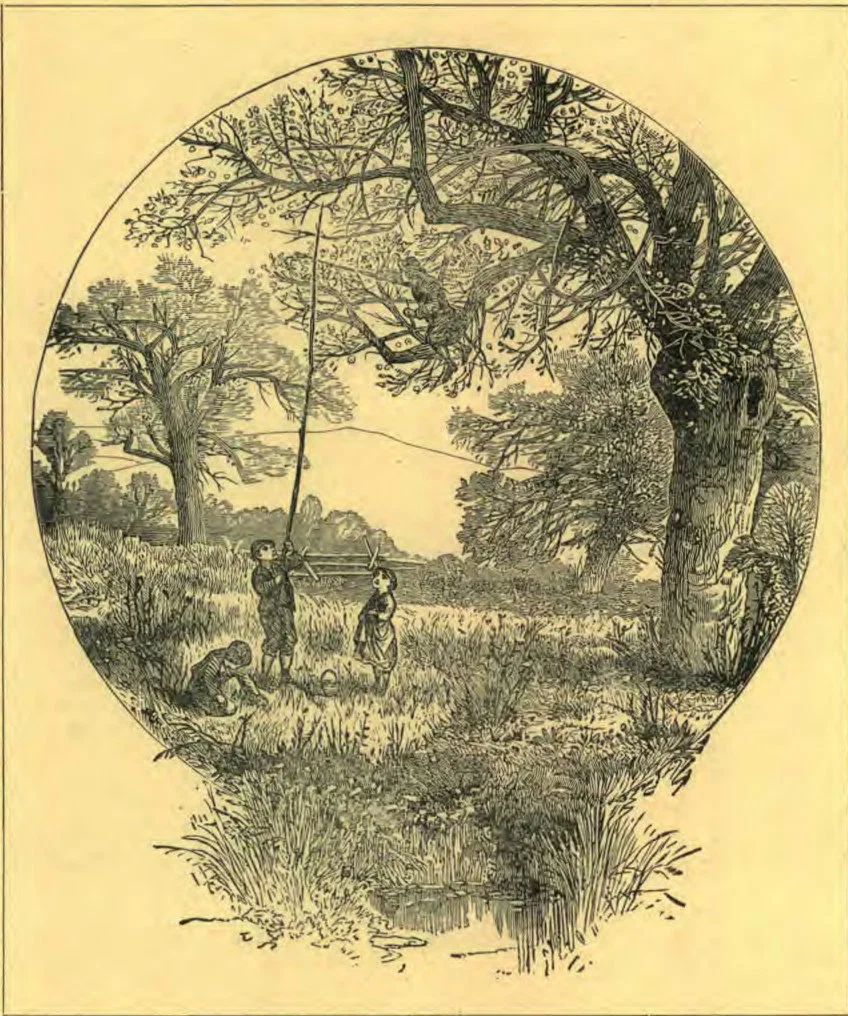
Then I look o'er a vine-clad wall, and see The innocent lambs in their playful glee, And their mother bleating close by their side, With a mother's love and a mother's pride; And swinging aloft in a chestnut tree, Some bright-eyed children are smiling at me.
And hastening on, through a gate I pass, And over a path fringed with brightest grass, Till I waiting stand in an open door, Where a child is playing upon the floor With beautiful tresses and azure eyes; And he smiles to see me, with glad surprise.
And he is a darling; would I could trace A picture but half as fair as his face, With his rosy cheeks and his teeth like pearls, With his forehead white and his golden curls, And his feet so tiny! his soft hands press My own in a loving and fond caress.
And my walk is over. I care not now For the lambs at play, or the apple bough, Or the rustic seat 'neath the shady tree, Where the grass and the flowers are fair to see, Or the singing brook and trees by the way; But I love the beautiful child at play, And of all sweet things which I hope to see, The sweetest of all is that child to me.
PERSIS P. KELLOGG.
RAGGLES
By J. E. Stevens
Raggles was only a scrubby little Indian pony. His owner had evidently considered him of no use, and had cruelly turned him loose on the bare prairie to shift for himself. He was a sorry-looking little fellow, as he stood one morning at the gate to Mr. Hudson’s large cattle ranch, in western Kansas, shivering in the wind, and looking with a wistful gaze at the slick, fat ponies inside.
Mr. Hudson noticed him, and started to drive him away; but his little daughter Lillian said: “Let him in, papa; he looks so hungry.” Mr. Hudson opened the gate, and the pony walked in, just as if it were his home. Mr. Hudson made inquiries, but no one knew anything about him; and as no owner ever came to claim him, Lillian claimed him as her special property, and named him Raggles, on account of his long, tangled mane and tail. He was a docile little creature, unlike the rest of the ponies on the farm. He soon came to regard Lillian as his mistress. She learned to ride him, and could often be seen cantering over the prairies with her father. But Raggles seemed to think that she was not much of a rider; for he would carefully avoid all the dangerous-looking places and holes in the ground made by coyotes and prairie dogs, which were very plentiful in western Kansas.
When the next spring came, Raggles did not look like the same little scrub. His rusty brown coat had all come off, and a new black one had taken its place. By the next fall the neighborhood could boast of a public school, and when Lillian began to go, Raggles found he had a regular duty every day.
Lillian would saddle him, and ride to the school-house, which was two miles away, then tie up his bridle, and send him home. At about half-past three, Mr. Hudson would saddle him again, and send him for Lillian. He always arrived on time; and if he was a little early, he would wait patiently by the door until school closed.
Some of my readers will remember the blizzard that struck western Kansas in 1885, when so many people lost their lives, and thousands of cattle were frozen to death. The storm commenced about noon, and the weather grew steadily colder. The snow blew so thick and fast that Mrs. Hudson was afraid to trust Raggles to go for Lillian, but Mr. Hudson was sick, and there was no one else. She went to the barn, put the saddle on him, and tied plenty of warm wraps on. Then she threw her arms around his shaggy neck, and told him to be sure to bring Lillian home. He seemed to understand, and started out with his shambling trot in the direction of the school-house.
One hour passed slowly to the anxious parents. When two had passed, their anxiety was terrible, as they strained their eyes to see through the blinding snow the shaggy form bringing their darling safely home. At last he came with Lillian on his back, bundled up from head to foot.
The teacher had fastened her on the pony, and given him the reign; and so he had brought her safely home, none the worse for her ride except being thoroughly chilled.—J. E. Stevens, in Our Dumb Animals.
THE STORY OF A RICH MAN.
MANY years ago a lad of sixteen years left home to seek his fortune. All his worldly possessions were tied up in a bundle, which he carried in his hand. As he trudged along, he met an old neighbor, the captain of a canal boat, and the following conversation took place, which changed the whole current of the boy’s life.
“Well, William, where are you going?”
“I don’t know,” he answered; “father is too poor to keep me at home any longer, and says I must now make a living for myself.”
“There is no trouble about that,” said the captain. “Be sure you start right, and you’ll get along finely.”
William told his friend that the only trade he knew anything about was soap and candle making, at which he had helped his father while at home.
“Well,” said the old man, “let me pray with you once more and give you a little advice, and then I will let you go.”
When the boy arrived in the city, he found it hard to get work. Lonesome and far from home, he remembered his mother’s words, and the last words of the canal-boat captain. He was then led to seek first the “kingdom of God and his righteousness.” He remembered his promise to the old captain, and the first dollar he earned brought up the question of the Lord’s part. In the Bible he found that the Jews were commanded to give one tenth, so he said: “If the Lord will take one tenth, I will give that.” And so he did, and ten cents of every dollar was sacred to the Lord.
Having regular employment, he soon became a partner, and after a few years his partners died, and William became the sole owner of the business. He now resolved to keep his promise to the old captain. He made an honest soap, gave a full pound, and instructed his bookkeeper to open an account with the Lord, and carry one tenth of all his income to that account. He prospered, his business grew, his family was blessed, his soap sold, and he grew rich faster than he had ever hoped. He then gave the Lord two tenths, and prospered more than ever. Then he gave three tenths, then four tenths, and then five tenths. He educated his family, settled all his plans for life, and gave all his income to the Lord. He prospered more than ever.
This is the story of Mr. William Colgate, who has given millions of dollars to the Lord’s cause, and left a name that will never die.—Selected.
THE SKIN.
By David Paulson
Nearly every one has been so unfortunate at some time in his life as to lose a greater or less portion of skin, either by some severe burn or other accident. All such persons remember very distinctly the severe pain that they had to endure when the wounded portion of the body came in contact with anything else, or was exposed to the air. The reason for this is that the skin which had previously so tenderly protected the thousands of little nerves ending in the deeper layers of it, are now left exposed, and they cannot accommodate themselves to their changed surroundings, and so shriek out their distressed feelings. In cases of serious burn the physician attempts to ease these delicate nerves by artificially supplying the place of the skin by spreading over the exposed surface an oily substance, or by keeping it constantly immersed in water, and often the nerves take so kindly to this that but very little more pain is experienced, though this is not always the case.
Those who have suffered a number of times in this way may have been led to suppose that the chief use of the skin was for protection; while the real facts are that there is scarcely a portion of our bodies that has so many and varied functions as the skin. Our bodies are furnaces that constantly throw off heat, as we become painfully aware when crowded into close churches or other public gatherings. The largest portion of this heat passes out through the skin. It is evident that if there was no way of regulating this heat, the body would not be able to retain a uniform temperature; but the temperature of the body varies scarcely a fraction of a degree in the scorching heat of summer or in the coldest winter. No heat regulator of human invention has ever yet been devised that could maintain so uniform a temperature under such varying circumstances.
Upon the skin devolves the important and delicate work of regulating the body temperature. The deeper layer of the skin is abundantly supplied with small blood-vessels. The size of these, and consequently the amount of blood that can come near the surface, is controlled by the nervous system. An illustration of this is the common phenomenon of blushing. When the nervous system recognizes that the body is storing up the least particle too much heat, then it allows the blood-vessels in the skin to expand, and so more blood comes near the outside, where it can be cooled. The flushed appearance of a person who has been exercising vigorously is a good illustration of this. To make this cooling-off more effective, the nerves at the same time stimulate millions of little sweat glands, which are located in the deeper part of the skin, to steal away a little of the liquid portion of the blood, and pour it out on the surface, and the resulting evaporation helps materially in the cooling process.
Another important function of the skin is that of being a sewerage system for a large portion of the poisons that are constantly manufactured in our bodies. There are several million of these little sewers through our skin, and it has been estimated that the skin of one person contains enough of these so that if they were put end to end, they would form a minute tube two and a half miles in length. Although so small, each one of them performs the work more satisfactorily than the best sewerage system which has been devised by man. Through these minute openings pass daily from two to four pounds of fluid heavily laden with poison. We do not realize that the amount is so large, because the most of it is at once taken up by the air surrounding us. It is only when the atmosphere around us is already nearly saturated with moisture, or the body has to throw it off more rapidly than the average rate, that we really become aware of this; and then we are said to sweat, while in the strict sense of the word, we really do so all the time.
In every part of the human body the tracing of the divine finger can be seen, and the skin furnishes much in its many functions that displays the love and wisdom of the Master Artist. DAVID PAULSON, M.D.
HOW AND WHY A GLACIER MOVES.
Every one knows that a glacier is a great river of ice, which, taking its rise among Alpine snows, moves slowly down some valley till it reaches a warmer place, where it melts and flows away as water. Even those who have seen glaciers, however, scarcely realize how similar in many respects the flow is to that of a liquid. Water flows rapidly down a slope; molasses flows more slowly, but its movement is none the less a true flowing. The ice-mass of a glacier is more leisurely still; but its motion is like the yielding flow of a very viscous liquid, not the steady push of a solid mass. In Knowledge, of March 1, P. L. Addison tells of one of the theories put forth by scientific men to explain this curious plasticity of large ice-masses. It is, perhaps, that which is now accepted by the largest number of authorities, and is not materially different from the theory of regelation put forth by Tyndall in his “Glaciers of the Alps.” We quote the principal parts of Mr. Addison’s article below:—
“It is hardly necessary to point out that a glacier does not slide down the valley which contains it. The well-proved differential movement, the inequalities of the ground over which it passes, and the bends round which it has to turn, render sliding motion impossible. And besides this, the apparently rigid glacier creeps down slopes on which soft clay or loose shingle remain practically immovable.
“If we examine a piece of ice, say for example an icicle, we find that it is exceedingly brittle; if thrown down upon the ground, it breaks into many pieces. A piece of soft clay can be bent or compressed into any shape with ease, and yet an ice-sheet, of exactly the same composition as the icicle, will steadily flow down slopes so gentle that soft clay will stand on them without moving at all. When a bed of clay moves down a hillside, the particles of which it is composed slide past and roll over each other, till they come to a state of rest at the bottom, but as the ice could not behave in this manner, other causes must be sought to account for glacier motion.
“There is a peculiar irregularity in the movement of glaciers which probably first led to the discovery of the cause, and this is that the motion is quicker during the day than at night, and the summer rate is often double that attained during the winter. This shows that pressure from behind cannot be the cause of the motion; for, through the greater accumulation of ice and snow on the higher levels, the pressure must be greater during the winter season when the movement is least. The fact that the motion of the ice-sheet is greater during the day than in the night, and in summer than during winter, naturally leads us to conclude that heat must indirectly have something to do with the phenomenon; for the movement is greatest during that part of the twenty-four hours when the ice is subjected to the sun’s rays, and in the warmer seasons of the year. An examination of the physical properties of the glacier will show how it can be affected by heat and yet, as a mass, remain in the form of ice.
“When a thin slab of ice is subjected to microscopical examination, it will be seen that it is not, as it appears to the naked eye, a homogeneous mass of solidified water, but a confused agglomeration of minute crystals, with cavities equally minute lying between them. A glacier is simply water in a crystalline state, and any motion in the mass involves the movement of the crystals of which it is composed.
“It has already been mentioned that the flow of the ice-sheet is quickest at the center and on the surface, and slowest at the bottom and against the sides of the valley; it follows, therefore, as the motion is differential, that the ice crystals in the center of the glacier must pass by those composing the sides and bottom. This appears to raise a difficulty, for if the minute crystals were to crush past one another, owing to their traveling at different speeds, they would soon be ground to a fine powder. This does not, however, take place, and the ice-sheet remains a solid and brittle mass.”
According to the theory that Mr. Addison is here expounding, the crystals move by melting and then recrystallizing under the influence of energy imparted by the sun, just as the crystals of snow in a snowball melt and recrystallize under the warmth and pressure of the hand, making the mass of thousands of solid snow crystals act like a plastic substance. Says Mr. Addison:—
“The method may be thus described: The heat of the sun melts the ice on the surface of the glacier, and it contracts in bulk on becoming liquid, and flows downward by the aid of gravitation into the interstices between the ice-crystals below. Here the water is no longer influenced by the sun’s rays, and again becomes crystalline; but the crannies and corners into which it has found its way are not suitable in shape to contain it in the form of crystals, and therefore in parting with its heat it employs that irresistible force due to crystallization to make the cavities larger. In other words, it pushes away the molecules surrounding it down the path of least resistance. But we must not forget that the molecules of water on becoming recrystallized part with latent heat. This heat is taken up by adjacent molecules of ice, which, in their turn, become water, flow downward and exert pressure in the process of recrystallization. Thus, little by little, and from molecule to molecule, the heat derived from the sun is transmitted through the length and breadth of the glacier. The action is not at one place alone, but permeates the whole mass. We must look upon the glacier as an agglomeration of moving molecules, which, having utilized gravitation to enable them to flow downward when in a liquid state, follow up that movement by an overpowering pressure produced during their process of recrystallization.”—Public Opinion.
A Good Christian Ever Praying or Praising
“A GOOD Christian,” says Trapp, “is ever praying or praising; he drives a constant trade betwixt earth and heaven.”
RESPONSIBILITY
By Carlyle
It is a high, solemn, almost awful thought for every individual man, that his earthly influence, which has a commencement, will never through all ages, were he the meanest of us, have an end! What is done has already blended itself with the boundless, ever-living, ever-working universe, and will also work there for good or evil, openly or secretly, throughout all time. But the life of every man is as the well-spring of a stream, whose small beginnings are indeed plain to all, but whose ulterior course and destination, as it winds through the expanses of infinite years, only the Omniscient can discern. Will it mingle with neighboring rivulets as a tributary, or receive them as their sovereign? Is it to be a nameless brook, and will its tiny waters among millions of other brooks and rills increase the current of some world's river? or is it to be itself a Rhine or Donau whose going forth is to the uttermost lands, its flood an everlasting boundary-line on the globe itself, the bulwark and highway of whole kingdoms and continents? We know not; only in either case we know its path is to the great ocean; its waters, were they but a handful, are here, and cannot be annihilated or permanently held back,— Carlyle.
WHAT IS A DUDE?
THE above question has been answered many times, and still new definitions are forthcoming. The following from the Religious Telescope is the latest, and one of the best:— “A dude is not a person; it is only an ‘it.’ How does it behave?—It walks upright, poses before mirrors, strikes an attitude, and—stands. How does it occupy its time?—In holding perpetual self-admiration societies. What is it good for?—For consuming hair-oil, perfume, cigars, and wearing fine clothes. What does it live on?—Self-conceit and self-admiration and its father’s money. Does it benefit mankind?—Slightly. How?—By demonstrating to sensible young men and women how silly it is to be a dude. Can you think of any practical use that could be made of it?—Well, yes. What?—It could be shut up in a glass case to be kicked to death by butterflies. The performance would amuse the spectators and be a good gymnastic exercise for the winged caterpillars. Young man, don’t be a dude. For pity’s sake, don’t!”
JACK'S RESOLVE.
"If I were the king of a country as wide
As the sky on a bright summer day,"
Said Jack with a nod, as he hunted about
In a wearied-to-death sort of way.
"And my wealth and my power were limitless quite,
To do just the thing I might choose,
Do you know what I'd get with the gold that I had?
How that wonderful power I'd use?
"I would give the last cent that I had in the world,
And I'd add my crown to the cost,
For a pencil," said he—then he paused with a smile—
"For a pencil that couldn't get lost."
— Little Men and Women.
SPIRITUAL VISION.
By Dr. A. B. Leonard
THE writer once heard an octogenarian relate his experience in a love-feast surrounded by people who had known him for many years. He spoke in trembling tones, substantially as follows: “My neighbors and friends, I am an old man; my race is nearly run. Many of you have known me for a long while, but you will soon know me no more. My eyes are so dim that I can scarcely recognize your forms, my ears are so deaf that I cannot hear your testimonies. My steps are so infirm that it is with great difficulty that I have reached this house of worship; but I desire to testify once more to the abiding experience of salvation. With my spiritual eyes I see clearly, with my spiritual ears I hear distinctly the voice of the Spirit bearing witness to my spirit that I am a child of God, and I am running more swiftly than ever in the way that leads to heaven.”—Dr. A. B. Leonard.
Lincoln’s Memory for History.
Among the incidents of Mr. Lincoln which the world will probably longest remember is that recorded by Alexander H. Stephens, one of the three commissioners, who, afterward writing of the event, said that Mr. Hunter made a long reply to the president’s refusal to recognize another government inside of that of which he alone was president, by receiving ambassadors to treat for peace. “Mr. Hunter,” says Stephens, “referred to the correspondence between King Charles I and his parliament as a trustworthy precedent of a constitutional ruler treating with rebels. Mr. Lincoln’s face then wore that indescribable expression which generally preceded his hardest hits, and he remarked: ‘Upon questions of history I must refer you to Mr. Seward, for he is posted in such things, and I do not pretend to be bright. My only distinct recollection of the matter is that Charles lost his head.’”—Century.
HOW THE PHONOGRAPH WAS DISCOVERED.
How many of the greatest inventions of the world have been discovered by accident. The story of Watt and the tea-kettle is too well known to be repeated. Photography is another invention, which in its first inception by M. Dugarre, was the result of an accident. The same is true of that wonder of modern inventions, the phonograph. The inventor, Mr. Edison, describes the way he discovered the principle of the phonograph, in the following manner:—
“I discovered the principle by the merest accident. I was singing to the mouthpiece of a telephone, when the vibrations of the voice sent the fine steel point into my finger. That set me to thinking. If I could record the actions of the point, and send the point over the same surface afterward, I saw no reason why the thing would not talk. I tried the experiment first on a strip of telegraph paper, and found the point made an alphabet. I shouted the words ‘halloo! halloo!’ into the mouthpiece, ran the paper back over the steel point, and heard a faint ‘halloo! halloo!’ in return. I determined to make a machine that would work accurately, and gave my assistants instructions, telling them what I had discovered. They laughed at me. That’s the whole story. The phonograph is the result of the pricking of a finger.”
MEETINGS FOR THE YOUNG AT THE UPPER COLUMBIA CAMP-MEETING.
By W. F. Martin
Two meetings for the young people were held each day, one at 5:30 A. M., and the other at 4:30 P. M. The morning meetings were altogether devotional, consisting of prayer and social services, while the afternoon meetings were taken up in giving instructions on various lines of practical godliness. A good spirit pervaded the meetings from the beginning, and the most of those present expressed a strong desire to draw near to God, and the blessing of the Lord was earnestly sought. Never have we seen young people more faithful in seeking God in prayer, and testifying for him. Much of this is to be attributed to the influence of the school the past year. However, those who have not had the privilege of the school shared the blessing.
Professor Sutherland occupied several afternoons in giving good instruction on practical themes. Oftentimes our young people go to camp-meeting to receive much benefit, but they do not retain what they have gained after they return home. We tried to guard against this tendency, and things which would be of lasting good were presented to them. Several inquiry meetings were held, which resulted in good to those who attended them. While there was no special excitement, we often felt the deep movings of God’s holy Spirit. The Upper Columbia camp-meeting of 1895 will be remembered by many young people as a time and place where much of God’s blessing was received. It is to be hoped many of them were better fitted to take up the battle of life anew, and work for God. W. F. MARTIN.
HORSE BEEF.
THE high price of beef and the remarkably low prices for which horses are now sold are having the effect to stimulate the horse meat industry. A regular horse meat packing-house has been established at Portland, Oregon. The horses used here are mostly canned or pickled, and are sent to foreign markets. It is reported that great Percheron horses, which show a perfect adaptability for farm work, are brought to Portland and slaughtered for beef! While the most of this meat now goes to Europe, it will be only a question of time before horse meat will win the favor of our epicures. It may even become a fad to have horse-meat festivals. A pork-eating people certainly cannot object to the horse, or even to the mule, on the ground that it is unclean. So we may expect that by and by, when we take our seat at the dinner-table of the hotel or restaurant, and the waiter rattles off his almost unintelligible jumble of the bill of fare, to hear along with the rest, the words “equine steak.” No, thank you, we wont have any on our plate.