The Youth’s Instructor, Vol. 48, No. 33.

From the Bay Islands

The Youth’s Instructor

Aug 15, 1895

S. D. A. Publishing Association · Battle Creek, Mich. · Aug 15, 1895

FROM THE BAY ISLANDS.

IN the month of November, 1891, Elder F. J. Hutchins and his wife landed at Coxen Hole, Ruatán, and at once began the preaching of the gospel. The Lord graciously blessed every effort put forth. The good work went on until Bonacca, one of the Bay Islands located in the Honduras Bay, an arm of the Caribbean Sea, has a Seventh-day Adventist church and building. Later a respectable school building was erected near the church.
Four weeks after our arrival, July 4, 1894, the clear tones of the church bell called together those interested in the subject of education. After singing “Great is the Lord, and Greatly to be Praised,” Psalm 127 was read, and then many of those present feelingly expressed their gratitude to God for the privilege of meeting on such an occasion. Elder Hutchins addressed the audience in behalf of the new enterprise, setting forth the great benefits to be derived from a thorough Christian education. There are some in this place who have for some time desired to see a school established for the training of the youth. These hailed with delight its opening. The parents, whose eyes were dimmed with tears of gratitude, retired at the close of the exercises, and we were left alone with those who desired to become students of the school. Since the supplies that had been shipped in May had not yet reached us, it became necessary to use what stray books could be found. Scarcely any two of these books were alike, still we were compelled to use them for nearly three months.
Six months having passed away, all were anxious again to meet in the school-room the faces of parents and friends, showing them something of what had been accomplished. July 4 we determined to entertain our friends by celebrating the school’s first anniversary. Early in the morning of July 4 several of us went to the island in search of decorations. After rambling among the “bush,” being bitten by sand-flies and bottle-flies, we retraced our steps to the beach where the little skiff “Dido” lay moored. Soon we were landed safely on the cay, when willing hands quickly and carefully placed our vines, branches, buds, and blossoms in the school-room. Now came the pleasant task of adorning the building. This being done, the dear old room had the appearance of some fairy palace. Over the rostrum gracefully hung the “stars and stripes,” also the flag of Honduras, blue, white, and blue. Under the flags was placed an organ belonging to one of the students. Several of those studying music favored us with pretty little instrumental selections. It was a pleasant sight to see the entire school, numbering about forty, stand in order on the platform and hear them chant,—
“We are happy and rejoice, giving thanks with heart and voice, And we join the swelling chorus, singing loud and clear,” etc.
The building is unceiled, and in the center, reaching across from rafter to rafter, was hung a large banner bearing the motto,— “BLEST UNION: LEARNING, LOVE, LIBERTY.”
The letters of the motto were about eight inches in height, being covered with cotton batting, then placed on the dark colored banner, and entwined with vines and bright-hued red and yellow blossoms. The effect in the lamplight was very pretty. During the exercises we joined heartily with the children in the celebration of this the school’s natal day, still we did not forget our native land, this being the day when the colonists declared their freedom. The program being finished, all returned to their homes with smiling faces and apparently with lighter hearts.
It is evident that the Lord is prospering the educational work in this place. Within the last few months several of the older children have enlisted for the first time in the Christian warfare. In our children’s meetings they often express themselves as being desirous of becoming missionaries. If they continue faithful, there is certainly no reason why some of them may not be useful laborers in the great harvest-field. There are also three or four adult members of the school who are struggling hard to fit themselves for usefulness.
When glancing over the vast territory of Central America and the West Indies, that as yet has received so little help, we feel like joining in the sentiment expressed below:—
“Work is abundant, the promise is great. Few are the reapers; in sadness they wait, Patiently toiling, yet daily they cry, ‘Pray ye that our Lord and Master reapers supply.’”
A discussion of the Central American field is found in the July number of the Sabbath-School Worker. Let us give our attention to the broad expanse of blue sea stretching from the southern coast of North America to the northern coast of South America. Here, in the midst of the Caribbean Sea, lie the West Indies. They consist of large and small islands, numbering in all about one thousand. An eminent writer in describing this region says, “Rare plants, palms, ferns, creepers, and flowers of dazzling beauty and enchanting perfume grow on every side in the most luxurious profusion; majestic forests of tropical trees cover its valleys and plains, and the abundance of its vegetation reaches to the mountain summits, and clothes them in verdure. Birds of fine plumage, such as the mocking-bird, the ruby-topaz, the emerald crested humming-bird, the crimson maize-bird, and hundreds of other varieties of land and water birds, are found in extravagant numbers. Wild animals are rarely found, and only of the smaller species.”
The geographical divisions are the Bahamas, Greater Antilles, and the Lesser Antilles. The Bahamas, having a loose, shallow soil, with a smooth, low surface, are of coral formation, and export largely sponges, shells, and arrowroot. Their climate is not disagreeably warm. Owing to the trade-winds and to the abundance of water surrounding them, the climate of the islands of the West Indies is not so warm as their tropical location would indicate.
The Greater Antilles comprise Cuba, Hayti, Jamaica, and Porto Rico. Cuba, a Spanish colony, known as the “queen of the Antilles,” ranks first as a sugar-producing country. Its capital, Havana, possesses one of the finest harbors in the world, and in the New World it stands second in the extent of its foreign commerce.
The Lesser Antilles include the Windward and Leeward groups. The Bermudas are worthy of mention, for here are located some health resorts. On these islands houses are often erected completely of blocks of coral, which if subjected to a single frost, would crumble to the ground. There is Barbadoes, a British naval station, the most densely populated island in the world. The island of Trinidad, with its pitch lake and mud volcanoes, is the burial-place of one of our faithful laborers who was a victim of yellow fever.
Cuba, with its fifteen hundred thousand inhabitants, a near neighbor to the United States, knows nothing of the third angel’s message. Then think of the West Indies as a whole, whose five million people are, comparatively speaking, without the light of the gospel. Let us take the nickels we had planned to spend for the gratification of pride and appetite, and put them into the Sabbath-school donations of the present quarter, three thousand dollars of which have been set apart by the General Conference for the building of a vessel to carry the gospel’s joyful sound from island to island in the Caribbean Sea. When you are passing down the street and see in the show-window something that pleases the eye, though the value may be but a trifle, save your penny for the mission box. Shall not the children in their innocence, the youth in their strength, and the aged in their weakness, come “to the help of the Lord against the mighty”?
ADA B. MILLER.

BREATHE THY SPIRIT.

“And when he had said this, he breathed on them, and saith unto them, Receive ye the Holy Ghost.” John 20: 22.
Loving Saviour, breathe thy Spirit Deep in every willing heart; Give to all thy free salvation, That from thee none e'er depart.
Let all taste the living water Flowing from thy throne above; Feed them with the hidden manna; Prove to all thy gracious love.
Write thy law with burning letters, Firm and true on each one's heart; Tear from it all earthly fetters, And to each thy strength impart.
Let thy holy grace inspire us Each to do thy perfect will; Put thy loving arm around us; Lead us on to Zion's hill.
MRS. EMMA MORRIS COPPAGE.

HOMES FOR THE FEEBLE MINDED.

(Concluded.)
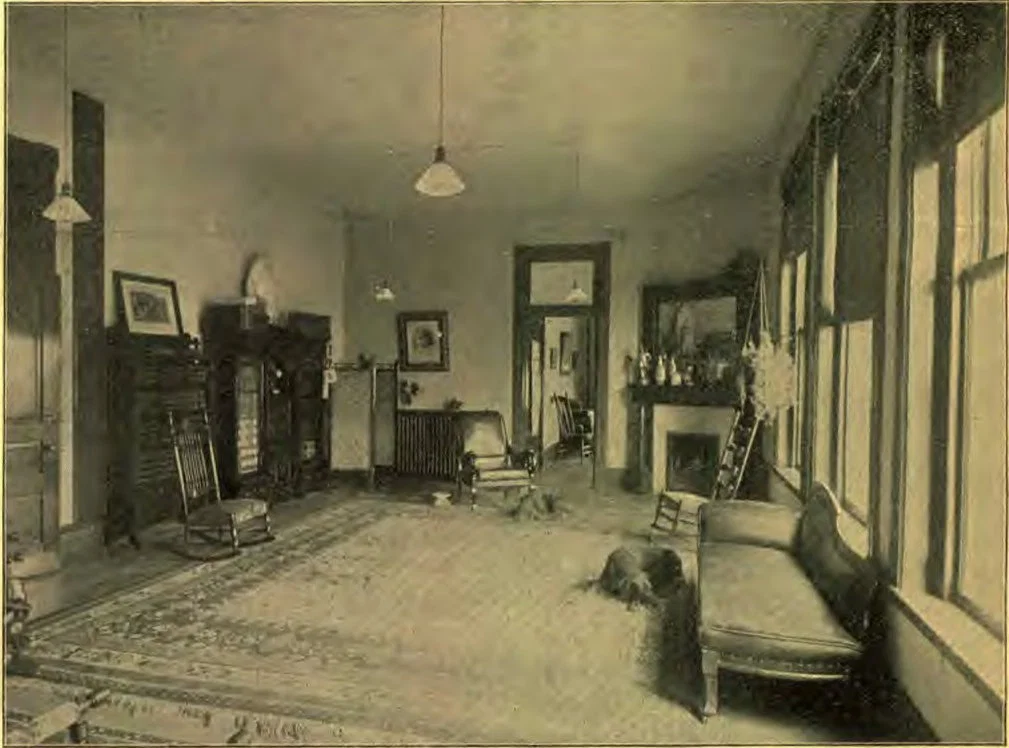
PLEASANT parlors are provided, with musical instruments and pleasant pictures to turn the mind from self to the beautiful things of nature; but many sit within these surroundings apparently as miserable as though they were among the tombs of Palestine. Still there is consolation to their friends, that their bodies are protected from severe exposure, even if their minds do not perceive the conveniences with which they are surrounded.
As we behold these sad things, we exclaim, “Come quickly, Lord Jesus.” Every year the numbers of the insane increase. Nearly every asylum in the land is filled to overflowing. Few ever go out from these institutions as sound in mind as before they became insane. It is like a deep wound which leaves a scar for life. Many take their own lives, or soon pass away from the effects of some incurable disease. Many hearts are made sad, both among rich and poor, by the confinement of some loved one in these institutions; but the world moves on, and things grow worse instead of better. The only remedy that is effectual is for Jesus to come to this earth and bid sin and disease depart forever, and take his children to himself. How earnestly every child of God should work to help complete the last work for the world, so that the Life-giver may come and open every insane asylum, and the graves as well, and liberate all that are in anywise bound by sin.
This world is groaning under the curse, and the Lord is working upon hearts, preparatory to sounding forth the edict, “He which is filthy, let him be filthy still: and he that is righteous, let him be righteous still: and he that is holy, let him be holy still. And, behold, I come quickly, and my reward is with me, to give every man according as his work shall be.”
J. H. D.
PARLOR OF INSANE ASYLUM, JAMESTOWN, NORTH DAKOTA.

A FEW NOTES FROM AFRICA.

It is not many years since Africa was a synonym for all which is dark and forbidding; and no doubt in many minds this is still true, nor are we disposed in any way to argue that there are no adequate grounds for this conception. It has been fitly termed the “dark continent.” It has dark places without number, which are “full of the habitations of cruelty.” Millions of fierce savages wander over its trackless wastes and unexplored regions. Lying as it does so largely in the torrid zone, it is very difficult for the gospel missionary to penetrate into those dark regions. Seemingly the curse rests more heavily on this continent than on any other. There are vast arid regions where no animal life can exist, and malarial districts where it is almost impossible to withstand the deadly miasma; but in spite of the many contingencies which exist, God, who from the “place of his habitation” is looking upon all the inhabitants of earth, is in his providence opening the way by which the heralds of the cross can plant the banner of Emanuel’s kingdom in all portions of the continent. Notwithstanding the fact that there are unhealthful climates, droughts, and plagues, the country is rich in diamonds, gold, and grazing districts. Men in search of the gold which perishes, are pushing into the interior, and immense sections of country, in the heretofore unknown regions, are being opened up.
Railways have been constructed among the mountains, and across the plains of Cape Colony, Natal, Orange Free State, and the Transvaal, and they are now being pushed farther and farther inland. The railways are conducted on the same general plan as those in England, and in many respects they are more convenient for this country than American railways would be. The “up country” trains must ascend heavy grades, and engines of tremendous power are employed on some divisions. The mail and passenger trains, all things considered, make fairly good time. Saloon carriages are run, and the traveler is made very comfortable. The trains which carry freight are called “goods trains.” Where the railway lines have not yet penetrated, and perhaps never will, other means are provided for the transportation of passengers, as, for instance, the “post cart,” which conveys mail and passengers. These carts are drawn usually by four or six horses. At intervals the tired horses are changed for fresh ones. The roads are generally very rough, and making a journey in one of these carts is an experience which does not soon fade from the memory. Some six or eight passengers are jammed into close quarters, and in addition to the inconveniences experienced, an exorbitant sum is charged for transportation.
Last, but not least, I will mention the ox teams, which are used chiefly for the transportation of goods. The wagons are of tremendous size, weighing some three thousand pounds, and costing about four hundred dollars. Many of them are covered with a good awning, and if you are not in a hurry, they make a very convenient conveyance from place to place.
The team is called a “span,” and consists generally of sixteen large bullocks. Four tons is considered an ordinary load, but considering the condition of the country through which they go, it is a very heavy load. These “transport wagons” are the “goods trains” of the districts where the railways do not run. The drivers “out span” wherever night happens to find them, and the bullocks are turned loose to graze. As a rule, this is all the food they receive. It is oftentimes a sad sight to witness the way these dumb beasts of burden are made to suffer from the cruel lash of the drivers, who whip them without mercy.
GEORGE B. THOMPSON.

CHRIST'S PARTING WITH HIS MOTHER.

Did you ever think of it? There came a day when our blessed Master had to do this very same thing, and no wonder if he was thinking within himself, Will this man stand or will he fall, when he comes to what cost me so much?
There came a day when Jesus rose — remember that he is as human as ourselves; Mary had schooled herself for it, but just like a death, no matter how long you have seen it traveling to you, when it comes, it seems as if you had no preparation — when he rose that day and said, “Mother, good-by; I am going away.” He is not forgetting how Mary rose in her frenzy, and threw her arms around him, and said, “My son, you don’t mean to say you are going away?” “Now, mother,” he would say, “be calm; you know we have often talked about this, my hour has come, I must go.” “But, my son, you will be back again?” “No, mother, I will never be back.”
And he is remembering, not forgetting, what it cost him to unclasp Mary’s arms, and set her back a bit, that he might bring you and me as near. Don’t misunderstand him; he knows it all, he has gone through it all. It is because he is so full of sympathy that he has to be a little cruel to be kind. “Break every tender tie, Jesus is mine.”
And if you lose anything or anybody in making an immediate, irrevocable decision for Christ before you go back to business, remember it is well lost — anything that would keep us back from an immediate surrender to Christ and to his service.
“Get thee behind me, Satan: thou art an offense unto me: for thou savorest not the things that be of God, but those that be of men.”
Who is my mother and my sister and my brother? Those that know the will of God and keep it.—Rev. John Mc Neill.

Our Greatest Glory Is Rising Again

OUR greatest glory is not in never falling, but in rising every time we fall.—Confucius.

THE HORR AND HARVEY DEBATE.

The numerous discussions and debates in the public press and in other ways upon the subject of finance, which have been a leading feature of the present political outlook, have at last led to a set debate between the chosen champions of those who may be called the gold and silver men. The publication of a little book called “Coin’s Financial School,” by W. H. Harvey, of Chicago, is the cause of this discussion. The debaters are Roswell G. Horr, formerly United States senator from this State, and now of New York City, and the author of the aforesaid book. The discussion involves the merits of the book, but it is not confined to that. It was opened July 16 in Chicago, in the presence of a large number of invited guests. The whole debate is being reported and published more or less fully all over the United States.
The difference of opinion between the debaters and those whom they represent may be briefly stated. Mr. Horr is a bimetalist,—that is, he believes in the use of both gold and silver for money,—but he believes in a single standard for money, and that that standard should be gold, as it now is. So as far as the standard of money is concerned, he is a monometalist. With him silver serves a good purpose as subsidiary coin, the same as copper. He holds that the demonetization of silver in 1873 was a wise action, to place the monetary system of this country in harmony with the systems which obtain in other countries, and that our monetary system should be regulated by the customs of other nations. Mr. Harvey is also a bimetalist, but he holds that silver as well as gold should be primary money, as it was before 1873; that the act of 1873, by which silver was demonetized, and lost its character as money, was a “crime”; that it was passed in a surreptitious manner, the majority of those who voted for it and favored it not knowing what the result would be; that this demonetization of silver has worked incalculable injury to the people of the United States; and that to remedy what has been done, this country should immediately remonetize silver, and open the United States mints to the free coinage of silver and gold at the old rate of sixteen to one. (By “sixteen to one” is meant that a fixed weight of gold shall be equal in value to sixteen times that weight in silver.) Great interest is being awakened by this debate, and the disputants are cheered by the unstinted applause of their friends.
Three points have been made very clear by this discussion,—that the silver dollar was the only standard of our system of money from the time of the establishment of our system of currency until 1873, that in 1873 silver was demonetized by act of Congress, and that since that time we have been upon a gold basis.
Mr. Harvey charges that the act of 1873 was a conspiracy of capitalists against the interests of the common people. The proof of this position is not clear. Still, he is able to show that many distinguished men who voted for and favored this measure, did not know that their action would result as it did.
Mr. Harvey thinks that the United States is controlled by the money power of England, and that there should be a second declaration of independence. He holds that with free and unlimited coinage of silver, New York and not London would be the commercial center of the world, and that France and many other nations would follow our example. Mr. Horr denies all this, believing that the return to the condition which existed before 1873 would cause a financial revolution ruinous to the country. No discussion in this country since the Lincoln and Douglas debates has attracted more general attention.
Both men are able disputants. Mr. Horr has long been known as an able orator and skilful debater. Mr. Harvey is not so well known, his publication of “Coin’s Financial School” first bringing him to public notice; but Mr. Horr is learning that the unknown quantity is a sharp lawyer, who has thoroughly studied the question of finance, and is perfectly at home in the arena of debate. The American people have the right to know the whole truth of this matter, and it is to be hoped that this debate will tend to that result.

A HARDENED CRIMINAL.

THE Scriptures have declared that in the last days “evil men and seducers shall wax worse and worse, deceiving, and being deceived.” The truthfulness of these words is illustrated by the career of one H. H. Holmes, into whose notorious history the public is taking a scrutinizing look. It is not our design to condemn the man before he has a fair trial, and he has been proved to be guilty; but the evidence so far goes to show that for many years he has committed each year crimes for which nothing but the gallows would be adequate punishment. His business(?) has been that of a swindler, and his method of operation has been to induce people to get their lives insured for his benefit, and then by some means to cause their death and get the money. He has found this a very lucrative calling, has made money fast and easy, and has been regarded as a very successful business man! He has had some confederates in crime, but he has not hesitated to get them out of his way in the same manner as the others, when he thought them dangerous, taking care always that they were well insured for his benefit before he got through with them. Innocent and helpless little children were to him nothing, only as a means to gain more money with their lives. Every humane impulse in him seems to have been dead, and nothing but the vilest and grossest self, lustful and cruel, was all that was left.
Holmes is now locked in a Philadelphia prison on a charge of murder there; but since his arrest and imprisonment, detectives have been examining into his past history, and he is now wanted in several cities to answer to similar charges. Wherever he has lived, examination of the premises reveals evidences of revolting crime. Human bones and bloody clothing are found in the cellars; and now some of his former confederates, fearing for themselves, are coming forward and testifying against him. And yet this fiend, this ghoul in human shape, passed through the world, mingled in good society, and was regarded as an upright business man. Some of the newspapers are inquiring where such a man could have been raised, and what the influences were which have surrounded him? As to that, it may be said that he lived in a country where the Bible is in nearly every house, where good influences might have been courted by him, and where he could have made an honest living; but of his own free will, in order to make money easy and fast, he sold himself to the devil.
The worst feature about all this is that no one can tell how many other persons are engaged in the same nefarious work. Some have been detected in the same business, though no one, so far as we know, has equaled Holmes. The revelation of such creatures as Holmes will have a tendency to make people suspicious of life insurance, and bring the whole system into disrepute. When any man thinks that there is a better way to get money than by squarely earning it, either by honest labor or by some legitimate business, he is on dangerous ground, and unless that evil desire is checked, there is no knowing where he may land at last.

SUPERSTITION

IN New York City, in a church on Seventy-Sixth street, there is an old bone, the possession of which by that particular church is of great value, for it draws an enormous crowd thither, and substantial benefits in the shape of cash donations flow into the church treasury. This bone is not an American bone, O no! American bones have no particular value, except as fertilizers for grape vines or some such common uses. Not so with the bone at New York City. That is an old-world bone, fondly supposed by the credulous people who throng that church that it is a part of the anatomy of Saint Anne. And who was Saint Anne, whose bones are in such great demand?—The mother of the Virgin Mary. But does any one know for certain that the Virgin’s mother’s name was Anne? or even if it was, that this piece of old bone was hers? or if it is, that there is any virtue in it? No one knows anything of the kind. The church took no interest in the bone business until several hundred years after the bones of Saint Anne, if saint she be, had become unrecognizable. A surgeon’s certificate would be necessary before it could be even known whether this bone, over which such a furor is made, might not be the bone of a donkey! The veneration of such unseemly relics shows that in no country in the world has ignorance and superstition a greater hold than here in the United States of America.
The Mohammedan goes on a pilgrimage to Mecca, and kisses the black stone. That to him is a meritorious action, and brings him a great blessing. The Buddhists become so excited over the exhibition of Buddha’s teeth that the British government has forbidden that they be shown. We marvel at these exhibitions of human folly, and we sometimes imagine that they are inseparably connected with heathen lands. But is this true? Here people throng to a church by thousands to kiss the glass case containing a little black bone! What is the difference between the actions of the Mohammedan, the Buddhist, and the professedly Christian?—None whatever. The African jungles may be searched in vain to find a purer specimen of worshiping a fetich than this exhibition which took place in New York City July 26, 1895. And this is called religion, and the devotees of this religion hasten to publish it in the newspapers! Is not the exhibition of such folly in the name of religion largely responsible for the prevalence of infidelity in the world? Is not this the cause that intelligent, thinking and reasoning men, seeing such things, look with a cynical eye upon religion, and are inclined to believe that religion is nothing but the work of designing priests to fatten on the gifts of the credulous people? Let every lover of the word of God show a better way that will draw souls to Christ.
M. E. K.

HONOR DUE TO PARENTS.

WITH the fifth commandment is connected a promise of long life. Life being that which all desire, Jehovah has connected it with his requirement that children should be subject to their parents.
Again: it is said, “Children, obey your parents in all things: for this is well pleasing unto the Lord.” The words of the wise man speak of disobedience as deserving a very severe punishment. “The eye that mocketh at his father, and despiseth to obey his mother, the ravens of the valley shall pick it out, and the young eagles shall eat it.” When the Lord Jesus comes with the armies of heaven, an angel standing in the sun cries, “saying to all the fowls that fly in the midst of heaven, Come and gather yourselves together unto the supper of the great God; that ye may eat the flesh of kings, and the flesh of captains, and the flesh of mighty men, and the flesh of horses, and of them that sit on them, and the flesh of all men, both free and bond, both small and great.” Rev. 19:17, 18. This will be the time when those that have dishonored their parents will share the fate of other disobedient souls. “My son, keep thy father’s commandment, and forsake not the law of thy mother: bind them continually upon thine heart, and tie them about thy neck. When thou goest, it shall lead thee; when thou sleepest, it shall keep thee; and when thou awakest, it shall talk with thee.” Prov. 6:20-22. Obedience to parents brings peace. Even where the parents may make mistakes, due honor to them in the sight of God brings happiness to the soul.
A few weeks ago the passengers on a street-car of one of our large cities stopped to take on a passenger. A young man, perhaps twenty-five years of age, threw his hand-baggage on the platform, and turned and threw his arms around the neck of an aged man, who, in turn, pressed the younger to his breast. Their lips met in a convulsive, hearty kiss, and “Good-by, father,” “Good-by, son,” were the words heard as the men separated.
Did the passengers who beheld this incident smile, or exchange sneering remarks, at a scene so unusual?—No. But on the other hand, the tears in the eyes of the young man brought a sympathetic moisture to the eyes of several in that car, as each recalled a last parting from father, years agone; the starting out in the world, leaving the parental roof; family ties which time and distance have almost sundered, ties whose sweet memories time can never entirely efface.
Five minutes later, as the same car stopped to let off passengers, another scene, wholly different, and even more pathetic, was witnessed by the occupants of the car. A man who had nearly reached the half century of life was staggering along the walk in a state of intoxication bordering almost on a state of helplessness. Holding fast to his hand was a boy about twelve years old, carrying under the other arm a bundle of newspapers which he had been trying to sell, endeavoring to guide the unsteady steps of his father and to lead him safely to the place they called home. The task of the lad was a difficult one, and expressions of pity for the child and of condemnation for the actions of the father were numerous and earnestly uttered.
In both cases the sons were not afraid to recognize their fathers, even in a public place where many eyes were looking on. The son whose father was intoxicated was not ashamed to be seen helping him along. The public eye looked upon that man as worthy of censure, and perhaps punishment; but the son looked upon this degraded being as father, and although regretting that he was in this condition, he was willing to help him. God will never let such actions of a child go unrewarded.
“Hearken unto thy father that begat thee, and despise not thy mother when she is old.” The way to do this is to heed the instruction that follows: “My son, give me thine heart, and let thine eyes observe my way.” When the heart is given to the Lord, it is easy to render due honor to the parents.
J. H. D.

DEATH AND LIFE.

THERE is such a condition of the body that is known as death. Death is not pleasant to contemplate; we avoid it in every way possible, but if it seizes one of our number, we say with bated breath, “He is dead.” How do we know that he is dead?—By the cessation of all the functions which are inseparably connected with life. There is no breath in the lungs, no beating of the heart, no flow of blood through the arteries and veins. The eyes do not see, nor the ears hear. There is no thought,—the once living, sentient being is become like a clod of earth. Outward appliances may affect the dead, making some movements that resemble life; but it is all artificial. Lift the hand of the dead, then release your grasp, and it falls a helpless thing. How different from life and activity!
There is also a condition recognized in the Scriptures as being “dead in trespasses and sins.” This is spiritual death. Such a condition may be as truly and unmistakably known as physical death. It may be known by the failure of the person to manifest the outward signs of spiritual life. Like rains lost in the desert sands, so the love of God toward them causes no springing life to appear. God makes all his goodness pass before those who are thus dead in their sins, but their eyes are so holden that they do not perceive it; gospel invitations to rest, peace, happiness, and glory are uttered in the most winning tones, but they fall unheeded, unheard upon the dull ear of the spiritually dead. Heavenly food, the word of God, sweeter than honey and the honey comb, is presented to these souls, and it is said to them, “O taste and see that the Lord is good,” but their appetites are not aroused to feed upon the word. They are wrapped up in self, feeding upon that, and they see nothing better. Rays of heavenly light in dazzling splendor fall athwart their pathway, but they still grope and stumble their way in darkness. What is the matter?—O! they are spiritually dead. “The god of this world hath blinded the minds of them which believe not, lest the light of the glorious gospel of Christ, who is the image of God, should shine unto them.” Such is spiritual death. The god of this world, Satan, is the cause of this condition. All mankind are naturally in this condition. To such the word of the Lord is, “Awake thou that sleepest, and arise from the dead, and Christ shall give thee light.”
Sad to say, some of those in this condition were once alive to spiritual truth. There was a time when they saw the image of God, as revealed in Christ, and there was seen in them something of the same image, as their lives grew in sympathy with the divine model. But they lost their first love, and spiritual death was the result. The word of life, which was making them fruitful in good works, has been choked out of them. Choked, some may say, why, how is that? Here is the word: “He also that received seed among the thorns is he that heareth the word; and the care of this world, and the deceitfulness of riches, choke the word, and he becometh unfruitful.” How many have had their spiritual life choked out of them in this way! And if this continues; if the love of the world is allowed to eclipse the beauties of a life of devotion to God and a home in his kingdom, spiritual death will be followed by utter and complete destruction. Hear the apostle Paul: “But they that will be rich fall into temptation and a snare, and into many foolish and hurtful lusts, which drown men in destruction and perdition.” 1 Tim 6:9.
Do any see themselves in a dangerous position because of their love of the world? Are they fearful that in them spiritual life is waning, or do they realize even now that it is already dead? If they do see themselves in this way, be assured that such knowledge is from God. That ray of light followed will lead to light and day. To sense our lost condition is the first step toward salvation. God, who gives the Holy Spirit to enlighten our minds, will give us strength to walk in the right path, and light to walk by. It is but a step from darkness to light, from condemnation to justification, from death to life. That step, if not already taken, should be no longer delayed. “Behold, now is the accepted time; behold, now is the day of salvation.” Step out at once lest the light which is in thee become darkness, and the Spirit plead no more.
M. E. K.

BEAUTIFUL HANDS.

While riding on the train not long since, we heard the following words: “What beautiful hands Miss — has.” “Why do you think so?” “Because they are small, white, soft, and exquisitely shaped.” Are these all that constitute beautiful hands? Let us ask a few questions:—
Are they charitable hands? Have they ever fed the poor? Have they ever carried the necessities of life to the widow and the orphan? Has their soft touch ever smoothed the irritation of sickness and the agonies of pain?
Are they useful hands? Do those delicate hands ever labor? Are they ever employed about the domestic duties of life—the homely, ordinary employments of the household? or does the owner leave all that to her mother, while she nurses her delicate hands in idleness?
Are they modest hands? Will they perform their charities or duties without vanity? or do they pander to the pride of their owner by their delicacy or beauty? Does she think more of their display than of the improvement of her mind and character, and the salvation of her soul?
Are they holy hands? Are they ever clasped in devotion, or elevated in prayer? Does she remember the God who has made her to differ from so many girls, and devote her mind, her heart, her hands to his service? Does she try to imitate the Saviour by going about doing good works? These are some of the qualities that make a hand beautiful.
J. H. D.
Continue reading: LESSON 9.—THE SABBATH IN THE LAST REFORMATION