As a rule, birds select sites for their nests with an eye mainly to security from enemies. And as these enemies include flying, crawling, and walking creatures, the nests are very likely to be well-hidden. Occasionally, however, the feathered builder treats us to a surprise by fixing upon the most singularly unexpected spot.
The water ouzel may be credited with having selected the most picturesque place yet recorded. The ouzel is a member of the sweet-voiced thrush family, but is what may be called an amphibious bird, since it divides its time very impartially between the land and the water. It is a very nimble land bird, and a good flyer, too, while in the water it is as much at home almost as a fish.
A pair of ousels once decided upon a spot just behind a waterfall. The only way to get at the ledge of rock was by flying through the waterfall; and this they did, going back and forth with building materials like a couple of school-boys on a frolic. The little birds were actually reared behind the transparent, ever-moving veil of water. —Selected.
HAMMER SIGNALS.
THERE are few boys either in the city or country who have not at times watched a blacksmith at work in his shop with his assistant, or striker. They have noticed that the smith keeps up a constant succession of motions and taps with a small hand hammer, while with his left hand he turns and moves the hot iron which the assistant is striking with a sledge. The taps are not purposeless, but given entirely for the direction of the striker. When the blacksmith gives the anvil quick, light blows, it is a signal to the helper to use the sledge, or to strike quicker. The force of the blows given by the blacksmith indicates the force of blow it is required to give to the sledge. The blacksmith’s helper is supposed to strike the work in the middle of the width of the anvil, and when this requires to be varied the blacksmith indicates where the sledge blows are to fall by touching the required spot with his hand hammer. If the sledge is required to have a lateral, or side, motion while descending, the blacksmith indicates the same to the helper by delivering the hand hammer blows, in which the hand hammer moves in the direction required for the sledge to move. If the blacksmith delivers a heavy blow upon the work and an immediate light blow on the anvil, it denotes that heavy sledge blows are required. If there are two or more helpers, the blacksmith strikes a blow before each helper’s sledge-hammer blow, the object being merely to denote where the sledge blows are to fall. When the blacksmith desires the sledge blows to cease, he lets the hand hammer head fall upon the anvil, and continues its rebound upon the same until it ceases. Thus the movements of the hand hammer constitute signals to the helper, and what appears desultory blows to the common observer, constitute the method of communication between the blacksmith and his helper.—Exchange.
The Royal Plate at Windsor Castle
The plate at Windsor Castle is worth, in round figures, nearly two million pounds. It is all Crown property, which means, practically, that it belongs to the nation. If a single spoon were lost, it would have to be replaced by the queen. When there is a State banquet at the Castle, the plate on the table is usually worth at least two hundred and fifty thousand pounds.
SEWING
By Sidney Dayre
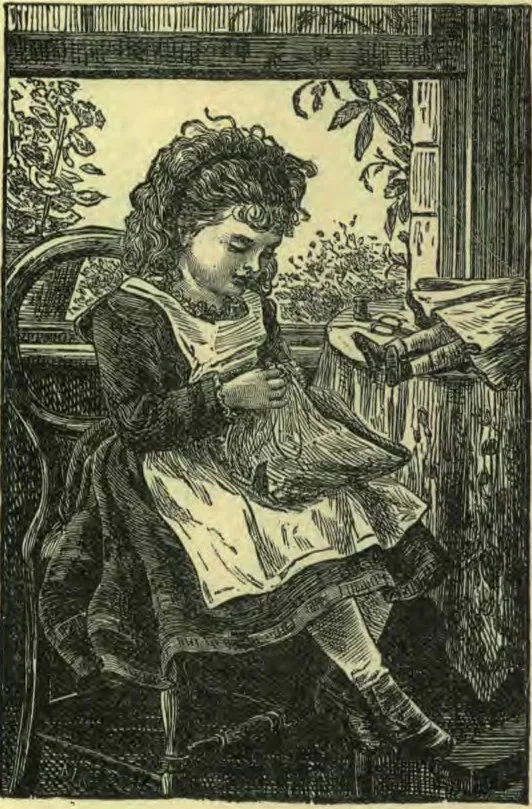
No, I am quite too busy:
To go outdoors and play,
This hemming will keep me working
As hard as I can all day.
“I’d rather play in the sunshine
Than sit in the house and sew;
But people must think of duty
Before their pleasure, you know.
“To-morrow will be the party,
And Dorothy cannot go
Unless I finish this for her.
(I can’t disappoint her so!)
“Sometimes I forget which finger
Goes under the little hem,
Or which one should have the thimble,—
It fits either one of them.
“Sometimes my thread gets tangled,
Or slips from the little eye;
Sometimes I prick my finger
Till I—well—almost cry.
“And how it makes my neck ache
To bend way down so low,
And be so careful! Oh, dear me!
It is dreadful work to sew.
“But there!—do you see the stitches
All in a little row?
My darling dolly’s handkerchief
Is finished, and she can go.”
—Sidney Dayre, in Our Little Ones.
HOW WILL'S KNIFE WAS FOUND.
“Be sure your sin will find you out.”
Mrs. Black was going to spend the day with her sister; and Will, and Joe, with their neighbor Rob Sawyer, were to keep house. They went with her to the gate, where she said,—
“Good-by. Don’t forget about the garden. Have as pleasant a time as you can.”
“What about the garden?” Rob asked, as they turned toward the house.
“Why, mother was afraid we might tramp some of the things that are just coming up, and said for us not to play there, and we promised we wouldn’t. Come, let’s look at the rabbits.”
All went merrily till, in the afternoon, Will boasted that he could outrun the other boys. Jumping up, he cried, “See if you can catch me!” and started off at the top of his speed. He kept ahead for some time, but was caught at last.
“You couldn’t have caught me if you had run straight after me,” he exclaimed. “Come into the garden and run on the walks; you can’t take cross-cuts there.”
Joe said, “We said we wouldn’t play there.”
“We won’t hurt anything; we’ll stick to the paths,” Rob said impatiently.
Will, eager to prove his fleetness of foot, and not stopping to think how serious a thing it was to disobey his mother and break his word, cried, “Oh, come on,” and started toward the garden gate.
The others followed, and in a few minutes the three were running along the wide paths, up and down, back and forth, Will always a little ahead, until he tripped in turning a corner, and fell full length on a bed of delicate young peas.
“Oh!” he sputtered, with his mouth half full of earth.
“Oh!” shouted Rob, bursting into a laugh at Will’s comical appearance.
“Oh!” groaned Joe, pointing to Will’s impression in the earth and the poor little crushed peas. “What will mother say?”
“She won’t say anything, because she won’t know about it, unless you tell her, and you are not likely to do that,” Rob said.
“I don’t like to deceive her so.”
“Oh, well, if you were so very much afraid of deceiving her, you oughtn’t to have come in here. You may as well keep it up now.”
“I guess we had better, Joe,” Will said; “only what will we do about these peas?”
“They are only smashed a little; we will straighten them up and rake over the ground, and make it all as good as new.”
So they went to work, and succeeded in covering most of the traces of the accident.
After that, things seemed to lag. The boys felt guilty, and were inclined to be cross, and, to crown all, Will discovered that he had lost his knife. They looked in the yard, in the house, and in the garden, but it was not to be found.
Rob soon said he was going home, and the boys did not urge him to stay.
When Mrs. Black returned, she said, noticing the rather subdued look on her sons’ faces,—
“Did you have a pleasant day, and were you good boys?”
“Yes’m,” Will replied, “only I lost my knife.”
“That is a pity. Have you no idea where?”
“No, ma’am.”
“Well, never mind; perhaps it will come to light yet. Don’t be so down-hearted about it.”
That night Joe said: “I wish we had told mother.”
“So do I,” was the reply, “but I hate to now. She would look so surprised, and she wouldn’t say much, and that would be worse than scolding. I guess we had better let it go.”
A few evenings later, Mrs. Black said, about bed-time: “I would like to have you commit this eleventh verse of the eighty-sixth psalm: ‘Teach me thy way, O Lord; I will walk in thy truth: unite my heart to fear thy name.’”
The boys did what she asked, wondering a little at it. “Now, do you think you can remember it?” she asked, when each had repeated the verse.
“Yes, ma’am.”
“I hope so.” Then turning to Will, she added, “I found your knife to-day.”
“Oh, did you? Where was it?”
“In the garden. I noticed that some of the peas looked bad, and in working with them I found the knife, covered lightly with earth.”
Then Will saw that the knife must have slipped from his pocket as he fell, and had been covered when they smoothed over the bed. He flushed and stammered, and at last told the whole affair, not sparing himself.
When he had finished, Mrs. Black said, “I have always trusted you both. Must I feel now that I cannot depend on your word?”
“Oh, no, mother!” they both exclaimed. “If you will only forgive us, and say you will trust us again, we will try to keep our word always.”
“I gladly forgive you. But you see it is not always easy to walk in the truth; you need help. Study this verse you have learned; if you will make its prayer for direction your own, and will seek to have such love and reverence for God that you will have more fear of his displeasure than of mine, he will help you to a truthful and upright life.”
“I will try, mother,” Joe whispered, as he kissed her good-night; and Will lingered a moment to say that he too would endeavor to walk in the “paths of righteousness.”—Youth’s Evangelist.
SUN ON THE NORTH SIDE.
We went, one cold, windy day last spring, to see a poor, young girl, kept at home by a lame hip. The room was on the north side of a bleak house. It was not a pleasant prospect without, nor was there much that was pleasant or cheerful within.
“Poor girl! what a cheerless life she has of it,” I thought, as we went to see how she was situated; what a pity it was that her room was on the north side of the house.
“You never have any sun,” I said; “not a ray comes in at these windows. That I call a misfortune. Sunshine is everything. I love the sun.”
“Oh,” she answered, with the sweetest smile I ever saw, “my sun pours in at every window, and even through the cracks.”
I am sure I looked surprised.
“The Sun of Righteousness,” she said softly—“Jesus. He shines in here, and makes everything bright to me.”
I could not doubt her. She looked happier than any one I had seen for many a day.
Yes, Jesus shining in at the windows can make any spot beautiful, and every home happy.—Guide to Holiness.
Only a Grain: A Verse on Small Beginnings
ONLY a grain, a single grain,
Let fall by a childish hand!
Years pass by, and we see a field of corn
Instead of a barren land.
A single grain is a little thing:
What did it bring?
Letter Budget.
ANNA L. HOLLENBACK sends a letter from Edwards Co., Ill. She says: “I am a little girl eight years old, but I cannot write very well, so I get my papa to write for me; for I want to tell all the little girls that I love the INSTRUCTOR, and love to read their letters in the Budget. I have no brother or sister, and the INSTRUCTOR is the only little companion I have. We began to keep the Sabbath when Eld. Shonk was here in Feb., 1885. We live four miles from church, but we attend Sabbath-school and meeting as often as we can. Sometimes the weather is so cold, or the road so muddy, that we cannot go. We have prayer-meeting at our house nearly every Sabbath evening. I learn my Sabbath-school lessons in Book No. 2. I want to tell Emma Johnson that I love her for giving her dollar to the Australian Mission; for I have an uncle and some little cousins in Australia. Papa says that he and his only brother went to Australia in 1852; that he worked in the mines there three years, and that my Uncle David Hollenback is there yet, living in a little town up in the mountains, over a hundred miles from Melbourne. I hope the INSTRUCTOR may reach my uncle and little cousins, and that they may learn to keep the true Sabbath. I want to tell the editor that I like the story about the walk to Emmaus. I close, with much love to all the INSTRUCTOR family.”
Can any read Anna’s good letter without feeling a spirit of sacrifice and a zeal to put forth their best efforts to give the truth to those who have no knowledge of it? We hope Anna may ever find the INSTRUCTOR a profitable companion.
GERTIE MAY MOORE writes a letter from Rawlins Co., Kan. She says: “I know you have never had a letter from this place. We are away out on the frontier, where the wild horse and antelope roam. I am eleven years old. I have one sister. She is attending school in Iowa. I have one brother nine years old. We have no organized church, but we have a Sabbath-school in a private house. There are six little girls of us who study in Book No. 3. My mother is the teacher. We have all been perfect every Sabbath for two months. We have a little colt, and he comes to the door every night and morning, and paws it open to be fed milk. We have a little kitten that we call Bonnie. I love to read the INSTRUCTOR. We give all of ours to our neighbors’ children. We did not receive any holiday gifts this year, as we gave all the money that we would have spent for them to the Lord. I am trying to be a good girl, and want to be saved with the INSTRUCTOR family.”
Gertie’s letter was written more than three months ago. Perhaps if she were writing now, she would be able to say, “I have had perfect lessons every Sabbath for five months. That was a good lesson you learned last Christmas, Gertie, when you denied yourself for Christ’s sake. We are glad so many of the INSTRUCTOR family are learning to sacrifice for the truth. He that is faithful in these things is providing himself a shield against the day of trouble.
MORRIS L. SABIN, writing from Chautauqua Co., N. Y., to renew his subscription to the INSTRUCTOR, sends his first letter for the same. He says: “I am seven years old. I go to day school, and read in the second reader, study arithmetic, spelling, and grammar. I have not missed a day of school this winter, and at the end of the term, I was promoted from the primary to the second grade. The last day of school I spoke a piece from the “Sunshine,” entitled, “Be as thorough as you can.” We are the only Sabbath-keepers here, and have to go nine miles to Sabbath-school; and as the roads are very hilly, we do not get there very often. But we have Sabbath-school at home every Sabbath. My sister and I study our lessons in Book No. 2. We have just learned the ten commandments. I want to be a good boy, so I can live with the INSTRUCTOR family in the new earth.”
Yours was a good selection, Morris; and it is a good text to live by, to “be as thorough as you can.” Your regular attendance at school and promotion there, are evidence that you are trying to be thorough. If you are finally promoted to a grade in the kingdom of God, it will be because you thoroughly repent and accept of Christ with all the heart. Shall you do this?
INA F. JAMES writes from Cleveland, Ohio. She says: “I am a little girl nine years old. I keep the Sabbath with my mother, sister, and brother. My grandpa James has kept the Sabbath more than thirty years, and is the best grandpa that ever lived. I attend Sabbath-school at the Mission rooms, on Bridge St., and study in Book No. 1. I also attend day school, and read in the third reader. I am trying to be a good girl, that I may meet the INSTRUCTOR family in heaven.”
We hope your grandpa James has one of the best little granddaughters in the world. Are you trying to be as good as he? But sometimes even good grandpas make mistakes, because they are only human beings; and so the Lord gave us a perfect Pattern to follow. Do you know who it is? Do you try to imitate him?