The Youth’s Instructor, Vol. 34, No. 19.

THE SCALA SANCTA

The Youth’s Instructor

May 12, 1886

S. D. A. Publishing Association · Battle Creek, Mich. · May 12, 1886

THE SCALA SANCTA.
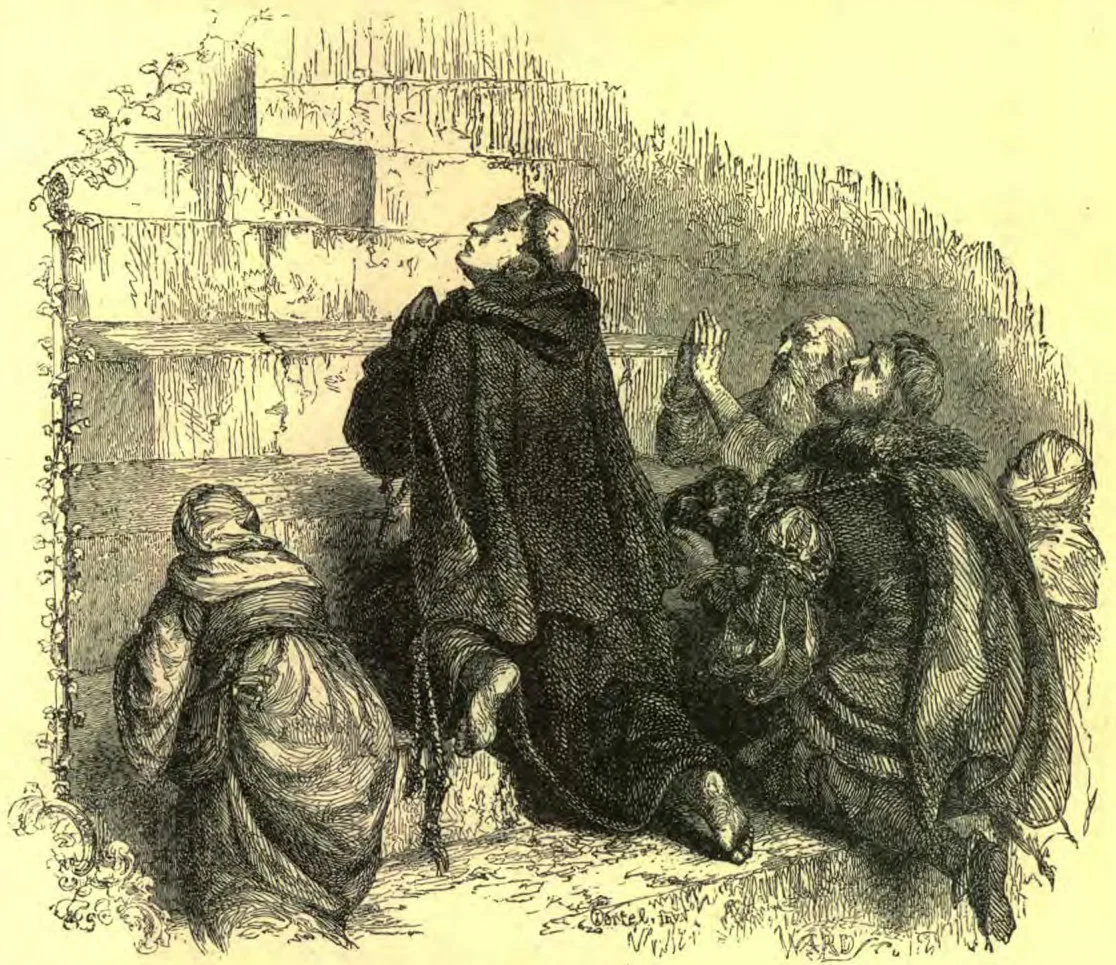
It was in the year 1510, or, as some say, 1512, that a humble monk, bent upon settling some disputes among the convents of his order, wended his way through the mountain passes of the Alps and across the burning plains of Lombardy to Rome. Much fasting, penance, and night vigils had emaciated his vigorous form; and the hot suns of Italy, beating fiercely on his head, made him feel faint and sick. The things he saw perplexed him, too; for as he drew nearer and nearer the holy city, the seat of church authority, he beheld, not the pure living, self-sacrifice, and devotion which he had a right to expect at the fountain head, but pomp, vanity, and vice, put on with a bold face.
As he visited all the sacred places, bowing before images, kissing the tombs of martyrs, seeing all, and believing all, the credulous monk was laughed at for his pains; and he soon found that he alone, of all the vast city-full had faith in what the holy fathers said.
In such a frame of mind, and tossed with doubts, he one day visited the Scala Sancta, or sacred stairway, down which, as tradition said, and this good monk Luther believed, the Saviour stepped when he left Pilate’s judgment hall. The stairs were brought from Jerusalem in 326; and it was commonly reported that the angels had carried them hither in the night. Too sacred by far to be tread by human feet, the devout pilgrims made the ascent of the twenty-eight marble steps on their knees.
Up this stairway the good monk was painfully toiling, pausing at every step to repeat an ave, or prayer. But when half way up, he stopped. As if a voice sounded from the heavens, he heard those words of inspiration that twice before had thundered in his ears, “The just shall live by faith!” Overcome by confusion and shame that he should have been so blinded by superstition as to believe that by such idle works he could be saved, he resolutely rose and descended the stairs.
This visit to Rome was a sorrowful one; for as Luther afterward said, “The nearer we approach Rome, the greater number of bad Christians we meet with.” “Yet,” he declared, “if they would give me one hundred thousand florins, I would not have missed seeing Rome;” for it was needful that the future Reformer should know beyond a doubt the corrupt state of the church. From Rome he went back to Wittenberg to preach those glorious truths that were to free from error the whole Christian world.
To this day the tourist at Rome may see devout Catholics from every nation, ascending Pilate’s stairs as a penance for themselves or their friends. As they ascend, they pause in their merry laughter, and through a hole cut in the wooden casing that protects the marble, kiss a drop of blood said to have fallen from the Saviour’s brow as he descended the steps. Beside these marble steps is a pair of wooden stairs by which they can come down. It is not deemed necessary to show any reverence in the act, since each ascension atones for years of sin. At the top of the staircase, in the little room built for the purpose, is said to be a picture, painted by St. Luke, of Christ when he was twelve years old.
How glad we may be that we have the Bible to read, and know that atonement for sin lies not in idle works, but in the blood of Christ! W. E. I.

“JUST GOING TO.”

“Now mother, isn’t Hal too provoking? He promised to take me strawberrying with him, and now he’s gone and left me!” cried Jessie, trying to restrain her tears.
“Hal broken his promise?” Her mother looked as if she could hardly believe it.
“Why, no, mother, I suppose not exactly. You see, he said I might go if I would be ready at two o’clock, and I was just going to put on my things, when he started off as hard as he could run. There he is now a long way down the other side of the common,” she added, with a little sob.
“And it is a quarter past two. Why didn’t you get ready in time?”
“I didn’t think it was so late. Besides, I was going to as soon as I had finished dolly’s apron. But Hal said the rest were waiting, and he could not stop another minute.”
“And you don’t blame him, Jessie? He had no right to keep the other children waiting, any more than you had to keep him. I am sorry that you have lost your afternoon’s pleasure just because you were behind time; but you can do nothing now but make the best of it, and learn that while you are ‘just going,’ your opportunity may be just gone.”
Jessie drew a deep sigh, and sat down to console herself with a book.
By and by her mother put down her work basket and went out of the room, saying, “Jessie, dear, look after the baby, and don’t let him go out of your sight.”
“Yes, mother, I’ll watch him. Here, birdie, come and see what Jessie has got.”
Baby took the china doll she gave him, looked at its head, pounded the floor with it, shook it as a cat would a mouse, and then crept off on an exploring expedition. Presently Jessie heard a crash and a cry that made her heart beat fast. She rushed into the next room, and there sat baby Dick on the floor, covered with bits of broken glass, and a little stream of blood running down his white forehead. He had pulled over and broken a vase on his own head. His screams soon brought their mother, and while she was bathing the wound, Jessie stood by saying, “I had missed him, and was just going after him, when I heard him cry. Poor little Dick!”
“If you had only gone, Jessie, instead of ‘meaning’ to go,” was the sober answer, “he would have been saved this sad wound.”
When Jessie’s mother went up to bed with her that night, she asked, “Has this been a pleasant day to my little girl?”
“No, mother, it has been a sad kind of day. In the first place, I was late at school this morning, and that put me out of humor for the whole forenoon; then I couldn’t go with Hal; and, worst of all, poor baby got hurt. Hasn’t it been a day of misfortunes?”
“And every one of them has happened because you were just ‘going’ to do, instead of doing it.”
Jessie unlaced her boots in silence. At last she said, “But I never mean to be late.”
“Of course you don’t. But the mischief is, my dear child, that you feel as if it were all well enough as long as you are just going to do your duty. That is a great mistake. ‘Just going to’ amounts to nothing. Do it; don’t stop to mean to do it.” And Mrs. Richmond spoke so earnestly that Jessie looked up in her face, and said: “Why, mother, what makes you care so much about it? Do you think I am so very bad?”
Her mother took her in her arms and answered, “I am sad at heart, Jessie, because I am afraid ‘just going to’ will spoil your whole life. It cheats you of your pleasure, and hinders you from your duties; and sometimes, Jessie, I am dreadfully afraid when my darling comes to heaven’s gate at last, and her Saviour asks, ‘My child, did you give your heart to me down on the earth?’ my poor child will have to say, ‘O Lord, I was just going to,’ and then it will be too late.”—Good Words.

MAY

I FEEL a newer life in every gale; The winds that fan the flowers, And with their welcome breathings fill the sail, Tell of serener hours,— Of hours that glide unfelt away Beneath the sky of May.
The spirit of the gentle south wind calls From his blue throne of air, And where his whispering voice in music falls, Beauty is budding there; The bright ones of the valley break Their slumbers, and awake.
The waving verdure rolls along the plain, And the wide forest weaves, To welcome back its playful mates again, A canopy of leaves; And from its darkening shadow floats A gush of trembling notes.
Fairer and brighter spreads the reign of May; The tresses of the woods With the light dallying of the west wind play; And the full-brimming floods, As gladly to their goal they run, Hail the returning sun. —James Gate

AN INTELLIGENT INSECT.

Many accounts have been given of the curious actions of insects, especially of the ants, showing that they think and reason. It is very interesting to see how these little creatures seem to talk to each other; and you will be amply repaid if you should watch some of them.
It is evident that they have the faculty of exchanging thoughts. An instance once came to my notice which showed that ants can not only impart knowledge to each other, but also train and discipline their young, even requiring obedience of them.
While walking along a sandy path soon after a rain, my attention was attracted by the little hills of sand, carried out of the ground by the ants, and piled up around the hole that served as an entrance to their city below. A great many families live in one of these villages, and each one has a home of its own. I was surprised to see how much they had done, for it had been only half an hour since it stopped raining. Out of curiosity, I sat down and watched them.
Soon I noticed among the busy workers a little fellow, only half the size of the larger ones. He seemed not to be working as the others were, and he had not been out of the ground long, before he started off as fast as he could run. When he had gone five or six inches from the hole, a large ant came out. I had noticed this one particularly, because she carried no sand. She ran all around, looking this way and that, as if in search of something. Soon she spied the little truant. It did not take her long to catch him, and holding him with one hand, or fore leg, she gave him a severe flogging with another. The little fellow tried to get away, and struggled as though he was badly hurt; but the old one dragged him back home by main strength.
I wonder if our parents could not learn a good lesson from this ant? It is evident that these little insects train their young to obey and respect them. If they make their little ones mind, our parents ought to make us mind, don't you think so? But then, I hope none of the little readers of the INSTRUCTOR have to be made to mind. It is a great deal better to do so willingly; for we cannot keep the fifth commandment if we do otherwise.
The ant works from early morning till late at night. It is a very industrious creature, and its ways are well worth observing. Therefore the wise man said: “Go to the ant, thou sluggard, consider her ways, and be wise.”
[The ants, like the bees, form a regular republic, composed of males, females, and workers. In a translation of the works of the great French naturalist Figuier, the writer says: “The workers have the charge of building, provisioning, and raising of the larvæ—in fact, all the care of the household, and the defense of the nest.”
He further adds: “From the birth of the larvæ, a troop of nurses is charged with the care of them. They put them out in the open air during the day. Hardly has the sun risen, when the ants, placed just under the roof, go to tell those which are beneath, by touching them with their antennæ, or shaking them with their mandibles. In a few seconds, all the outlets are crowded with workers carrying out the larvæ in order to place them on the top of the ant-hill, that they may be exposed to the beneficent heat of the sun. When the larvæ have remained some time in the same place, their guardians move them away from the direct action of the solar rays, and put them in chambers a little way from the top of the hill, where a milder heat can still reach them. . . . The care which the working ants bestow on their young does not consist only in nourishing them and procuring for them a proper temperature; they have also to keep them clean. ”
“The tranquil inhabitants of these subterranean republics are bound together by mutual affection in a devoted fraternity, which makes them ever ready to assist each other. They all help one another as much as they can. If an ant is tired, a comrade carries it on his back. Those who are so absorbed with their work that they have no time to think of their food, are fed by their companions. When an ant is wounded, the first one that meets it renders it assistance, and carries it home.” I wonder if all the INSTRUCTOR family show an equal interest for their fellow-creatures?—Ed.]
E. W. WEBSTER.

SALUTING TEACHERS.

It is pleasant to see the good old politeness returning. There are towns in New England where a majority of the boys salute their teachers in the street by bowing and taking off their hats. This shows good breeding and good sense on the part of both teachers and pupils. Every one loves to see it, and wishes the custom were universal.
In the olden time such observances were exacted of all scholars. Boys were required to come to a stand on entering the school-room, and bow to the teacher. No mere bob of the head would be accepted; the bow had to be low, formal, and deliberate, and some teachers watched it closely, and compelled the boy to repeat the ceremony if it were not executed to their satisfaction. On leaving the school-room at the end of the morning and afternoon, the same tribute of respect was required.
There were martinets among both parents and teachers in former days who made the morning bow a thing of terror and of torment to children. Frederika Bremer describes in her memoirs the dread with which she approached her father and mother in the morning, and the stern, cold rigor with which her timid courtesy and her manner of advancing were watched and criticised by her father. If he detected or fancied anything wrong in her performance, he would send her out of the breakfast-room, to re-enter and repeat the awful ceremony.
Even this unfeeling and harsh training was, perhaps, better than no training at all in the minor morals. There should be spontaneous and cheerful politeness between pupils and teachers, between parents and children. Boys should salute their teachers from a feeling of respect and good-will toward them. At the same time, a little instruction on the subject of polite observance may serve to suggest the idea and improve the method.
There are boys among us, and good boys, too, who never performed a polite action in their lives, nor uttered a polite word. They would be ashamed to take off their hats to a teacher, and if they should do it, they would blush, as if they had committed a crime. That is what the French call “bad shame” (mauvaise honte), to distinguish it from the feeling caused by doing wrong, which is good shame. It is such boys who need the help which a lesson in politeness would afford.—Companion.

The Rage of the Flowers.

THE trees and the flowers seem running a race, But none treads down the other; And neither thinks it his disgrace To be later than his brother. Yet the pear-tree shouts to the lilac-tree, “Make haste, for the spring is late!” And the lilac-tree whispers to the chestnut-tree (Because he is so great;) “Pray you, great sir, be quick, be quick! For down below we are blossoming thick!”
Then the chestnut hears, and comes out in bloom, White or pink, to the tip-top boughs: Oh! why not grow higher, there's plenty of room, You beautiful tree, with the sky for your house? Then, like music, they seem to blend out together, The little and big, with a beautiful burst; They sweeten the wind, they paint the weather, And no one remembers which was first.
White rose, red rose, Bud rose, shed rose, Larkspur, lily, and the rest; North, east, south, west, June, July, August, September!
Ever so late in the year will come Many a red geranium, And chrysanthemums up to November! Then the winter has overtaken them all, The fogs and the rains begin to fall; And the flowers, after running their races, Are weary, and shut up their faces; And under the ground they go to sleep. “Is it very far down?”—“Yes, ever so deep.” —Selected.

“I AM GOING TO SMOKE THE BEST CIGARS.”

GRANT and Ross Graham are twins. Grant is a stirring boy, and often earns an extra dime to help swell the family purse, which is sometimes very slim.
Ross loves his books, and would like to get a good education; but he knows that both he and his brother must soon quit school and begin to work.
These boys go to a wide-awake school, whose teachers are anxious to do all the good they possibly can for the children under their care.
One day, on their return from school, Ross hastened to his mother with the good news that he had pledged himself not to taste anything that would intoxicate, or to use tobacco in any form.
“May you be enabled to keep the pledge!” said his mother fervently, and then turned to Grant, expecting to hear the same news from him; but as he did not speak, she asked: “And how is it with you, my boy?”
“I didn’t sign the pledge,” answered Grant. “You see, mother, I am going to leave whisky and such trash alone; but I have made up my mind that when I am twenty-one, I am going to smoke the best cigars.”
“You would better count the cost,” said his mother. “The best cigars will take much of your earnings, and their use will bring to you many evils which you cannot foresee.”
“I don’t see how they will hurt me! Father smokes, and so does the Rev. Mr. Blank, and ever so many more ministers I can name.”
“How old are you, Grant?” asked his mother, without appearing to notice his remark.
“Eleven years old.”
“Only eleven; and why must you and your brother, while so young, quit going to school?”
“Because father cannot afford to send us any longer; and, besides, we must help earn our own living.”
“True. Suppose your father had put away twenty cents a day for twenty years, how much money would he now have?”
Grant made the calculation, and replied:
“He would have $1,460.”
“And not only that amount,” replied his mother, “but also the interest on much of it he might now have, had he not begun to smoke good cigars when he was twenty-one—just twenty years ago.”
Grant made no reply, but all the day he kept thinking something like this:—
“We are very poor. Father works hard, but he is sickly. He still smokes two cigars, sometimes more, a day. He has already smoked away more than $1,460—whew! What a young fortune! If we only had that much money now, Ross could go to school long enough to graduate, and mother and the children might have many comforts.”
The next day when, at the close of the school, the teacher laid the temperance pledge upon the table, the first one that walked up and put his name to it was Grant Graham.
He had changed his mind. “For,” said he, “I will never puff away $1,460 in smoke!”—Presbyterian Journal.

MY PRAYER.

Many years ago, before there were any gray hairs on this head of mine, I made up a simple prayer, which you may like to copy and to use. Here it is:—
“Do thou bless me, and make me a blessing. Do thou make me a daughter of consolation; and do thou so order my life that thou, in all things, mayest be glorified. For Jesus’ sake. Amen.”
I have used that prayer constantly, and have taught it to many. It has been printed on a small card and inclosed in letters. And I only hope others have found comfort in it, as I have.
You remember God’s beautiful promise to Abraham: “I will bless thee, and thou shalt be a blessing”? And as the very same God is ours, we may ask for the very same thing.
To have the good blessing of our Father on us is to be truly happy. He will prosper all that we do, and we shall see how he guides every change for the best.
And then how bright to be a blessing! To be made useful, and earnest, and true. He will do all this for us, if we ask him for Jesus’ sake.
I always like the name given to the apostle Barnabas,—“A son of consolation.” It sounds as if he went about making people’s troubles lighter with kindly Christian words and deeds. So, as I am not a son, but a daughter, I long to share in that sweet name, and to be “a daughter of consolation.”
There are so many ways of cheering. If we pray to be taught, we shall soon find them out.
It is grand to live for the glory of God. Thus we seem only a little lower than the angels. And it gives a great rest to the mind to feel sure that all that seems strange and trying in the life of those who pray, is working for God’s glory.—Selected.

“YOU WON'T MISS IT.”

In one of the provinces of the Dominion of Canada, there lives a blacksmith who has a little daughter of whom he is very fond. The child was persuading him to let her have what she wished, and he promised.
“Let me look over all your money at night when you come home, and take out all the five-cent pieces for myself and put them into my money-box. You won't miss them!”
He promised to let her do this for a year, and kept his promise. Sometimes there were one or two “half-dimes,” sometimes there were none, but all that could be found was stored in the box, and he did not miss them.
In the middle of the year, the church-warden came around to collect subscriptions for the minister's stipend and other church expenses. The blacksmith complained of the hard times, and thought he could not do much. He was reminded that he had paid nothing for his pew in church, and should therefore give liberally towards the expenses of the church, since he should not offer to the Lord his God of that which cost him nothing. After some demur he gave one dollar and a half as his year's subscription for religious purposes.
At the end of the year his little daughter, with great glee, brought out the money-box to see how much her fund amounted to. When it was counted, it proved to be nearly twenty-seven dollars. He had not missed it.
If he had regularly put by God's share of his earnings, he would not have missed it in this world, and would have his reward laid up in the next. But when men do not give God his just share in this world, they will certainly miss their reward in the next.—Selected.

The Bible's Enduring Power Against Skeptics

The charge is made now and again by the little skeptics who swing their lanterns in the face of the sun and claim the credit of making the world light, that thinking men have done away with the Book of books. But the sun shines on, and the world at large does not mistake lantern-light for sunlight. The glad truth remains that the Bible is not the transient book of a buried past, but the permanent possession and impelling power of an ever-living present.—Laurens, in The Standard.

The Love of Christ Like Sky and Sea

The love of Christ is like the blue sky, into which you may see clearly, but the real vastness of which you cannot measure. It is like the sea, into whose bosom you can look a little way, but its depths are unfathomable.—McCheyne.

IMPORTANT BIBLE SUBJECTS.

LESSON 6.—EXTENT OF THE LAW'S JURISDICTION.

(Continued.)
[NOTE TO THE STUDENT.—Do not consider the lesson learned until you can give at least the substance of every text, with the correct reference for each. The references in black letters indicate those texts that should be committed to memory. A little diligent application each day will enable you to learn them, although this need not be considered a test of scholarship.]
1. Did the law exist before it was spoken from Sinai? Give proof.
2. Can you prove that its claims are binding on Gentiles as well as on Jews?
3. Over what part of the earth has the law jurisdiction? Proof.
4. How many apartments were there in the tabernacle built by Moses? Ex. 26: 33.
5. What article of furniture was in the most holy place? Ex. 26: 34.
6. Why was it called the “ark of the testimony”? Ex. 25: 16.
7. What was this “testimony”? Ex. 31: 18; Deut. 10: 4, 5.
8. Of what was this earthly tabernacle a pattern? Heb. 9: 8, 9, 23, 24.
9. Was the furniture of the tabernacle, as well as the tabernacle itself, made according to this heavenly pattern? Ex. 25: 9, 40.
10. Is there a real temple in heaven? Heb. 8: 1, 2.
11. What article of furniture is specially noted as having been seen in it? Rev. 11: 19.
12. Since the ark was called the “ark of the testimony” because it contained the tables of the law, what must be in the ark in the real temple in heaven? (See note.)
13. Then what relation did the tables which Moses placed in the ark bear to those in the temple in heaven? (See note.)
14. Where is the Lord’s throne? Ps. 11: 4; Hab. 2: 20.
15. Between what beings is his seat? Ps. 80: 1; 99: 1.
16. In the earthly tabernacle, from between what figures did the Lord speak to the people? Ex. 25: 22.
17. Then of what was the ark in the earthly sanctuary a representation?—Of the throne of God in the temple in heaven.
18. What was within the ark, and underneath the cherubim? Ex. 25: 16, 22; Rev. 11: 19.
19. Then what relation do the commandments sustain to the throne of God?—They are underneath it, forming its foundation.
20. Can you quote any texts of Scripture that directly support this conclusion? Ps. 89: 14; 97: 2. Compare Ps. 119: 172.
21. How extensive is the authority of God’s throne? Ps. 103: 19.
22. Then how extensive must be the jurisdiction of the ten commandments?
23. Must they not, then, be the rule of conduct in heaven as well as on earth? Ps. 103: 20.

NOTE.

In Ex. 31: 18 we read that the Lord “gave unto Moses, when he had made an end of communing with him upon Mount Sinai, two tables of testimony, tables of stone, written with the finger of God.” In Deut. 5: 22 we learn that it was the ten commandments that were written on the two tables of stone; and from Deut. 10: 4, 5 we learn that these tables were placed in the ark. Therefore we know that the ten commandments are the “testimony;” and when John says (Rev. 11: 19) that in the temple of God in heaven he saw the “ark of his testimony,” we must conclude that the ten commandments are in the ark. And, further, since the earthly tabernacle and its furniture were “patterns of things in the heavens” (Ex. 25: 9, 40; Heb. 9: 23, 24), we must also conclude that the ten commandments which were on the tables of stone in the tabernacle which Moses built, were but a copy of the ten commandments in the temple in heaven.

“IT IS MY BOY.”

Through Rochester, N. Y., runs the Genesee River, between steep and rocky banks. There are falls in the river, and dark recesses. One time a gentleman who lived in the city had just arrived on the train from a journey. He was anxious to go home and meet his wife and children. He was hurrying along the streets with a bright vision of home in his mind, when he saw on the bank of the river a lot of excited men.
“What is the matter?” he shouted.
They replied, “A boy is in the water.”
“Why don’t you save him?” he asked.
In a moment, throwing down his carpet-bag and pulling off his coat, he jumped into the stream, grasped the boy in his arms, and struggled with him to the shore, and as he wiped the water from his dripping face, and brushed back the hair, he exclaimed, “O God, it is my boy!”
He plunged in for the boy of somebody else, and saved his own. So we plunge into the waters of Christian self-denial, labor, hardship, reproach, soul-travail, prayer, anxious entreaty; willing to spend and be spent, taking all risks, to save some other one from drowning in sin and death, and do not know what a reflexive wave of blessing will come to our own souls.
In seeking to save others we save ourselves and those most dear to us, while others, too selfish to labor to save other people’s children, often lose their own.—Selected.

The Ice King's Work.

The readers of the Instructor who have studied geography must have learned something about the great glaciers of the Alps, in Switzerland. They may have learned too, that there are glaciers in other countries, some quite as remarkable as the Alpine glaciers. Less is known of them, however, because fewer persons visit their locality.
A glacier is really a “river of ice;” and there are some things about one that seem very curious until understood. That a river of solid ice has a constant motion forward, seems almost incredible; but to test it, in 1827 a man built a hut upon a glacier, and it was discovered that every year the house was farther down the valley.
A writer in Harper's Young People says that “people who were interested to learn more about this movement set rows of stakes up in the ice, straight across from side to side of the glacier, and two on each bank to mark the starting point. This row of poles, as it moved, did not remain straight; it bent like a bow in the middle, curving out toward the lower end of the glacier, showing that middle part moved faster than the edge. This is known to be true of an ordinary river; the water rubbing against the banks and against the bottom of its bed is hindered, and moves more slowly than the water in the middle and on top does.”
The same writer says the source of the glacier is in a high mountain valley, where a great body of snow becomes tightly packed; and that if you follow its course, you will see that it “gradually changes into a solid mass of whitish ice, scored all over with cracks and crevices, broken up into great masses and blocks of ice on the surface, and covered often with dirt and stones. Finally you come to a place where the weather is warm enough to melt the ice, and then it flows off as a stream of water.”
Of the movement of the glaciers, she says:—
“Each winter, snow piles itself high on the mountain-top; each summer, this snow is softened and made slushy, but not melted. The soft snow sinks and packs, and is pushed down into the easiest channel. The next winter a new weight of snow is added, making a greater pushing force. It is hindered in its travels, and being pushed behind and hindered in front, it packs tighter and tighter till we find it, farther down in its bed, a mass of ice. The weight is getting greater and greater with each winter's load of snow; and so the ice is forced down, no matter what is in the way, and the valley is finally filled with the moving river of ice.”
“A great many wise heads have been puzzled to know how ice can fit itself to the channel. Ice is one of the brittlest things in the world, but it has a quality that we do not often have occasion to notice. It melts easily, but it also freezes easily. The scientist Faraday discovered this quality of ice in a very commonplace way. One hot summer's day, in a restaurant, he noticed some bits of ice floating in a dish of water. The ice was melting; and yet every time two pieces touched, they froze. Tyndall, another great scientist, has explained the movement of glaciers by this simple principle. It was he who found that ice could be crushed out of one shape into another, and that the broken bits froze at once together and made a solid lump as the snow does. Now glacier ice, underneath the surface, is squeezed in a mold made of its bed and banks and the heavy weight of ice above; the moving part of the ice, which fits itself to the channel-mold, is broken and ground up into bits, but these bits, being pressed together again, freeze into the new mold that it is pushed into—that is, the new part of the channel—just as Tyndall's ice, which was at first squeezed in a round mold, came out a ball, and being squeezed again in a cup-shaped mold, came out a perfect cup of ice.”

PURPOSE

It is no dream, No castle-building time, that we call life; To catch the gleam Of heaven in the strife, Our toil must tend to reach the better life.

VEGETABLE CLOTHING.

Perhaps you say that is no new thing, that clothing has always been made of vegetables, as from cotton, flax, hemp, etc. But in this instance what is meant by “vegetable clothing” is that which grows all ready for use. You may learn all about it in the following which C. J. Russell writes for the St. Nicholas:—
“About two hundred years ago the governor of the island of Jamaica, Sir Thomas Lynch, sent to King Charles II. of England a vegetable neck-tie, and a very good neck-tie it was, although it had grown on a tree and had not been altered since it was taken from the tree. It was as soft and white and delicate as lace, and it is not surprising that the king should have expressed his doubts when he was told that the beautiful fabric had grown on a tree, in almost the exact condition in which he saw it. It had been stretched a little, and that was all.
“But if King Charles was astonished to learn that neck-ties grew on trees in Jamaica, what must have been the feelings of a stranger traveling in Central America, on being told that mosquito-nets grew on trees in that country? He had complained to his host that the mosquitoes had nearly eaten him up the night before, and had been told in response that he should have a new netting put over his bed. The host calmly continued, ‘In fact, we are going to strip a tree anyhow, because there is to be a wedding on the estate, and we wish to have a dress ready for the bride.’
“You don’t mean,” said the traveler incredulously, ‘that mosquito-netting and bridal dresses grow on trees, do you?’
“That is just what I mean,” replied his host, ‘and if you will follow the men, you will see that I speak the exact truth.’
“Looking for some jest, the stranger followed the two men who were to pluck the singular fruit, and stood by when they stopped at a rather small tree, bearing thick, glossy green leaves. The tree was about twenty feet high and six inches in diameter, and its bark looked much like that of a birch-tree.
“After cutting the tree down, three strips of bark, each about six inches wide and eight feet long, were taken from the trunk and thrown into a stream of water. Then each man took a strip while it was still in the water, and with the point of his knife separated a thin layer of the inner bark from one end of the strip. This layer was then taken in the fingers and gently pulled, whereupon it came away in an even sheet of the entire width and length of the strip of bark. Twelve sheets were thus taken from each strip of bark, and thrown into the water.
“When each strip of bark had yielded its twelve sheets, each sheet was taken from the water and gradually stretched sidewise. The spectator could hardly believe his eyes. The sheet broadened and broadened, until from a close piece of material six inches wide, it became a filmy cloud of delicate lace, over three feet in width. The astonished gentleman was forced to confess that no human-made loom ever turned out lace which could surpass in snowy whiteness and gossamer-like delicacy that product of nature.
“The natural lace is not so regular in formation as the material called illusion, so much worn by ladies in summer; but it is as soft and white, and will bear washing, which is not true of ‘illusion.’ In Jamaica and Central America, among the poor people this wonderful lace supplies the place of manufactured cloth, which they cannot afford to buy; and the wealthier classes do not by any means scorn it for ornamental purposes.
“Long before the white man found his way to this part of the world, the Indians had known and used this vegetable cloth. Some time after King Charles received his vegetable neck-tie, Sir Hans Sloane, whose art collection and library were the foundation of the British Museum, visited Jamaica. He described the tree fully, and was the first person who told the civilized world about it. The tree is commonly called the lace-bark tree. Its botanical name is Lagetta lintearia.”

PHOTOGRAPH OF A FLASH OF LIGHTNING.

A PHOTOGRAPH has been taken of a flash of lightning, the main stream of which was about four feet broad. The flash consisted of four distinct parallel streams. Between the first and second streams were bright and dark stripes, the second and third streams were very close together, while there was a greater distance between the third and fourth. The four streams belonged to one flash, which passed to and fro from the clouds to the earth twice, using in its return journey the seam of air heated on its outward passage, and, as the different breadth of the spaces between shows, taking more to go to the earth than to reach the clouds.—Sel.
Continue reading: A SINGULAR NESTING-PLACE