Your ShelfYour Projects

Signs of the Times, Vol. 30, No. 5.

THE HERITAGE OF DISOBEDIENCE
Earlier text: LESSON 7.—FEBRUARY 14.—JESUS FORGIVES SIN

Not Conscious of Doing a Great Thing.

It may be set down as a general rule that the moral decisions made on which events hung, the pivotal decisions of great crises, were not made with a consciousness that they were great, or that upon them hung great events of history. In the vast majority of cases these decisions "never showed the choice momentous till the judgment had passed by." Back of these decisions was a sense of duty, a divine impulse which demanded sacrifice, self-abnegation, doing just what God said. Oftentimes it is but the speaking of a word in trembling of heart, yet believing it to be duty. There is none of self in such an act, and God can use it. But when man feels that he has done some great thing, there is usually so much of self in it that God can not consistently use it. And if some consciously great thing is done, it is frequently but the fruitage of some prior obscure thought of duty on the part of some lowly soul.

Life and Law.

The following words of recent unknown human utterance express a great truth: "We breathe freely when our lungs are sound. We live freely when our life is sound. And the sound life is that alone which steers its course by the never swerving compass of the moral law. Thus God's law is man's liberty." That is worth all the volumes of sophistry and casuistry now-a-days which endeavor to prove that whatever our moral condition we have the life of God. The life of God is a sound, whole life, flowing out from the great Fountain in harmony with His moral law, and if man possess it at all, he must receive it in harmony with the same law.

The Theater and Ecclesiastical Empire

The Theater.—A little over a year ago there was given in the high-class theaters of New York, a play, which one paper declared, "shines and stinks with the slime of Sodom;" another as "horrible in conception, ruthless in execution, poisonous in spirit;" another as "particularly foul and offensive," and so on. A few months later and the "Passion Play" and "Parsifal," follow. And so the pendulum swings from the vile to the simulated virtuous, from rottenness to make-believe righteousness, till minds and hearts of those who behold are so confused that virtue and vice are indistinguishable. Read the article elsewhere in this paper, "What Is the Objection to the Theater?"
Ecclesiastical Empire.—One of the great questions before the world at this present time is the relation of religion or the church to the State, or the relation the State should sustain to the church. What is the province of the church? What is the province of the State? What is the duty of the Christian? What have been the results of the State yielding to the church, as many well-meaning religious people are now demanding. In no way can such questions as these and many other related ones be so well and so strikingly answered as in actual history, filled with striking object-lessons. A volume lies before us as we write, entitled, "Ecclesiastical Empire," By Alonzo Trévier Jones, which covers the entire ground of the Christian era, with its many, many lessons in theory and object. The middle ages of the great powers of Europe are placed before us, the perversion of Christianity by pagan philosophy, the theological controversies of the early centuries, how the Papacy became a world-power, the "Holy Roman Empire," Papal supremacy, the spirit of the Papacy, the Reformation, true and false Protestantism, what has occurred and is occurring in our own country,—all are faithfully set forth. The book contains five maps, 27 chapters, 874 pages; bound in cloth, only $2.50. It is of value in every student's library.

Religious, Prophetic, and Physiological Charts

See advertisement in another column if you are in need of religious, prophetic, or physiological charts. We are assured by ministers that the work is good.

Christ Supplies Every Need

Dear soul, you need Christ Jesus the Lord; and He is waiting to supply all your need. Why not let faith reach up and make the connection between the need and the supply?

Theater, Objections to

The Theater, Objections to.—We give in another column part of a tremendous article from the Sunday School Times, entitled "What Is the Objection to the Theater?" We appeal to our readers to study it. The whole article may be obtained in tract form for 5 cents by addressing the Sunday School Times, Philadelphia, Pa.

ARTICLES TO COME.

In the Home.

WE shall begin in a few weeks some articles which will be of great interest and profit in the home life, by Mrs. L. D. Avery-Stuttle. These articles will be short, pithy, suggestive, helpful, full of Christian sweetness. Here are some of the topics treated:—

Love in the Home,

Family Prayer and Its Importance, The Influence of Family Prayer, Bedtime Talks with the Children,

Sympathy with the Children,

Companions in Books, Good and Pure, The Bible First of All, Reading History and Biology,

Reading Poetry, Memorizing,

Sunshine in the Home, Order in the Home, Economy in the Home,

Thrift in the Home,

All a Part in the Home Work, Gentleness and Tenderness in the Home, Helpfulness in the Home,

Soft Answers Turn Away Wrath,

Conversation in the Home, Evils of Gossip, Narrowing, Poisoning, Talking of Things, not Persons.
These form only a rough outline of a series of home articles which are needed and will be helpful in many homes. Will you not help to give the paper a wider circulation because of them.

In Our General and Outlook Departments.

There has already begun a valuable series of articles on the History of Government. Are you reading them? The information they impart in tracing the history of human attempts to establish a permanent beneficent rule among men from ancient Babylon to the present day, are worth much more than the price of the paper for one year. Moreover the principles underlying true, permanent government are so well set forth that by them we can safely predict the results of all human government.
Prof. George W. Rine will contribute an illuminating series of articles on Capital and Labor, a subject always of interest and importance.
Then there will be other articles on prophecy, on the signs of the times, on the blessed Gospel and its consummation at the coming of our Lord, on health and temperance, and all that makes for practical godliness.
Where can so much information on Biblical subjects be found for $1.50,—the price of the SIGNS OF THE TIMES for one year?

The Eight-Hour Labor Debate

The Eight-Hour-Law Demand.—We believe in minimizing of the hours of labor as far as possible; but to require that the Government shall purchase nothing but what has been manufactured by men working only eight hours a day is carrying the matter altogether too far. In fact, it is an impossibility. Many of the things which the Government needs have in their very inception been wrought out by days and nights of hardest labor known—mental labor. The designs that the workmen are materializing, the plans which they are filling up, were wrought out by men who worked more or less every waking hour throughout the twenty-four. The brains that plan for the successful operation of the large factories of the country can no more be limited by hours than the wind. If it were so, there would be multiplied failures. And while men with families ought to have some time with their families, some time for heart and home and mind culture, candor compels the belief that the majority of workmen would make worse use of the time outside of the hours of labor than inside those hours. The continually shorter day means more loafing, more drunkenness, more dissipation, more family troubles, more dissatisfaction, and more unreasonable discontent.

Work a Privilege

Work a Privilege.—Some one has well said: "The chance to do work is not a penalty, it is a privilege. Life is so constituted that the man or the woman who has not got some responsibility is thereby deprived of the deepest happiness that can come to mankind." It is most emphatically true. More miserable than the Flora McFlimsey of Madison Square, who among all her dresses had "nothing to wear," is the individual with nothing to do. There is no corruptor of character like idleness. It is better morally, physically, mentally, for a man to do something for nothing, rather than nothing for nothing. Much of present teaching is leading many to look upon labor as a curse, and idleness and amusement the chief end of man. It is a woful sign of the times, the sure forerunner of degeneracy, revolution, fanaticism, anarchy, and destruction. The one only hope of the world is in Him who said, "My Father worketh hitherto, and I work."

The Female False Christ

How any person, who ever has studied God's Word with a modicum of intelligence, could be led astray in following the female false Christ, of Brooklyn, N. Y., is beyond understanding; and yet she has a goodly number of followers. Some of them, doubtless, most of them, are affected by the superstitions, the mysterious, the impressiveness of surroundings and marvelous claims of “Manna Mysteria,” as the Miss Sherk, of Jewish extraction, calls herself. She may be honest in her conviction, but the whole movement is only one of the latter-day delusions to deceive and destroy souls, and to make the second advent of Christ a laughing stock. And yet, the Divine Word, which foretells Christ's coming, foretells all these delusions and counterfeits. None need be deceived.
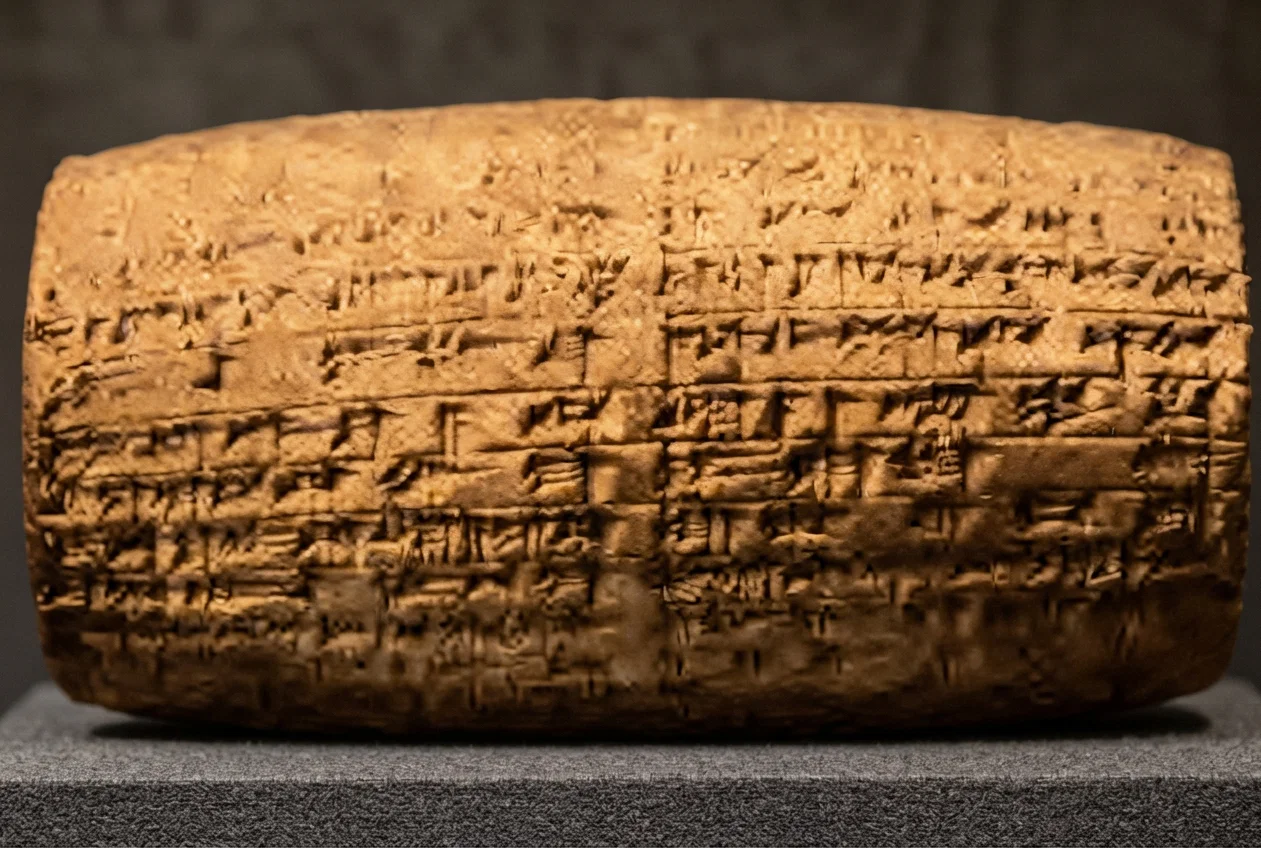
Cylinder of Nabonidus (Nabonadius), containing a prayer for his son, Bel-shar-uzur (Belshazzar).
Mariposa Lily.
Mariposa Lily.

You have reached the end of this edition.

Signs of the Times · Feb 3, 1904