WE have seen that by the time of the conquests and the establishment of empire by Nabopolassar and Nebuchadnezzar, of Babylon, the spirit of independence of the peoples had been so completely broken down that the despotism of empire had secured undisputed sway. This was so effectually accomplished by Babylon, that the Scripture plainly defines it as “the hammer of the whole earth.” And, yet, Babylon had only perpetuated the hammering of the peoples which Assyria, with but a brief interval, had kept up for more than a thousand years. And this perpetual hammering, continued by Babylon, had effected at last what the ambition of every imperialist, since Nimrod, had ever hoped: the silent suffering and submission of all peoples to one predominant and absolute will.
This work of Babylon in perpetuating the destructive work of Assyria in this respect, is forcibly told in the expressive words of the Scripture concerning their dealings with the peoples: “First the king of Assyria hath devoured him; and last this Nebuchadnezzar king of Babylon hath broken his bones.” While Assyria, in its lust of empire, had fed itself on the substance of the peoples, Babylon completed the work by breaking their bones and sucking the very marrow. And tho a single king of Assyria, as Sennacherib, might compel the nations and peoples to such submission as that, like terror-stricken chickens, “none opened his mouth or peeped;” yet, when the direct assertion of personal power by that particular king was passed, all people were prompt to stand up again for freedom and independence; but when Babylon, “the hammer of the whole earth,” had laid upon the nations and peoples her crushing strokes, the subjection of all was complete, and their submission final.
And now that the supremacy and absolutism of empire was attained in permanency, and the imperial spirit was absolutely free to demonstrate what it could and would do when entirely untrammelled and undisputed, this was demonstrated to the full, and that in such measure as to be a perpetual lesson to all peoples that should follow, even to the world’s end. And in order that empire might be saved from what it would certainly do if left to itself, God foretold to all by giving to Nebuchadnezzar the first head of permanent empire, a vision in a notable dream. In this vision God showed to Nebuchadnezzar that his empire, tho universal and so great, would be succeeded by another, inferior; which would be succeeded by another, further inferior; and that, in turn, by another, yet further inferior, which would go all to pieces; and then even the pieces would be dashed so utterly to pieces that they would be “like the chaff of the summer threshing-floors;” and the wind, as with chaff, would hurl them lightly away, and no place be found for them.
But this could not be believed even from God, by one who stood as the proud possessor of permanent, worldly, imperial power; and he undertook to disprove it by setting up against it the imperial idea.
God’s Truth versus Human Ambition.
To show the gradation and inferiority in the succession of empires, the Lord, in the vision, had presented the image of man composed of metals of inferior gradations from head to foot, the head only being of gold: this head of gold representing the empire of Babylon. But Nebuchadnezzar could not accept, as correct, any such representation as that. Accordingly, he, too, presented a great image, but all of gold from head to feet; thus excluding all suggestion that there should be even any succession of empires, much less a gradation of inferiority in succession. This great image, all of gold*, was but the king’s assertion that the golden glory of his empire of Babylon should continue forever.
History of Government BY ALONZO TREVIER JONES AUTHOR OF "TWO REPUBLICS," "EMPIRES OF THE BIBLE," "GREAT EMPIRES OF PROPHECY," "ECCLESIASTICAL EMPIRE," ETC.
And this embodiment of his idea, King Nebuchadnezzar set up; and required, under the terrible penalty of a burning, fiery furnace, that all the peoples, nations, and languages should accept it. But amongst his subjects there were some servants of the Most High God, who had studied, and who understood, the truth as to empire. These being loyal to God, and, therefore, holding His idea to be the correct one, refused to accept the imperial idea. Therefore, they were cast into the burning, fiery furnace, heated to the highest possible degree. But God preserved them, and they came forth unscathed, and with not even the smell of fire upon them. And thus God not only vindicated their course as righteous, but confirmed the truth of His idea of empire and changed the king’s word and also his idea of empire.
After this lesson, King Nebuchadnezzar was led of God; but when he had died the empire shortly demonstrated what it could and would do; that is, sink itself in everlasting ruin by intemperance. For when the abundant tribute of all nations flowed in an uninterrupted stream into the one treasury of Babylon; and the permanent submission of all nations and peoples had left the government in complete idleness so far as military expeditions were concerned; the imperial classes thus having an endowment of boundless wealth and abundance of idleness, intemperance of every sort grew to such a height that the empire sank in a night in the drunken, lascivious feast of Belshazzar, which he made “to a thousand of his lords, and drank wine before the thousand.” And this perfection of ruin was accomplished in only twenty-three years from the death of Nebuchadnezzar.
The Medo-Persian Regime.
In that night of drunken lasciviousness “was Belshazzar the King of the Chaldeans slain;” the mighty empire of Babylon sank; and the succession of empire passed to the Medes and Persians.
The Medes and Persians were peoples who had grown up through self-discipline and hardships of natural surroundings; and so, both by circumstances and by choice, they were a strictly temperate people. This Temperance of the Persians, and the value of it, was so well known amongst the neighboring kingdoms, that when King Croesus was contemplating war upon the Persians, one of his counsellors dissuaded him with the observation: “Thou art about, O king, to make war against men who wear leathern trousers, and have all their other garments of leather, and who feed not on what they like, but on what they can get from a soil that is sterile and unkindly; who do not indulge in wine, but drink water; who possess no figs nor anything else that is good to eat.”
And the Medes and Persians knew of the intemperate course of Babylon that was surely working her undoing. And they understood the situation so well that they calculated upon the intemperance of Babylon as a capital element in their plans for empire. For when Cyrus, the leader of the Medo-Persian armies, addressed his troops at the beginning of his expedition against Babylon, he said: “Do you know the nature of the enemy you have to deal with?—They are soft, effeminate, and enervated men; men not able to bear either hunger or thirst; equally incapable of standing either the peril of war or the sight of danger; whereas, you that are inured from your infancy to a sober and hard way of living—to you, I say, hunger and thirst are but the sauce and the only sauce to your meals; fatigues are your pleasure; danger your delight.”
It is further said of the Persians that “the only food allowed either the children or the young men, was bread, cresses, and water; for their design was to accustom them early to temperance and sobriety. Besides, they considered that a plain, frugal diet, without any mixture of sauces or ragouts would strengthen the body and lay such a foundation of health as5would enable them to endure the hardships and fatigues of war, to a good old age.” And Herodotus declares that before their conquests “the Persians possessed none of the luxuries or delights of life.”
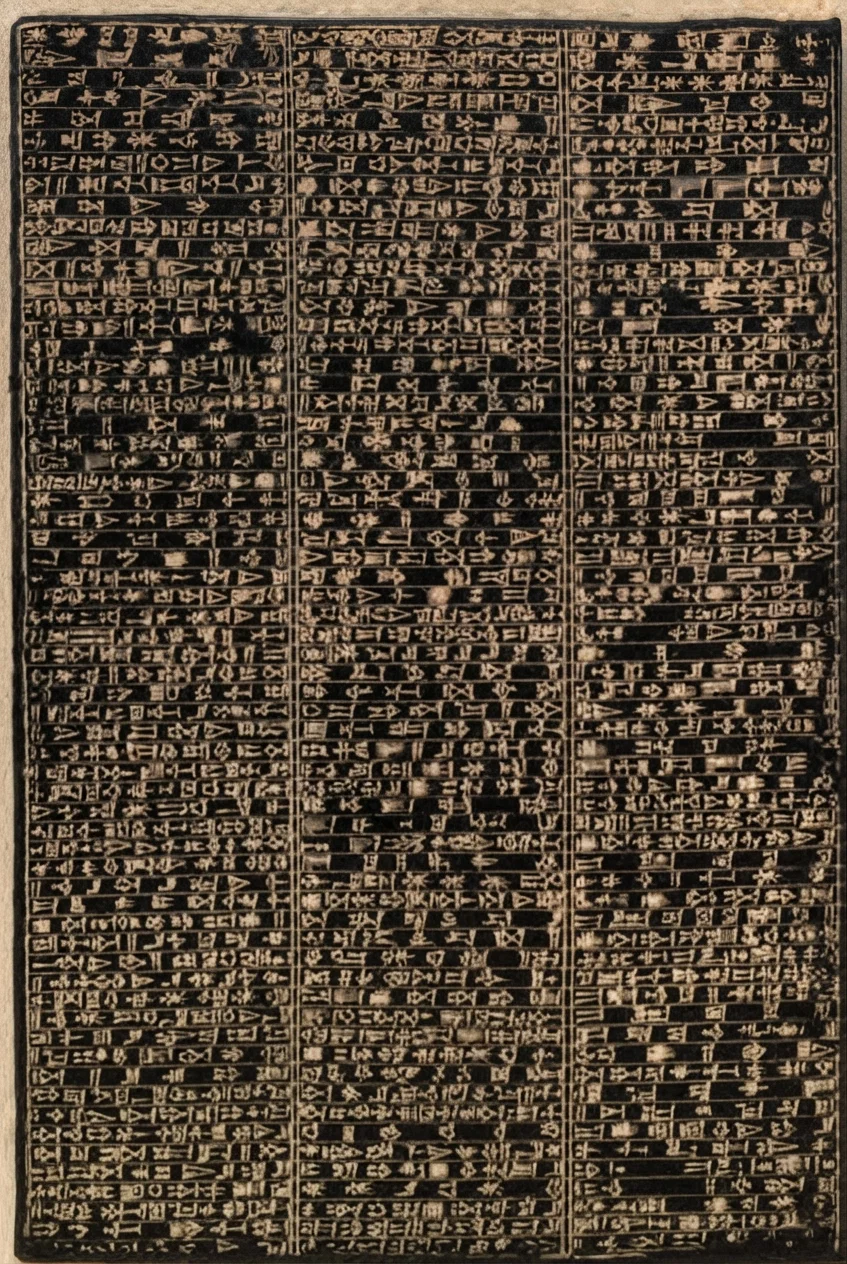
A black basalt book of Nebuchadnezzar, containing a record of his building and beautifying of the walls and great edifices of Babylon, and a prayer to Marduk, or Merodach. This basalt slab is in the British India Office, London.
This is the people who succeeded to the world empire in the place of the idolatrous, luxurious, drunken, lascivious, imperial power of Babylon. But when Medo-Persia had succeeded to the imperial world-position and power of Babylon, again empire demonstrated precisely all that absolute empire in permanency could do. The invaluable experience and lessons of both the principle and practise of temperance were forgotten. The principles and the practise and the experience of temperance were all swept away; and that which was a new order of things to them, the untold wealth in the uninterrupted stream of tribute from all peoples and nations, governmental idleness by the submission of all nations, and the consequent intemperance, carried this empire over the same course that Babylon had gone to ruin.
Indeed, of them history records that “to such a height was their luxury grown, that they would have the same magnificence and enjoy the same pleasures and idleness in the army as in the king’s courts, so that in their wars the kings marched accompanied by their wives, their concubines, and all their eunuchs. Their silver and gold plate, and all their rich furniture was carried after them in prodigious quantities; and, in short, all the equipage and utensils so voluptuous a life requires. . . . This luxury and extravagance rose in time to such an excess as to be little better than downright madness.”
The Succession of Grecia.
And in this excess of intemperance the Persian empire sank, as had Babylon before her. The Persian empire sank before another new people, accustomed to hardships, and tho not so strictly temperate as were the Medes and Persians in the day of their accession to empire, yet, so far more so than were the Persians at their last, that they could be called a temperate people. For when the Greeks first met the Persians at Marathon, and before as well as afterward, it is recorded of them that they were “well disciplined troops under skilful and experienced commanders; soldiers accustomed to temperance; whose bodies were inured to toil and labor, and rendered both robust and active by wrestling and other exercises practised in that country.”
But the glory of wealth and luxury of empire that came to the Greeks, immediately robbed them equally of their power. Their mighty king, who won the world-empire before he was thirty-three, perished as the result of a drunken bout; the empire was broken to pieces, was held in four parts, then in two, but going the same course of empire—vast wealth, abundance of idleness, and consequent intemperance—till “the transgressors came to the full;” and again empire, having demonstrated precisely what alone empire can and will do when it can have its own way in undisputed sway, perished; and in its place there came empire by another new people, built up by hardships, self-discipline, and temperance.
Roman Dominion.
For at the time when the Romans were rapidly stepping to the very height of world-empire, three ambassadors were sent by the senate to the king of Egypt in his capitol. In their honor the king spread a banquet of “all the variety of the most assumpitious fare. Yet, they would touch nothing more of it than was useful, and that in the most temperate manner for the necessary support of nature, despising all the rest as that which corrupted the mind as well as the body, and bred vicious humours in both.” Such was the moderation and temperance of the Romans at this time. And hereby it was that they at length advanced their State to so great a height. In this height would they have still continued could they have retained the same virtues. But when their prosperity and the great wealth attained thereby, became the occasion that they degenerated into luxury and corruption of manners, they drew decay and ruin as fast upon them as they had before victory and prosperity, till at length they were undone by it. Being so undone, the empire of the Romans sank in annihilating ruin as had the empires before it.
Such is the repeatedly demonstrated course of empire. And thus it is also repeatedly demonstrated that such is precisely and only what absolute empire in permanence can and will do.
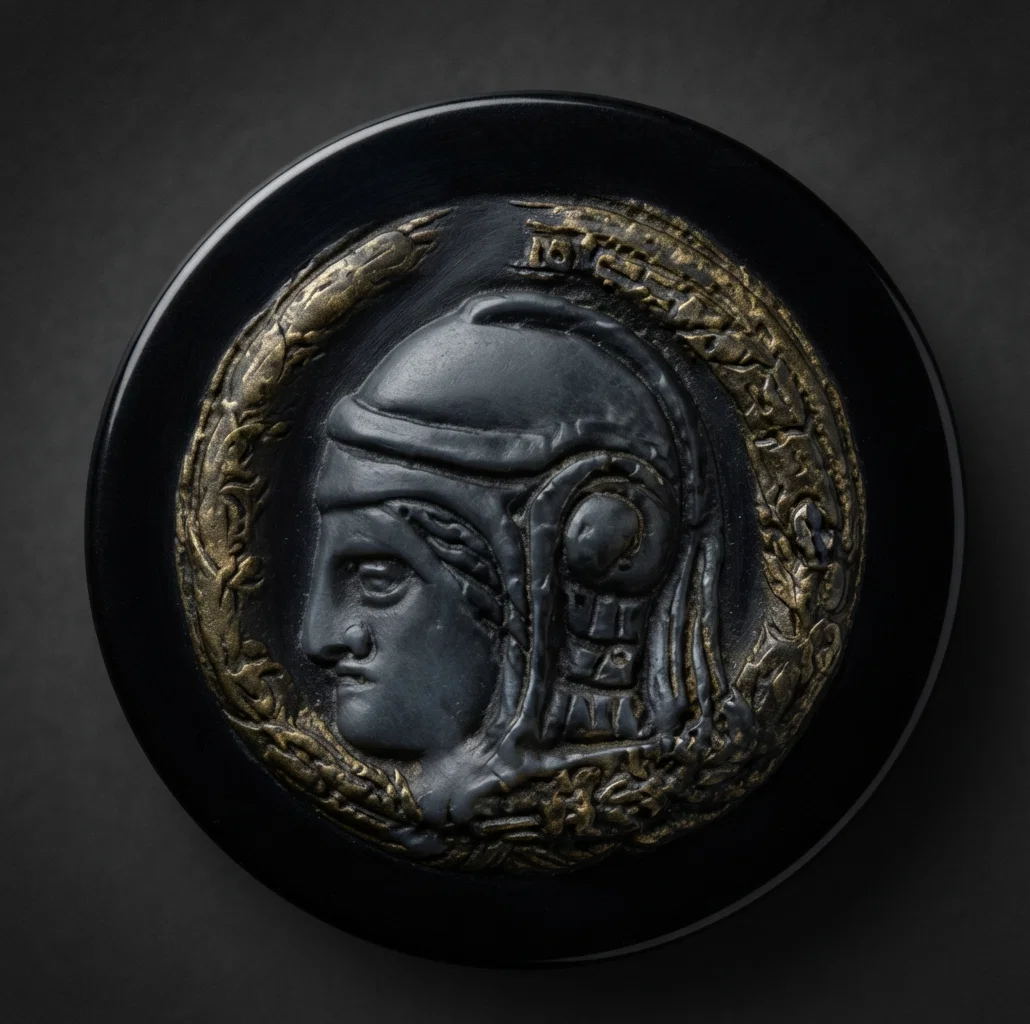
Cameo portrait of Nebuchadnezzar, a votive offering dedicated to Merodach; engraved on a black stone.
“OUR FATHER!”
By Mrs. Carrie Butcher
BY MRS. CARRIE BUTCHER.
AND dare I, a frail worm of the dust, presume thus to address the great and mighty God? the “Creator of all things,” “the High and Lofty One that inhabiteth eternity?”
Yes. O my soul, wonderful as it seems, this is indeed thy exalted privilege; and not thine only, but to every member of our fallen race comes the glorious tidings, “If the Son therefore shall make you free, ye shall be free indeed.” O, ye tempted, care-worn ones, lift up your eyes to Him whence comes your help.
Since the Only-begotten of the Father, Jesus Christ our Saviour, “hath once suffered for sins, the Just for the unjust,” we may reckon ourselves free. From Calvary’s rugged brow comes the glorious declaration: “It is finished!” Hail, all hail! Thou blessed Son of God! who didst take upon Thyself the form of a man, and humbled Thyself, “and became obedient unto death, even the death of the cross,” that a guilty, ruined, helpless race might have hope. Shout, O heavens! be glad, O earth! for, lo, the son of Mary comes forth Conqueror over death, hell, and the grave, and hath ascended into heaven, and sits at the right hand of the Majesty on high, making intercession for us! Praise His holy name! “He is able . . . to save them unto the uttermost, that come unto God by Him.”
Inasmuch as we who are afar off are now “made nigh by the blood of Christ,” let us “draw near with a true heart in full assurance of faith,” more especially since God Himself hath declared us to be joint-heirs with the Lord Jesus Christ, and hath called us to be sons and daughters. O, shall we think of Him as a stern, unyielding judge, a hard master?—No, no. He is our Shepherd, and we the sheep of His pasture.
Now, O child of God, dare to assert your rights. Take the blessed Word, your Father’s will and testament to you, and, reaching out for your possessions, claim them, remembering, as God said to ancient Israel regarding their promised inheritance, “Every place that the soul of your foot shall tread upon, that have I given unto you.” Joshua 1:3. So He is saying unto you, They that believe enter into rest, “Him that cometh to Me I will in nowise cast out.” “According to your faith be it unto you.” Every promise that you step out upon, claim by faith, is yours, if you will meet the conditions of repentance and a turning away from your sins. “He that spared not His own Son, but delivered Him up for us all, how shall He not with Him also freely give us all things?” Take Christ for your abiding, indwelling life. For “in Him dwelleth all the fulness of the Godhead bodily.”
Red Oak, Texas.
How They Became Convinced
By J. W. Westphal
[Believing it would be of interest to our readers, the editor of the SIGNS OF THE TIMES has asked Sabbath-keeping ministers and evangelical workers to tell in a few words the scripture or scriptures, the truths and principles, which constrained them to accept the unpopular truth of the seventh-day Sabbath. These testimonies must not exceed 500 words. Let us hear from all.]
CXXIX.
WHEN in the summer of 1878 Brother H. W. Decker came to the little city of New London, Wis., to hold meetings in a tent, I was not a Christian, neither was I willing to be one. I had repeatedly heard the call to give my heart to God, and only once had I given even reserved assent. During the eight weeks of meetings I attended but twice. I might have attended oftener, but from the meetings that I had attended there resulted a deep conviction in my heart, a conviction not simply from the arguments presented, but from the power accompanying the message, that the truth of God was being given to the people, and a call more distinct and more powerful to give my heart to God than I had ever heard it before came to me,—all of which I did not wish, and therefore remained away. The fear and dread I had before entertained of being laughed and jeered at for being a Christian were greatly intensified, now that to be a Christian involved very clearly to my mind the unpopular doctrines and practises of the Seventh-day Adventists relating to the Sabbath, etc. Being a youth of only seventeen years, I feared most of all that it would rob me of the one day, Sunday, for fun and frolic.
Not being content with remaining away from the meetings, I foolishly opposed my parents when they began to observe the Sabbath of the Lord. Desiring to rid myself of the convictions that had taken possession of me, I wished to go where nothing would remind me of the truths I had learned. Circumstances seemed to favor and I was permitted to leave home and work in a lumber camp the following winter. But there was no fleeing the Lord’s presence. In mercy, tenderness, and patience He followed the aimless runaway. With distance from home, friends, and the truth, my convictions increased. The Lord continued speaking to my soul. I was rejoiced more to return home the following spring than I had been to leave, and I was resolved no longer to shun the place the Lord might choose to teach His people. The following summer I surrendered my heart to God, and with that I began to observe the Sabbath. What one text more than others brought me to this decision I can not say. Of one thing I was then and am still deeply conscious, and that is, that God was leading and teaching me. The Sabbath became my delight. For Sunday’s fun, I found delight in the Lord. Fears of scoffs and jeers no longer moved me. Ever since I have humbly rejoiced in the message that has brought to me the Sabbath, and in the Lord who has dealt so lovingly and patiently with one so determined and wilful. J. W. WESTPHAL.
NOT THEORY, BUT LIFE.
By Editor
THE truth of God is not a matter of theory, but of life. We have no desire to argue it, in order to get the better of an opponent or to demonstrate the superiority of our belief. We leave that to those who love to live on dry, dead forms.
He whose combativeness is aroused fortifies himself, and more frequently against the theory which his opponent holds than against the man or his argument. The argument may be clear, convincing, cogent, to an unprejudiced, receptive mind; but when it meets or arouses prejudice or combativeness, it closes the ears and heart to the truth which it seeks to force home.
THE SIGNS OF THE TIMES has strong, unpopular truth to present to the world. It bears a message of reform based on the Word of the living God.
We have given ourselves to this work because we believe the Bible to be the Word of God, and what is therein written is the word of life to perishing men.
We believe that God's moral law, the reflect of His own character, is summarily comprehended for sinful man in the Decalogue, and is obligatory upon all men.
We believe that this is clearly shown by the Word of God.
But we have no desire to argue that this is so in order that we may show our belief to be right, and win some adherent to the theory. We have no desire to debate the theory with some antinomian advocate.
But we do wish to present the evidences from God's Word so clearly that every loyal, obedient heart will gladly yield to such a Ruler, to such a law, and be obedient.
We believe that the Bible teaches clearly that the seventh day is the Sabbath of the Lord our God; that Christ Jesus is the only Saviour, the only source of righteousness and life to this world; that He is coming again, that He is coming soon, to restore all things, to judge the nations, and to reward His own. We believe that the Bible clearly proves the truth of all this, all theories to the contrary notwithstanding.
To prepare men for the glorious consummation of "the travail of His soul," He has sent to this world a great threefold message of instruction, of reproof, of warning, of salvation. Rev. 14: 6-14.
But we have no desire to argue these things merely to convince you that we are right.
We do desire, however, to tell you the old, old story, ever new with abundant, present, all-sufficient life and truth of God. It has in it all of blessing, none of cursing. It has in it all of joy, none of sorrow. It brings light, not darkness; healing, not hurt.
Received by faith, God's law becomes a code of enabling acts, empowering us to fulfil its every precept; the Gospel becomes indeed good tidings, releasing us from the bonds of sin and transgression, and setting us free to do the will of God. The proving of that law makes us love it with all the heart. The proving of Christ Jesus demonstrates Him a Saviour, a helper, a friend, a companion, dearer than all beside.
But we did not get these and other precious truths by argument; neither will you.
We shall present reasons for their acceptance, because we know they will do you good. We ask you, dear soul, whoever you are, to weigh our reasons in the light of the Word of God, by which you shall be judged in the last day.
INFIDELITY A RESULT OF PERVERTED TRUTH.
EXTREME representations of Christianity and extreme assumptions on the part of its professed devotees always result in reaction toward infidelity. This is why the great deceiver invents and encourages such things. It was the false doctrines and extravagant assumptions of the Roman Church that gave rise to the infidelity in France, which culminated in the great Revolution, with all its terrible results. Christianity had been so grossly misrepresented that men rebelled against the power that called itself by that name; and, in their ignorance, not knowing anything of the genuine principle, they rushed to the farthest extreme for a substitute.
Another Roman dogma, adopted extensively by Protestants, has worked mightily for infidelity, and this is the monstrous incubus of eternal torment. It is a terrible misrepresentation of the character of God to portray Him as a tyrant who takes pleasure in the torture of his enemies. This is the idea the heathen have of a god; therefore their idols are represented as vindictive creatures, and their worship is but a series of efforts to appease the wrath of some being possessing only traits of cruelty and revenge. There are men, however, whose instincts (unconsciously influenced by the Spirit of Christianity in the world) revolt at such things. And when they are led to believe that the Christian's God is one who will take pleasure in the eternal torment of His enemies, they instinctively shrink from allegiance to Him. Hence we have infidelity and human endeavor in the line of self-preservation and self-elevation.
If such men would study the Word of God in its own light, from its own standpoint, they would see the God of the Bible portrayed as a God of love. "God so loved the world" (John 3:16), "while we were yet sinners" (Rom. 5:8), "that He gave His only-begotten Son, that whosoever believeth in Him should not perish, but have everlasting life" (John 3:16); "the wages of sin is death; but the gift of God is eternal life" (Rom. 6:23). Sin and death came upon the race through man's own disobedience, and the Son of God gave His own life as a ransom for all who would believe and accept pardon and eternal life. Then men who suffer the penalty of eternal death (not torture) will do so because they will not accept the life provided for them. See John 5:39, 40. "God is love" (1 John 4:8), and is "not willing that any should perish" (2 Peter 3:9). "As I live, saith the Lord God, I have no pleasure in the death of the wicked; but that the wicked turn from his way and live." Eze. 33:11. But He can not in justice save men who choose sin and its consequences. It would do them no good, and they would continue to mar the peace of the world. "Let favor be showed to the wicked, yet will he not learn righteousness; in the land of uprightness will he deal unjustly, and will not behold the majesty of the Lord." Isa. 26:10. So the Lord continually makes this appeal: "I have set before you life and death, blessing and cursing; therefore choose life, that both thou and thy seed may live." Deut. 30:19. To teach that such a God of love could find pleasure in torturing forever any of His creatures is a travesty on His character, and a sheer perversion of His holy Word. It is no wonder that such a dogma should make infidels of those who do not study the Word of truth for themselves.
OUR HOPE IN CHRIST.
In the time of Abraham men had relapsed again into idolatry till the worship of the true God was well-nigh obliterated. Abraham had not departed from the Lord, and, in order to save him, and make of him a missionary of the truth, God called him out from his idolatrous surroundings. In connection with this call, the Lord made him great and precious promises. These promises were made to Abraham because the Lord knew that he had an obedient heart, and would also teach his children to be loyal. It required great faith, in the midst of such surroundings, to step out on these promises, and go to a land of which he knew nothing whatever.
But "he staggered not at the promise of God through unbelief; but was strong in faith, giving glory to God; and being fully persuaded that, what He had promised, He was able also to perform. And therefore it was imputed to him for righteousness." This promise was made to Abraham in an unconditional form, because the Lord knew that he had faith to fulfil the necessary conditions. The promises included the heirship of the world (Rom. 4:13), but not the world in its present condition. That portion which his natural seed occupied was but a type of the eventual, greater possession. It was in this typical land that he sojourned as in a strange country (Heb. 11:8-10), "for he looked for a city which hath foundations, whose Builder and Maker is God." That city is the New Jerusalem, which is described in Revelation 21 as coming down out of heaven on the new earth.
But the point of interest to us is that this promise is not to Abraham alone, but to his seed, also. Not to his natural seed, but to his spiritual seed. Primarily, Christ is the Seed contemplated in the promise (Gal. 3:16). "And if ye be Christ's, then are ye Abraham's seed, and heirs according to the promise." Verse 29. Because Abraham believed this promise, and demonstrated his faith by his works, "it was imputed to him for righteousness." And the apostle leaves us this assurance: "Now it was not written for his sake alone [it was not necessary to write it for him], that it was imputed to him; but for us also, to whom it shall be imputed, if we believe on Him that raised up Jesus our Lord from the dead."
So our hope in Christ, through the promise to Abraham, consists in a home in the everlasting kingdom of Christ, on the new earth. This will come to us through a resurrection of the dead. 1 Cor. 15:13-18.
HE DOES NOT KNOW CHRISTIANITY.
By Editor
It is not the custom of this paper to make any notice whatsoever of unsigned communications; but we make an exception very rarely, if not to "adorn a tale" to "point a moral."
We have received not a few letters from union working men who have read our Capital and Labor issue. Almost invariably they see and appreciate the consistency of our position as Christians. (We do not here refer to Socialists, who agree with us as to conditions, but not as to remedy.) From purely worldly and political view-points much may be argued in behalf of Unionism and Socialism; but men who look beyond this short, disappointing life must take broader views. We do wish to note some principles in an anonymous letter which has come to us, the writer of which says:—
I am a child of God, a member of the Advent Church, and a member of the union. I try every day to walk in the light of God's Word. I believe in union labor. It is right and good.
When union men will do according to their constitution, they will not do wrong. The same with members of the church, yes, and the Advent Church, when its members go according to its constitution, which is the Word of God.
I prefer the company of union men before non-union, because they believe as I believe in regard to the union. I love the company of Advent Christians before others, because they believe as I believe; for I love to think of the second advent of my Lord. The old proverb is ever true, "Birds of a feather flock together."
I honor and respect a non-union man; if he is sincere and honest, he would have no desire to work with union men; he would seek employment with those of his own class. Union men and non-union can not work in harmony any more than Christians and the world. There would be no occasion for clashing if men would be true men, be they union or non-union. I have no desire to work with non-union men. But I am ever ready to be kind, good, and just to all men, whether union or non-union. And that is what our Constitution teaches.
YOUR BROTHER ADVENTIST.
The first thing that strikes one in this letter as a whole is the low plane on which it places Christianity, and its exaltation of a mere human agreement.
First of all, then, Christianity is not a mere organization, no true Christian church is a mere organized body of belief in certain rules or regulations. Christianity, if it is anything, is a life, the life of God sent down to men; and he who receives it enters into life-union with God and life-union with every soul who likewise receives Christianity. No mere set of rules binds him, no mere human covenant binds him, no mere union of sentiment and belief binds him to his fellow-believers. He is bound to them by the life of God in Christ Jesus, a tie above all human ties.
2. By this very union with Christ he is bound to regard above all others his brethren in Christ Jesus. In fact, this is one of the tests of genuine Christianity. "By this shall all men know ye are My disciples, if ye have love one for another."
3. By his redemption in Christ Jesus, by the very fact of his life-union with God, the Christian is bound to labor for all others beyond the church. "I am debtor both to Greeks and to Barbarians, both to the wise and to the foolish;" and we may as truly add, "both to the union man and the non-union man." "So then, as we have opportunity, let us work that which is good toward all men, and especially toward them that are of the household of the faith."
4. It therefore follows that no human union of any sort should be permitted to come between us and the mission which Christ has given His followers to every man. But this writer would prefer a union man to his own life brother in Christ Jesus who was a non-unionist. And if he is a faithful union man, living according to the union constitution, he will, in times of stress and strife and difference, stick to his fellow unionist, and turn from the non-unionist, even tho a fellow Christian. To keep his union constitution, he must utterly ignore the requirements of Christianity. If he do right in times of difference, and hold with his non-union Christian brother, he separates himself from the union or becomes subject to fine or penalty.
5. It is not the business of our "Brother Adventist" or any other Christian to judge as to whether a non-union man is sincere or not. That rests with God.
6. Again, what does our brother do with the "Golden Rule"? How does it or can it work in the union which he prefers? Christ did not say: "All things therefore whatsoever ye would that union men should do unto you, even so do ye also unto them;" but "whatsoever ye would that MEN [all men] should do unto you, even so do ye also unto them," the all men. We know that no union man wishes to be deprived of work for the support of his family. We know that he would not wish to be waylaid on his way home; that he would not like to be called "scab;" that he would not wish his place of business "picketed" and his business injured; that he would not like to have men pursue, in a score of different ways, the course toward him that he does toward a non-union man. Why do union men do this, then?—Simply and solely, in the last analysis, because they do not know Christ and have not His Spirit. Their defense is never from the side of Christianity. It is strange that a Christian should stand with them in these things, which are the logical outgrowth of their demands and claims.
We have no prejudice, whatsoever, in this matter. We know union men of the world whom we respect, not because of their unionism, but because of their manhood. We know mean non-union men, mean not because of their non-unionism, but because of yielding to inherent selfishness. In doing common, secular, legitimate work, we do not see why any Christian could not work with both unionists and non-unionists, or either, if both were equally manly.
Christianity lifts a man above all these schemes of men. It makes him value a man above all human organizations to which he may belong. It does not measure a man by his politics or social creeds, but by his needs and his possibilities in Christ Jesus. In the Christian's relations with men, apart from regular government, he can not be bound by any human rules and regulations whatsoever.
"BE YE HOLY."
HOLINESS is essential to salvation, for without it no one can please the Lord. Heb. 10:14. To be holy is a command of God. Lev. 11:44; 20:7; 1 Peter 1:16. Holiness is attained only by faith in Christ and communion with His Spirit; for without Him we can do nothing. John 15:5. Those who please God, against whom there is no condemnation, have attained that position because, being in Christ, they "walk not after the flesh, but after the Spirit." Rom. 8:1.
Holiness is perfected by cleansing ourselves of all filthiness, or defilement, of the flesh and spirit, in the fear of God. 2 Cor. 7:1. Inspiration also makes this appeal: "I beseech you therefore, brethren, by the mercies of God, that ye present your bodies a living sacrifice, holy, acceptable unto God, which is your reasonable service." Rom. 12:1. To this end we are specially enjoined to be holy in our conversation. 1 Peter 1:15; 2 Peter 3:11.
The standard of holiness is the character of God, and His character is expressed in His law, which is righteous (Deut. 4:8), which is perfect (Ps. 19:7), which is holy (Rom. 7:12). Therefore holiness is harmony with the law of God. To walk after the Spirit is to "delight in the law of God, after the inward man" (verse 22), for "the law is spiritual" (verse 14). "Blessed is the man that walketh not in the counsel of the ungodly, nor standeth in the way of sinners, nor sitteth in the seat of the scornful. But his delight is in the law of the Lord; and in His law doth he meditate day and night." Ps. 1:1, 2. This is holiness, a condition acceptable to God. Self-asserted goodness is not holiness; it is presumption.