A German writer asserts that bees are excellent storm warners. He says that on the approach of thunderstorms, bees otherwise gentle and harmless become very irritable, and will at once attack any one, even their usual attendant, approaching their hives. A succession of instances is given in which the barometer and hygrometer foretold a storm, the bees remaining quiet, and no storm occurred; or the instruments gave no intimation of a storm, but the bees for hours before were irritable, and the storm came.
For the INSTRUCTOR.
THE BEST WAY.
By W. E. L.
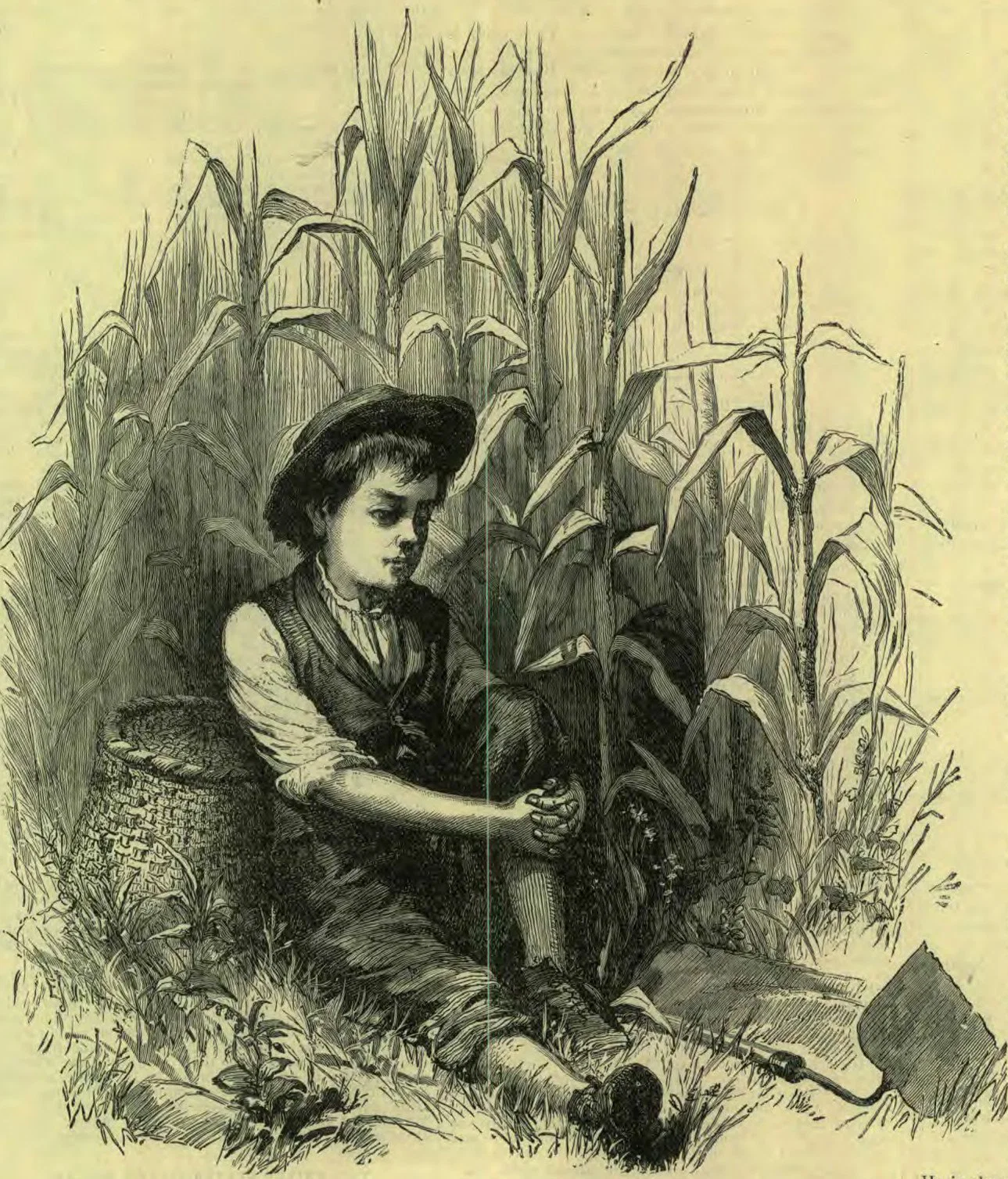
How hot the July sun poured down! Will rested on his hoe handle, and drew his sleeve across his face to wipe off the moisture. Such a lot of potatoes to hoe! He looked back at the rows that he had hoed, and then over at what there was still to do. A sullen look crept into his face, but he worked on. At the end of the long row he halted; and flinging the hoe in the furrow, sat down in the shade of the tall corn that was nodding its tassels in the fitful breeze.
“I don’t believe there ever was a boy that had such hard times as I do,” he muttered to himself. “It’s just work, work, work, work, from morning till night. I’m sick of it.” And Will pushed back his hat and leaned against the old basket to think it over, and build castles about what he meant to do by and by. When he grew to be a man, he wouldn’t work on a farm all day; he would live in a fine house, like Mr. Brown’s, with a great spreading lawn and tall shade trees in front; he knew just how it looked, for he went by there almost every time on his way to town. Once he had seen a little boy just his own size out in the yard, reading in a book, and how he wished he could change places with him. He would have a span of gray ponies, too, such as he had seen Mr. Brown driving out of the great gate. So he went on planning and thinking, till the minutes crept into half an hour—a whole hour—or more. Suddenly Will was startled at a rustle near him in the corn, and springing up, he saw Uncle Esek looking at him with a peculiar twinkle in his eyes.
Uncle Esek was no real relation to Will. He was an old, weather-beaten man who lived in a little log house a mile up the road from Will’s home. He was shrewd and keen, and by his kindly words spoken at just the right moment, he often helped many a perplexed boy out of his troubles.
“Well, what is it?” said Uncle Esek, glancing down at the hoe and then at Will’s flushed face, from which the discontented look had not yet faded away.
Will looked as if he would rather not tell, not feeling sure what answer Uncle Esek would give him; but at last he said: “Don’t you think it’s mean to make a boy work all the while, anyhow? When I get to be a man, I shan’t do anything I don’t want to,” and he looked up rather defiantly; then he told him what he had been planning.
“Well,” said Uncle Esek in his slow, quiet way, “I can remember when Mr. Brown was a little boy like you, and didn’t live in half so good a house as yours. He had to work just as hard, too.”
Will looked surprised.
“Yes,” continued the old man, “he worked just as hard; but he didn’t fret about it, and stop to build castles in the air when he ought to have been at work. ‘The hand of the diligent maketh rich,’ the good Book says, and I think you will find this true. And there is another verse, ‘Seest thou a man diligent in his business? he shall stand before kings; he shall not stand before mean men.’”
“But Mr. Brown don’t ‘stand before kings,’” urged Will.
“No,” said Uncle Esek, “but every body respects him and values his good opinion.”
Will picked up his hoe thoughtfully, while Uncle Esek continued: “Every thing in this world worth the having costs something. We always have to pay all that a thing is worth before we get it. If we want money, we must work for it; if we want to be wise, we must study hard and think a great deal; if we want to have an easy time when we are old, we must work for it when we are boys.”
“May be that’s so,” said Will; “I never thought of it before. But anyhow you can fix it, I don’t like to hoe potatoes, though I suppose it will have to be done,” and he moved slowly towards his unfinished work.
“That’s right,” said the old man, looking after him; “do the things that are waiting right at hand to be done. And after all, my boy, it doesn’t make so much difference what we work at, though it is a great deal pleasanter to do what we enjoy; but it is the way in which we do the work that makes men of us.” W. E. L.
Letter Budget.
By Editor
WE are sorry to crowd so hard on these precious letters, but see no other way; for all cannot be printed. By giving little extracts from each, we hope to clear the box of all up to March, unless some letter may have accidentally been placed in the wrong package. If this has happened, we shall come across it after awhile. Will begin this time with—
ESTELLA HENDRICKS, of Illinois, who has no brothers or sisters, but keeps the Sabbath with her parents. They go three miles to attend church and Sabbath-school.
LAURA M. JENSEN, a Danish girl of Wisconsin, who has only been in this country four years, says she receives the INSTRUCTOR from an uncle. The family all keep the Sabbath but the father. Laura is learning the ten commandments.
RHODA FERRELL, of Minnesota, enjoys reading the letters from other little girls who are trying to do right. Their Sabbath-school is small in the winter because some live so far away. She wants to be counted with the Lord’s jewels, when he comes.
ROY MOLLENHOUR, of Indiana, seven years of age, says he is trying to be a good boy, so he will not have to call for the rocks and mountains to fall on him, when the Saviour comes.
JOHNNIE SAXTON, a little boy in Michigan, who has no Sabbath-school to attend, but who is keeping the Sabbath with his mamma and grandma, means to be ready to meet the Saviour at his appearing.
ELSIE M. BROWN lives with her auntie in Minnesota, because her papa is dead. But her parents and brothers and sisters all kept the Sabbath. She attends Sabbath-school, also day school, and has not lost a moment from school since she has lived with her aunt.
IVA LAUGHLIN writes from Michigan. She says she and her little brother have kept the Sabbath with mamma for seven years, and with papa two years.
PEARL M. COLE, whose home is in Wisconsin, had just buried a dear sister; but she sleeps in hope to arise in the first resurrection, so they do not mourn as do others.
MAUDIE PORTER lives away in California, and in a place where there is no Sabbath-school, but they learn Sabbath lessons at home. She has a cunning baby brother who tries to talk.
THEN we have a letter from LEMUEL MOLLENHOUR, of Indiana, Roy’s brother. Lemuel is eleven years old. So many of their Sabbath-school scholars have moved away, they can have no school, and they are very lonely.
Two boys have written from Iowa, CHARLEY A. PORTER and BOYD KRAMER. Charley, with his brother and sisters, has no Sabbath-school to attend, but they study Sabbath lessons at home. Two of his sisters have died of consumption, but he hopes to meet them again in the new earth. Boyd has good Sabbath-school privileges, and seems to enjoy them. He is eleven years old, and is in the highest room at the day school.
ERIC E. COVERT wrote from Indiana, ANDREW LINDGREN from Minnesota, and OTTO W. SPRECHER from Wisconsin. Eric has a little brother, but his only sister died last October. She would have been a year old last February. Eric was trying to read the INSTRUCTOR through every week. We hope he will persevere in this; and that what he cannot understand of what he reads, he will ask some one to make plain for him. Would the boys and girls all do this, they would add much to their storehouse of knowledge every week. “Read [understandingly] and you will know.” Andrew and Otto think it is nice to read the Budget, just as many others say. That is all right, but don’t stop with the Budget, dear boys and girls; and the older ones should read it to the younger ones.
There are eight letters remaining, all from dear little girls who have written very nicely, telling about their Sabbath-schools and day schools with as much interest as the other girls have done; but we have space for only their names, which are as follows: From Wisconsin, ANN M. CHAPMAN, and EMMA P. FESSLER; Indiana, CLARA BELL RITTER and M. E. CYRAM; Iowa, DALE SYLVESTER; Minnesota, BLANCHE EMERY; Kansas, OLLIE WHEELAND, and from Michigan, MYRTIE AODAS. A good many have written their first letter in this paper; but we hope not the last; and shall there not be a great improvement in your next letters? We feel sure there will.
WORK FOR ALL.
If little things that God has made
Are useful in their kind,
Oh, let us learn a simple truth,
And bear it on our mind:
That every child can praise the Lord,
However weak and small.
Let each with joy remember this—
That God has work for all.