[[FIGURE]] UP to the present time, the ambassadors in conference in England, under the patient chairmanship of Sir Edward Grey, have succeeded in prolonging the peace, but almost every morning brings to light some new and perplexing factor in the confused situation. The great powers are still talking firmly about what they will allow Montenegro to do, and are calling upon her in stern tones to evacuate Scutari. But people can not forget that very firm tones were used before hostilities began in the Near East, and that the little nations paid no attention to the great powers, but managed their own affairs, and did surprisingly well. Austria, however, seems to have made up her mind that a death struggle between herself and some of the Balkan peoples is only a matter of time, and that she may as well fight now as later. The question for the other powers is whether they will support Austria's selfish and unscrupulous policy, or run the risk of being involved in a European war. It grows clear that Austria is not going to yield this time, and unless she gets her own way in Albania, will not hesitate to precipitate a war in which Russia, Germany, France, and Italy may soon be involved. The other European governments do not want war; and so it is probable that Austria, being determined, will get what she demands, unless the little nations themselves defy her.
The Price of Peace and the "War Devil"
Public opinion in England is far from satisfied with the position. There is nothing glorious about the idea of the concert of Europe combining to coerce tiny Montenegro, and the English people do not relish the part they are made to play. Mr. Zangwill has given vent to the general feeling in an explosive article in the "Daily Chronicle," in which he says:
"The price of peace is paid not only in hard cash but in honor. The fear of the Lord is the beginning of wisdom, but the fear of the war devil is the beginning of madness. Worse than war is the death of the soul of a people. For if there is a peace of God which passeth all understanding, there is a peace of the devil which passeth all endurance. It is a peace purchased by sacrificing to security every high national ideal, every generous instinct. Such a peace we enjoy to-day. . . . We have the cost of greatness, only no greatness. And the same spiritual blight has spread over the bulk of Europe. Hampered by their coats of mail, the nations can scarcely move a finger. The Balkan States rush in where the great powers fear to tread. and when at last united Europe nerves itself to demonstrate, it is against—Montenegro."
Mr. Zangwill's article is headed "The War Devil." The term is significant. Several of our writers are beginning to use language, when they deal with the present situation, which expresses an uneasy conviction that some malefic being is at the helm of Europe's ship of state, controlling the minds of its politicians and diplomats, and leading the nations on to certain destruc- tion. Again and again our public men denounce the insanity of our vast armaments; and yet, altho common sense revolts at the appalling sacrifices demanded of the civilized nations, an irresistible force seems to urge them all ever on the downward path. Says Mr. Zangwill:
"Imaginatively incarnated, this subtly pervasive necessity would appear as the spirit of a war devil, chuckling with grim humor as he watches the writhings of his minions and marionettes—statesmen primed with culture and Christianity, their lips chanting the praises of peace, yet condemned by their mocking master to add brick after brick to the temple of Apollyon, and to build not God's kingdom on earth, but the devil's!"
Familiar to the Student of Prophecy
How familiar are these sentiments to the student of prophecy! They are but the echo of what he reads in the Scriptures. He turns to the prophecy of Joel about the arming of the nations in the last days, and the prophetic word, "Prepare war," comes in resounding echoes back from the dockyards and arsenals and battle fleets, where the din of preparation goes unceasingly forward. The book of Revelation shows us the kings of the earth and their armies led by the spirits of demons to the field of Armageddon, to the battle of the great day of God almighty (Rev. 16:13, 14); and lo, to-day, when this prophecy is on the verge of fulfilment, men's mouths are full of the phrase "war devil." There is no mistaking the grim reality that lies behind the expression.
What but the madness that precedes and ensures destruction could have induced the leading nations of Europe to take upon themselves the gigantic burdens which have lately been added to their already heavy loads? Germany is to raise $250,000,000 dollars by an extraordinary tax on capital, and to increase her tremendous annual expenditure by $50,000,000. Her army is to be enlarged by another 160,000 men. France at once feels that this move imposes upon her the necessity for equal sacrifice, and promptly adds fifty per cent to the strength of her standing army. Russia, too, takes from her population another 150,000 men to swell her vast armies.
To Make Service Compulsory
The same spirit is making its way in England. The government has so far stood firm against the demands for conscription, but the movement in favor of compulsory service gains ground steadily. Conscription has already become a live issue in the political world. Lord Roberts continues to go up and down the country preaching the necessity for universal military service, and he is assisted by powerful advocates, who join in declaring that nothing but conscription will ever save the English nation from the rot that is eating away its vitality. Soon it will be proclaimed as the highest moral duty to serve in the national armies. In England the "war devil" appears as an angel of light.
"Armor-Plate Patriotism"
It is interesting to note, however, side by side with the glowing appeals to patriotism and the eulogies of the militarist ideal, reports of the gross scandals unearthed on the continent in connection with what is cynically termed "armor-plate patriotism." It appears that a good deal of the fuel that keeps the flame of military ardor burning briskly among the nations is supplied by the people who sell armor and guns to the European kingdoms. While the journals subsidized by these wealthy organizations are extolling to the skies the patriotic spirit that arms itself to the teeth against all its neighbors, the big armor-plate trusts are enriching themselves by selling their wares to all and sundry, regardless entirely of whether the weapons are likely to be used against their native land or not. German firms gets11inflammatory articles printed in the French papers to stir up race hatred in the two countries and promote business. French capitalists control concerns that supply weapons to Germany. Austrian firms extend their operations to Russian soil, and supply Russian armies with munitions of war that are more than likely to be used against Austria itself, making large profits out of the transaction. Everywhere the noble business of supplying war equipment seems to be a remunerative one; the shareholders draw annual dividends of thirty per cent. Thus the game goes on merrily, and the peoples pay and bleed, while the armament manufacturers organize scares, and run a department for the creation of embittered public sentiment.
All that the firms concerned have found to say, as yet, in their own defense, is to deprecate the introduction of too much Pharisaism into the criticism. Their motto is that business is business, and that they must advertise to succeed. If only the peoples and the governments would take this view of the whole matter, it might help them to keep cool when the next press campaign rages; but unfortunately, public passion seems to rise too readily to every suggestion of a holy war against some prosperous rival. The "war devil" has enough well-paid talent at his disposal to make his ideas popular.
Financial Prosperity
England is at present enjoying a good measure of financial prosperity, according to the recent budget of the chancellor of the exchequer. He estimates an expenditure, for the coming year, of about $978,000,000, an increase on the past year of some $35,000,000, but expects that the twelve months before us will prove so prosperous that the income will rise sufficiently to pay the bill. Fifty years ago the income tax yielded $4,375,000 for every penny levied, now every penny brings in $15,000,000. During the same period, national expenditure has risen by 180 per cent, while taxable capacity, as gaged by the income tax, has risen by 242 per cent.
The Militant Suffragettes
Our militant suffragettes have been very active during recent weeks. Mrs. Pankhurst, one of their foremost leaders, has in the most open way invited the destruction of property as a means of compelling the country to give women the vote. Railway stations have been burned down, houses set on fire, golf links injured by corrosive chemicals, telegraph wires cut, and a number of bombs have been found in public buildings. These latter, however, having universally failed to go off, it is doubtful whether they were ever intended to explode.
Mrs. Pankhurst was arrested, and charged with inciting to the commission of crime, and being found guilty, was sentenced to three years' penal servitude. However, she announced to the court that she would refuse to take food so long as she was kept in prison, and she was true to her word. No attempt was made to feed her forcibly, and when her life became endangered she was released on a license for fifteen days. The term has expired, and she is still too weak to leave her home. The government has made no fresh move in her case as yet, but the sentence of penal servitude empowers them to rearrest her at any time before the three years has run out. This will enable them to put her in prison again as soon as she creates further trouble.
Photo by Paul Thompson
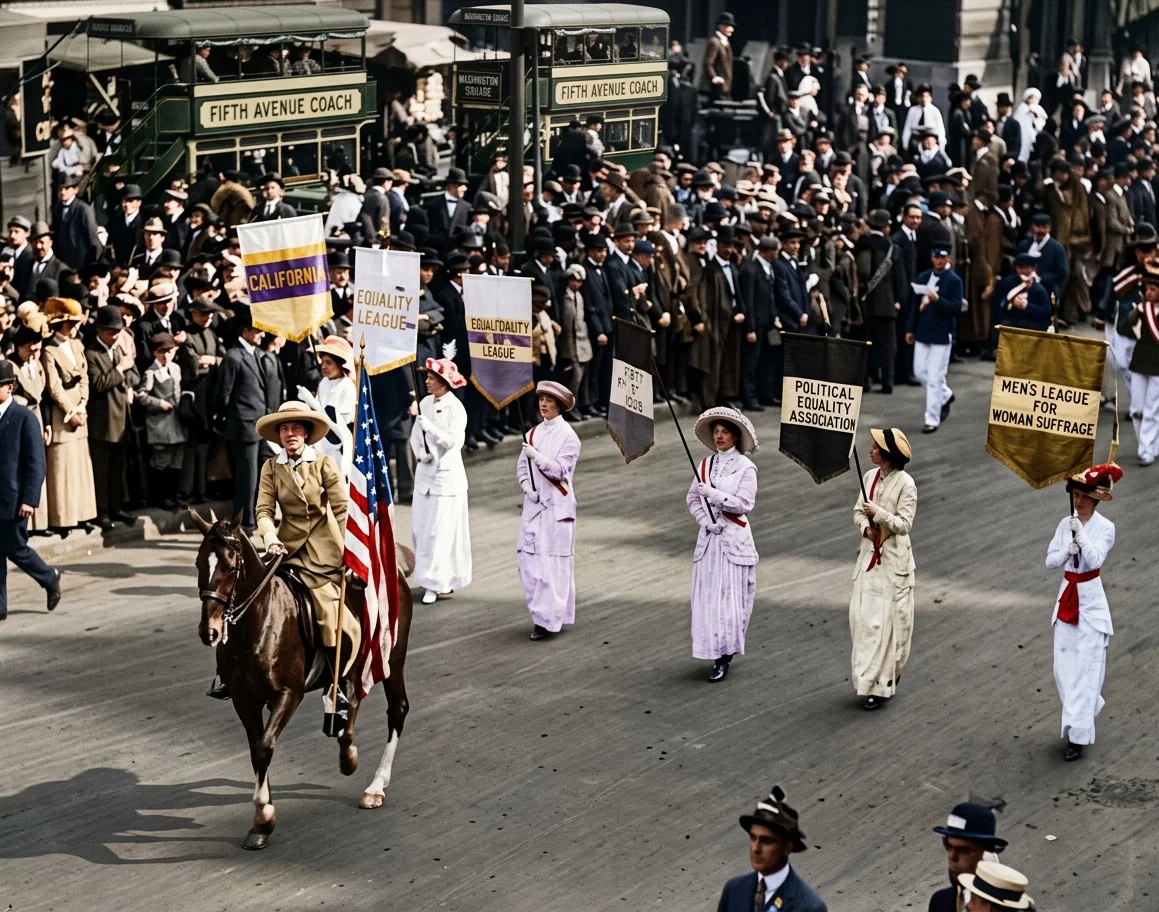
Suffragette parade in New York City May 3. This is the head of the procession that was 30,000 strong.
[[FIGURE]] The authorities have been sorely perplexed to know how to deal effectively with the militant suffragettes and put a stop to their destruc- tion of property. One member of Parliament thought it would solve the problem if they were deported to some small island in the British dominions, supplied with sufficient food, and left to their own devices. This, he said, would be treating them as prisoners of war, and as they claim to have declared war against the government, the militants could not complain.
The government, however, has brought in a bill, known as the "Cat and Mouse" Bill, which authorizes the authorities to let the hunger striker out of prison when her health renders such a step advisable, and rearrest her at some future time to serve the full remainder of her sentence. This would mean that a person sentenced to a year's imprisonment and needing to be released after a week, might have to go back to prison another fifty- one times before she had served her sentence.
The English suffragettes have certainly made a considerable impression upon the public mind, but that impression is hardly favorable to their movement. Now they are unable to hold meetings in the parks or other public places, because the meetings are invariably broken up by mobs, and in view of the continual disorder thus created, the police have prohibited the holding of open-air meetings by the militants.
Since the foregoing lines were written, the police have taken vigorous action, closing the offices of the militant party, arresting their leaders, and confiscating all inflammatory literature. They give notice that it is their intention to proceed against the militant movement in all its manifestations. So the authorities also have declared war now. They have waited a long time to strike, but they seem to feel that they have now waited long enough.
W. T. BARTLETT.
Copyright by Underwood & Underwood
Marching Girl Scouts in Germany
The Demoralizing Effect of Crime News
Hon. John D. Works, United States senator from California, has introduced a bill in Congress to make it unlawful to publish the details of crimes and accidents in the District of Columbia. Mr. Works made a strong speech in the Senate, in favor of his bill. He showed that the constant publication of crimes and vices in all of their gruesome and sickening details has a very demoralizing effect upon the people who receive and read the papers. He called attention to a single issue of a paper picked up at random from which he selected some fifty-one headings that told of crimes, running all through the calendar, from matricide to ordinary petty thievery. He also spoke against the custom, which has become so general among newspapers, of allowing reporters to originate stories that are almost pure fiction, and publish them as fact, merely to create a sensation. There is no question but that great reforms are needed in these lines, not merely in the District of Columbia, but throughout the country. The class of matter printed in many of the papers is unconsciously, and often unwittingly, producing a baleful effect.
Mexico and the Money Power
THE Mexican correspondent to the Christian Herald says: "No sooner was Madero deposed than a large factory in Pueblo cut ten per cent from the salaries of its employees. Complaint was made, and capital replied: 'Take what is given and be grateful. The day will come when you will be glad to work for a crust.' Labor replied by burning the factory." Another sentence from th's correspondent says, "No right to think, no right to live," seems to be the policy of the present administration, since not more than five days ago (from the date of writing) forty men found talking together were accused of plotting, and shot ere the morning light."
There seems to be an undercurrent of conviction that much of this trouble in Mexico is occasioned by a strife among rival capitalists, rather than among the people themselves. Certain moneyed interests are fanning the flames of revolution and keeping them going. Of course the absolute evidence of this it is difficult to get hold of, because such things are always done under very thick covering; but we know, as a general rule, that wars are caused by one of two things,—either some religious controversy or religious fanaticism, or else some one of the many phases of advancing commerce. We know that in this case it is not a religious war, and commerce is more than likely at the bottom of it. The statement from the Herald's correspondent seems to strengthen this conviction. If men would seriously analyze the things of this and a similar character that are in progress throughout this world, they would have but very little difficulty in seeing that the world is not getting better as so many blinded guides would try to have us believe.
Tariff Troubles Ahead
The discussion on the tariff question is becoming quite acute and very interesting. As usual, there is the talk, on the part of certain business interests, that if the tariff is reduced we will have hard times and thousands of men will be thrown out of employment. But Secretary of Commerce Redfield has announced, in one of his speeches, that if "big business" resorts to such tactics as that, the government will be called upon to send competent persons to their business establishments to make definite investigations as to whether or no they are using this means of fighting the tariff in order to extort exorbitant prices for their commodities. It can be readily seen that as this situation becomes more and more strained, there is liable to be introduced into the country some very serious trouble. Some will say, of course, that in order to avoid this trouble the tariff should not be "tinkered with," and that the business of the country should be let alone. On the other hand, if "big business" is permitted to go on in the way it is going, it will of itself soon bring about great revolutions because of the dissatisfaction that is being stirred up among the rank and file of the people. So there is trouble ahead if it isn't attacked, and there will be trouble ahead if it is. This world is reaching a situation that may well cause uneasiness; but to the individual who knows what it means, there is no uneasiness whatever. The masterful hand of Omnipotence will soon seize the helm. This will be a necessity. Affairs are rapidly reaching the place where they are going beyond the control of mortal man. Good men and true are grappling heroically with the situation. We may be assured that in this they are having divine help and guidance; but even then it is getting beyond them, and the personal second coming of Christ will soon be found to be a necessity in order to meet the conditions. Thoughtful men who laughed at such an idea a few years ago, are coming to see it clearly, and many others still will see it as the days go by.
Sunday Legislation
Sunday Legislation.—Massachusetts has passed a Sunday law which makes it a misdemeanor for an individual to be employed for more than six days out of the week. Exceptions are made to newspaper workers, janitors, bakers, drug clerks, and persons caring for fires and machinery. From the list of exceptions, it would seem that not very many people are left to whom the law would apply, particularly in a manufacturing state like Massachusetts.
The united cooks' organization of Chicago are petitioning the legislature of Illinois for a Sunday law that will give the cook one day's rest in seven. A bill has been introduced into the legislature which provides for fines ranging from $25 to $100 for employers who refuse to give their cooks a day's rest out of each week. Every individual is entitled to a day of rest. He should have manhood enough to assert himself and secure it. This has been done over and over again by thousands upon thousands of individuals who had a conscience in the matter and who demanded a day of rest because of their conscience. But where there is no conscience involved in the question, for the state to compel people to refrain from labor on any day, whether they so desire or not, will work evil rather than good. We have history upon the question, that shows this conclusively. The first step is to secure a general day of rest by law. Then the masses of people will go to the parks and other places of recreation and amusement. This will be unpleasing to the clergy, and a little later there will be laws that will require attendance at church. It was so in the fourth and fifth centuries, and on down through the Middle Ages; and similar causes and actions will produce similar effects, regardless of the fact that we believe that we are sheltered by the advancement and civilization of the twentieth century.
Demands of British Money Kings
FROM the Gospel Messenger of March 8, 1913, the following paragraph is taken:
"Simply to save British speculators from a loss of $60,000,000, invested in opium imported from India, Sir John Jordan, representing the British government, is seeking to force China's acceptance of the entire amount of the drug now on hand. All this, despite the fact that Chinese officials have practically ruled out all opium, prohibited all opium-growing in their own land, and effectually stopped the sale and use of the drug. This, naturally, leaves the British merchants in Chinese seaports without a market for their stock of opium, and now they come forward with the demand that China sell the drugs as a government monopoly. As this demand is most forcibly backed up by Great Britain, and, if refused, involves the future status of the republic, there is great consternation throughout China. Western nations are being solicited to support China in the stand she has taken against the opium evil. There is no good reason why enlightened public opinion, both in the United States and in Europe, should not support the Chinese government in its gallant struggle against the opium curse. There is no good reason, furthermore, why British speculators should be protected at the expense of the degradation of China's millions. It is neither right nor just to force the purchase of a drug upon the Chinese, when they have emphatically declared against it on the ground of its destructive influences."
The Craze for Money
The craze for money in this time has driven men to the place where all they can see in a fellow being is the opportunity he affords to get money out of him. His base appetites and passions are cultivated, regardless of depravity and eternal ruin, all for the purpose of creating a market for commodities out of which money is to be made. This is the general rule in the world, and the exceptions are greatly in the minority. And yet men will tell us, regardless of these facts, that the world is getting better, and that we are about to have a millennium of righteousness.
World's Purity Federation
World's Purity Federation.—The seventh International Purity Congress of the World's Purity Federation is to be held in Minneapolis, Minnesota, November 7-12. This federation has been in existence for something like fifteen years. Governors of states in this country have already appointed leading men and women to attend this convention as delegates. Well-known individuals from various parts of the world are expected to be present. The congress certainly has before it a very important work, and every person who is interested in the moral uplift of society should give a helping hand to enterprises of this sort. The plan of the organization provides for delegates to be appointed by chief executives of the nations, states, and provinces, mayors of cities, etc., while local church commissions, brotherhoods, educational institutions, or other societies interested in moral reform may appoint one delegate each. Any one interested in this matter should address the president, B. S. Steadwell, La Crosse, Wisconsin. The white slave trade has become an international peril. It is one of the signs of the time in which we are living; and we should do all in our power to combat this slavery, which is so degrading as to be beyond comparison with every other form of slavery that has ever existed.
Tornadoes and the Perils of the Last Days
By Editor
Despatches of May 14 tell of destructive tornadoes that swept away several towns in Nebraska. This comes very soon after the tornado that did so much damage in Missouri. It is well to make a note of these mighty agents of destruction that have been visiting us during recent months. A regular army of them swept through the Southern and Eastern States a few weeks ago, and before the débris was all cleared away others followed, and then a few days later came a small army of tornadoes through the Middle West, the most destructive of which struck Omaha. These things ought to cause men to think. People ought to be able to notice that there is a striking connection between moral conditions in the world and physical conditions in nature. "The prince of the power of the air" would operate to destroy men whenever he can, but he is only permitted to do this as the world becomes so wicked that the protection of the Almighty must necessarily be withdrawn; and we are not at all backward to make the statement that storms, earthquakes, and pestilences will increase in an awful degree as time passes. We know this not because of any special intelligence that we possess, or of any peculiar human skill, but because of evidence that is beyond the human. It is the evidence of the divine Book of the Infinite God. We are in the perils of the last days; and when the Master was here in person, He made the solemn announcement that "there shall be signs in the sun, and in the moon, and in the stars; and upon the earth distress of nations, with perplexity; the sea and the waves roaring; men's hearts failing them for fear, and for looking after those things which are coming on the earth; for the powers of heaven shall be shaken. And then shall they see the Son of Man coming in a cloud with power and great glory. And when these things begin to come to pass, then look up, and lift up your heads; for your redemption draweth nigh." Luke 21:25-28.
Concentration of Wealth
One of the big corporations of the country is proposing to increase its capital stock from fifteen million to seventy-five million. This new stock is to be divided among the present stockholders by a four hundred per cent stock dividend. This prospect has caused the stock of this company to make a very material advance in price. The concentration of wealth that is in progress is quite well seen through transactions of this kind. Sixty million dollars is a large sum of money to have accrued in a single corporation, and to be ready to be distributed among shareholders in stock dividends.
Essaad Pasha Assassinated
Essaad Pasha, who commanded the Turks throughout the siege of Scutari, and who, upon the evacuation of the forts of that place, withdrew his army and formed the provisional Albanian government, has been assassinated. Doubtless, according to the reports, some political trickery is back of the assassination.
IN THREE DAYS
SAN FRANCISCO
Overland Limited
TAKES YOU
To Chicago
ACROSS GREAT SALT LAKE
AND
HIGH SIERRA BY DAYLIGHT
Luxurious High-class Equipment
Electric Lighted Throughout
Pullman Drawing-room
Stateroom
Vestibuled Sleeping-cars
Careful and Attentive Dining
Service
Parlor Observation-car with
Library and Cafe
Ladies' Reading-room
Gentlemen's Smoking-room
Daily News Bulletins
Latest Papers and Magazines
Southern Pacific
The Odd Man
HE was brought into the ward by the orderlies, and not a man in the barracks was sorry he had "gone sick." In a few hours there was not a patient in the ward who did not wish he had been taken somewhere else.
He was an "odd man," without any friends outside the barracks; and he never tried to make any inside. No one ever knew him to do a comrade a good turn, but there were a number to whom he had done many bad ones.
In oaths and curses he took delight; believed in neither God nor devil; knew he was dying, and that no one would be sorry when his end came; and yet he lay there in his cot doing his utmost to make all within his reach as miserable as he could.
He would watch the chaplains come and go, listen to their talk with a leer on his face, fling aside with a contemptuous laugh the books and papers left on his cot, and make himself so disagreeable that one and all dreaded coming near him.
But one day a new chaplain came to the ward where the old man lay—a chaplain with a bright, cheery smile and face; one who knew nothing about this patient; who spoke to him just a word as he passed between his cot and the next, the cot of a man who had gone sick the day before. The chaplain sat down, and began to talk to the man he had come to see; and the patient whom he had not come to see listened to the conversation, trying, out of sheer curiosity, to hear what he had to say about religion. Certain words fixed themselves on his memory: "God so loved the world, that He gave His only-begotten Son, that whosoever believeth in Him should not perish, but have everlasting life."
Those words haunted him. They kept him awake that night; and the next day he was so quiet that the others thought he was dying. They asked him, "What's up?"
The odd man looked at them, and demanded the name of the new chaplain.
"O, he's the one at the Soldiers' Home down in the town! They always look up their men when they're sick. It doesn't matter what's your religion, it's all the same; if a man goes to the Home, he's looked after."
"Belongs to the Home, does he?" the odd man said; then he relapsed into silence again, and they could get nothing more out of him, except that he wanted to be quiet and think.
Suddenly, in the night, the orderly found him so much worse that he sent for the surgeon, who, on seeing him, thought he could not live until morning.
They listened while his words came slowly and painfully, and found he wished to see the chaplain who belonged to the Soldiers' Home. In great astonishment they heard the request and granted it.
The chaplain arrived about two in the morning, and was straightway taken to the odd man's cot. Then the man who the day before had been thinking, began to express his thoughts in words:
"You said God loved—God sent His Son to die—for the world. Does that mean me?"
When assured that the words certainly meant him, he went on talking, slowly and painfully, but very distinctly: "I never knew any one—who loved me. My mother I don't remember—my father died in penal servitude. I have no relatives or friends. I want you to tell me—what love means—and why God loves me. I have been longing—for some one—to show me—what love means. I have had a hard life—and I have hated, and been hated in return—but I have never loved or been loved before."
So there, in the hospital ward, in the stillness of the night, with the screen drawn around the cot, the chaplain told the man the old, old story of Jesus and His love; and he told it with such power that the sick man burst into tears.
"God loves me," he repeated over and over; "and all my life I have fought against Him. Now I am dying; I can do nothing for Him—nothing for Him who loves me. God loves me. God loves me."
And then he lapsed into unconsciousness. The chaplain stood waiting with the others to see the end. But the end did not come. After a little time the man roused himself, and looking straight at the chaplain, he asked, "Are you quite sure God loves me?" with an emphasis on the "me," which all the listeners noticed.
"Quite," was the reply.
Suddenly the odd man seemed to receive a new lease of life. He rallied; the crisis had passed for a time.
"I'm going to live," he said. "I'm going to show I love Him. I'm going to do something here, in this hospital, for Him who loves me. God loves me. God loves me."
And when the chaplain left, the "odd man" was still repeating, "God loves me."
"You have given him the spur for a time," the surgeon remarked, as he and the chaplain left the ward together; "but he is a doomed man; he can't live very long."
The two shook hands, and parted to go their separate ways. "No wonder," thought the chaplain, as he unlocked his door, "no wonder that verse took hold of him—'God so loved the world.'"
Next day the men in the ward noticed a great change in the "odd man." Each oath and murmur was broken off short—for however ill this patient was, he could always swear and grumble—and as the days passed, and he seemed to grow stronger, he was on the watch to do little deeds of love and kindness for others.
He offered to read aloud to the man in the next cot, whose eyes were too painful to allow him to read. The "odd man" read well, too; he had the rare gift of reading as if he really felt an interest in the article read. He had learned to read in an institution for the sons of men and women in prison, and his reading delighted his comrades. That was one thing he could do for Him who loved him, and he did it well.
The patients asked one another, "What's up with him?" but each could only shake his head and wonder.
The days came and went, and so did the men in the hospital. The chaplain from the Home came and went, too; and the "odd man," the unloved one, was the helper of all, the brightest and happiest man in the ward.
As he grew weaker, the men's eyes grew dim with sorrow; for the "odd man" had become the odd man from quite another standpoint. He was the man every one loved, and who seemed to love every one.
He told the secret of his changed life and the story of God's love; and some, who had once tried to be Christians, and had given up in despair, because they had tried in their own strength, thought that if God could help and keep him true, He would help and keep them; and so they turned about, and they were kept because they trusted in Him who is able to keep from falling. One or two others saw in the "odd man" a genuine Christian, and, thinking there must be something in religion to change a man as he was changed, began to look at God's love for themselves.
After a time the end came; and suddenly, as he had done once before, the surgeon sent for the chaplain from the Home. But altho the chaplain came in haste, he was too late.
"He had just a smile on his face, and he stretched out his arm, and raised his hand," the orderly who was attending him said, while the tears glistened in his eyes. "I thought he wanted something, so I went up, and I caught the words, 'God loves me. God loves me.'"
"Yes," said the chaplain, "those were his favorite words. I am not surprised they were his last."
After a moment or so of silence, the surgeon quietly said: "I think I never saw a more peaceful ending to months of fearful pain. He must have suffered agonies at times, and yet, since that first time when I sent for you, he has never grumbled nor complained."—Bombay Guardian.
Work
"THERE are many who desire to engage in some Work—spelled always with a capital—who have a profound distaste for doing even their fair share of the ordinary work that falls to the ordinary mortal every day. They are looking for some task so important and extraordinary that it will render their excuse from common duties entirely proper. If they had lived in Nehemiah's time they would never have been content with each repairing the breach 'over against his own house,' but would have spent their time in racing around the wall looking for some particularly large opening in which to display their very remarkable talent for building."