The halls of Miss Amnersley’s school were filled with such scraps of conversation and exclamations as these. In every room there was a cheerful riot of packing and preparation for leaving. The girls were exuberantly happy as only girls can be who leave the next day for their Christmas vacation.
In one pretty room at the end of the corridor were two girls working as busily and chatting as gayly as the rest. But now and then a thought would intrude in a moment of silence; and a half-puzzled, half-anxious look would pass over Lorraine Hill’s face.
“Mary,” she said to her roommate, after one of these silences, “I almost think I’ll change my mind about going home with you for vacation. Somehow I think I ought to go home to mother.”
Mary’s flushed little face came up from the depths of her trunk with a jerk.
“Not go! Well, Lorraine Hill, I guess you will go!” She was at Lorraine’s side in an instant, her pretty pleading eyes looking into Lorraine’s graver dark ones.
“Why, think how we have counted on it all this time! And you know that you won’t have one bit of fun at home, all alone in your great big house!”
“But doesn’t it seem selfish, my leaving mother there? You know I want to go with you, Mary dear; but—”
“Then go! Your mother said you could, and if she had wanted you very much, she would have told you. O Lora, do go!”
Lorraine swept her away with a laugh.
“All right, you little buzzing bee. I suppose you are right. You’d better rush to your packing, and let me do mine, or we won’t either of us go.”
Lorraine and Mary were among the cheeriest the next morning as they drove away for the station; and if there were any little twinges of conscience, Lorraine tried to stifle them, and evidently succeeded remarkably.
The two girls plunged into a whirl of shopping in the two days left before Christmas. As Lorraine mailed her mother’s beautiful gift she thought again of the loneliness of her home and contrasted it with the gay rush of pleasure which she was enjoying with the assistance of Mary’s two stalwart brothers and bevy of friends.
“I do hope,” she thought, “that mother went to Aunt Rose’s for Christmas. She told me to come here if I wanted to, and that it would be even quieter for me at home than ever this year if I came. Dear mother! She is good to me.”
It was still, however, with the little guilty feeling that she dressed that night for the festivities in her special honor.
“You look like a dream, Lora, in that pretty, simple gown,” Mary sang out as she stopped for one last look. “We must go down now; I heard somebody come.”
The evening was delightful; the exhilaration of the holiday season was in the air, and nothing marred the pleasure of it until, over the ices, Lorraine was speaking casually to an old friend of her mother’s.
“And how is your mother, Lorraine?” he asked.
“Quite well, Mr. Moran, I think, though mother never says much about herself in her letters,” replied Lorraine brightly.
“She recovered from her operation all right, then?” He looked at her keenly.
Lorraine gasped and turned white. “What do you mean? What operation? What—?”
“Here, sit down and drink this orangeade. Do you mean to tell me that you didn’t know that your mother is ill?”
“Of course not—she never told me a word. O—that’s what she meant when she said it would be very quiet, but she’d love to see me. O mother!”
With effort she composed herself in a moment, and said, “Please find out about that midnight special. I must go at once.”
She went to her room and began packing hastily. Three quarters of an hour! Could she ever make it?
Mary and her mother came up as soon as Mr. Moran had told them. Mary’s blue eyes filled with big tears, and she spoke through her sobs.
“It’s all my fault, Lora dearest. You would have gone if it hadn’t been for me. I’m so sorry!”
“Never mind, dear. It’s my own fault, for being so selfish as to leave my mother alone all this time.”
Hasty good-bys, a silent rush in a taxicab over the gleaming streets, quick boarding of the train, and she was off, with ample time for reflection in the three hours ahead. She thought of her mother’s never-failing kindness and patience; of her constant consultation of Lorraine’s wishes; of her unselfish devotion; and of her quiet giving up of her daughter’s company when ill and lonely.
“Oh! how could I! Just wait till I get home—if I won’t make it up to her! If—” But she could not voice the terrible thought even to herself.
At last, her home city! And then only a few moments until the taxicab stopped in front of her own home. Yes, there was a light in her mother’s room, and on the second floor.
She never stopped to hear the exclamations of the old housekeeper, but bounded on upstairs. She stopped with a quick contraction of the heart at the sight of the white-capped nurse in the hall.
“I’m Lorraine. Tell me—” She could go no farther.
“I’m surely glad you are here, Miss Hill. You are just what she needs. Why, child, don’t cry now! She is out of all danger.” Lorraine went on in, with a glad thankfulness.
“I knew my girl wouldn’t forget me,” whispered the pale lips. “I did want you so, daughter, but I didn’t wish to be selfish.”
“You selfish! Dearest mother, I am the selfish one. Can you forgive me? Mother, I have come to stay till you are well; and then you are going with me.”
Lorraine must have learned her lesson, for one of her teachers just told me that she had never seen greater devotion to a mother than Lorraine showed.
GERALDINE YOUNG.
Facing Evil Through the Consciousness of Duty
THERE is no evil which we cannot face or fly from but the consciousness of duty disregarded.—Alexander Maclaren.
Remembering the Lord's Goodness and Mercy
“THE Lord wants us to remember his goodness and mercy so intensely that we shall forget our own troubles.”
Why Observe the Morning Watch
By C. L. Benson
The Morning Watch does much to develop a life of reality. It brings a person face to face with himself, and leads him to realize and appreciate more constantly the real meaning of Jesus Christ to him. It will do much to correct his habits, his attitude, his relationships, because it reminds him in a very personal way, day by day, that if the Master is Lord of all, he has the mastership of his life.
Now with reference to the time and manner of devotional Bible study. Let it be a regular time, a Median and Persian hour that changeth not. It should be a daily time, “when man in the bush with God may meet,” because each day is big with opportunities, as well as temptation and pitfalls; therefore we should fortify our lives spiritually each day. Naturally the question arises, When? Let it be the choicest time of the day. At night we are usually tired or occupied with the daily occurrences. In the middle of the day it is impossible to avoid interruptions. But the first hour or half hour of the day seems to be the best.
In the morning the mind is less occupied; and as a rule, is clearer and the memory more retentive. But forget these reasons if you choose. The whole argument for the Morning Watch may be summed up thus: It equips a person for the day’s fight with self and sin and Satan; the young person who observes it does not wait until noon before buckling on the armor; he does not wait until he has given way to temper, to unkind words, or unworthy thoughts, or to easily besetting sin, and then have his Bible study and prayer. He enters the day forewarned and forearmed.
John Quincy Adams noted in his journal, in connection with his custom of studying the Bible each morning, “It seems to me the most suitable manner of beginning the day.” Lord Cairns, one of the busiest men in Great Britain, devoted the first hour and a half of every day to Bible study and secret prayer. Wesley, for the last forty years of his life, rose every morning at four o’clock and devoted from one to two hours to devotional Bible study and prayer. Greater than all, we have it on the best of evidence that Christ rose a great while before it was day to commune with God. What he found necessary or even desirable, can we do without? Spirituality costs. Shall we pay the price? C. L. BENSON.
To Our Junior Boys and Girls
By Editor
FOR fear you might wonder what has become of our Junior Bible Year assignments and articles, we are hastening to tell you that from now on the INSTRUCTOR will not be printing these, as the end of the 1917 assignments has been reached, and it seems best to discontinue giving them in the paper.
But listen! For boys and girls who expect to take the Bible Year in 1918, there is a neat little folder prepared to place in your Bible telling just what chapters you are to read on each of the 365 days of the new year. Secure this at once from your conference Missionary Volunteer secretary, so that you can commence your Bible reading on January 1.
We trust there were hundreds of Juniors who completed the Bible Year in 1917.
5. What do the works of God declare to all people? Ps. 19: 1-3.
6. How much time was used in the work of creation? Ex. 20: 11.
First Day
7. How did the earth appear in the beginning? Gen. 1: 2.
8. How was light made? What names were given to the light and to the darkness? Verses 3-5.
Second Day
9. Describe the work of the second day. Verses 6-8. Note 3.
Third Day
10. How was the dry land made to appear? What names were given to the dry land and to the waters? Verses 9, 10.
11. What did God place as a barrier over which the sea could not pass? Jer. 5: 22.
12. What was the earth made to bring forth? Gen. 1: 11, 12. Note 4.
Fourth Day
13. Why were lights placed in the firmament? What was the greater and lesser lights each to rule? Upon what day were these lights made? Verses 14-19.
14. For what creative power in our lives should we daily pray? Ps. 51: 10.
Can You Tell
Why we have day and night?
Why we have four seasons in the year?
What measures off the year?
Draw an ellipse representing the path in which the earth travels around the sun. Then show what makes day and night, the seasons, and the year.
Notes
1. The first question of this lesson has at one time or another been upon the lips of every intelligent person. “What? How? Why? are the three questions which man is always asking of nature.” We have the true answers in simplest form in the book of Genesis. The title “Genesis” means origin, birth, beginning.
2. Many believe that millions of years were required in creation, each “day” of Genesis 1 meaning a long period of time. But the Bible declares that the six days of creation week, like every other day since time began, consisted of evening and morning. God’s “works were finished from the foundation of the world” (Heb. 4: 3), so it did not take ages of evolution to finish what God made in the beginning.
3. “When light shone upon the deep, the waters on the surface became heated, and turned to vapor. These clouds of vapor hung close down over the earth. Air was created. It is heavier than vapor, and it pushed the vapor up above the earth to a place where the air and vapor are of equal weight,—where they balance. One of Job’s friends asked him, ‘Dost thou know the balancings of the clouds?’” Job 37: 16.—“Bible Lessons,” Book One, McKibbin, p. 20.
4. “The God of heaven is constantly at work. It is by his power that vegetation is caused to flourish, that every leaf appears, and every flower blooms. Every drop of rain or flake of snow, every spire of grass, every leaf and flower and shrub, testifies of God. These little things so common around us, teach the lesson that nothing is beneath the notice of the infinite God, nothing is too small for his attention.”—“Testimonies for the Church,” Vol. VIII, p. 260.
Plagiarism in Student Writing and Submissions
Plagiarism
I WANT you to see the dear little poem of mine in our school paper; I have called it '—,' said a young girl to a friend.
And that evening the friend was horrified to find that “the dear little poem” was one that had appeared in a popular magazine some weeks previous, the young woman having merely added a few lines to the author's work, signed her own name, and passed the poem to the editor as her own production.
Some months ago a teacher sent the editor of the INSTRUCTOR a composition that had been passed in to her by a young woman as an original exercise in her school work. This teacher thought the contribution was worthy of a place in the paper, and it was, for it had appeared in the INSTRUCTOR only a short time previous, having been selected from the Youth's Companion. The student who had given it to her teacher as an original exercise in English had copied it almost verbatim.
Another person recently sent in as his own missionary experience an incident related by the veteran missionary of the New Hebrides as having taken place many years ago in his work among the cannibals of the Pacific Islands.
Some one sent to the INSTRUCTOR a poem purporting to be her own, that had been written by another and printed in the Review over the real author's name.
Thus it goes. On every hand there are similar evidences of dishonesty. It is just as wrong to appropriate to oneself credit for productions written by another as to steal a horse. One who boldly signs his name to another's article, and allows it to appear in print as his own, is a thief of the darkest hue. Taking another's knowledge and parading it as one's own, is a despicable thing to do. The student who copies at examination time is dishonest; but plagiarism is a meaner kind of thievery, if there are degrees of dishonesty.
Why do people do it? It is a crime punishable by law. It is as much of a disgrace, to say nothing of the sin, as to break into a neighbor's house and steal his goods.
All who profess common decency, much less Christianity, should eschew all forms of dishonesty. Let us be true and pure in all we do, that the Lord may claim us as his own, and that we may not grieve him again by playing a Judas part in life.
Morning Watch Studies
THROUGHOUT the past year Miss Erickson has furnished a most helpful and readable series of studies on the texts found in the Morning Watch Calendar, as an aid in helping one get the most possible good out of the early morning period of worship. These articles have offered spiritual help of an unusual character. The Missionary Volunteer Department, however, feels that, since the Morning Watch has become so widely established, and there is such a press of work in the general office, the studies must be discontinued.
Many will miss these helps, but it is hoped that their discontinuance may lead the young people to rely more upon their own personal study of the Word.
“Midnight, Christians!”
WHEN Henri Regnault, the brilliant young painter, left his easel to fight and die for his country in the Franco-Prussian War, France lost one of her most promising artists and one of her most lovable sons. The beautiful nature of the young patriot, and the grim surroundings in which he met his death, are revealed in a little incident of the war told in Lectures pour Tous.
One cold, snowy night—it was Christmas eve—Regnault was stationed with the outposts on the banks of the Seine. The men lay, two or three yards apart, in ditches, exchanging shots with the Prussians on the opposite shore.
The night advanced, cold and gloomy. The falling snow hushed all sounds save the occasional rattle of the German muskets, and the replies from the French guns. Suddenly a church bell in the near-by village of Suresnes began to toll the hour; then in the distance another began to ring, and another.
The hollow, cheerless voice of some soldier spoke from one of the ditches: “Midnight! It’s Christmas! Ah, what a Christmas!”
But in the thought of the day that was being rung in, Regnault forgot all the horrors of the war, his surroundings, and the guns of the Germans. He remembered only that it was Christmas. Leaping from his shelter to the breastworks before him, he faced the enemy. Indifferent to the bullets that sped past him, he began to sing the Christmas song of Adolphe Adam:
“Midnight, Christians,
It is the solemn hour.”
With his full clear voice, he sang, and defied the guns of the enemy. His song told that, in spite of hatred, in spite of violence, in spite of death, there was still love and beauty on this earth, and that as long as that one man’s heart beat, it would beat for all that was lovable and beautiful, for art, for family, for country, and for mankind.
When he ended his song, Regnault was surprised to find that the firing had ceased. A great silence reigned over both shores of the river. His comrades had stopped fighting to listen to him, and so had the enemy.
Then from across the river a voice broke the stillness. A German soldier was singing a Christmas hymn of his land. The French listened as silently and as attentively as their enemies had listened to Regnault. When the song finally died away, there was complete silence for a few minutes. Then the popping of guns began again. The Franco-Prussian War, that Regnault and the spirit of Christmas had interrupted for a moment, was resumed.—Youth’s Companion.
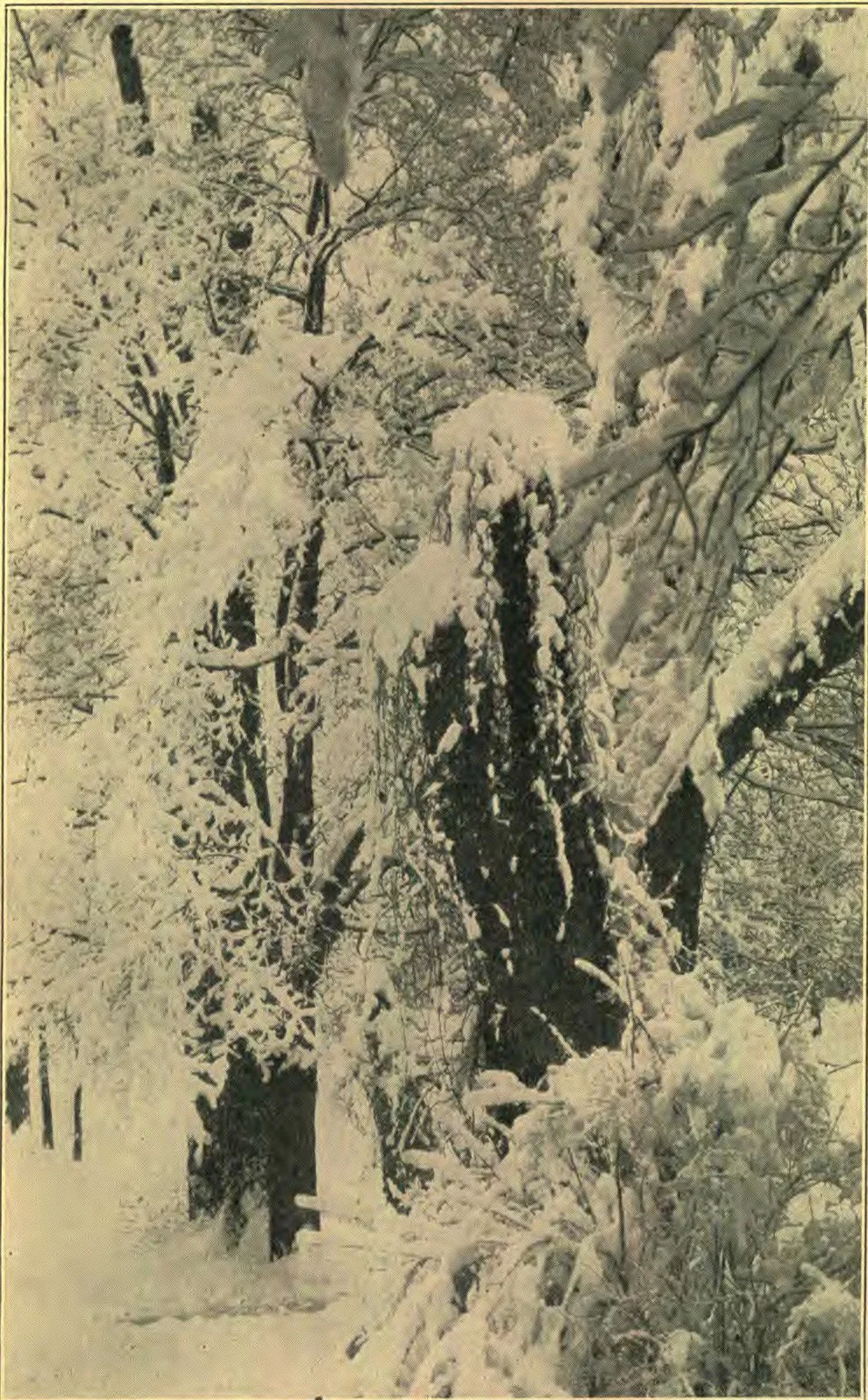
THE SILENT SNOW POSSESSED THE EARTH.—TENNYSON.
THE LAW AND THE GOSPEL
Has the Gospel Taken the Place of the Law?