Donald Hunter was ready with his notebook to take down the passages when the meeting in the tent began on Tuesday night. Elder Harris had announced that he would speak that evening on the proper relation of the law of God to the gospel of Christ. This was a question upon which Donald had heard based many arguments against the Sabbath, and he wanted every text, so that at home he might carefully study the subject for himself. The tent was again crowded. The people seemed to feel that an understanding of this subject was vital in establishing the truth or falsity of Brother Harris’s position on the Sabbath question. The minister said:
“In order to do away with the obligation to observe the seventh day, the theory is advanced that the gospel has taken the place of the law, and therefore no Christian is under obligation to observe it. This theory teaches that the old dispensation was a dispensation of law, and continued to the death of Christ; but that the present dispensation is a dispensation of grace in which we have nothing to do with law, and hence all Christians are free from the law.”
“Now the truth of this subject is made so clear by the Bible that no one need remain in error concerning it. The law of God is that part of his divine revelation which was spoken by God himself to men in the thunders of Sinai (Deut. 4:12, 13), and written with his own finger on two tables of stone. Ex. 31:18; Deut. 4:13.
“The gospel is defined in Romans 1:16. It is the power of God to save men. This salvation is from sin. Matt. 1:21. It is evident therefore that the gospel has been made necessary because of sin. If there had been no sin, there would have been no need for a gospel. But sin came, and this made necessary a gospel to save from sin.
“But what is sin?—‘Sin is the transgression of the law.’ 1 John 3:4. This is God’s definition of sin.
“Now let us put these things together. The gospel is the power of God to save men from sin. Sin is the transgression of the law. Law, then, existed first, for there could have been no sin had there been no law to transgress. Transgression brought sin into the world. Sin made the gospel necessary.
“It is plain from this that the gospel was introduced to save men from transgressing the law; and to use the gospel, as some now do, as an excuse to transgress the law is a total perversion of its real purpose.
“If the law is now abolished, as some teach, then there is no need at all for the gospel. For if the law is abolished, it follows that sin also is abolished, for it is impossible to sin without the law, as ‘sin is the transgression of the law.’ Notice how clearly Paul puts this in Romans 4:15 and 5:13. Where there is no law there can be no sin. Hence if the law is abolished we are both without sin and without law.”
“But something else follows from this. The gospel is for the purpose of taking away sin. But by the abolishing of the law, sin has already been taken away, and thus the gospel is not needed, for the very purpose of the gospel is secured by abolishing the law, as this also abolishes sin. Hence the gospel, too, is abolished by this teaching of the abolition of the law.
“It becomes evident at once that this dangerous teaching of the abolition of God’s law destroys itself. It abolishes altogether too much, for it does away not only with the law, but also with sin, with the gospel, with the church, with the gospel ministry, and with the great sacrifice of Christ on Calvary, for that sacrifice was offered to take away sin. No person who loves Christ, who loves the gospel, who loves the church, ought ever to be found teaching such a God-dishonoring doctrine as the abolition of the law, a doctrine which today is so popular.
“The law does not save men. That is done by the gospel. No one can get salvation out of the law. By doing what the law requires he cannot secure salvation. Rom. 3:20. The law condemns the sinner to die. Rom. 7:10. It cannot save him. It is not the purpose of the law to give salvation. That is the purpose of the gospel.
“And when we come to the gospel, and are saved by it and our transgressions are forgiven, then the condemnation of the law, the condemnation to death, passes away. Then it becomes true that ‘ye are not under the law, but under grace.’ Rom. 6:14.
“This does not mean, as many seem to think, that we are free to break the law. Not at all. The man who breaks the law is not under grace, but under the law. It is the man who is under grace who keeps the law, and he remains under grace only so long as he keeps the law. When he breaks the law he is no longer under grace, but goes back under the law. Let me illustrate this:
“A man commits murder. He is arrested, tried, and convicted. He is sentenced to life imprisonment, and taken away to jail. He is now under the law. But why?—Because he has broken it. Why are you not put in that same jail with him? Why are you free from the law and out of prison?—Because you are keeping the law. The law has no terrors for those who obey it. The murderer is under the law because he has broken it. It is clear, then, that those who have broken the law are under the law, and those who are free from the law are those who are keeping the law.
“But because of good behavior, after serving ten years of his sentence, the governor pardons this murderer. When he walks out of the prison he is no longer under the law, but under grace, the grace of the governor. He is now in the same position as the sinner whose sin Christ has forgiven. Does this mean, however,9that the murderer, who is now free from the law, can go out and break the law? Does being under grace mean that he has a license to transgress the law? Can he now go out and kill another man because he is no longer under the law but under grace?
“It will be, I am sure, plain to all that the murderer will remain under grace only so long as he keeps the law. If he should again transgress the law, if he should kill another man, then he would be under the law again, and would go back to jail.
“Just so is the case of the Christian. The pardoning of our sins does not afford us a license to commit additional sins. It frees us from the condemnation of the law and puts us under grace, but we remain under grace only so long as we keep the law. When we break the law, when we break any of its ten commandments, the Sabbath commandment or any other, then we are back under the law again, and no longer under grace.
“Therefore those who keep the Sabbath are not under the law, but rather those who break the Sabbath.
“That we thus establish the law by faith in Christ is made plain in Romans 3:21.
“The purpose of the law is not, as I have said, to save men, but to point out their sin, and thus to reveal to them their need of a Saviour from sin. The law is a great sin detector. It points out sin, but it cannot remove it. But what law is it which points out sin, and to transgress which is sin? It is the ten-commandment law. This will be seen by reading Romans 7:7. The law which reveals sin is the one which says, ‘Thou shalt not covet.’ This is the law of ten commandments, the same law which contains the Sabbath commandment.
“Now the purpose of the gospel is to take away what the law points out. Hence the law and the gospel must go together, and can never be separated. Both are needed. This will be seen by reading James 1:22–25.
“Here the law is likened to a looking-glass, a mirror. When the laboring man comes home from work he looks into the mirror to see the condition of his face. The looking-glass reveals to him the fact that his face is soiled. It will not lie, it tells the exact truth. It points out to the man his need of cleansing.”
Here every one became especially interested, as Brother Harris brought out a basin of water, a piece of soap, a towel, and a mirror. He was about to give an object lesson of the teaching of the Bible. He said:
“Now what this looking-glass does for the man is like what the law of God does for the sinner. It points out sin. This soap and water represent the gospel, that which takes away sin.
“The man who looks into the looking-glass would not think of taking it from its hook, and rubbing it over his face to cleanse his face.” Here Brother Harris illustrated by rubbing the looking-glass over his face, which caused his listeners to smile. “That is not the purpose of the looking-glass, and neither can it do that work. The man should apply the soap and water [here the speaker plunged his hands into the water, lathered them well with the soap, washed them, and dried them with the towel, to the great interest of all] and cleanse his face and hands, when the glass has revealed their soiled condition, just as we go to Christ and wash away our sins in his blood when they are pointed out by the law.
“And now,” said the preacher, “what would you think of a man who, after seeing in a glass his need of cleansing, would take a hammer [then taking a hammer, the speaker struck the looking-glass a blow which shivered it to pieces, startling his big audience into the most intense attention] and break the glass to pieces, saying, ‘You are abolished’? This would not help his face, would it? Neither can a sinner get rid of his sins by saying that the law is abolished.
“The duty, then, of every person who learns that the seventh day is the Sabbath is not to claim that the law is abolished, but to confess his past transgressions of this commandment, and go to Christ for grace to keep the Sabbath in the future. When the law points out our sin, let us not try to get right by abolishing the law, for that we can never do, but get right by accepting Christ’s grace and bringing our lives into harmony with his law, and thus fulfil its requirements.”
When they arrived at home that night, Mr. Hunter said to his wife: “I always thought that subject of the law and the gospel was a most complicated and intricate subject, hard to be understood, and I never hoped to be able to understand it so clearly as this sermon has caused me to. Why, it is as clear as the sun at noon, so clear that a child can comprehend. Certainly Brother Harris has a most wonderful understanding of the Scriptures to make them so plain to his hearers. This subject clears up many things which have perplexed me, and I am profoundly thankful I heard it.”
Donald was glad, too, that he had heard it, for he felt now that no one would ever be able to confuse him about the relation of the law to the gospel. He would never forget that illustration of the looking-glass and the soap and water.
The Heavenly Merchantman
By Eliza Rose
THE efforts of the earthly merchant are all put forth to secure his own interests. If he contemplates making a purchase, he must needs see the goods; he must test them, try them, prove them; and if they are not satisfactory, he does not buy.
Not so with the heavenly Merchantman. His interest, his efforts are all for the good of his purchase. It matters not that the purchase is in itself worthless. “God commendeth his love toward us, in that, while we were yet sinners, Christ died for us.” There is no need for us to be concerned over the purchase; we are already bought and paid for. But now comes the testing, the proving, that it may be known whether the Buyer can use us in that living temple which he builds, or whether he must reject us as useless.
Again, the value of earthly merchandise is not at all affected by the price paid for it. An enormous price may be paid for a worthless article; that does not add any value to it. Not so with the heavenly Merchantman. Mankind was worthless. “Ye have sold yourselves for naught,” says the Lord to us; and thereby we proclaimed our own worthlessness. But the Lord says again, “I will make a man more precious than fine gold; even a man than the golden wedge of Ophir.”
All are of equal value in his sight, from the beggar in the gutter to the king on his throne, because all were “bought with a price.” “Ye were not redeemed with corruptible things, as silver and gold, . . . but with the precious blood of Christ.”
And so all men are of great value in his sight, not because of any worth in themselves, but because of the incalculable price paid. So greatly does he value them that he prayed, “Father, I will that they also whom thou hast given me, be with me where I am.”
ELIZA ROSE.
Seagoing Lumber Rafts
By Day Allen Willey
THE raft has been used for centuries for carrying various cargoes. It carried Egyptian cotton on the Nile; it is in service on the Kongo River in Africa and the Ganges in India; but the raft which is its own cargo is that composed of logs—a method of water transportation that originated in Nova Scotia a half century ago.
A LUMBER RAFT READY FOR A VOYAGE
Tree trunks cut from Nova Scotia forests were moved on wooden rollers to one of the harbors, where the logs were piled in layers and bound together with twisted wire rope. The raft was to be taken to a lumber mill on New York Harbor, where the logs were to be cut into timber for building purposes. To haul the raft while on the sea, one end of a heavy wire rope was fastened to its bow, the other was secured to the rear deck of a steam tugboat. It started on its ocean journey, but never reached its destination, for a gale of wind sprang up, the towing rope parted, and the raft drifted out to sea. Later, some of the logs were washed ashore on the Norwegian Coast.
In the Northwest the transportation of lumber in rafts is very extensive. They are of enormous dimensions, in shape closely resembling a cigar, having its greatest diameter at the middle and tapering to a point at both ends. While these rafts are of varying sizes, the smallest usually contain at least five thousand pieces of timber ranging from eighty to one hundred and ten feet in length and from two feet to nearly five feet in diameter at the butt.
Consequently, some of the rafts made in this peculiar fashion are nearly as long as the largest transatlantic liners, measuring no less than six hundred and fifty feet from end to end. So compactly are the poles arranged, however, that the greatest diameter is not over sixty feet; but, as our picture shows, the great weight of the wood forces a raft down in the water until the highest portion is rarely over ten feet above the surface.
To bind together the logs on the raft so that it will withstand the force of the seas to which it is exposed in the trip down the coast from the Columbia River or Puget Sound to San Francisco and the southern California coast, is a difficult problem. As the cigar shape offers less resistance than any other to the force of the waves, this has been adopted.
In order to pile the timber into this form, a huge skeleton, or shipway, as it is called, is constructed. This is practically a cradle, moored in the water adjacent to the boom where the logs are confined.
By means of a boom derrick the tree trunks are lifted from the boom one by one, and placed in the cradle so as to overlap each other, the plan followed being somewhat similar to that used in laying a brick wall, the end of each log coming opposite the center of the one adjacent to it, although to a novice the raft looks as if it were made up of timber thrown in without any order. After completion the raft is wrapped with iron chains lashed around it at intervals ranging from twelve to twenty feet apart. The chains are composed of one and one-half inch links, and after the chains have been stretched taut by a hand or steam windlass the ends are clamped together by little steel wheels. To prevent the chains from slipping, iron staples are driven through the links into the outside poles. In addition to the chains, however, side lines, as they are called, consisting of wire ropes, are stretched around the raft between the chain sections, so that, when the wrapping is completed, the mass of logs is bound together very securely.
When the wrapping is finished, the raft is ready for launching. The cradle in which it has been formed consists of two sections held together at the bottom by bolts. To each bolt is attached a rope, and when the raft is ready to be floated, it is necessary only to pull on these ropes. The bolts then slip back in their sockets, the two sections of the cradle fall apart, and this curious sea craft is ready to be towed away by tugboats.
In building the raft two two-inch chains are stretched lengthwise from end to end through the center. One of these is bolted to a sort of bulkhead at one end, consisting of a band of iron which is fitted around the projecting ends of the outer pieces.
The other chain, called the towing chain, is connected at the forward end with the towing hawser, and secured inside the raft by lateral chains which extend also from side to side, being fastened to those which encircle the raft. In this way the towing strain is well distributed and is not borne merely by the bow end.
To move this unwieldy bulk, two powerful steamers are usually employed at sea, one for pulling directly ahead, and the other to aid in keeping the raft in the right course, especially in rough weather. But a comparatively small portion of the surface is exposed to the seas; otherwise it would be impossible to transport the timber in this form. The depth in the water allows only a very slow rate of speed to be maintained. The average time required between the Columbia River and San Francisco is from ten to fifteen days, according to the weather, although the distance is only about seven hundred fifty miles.
The Columbia River rafts are put together at a11town called Stella, which is located in the lumber country about forty miles from the mouth of the river. These rafts are the largest which have yet been transported down the coast.
While many of these rafts have been safely taken to their destinations, some have had their fastenings torn away by the force of the waves. Where such accidents have occurred, the scattered logs have spread over the ocean for a distance of many miles, and have formed a very serious danger to vessels.—Day Allen Willey.
Insignia of Our Soldiers
THE service uniform of the United States Army is a cap with brown, falling visor, a coat and breeches of olive-drab cloth, and brown leggings of either leather or canvas. So far the uniforms of officers and men are very similar, although only officers should wear the leathern leggings. The first difference, says the Boston Transcript, is to be seen on the front of the cap, where the officer wears the escutcheon of the United States, and the enlisted man, the insignia of his branch of the service—crossed rifles for infantry, crossed cannon for artillery, and crossed sabers for cavalry. On the coat collar an officer wears the bronze letters “U. S.” and a device of the crossed arms of his branch of the service. The enlisted man wears on one end of his collar a round disk that bears the weapons, the letter, and the number of his unit; on the other end of the collar he wears another disk with the letters “U. S.”
The field uniform consists of the campaign hat and cord, the olive-drab shirt, and the remainder the same as the service uniform. The hat is the same for officers and men, but the officers below the grade of general wear a hat cord of black and gold, while the enlisted men wear a wool cord of the color peculiar to the branch of the service: blue for infantry, red for artillery, yellow for cavalry, orange for signal troops, and maroon for medical and hospital service.
A general wears five-pointed stars in number according to his grade—one star for a brigadier general and two stars for a major general. For the field and line officers the insignia on the collar and shoulder straps are as follows: colonel, a silver spread eagle; lieutenant colonel, a silver leaf; major, a gold leaf of the same design; captain, two silver bars; first lieutenant, one silver bar; chaplain, besides the insignia of line rank, usually that of captain, a Latin cross of silver.
The insignia of the enlisted men who have gained noncommissioned rank are in the form of chevrons on each sleeve: the regimental sergeant major has three inverted V-shaped bars with three arc bars below the open side of the chevron; the battalion sergeant major has three chevrons with two arc bars; the regimental supply sergeant has two straight bars below the chevrons, with two for the battalion and one for the company sergeant on that duty.
In the company, the first sergeant has three chevrons with a diamond-shaped figure in the included angle below; all duty sergeants, three chevrons; corporals, two chevrons; and lance corporals, one chevron. A color sergeant has a five-pointed star in the included angle of the chevron; a sergeant of the commissary service has a crescent below his chevrons; a chief trumpeter has one arc below the three chevrons, with the form of a bugle inclosed; the drum major has three chevrons with crossed batons in the inclosed angle.
Duty men wear appropriate devices. The cook wears a cook’s cap on his sleeves; a first-class gunner, a projectile, point up with a bar below; a horseshoer, a horseshoe; a mechanic and artificer, two crossed hammers; a mechanic-farrier, a horse’s head; a mechanic-saddler, a saddler’s skiving knife.—Youth’s Companion.
Israel Putnam and His Namesake
ISRAEL PUTNAM, familiarly known as “Old Put,” was born in Salem, Massachusetts, in 1718. Many stories are told of his great courage and presence of mind. His descent into the wolf’s den, shooting the animal by the light of her own glaring eyes, showed his love of bold adventure. His noble generosity was displayed in the rescue of a comrade scout at Crown Point, at the imminent peril of his life. He came out of one encounter with fourteen bullet holes in his blanket. At Fort Edward, when all others fled, he alone fought back the fire from a magazine in which were stored three hundred barrels of gunpowder, protected by only a thin partition. “His face, his hands, and almost his whole body were blistered; and in removing the mittens from his hands, the skin was torn off with them.” In 1758, a party of Indians took him prisoner, bound him to a stake, and made ready to torture him with fire. The flames were already scorching his limbs, and death seemed certain, when a French officer burst through the crowd and saved his life. The British offered him money and the rank of major general if he would desert the American cause; but he could neither be daunted by toil and danger, nor bribed by gold and honors.
One of General Putnam’s descendants, Israel Putnam, fifth, eager to uphold the record of his illustrious ancestor, is now an active member of the United States Marines, awaiting orders for service in France. Young Putnam says: “I chose the marines because they see much active service. My family has become identified with American history by taking part in all wars since the Revolution. I hope to do my full share in the present war, and am willing to give my services as a private and earn promotion as I merit it.”—Selected.
A Business Girl Should Dress Plainly and Neatly
A BUSINESS girl should dress plainly and neatly. “Gladys was a stenographer. She had an adaptable disposition, an unruffled temper. But she persisted in wearing earrings, white-topped shoes, gowns of astounding combinations of color, and in powdering her nose like a doughnut. The consequence was that her chief never thought of giving her any more responsibility or of increasing her salary, for the simple and sufficient reason that he was not able to think of anything, when he looked at her, except what an amazing-looking young person she was.”
Reading the Bible: Daniel Webster on Scripture
By Daniel Webster
READING the Bible enables me to express my ideas in the fewest words. The Bible teaches men the best and surest road to business success, and also the way to eternal life.—Daniel Webster.
Repairing Runs in Stockings with a Crochet Hook
STOCKINGS with very bad “runs” need not be thrown away. Use a crochet hook to catch up the dropped stitches.
Will You Observe the Morning Watch During 1918?
Our Lord's Prayer Life
If the hill back of Nazareth could give forth its secret, if the lake of Galilee could tell what it witnessed, if the desert places round about Jerusalem could tell their story, if the Mount of Olives could speak out and tell us what transpired there, they would all tell us, more than anything else, of the prayer life of our Lord. They would reveal its intensity, its unselfishness, its constancy, its godly fear that made it irresistible.—John R. Mott.
Will You?
I believe we ought to utilize the Morning Watch in our entire denominational work. First, I should like to see our ministry adopt it, and we discipline ourselves to its regular and systematic observance as a part of our Christian experience.—I. H. Evans.
Why I Keep It
The Morning Watch faithfully kept, and conscientiously applied to the individual circumstances of every one, will do much toward bringing success in this life, as well as preparing one for a place in the kingdom of God. The Lord says: “I love them that love me; and those that seek me early shall find me.” Prov. 8:17. This promise is for the one who seeks the Lord early in the day as well as early in life. Let us keep the Morning Watch.—Frank H. Mills.
Why We Accomplish Little
The first hour is the best, and hence belongs to the Master, if we would keep the first commandment. We do much, but accomplish little, because we start out alone, with the devil's pet lie in our hearts, “I haven't time to spend in study, meditation, and prayer this morning; later today I'll have more time.”—S. A. Oberg.
How I Observe It
When retiring for the night, I open my Bible to the Morning Watch verse for the next day, think of it until lost in sleep, and in the morning my eye catches the verse the first thing, as the Bible is open.—Alta Carr.
How the Calendar Helps
One of the greatest needs of our young people is prayer and the study of God's Word. We realize that there is a necessity for some aid to study, meditation, and prayer which will help our youth to adhere to this custom day by day. This need is filled by our Morning Watch Calendar. Thousands of young people are learning the value of the Morning Watch, and to the faithful observance of it hundreds have attributed their growth in Christian life.—W. L. Hyatt.
Give the Calendar to Others
“Every day I read the Morning Watch Calendar you sent me. The print in my Bible is small, and I do not often use more than the New Testament, but have to get the Bible out to find all the texts.” This lady also writes that a friend who is a public school teacher said she would like one. These people live in Massachusetts, and make no profession of religion, but the Calendars have set them to reading their Bibles.—Jennie R. Bates.
In Several Languages
The Morning Watch Calendar is now printed in the English, Spanish, German, Finnish, Japanese, Korean, Chinese, Danish-Norwegian, and Portuguese languages. Its circulation in the English language alone has grown from 6,000 to 60,000.
A Calendar For
Every Senior Missionary Volunteer
Every Junior Missionary Volunteer
Every pupil in your church school
Every pupil in your Sabbath school
Every member of your church
Every Seventh-day Adventist boy in army camps
Every isolated Sabbath keeper
Every member of every Seventh-day Adventist home
Every minister
Every conference worker
Every friend to whom you send New Year's greetings
Everybody!
Helen’s Happy Christmas
By Alma Hill
ALMA HILL
It was early in November when Helen began to look forward to Christmas with an intense expectancy. If she had been older I am sure she would have counted the days and weeks many times. As it was she contented herself with fascinating mind pictures.
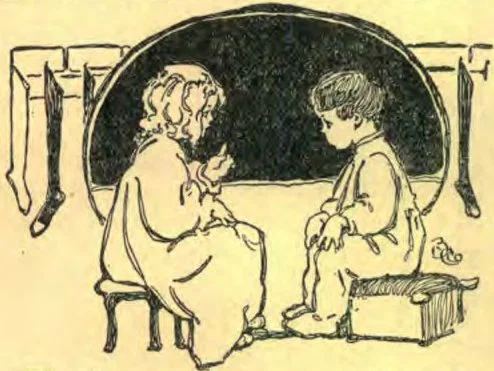
CHRISTMAS MORNING
Father came in one evening, and taking his little daughter on his knee, began telling her stories in a homely way. Finally he said, “Now, Helen, I want you to tell papa a story; tell me what you have been doing this livelong day.”
“O papa!” she joyously exclaimed, “I have had the nicest time! I have been just p’tending Santie had come and brought me lots and lots of fings. You know, papa, a dolly, and clothes, and some playfings like Ruth’s, and oh! all those other fings I’m going to get if I’m a good girl.”
“That’s right, daughter, I like to hear you add the last; you know there are many ways of being a good girl. I want you to tell papa how you acted when Ruth was over to see you yesterday.”
Helen was astonished at this request, but although she was only three years old, she knew when papa and mamma spoke she must obey.
“Oh, papa, Ruth was a naughty girl! Why, she wanted all my playfings. Why—why—she wanted to play with my dollies and I was ’fraid she would break them. Papa, you don’t like broke dollies, do you?”
“No, dear, I do not like broken babies, and I do like to see you careful of your things. I want to know, did you let Ruth play with the things she wanted?”
Helen’s bright, baby-blue eyes looked straight into his as she proudly admitted, “’Course I didn’t; she’d break them.”
The manner of her entertaining was much as Mr. Jenks anticipated. He was a man of sterling character and a gracious host. He was also a very conscientious father, and this seemed an opportune time to instil into the mind of his only daughter the gracious qualities of hospitality that are as much to be admired in children as in older persons. Having a plan already in mind, he asked her about Christmas.
Delighted, she clapped her hands and breathlessly exclaimed, “Nice big dolly, great big Christmas tree, with lots of shiny fings on it.”
The father watched her bright face as he asked, “Do you know what Christmas is going to bring the little children on the next street?”
“Why, daddy, they don’t want anyfing, do they?”
“O yes, dear, they want pretty things just as much as Helen does, but Christmas does not always come to poor children. I wonder how my little girl would like to ask those children in Christmas morning and give them some of her playthings.”
“Papa! give them for all the time?”
“Yes, just think how lovely that would be! And they would be your very own company. Mamma and I might help if you needed us, but you would try to see how well you could make them enjoy their visit.”
“Papa, but—”
“Would you like to do that, Helen?”
“Yes, I fink so.”
Accordingly extra preparations for Christmas were soon under way. It was not long before Helen caught the spirit, and her little feet were busy running errands here and there.
Finally Christmas came. Such a beautiful, bright, cold, snowy day! The hearts of the children concerned in this festivity were as cheerful as the outside world.
At nine o’clock the little hostess met her guests at the door, and greeted them with as warm a welcome as any one could desire.
The visitors went into ecstasy over the gorgeous tree, the first they had ever seen. They were satisfied without gifts, and their cup of joy ran over when each received a beautiful box full of good things.
When all the gifts had been distributed, the rest of the morning was spent in delightful games. Papa and mamma enjoyed the childish games as much as any one.
Helen enjoyed every moment. The dear child had caught the true spirit of Christmas, “It is far better to give than to receive.”