Mr. and Mrs. Andrew Carnegie have subscribed $250,000 to the Y. M. C. A. war fund.
Members of Congress will urge that the government make land allotments to our soldiers after the war, thus helping them to get a ready start in life after their return from Europe.
Difficulties experienced by aëroplane camera men in making photographs of enemy movements below has brought about the invention of a new device, the pistol camera, which greatly facilitates their work. German airmen originated the pistol camera.
The Institute of France has recently awarded a prize of $2,000 to each of two Frenchmen having unusually large families, one having fifteen children, the oldest of whom is under eighteen; and the other having sixteen children, ranging in age from thirty-four to eight.
Gaza has fallen to the British in their victorious sweep through Palestine, and now they are closing in on Jerusalem. An important factor in their success has been the work of the Australian Camel Corps. These men, mounted on the torpedo-proof “ships of the desert,” have been enabled to cross with ease the sandy stretches that are the greatest obstacles encountered in Palestine.
Dr. H. D. Dakin, an American chemist, has discovered an easy way of disinfecting drinking water. A tablet containing one sixteenth of a grain of halazone will kill every germ in a quart of water without making the water unpalatable. In a dilution ranging from 1-200,000 to 1-500,000, halazone will destroy such water-borne germs as the colon bacillus and the typhoid bacillus and the deadly cholera vibrio.
Camp Funston is the largest army camp in the United States. Its fifty thousand men have been drawn from seven States: Nebraska, South Dakota, Missouri, New Mexico, Colorado, Arizona, and Kansas. There are twelve Y. M. C. A. stations at Camp Funston. Here the noncombatants, of whom there are 140 representing ten denominations, are organized into a separate company. Instead of drill these men work on trucks in connection with the Sanitary Department.
Wonderful strides have been made recently in changing the attitude of the government toward the liquor traffic. An amendment has been made to the Post Office Appropriation Bill making “bone-dry” every prohibition State in the Union by forbidding importation into it and transportation therein of intoxicating liquors for beverage use, and by closing the mails to liquor advertising of all kinds in prohibition territory. Twenty-five States are now “bone-dry.”
The annual report of the Rockefeller Foundation for 1916 shows, among other items, the following objects to which Mr. Rockefeller has contributed during the year: To the Red Cross (unconditionally), $5,000,000; to the Y. M. C. A., $300,000; for medical research (to find out what causes pneumonia, cancer, etc., and how these diseases can be cured), $951,000; for playgrounds, $2,000,000; for Dr. Carrel’s research work in France (resulting in saving the lives of thousands of suffering men), $300,000; to the China Medical Board (in a country where physicians are as rare as hen’s teeth and thousands die needlessly), $814,000; for the children of Belgium, $100,000.
At the same time China turns her back to Germany she throws out a moral challenge to Great Britain. She has closed her doors upon opium, and in this challenges Britain to pass prohibitory law in her colonies that still produce this drug for countries which have not yet prohibited its importation. The United States as well as England would do well to take a lesson from China’s bravery and bold morality.
Mrs. Anna Coleman Ladd, a sculptor of Boston, has devised a method of overcoming in part the facial disfigurations suffered by soldiers. She suggests that a soldier whose face has been made unrecognizable by wounds wear a mask fashioned to resemble his original countenance. Her plan, it is said, has received the approval of Maj. V. P. Blair, who is attached to the War Department at Washington.
The man who first thought of putting an eraser on the end of a lead pencil made $100,000 out of the thought. The man who patented a metal top for bottles made $54,000 the first year. The man who first conceived the notion of punching a hole in a piece of paper and pasting it on a tag to prevent the string from tearing through also did well.
Vessels now carry hydro-aëroplanes to be used to chase away enemy airships in case of an attack on the water. Enemy planes recently attacked a vessel with bombs, but were driven off by the large hydro-aëroplane which the vessel quickly lowered into the water, and received back on board after it had successfully routed the attacking planes.
Miss Eleanor Hill Weed, of Washington, granddaughter of late Representative Ebenezer Hill of Connecticut, “did her bit” this summer by cultivating, with eleven other girls, the big Vassar College farm of eight hundred acres, doing everything from handling the plow to harvesting the crops.
Mrs. Chalmers Watson, M. D., highest ranking woman officer in the British army, has just been appointed chief controller of the Woman’s Army Auxiliary Corps, which gives her command over the thousands of women working behind the fighting lines in France.
Women are knitting everywhere, in street cars, in autos, on railway trains, in parks, in depots, in stores, and in offices,—anywhere and everywhere that there is a waiting or resting period. This is not an impractical nor unseemly convention for peace time as well as war time.
The Reward of Adversity
By Paul N. Pearce
Do not think that because you are called upon to suffer affliction and trouble that your life need necessarily be counted as a failure. Affliction is often the stuff great men are made of. What may seem one’s misfortune may prove to be the stepping-stone to some real accomplishment.
As an example of this take, for instance, the life of Milton, the blind poet as he is called, who labored in affliction yet is ranked with the greatest of all poets.
At the age of forty-three, his biographers tell us, he was in total darkness. To find the key to power and knowledge requires a long apprenticeship. Few men accomplish this before the age of forty. Milton had attained this power only to find the fruits of his labor snatched from him.
It was after this terrible calamity that Milton produced his masterpiece, “Paradise Lost.” During the great plague and the London fire he wrote “Paradise Regained.” Upon these poems, written in his affliction, more than upon any other of his works, rests the immortal name of Milton.4
Nor do we need to go abroad to find examples of achievement in spite of adversity. “It is a significant thing,” says the editor of a popular magazine, “that a large proportion of the lives of history have been conceived in suffering and nurtured on disappointment and pain.”
We read of Lincoln as the village story-teller. But the real Lincoln is seen only in his pleadings with God for divine guidance in controlling the destinies of this mighty nation. Lincoln has assumed the place which Secretary Seward said he would— along with Washington, Jefferson, Franklin, and Adams, one of the “benefactors of the country and of the human race.”
Luther, a truly great man, in the eyes of the world sacrificed his honor and his fame, but throughout the ages his name has stood for freedom of religious thought and liberty of conscience.
We as young people have, in our hours of disappointment and distress, the consolation that suffering is that out of which true greatness grows. Yielding to our afflictions will destroy us. Conquering them will develop in us a finer spirit and make us better men and women.
The apostle Paul fought the good fight of adversity and he kept the faith. And Paul will be remembered throughout all eternity. PAUL N. PEARCE.
Celebration of the Peruvian Day of Independence
By J. M. Howell
J. M. HOWELL
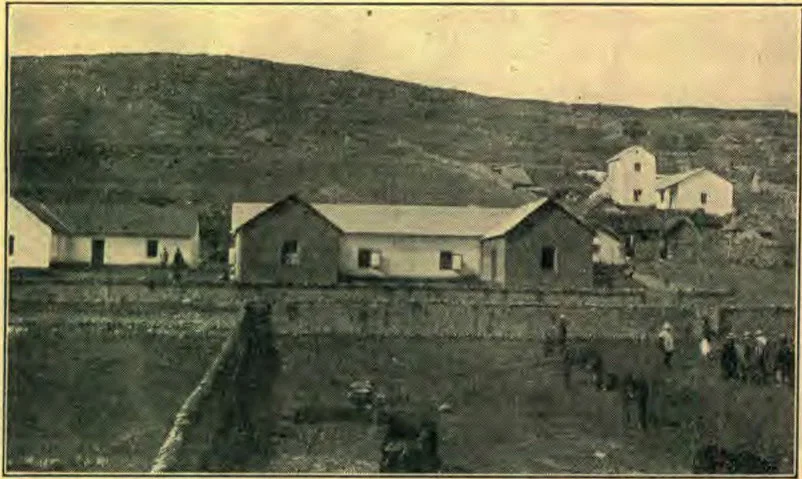
PLATERIA MISSION WHERE THE CELEBRATION TOOK PLACE
THE Peruvian day of independence, July 28, is perhaps the greatest feast day known in the republic. Everybody is expected to take part, and the national colors are flying everywhere. Many know nothing of the liberty which the day represents, for they are as truly slaves as ever existed,— slaves to King Alcohol. On every side are proofs of his domination. The celebration that ought to be an honor to the country turns into a drunken revelry, nearly always ending in bloodshed and loss of life. But the Indians that live around the mission station have stopped celebrating in this way, and it is a relief to come from one of these celebrations to the kind we have here at the mission.
As the twenty-eighth of July fell on Sabbath this year, we postponed the feast till Sunday. The evening after the Sabbath the bands from the various districts came to the mission for what is called “the vespers of the feast,” consisting of music and bonfires. After these opening exercises the people went into the church, where Brother F. A. Stahl showed many stereopticon pictures, which pleased them as much as they would little children in the States.
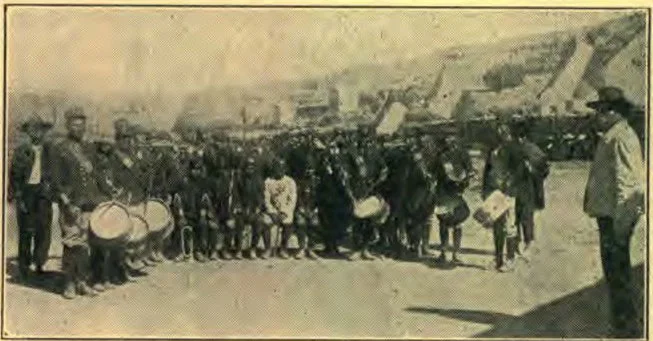
Sunday morning we were awakened early by the blowing of trumpets, and in all directions people could be seen hurrying to and fro. At about ten o’clock they began to gather, at first only a few, then in groups, till at noon there were present about twenty-five hundred. Brother C. V. Achenbach came from his district, bringing nearly all his people with him. The Indians marched and played till about two in the afternoon, when the school gave a short program. Rest and luncheon followed. On one side of the school yard women sat selling oranges and bread.
After the intermission the different companies went through various exercises copied after the military drills of the Peruvian army. All the young men were dressed in uniforms of blue and white, and the captains were in full military dress. The guns and swords were made of wood and tin. The drills were performed creditably. At four in the afternoon the visitors began to return home. First we escorted the Esquinas company a short distance on their homeward way, then the Chinchiri and Patillani companies, and last the Ccota company.
A BAND THAT TOOK PART IN THE CELEBRATION
Early on the morning of the thirtieth Mr. and Mrs. Stahl and Mr. and Mrs. Borrowdale went to the peninsula where Mr. and Mrs. Achenbach are located. There they had a repetition of what had happened the day before in Plateria, with the addition of a balsa race on the thirty-first, in which Brethren Stahl and Borrowdale took part, causing great merriment among the onlooking Indians.
These feasts serve to make us better acquainted with the Indians, and many attend whom we have never before seen. They come because their relatives will be there, and they think they can attend the celebration and return to their homes just as unconcerned about religious things as when they went; but not so, for in all patriotic speeches an effort is made to lift the mind from this world and the perishable to the kingdom that is soon to replace all earthly kingdoms, where there will be no more death, neither sorrow nor crying. Without doubt many will in the judgment day be glad they attended the interesting and helpful celebration of the Peruvian day of independence at the Plateria mission.
Accuracy in Quotation
By Zibah M. Beaman
WHY borrow a camera while your own camera may make a better photograph?
When, however, it is clearly evident that one's own idea, form of expression, or authority is inadequate to present the subject in hand, and there can be found an expression that is fully sufficient, it will doubtless be welcomed by those addressed; but the responsibility of accurate quotation is sometimes not fully appreciated.
In presenting a quotation, one should cite the authority and reference, thus preparing the mind to receive the especially important message. There is no such word as “Theysay.”
That the force of a quotation may remain unbroken, it must stand on its own footing. If one person must oppose another, let him do it fairly, not by misrepresenting what he has said. Placing a smoked glass before the eye will never cause an eclipse of the sun, no matter how much one might desire to bring about the phenomenon.
Another slip to guard against is that of taking a phrase, clause, sentence, or paragraph out of its proper connection, and constructing a theory into which to make it fit. This might crudely be illustrated by the extreme example of a certain speaker who very much disliked the current fashion of ladies’ hairdressing, and accordingly sought sympathy with his notion by taking as his text Matt. 24: 17, “Top not come down.”
If quotations are written, the punctuation should be exactly transcribed, else one may come as far from the author's thought as the following statement concerning Cæsar is from the intended description: “Cæsar entered upon his head, his helmet upon his feet, armed sandals upon his brows, a cloud in his right hand, a sword in his eye, an angry glare.”
The one mistake perhaps most common and beyond doubt the most disastrous is that of misquotation, which is largely due to carelessness. What human intellect could number all the accidents that have occurred because of added or omitted words in quoting what ‘some one said’? For an example of this type of mistake let us look back to that fatal temptation in the Garden of Eden, and determine the real cause of the yielding. In Eve’s reply to the beguiling serpent’s suggestion, she meant to answer by giving the words of the divine command; but she added, “neither shall ye touch it,” and substituted “lest ye die” for “thou shalt surely die.” The overstatement and insufficient certainty gave occasion for a root thought of doubt which resulted in the precipitate step that doomed our world.
God’s displeasure at such indefiniteness is so great that he has said concerning his message to man, “If any man shall add unto these things, God shall add unto him the plagues. . . . If any man shall take away from the words of the book of this prophecy, God shall take away his part out of the book of life.” Rev. 22: 18, 19. Mindful of God’s jealous attitude regarding his Word, shall we not use carefully all borrowed expressions, thus doing much to overcome the habit of inaccurate quotation?
ZIBAH M. BEAMAN.
The Lights
By Ida M. Eggleston
FROM my car window I saw a bright light. At first I wondered whether it was a luminous star low down, or whether it was an electric light high up. But soon I noticed that we had left that light behind us and I could no longer see it. Then I knew that it was no star, but one of the city lights.
So do earthly lights and hopes go out or stay behind while we pass on; but it is not so with the heavenly lights, for they accompany us all the way. From the same window, I saw a faint twinkling star high up in the sky. It was not so bright as the earthly light, but when we had traveled miles onward, I could still see that faithful light.
The lights of the car made it difficult to see anything outside on account of the reflection on the windowpane of the things within, unless I interposed myself between the lights and the darkness outside. Then through the dark I always saw the little star.
So, I thought, earthly lights are like everything else earthly,—aspirations, pleasures, successes. Sometimes they look brighter than the heavenly; but they do not go ahead of us. Things which we can see, fashion, and handle, look more tangible than the things of simple faith, but as the heavenly light does not leave us, so faith will be a light that will accompany us on our pathway to the end of our pilgrimage. I bowed my head and prayed: “O Lord, teach me to set true values on the lights before my eyes, and to look up higher than the lights of earth, and to love the light of faith, so that when the attractions of the world are so bright as to make mirrors of my soul-windows, and I see material things in wrong perspective, I may think to look for the star of faith.”
On reaching home I beheld from my window the same faint star in the sky, and I thought: It will be thus with life. When toil is over and I stand before the open grave, the star of my faith will shine just beyond and I shall say with perfect peace, “Blessed are the dead which die in the Lord.” IDA M. EGGLESTON.
Belief Versus Unbelief: Intellectual and Moral Arguments
INTELLECTUALLY, the difficulties of unbelief are as great as those of belief; while, morally, the argument is wholly on the side of belief.—Arnold.
Notes on Christmas
We were once fined for keeping Christmas. Yes, in America! In 1659 the General Court of Massachusetts enacted that “anybody who is found observing, by abstinence from labor, feasting, or any other way, any such day as Christmas Day shall pay for every such offense five shillings.” This law held and was enforced for twenty-two years, and even when it was finally repealed in 1681 the Puritans grew bitter and for years never recognized the day.
Nobody knows when Christ was born, of course, and December 25 is simply an arbitrary date. The day has been variously fixed and celebrated on April 20, May 20, March 29, September 29, and quite generally on January 6.
“The Christmas tree was born in Egypt. There the tree used was the palm; and the ceremony was in full force long before the days of Anthony and Cleopatra. The palm puts forth a fresh shoot every month, and Old-Year parties were given with a palm spray,6with twelve shoots, symbolizing the completion of another year. The custom passed into Italy, where the fir tree was employed for the purposes of celebration; and its pyramidal tips were decorated with burning candles, in honor of Saturn. This festival, the ‘Saturnalia,’ was observed at the winter solstice, ranging from the seventeenth to the twenty-first of December. Then came the ‘Sigillaria,’ days for interchanging presents of figures in wax, like those on the Christmas tree; and, finally, the ‘Juvenalia,’ when men became ‘boys with boys,’ matrons turned children once again, and young and old indulged in the solemn romps with which the festival closed, and which used to mark our own old-fashioned festivities at Christmastime. Then the Christmas tree passed into Germany, but there still may be seen the pyramids which sometimes are substituted for the tree.”
“Santa Claus is buried in Italy — that is, the man from whom we got Santa Claus. He was St. Nicholas — an archbishop of Myra, in Lycia, who passed away on Dec. 6, 342. He was supposed to be a holy personage of unusual attributes, with an especial love for children. In Russia, December 6 is a church day; in France it is the grand fête day of children; in many provinces of Germany it is celebrated as a preliminary to Christmas; in the Netherlands it is the real day for gifts, with December 25 as a church day; in South Austria it takes the place of our Christmas Day. Nicholas was abbreviated to ‘Klaas’ by the Dutch, and from this our ‘Claus’ is easily apparent. At Bari, on the southeastern coast of Italy, the bones of St. Nicholas are interred, and on every December 6, thousands of pilgrims visit the tomb and great ceremonies are held.”—The Ladies’ Home Journal.
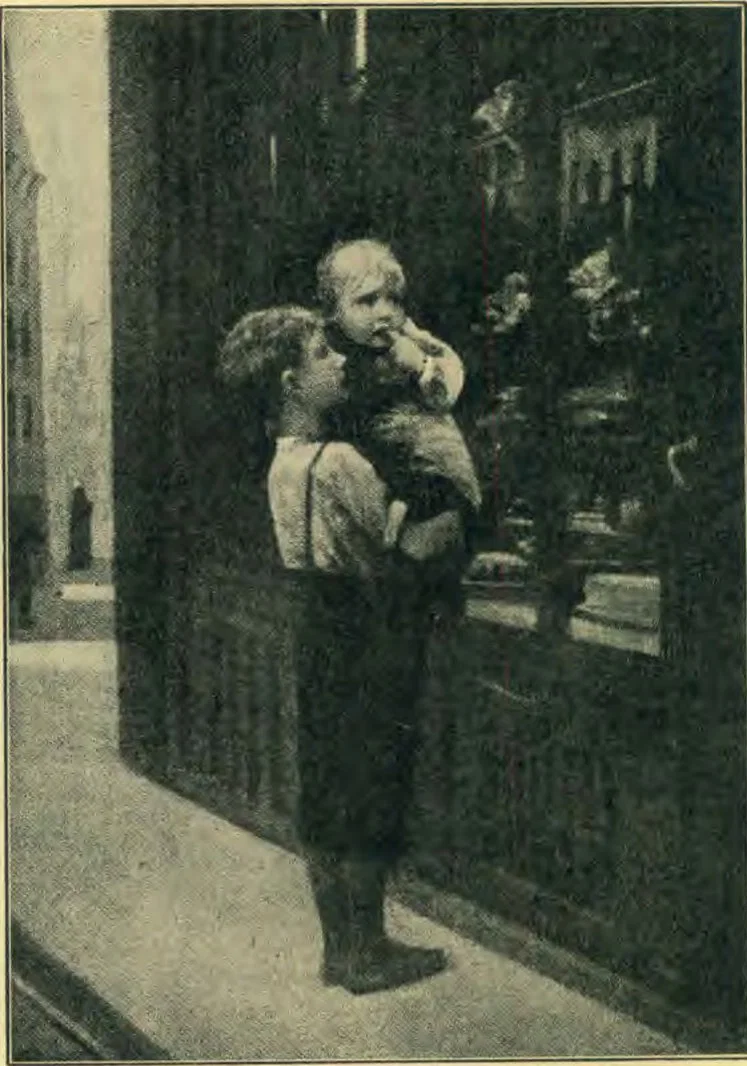
THE TEMPTING SHOP WINDOWS YIELD NOTHING TO THOUSANDS OF WISTFUL CHILDREN THIS CHRISTMASTIDE
Christmas in Norway
By H. J. Halvorsen
H. J. HALVORSEN
All was excitement in the house. Nobody seemed to know just what to do. The mother was still sitting at the table reading the letter over for the third time. Sophia ran out to meet her sister who was returning from work.
“O sister,” she cried, “guess! Guess what is going to happen in about two weeks!”
“Guess what is going to happen?”
“Yes, something really good; we got a letter from Chris today telling us that he and Ben were in London and would be home in about two weeks. They have just come in from Constantinople and will leave London as soon as they can unload the boat and get it reloaded.”
“Good! Just in time for Christmas. What can we do to make things interesting? You know this is the first time they have been home at Christmas for a long time. Sailors must stay away from home so much.”
“That is true,” replied Sophia; “but then they see a great deal of the world, places that we only study about.”
“I know what will be lots of fun. Let’s play Yule Buke; many of the people won’t know the boys.”
Yule Buke is after the order of our Halloween celebration. The boys and girls dress up so they cannot be recognized, and then go visiting. The plan is to go from house to house and not make themselves known until they have received something to eat. This custom, however, has really passed away in Norway.
“We must begin at once to get things ready, Sofie. There is no time to lose.”
The next week was a busy one for all. There was the house to clean and decorate, and the baking to look after. Of course the cookies would be baked first. The literal translation of the Christmas cookies is “poor man’s baking;” but if you were to taste them, you would exclaim, “Fit for a king to eat!” The longer they lie the better they get. Pie is not on the menu in Norway. Raisin bread and cake that are to be bought at the bakery must be ordered early.
The national Christmas dish consists of rice cooked in milk and served Christmas Eve. When it is dished up, a large piece of butter is placed in the center of each dish of rice.
One of the chief dishes for the Norwegian Christmas dinner is steak made of the ribs of hogs. If that cannot be obtained, mutton or beef is used. People who are in poorer circumstances use a special kind of fish prepared in a special way for the occasion.
Nothing is known in Norway about Santa Claus. The parents and friends place presents on the Christmas tree, and at the right time the children go and get them.
“Merry Christmas, Chris,” called Sophia up the stairs. “Look at the fine snow, it will make our coasting much better.”
Coming down, Chris asked, “Can all of you go out this forenoon for some fun?”
“No, we girls must help get dinner this morning. Chris, what did you have last year for Christmas dinner?”
“Nothing like a Norwegian dinner I can tell you. I was in Brazil putting on a load of sugar at the time.”
“Two years ago, at Christmas time, I was in New York in America,” said Ben. “They do not know how to celebrate Christmas. The next day after Christmas everybody went to work as usual.”
“What, work Christmas week?” was heard from every one.
“Yes, the Americans do. They seem to be too busy to spend more than one day celebrating. Instead of business stopping for the rest of the week it goes right on through the holiday season.”
“Well, we are in Norway this year,” replied Chris, “and shall have the whole week in which to visit, skate, coast, and do whatever we feel like doing.”
In Norway, work stops at Christmas, not to be started again until after New Year’s Day. Even the stores are closed for several days after Christmas. The week is spent in visiting neighbors and friends and in general merrymaking. When people go visiting, Norwegian hospitality requires that they have something to eat before they leave. Of course only a light lunch is provided.
For the young people, Christmas in Norway, as elsewhere, is a jolly time. All the boys that have been out at sea are at home. Everybody, so to speak, is either on the ice skating, or else out coasting down the big hills which are so numerous. Many exciting contests are held on the hills.
Shall We Patronize the Moving Picture Show?
By Mrs. E. M. Peebles
It would seem that this question need not be asked of any one who is a reader of our good paper, but lest we are not all clean, I have made a few extracts from an article which lately appeared in a leading magazine, from the pen of “one of the world’s great scientists,” a professor of psychology in Harvard University. He says:
“We have today more than twenty thousand moving picture theaters in the United States, and every year three billion people pay their nickels and dimes at the entrance gates, . . . and every day about two million children sit for hours in the dark hall and gaze at the pictures thrown upon the screen.”
“The plays poison the innocent mind and carry the germs of vice into honest homes. Every year hundreds of photo-plays are brought to the market which depict the sins of the senses and unveil the degradations of love. . . . Their unclean and suggestive influence work havoc in the adolescent.”
Speaking of the harm done by the exhibitions of crime, he says:
“One is fascinated by its romantic surface, by its boldness, its cleverness, and from here it is only a step to the impulse to imitate the transgressor. It has been claimed that more than two thirds of the juvenile criminals in certain large cities have been found victims of the moving picture shows. . . . Perhaps the worst feature is the utter triviality and cheapness of most photoplays. The cultural level on which they move is that of the gossiper. . . . All the regrettable features of the lower type of newspapers are repeated7here in exaggerated form. The mind easily becomes accustomed to such an atmosphere of vulgarity and triviality, just as a man becomes adjusted to poor air. Too many evils in the life of the community result from a certain flabbiness of the intellect and indifference of the heart.”
After mentioning many other harmful influences, he continues:
“But it is still more true that the oft-repeated contact with trash gives the stamp of mediocrity. Just as the hearing of slang ruins the senses for the purer shades of language, so the seeing of silly, stupid photoplays destroys the sense for the finer and deeper shades of existence.” Again: “The rapid flight of the pictures accustoms the mind to haste and superficiality, . . . and one acquires the habit of mental haste and carelessness. Instead of the fine discipline of the soul, which ought to be the noblest product of the years of education, a trend toward low, shiftless thinking and acting must result.”
Another writer in the same magazine says:
“For its own protection society ought to prohibit the display of scenes in public places, open to all people and patronized mainly by the young, which would not be tolerated on the street or in the home.” “The most serious problem in American life today relates to the matter of suggestion of vicious conduct. Everything possible is being done in the schools to shield the young from such suggestion, and turn their thoughts from lewdness and sensuality, . . . but the moving picture show can in one evening fill the mind of a boy with visual imagery which will last for weeks, and undo the work of the school.”
Both writers are very hopeful for the future of the moving picture show, and see great possibilities for good in utilizing it for educational purposes, but we who so well know the future and the trend of the times may still beware.
Still another writer in another magazine speaks of the plays as “rubbish,” as “reeking bloody stuff, false to life, trashy romance, and cheap excitement, without intellectuality and without mentality,” and says, “We don’t want them. We are sick of these plays, weary of their mechanical construction of the conventional villain, hero, and heroine.” He speaks of the public’s being dosed with twaddle and sentimental falsity, and concludes with these words: “You cannot feed half the population of a nation, year after year, on such stuff as movies are made of, and expect it will have no effect upon its tastes and character.”
In the articles from which these quotations are taken, no reference is made to the subject from the religious viewpoint. It is treated only from the ethical, the social, and the moral as contrasted with the really immoral, and if so many counts can be made against these shows by men of the world, what shall we say who know and are teaching and carrying to the world the grand old story of the cross,—we who are looking for the speedy closing of the great drama which has for six thousand years engaged the attention of “men and angels,” the great consummation of the plan of salvation?
We are a spectacle or theater to those sinless beings of unfallen worlds, and the curtain is soon to fall. Almost the last acts are now passing in the courts of heaven and upon earth, and every individual is an actor. Every moment is precious. Angels are hurrying to and fro to assist those who are trying to make the needed preparations, and the Holy Spirit is visiting hearts everywhere. There are calls from all over the world: “Come over . . . and help us.” Ethiopia is stretching out her hands to God, and the isles are waiting for his law. Just a few more precious moments and then will go forth the final decision, “He that is righteous, let him be righteous still. . . . And, behold, I come quickly.”
If the man of the world sees a waste of time in attending these shows, how shall we who know the shortness of time and the great work to be done, regard it? If he sees only the mental, the social, and the moral side, how shall we regard it who expect soon to be ushered into the presence of Jehovah and all the sinless beings of heaven, without spot or wrinkle or any such thing? If the cheapness, the vulgarity bordering on the obscene, is painful to him, what must it be to our guardian angel who is supposed to accompany us all the way? to our Saviour? and to that Holy Guest who is our teacher and guide? And more, if our ear is attuned to the music of heaven, how can we be pleased with the ragtime that is played to attract the passers-by?
Methinks our Saviour would be ashamed of us if when our name is called up yonder our angel should have to answer, “He is at the moving picture theater,” and I greatly fear the name would be instantly blotted out.
But some may argue that one needs a little mental relaxation. Who that has tasted of the powers of the world to come; who that has drunk deeply at the wells of salvation, and knows the baptism of the Holy Spirit, can be pleased to witness the vulgar display of morbid sentiment? The portrayal of crime would be torture to him rather than pleasure. He may have loved those things once, but now he hates them. Instead, his mind is filled with the thoughts of God and of the sublime imagery of his Holy Book as compared with the tawdry finery of the stage and the tinsel and silly decoration of lewdness. The pen pictures of Isaiah, of David, of John the revelator, and of the other writers of Inspiration, and the beautiful, the pure, sweet language from the Spirit of prophecy of our own inspired writer who now sleeps in Jesus, spoil earthly shows for him. He can almost speak the language of Canaan, and in the singing and making melody in his heart to the Lord he finds sweeter rest and relaxation. He hears the blessed invitation, “Come unto me, all ye that labor and are heavy laden, and I will give you rest.” He goes, and finds the rest he needs.
MRS. E. M. PEEBLES.
“The Night After Christmas”
By William L. Stidger
'Tis the night after Christmas, and all through the house
Not a creature is stirring, not even a mouse;
While a dear childish treble, in sweet lullaby
As soft and as low as the wind’s whispered sigh
When it swings the bough-cradles where new birdlings peep,
Is starting to sing her dear dolly to sleep.
'Tis the night after Christmas, and all through the house
Not a creature is stirring, not even a mouse;
For who dares to stir when she bids us be still?
“I’s afraid ’oo will waken my baby, ’oo will!
You, muver and favur, go sit over ’air
By ’at fire—and be dood—in ’at big old chair!
And don’t ’oo dare whisper—and don’t ’oo dare peep
’Til my ’ittle baby is good fast asleep!”
Then she sings and she rocks in her little red chair,
And the shadows steal over us all sitting there,
Till only the flickering fire lights the room
As she sings to her dolly a soft baby croon
On the night after Christmas, when all through the house
Not a creature is stirring, not even a mouse!
“Jesus loves ’oo—iss I know,”
Sweetly she’s singing so soft and so low,
Till her own baby head nods in slumber’s soft touch
While her doll to her breast in a firm little clutch
She holds; then asleep in her little new chair
We watch her and love her—our babykin there!
So the night after Christmas is dear to us, too,
As the night after Christmas is, no doubt, to you;
When the fun is all over, the frolicking done,
The shadows creep out at the set of the sun,
And baby still rocking her dolly to sleep;
How still—and how sacred; God-given and sweet!
—William L. Stidger, in Christian Observer.
FLORENCE WELTY MERRELL
By Florence Welty Merrell
Perseverance
“The spider taketh hold with her hands, and is in king's palaces.” Prov. 30: 28.
THERE is a little weaver,
One who is exceeding wise.
Her hands are small and clever
And successful where she plies.
Her foes are always active,
And armed with brush and broom,
Are guarding all the entrances
To keep her from the room.
But she is quite determined
Not to leave her work undone;
So, shrewdly in the palaces
Of kings her lace is spun.
If we a life are weaving,
We must be as wise as she;
We must forge ahead, and so
Outwit our bitterest enemy.
We must be intensely earnest!
Time is ever on the wing.
We must put our bit of lace work
In the palace of the King.