LONG time ago a poor American lad sailed over to England. He was a printer, and as soon as he landed, he began to look for work. The English printers did not seem to think he amounted to very much, because he came from America. They thought Americans were little better than savages. This youth, whose name was Ben, heard what they said, and stepping up to a case of types, he set up these words, “And Nathanael said unto him, Can there any good thing come out of Nazareth? Philip saith unto him, Come and see.”
The foreman was so much pleased at the young man’s witty rebuke that he gave him a place in his office. The workmen soon discovered that this American could do as good work as they could. They found out another thing, and that was that he was a good deal stronger than they were. They couldn’t see how this could be, for the American drank only cold water. They had to have their beer every day “to make them strong.” They tried to make Ben believe that he could lift more if he would drink beer too; but he told them there was more strength to be found in a loaf of bread and a pint of water than in a pint of beer. The printers laughed at him. I wonder if in after years they remembered what he said; for this boy printer became the great Dr. Franklin, who brought the lightning down from the clouds, and made it work for man.
There is another cold water boy you would like to hear about; for you have not learned so much about him as you have about Ben Franklin. His name was Horace Greeley.
You can hardly imagine how much drinking there was going on when Horace was a little boy. There wasn’t a Temperance Society in all the land. No one had thought of such a thing. Everybody had great barrels of cider in the cellar, which they kept and drank until it was so sour that they couldn’t swallow it without making wry faces; then they called it vinegar. Whenever there were any weddings, or any funerals, or militia trainings, or merrymaking, cider, rum, and whisky were used more freely than water. Every one drank, the good preachers with the rest. Though the pious folk did not drink as much as the others, I am sure they drank a great deal more than was good for them, and often went home, after a neighborhood gathering, with a very queer feeling in their heads.
Horace was a thoughtful lad. He could see for himself what a bad thing it was to drink so much, and no doubt had known many promising men who at last filled drunkard’s graves. He made up his mind that he would not drink anything except water, and he told his folks at home about it. I think that was a brave thing for a boy in such a neighborhood to do, don’t you?
But it got out that Horace Greeley wouldn’t drink, and that made a great deal of excitement. The boys thought they could “take the notion out of him.” So one bright June morning when they were down to the water washing sheep, they caught Horace and poured a tumblerful of whisky down his throat. They thought they had cured him of the cold water craze; but they were mistaken. He was made of better stuff, and never from that day did he drink any more liquor. He didn’t drink tea, for he did not like it; but he did drink coffee. Yet one morning, after he had drank some strong coffee, he woke up and found his hands trembled, and he said to himself, “No more coffee;” and until his death he never drank anything but water. It was this principle he had of sticking to what he knew was right that helped to make him so great a man in after years. Our good old poet Whittier has called him “the second Franklin.” W. E. L.
HELPING
By S. Isadore Miner
In a stately city mansion a dainty maiden sat,
Her slippered feet imbedded in a costly Turkish mat;
On the walls hung rare old paintings,—treasures from beyond the seas,—
Marble statues, silver vases, everything the eye to please;
With bright bits of silks and satins scattered all around,
Grace sat working crimson roses on a purple velvet ground;
Surely ’twas a pretty picture, well an artist’s brush might trace;
But a frown of discontentment clouded all her lovely face:
“I'm so tired of all this rubbish, working roses just for fun,
Crazy-quilts and showy tidies help nobody when they're done.
But real work isn't stylish; that's for servant girls to do;
Yet I'm tired of fancy stitches; wish they'd get up something new.”
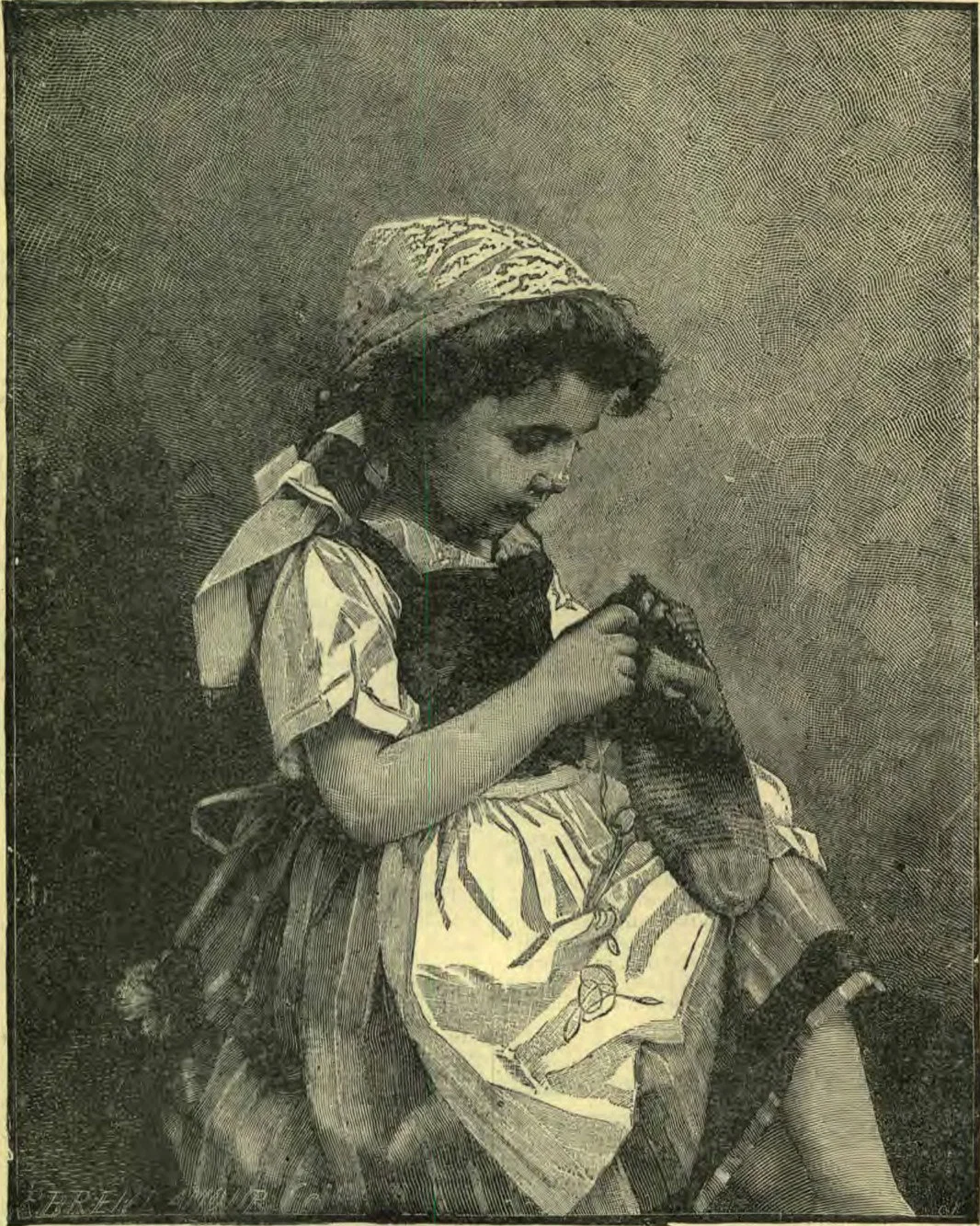
By a lowly country cottage, in a shady nook sat Nan,
Bare feet, bare arms, bare neck, and her plump cheeks brown with tan;
Folded kerchief 'round her head, in her tidy homespun frock
She sat darning ragged holes in a half-worn, clumsy sock,
Singing, oh, so blithely, as in and out her needle ran,
Till the birdies hushed their singing to learn a song from Nan.
Surely ’twas a pretty picture, well an artist’s brush might trace;
For a smile of sweet contentment lighted up her sunny face:
“I'm glad I'm getting big enough to mend these socks for brother;
It isn't just the nicest work, but then, I'm helping mother.
There's lots of things that I can do from early morn till dark;
She says she couldn't spare me, and I'm happy as a lark.”
As I listened to these maidens, and saw the work they wrought;
Their words and tasks, though different, a useful lesson taught.
I do not know as it is old, I cannot say it's new,
“'Tis not what we do that matters; 'tis the good that we may do.”
S. ISADORE MINER.
Letter Budget.
OUR readers will be glad to hear again from Miss ALICE BRADLEY of Middlesex Co., Conn. She writes: “Dear editors,—May I not have another tiny place in the Budget? I think the INSTRUCTOR grows more and more interesting every week. I am always glad to welcome it. I want to thank Luther Dobie for his kind offer in the INSTRUCTOR of March 30. It was very kind of him, and he may be assured I fully appreciate it, as I do the kindness of all the others who have so thoughtfully remembered me. I am not able to read now, but mamma reads for me. I like the Budget ever so much. And now, many thanks for the good and interesting paper, and may the choicest of heaven’s blessings be upon the dear editors and readers of the INSTRUCTOR.”
LENA LARSEN writes a letter from Chicago, Ill. She says: “I like so well to read the letters the little girls and boys write for the Budget that I have often thought I would like to write. I am a little girl ten years old, and have kept the Sabbath all my life with our family, which consists of my parents, sister, and I. My parents have kept it thirteen years. I attend Sabbath-school regularly, and have perfect lessons. I have a Bible which I read in every day. Eld. Hanson, who is our preacher, is going to New York. I am sorry, because I may never see him again on this earth. I am trying to overcome my sins, that I may meet the dear readers of the INSTRUCTOR in the land God has promised the children in the fifth commandment.”
FRANK U. HORNING writes from Butte Co., Cal. He says: “I belong to the INSTRUCTOR family, and have not often seen a letter from California, so I will send you a few lines. My parents, brothers, and sister, and myself keep the Sabbath by ourselves, fifteen miles from any other Sabbath-keepers. I am nine years old, and my youngest brother is seven. We have a family altar, and all of us pray every day. We study in Lesson Book No. 2. If it is the Lord’s will that we shall be saved, we hope to meet the INSTRUCTOR readers in his kingdom. I have two hens with young chickens. Every tenth is for the Lord.”
ELSIE L. JESSUP, of Gaylord Co., Mich., writes: “I am nine years old. I keep the Sabbath with my mother. My father does not keep it, nor none of my relatives but my mother. I love to go to Sabbath-school. I study Book No. 1. I have no brothers or sisters. I love to read the letters in the Budget, and I hope to meet you all in the new earth.”