The Youth’s Instructor, Vol. 35, No. 19.

A SONG OF SPRING

The Youth’s Instructor

May 11, 1887

S. D. A. Publishing Association · Battle Creek, Mich. · May 11, 1887

A SONG OF SPRING.
"SING a song of Spring!" cried the merry March wind loud, As it swept o’er hill and valley from the dark breast of the cloud; But the wind-flowers and the violets were still too sound asleep Under the snow’s warm blanket, close-folded, soft and deep.
"Sing a song of Spring!" cried the pleasant April rain, With a thousand sparkling touches upon the window-pane. Then the flowers that waited in the ground woke dreamily and stirred; From root to root, from seed to seed, crept swift the hopeful word.
"Sing a song of Spring!" cried the sunshine of the May; And into bloom the whole world burst in one delicious day! The patient apple-trees blushed bright in clouds of rosy red, And the dear birds sang with rapture in the blue sky overhead.
And not a single flower small that April’s raindrops woke, And not a single little bird that into music broke, But did rejoice to live and grow and strive to do its best,— Faithful and dutiful and brave through every trial’s test.
I wonder if we children all are ready as the flowers To do what God appoints for us through all his days and hours; To praise him in our duties done, with cheerful joy, because The smallest of those duties belongs to his great laws.
O Violets, who never fret, nor say, “I won’t!” “I will!”
Who only live to do your best his wishes to fulfill, Teach us your sweet obedience, and we may grow to be Happy, like you, and patient as the steadfast apple-tree! —Celia Thaxter, in St. Nicholas.

THE GARDENS OF MELBOURNE.

Just before leaving Australia for America, via New Zealand, I visited the Melbourne Botanical Gardens in company with a friend. These gardens are situated about a mile and a half from the center of the city, the River Yarra forming the northern boundary. The gardens comprise an area of eighty-three acres. They are located in the Government domain, which covers an area of about three hundred acres, and in which stands the Governor’s residence and Government buildings. The garden has been under cultivation for forty years, and has been brought to a remarkable state of perfection. Four green, undulating lawns meet the eye, stretching many acres away, and covered with different grasses, principally what is known as Buffalo grass. This is often cut, and being allowed to remain on the ground, it forms a solid mat some three inches deep.
Trees, flowers, shrubbery, and plants, are gathered here from all parts of the world, and diversely grouped in the most artistic manner. There are about two thousand species of plants represented. In one portion of the grounds are two thousand varieties of ferns. We passed through the fern ground by a winding pathway, nine hundred feet long. Here, along the water course, and lining the pathway on either side, are hundreds of native tree ferns. These, together with the thousands of smaller native ferns growing luxuriously among them, form beautiful vistas all along the pathway.
A lake covering an area of about eight acres, with its surrounding rockeries, rustic bridges, and numerous islands, is a pleasing and picturesque sight. The islands are planted with various specimens of native and imported vegetation. Here may be seen the English water lily, the papyrus from the Nile, and many aquatic plants, among which water fowl of various species may be seen gliding about.
In the gardens are represented various portions of the world,—the jungles of India, rocky elevations, and our own Western prairies. Plants from the tropical portions of the world are found in hot houses, while those of the temperate zone are so arranged that a cool breeze fans them into lively activity. We here saw the old New England pine, a familiar face, indeed, in a land of strangers. We were informed that in some portions of the gardens were banyan trees.
Three rustic summer houses, built principally with colonial woods, are placed in various parts of the grounds for the convenience of the public. These are very artistically designed, octagonal in shape, and having gable openings at intervals around the walls.
One hundred and seventy different species of plants are cultivated for medicinal purposes, each variety having a metallic label placed before it, with a description of the plant. Large quantities of the roots and leaves of these plants are often distributed among medical students for experimenting in the manufacture of medicinal remedies. The whole garden is kept in neat order, and everything presents a fine appearance. Notwithstanding many men are constantly employed, there are many acres in an uncultivated state. The garden is thronged with thousands of visitors on Sundays and holidays, the lawns being crowded with the public, for whose benefit the institution is maintained not only as a resort, but as a school for useful and scientific information.
There seemed to be but one thing lacking to render the scene perfect, and that was the singing of the beautiful birds which are found in this part of the world and in China. In Sydney there is a collection of birds from all parts of the world, and could these, with their plumage resplendent in the sunshine, have been loosed in the gardens and permitted to fly about among the trees, warbling the praise of God, it would have seemed the nearest approach to Eden possible upon a sin-cursed earth.
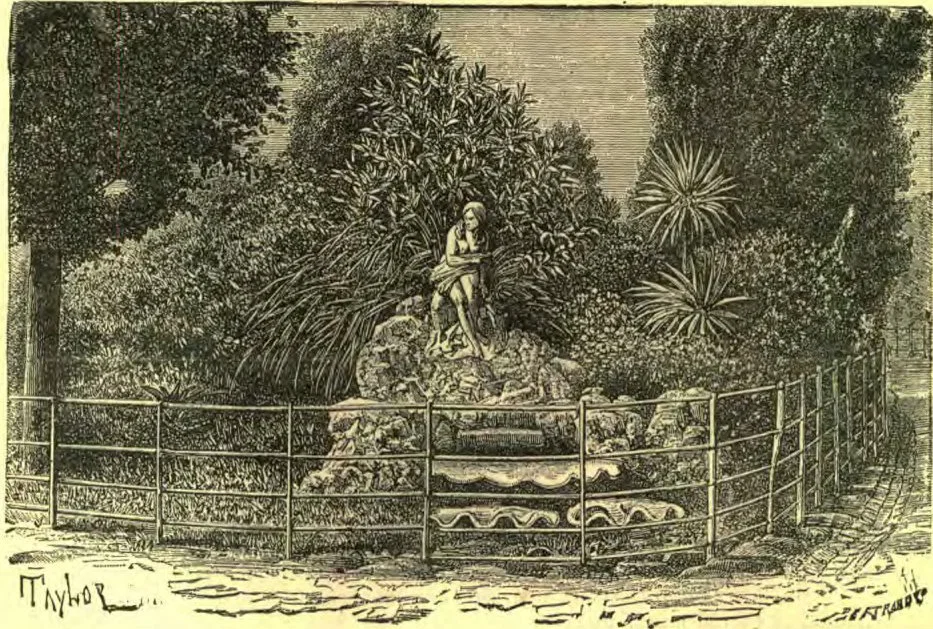
Melbourne has many other extensive parks and public gardens. Our picture gives a partial view of the Fitzroy gardens, which are “one dense network of avenues of oak, elm, and plane, with a ‘fern-tree gully’ in the middle. Casts of famous statues abound; ponds, fountains, rustic houses, and small buildings after the design of Greek temples give variety and beauty to the scene.” S. N. Haskell.

BESETTING SINS.

Alice Gray leaned over the fire, her chin resting on her hands, and a pensive look in her brown eyes. It was Sabbath, and that morning, in church, she had listened to Mr. Bentley's sermon with rather a curious interest as he spoke of the “sin which doth so easily beset us.” Now she was quietly wondering what could be her own besetting sin.
“I am sure,” said she to the fire, “it is not ill-temper; and it can't be acting deceitfully, and speaking horrid untruths; for I should despise myself if I did that. I don't hate anybody, or take what does not belong to me, and no one can say that I”—
“Alice,” called Aunt Mary, gently, from her seat in the adjoining room, “if you have finished with my pencil, will you get it for me? I need it for a few moments.”
“Why, Aunt Mary! didn't I return it yesterday?” began the little girl, when, catching herself up, she said hastily, “Oh! I remember. I was in a hurry, so I just slipped it into my pocket when I went to Kitty Blake's. I'll run and get it.”
But, in a short time, Alice walked into the room with a face which was very long indeed. The gold pencil, which she knew her aunt prized highly, was gone from the pocket,—lost, probably, on the way to her friend's house.
“O my child! why did you not give it to me as soon as you had finished? You would then have saved all this trouble,” exclaimed Aunt Mary, trying not to be too severe on her little niece, who looked really penitent, though she only said, as so many little girls have said before, “I didn't think.”
While she stood with downcast eyes, clasping and unclasping her fingers, her father walked into the room, saying with the air of one who expects a satisfactory reply, “Alice, did you mail my letter yesterday?”
“Oh!” and Alice's heart gave a great thump. “Papa, I forgot it!”
Mr. Gray stopped in his complacent march up and down, and hastily turned to look at her. “My daughter,” said he, “that letter is an important one, which should have gone, by all means, yesterday; bring it to me at once.” Papa spoke sternly, and Alice quickly obeyed.
“I see, Alice, that you are not to be trusted,” said Mr. Gray, as he took the letter from her trembling hands.
This last bitter thrust was more than the little girl could bear, and she hastily left the room, while hot tears rained down her cheeks; for we are never so unhappy as when we have no one but ourselves to blame as the cause of our trouble.
It was not many days later that Alice met with a trial which cost her a great many sighs. A cousin, traveling abroad, had sent her as a gift a beautiful lace handkerchief, which was the pride of her heart. This she carried into the parlor to exhibit to some friends, and after the handkerchief had been duly admired, it was placed on the corner of a table. Of course, nobody could explain just how it came about, but an ink-bottle which had been placed on the table was overturned, and the handkerchief was ruined.
Alice? O, yes! Alice remembered, in the midst of her grief, that it was she who had put the ink-bottle in the unsafe place.
Ah, my child! has not this week shown you the “sin which doth so easily beset you”? Do you know now what is your chief fault? I think so: for, as Sabbath again drew near, she whispered to Aunt Mary: “I believe I have learned my besetting sin. Don't you think it is carelessness?”
“Yes, dear; carelessness, leading to a long train of evils which end in selfishness; for do you not think it is selfish to be as thoughtless as one little girl has been during the past week?”
Alice's face flushed painfully, as she said: “I never knew I was so selfish.”
So Alice is taking her lesson to heart, and striving bravely to overcome her own “besetting sin.” I wonder whether other little ones cannot do likewise! —Laura M. Freck, in S. S. Times.

WHAT SHE DID.

Many stories are told of the courage of the women of that early generation who first broke ground in the forests of Pennsylvania and Virginia. They were in constant peril from wild beasts and from hostile Indians, but with heroic patience endured hardships, labor, and disease.
An example of another kind of courage is preserved by the descendants of Christiana Dickson, the wife of one of the first settlers of Erie County, Pennsylvania. She was a small, blue-eyed, low-voiced woman, extremely timid by nature; on only one point she was resolute; she had a horror of drunkenness.
She lived in the days when the use of liquor was universal. Whisky was as common a drink as water among these hardy, hard-working pioneers. A temperance or abstinence society was unheard of.
But when her sons were born, she resolved, as far as she could, to put a stop to whisky-drinking in her home. Her husband being absent from home, her brothers called for the help of the neighbors, according to the custom of the time, to put up a barn needed on her farm. They all assembled and went to work, while she prepared a great dinner. After an hour or two, whisky was asked for. One of her brothers came to the house for it; she refused to provide it, to make her friends drunk.
Her other brothers, and at last an elder in the church, came to reason with her; to tell her that she would be accused of meanness. Without a word, the little woman went out to the barn, and baring her head, stepped upon a log and spoke to them in a modest tone:—
“My neighbors,” said she, “this is a strange thing. Three of you are my brothers, three of you are elders in the church, all of you are my friends. I have prepared for you the best dinner in my power. If you refuse to raise the barn without liquor, so be it. But before I will provide whisky to give you, these timbers shall rot where they lie.”
The men angrily left the work and went home; the little woman returned to the house, and for hours cried as though her heart would break. But the next day every man came back, went heartily to work, enjoyed her good dinner, and said not a word about whisky.
Afterwards the use of whisky at barn-raisings was discontinued in the county. Her sons grew up strong, vigorous men, who did good work in helping to civilize and Christianize the world; their descendants are all of a high type of intellectual and moral men and women. If she had yielded this little point, they might have degenerated, like many of their neighbors, into drunkards and spendthrifts.
Our stout-hearted pioneer forefathers redeemed the land, and drove out the wild beasts and serpents; but there are still vices and malignant customs to be conquered, and for the work we need women of high souls and gentle spirits, like Christiana Dickson.—Companion.

YOUTHFUL DISREGARD OF REPROOF.

There is, perhaps, nothing more painful than to see children, especially large boys, who ought to know better, uncivil and disrespectful to their superiors, but particularly so to their parents. When I was a boy myself, I regret to say I fell into this very bad fault, for which I was not alone blameworthy. I was considered remarkably smart for my years, and my singularly wise sayings and doings delighted admiring friends. I suppose I was looked upon as a young Solomon. I was generally brought into the parlor for the express purpose of entertaining company. But I remember that I was wise enough to understand and mark well all the praises they heaped upon me. All my wisdom was gathered from my friends, and yet they gave me credit for originality in everything I said or did. By these aids I soon discovered my great importance, and this made me impertinent—a pest and scourge to my parents.
When I had grown up to the age at which I ought to have been a pleasure to them, I was disobedient and sadly disrespectful. When I think of the irreverence I was guilty of, for a moment I feel to this day crimson with shame. And if I thought it could make amends for my folly, I should like to undergo the floggings which I ought to have received then.
At school the teacher was a fine man, a first-class disciplinarian, and kept me in my place well; but I disliked him for what I styled his severity, and was as disrespectful and disobedient as I well dared to be. I was afraid of an open conflict with him, knowing that, in this case, I must fare poorly. In secret, however, I did what I could to disaffect the other scholars and make them disrespectful. In this I succeeded admirably, especially among the larger boys. We could all plot mischief against him, and sneer at him behind his back. His rebuke made us angry and revengeful, and we consoled ourselves with the hope of paying him for it when we grew up. In the meantime we enjoyed ourselves delightfully in making game of him, much to the entertainment of the scholars. I was the prime mover in these annoyances, and it never occurred to my mind that my heartless conduct would receive a sudden and unexpected check.
On one occasion he reproved me. Thinking myself master of the situation, I tossed my head in defiance and sneered contemptuously, looking for the approval of my rude comrades. But before I had time to think what I was doing, the teacher made my ear ring with a blow of his open hand. I staggered a little, but instantly recovering myself and shrugging my shoulders in contempt, dared him to repeat it. He commanded me to leave the room. Glad of the opportunity, I went, and closing the door with an impudent farewell, ended my school education.
In Sabbath-school I was even worse. I knew the teacher had no means of enforcing his instructions, except by moral suasion. I was irreverent, even in the most sacred things. I turned my pious teacher’s instructions into ridicule to make the others laugh. More than once I used bad language to his face, and I am now convinced that he was a man of more than ordinary grace, or his temper could not have brooked my conduct for a moment. Yet, strange to say, I never knew of his having made any effort to obtain my removal out of the class. I think his prayers were answered, however, by my suddenly leaving the place. I went to business, and was there but a month when my bad manners were directed toward my employer. He told me quietly that I might go home to my father. I tried several other places with a similar unhappy result—unhappy for me, unhappy for my employer.
I had grown to be a young man, and knew that I was losing my time, that I could never be worth anything in the world. In weeks of despondency I had time to reflect. I saw that I had been turned out of school for my insubordination; that I had been disrespectful to my Sabbath-school teacher, though he desired my best interests, that my ill-breeding had turned me out of three or four situations, and prevented me from occupying others. I next saw that if ever I expected to do well, I must govern my temper, suppress my insufferable pride, which had developed by this time into impudence, and practice obedience and respectfulness to my superiors.
The disgrace of having been turned out of several situations, to the certain knowledge of my acquaintances, mortified me. My ill-fortune had its good effect upon me. After the exercise of patience and practice of self-culture for a long time, I succeeded in getting another situation. When entering upon it, I made up my mind to try better conduct, and be as respectful as possible to all around me. I was able to keep my place this time, and learned that steadiness, honesty, and respectfulness to my superiors were indispensable to a young man’s success.
If you wish ever to prosper in this world, you must begin to obey the fifth commandment, which is, “Honor thy father and thy mother, that thy days may be long upon the land which the Lord thy God giveth thee.” If you neglect this, take care that you come not under the curse which declares, that “The eye that mocketh at his father, and despiseth to obey his mother, the ravens of the valley shall pick it out, and the young eagles shall eat it.”—Selected.

THE ORIOLE'S SONG.

O! the deep, rich note of the oriole, As he swings in the swaying elm; My heart leaps up with a joyous bound At the glad return of the well-known sound Up in the leafy realm.
“Cheer up,” he says, as he swings and sways In the airy world above; “For the sunbright May, it is here again, And the world is fresh with the spring-time rain, And life is led by love.
“Then cheer up, cheery, cheer up, cheer, Blossoming time is near: We sway and sing in the clear, cool morn When the diamond dew on the leaf is born, Up in the bird-world here.
“I sing the song that was given to me, I welcome the risen sun; I give good words for the coming day: Oh! keep my song in your heart alway From morn till the day is done.”
—Julia M. Hooper.

ONE OF GOD'S PICTURES.

“Father, what is the definition of artist?” said Fred Inglesant, looking up suddenly from his book.
“In what particular sense is it to be applied?” was the questioning reply.
“Painting,” said Fred.
“The simplest definition, I think, would be: one who produces a pleasing and natural effect in the harmony of color, skillful grouping, and correct outline of his scenes or forms. He who comes nearest to nature is a true artist. It requires a keen eye, a ready touch, and a soul alive to all that is good and beautiful, to reproduce the work of the greatest artist the world has ever known or ever will know.”
“Do you mean Michael Angelo or Raphael?” asked Fred.
“No, neither of those; if you walk out with me, I will show you one of his pictures.”
As none of their friends had handsome paintings, Fred was surprised, and his surprise increased as they neared the river.
His father stopped. “What do you see?” he asked. “The river dotted with sails,” Fred said, looking questioningly at his father.
“Yes, a clear, flowing stream, widening out until it is touched by the heavenly azure of the sky, over which float opal clouds, with here and there breaking through them floods of golden light; all this reflected in the mirror below, as are the white sails gliding so smoothly over it.”
“Oh, now I see the picture you promised me, father!” exclaimed Fred, catching some of his father’s inspiration. “See how it is framed in by those trees, which seem to form an arch over this end of it, and the rocks on this side, and all the tangle of wild flowers and vines. Even this old log helps to make it more perfect, doesn’t it?”
His father smiled. “I need not tell you who is the greatest artist now, I see,” he said. “The critic can find no fault with His work.”

INNOCENCE AND GUILT.

GIUSEPPE was a little Italian boy; so bonnie with his great dark eyes, and curling hair, and sweet, innocent lips, that an English artist made a picture of Giuseppe’s head, and called it the “head of a cherub.”
Twenty years after, the same English artist came again to Italy to paint pictures; and one day he visited a court of justice, where a notorious band of brigands, who had been captured with great difficulty after a series of atrocious crimes, were being tried. The artist was greatly struck with the appearance of one of the prisoners, more cruel, more evil-looking than the rest, and hastily taking forth his sketch book, he drew the brigand’s head, and by-and-by produced a pair of pictures to the world called “Innocence” and “Guilt”; the one, the head of the boy painted twenty years ago, the other, that of the brigand he had lately seen in the court of justice.
What will you say when I tell you that both the pictures represented the same person?
Yes, greatly shocked was the artist to learn that the happy, innocent child and the hardened criminal were one and the same. Neglected childhood, idle boyhood, and bad companions had blotted out the beauty and the innocence, and led to breaking the law, to crime, and at last to death.

True Politeness: Treating Others as You Wish to Be Treated

TRUE politeness is perfect ease and freedom. It simply consists in treating others just as you like to be treated yourself.—Chesterfield.

QUEER THEORIES CONCERNING EARTHQUAKES.

In the course of a lecture delivered recently before the Rigaku Kyokai, or Science Society, of Tokio, on the causes of earthquakes, Prof. Milne classified the theories as to the cause of these phenomena into three kinds—unscientific, quasi-scientific, and scientific. Modern-science theories occupied the main part of the lecture, but we will follow him only in the two former ones.
In the first class, the unscientific, he included the explanations of the negro preachers of Charleston after the late earthquakes there, that they occurred in consequence of the wickedness of the population. The Mussulmans of Java recently prayed to the volcanoes there to cease their shakings, at the same time promising reformation of life.
That earthquakes are the direct result of man's wickedness is an idea that has always been common. About 1750, earthquakes were felt in many parts of Europe, which were widely attributed to that cause, and innumerable sermons were preached, inculcating the lesson that if mankind would live better lives there would be no more earthquakes. In 1786, after a shock at Palermo, the people are recorded to have gone about scourging themselves, looking extremely humble and penitent.
The Professor then passed on to the myths which attribute earthquakes to a creature living underground. In Japan it is an “earthquake insect” covered with scales, having eight legs; or a great fish having a certain rock on his head which helped to keep him quiet. In Mongolia the animal was said to be a frog; in India, the world-bearing elephant; in the Celebes, a world-supporting hog; in North America, a tortoise. In Siberia there was a myth, connected with the great bones found there, that these were the remains of animals that lived underground, the trampling of which made the ground shake. In Kamchatka the legend was connected with a god, Tull, who went out hunting with his dogs. When the latter went out to scratch themselves, their movements produced earthquakes. In Scandinavian mythology Loki, having killed his brother Baldwin, was bound to a rock, face upward, so that the poison of a serpent should drop on his face. Loki's wife, however, intercepted the poison in a vessel, and it was only when she had to go away to empty the dish, that a few drops reached him, causing him to writhe and shake the earth.
The lecturer had no means of collecting the fables of the southern hemisphere, but they would be worth knowing for comparison. As to quasi-scientific theories, these endeavored to account for earthquakes as parts of the ordinary operations of nature. It was supposed, for instance, that they were produced by the action of wind confined inside the earth. The Chinese philosophers said that Yang, the male element, entered the earth and caused it to expand and shake the ground in its efforts to escape. Its effects would be more violent beneath the mountains than in the plains, and therefore earthquakes in the north of China, which was mountainous, were said to be more violent than those in the south. It was supposed that when the wind was blowing strongly on the surface of the earth there was calm beneath, and vice versa. Aristotle and many other classical writers attributed earthquakes to wind in the earth.
Then comes the theory of electrical discharges, which was advocated in 1760 by Dr. Stukely, as well as by Percival and Priestley. This theory is held by some in California at the present time,—that the network of rails protected the State against any dangerous accumulation of electricity. But Mr. Milne showed that the laying down of rails in Japan did not have that effect. He thought the electric phenomena which sometimes attended earthquakes were their consequences, not their causes. Earth currents unquestionably accompany earthquakes, but, as has been said, they appear to be the consequences, not the causes of the latter.
Next came the chemical theories, which were very strong in Europe up to the beginning of the present century. It was imagined that under the ground were certain substances, such as sulphur, niter, vitriol, which, by their action upon each other, resulted in violent changes, giving rise to vapor, the sudden production of which, in certain cases, would shake the ground.
It was not until 1760 that Dr. Mitchell, who wrote a good deal on the subject, first threw out the theory that earthquakes were connected in some way with volcanoes, because they were most frequent in volcanic countries. He observed that large quantities of steam were given off from volcanoes, and came to the conclusion that an earthquake was produced at the time that an attempt was made to form a volcano; that steam got in between certain strata, and, as it ran between them, caused pulsations. Prof. Rogers, about the same time, in North America, endeavored to show that it was steam.—Nature.

FAITH

LESSON 6.—CONQUESTS OF FAITH.

1. What saved the harlot Rahab in Jericho? Heb. 11:31.
2. Did works have to do with her salvation and justification? Jas. 2:25.
3. What brought down the walls of Jericho? Heb. 11:30.
4. What works were manifested on this occasion? Josh. 6:13-16.
5. What worthy representatives of faith does Paul mention? Heb. 11:32.
6. After Gideon’s army had been reduced from 32,000 to 300, were works necessary? Judges 7:20, 21.
7. What has faith oftentimes accomplished? Heb. 11:33, 34.
8. What has it led people to endure? Verses 35-37.
9. Did faith bring the fulfillment of the final promise? Verses 39, 40.
10. In view of the experiences of these worthies, what ought we to do? Heb. 12:1-3.
11. How may we show that God is pleased with our continued efforts to seek him and exercise faith in him? Luke 18:1-8.
12. Does faith always bring immediate answers to prayer? Luke 18:7.
13. How long did Daniel fast and pray on a certain occasion? Dan. 10:2.
14. When Gabriel appeared, what did he say to Daniel? Verse 12.
15. Who, besides Gabriel, was brought from heaven to earth by Daniel’s prayers? Verse 13.
16. How long did the prayer of faith once prevent rain? Jas. 5:17.
17. How many times did Elijah pray, on one occasion, before there was any appearance of rain? 1 Kings 18:43, 44.
18. What had he previously told Ahab? Verse 41.
19. Will those who are looking for Christ to come, manifest this persistent faith? Luke 18:8.
20. What indicates that there will be but a small amount of this faith in the last days? Last clause.
21. Have you this faith?

UNEXPIRED SUBSCRIPTIONS TO THE S. S. WORKER.

It was stated some time ago in the INSTRUCTOR that the amounts due subscribers for unexpired subscriptions to the S. S. Worker would be applied on their subscriptions to the INSTRUCTOR, unless otherwise ordered. But very few have given us any directions in the matter, and we have therefore been applying the amounts as stated. We find, however, that many of the Worker subscribers’ names do not appear on the INSTRUCTOR list, as they probably receive the INSTRUCTOR in the clubs sent to the Sabbath-schools. Now we do not wish to send extra numbers of this paper to those who already receive it, and we would therefore request that all who have unexpired subscriptions to the S. S. Worker and who receive the INSTRUCTOR in clubs, immediately notify the publishers of the INSTRUCTOR as to how they wish the amount due them applied. If it is desired that the money be applied on your club subscription, please state it, and give the address to which the club is sent. Or if you may wish to donate the amount to the publishing fund of the International S. S. Association, or apply it in some other way, let us know immediately, so that the matter may be closed up without further delay.
A. B. OYEN.

ONE SOURCE OF INFLUENCE.

Not least among the sources of the Sabbath-school teacher's influence is the fact that his labor is gratuitous. A wise and competent secular teacher may, and often does, have a potential and far-reaching influence over his pupils. By virtue of superior knowledge, of wholesome discipline, by tact and gentleness and obliging good humor, such a teacher may secure a lasting hold on his scholars. But the duties of the secular teacher are more or less perfunctory, and his relations to the scholar assume, to a certain extent, a professional character.
On the other hand, the faithful Sabbath-school teacher's sole spring of action inheres in his Christian love. He sees in his pupil one for whom Christ died, one on whom his image is written; that image may be marred, defaced, and almost blotted out, but still it is there. He sees in every neglected child a possible disciple and heir of heaven, one whom the Father would not willingly leave to perish. He sees in the truth the instrument of life and salvation. He sees in the Sabbath-school a convenient and efficient means of bringing the neglected, the lost and wayward, into direct and vital contact with the saving power of the truth. The Christian love, akin to that which the all-Father exercises toward his creatures, is not only a powerfully impelling force, but when it finds warm and persistent voluntary expression, it commends itself to the confidence of the scholar, and becomes a source of vast and extended influence.—J. Bennett Tyler.

POWER OF SUNSHINE.

In a recent number of the Chautauquan there is an interesting article by Charles Barnard in which he shows that the great star which we call the sun is literally the stove that keeps the whole world warm. In conclusion he gives the following curious facts:—
Heat expands and cold contracts, and everything warmed by the sun expands under its gentle heat. Every rail on all our railroads expands and grows perceptibly longer in bright sunshine, and contracts and grows shorter whenever a cloud cuts off the heat, or the earth in turning moves away from the sun. So it is found necessary to leave a little space between every rail, wherein it can stretch itself in hot summer days. Were all the rails pushed close together in laying the track, the first day of hot sunshine would pull the track to pieces, or render it so uneven that it could not be used. Every iron bridge stretches in the sunlight, and would tear itself to pieces were it not carefully adjusted for this expansion in the sun, and given a chance to freely move on its foundation whenever the warm fingers of the sunshine are laid upon it. Brooklyn Bridge is in four distinct pieces, with plenty of room between to move, and it does move every day. In warm sunshine it is longer by several inches than on a cold night. The cables of the bridge are continuous, but the expansion caused by heat lengthens the cables, and they let the bridge sink two or three feet in the middle. Even a passing cloud, hiding the sun for a few moments, will cause the entire bridge to rise in the middle by cooling and contracting the cables. I have personally measured the movement of Brooklyn Bridge on a hot summer’s day, between bright sunshine and the shade caused by clouds, and have seen that it moved over one inch in less than two hours. In building the great bronze Liberty in New York Harbor, the same thing had to be guarded against, and provision is made to allow the whole vast figure to move under the expansion caused by the heat of the sun. The movement, owing to the irregular surface of the statue, is not visible, as in the Brooklyn Bridge, yet it is there. Even Bunker Hill Monument, which is built wholly of stone, is distorted out of shape every day by the sun, though the movement cannot be proved except by certain experiments made for the purpose.—Interior.

WONDERS OF THE SEA.

The Electrical Review compiles some of the most wonderful features of the great sea, which we publish below for the benefit of the readers of the INSTRUCTOR:—
“The sea occupies three-fourths of the surface of the earth. At the depth of about 3,500 feet, waves are not felt. The temperature is the same, varying only a trifle from the ice at the poles to the burning sun at the equator. A mile down the water has a pressure of over a ton to the square inch. If a box six feet deep were filled with sea water, and allowed to evaporate under the sun, there would be two inches of salt left on the bottom. Taking the average depth of the ocean to be three miles, there would be a layer of pure salt 440 feet thick on the bed of the Atlantic. The water is colder at the bottom than at the surface. In the many bays on the coast of Norway the water often freezes at the bottom before it does above.”
“Waves are very deceptive. To look at them in a storm, one would think the water traveled. The water stays in the same place, but the motion goes on. Sometimes in storms these waves are forty feet high, and travel fifty miles an hour—more than twice as fast as the swiftest steamer. The distance from valley to valley is generally fifteen times the height, hence a wave five feet high will extend over seventy-five feet of water. The force of the sea dashing on Bell Rock is said to to be seventeen tons for each square yard. Evaporation is a wonderful power in drawing the water from the sea. Every year a layer of the entire sea, fourteen feet, is taken up into the clouds. The winds bear their burden into the land, and the water comes down in rain upon the fields, to flow back at last through rivers. The depth of the sea presents an interesting problem. If the Atlantic were lowered 6,564 feet, the distance from shore to shore would be half as great, or 1,500 miles. If lowered a little more than three miles, say, 19,680 feet, there would be a road of dry land from Newfoundland to Ireland. This is the plane on which the great Atlantic cables were laid. The Mediterranean is comparatively shallow. A drying up of 660 feet would leave three different seas, and Africa would be joined to Italy. The British Channel is more like a pond, which accounts for its choppy waves.”
“It has been found difficult to get correct soundings of the Atlantic. A midshipman of the navy overcame the difficulty, and shot weighing thirty pounds carries down the sinker. A hole is bored through the sinker, through which a rod of iron is passed, moving easily back and forth. In the end of the bar, is a cup dug out, and the inside coated with lard. The bar is made fast to the line, and a sling holds the shot on. When the bar, which extends below the ball, touches the earth, the sling unhooks and the shot slides off. The lard in the end of the bar holds some of the sand, or whatever may be on the bottom, and a drop shuts over the the cut to keep the water from washing the sand out. When the ground is reached, a shock is felt as if an electric current had passed through the line.”

Correction to the Inch of Rain Answer

In the answer to the question, “What is an inch of rain?” in the INSTRUCTOR for April 20, was an error in the types, there being commas inserted where decimals belong, both in the number at the end of the third and at the beginning of the seventh lines. Corrected it reads, “277.274 cubic inches to the gallon,” and “an inch deep of rain weighs 100.993 tons.”
Continue reading: TWO COLD WATER BOYS