“I’M afraid,” said Aunt Mary to her family at breakfast, “that our meeting will be poorly attended to-day; for it has rained all night, and it does not look as if it would clear up. It’s too bad; for I am anxious for the sisters who live in the country to attend. I am so pleased at the change I can see in these dear sisters. Mrs. Brown’s house looks altogether different, and little Willie has not been ill since the morning she came to me several weeks ago.”
Although the morning looked so unfavorable, the afternoon cleared off bright and pleasant. All nature seemed to be smiling and praising God. Nearly all the ladies were present, and were as enthusiastic as ever. Some of them reported success in making cream sticks after Aunt Mary’s recipe, and told how well their families enjoyed them. The following menu had been neatly written on the board, and they proceeded to copy it:—
Breakfast Menu
FRESH FRUIT
GRAINS OF GOLD CREAM
WHOLE-WHEAT BREAD WHEAT PUFFS
BAKED POTATOES POACHED EGG
BUTTER CREAM GRAVY
MILK
“I have been surprised,” said Aunt Mary, thoughtfully, “while visiting in the country, to see that so many of our country people make so little use of their many advantages. The farmer’s wife is especially blessed with rich opportunities for a wholesome diet. Some of you look incredulous,” said Aunt Mary, “but let us see if this is not true. Here in the country we can have fresh vegetables, fruit, cream, milk, butter, buttermilk, and eggs in abundance. And we can raise the beautiful flowers to adorn our tables. If we do not have these things, the fault is ours; for we certainly have the opportunity. Without labor we can get nothing that is worth having,” continued Aunt Mary, “and I know it requires labor to have a good garden, and raise small fruit and flowers. Every member of the family should be enlisted in this good work, in order to make it a success. The boys and girls should not only have their missionary garden, but they should help with the family garden.
Then there is that dining-room table. I remember a dining-room table in a little log-house in the country, that was a model of neatness. The dear sister who owned it did not possess a linen table-cloth, but she had made some of muslin, and they were always white, and were neatly ironed. The knives, forks, and spoons, which were of steel, shone brightly, and were arranged neatly, as, indeed, was everything else on the table, while a few flowers adorned its center. It gave me an appetite just to look at that table.
“But I have a vision of another table. An old red cloth covered it. Knives, forks, and plates seemed to have been thrown on, and the whole appearance of the table was most uninviting; and this is only a sample of what I have met many times. Christ should be the unseen guest at every Christian’s table; so let us prepare it as if we expected his presence.
“Now we will take up our breakfast menu. Just a word about preparing our baked potatoes and other root vegetables. For five or ten cents you can get a brush that will be a great help in cleaning these vegetables. It cleans them better than the hands can do it, and saves the hands besides. Potatoes should be thoroughly washed and dried before placing in the oven to bake. Potatoes, baked, are more wholesome than prepared in any other way.
“Grains of gold (corn-meal) mush is very nutritious, if sufficiently cooked. At least three hours should be used in cooking it thoroughly, and, like the oatmeal, it should be prepared the previous day.
“Wheat puffs are a luxury, yet they require but little care and time for making. To two cups of milk add a little salt and the well-beaten yolks of two eggs; then sift in, a little at a time, and beating meanwhile, three small cups of flour. Beat until light, then fold in the stiffly beaten whites of the eggs; and bake in hot gem-irons. This is much better than the batter breads made with baking-powder and soda.
“There is so much to be said about bread-making, and so much depends on good bread, that the whole hour might be spent very profitably on this one subject. To make good bread requires, first, good flour; second, good yeast; and last, but not least, proper attention. Good flour will have a creamy white color, and will fall light and elastic from the hand; but you may have ever so good flour, and unless you have good yeast, your bread will be poor. Good yeast has a fresh, pungent odor, and is light and foamy; while poor yeast has a sour odor, and a dull, watery appearance.
“Bread sponge should be made at night if it is desired to have the bread baked in the early part of the day. The flour should first be warmed, especially if the weather is cold, and the sponge kept in a warm, even temperature. Nice mealy potatoes, say one of medium size to two loaves, will make the bread keep fresh longer. When light, the sponge should be about twice the size it was when set. The sponge should be mixed the first thing in the morning, care being used not to add too much flour, as it makes it tough and hard. This dough should be thoroughly mixed for several minutes. Everything now depends upon the kneading. After it is thoroughly kneaded, put in a warm place to rise. If the dough has been properly kneaded, it is not necessary to knead it again when forming the loaves. Individual tins for the loaves are preferable, as you thus get the crust on all sides. Let the loaves rise to twice their size, and bake in a moderate oven for one hour. When taken from the oven, turn loaves out of the pans on the sides, so that the steam will not soften the crust. Then, when cold, roll each loaf in a cloth, and put in a tin box.”
Many questions were asked by the ladies, and were cheerfully answered by Aunt Mary, after which a general discussion followed. All went home feeling well paid for coming to this meeting.
Mussoorie, India.
Straight Talk on Tobacco
WOMEN'S tirades against tobacco do not carry much weight with the average smoker; nor do the charges of its harmful effects made by those whose opinions are dismissed as prejudiced, unfounded, and extreme. But fair-minded men ought to be ready to consider statements of scientific fact presented by a trained and scholarly investigator. When one of the leading physicians and nerve specialists of the United States, for example, states that the effect of tobacco upon the heart and blood-vessels has been proved to be that of an active poison; that tobacco is responsible for arterial degeneration in those long habituated to its excessive use, and interferes with the proper function of both lungs and heart, finally paralyzing their central nerves; that it acts upon the nerve-centers, brain, and spinal cord; that it has a powerfully depressing effect upon the nerves of motion; and that its chronic effects are to induce a poison-congestion of the brain, spinal cord, and end nerves in heart, lungs, muscles, and skin,—it would seem that the rather positive disfavor with which some men and women view the use of tobacco is not so unfounded, after all. The chief excuse for using tobacco is that it is so, soothing! The process of degeneration, usually is.—The Sunday School Times.
The Roman-Swiss Conference
By Guy Dail
GUY DAIL
The sixth annual session of the Roman-Swiss Conference (which is the twenty-fifth yearly meeting of the original Central European Conference) was held in Orbe, in the canton of Vaud, August 10-14.
Orbe, or as it was known to the Romans, Urba, contains about two thousand inhabitants. The chief industries of the town are the chocolate industry and tile manufacturing. The place is not without historical interest. In 613 A. D. Brunhilde was taken captive here; and in 1511 the reformer Viret was born in Orbe. It seems, also, that Rudolf III, of New Burgundy, had his residence at this place. An ancient church and two towers on a hill are still interesting monuments of the past.
About five minutes’ walk from the town our beautiful camp of more than fifty tents was located in an orchard on the left bank of the Orbe River. Of the fourteen churches in the Roman-Swiss Conference, thirteen were represented by forty-nine delegates. In all, about two hundred fifty of our own people attended; the outside interest was a little slow in developing, but the Sunday meeting was well visited, there being two hundred present from the town and surrounding neighborhood. All were well pleased with the meeting, as they felt that God had been with them, and had blessed them richly. The business of the conference interested all.
We were especially gratified to see the manner in which this little Roman-Swiss Conference views the work in the regions beyond. Not only do the brethren here plan to keep up their First-day and Sabbath and annual offerings, but they also voted to raise an extra fund, averaging twenty-five centimes a week for each member. In addition to a second tithe, and paying the teacher in the school, the Roman-Swiss Conference further decided to pay a worker in northern France for one year, and to bear the traveling expenses of two delegates to the next General Conference. Thus this small French-speaking field, with only five hundred twenty-five members, continues to share liberally its funds with the large and needy Latin Union Conference, with its one hundred ten million population. Not only is the Roman-Swiss Conference doing so well in supplying financial aid, but it is taking steps to organize Missionary Volunteer Societies, and we trust that in the future it will prove a still more efficient recruiting ground for workers for the needy fields beyond. For the time being, only one worker was voted to another field,—a student at Gland, who will go to Algeria. Not only are there French and Italian cantons in the territory of the Roman Conference, but there are also about one hundred thousand Germans. Heretofore we have had no workers here who could hold lectures for the German-speaking population of French Switzerland; but it has just been voted to employ a German- and French-speaking laborer. Thus we hope to get a good start among the German population of Roman-Switzerland, as well as to increase our strength among the other nationalities there.
The publishing department was also carefully considered at this time. The French health paper is increasing the size of its edition. By personal effort, the delegates promised to sell the paper, and there is to be a special edition of eight thousand (the regular circulation is five thousand monthly), nicely printed, with a cover illustrated in various colors. We feel sure that as the churches thus engage in the sale of this paper, it will prove a blessing to them as well as to the people who may purchase or subscribe for the periodicals containing instruction for these times. In the Roman-Swiss Conference the book sales for 1906 amounted to only about thirteen hundred francs, but for 1907 they were about ten thousand five hundred francs, a remarkable growth. This shows what can be done when books are to be had. But in these small countries we find it very difficult to secure the capital necessary to issue new publications as rapidly as we would like. However, during the coming year it is planned to get out two new books in the French—“Christ’s Object Lessons,” and a treatise on health. There is also another factor that seriously interferes with the best development of our colporteur work in the Latin Union Conference: the young people seem to regard canvassing as only a preparatory course to some other department of the message, and as soon as they have been engaged in selling our good publications for one or two years, they wish to do something else. The Latin Union Conference president stated the case in these words, as he was speaking in open conference about the canvassing work in this field: “Too many have regarded the canvassing work as the vestibule to the parlor of evangelization; however, in the third angel’s message there are no parlors, but only workrooms, and the colporteur’s work must be a distinct department of the message, and we must see to securing reliable men who will enter it and make it their life calling.” The sales of the union publishing house for 1907 amounted to thirty-six thousand two hundred francs, about nine thousand six hundred francs more than during 1906.
The Gland Sanitarium has had an excellent patronage, the number of guests varying from fifteen during the dull time in the winter season to fifty-five at the height of the summer season. The Philanthropic Society earned nearly twelve thousand francs last year. There is great need of additional room for guests at the sanitarium, and we hope the day may soon come when means can be provided for enlargement.
The union school at Gland will begin the first of October. Every field in the Latin Union Conference, save Algeria, plans to have representatives at the school. Portugal, which has heretofore sent no students, is planning to be represented the coming semester.
Harmony characterized the business meetings. The brethren were free to express their opinions as to the matters that were brought before the delegates, and the kindest feeling prevailed. Elder J. Curdy was again chosen president.
In connection with the Roman-Swiss meeting, there was a session of the Latin Union Committee. Brethren L. R. Conradi, L. P. Tieche, C. T. Everson, H. H. Dexter, W. Bond, and Gustaf Roth were present. It was recommended that, beginning with Jan. 1, 1909, northern France be cut off from the French Conference, and be under the direct supervision of the union conference committee. Brother U. Augsbourger is to go to Algeria, to take the place made vacant by the recall of Brother Paul Steiner to act as the German- and French-speaking worker in Roman-Switzerland.
During the year there has been an addition of forty-five to the list of workers in the Latin Union Conference. As to finances: In 1907 their tithe was 48,563 francs, against 42,099 in 1906; donations, 11,417 francs, a gain of 2,166 francs over the previous year.
The future of the union seems bright and hopeful. For the thirty-three evangelical laborers and the eighteen canvassers we wish much of God’s blessing and Spirit, that the work may grow more rapidly than ever in the past. In many ways it is a difficult field in which to operate; but God is greater than all the difficulties, and his Spirit, given in rich measure, will enable the laborer to have an abundant harvest. We trust all the friends of the message will pray often for this field and its workers.
Hamburg, Germany.
The Ancient Empire and Its Conquest
By ED. F. FORGA
A Plea for the Inca Indians of Peru—No. 1
The Ancient Empire and Its Conquest
ED. F. FORGA
THE grandeur of the glorious past of this race stands in remarkable contrast to their later history written in tears and blood, and to their present pitiful condition. Of their former civilization, their ingenuity, their industry, and their intelligence, there are left many evidences. There are traces of well-constructed roads hundreds of miles in13length.
In the mountains are many large terraces used anciently for agricultural purposes, and irrigated by a marvelous system of canals and aqueducts. Along the valleys, in places which to-day are depopulated and barren, the traveler can see traces of former cultivation, made possible only by an ingenious system of irrigation. All these, with many other relics, indicate how flourishing must have been the condition of the people that once inhabited these regions.
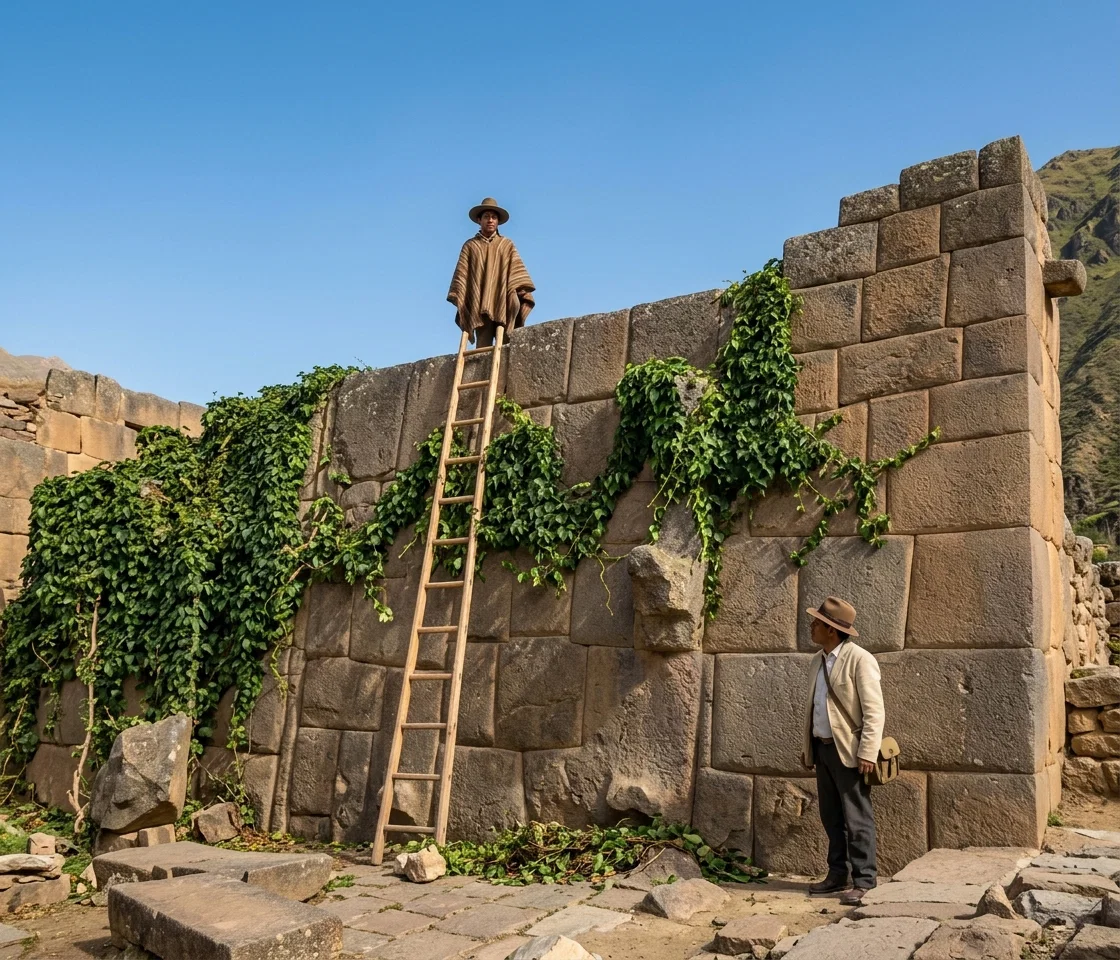
OLLANTAITAMBO (PERU)
Ruins of the walls of the palace of Ollanta, an Inca emperor
Scattered through the country in the principal centers and at strategic points, we find ruins of temples and of fortresses the construction of which is a marvel to modern civil engineers. These forts are constructed with blocks of stones sometimes as high as sixteen feet or more, carried—no one knows how—for many miles, and fitted together, without mortar, with such exactness that a knife-blade can not be inserted between two stones.
The social organization of this people was scarcely less wonderful, as they realized in fact that which is the dream of modern socialism—communism of property.
In scientific knowledge the ancient Incas were doubtless not excelled by any other contemporary race or nation. They knew of the zodiac, and were acquainted with the use of solar and astronomical instruments. In writing they used the quipus. This was a cord, from which were suspended many smaller strings full of knots, the arrangement and color of which expressed thought.
As workers in metals and as potters, they displayed an infinite variety of designs. They were very skilful in the home industries. Their clothing was of wool, woven and beautifully colored. Some of their clothes were especially artistic in fineness of texture, in weave, and in beauty and harmony of color.
Referring to that time the Inca Indians can sing:—
> “We were born free, and free would we remain.
>
> Till then to us not known was slavery’s chain.
>
> We loved our hills, our rulers we revered,
>
> And no attack from anywhere we feared.
>
> We tilled our land
>
> With busy hand,
>
> And were content to serve
>
> our gods in peace
>
> As best we knew. Our
>
> fellow man to please
>
> Was our sole aim, and
>
> heaven to appease.”
In the early part of the sixteenth century a band of Spanish adventurers landed in Peru, led by Pizarro, a representative of the civil power, and by the monk Valverde, a representative of the Roman Church. After this party had obtained a foothold in the country, one of their first acts was to demand of the emperor Atahualpa that he accept the Christian faith as expounded by Valverde, that he renounce his authority, and that he pay tribute to Charles V and his successors, the sovereigns of Spain. These peremptory demands being indignantly refused, Atahualpa was seized and held prisoner, and hundreds of his followers were cut down by the Spanish soldiers. After buying his freedom for nearly fifteen million dollars’ worth of gold, the unfortunate ruler was condemned to be burned alive, but was graciously strangled instead, in view of the fact that he embraced a crucifix presented to him by the monk Valverde, as a token of his acceptance of the Catholic faith.
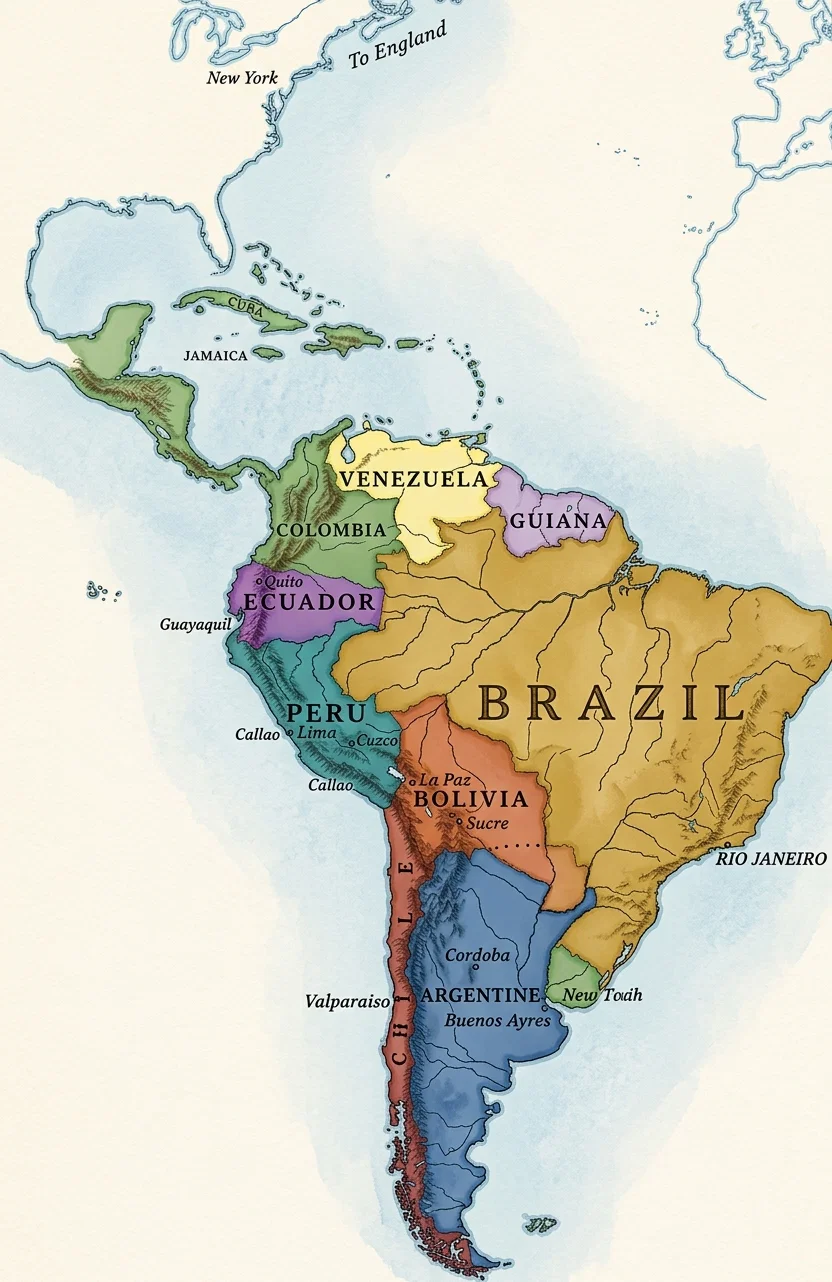
MAP OF SOUTH AMERICA
The Inca Indians are scattered in Ecuador, Peru,
and Bolivia
Treacherous and cruel as was this act, it is but one illustration of the general conduct and policy in the subjugation of these Indians, who in many respects excelled their European conquerors. The story of the conquest of the Inca empire is an object-lesson of the sure result of a complete domination of the state by the church.
It was the worst element of the Spanish population, those who loved riches as much as they despised labor, who went to these far countries as priests and laymen, enslaving these poor aborigines, whose nature was mild and kind, and who were accustomed to honest, hard labor. In consequence of this greed for gold, the natives were killed by the thousands, or deprived of nearly all their possessions.
Markham, in his “History of Peru,” tells us that forced labor in the mines, separating the unfortunate men forever from their wives and families, largely contributed to this unhappy state of things. For the mines of Potosí (Bolivia) this forced labor, or mitta, as it was called, brought together 11,199 laborers from certain districts in 1573. Just one hundred years afterward, these laws having in no way been relaxed, only 1,674 workers could be obtained. These figures speak for themselves. “In a century nine tenths of these people had been destroyed by overwork and cruelty.”
“The oppression on the part of owners of obrajes, or manufactories of coarse woolen and cotton cloths, was as crushing as that employed by the mine-owners. These manufacturers engaged men called guatacos to hunt the Indians and drive them into the obrajes. The masters then forced their victims into their debt, and thus obtained an excuse for keeping them in perpetual slavery. Children were dragged from their homes, in defiance of the law, forced to work hard at twisting woolen and cotton threads, and were cruelly whipped.
AN INCA INDIAN YOUTH
“Many districts which originally contained one thousand male Indians, and yielded eight thousand dollars of tribute, were reduced to a hundred within a century; yet the original tribute was demanded from the survivors, and payment being impossible, they were carried off into slavery.”
Northwest Rhodesia, Africa
By W. H. ANDERSON
I HAVE not sent a report for the REVIEW for some time. I know from reports from the camp-meetings that our people are waking up to their responsibilities in the mission work. There is nothing that cheers the heart of the lonely worker out at the front like the messages that have come from the camp-meetings this year. Let the good work go on.
Three years ago to-day our ox-wagon drove up to this place. Then it was bare veldt. Some of the settlers in the West know what it means to arrive for the first time on a claim on the open prairie, and make a start. That is what we had to do here. We were one hundred miles from the post-office, and two hundred miles from the nearest railroad station. We received our mail once a month, and then a boy went to the office for it. It usually took him ten days to make the journey. We were five hundred miles from the nearest grocery store, and had our provisions once a year.
All this is now changed. The railroad is two miles from our door. The post and telegraph office is only eighty-eight miles away. The mail comes every week. In five days we can go to Cape Town. God is working here to open the country for the gospel. Five years ago it was not safe to travel in parts of this field. Where I now have an out-station, a man was murdered by the natives only four years ago. Quiet and peace now reign where once were raid, war, and murder.
On the farm we have made changes also. A comfortable brick house has taken the place of the mud one we first occupied. It is made of burned bricks, with iron roof, and a cement, ant-proof floor. We now hold school in a brick schoolhouse, with iron roof and cement foundation. This was a donation from my wife just before she died. The cost of the material was five hundred dollars. We made the bricks and did the mason work. There are ten huts for the boys' bedrooms, and a brick and iron building for a dining-room. We are now making bricks for another building.
We have over four hundred fruit-trees and vines growing on the station. They are of the following varieties: Plums, apples, guavas, persimmons, papaws, lemons, oranges, bananas, granadillas, pineapples, pears, grapes, and apricots. We have had fruit from some of these, and shall have some from all of them this year if no accident comes to them.
There is a good garden at the spring, where we have plenty of water for irrigation. At present there are vegetables for table use, and soon there will be some for the market. We raise cabbages, beets, radishes, lettuce, cauliflower, tomatoes, beans, peas, melons, cucumbers, turnips, carrots, onions, potatoes, celery, and parsley. These can be grown all the year round here by planting for succession of crops. This makes us a good living.
In addition to the garden, one hundred acres were under cultivation last year. From this land the school was supplied with food, and there was over three hundred dollars' excess for the market.
All the work on the farm, buildings, and garden is done by the students in the school. I have never hired any help since I came here, except a mason to help on the buildings.
I must not forget that, through the kindness of Brother J. V. Willson, our conference secretary, we have been able to beautify the place to some extent. There are over seventy ornamental trees growing near the house. In the yard and in pots there are over thirty kinds of flowers in blossom. These add much to the beauty of the mission, and the pleasure of the workers and students.
Since coming here, I have devoted most of my time and energy to teaching. I have eight boys who will pass a fourth-grade examination in reading, writing, spelling, arithmetic, geography, and Bible. Others are in the third and second grades, besides beginners. There are now forty-one in the boarding-school, and this number is on the increase.
It is my purpose to train and educate workers here to give the gospel to the people of this country. I have boys from the Zambesi valley, three hundred miles to the west; from Lake Tanganyika, four hundred miles north; from the Zambesi, one hundred miles south; and from the Batoka plateau, and the Kafui valley. I long for the time to come when I can send them home to tell their people what God has done for them.
They have already begun to go out, as we have now three out-stations. The two in operation have a daily attendance of fourteen to eighteen in each school. At the other one the boys have been busy building, and will not open their school until next month. I expect a better attendance there, as the influence of our workers over the people seems to be stronger than at the other places.
At one of the out-stations we have one hundred acres of land, and the teachers have erected four huts, and set out twenty fruit-trees. I had planned for them to build a schoolhouse this year, but the teacher in charge asked to wait until next year, when he would have time to make and burn bricks, and so build a permanent schoolhouse of brick.
At another station we have a few fruit-trees in bearing. A schoolhouse fourteen by twenty-six feet has just been completed. It has mud walls, grass roof, and an earth floor. They have finished three huts, and are now working on another. The ground is prepared for sixty more fruit-trees at this place. They are troubled frequently with lions here, and the cattle are in constant danger.
I had permission from the government to open two more stations, and had them started, but had to abandon them because I did not have the men to carry them on properly. The government officials are watching our work closely, and thus far have been very friendly to us. I want to keep them friendly as long as possible.
The gospel has found lodgment in some hearts, and some have expressed a desire to serve the Lord. We organized a church one year ago, and admitted six by letter from the mission at Solusi. Since that time we have added eleven by baptism as the first-fruits from this field. There are others who desire to be baptized, but we have to make haste slowly in these matters. I hope that the time may come when I can give more attention to this branch of the work, and build up a strong church here, from which we can send out missionaries to all this field.
I was greatly rejoiced in June to welcome Brother and Sister J. F. Olmstead to this field, but my joy was soon turned to mourning. A few days after his arrival, Brother Olmstead was taken with fever. Repeated attacks soon began to tell on his strength. I advised that he go south, and they left here after a stay of about two months.
This leaves me alone again, but for the pleasant companionship of my little girl. It is lonely here. When I am out about my work, I do not feel it so much; but when I come to my meals, and come home at night, the house seems so desolate and empty. My dear companion is resting. There is laid up for her a crown of life. Yet many times a day my heart cries out, 'Come back to me; I am so lonely.'
I thank the many friends in the home land for the letters of sympathy and consolation that they have sent. I have not had time to reply to all of them, but I do appreciate them.
Pray for me, that I may have grace to stand at my post of duty. As I look at the work around me, I can but say, 'So much to do, so little done!'
W. H. ANDERSON.
The Work in Mexico
By G. W. Caviness
SINCE returning from California, I have spent some time in instructing a number of interested persons, and have had the satisfaction of baptizing five, and adding one other to our church last Sabbath. These are all Mexicans, and some of them are heads of families. We expect that other members of these families will unite with us. Our chapel, which was plenty large enough for us when we first rented it about two years ago, will now scarcely hold those who attend on the Sabbath.
One thing commendable about our Mexican brethren is that they seldom fail to be present at the quarterly meeting, and it is now almost impossible to celebrate the ordinances in our small quarters with the numbers that attend. We feel very thankful that the Spirit of the Lord is working upon hearts.
The four young men who came from California to canvass are having good success. Although they know but little of the language, they canvass Mexicans, and succeed in taking orders. The report for the first three weeks spent in canvassing was nearly five hundred dollars' worth of books, and there seems to be no particular falling off since. Of course this is Mexican money. From the15little we have seen of the work in this department, we firmly believe that many of our larger books can be sold to the better classes of Mexicans; and when these young men have acquired a sufficient mastery of the Spanish language to use it successfully, and be able to train native help, we shall certainly see a great advance in this work.
The press donated by the Pacific Press Publishing Company is now set up and in operation. With this we shall be able to do much more and better work than we have ever done with our foot-press. The circulation of our Spanish paper, El Mensajero de la Verdad, has reached its highest point, and is still increasing. We shall doubtless have to publish nearly double the present issue during the coming year.
The outlook is encouraging. Brother Novak is now with us, and we expect Elder G. W. Reaser within a short time.
We are very much cramped at present in almost every direction. We must enlarge our printing facilities, and also find a larger place for our meetings. Then we can not get on much longer without a school. These three things are urgent, and we hope that at our council to be held early in November these matters will receive attention, and plans be laid for the enlargement of our work.
We believe that the time has fully come for the work to go forward in power here in this needy field, and trust that our brethren will remember us in their prayers and also with their means, that the work may not be hindered longer, but carried rapidly forward to its successful close.
G. W. CAVINESS.
Norway
By N. C. Bergersen
By request of the General Conference Committee, I left the Iowa Conference in May, and attended the conference meetings in Denmark, Norway, and Sweden. I am now in Norway, where I have labored for two months. In that time I have looked after the missionary correspondence and business of the conference, and have visited twelve churches. The Lord has indeed met with us from time to time, and his Spirit and Word have brought many a blessing to the believers. Several friends came to the meetings, and some began to keep the Sabbath. I baptized six on this trip. Other workers in the Norway Conference have in the same time baptized several.
I met a brother four weeks ago who had never seen a Seventh-day Adventist minister, and had just met an Adventist brother a few days before he saw me. He had bought a book ("Bible-reading") some years ago of one of the canvassers, but the neighbors said he must not read that book, so he gave it to the children to play with. His wife was taken sick and died, and the man began to call upon God. One day he picked up the book that the children had played with, and began to read; in this way he found the Saviour, and soon began to keep the Sabbath. I had a long talk with him on all points of our faith, and one week later he was baptized and united with the church, and is glad in the Lord. By this we see what our good books can do, if we only give them a chance to get out among the people.
The good work is moving forward, but we wish to see it move faster, by the help of the Lord. I am of good courage, and have planned to hold meetings in several cities this fall and winter. Besides this, I shall visit some churches and look after the work in general.