Your ShelfYour Projects

Review and Herald, Vol. 85, No. 44.

Enough to Show the Way
Earlier text: North Brazil Mission

Temperance Lessons

THE curse of intemperance, like a terrible plague, spreads over the world, producing poverty, disease, crime, and hopelessness everywhere. It is the duty of those upon whom the light of the third angel’s message has shone to call the attention of the people to the significance of these things, to work earnestly against this great evil, and to present to the world the principles of true temperance. Those who have “the everlasting gospel to preach unto them that dwell on the earth,” should stand at the front in this temperance warfare.
To help our young people to occupy their true position in this work, we have prepared a series of temperance lessons for our Missionary Volunteer Societies, which began in the Instructor of October 27. An effort has been made to give the essential facts of this great question in eight lessons, on the following subjects: The Curse of Intemperance; The Liquor Traffic; Tobacco; Opium, Drugs, and Patent Medicines; Tea and Coffee; History of the Temperance Movement; Christian Temperance; Our Duty and Responsibility.
These lessons, which alternate with mission studies, will close about the last of February; and it is proposed that each society or church shall give a special temperance program at that time. Aside from the excellent material found in these lessons, there will be published about that time a special Temperance number of the Instructor.
The young people need the help and encouragement that parents and church officers can give. The Missionary Volunteer Department is doing what it can to aid our young people in obtaining a knowledge of the temperance question, and in becoming temperance workers. We solicit the co-operation of all our workers and older members in this effort.
M. E. K.

Missionary Volunteer Reading Course

OUR Missionary Volunteers are taking up the Reading Course with marked enthusiasm. A large number have enrolled. Good words came from the field. One secretary reports seventeen Reading Course members in one church; in another conference a certain church has twenty-two young people taking the Reading Course. A letter recently received, says: “Please send me two or three hundred enrolment cards.”
These messages bring cheer; for they show that many of our young men and women are studying those grand truths which helped the noble Waldensian youth to remain faithful in the face of fearful persecution. The prayerful, systematic study of the books in the Reading Course (“Great Controversy” and “Daybreak in the Dark Continent”) will also be a great help in preparing for efficiency in service.
The benefit derived from studying these books might be reaped by many more if homes would follow the suggestion given in “Testimonies for the Church,” Vol. VII, page 64, which says: “Form a home reading circle, in which every member of the family shall lay aside the busy cares of the day, and unite in study.” M. E.

Young People's Work

Conducted by the Young People's Missionary Volunteer Department of the General Conference
M. E. KERN,   -   -   -   Chairman
MATILDA ERICKSON,   -   -   -   Secretary

Current Mention

— At Hurst, Ill., on October 20, a band of robbers dynamited the Russell Company's bank, and escaped with $25,000. The robbers have not yet been apprehended.
— A proposed constitution for the Chinese government has been published at Peking. The program arranged by the Chinese authorities to bring about a parliamentary form of government for China covers a period of ten years, leading step by step from the present form to the parliamentary form.
— Reports from Manila concerning the recent typhoon in the Cagayan Valley state that probably not less than three hundred persons lost their lives in that district as the result of that storm. The same advices state that there have been fifty-five separate earthquake shocks in the city of Manila between October 19 and 22, but not of sufficient severity to cause material damage.
— Destructive forest fires continue to rage in New York, Maryland, West Virginia, Michigan, and Wisconsin. As a result of these fires, thousands of acres of standing timber are being destroyed, thus bringing perceptibly nearer the long-threatened lumber famine in this country. The number of persons who are known to have lost their lives through the recent forest fires in Michigan is now forty-one, and it is believed that a number of others also have perished.
— The United States minister to China has cabled the State Department that the treaty powers have signified to the Chinese Foreign Office their willingness to sign an agreement prohibiting the importation of morphine and instruments used in injecting it. In furtherance of the war against opium, an international commission is to meet at Shanghai, China, on Jan. 1, 1909. The growth of the opium evil in other countries than China is arousing the different nations to the necessity of taking energetic measures against it.
— The battle-ships “Alabama” and “Maine” have completed their long cruise around the world, one arriving at New York on October 19, and the other at Portsmouth, N. H., on the same day. The voyage occupied 309 days.
— Owing to the activity of night riders in the Reelfoot Lake district of Tennessee, finally culminating in murder, that district has been declared under martial law, and State troops are now encamped there. The governor has declared his intention of bringing the leaders in this disorder to justice, and a reward of $12,000 has been offered for the conviction of those responsible for the death of Captain Quentin Rankin. The night riders have threatened the State's attorney with death if he attempts their prosecution.
— As a result of the numerous criticisms of the American navy, especially in the matter of the width of the armor belt, a conference of naval officers was called sometime ago. This conference has recommended that, in the ships hereafter built for the navy, the armor belt shall be from one to two feet higher than on the vessels now built, and shall extend one foot farther below the water-line. The heavy guns and the guns designed to repel torpedo attacks will in future vessels be placed considerably higher above the water-line than they are on present ships.
— The danger of a general European war is not yet averted. During the past week conferences have been held between Russia's foreign minister, M. Isvolsky, and the emperor and foreign minister of Germany at Berlin; but nothing definite has been as yet accomplished. Austria-Hungary has sought to settle the difficulty over her annexation of the two provinces by dealing direct with Turkey; but Turkey has definitely refused to negotiate with Austria-Hungary concerning the matter. Bulgaria has endeavored to form an offensive and defensive alliance with Turkey; but this proposition also Turkey has refused to consider. It is reported that clashes have occurred on the frontier between Turkish and Bulgarian troops, also that Turkey is quietly but determinedly preparing for war.
— During the past week the members of the American fleet at Tokyo, Japan, have been receiving all the attention that it was possible for the Japanese to lavish upon them. There have been processions in which many thousands of persons took part, garden parties, banquets, and much speech-making. Everything that one nation could do to make the representatives of another nation welcome has been done by the Japanese. Officers and men alike have shared in these attentions. The felicitous message sent by President Roosevelt to the emperor of Japan was delivered by his representative, and was personally responded to by the emperor. This is considered by the Japanese as indicating practically an alliance between the two nations. The fleet remained at Yokohama until the 23d inst., when a portion of the fleet was detached, and sailed for Amoy, China, while the remainder returned to Manila. The entire fleet will reassemble at the latter place before proceeding on its homeward voyage.

Experiences in Missouri

We have reached the nineteenth week of the Missouri religious liberty lecture tour. My last report was written from Jefferson City, the capitol. A week was profitably spent there in personal effort, and in the distribution of the religious liberty leaflets. As this was early in August, and nearly all the State-house officials were absent upon their summer vacations, we decided to postpone public meetings.
Leaving Jefferson City, we next visited Broomville, Fayette, and Sedalia. In the last-named place we opened our campaign. From Sedalia I went to the Colorado and Nebraska camp-meetings, spending a few days in each of these annual conferences, doing what I could to arouse the people to a keen perception of the value and the need of a strong religious liberty work at this time. During my absence from Missouri, Mrs. Wightman continued the work in Sedalia and the surrounding country without interruption. From Hastings, Neb., I returned to Jefferson City in time for the political conventions, September 8. According to provisions of the new primary law of the State, all political parties were obliged to meet at the State capital not later than that date, to formulate and declare their platforms, candidates having been already chosen at the primary election. The Republican, Democratic, Prohibition, Socialist, and People's parties were represented in separate conventions by the party leaders and the foremost men of the State. A number of members of Congress were present, among them such noted political lights as Champ Clark and D. A. DeArmond. It was a favorable opportunity for your correspondent. A vast amount of religious liberty literature was carefully distributed, members of platform-making committees were visited, and every legitimate effort was made to have these leaders and lawmakers of the people see that it is no part of the duty of the civil government to enact religious legislation. Results were partially, though not wholly, satisfactory. A powerful religious element was at work. The Democratic and Republican conventions adopted a plank for “Sunday closing” having direct reference to the enforcement of laws against the saloons, but absolutely without a word of reference to the moral or religious phases of the question. This was not quite as much as the so-called “reformers” of the Judge Wallace type had hoped for; but they had to be content. Personally, I should have been glad to see the saloon question dealt with from a purely civil and social basis without special reference to “Sunday closing,” or to a particular religious institution. It should be remembered that temperance laws are ostensibly for the protection of the individual and not an institution.
Receiving a letter from the resident judge of Callaway County, asking for a return engagement at Fulton, after visiting California and speaking in the court-house there, we hurried back to Fulton. The judge had performed a painstaking work in arranging for the meeting, and in personally advertising it, and the large court-room was literally crowded with people. Influence had been the best advertisement. So eagerly was the literature sought, that a large supply was quickly exhausted.
The next stop was at Columbia, a college town, with no fewer than five colleges. As a result of extensive advertising, six hundred persons came to an open-air meeting. Among these were at least two hundred students. The interest may be measured by the fact that when names and addresses of those desiring to know more upon the subject, and wishing to correspond with the secretary, were asked for, fully seventy were handed up. Among these were the cards of two prominent lawyers, one of whom is a member of the legislature, and leader in the Democratic party. He tarried for an interview, and at its conclusion promised to place himself on record every time as against religious legislation of any kind, and to help us at Jefferson City in making us personally acquainted with lawmakers and officials. The value of his help in this direction can hardly be estimated.
A second visit to Boonville brought out over two hundred persons to hear. A second visit to Fayette produced interesting results. We announced the meeting at half-past four, at the close of the annual stock sale.
Five hundred persons gathered on the court-house lawn; among these were the court-house officials,—judge, sheriff, clerks, etc.,—who sat by the speaker's stand. There were prominent persons from all parts of the county, who had been attracted to the stock sale. We closed the meeting at six o'clock, but did not get away until a quarter past seven, so many were the importunities for literature and information.
At Chillicothe we advertised the meeting to immediately follow the passing of Judge Taft's special train; at Higbee, to follow the passing of Colonel Bryan's special train. Four hundred listened at the former place, and six hundred at the latter. At the Lexington court-house a large audience gathered. The principal places, besides those already mentioned, in which mass-meetings were held, are Marshall, Slater, Higginsville, Carrollton, Brookfield, Gallatin, Glasgow, Brunswick, and Salisbury. The audiences at each place ranged from three hundred to five hundred in numbers, with the single exception of Gallatin. In the majority of these places the mayors of the respective cities attended, also many municipal
councilmen, police magistrates, and officials. The newspapers have been especially kind in publishing notices, in some instances allowing us nearly a column of matter prior to the meeting, and a column afterward. I am now in correspondence with some of the most prominent citizens of the State. This is very encouraging.
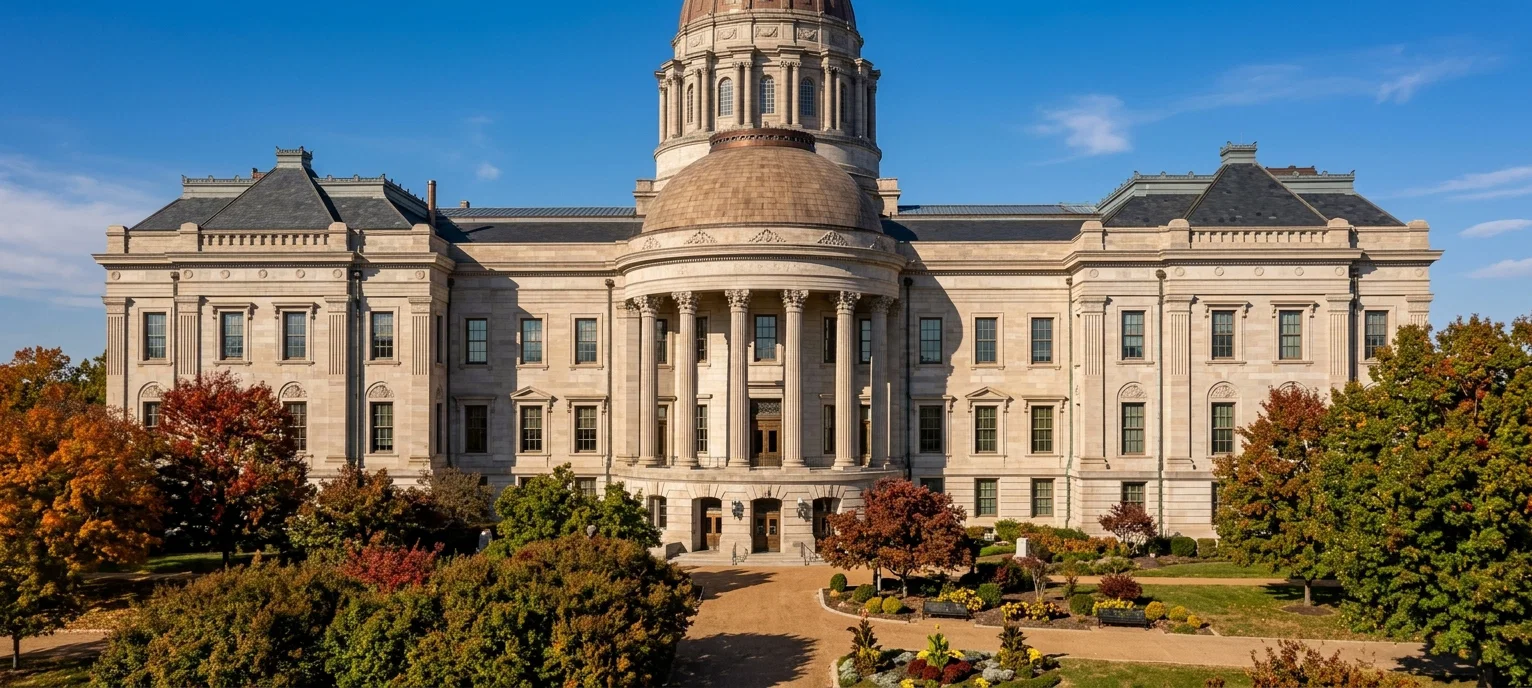
THE STATE CAPITOL BUILDING AT JEFFERSON CITY, MO.
Liberty is appreciated wherever we place it. I can not say too much for this journal. I regret exceedingly that we could not have had tens of thousands of copies of this valuable journal to circulate during this extraordinary effort to reach the public mind. Liberty is a most valuable adjunct to religious liberty work everywhere. I regard this magazine as absolutely indispensable to public work of this kind. Its circulation should be rapidly increased by a united effort upon the part of those who are standing for principle. The Religious Liberty Leaflets, Nos. 1, 2, 3, 4, 6, 8, in a State-wide tour of this kind are invaluable. This is one of the ways of leaving something behind you—a silent workman who continues the work begun. These leaflets are eagerly sought. I can scarcely supply the demand. In the face of the religio-political work of Judge Wallace and his many supporters, the people seem to be hungering for truth upon the question of proper civil government—an all-absorbing question in the State of Missouri now—and that of “inalienable rights.”
That the Lord may continue to help us is my prayer, and should be the prayer of all. We have trusted fully in his power and in his wisdom, and have realized “moment by moment” that the work belongs to him—the one who “commanded, and it stood fast.”
We are now at Glasgow, a historical spot upon the banks of the Missouri, and in the heart of the State. In the next twenty-one days we shall make a rapid trip, reaching a score of towns, and giving a lecture in each, and then the Missouri religious liberty tour will end. With sadness we shall see this work close, after a patient and persevering and continuous work of one hundred fifty days. While it will become a pleasant memory alone, who can tell of the lasting impressions, and of the good that may, in the providence of God, have been accomplished?
In a future letter I will deal with particulars of the tour, giving methods of work that may be of interest to our workers in similar lines.
JOHN S. WIGHTMAN.

Christian Liberty

Reports, Notes, and Comments Pertaining to the Current History of the Rights of Conscience
Conducted by the Religious Liberty Bureau
K. C. RUSSELL        Chairman W. A. COLCORD        Secretary

Treating With Rome

In an address delivered at the dedication of the Y. M. C. A. building at St. Paul, Minn., Sunday, September 27, Mr. Taft, the present Republican nominee for president of the United States, while speaking of the growth of the spirit of “religious tolerance,” took occasion to make the following explanation as to why, in adjusting matters in the Philippines a few years ago, the United States government had dealings with the pope of Rome, and the part he (Mr. Taft) took in the matter:—
“I have in mind an instance of the growth of this religious tolerance, which I venture to bring to your attention. In the reorganization of the government in the Philippines it became necessary to transfer the sovereignty of Spain, inextricably bound up with the Roman Catholic Church in charities, in schools, in business, and otherwise, to a subordinate government of the United States, in which, under our system, the church must be entirely separate from the state. It seemed impossible to find any one with sufficient authority in the islands to effect a proper settlement of these matters, and it was proposed to send an agent of the government to the head of the Roman Catholic Church to secure some authoritative action and agency by which the result desired could be obtained.
“The President and Mr. Root were anxious to bring this about, but they hesitated, reluctant to arouse any sectional feeling against a course which seemed to recognize the head of the Roman Catholic Church as one with whom we could have diplomatic relations, something contrary to the precedents in our government since its beginning. Accordingly, they consulted the ministers of the leading Protestant churches, explained the differences arising, and the necessity for the action proposed, and procured from them assurances that they would stand by the government in taking the very commonsense course—the American course—of dealing with the man who had the authority to act; and I was designated as the agent of the government.
“I went to Rome, and effected a general understanding as to what was to be done, and was prepared, when the apostolic delegate came to the Philippines, to close with him, after a great deal of negotiation, the contracts of the settlement, which I do not think it too much to say brought about a result which was just both to the church and the people of the islands and to the government of the United States in jurisdiction.
“I venture to think that but for the spirit of tolerance, both in the Protestant denominations and in the Roman Catholic Church, which now prevails in this country, such a result could not have been obtained. It is due to the spirit of Christian tolerance, and it is a condition in which we should all rejoice.”—Washington Post, Sept. 28, 1908.

NOTICES AND APPOINTMENTS

Notice!
As I expect to labor in Dubuque, Iowa, during the winter, if any of our brethren having friends or relatives here will kindly inform me, giving name and address, I will call on them. Address R. E. Burke, 29 Arlington St., Dubuque, Iowa.

A Visit to Newfoundland

SEPTEMBER 26 I left Washington for a visit to Newfoundland. It was thought advisable at this season of the year to make the trip by rail as far as possible, and so I went via Portland and Bangor, Maine, and St. Johns, New Brunswick, to Sidney, Nova Scotia, where I took the steamer across the gulf to Port Aux Basque, Newfoundland, and resumed my journey again by rail to St. Johns. This necessitated traveling the entire length of the island. It was a most interesting trip, as the island is interspersed with beautiful lakes and rivers. Newfoundland has been very fittingly called the “Switzerland of North America.” The chief industry of the island is fishing.
After a ride of twenty-eight hours from Port Aux Basque, I reached St. Johns, a city of forty thousand inhabitants. This being the first visit paid to the island by any of the General Conference workers, I was accorded a most hearty welcome by our church in St. Johns.
The purpose of my visit was to speak at a mass-meeting Sunday evening, October 4, in opposition to a movement of the Lord’s Day Alliance to secure by moral suasion and legislation a stricter observance of Sunday. This meeting was held in British Hall, one of the largest halls in the city. The attendance was large. It was found necessary to supply additional seats, and then people were standing in the entrance. This large attendance was most gratifying to Elder C. H. Keslake, the superintendent of the Newfoundland Mission Field, and also to the members of the St. Johns church.
The meeting opened by singing “Onward, Christian Soldiers,” which was followed by an earnest prayer from Brother Fred Johnson, a licensed minister of the Canadian Union Conference and former student of the South Lancaster Academy. After an appropriate and earnest address by the chairman of the meeting, Elder Keslake, the writer was introduced as the speaker of the evening.
After paying a fitting tribute to their country; assuring them that I was not there to antagonize individuals, but to present what we believed to be right principles, and expose wrong ones; and showing them that we were not in opposition to the Lord’s day, but in its defense, I gave a lecture on the limits of civil authority, setting forth the legitimate sphere of both the church and the state. I endeavored to apply the principles to the Newfoundland Lord’s Day Alliance movement. Scarcely had I begun my lecture before I was interrupted by members of the Lord’s Day Alliance, who were in attendance, interjecting words of disapproval. This conduct continued at intervals during the entire lecture, notwithstanding our vigorous protests. It was evident, however, that, with but few exceptions, the audience was in sympathy with us, for the applause was frequent and enthusiastic throughout the lecture whenever points were made against the Lord’s Day Alliance movement.
It was feared at times that the meeting would be disturbed by a violent mob, as the course pursued by the members of the Lord’s Day Alliance who were present became exasperating to the audience. Quite a number of women left the meeting when the outbreaks were the most violent. We feel sure that the angels of God were there to hold in check the efforts to break up the meeting, and that this was one of the instances where the Lord made the wrath of men to praise him, and the remainder of their wrath he restrained; for it was a most practical demonstration of the wicked spirit that lies back of every effort to secure Sunday legislation by civil enactment. Nothing could have emphasized the principles we presented to the people, at our lecture, more than the unseemly conduct displayed that night by the representatives of the Lord’s Day Alliance. The meeting is being freely discussed by the citizens of St. Johns on account of these things, and there seems to be a general disapproval of the unchristian treatment accorded to us.
In order that the readers may better understand why such a violent spirit was exhibited at this meeting, I would say that for the past year there has been carried on a discussion on the Sabbath question and religious liberty, through the columns of the Plaindealer, between Elder C. H. Keslake and the champions of the Lord’s Day Alliance, and a week or two before this mass-meeting, there was a mass-meeting called by the friends of Sunday legislation, at which time the Newfoundland Lord’s Day Alliance expounded their side of the question. From this, it will be observed that our meeting was a climax to the controversy that has been carried on through the public press of Newfoundland on the Sabbath question and religious liberty. The night following the mass-meeting, we held a service in our church building in St. Johns.
My visit to Newfoundland was a most pleasant, and, I trust, profitable one. The work in this island is prospering under the direction of Elder Keslake, notwithstanding the difficulties which exist in the work of evangelizing the inhabitants.
K. C. R.

Religious Liberty Notes

REFERRING to the petition work, a sister in the State of New York says: “I particularly delight in this work, as it gives me an opportunity to reach those whom it would be very hard otherwise to approach.”
A brother writing from Santa Rosa, Cal., referring to the petition campaign, says, “The members of our church were quite enthusiastic over the matter to-day,” and asked that ten more petition blanks be sent them.

Notice!

THE addresses of the following-named persons are desired by the Seventh-day Adventist church of Sioux City, Iowa: Mrs. Jessie Morgan, Mrs. C. H. Flick, Mrs. Mary Saulsberry, and James Wicks. All other absent members will please report inside of three months. E. M. FREDRICKSON, Clerk.

Notice!

MRS. WM. J. KEELE, of Cedar Grove, Tenn., requests clothing for the needy, sent to Huntingdon, Tenn., freight prepaid. She can use several barrels in her work at that place. Children's clothing, ages from one to fifteen years, both sexes, is most acceptable. She wishes here also to thank all who sent clothing to her last winter.

Notice!

To those who wish to homestead in northeastern Wyoming. We live about twenty miles from the Black Hills proper. The government gives one hundred sixty acres for about $35 and residence of five years. Climate is delightful; altitude about 4,000 feet; plenty of timber for fuel and building; lumber is cheap. We are twenty miles from Sundance, the county-seat, where the United States land office is located. Good stock country; poultry, eggs, and butter bring good price. Plenty of water. Church-school privileges. For any further information address, with stamp, C. W. M. Read, Sheldon, Crook Co., Wyo.

Revisions for the 1909 Year-Book

REQUESTS for revision of directory matter for the 1909 Year-Book were recently sent to all the secretaries of conferences and managers of institutions, asking that revised directories be sent so as to reach the General Conference Office, November 1-10. Will those who received these requests please send the matter forward without delay? All the revisions should be in hand at the time specified, in order that the publication may be issued before much of the matter becomes obsolete, and needs a second or third revision. Delinquent returns will therefore take their chance of not being published.
H. E. ROGERS, Statistical Secretary. Takoma Park, D. C.

Thanksgiving Number

THE November issue of the Signs of the Times monthly special will be a Thanksgiving number, and it will present a veritable feast of good things.
The editor will give a brief history of Thanksgiving days from the time when the Feast of Tabernacles was instituted among the children of Israel to the present day.
The Home Department will contain an interesting Thanksgiving story, entitled, “Mrs. Staples’ Silk Dress.” A vegetarian Thanksgiving menu is also given in the Home Department. Mr. E. G. Fulton, who furnishes the menu and the recipes, is a master-hand in the preparation of wholesome and attractive dishes from the best things Mother Earth produces,—grains, nuts, vegetables, and fruits.

Obituaries

KINGSBURY.—Died at Portland, Ore., Oct. 7, 1908, Jesse Kingsbury, aged seventy-one years. Brother Kingsbury embraced present truth several years ago. He leaves a wife, three sons, and one daughter to mourn. Funeral sermon by the writer. DANIEL NETTLETON.
HALL.—Died at his home in Hildebran, N. C., of a complication of diseases, Brother Augustus E. Hall, aged 64 years, 8 months, and 8 days. He was for many years a member of the Seventh-day Adventist church at Mansville, N. Y., but for the past seven years has lived in North Carolina. He died in the faith, and we trust will have the overcomer's reward. A wife and daughter are left to mourn. The funeral service was conducted by the writer. ALBERT CAREY.
MOREY.—Edsell, infant son of Brother and Sister E. A. Morey, was born June 25, 1908, and died Sept. 8, 1908, at Wichita, Kan., aged two months and thirteen days. We laid him away in the beautiful Wichita Cemetery to await the coming of the Life-giver to bring him from the land of the enemy. Words of comfort were spoken by the writer, from Jer. 31:15, 16. H. E. KIRK.
CARMAN.—Died of tuberculosis at Riversdale, Jamaica, B. W. I., June 18, 1908, Lector Ethel Carman, aged twenty-eight years. She came with E. C. and Mrs. Cushman to Jamaica, hoping to regain her health, but was disappointed. Her pleasant smile and cheerful words blessed all with whom she came in contact. She longed to live to see the Saviour come, but since that was denied her, she found comfort in the thought of being raised with those who die under the third angel's message. The funeral service was conducted by the writer. She sleeps under the logwood-trees on the school farm. C. B. HUGHES.
WHITMAN.—Died at her home in South Woodstock, Maine, Sept. 7, 1908, of Bright's disease, Sister Mary S. Whitman, aged 69 years, 5 months, and 18 days. Sister Whitman was born in Poland, Maine. In 1856 she married Geo. Whitman, of South Woodstock, where the greater part of her married life has been spent. Twenty-seven years ago the light of present truth came to her, since which time she, with her husband, has been a firm believer in, and a staunch advocate of, the truths of the third angel's message. Firm and unyielding in her devotion to the cause of God, constant and faithful in all her relations in life, and beloved by all who knew her, she peacefully rests under the benediction of Rev. 14:13, awaiting the Life-giver's call to life and immortality. She leaves a husband, three daughters, three brothers, and numerous other relatives and friends to mourn. Words of comfort were spoken by the writer, from 1 Thess. 4:13-18. H. C. GILES.
HODGES.—Died at College View, Neb., Sabbath, July 4, from a second stroke of paralysis, Sister Abbie Hodges, wife of Noah Hodges. Her maiden name was Abbie B. Huntley. She was born at Upper Sandusky, Ohio, Oct. 26, 1843. Nov. 20, 1867, she was married to Noah Hodges, and went to his home at Sandyville, Iowa, where they lived until they moved to College View in March, 1891. Her Christian experience began in 1859, when, at sixteen years of age, she embraced the views of Seventh-day Adventists under the labors of Elder M. E. Cornell. From that time to the day of her death her faith never wavered for a moment in loyalty to the Saviour, or in devotion to this cause. In all religious and church work she was intensely active until failing strength made it impossible to carry so many of these burdens as formerly. In Iowa she was interested in tract society work, being district secretary for years. When the family moved to College View, she became a charter member of the College View church, organized in 1891, and was a deaconess in this church until advancing years made it necessary for the duties of this office to be laid aside. Her religion was manifested not simply in official acts and attendance upon church services, but in quiet, kindly ministration to the wants of others. She was, in the language of the Scriptures, “given to hospitality,” and she delighted to entertain the ministers and the brethren and sisters who came to attend meetings at their home in the early days. Sometimes there were as many as forty to care for; but she never complained, no matter how large the company. On the contrary she was always happy in this work. She had a heart full of love for her many friends, and was especially beloved by all of them. Many a weary pilgrim, tired and worn by labors in the gospel field, has found a haven of rest in her home, and has been nursed back to vigor by her gentle hands. The text for the funeral service was Job 5:26. C. C. LEWIS.
Continue reading: Business Notices