IS THE GERMAN EMPEROR COURTING THE FAVOR OF THE ROMAN PONTIFF?
By Chas. T. Everson
WITHIN less than a week the two great Protestant monarchs of Europe have visited the pope. The visit of Edward VII., king of the British nation, we referred to quite fully in our last article, and desire at present to notice some features in connection with the visit of William II., Emperor of Germany, to the Holy See.
We recall from the article dealing with the visit of the English sovereign that King Edward went in quite a modest way to see the pope. But the visit of the German sovereign was in marked contrast to the visit of Edward VII. The Emperor of Germany, for the third time, has now presented himself at the papal court. On his former visits he has always employed the carriage of the German Embassy at Rome in going to and in returning from the Vatican. On the occasion of his last visit, however, he went to the pontifical court with such pomp and ostentation that it has completely eclipsed his former visits.
In fact, when the German monarch left Berlin to come to Rome to become the guest of Victor Emmanuel III., King of Italy, he took with him the imperial carriage, his own livery, body-guard, and a large retinue. His own horse he took to ride on the occasion of the great military display given in his honor by the King of Italy, but the imperial carriage and livery he employed solely on the occasion of his visit to the pope.
On Sunday morning of May 3 the German sovereign attended divine worship in the private chapel at the German Embassy. It was a service conducted according to the usual German Protestant rites, with a sermon delivered by Pastor Peters, the preacher of the Embassy. From the Embassy the royal party went to the German Legation to the Vatican, where the emperor gave an elaborate luncheon to a small company of invited guests, prior to his visit to the pope. On this occasion Cardinal Rampolla sat at the emperor's right and Cardinal Agliardi was at his left, and directly in front of his majesty and between the two German princes, sat the German minister to the Vatican. At the right of the crown prince was Cardinal Gotti. We notice that, altho the guests were few, consisting mainly of the emperor's suite, yet among them were three of the most powerful cardinals of the Catholic Church.
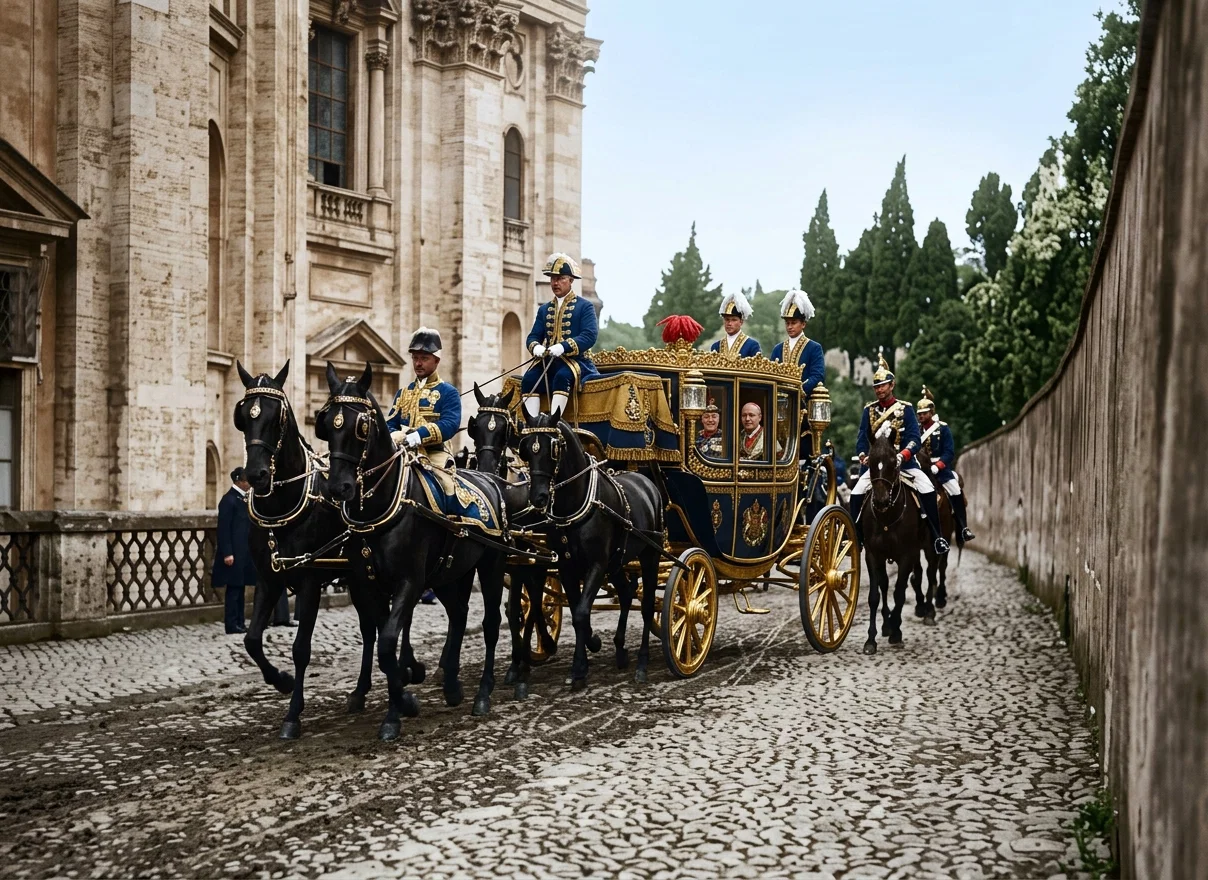
At the conclusion of the festivities the first person to leave the Legation was Cardinal Rampolla, who went directly to the Vatican and repaired to the private apartments of the pope. Here he held a brief interview with the Roman pontiff. Shortly after the cardinal's departure, the royal party left the Legation for the Vatican. It was preceded by a company of carabineers, and the men in charge of the German imperial stables, who were dressed in magnificent attire. Four black horses, upon two of which were mounted lackeys, drew the imperial carriage, which was luxuriously upholstered in white. Following the carriage came the emperor's own body-guard, brought with him from Germany, especially for this occasion. They were dressed in very showy uniform, with silver helmets upon which were mounted eagles of the same metal, and brilliant breastplates covered their waistcoats of white.
In the carriage with the emperor was the crown prince, while following came fourteen carriages containing Prince Eitel, General Wandersee, and the retinue of his majesty.
German Emperor Going to the Vatican.
At the Vatican also the most extravagant preparations were made for the reception of the sovereign of Germany. In fact, honors were accorded this Protestant monarch that are denied even to Catholic kings. As he entered the Vatican the magnificent Swiss and Palatine guards and the dignitaries attired in gorgeous apparel appeared to their best advantage, and the general atmosphere of the surroundings was one calculated to impress the emperor and the princes with the greatness of the pontifical court. As on the occasion of the visit of King Edward, the throne room was turned into an ante-chamber and the interview was held in a small adjoining room. Leaving the princes with the German minister, alone the emperor entered the audience-chamber, in the middle of which he met the pope, stooped with age and leaning on his cane. His majesty bowed twice while he took the outstretched hand of the aged pontiff, who wore the rich, traditional, white robe, but no ermine cape, while around his neck was a necklace of gold, to which was attached a cross of the same material. The pope immediately opened the conversation, inquiring about the condition of Victoria Augusta, the German queen, speaking sympathetically concerning her recent accident. The queen is a very strong Protestant, and, consequently the pope wanted to make her feel that he was very friendly toward her, for it is said that one reason besides her recent accident, that deterred her from coming to Rome, was her aversion to going to the Vatican. The pope also expressed himself as much pleased with the progress of Catholicism in Germany. The interview of the emperor and the pope lasted twenty-five minutes, and at its conclusion the emperor introduced the princes to the pontiff, who asked the young men how they were impressed with Rome, “the center of Catholicism and antiquity.” The crown-prince responded that he was glad of the opportunity of coming to Rome, and thereby satisfying a long-felt desire. The pope then presented the emperor and the princes with three magnificent and costly mosaics, while the emperor in turn gave to the pontiff two beautiful photographs of the cathedral at Metz.
The royal party then repaired to the third floor, where are the apartments of Cardinal Rampolla. The German sovereign and the princes entered the throne room where anciently the cardinals received the visit of the pope, and there held a brief interview with Cardinal Rampolla, the papal Secretary of State. That the emperor has displayed such friendliness for Cardinal Rampolla is quite significant, as he is the individual that deals directly with the sovereigns in presenting the claims of the Catholic Church, when any difficulty arises.
The entire visit at the Vatican occupied an hour and ten minutes. And that it was regarded by the pope with a high degree of satisfaction is evinced by the fact that he went to the window to see the grand procession as it was leaving the Vatican. And, furthermore, wherever the German sovereign went thereafter in Rome, from the windows of the cloisters and convents and from the street corners, the nuns, monks, and priests, waved their handkerchiefs and saluted his majesty with great applause, and the Catholics in general expressed their admiration of the emperor's new attitude toward the Vatican in no uncertain terms.
On the day following this visit to the pope the emperor spent one whole day visiting Montecassino, the famous convent, founded by St. Benedict. He donated to the library twenty volumes of ancient manuscript and contributed $2,200 toward beautifying and repairing the crypt of the monastery.
It is not an unusual occurrence for monarchs to visit and confer favors upon Montecassino, for, from the time of Totela, the Gothic conqueror of Rome, in the sixth century, many powerful monarchs have presented themselves at the St. Benedictine shrine. But at a time when France is driving out from its country the Benedictine and other orders of the Catholic Church, it seems quite significant that the German monarch should be embellishing the tomb of the founder of this powerful order.
That his majesty is seeking the influence of the Vatican is certainly believed at the pontifical court; and many go so far as to affirm that he is taking advantage of the present Catholic disturbances in France to ingratiate himself into the good-will of the Roman pontiff. And that he is, in a large measure, succeeding in obtaining the birthright of “the first daughter of the church” is quite evident. For, on the day following the emperor's visit, the pope emphatically declared that now, under no consideration, would he receive the President of the French Republic if he should come to Rome. The emperor wishes to bring to bear upon the strong Catholic wing of the Reichstag the influence of the Vatican in his favor, for then he can readily dispatch some measures that have been giving him no end of trouble. But in Germany the entire Protestant press has come out in no uncertain terms in denouncing the emperor for the ostentatious way in which he has accentuated this visit to the pope. They are not so much opposed to the fact that he went, except for the ostentatious manner in which he paid this visit which is susceptible of an interpretation that is not at all pleasing to the Protestants of Germany.
The Italian people also regard the emperor's recent visit with no small degree of dissatisfaction; for the German monarch, while a guest at the palace of their king, went to visit the pope, the avowed enemy of the Italian monarch with a pomp and ostentation reserved solely for this papal visit.
The relation that exists between the Vatican and the Italian Government can be well understood from the following circumstance. When Humbert succeeded to the throne of Italy he made a visit to the king of Austria that has never been returned, because the Austrian monarch is a staunch Catholic. He will not visit Rome, for then he would have to stop at the palace of the King of Italy; and this he does not wish to do, because of the enmity between the king and the pope. Therefore when the German sovereign went from the palace to the Vatican with such ceremony it would seem that he was more anxious about gaining favor at the Vatican than to please his hospitable host at the Quirinal palace.
And as we view these events in the light of divine prophecy, we can see that the beast shall again, for a short time, make his power to be felt. The countries where his great achievements have been wrought in the past are weak and drifting away from firm alliance, and, therefore, his efforts in these days, among the great Protestant nations like Germany, the United States, and England. That he is succeeding in these directions is plain to all who are alive to the things that are occurring around us. It ought to tell us in unmistakable terms that the coming of the Lord hasteneth greatly and what we do we must do quickly.
CHAS. T. EVERSON.
79 Via Napoli, Rome, Italy.
Increase of Insanity in Scotland.
The Medical Record of June 6 thus begins an editorial article:—
The annual report of the British Commissioners in Lunacy shows that the number of insane in Scotland is increasing almost by leaps and bounds. In earlier years the recurrent increase in annual percentages might be explained as the natural result of the efforts put forth to bring the cases of existing insanity under official cognizance. Now, however, this excuse will not stand. Lunacy is increasing at a rapid rate, and the fact is obvious that lunatics are being manufactured.9
Among the causes given are strong drink, the constant drain of the healthiest of the people to other parts, strong tea, and dyspepsia. But these do not satisfy the doctors.
THE DRINK CURSE.
The Medical Record, the foremost medical journal in this country, a journal of by no means prohibition or teetotal proclivities, notes with alarm the growing seriousness of the drink evil. In its issue of June 6 its leading editorial is upon this subject, and its relation to insanity. The general situation it outlines as follows:—
Almost every country of the world is taking up the drink question. The authorities in some lands have become seriously alarmed at the inroads which the unbridled consumption of alcohol has made and is making into the prosperity, health, and morals of their people.
In France the unrestricted sale of alcoholic beverages has already brought forth dire results. Prominent French physicians have begun a crusade against the drink habit. In Russia the excessive drinking among the peasantry has impelled the government to step in and take control of the sale of spirituous liquors. Altho in America drinking has never been so common nor carried to such an extent as in Europe, yet even here statistics tell us that there has been a decided increase in the consumption of alcohol. Great Britain has always had an unpleasant reputation as a country whose people were addicted to strong drink on a large scale, and it still, in this respect, retains its position in the front rank. The situation, too, is at the present time aggravated, in that adulteration of beverages containing spirits is the custom everywhere. Too much of the genuine article is bad enough, but when, in place of pure or comparatively pure spirituous beverages, vile concoctions are substituted, the evil is intensified in a corresponding degree.
And then a London authority (Dr. Robert Jones, medical superintendent of Claybury Lunatic Asylum) is quoted as showing that out of the 50,000 certified male lunatics in England and Wales alone 10,900 became insane through strong drink; and of the 60,000 female lunatics 5,700 are insane from the same cause. In the asylum over which Dr. Jones presides, in a period of nine years 3,773 male patients have been admitted, of which 500 were insane from drink, and 4,720 females, of which 594 were insane from alcoholism. For the whole of London during this same period there were received into asylums 2,662 men and 1,677 women “who owed their insanity to alcoholic intemperance.” The editorial thus closes:—
The relation between drink and insanity is far more intimate than it was at one time believed to be. Perhaps the assertion that drink is the most potent cause of mental disorders would now pass without cavil. Certainly the brain is the organ which is most disastrously affected by excessive indulgence in alcohol, for altho other organs may be seriously injured, the outcome of the habit is more frequently mental dissolution.
What a splendid argument is this for prohibition and teetotalism, tho not so intended. Alcohol is never needed as a beverage or a medicine, as thousands of instances—living examples—constantly demonstrate.
Anti-Secrecy
From a circular letter of the National Christian Association we take the following item of interest:—
There was held recently in Chicago some dozen meetings in the different divisions of the city, at which the theme was, “Secret Associations.” The occasion was the anniversary of the National Christian Association opposed to Secret Societies. Nearly two hundred and fifty of the pastors of Chicago are known opponents of lodges. They are members of various denominations, including the United Presbyterians, Free Methodists, Presbyterians, Baptists, Reform Presbyterians, Methodist Episcopal, Lutheran, Congregationalists, Evangelical Association, Swedish Mission Covenant, Holiness, Seventh-day Baptists, Christadelphians, Mennonites, German Baptist Brethren, Holland Reform, and Friends.
To this list, indicating the denominational affiliation of so many influential persons opposed to secret societyism, we are pleased to add that the Seventh-day Adventist denomination as a body regards the whole secret society principle as unscriptural, and therefore unchristian.
The Mad Mullah
The Mad Mullah of Somaliland, Haji Mohammed Ben Abdullah, is now marching with a force of 6,000 mounted men to attack the British lines of communication. He intends to cut off the British who are at Berbera, compelling them to retreat, or surrounding and capturing them. The British are strengthening their position as far as possible.
Strikes and Lockouts
Three thousand lumber men will be thrown out of employment in the vicinity of Puget Sound during the month of July, as the result of a decision of the Puget Sound Loggers’ Association to reduce the output in order to maintain the price. . . . . The strike of hotel laborers in Chicago is still on, tho the hotels are running in almost their usual capacity. It is expected that this strike will be a failure, owing to the fact that other unions have not supported the strikers in their fight against the hotels. . . . . The strike at Morenci, Arizona, is at an end, but only a portion of the miners have returned to work. It is stated that the Italians will not be employed again. . . . . The strike at Randsburg, Cal., has practically killed the town for the time being. Merchants are giving no credit, and business is at a standstill. Some of the mining companies have sent their mules to pasture, and many of the men are leaving the place. . . . . There is a strike of freight handlers at Kansas City, Mo., on the St. Louis and San Francisco Railway, the Burlington and Rock Island, and the Santa Fe. The demands of the men have been refused, and negroes are being employed to take their places. . . . . The strike of laborers in the building trades at Omaha has come to an end, and building operations, which had been delayed for the past four months, have been resumed, the men returning to work at the former scale of wages. . . . . There is a threatened strike of miners in the mines near Mojave, in sympathy with the strike at Randsburg. . . . . The strike in the cotton mills of Lowell, Mass., has been officially declared at an end. The strikers have lost, and only a portion of them will find employment at their old places. The amount lost to the strikers in wages is stated to be $1,300,000. . . . . The strike of street-car men in Dubuque, Iowa, is still on, and the company is running its cars under the protection of four companies of militia.
The Servian Matter
Prince Peter Karageorgevitch has accepted the call to the throne of Servia, and has proceeded to the capital, escorted by a committee from the Servian Parliament. After the commission of the crime by which the way was opened for Prince Peter to take the throne of Servia, he expressed a determination to punish those who were implicated in the murder of the king and queen; but, since his selection by the Servian Parliament, the new king has weakened in his expressed purpose. The government is really in the hands of the military, and as the people have taken sides with the regicides, the king would find it impossible to retain his position if he attempted to punish those who made it possible for him to be king. On the other hand, the nations of the world are urging upon the king the necessity of punishing the guilty parties. He is thus between two fires. Only two nations have recognized the new government of Servia; namely, Austria and Russia; and both these nations have advised punishment of the murderers as the only proper course. France, Germany, England, and the United States are waiting to see what the new king will do in the matter, before recognizing his government. There has been some attempt in Servia to turn the monarchy into a republic; but the leaders of the army have control of the situation, and no republican propaganda is allowed. Further details of the assassination reveal an almost unexampled cruelty on the part of the murderers. It seems that the first reports were true—that the bodies of the king and queen were thrown out of an upper window to the ground after the assassins had mutilated the bodies.
A Terrible Visitation.
The town of Heppner, in western Oregon, was almost completely destroyed in the flood following a cloud-burst which occurred on June 14, bare mention of which was made last week. The flood came down the valley without warning, and the victims were caught, many of them while sitting at their evening meal. Everything in the path of the flood was reduced to kindling wood, and many of the buildings in the edge of the flood were wrecked where they stood. Human beings, animals, and the wreckage of homes and business houses were piled in a terrible mass along the course of the stream, and for days large bands of workmen have been busy in recovering the bodies of the victims. The first estimate placed the number of dead at 300, but this is evidently in excess of the real number. Latest reports state that 177 bodies have been recovered, and 35 are still missing. The most careful estimates now place the number of dead at 200. Relief funds were started at once, and thousands of dollars' worth of provisions and clothing, and several thousand dollars in money have been sent to the sufferers.
The Floods.
The governor of Kansas reports that the situation in his State as a result of the floods is appalling; that more than 30,000 of the inhabitants of that State are homeless; that a fertile valley 200 miles long and five miles wide has been converted into a watery waste; and he asks the charitably inclined everywhere to contribute to the necessities of the Kansans. The Rio Grande has overflowed its banks in many places, Los Cerrillos is entirely submerged, Alameda also, whose inhabitants have fled, and Albuquerque is in danger of inundation. The tracks of the Santa Fe have been washed out, leaving Albuquerque cut off from the East. The Fraser River, in British Columbia, is over its banks and is flooding the country, and the people are moving their household goods to higher ground. The waters at Kansas City and St. Louis have receded, leaving mud, debris, and ruined buildings behind.
In the Orient
In the Orient.— In spite of the protests of Korea, Russia continues to hold the position seized on the Korean side of the Yalu River at its mouth, and troops and artillery are said to be moving toward the Korean frontier. Roads fit for the use of artillery are being constructed near the frontier, and a railway is being surveyed there by the Russians. The Japanese press is urging the government to recognize the seriousness of the situation, which probably means Russian possession of the whole Korean peninsula, and which would put Russia in a position to menace Japan in a serious manner. The North China Daily Mail says: “How can Japan help seeing that every day’s delay is being used by Russia to pile up preparations for eventual war and to consolidate her hold on Manchuria?” The Japanese are anxiously watching for Russia’s next move. The Japanese minister states that the new treaty between China and Russia will probably be signed privately, and that it is imperative that Japan should protest and assist China in resisting the Russian demands. The Russians are also manifesting considerable activity in Thibet. A Russian explorer in disguise has just returned from a year’s residence in the capital, and has given his report to the Imperial Geographical Society. A party of Russian surveyors are now carrying on surveying operations in Thibet. In the recent Russian naval maneuvers in Asiatic waters, one of the fleets was designated as the Japanese fleet, which was probably a hint to Japan.
The Postal Department Investigation.
The continued probing into the conduct of affairs of the Postal Department reveals additional dealings of a corrupt nature on the part of some of the officials in that department. The President has indicated his determination to go deeper into the matter; but fraudulent transactions made previous to his administration will not be taken into account in the indictments which will be brought. The superintendent of the money-order system has been removed from his position, owing to improper actions in connection with a contract for the printing of money-order blanks. Illegal acts are charged against the superintendent of the free-delivery system at the capital. The money-order office and the dead-letter office are both to undergo an investigation, tho there are no specific charges. Investigations are now going on in the New York Post-office, and it is expected that some disclosures of fraudulent transactions will be made there as well as at Washington.
Casualties
Casualties.—Six men were blown to pieces by an explosion of lyddite at the lyddite factory of the Woolwich Arsenal, England, on June 18, and the factory was completely wrecked........ Eleven sailors perished in the wreck of the Belgian steamer Rubens in the North Sea on June 10........ Six men were killed and a score or more injured by the explosion of 3,000 pounds of dynamite near Senecaville, Ohio, on June 20. The dynamite was exploded by lightning........ One hundred and fifty Chinese lost their lives in the burning of a temple recently at Pingtu, China. The worshipers were burning a quantity of incense paper, which set fire to the building, blocking the exit........ Ten persons were killed and a number injured in a railway collision at Raymond, Iowa, on June 19........ Two persons were killed and twenty-eight shockingly injured in a wreck on the North Shore Railroad near Point Reyes, Cal., on June 21, while returning from a funeral on a special train.
Affairs in Turkey
The inhabitants of Kurdistan are reported to be taking up arms, and the American, British, and German ambassadors are making protests against the action of the Kurds toward the Armenians. Armenian teachers are being arrested, and the houses of the Armenians are being searched by the Kurds, which is causing great fear and uneasiness. In Macedonia the Turkish regulars and Bashi Bazouks are said to be pillaging in all directions and mistreating the inhabitants. Hundreds of Bulgarian refugees are leaving that section of the country, bringing with them what they can transport, and these refugees say that the population of whole villages farther from the frontier are following their example, leaving their homes and fleeing for their lives.
Affairs in China
News has been received in Peking that the famine in the province of Kwangsi is growing worse. The starving population is estimated at 200,000, and, daily, numbers of deaths occur from starvation. A Japanese report states that cannibalism is being practised and human flesh is publicly offered for sale. The famine is contributing to the seriousness of the rebellion. The Kwangsi and Yunnan rebels have joined forces, and they are said to number 50,000, most of whom are armed with modern weapons. The French consul is reported to have notified the Chinese Government that unless the insurrection in Kwangsi is suppressed, French troops will be sent across the border to quell the disturbance.
Duncan Creek Gold Fields
The governor of Yukon Territory reports that the Duncan Creek country bids fair to surpass the famous Klondike diggings in richness. He reports that large amounts of gold are being taken out on all the claims in that district.
U.S. Railroad Earnings and Wages in 1902
The gross earnings of the railroads of the United States for the year 1902 amounted to $1,588,526,037. Over a million persons were employed in conducting this vast business, and their wages amounted to $610,713,000.
THE HIDDEN WORLD.
By E. M. Patton
Part 1.
“There is no use in trying, Aunt Mary, at least for me,” said young Mrs. Lee, despondently as, supper work over, and baby tucked into bed, she had at last settled wearily into a rocking-chair.
“No use in trying what? my dear,” gently inquired Aunt Mary.
“Why, trying to study the Bible and think about it while I am at work during the day. You know the new minister said last Sabbath that every one might become a fair Bible student by just meditating upon a few texts every day while at work. I have always felt a great desire to know more about the Bible. But I never could get the time for study through the day, and when night comes on I am always too tired to do any thing more than read, or a little light sewing, or something of that sort.
“It is easy enough for a minister to talk,” continued Mrs. Lee, after a few moments’ silence, “or any one else, for that matter, who hasn’t had experience in the particular thing he is talking about. I am not saying that the plan might not be a good one for people engaged in many kinds of work; but for a housekeeper, who has all of the hundred and one little things to attend to every day, it is quite out of the question. In fact, I don’t believe it is possible.”
“But I do,” Aunt Mary quietly broke in. “The good Word has been made so plain that even he who has to run may read and understand. And there are but very few housekeepers so driven but that they may find a few moments’ time for meditation and rest—if they only think so. Have you never tried taking one little verse in the morning?”
“O yes, often, Aunt Mary, and that is one reason I know what I am talking about. Now this morning, for instance, I opened my Bible to one of the psalms, and, as I was combing my hair, I repeated a verse until I thought I had it well fixed in mind; but as a matter of fact I never even thought of the Bible again, let alone recalling that particular text.”
“I have often thought,” she continued, rocking slowly in the deepening twilight, “of a remark I once heard a poor mother make, that if her being saved depended upon the amount of Bible study she was able to do, she would have to go unsaved. I thought it a very dreadful remark at the time, but I begin to appreciate now how she felt.”
Just here they were interrupted by a ring of the door-bell. A neighbor called to spend the evening, and all thoughts of the conversation passed from Mrs. Lee’s mind.
Not so Aunt Mary, however. The next morning she happened into the kitchen just as Mrs. Lee was cleaning the lamps.
“I see you are free from one habit which I found very annoying in my early housekeeping days,” said Aunt Mary, as she sat down by the table and began to polish the lamp chimneys for her niece.
“What is that?” inquired Mrs. Lee, looking a little curious.
“Why leaving my lamps until the last thing in the day, or not fixing them at all until I wanted to light one. I was extremely particular about the rest of my housework, too, and I used to try hard to reform on this point. I would care for them faithfully for a few days, then some morning in the rush of other work I would forget them, and that night was sure to be the time that John would be the first to light the lamps, and perhaps find none of them filled!” And Aunt Mary laughed heartily at the thought of her early experiences.
“Well, how did you succeed?” questioned Mrs. Lee, for she knew of no one with a better reputation for careful and methodical housekeeping than Aunt Mary Burnham.
“When I began searching the Word for texts to help me in my housework,” she replied, “I took that beautiful parable of the Ten Virgins first, probably because it was on the subject of lamps and quite familiar. As I thought more about it, while caring for my lamps, the real lesson itself began to come home to my heart as never before—that of being ready, my own life lamp trimmed and brightly burning for the Master. My occasional forgetfulness in caring for my lamps until the last hour seemed an indication of my Christian experience. I was no better than one of the foolish virgins. When I determined, with God’s help, to be among the wise ones, it was the means of my forming the habit of always caring for my lamps early in the day. There was such peace and satisfaction, too, in knowing that nothing could absorb my attention through the day to the exclusion of making that preparation, for I was ready.”
“There are many other precious lessons in the Word which came to me in connection with this special work, the Word itself is a Lamp; and ‘I am the Light of the world.’ It only took a moment—for I learned to keep a Bible on the kitchen table—to look up a text for that time, and it wasn’t necessary always to look up a new one every morning. One verse, and sometimes just a thought in a verse, would last for a number of mornings or until the lesson became a part of my life experience.”
This part of the morning work over, Aunt Mary went to take dinner with a friend. But the quiet little talk stayed with Mrs. Lee, and there was born in her heart a new longing to have her life filled with an experience in these holy things. The more she thought about it, the more was unfolded to her understanding some of the beauties of the lesson contained in that wonderful parable. Other texts bearing on the same subject were brought to her mind—texts which she had heard or read at other times, but which had never seemed to make any impression on her mind. But now they came to her with a beauty and significance never appreciated before.
Perhaps the strangest part of all was that Mrs. Lee suddenly realized that her work was moving along on oiled wheels, compared with the way it sometimes seemed to drag. Baby had been quiet and contented with his playthings, fretting only when it came time for his morning nap. She was accomplishing more than she had thought possible for the forenoon, and with so little of the usual fatigue, too. Instead of being distracted and making blunders in her work, as she had always argued that she would if she did not keep her mind directly on her work, her thoughts seemed unusually clear. “Of course,” came a little whisper to her mind, “it might not always work so well every day.” She remembered, as the little seed of doubt began to take root, that her days had not always been alike anyway, some were always easier and more quiet than others, and this might have been only one of the quiet days, after all.
Probably no seed, not excepting the famous mustard of Bible account, is capable of such tremendous growth in a few moments of time as one little doubt that is cherished long enough for it to take root. In a few minutes all thought of the morning lesson was crowded from her mind, and she suddenly discovered that unless she hastened things greatly her dinner was liable to be late. This simply could not be, for they lived some distance from the school which their two older children attended, and there was just time for them to come home for a warm dinner and go back again, if everything could be on the table, ready for them when they came.
To make matters more perplexing, she found that she was out of the very thing she had planned as a basis for the children’s dinner, and stepping to her slate, which hung by the pantry door, she felt provoked when she saw that she had already ordered it by her husband several days before, and that he must have forgotten it. At the same time, baby woke up from his long nap, and as if to make up for the good behavior of the morning, began to fret and worry for his dinner. E. M. PATTON.
(Concluded next week.)
“WHY BEHOLDEST THOU?”
By T. E. Bowen
By beholding we become changed. A person usually is what he contemplates continually—with what he chooses to be associated and behold. That man who delights in the scenes of the barroom, who finds enjoyment in listening to the vulgar jests and stories there told, seldom rises above his surroundings. He soon becomes one of the rest, and is lost in the crowd thronging the broad road. Why does he choose to behold such scenes?—He loves to do so.
Some people who would consider it a disgrace to be seen in a barroom, who would take no delight in beholding scenes of this character, delight in beholding continually the mistakes, or what to their perverted visions are the mistakes and imperfections of others. In this class may be found many whose names are attached to church registers. They take delight in devouring people. Not exactly South Sea cannibalism, but so much like it God calls it “bite and devour one another.” In plain English such acts might be called “cannibalism.” Usually the flesh of other people’s backs has the best flavor to this class, as they almost invariably attack their victim in the back.
Before this disease reaches these last stages, it usually begins in a small affection in the eyes. With great care small objects are discovered in other people’s eyes. Somehow with peculiar cleverness great skill is attained by these people; for at quite a distance they can discover in another’s eye so small an object that in Bible lore it is called a “mote.” But why do they see them?—It comes from long practise in looking for them? And the very fact they can so accurately detect them, at once pronounces them experts themselves in their line. Were they free from this eye affection themselves, nothing would be heard from them, at least in the way they deal with the disease.
Why behold? There are many beautiful things to look at. There are many noble qualities in our friends to admire. Why not put in our time looking at these? Yes, unfortunate friend, you are self-condemned, by your conscience, your better sense, and your compassionate Redeemer, for beholding these things. “But are they not plain to be seen?”—Yes, yet you do not have to behold them.
Here is our “beholding” object. “And looking upon Jesus as He walked, he [John] saith, Behold the Lamb of God!” The pure eye never will tire beholding Him. In Him is the perfection of all beauty. In Him centers every perfect object and trait of character, everything in our world that is lovely. From Him all that is good in us, in our neighbors, and friends, came. Why not behold these things? Why honor the devil by beholding his blemishes upon the works of God? This pleases his Satanic majesty well.
Christians, shall we not with Job make a covenant with our eyes not to behold these things? At our table one morning some conversation passed between older members of the family regarding speaking evil of others. The mother checked the father from a remark about to be made by touching his toe, unobserved. He changed the remark so markedly that the little six-year-old girl came forth with the11pertinent wish that she had some “hooks and eyes for her lips.”
It might not be out of place to have a set also for the eyes. Surely by beholding we become changed, and by our words we shall either be justified or condemned. If, using our lips and words, we condemn, we shall be condemned; but if we justify and forgive, we shall be freely justified and forgiven. What are you beholding? T. E. BOWEN.
A HOME OF GRACE.
By Benj. Phillips
“THIS world is gracious yet,” I calmly said;
I saw a home that made me so aver,
A home thrice welcome for a wanderer,
Where oft such weary one as I was fed,
Where blossomed pansies white and roses red,
Where songbirds in the smiling meadows stir,
Reviving thoughts of youthful days that were
Awakening the life I thought was dead.
The low, sweet breezes played upon my face,
The perfumes from the blossoms came to me—
Delightful rural scene, fair home of grace,
For weary souls a harbor safe to be;
May storm-clouds never come to bring regret
To this dear haven, bright and cheerful yet.