We were waiting on the shore for our rustic ferry-boat to cross and carry us over for an afternoon in the grove. Mrs. Leighton looked dainty and stylish as usual—the embodiment of wealth, culture, and luxurious ease, I said to myself as I watched her. Her dresses always suited her, and nothing could have been more becoming than this simple one with its collar and vest of soft white silk. I noticed it all with an involuntary sigh.
“You are tired,” she said quickly, “let me take baby.”
“O, no!” I answered, holding him closer. I felt a half jealousy of her that afternoon—a little feeling of resentment because she had so much. But baby was my treasure; she could not have him.
She had seemed to me like some tropical bird when she fluttered down into our quiet village that summer. She was a semi-invalid in search of rest and pure air; and she had found both at the home of my neighbor, with its old-fashioned rooms, quaint garden, and wide orchard. I had not expected to see much of her, but, tho the advances were all on her side, we grew quite friendly as the weeks went by. She seemed to enjoy coming to our little house. It was pretty and pleasant, and I had thought it almost perfect before she came. I hardly knew why it was that I began to find flaws in it now—to be fretted because the paper was cheap, and the engravings so plainly framed, and to find the planning and contriving to which I had always brought such enthusiasm, growing irksome. I do not know whether Robert noticed the change, but I fear he did. And dear Grandma Ellis—Robert’s grandmother, who had always lived with us—used to watch me with a shadow on her sweet face, and say, “Don’t let your blessings grow dim, child; don’t let your blessings grow dim.”
But they seemed dim that day—pale and faded things scarce worth the counting, and my life pinched and narrow, while others’ were so full. I had just the monotonous round of home care and enjoyments, and the few social pleasures a sleepy village could offer. Every little luxury in the way of books and pictures must be carefully planned for in our home, and journeys were hardly to be thought of. I felt restless and discontented—“not dissatisfied, but unsatisfied,” I persuaded myself, by way of covering up some thoughts I did not care to own. I loved all beautiful things as well as Mrs. Leighton did, if I could but have leisure and means to enjoy them.
As we sat under the trees that afternoon, I drew from her the descriptions of the places she had visited, and the things she had seen. She talked well, and the life she pictured fascinated me.
“You are free, and you have so much,” I cried. “I wish some things could be more evenly divided.”
The laugh with which I spoke could not have veiled the feeling, for she suddenly turned and looked at me.
“Would you care to be so free that your coming or going would make no difference to any one—that no one would miss you or watch for you?” she asked slowly. “I come and go at will because I have no kindred anywhere, no home in any land on earth. But all the marvels I have seen do not seem so beautiful to me as a little home like yours. Sometimes, when I have watched you and others like you, I, too, have thought things were not evenly divided.”
All at once the woman’s lonely heart and desolate life stood revealed. Her world looked so wide and empty that I shuddered and clasped my baby closer.
“No, no, not that—I did not know,” I faltered. “I thought you were so happy.” —
“Because I did not go about mourning? I must make the most and the best of what I am and have, for myself and others. There is many a hungry heart that obeys the command to anoint the head and wash the face, and appear not unto men to fast, but the Father who seeth in secret, knoweth how starved it is for the sweetness it sees all around it.”
She smiled, tho her eyes were wet.
“Little woman, the divisions of this world make a long, hard sum, and only when we reach heaven shall we be sure of the right answer.”—Kate W. Hamilton.
AN IDLE BRAIN IS THE DEVIL’S WORKSHOP.
By Margaret Stowe
ONE of the minor uses of steady employment is that it keeps one out of mischief, for truly an idle brain is the devil’s workshop.
An idle woman’s idea of life is dressing, talking, eating, and sleeping. Unfortunately for the world there are many of that class who do nothing else, in fact they are satisfied to do nothing else. If they once could taste the satisfaction, the happiness, and contentment that accompany a mind well employed, all desire for any other attitude would be quenched entirely.
Have an aim in life, an occupation in which your thoughts and expression can be of use to others. Make that the motive of your work and it will bring in far greater contentment than to build it on self.
No matter how easy a woman’s circumstances may be or how high her social position, she would be happier, more reposeful, and, in consequence, I believe, more healthful, if her mind were occupied in some serious line of thought.
When the mind is idle it becomes restless, craving excitement in any form, and it is then that temptation finds easy access and evil thoughts slip in to rule.
Be earnest. Do not waste your life in preparing to live. If, as Schopenhauer says, “Every day is a little life,” then be sure and make the most of your lives.
A very good definition tells us that “work is human activity adapting itself to some human need—the power to work is the power to lay hands on some part of the universe and make it go.”
Work is a potent way of impressing ourselves upon the race. It is our impetus, our activity, our conscious energy exerted toward progress.
The brain is most active, most helpful when expressing—given out. You have a debt to pay. What you give out to society, to the world, is a return of gifts that have been made to you.
We do not view this side of the question often enough. For generations the race has been working, suffering, thinking, and planning for you, in order that your life may be complete. Begin to-day and make your return.
Some people take no thought of money until they have come to the end of it, and many are apt to do that with their time.
Do not allow the hours to pass by unemployed. The time will come when you will regret the hours you have wasted, but then the habit of idleness may already have become confirmed and you can not break the bonds.
Remember that “lost wealth may be replaced by industry, lost knowledge by study, but lost time is gone forever.”—Margaret Stowe.
SWEET DREAMS OF THE PAST
By R. D. Benham
The sun has just set and the day’s labor ended,
And softly the twilight creeps into my room;
The lights and the shadows of evening are blended
As over the hills floats the beautiful moon.
The light breeze of evening steals down from the mountain
And wafts the shrill note of the lone whip-poor-will,
As sadly she sings ’neath the trees by the fountain,
And peace folds her wings over valley and hill.
The limbs all weary with toil and commotion
At last find repose in the hush of the night;
And joys only known in the “sweet home” devotion
Now gladden the heart in the day’s fading light.
The fire-fly’s lamp is aglow o’er the meadows,
And night-birds are chanting their evening refrain;
And stars now awake in the deepening shadows,
And crickets are heard in the ripening grain.
These carry me back to my dear happy childhood;
Like echoes of Eden they ring in my ears,
And garden, and field, and the sweet-scented wildwood
Are beck’ning me on through the vanishing years.
And dream-like I list to the whispering voices
That come from afar like a sweet chime of bells;
And bird songs I hear and my spirit rejoices
To wander once more through those musical dells.
But alas! ’tis a dream and the vision is fading;
The scenes that I loved are still far, far away;
And the years hasten by and their forms are receding,
And fainter their voice at the close of each day.
My feet they are heavy, my heart it grows weary,
My eyes they grow dim, and my hair’s turning gray;
The days are so long, and the nights are more dreary,
And I, like the past, will be soon far away.
Beaverton, Oregon. R. D. BENHAM.
GENERAL MEETINGS IN CALIFORNIA.
By M. H. Brown
Healdsburg, July 4 and 5
Stockholders’ Meeting of Healdsburg College, 11 A. M., July 6
Young People’s Convention, Healdsburg, July 9-14
Hanford, “ 16-21
Camp Meeting, Eureka, July 23 to Aug. 3
Teachers’ Institute, Healdsburg, Aug. 3 to Sept. 11
Sebastopol, Aug. 8 and 9
St. Helena, “ 15 “ 16
Santa Cruz, “ 22 “ 23
Armona, “ 29 “ 30
Fresno, Sept. 5 “ 6
Stockton, “ 12 “ 13
Woodland, “ 19 “ 20
Pastor A. T. Jones and other good laborers will attend these meetings, and a special effort should be made by all our people accessible to them to be present, and avail themselves of the means of grace they will afford. M. H. Brown.
NOTICE
WANTED: To correspond with bright, intelligent, and consecrated Seventh-day Adventist young men from sixteen to twenty-two, who wish to engage in Sanitarium work in either medical or business lines. For particulars, address:
St. Helena Sanitarium, Sanitarium, Cal.
SOMETHING NEW
By Alfred Mallett
Agents wanted to sell Keepcleanpaste
Removes all dirt, stain, grease, etc., from the hands in an instant. Sells to every mechanic. If you want to make a good living, send five cents for a sample box at once. Agents write that it “sells like hot cakes.”
Address,
ALFRED MALLETT, Nyack, New York
Tell Your Friends
Of the Low Rates in effect March 9th to June 15th
$33.00 from Chicago
$25.00 from Kansas City, Atchison, St. Joseph, Ft. Worth, Houston, and common Missouri River points
Corresponding rates from other points
SANTA FE Agent will receive deposits for tickets and give full information
Santa Fe
SAN FRANCISCO
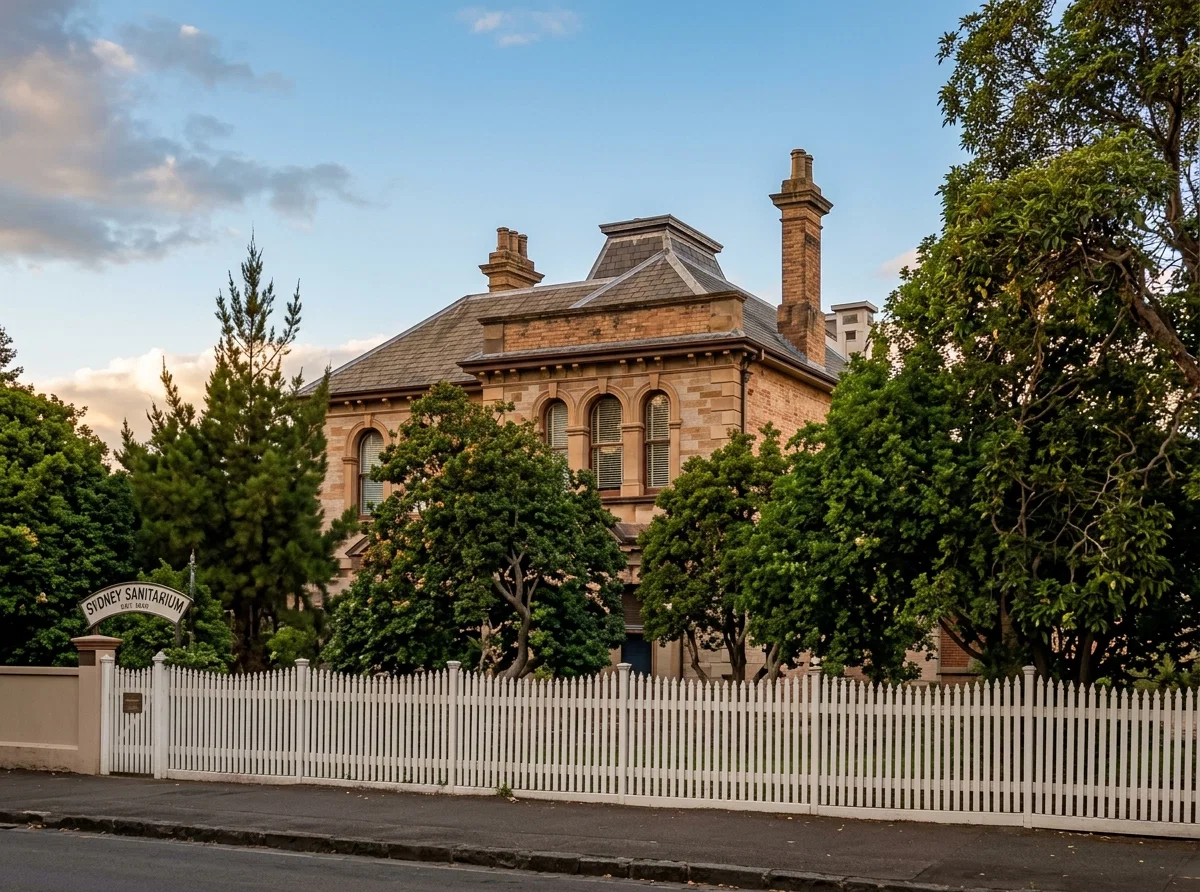
Health Home, Near Sydney, Australia.
IS IT A GOOD INVESTMENT?
The Australasian Field.
Our General Conference Committee, after a careful review of the work in many lands, and the necessities and opportunities in many fields, has requested all our people to contribute liberally, July 7, to the support of our missionary enterprises in Australasia.
It will be of interest to those who have made gifts to the Australasian field, and to those who are now asked, for the first time, to contribute of their means to this work, to know what has been accomplished by the financial assistance rendered to the Australasian work in past years.
From their earliest experiences the Australian and New Zealand Conferences have made a brave effort to be self-supporting, and to take the message of present truth to the vast, unworked portions of their territory. The records of the tithes and offerings they have paid in seasons of great adversity, as well as in times of prosperity, stand as a worthy example to our brethren in other lands.
The conditions of the field threw upon the workers in Australasia extraordinary responsibilities. It was found necessary to establish a publishing house, a training-school for Christian workers, also to build meeting-houses in many places, and later, to establish sanitariums, hydriatic treatment rooms, and a health food business.
The need for these institutions, and the fact that the adherents of the cause were but few in each colony (about 500 in all when the Echo Publishing Company was organized, 1,200 when the Avondale School was started, and not more than 2,000 when the sanitarium building was begun) appealed strongly to our people in America, Africa, and Europe, and they have contributed freely for the building of churches, and the planting of necessary institutions in Australasia.
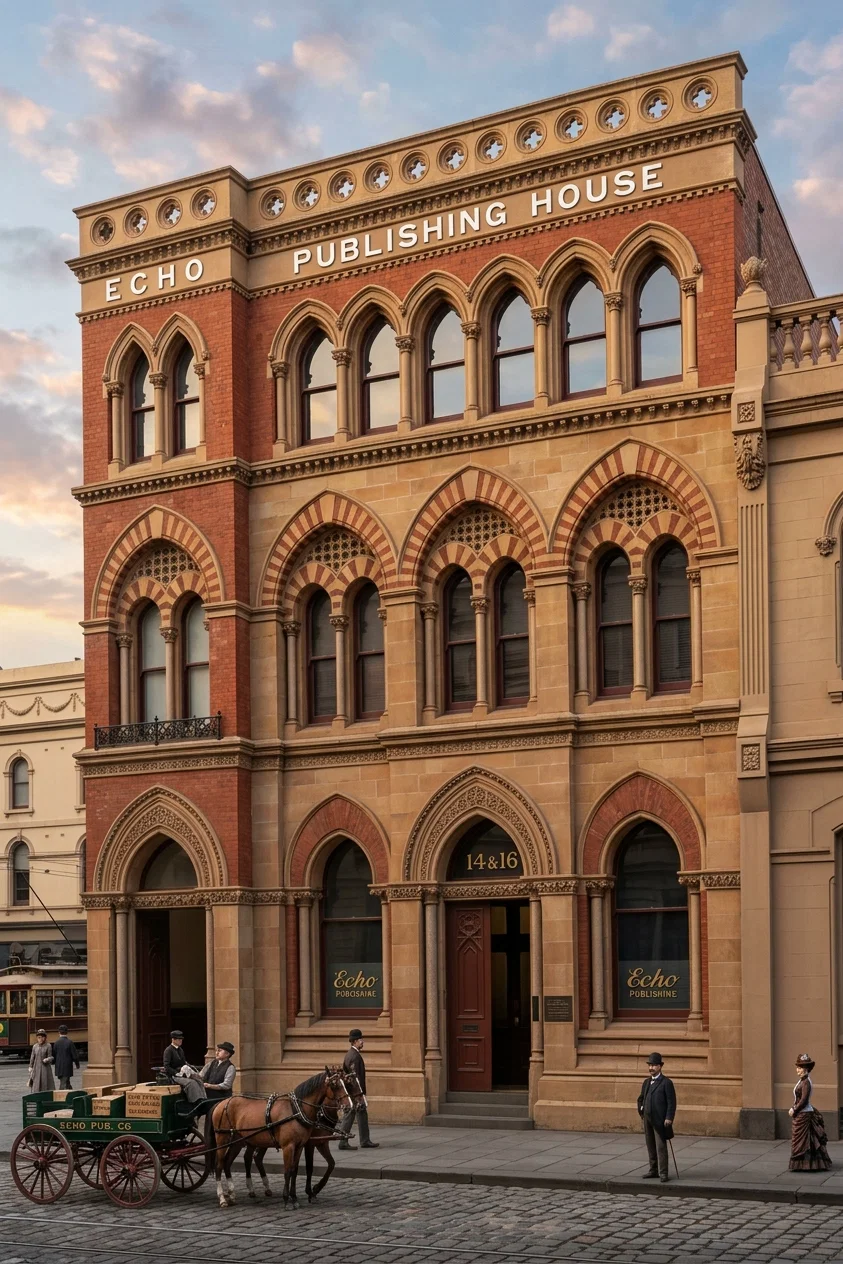
Office of Echo Publishing Company.
This brief review is written that our friends may know that the contributions have been wisely used.
The Echo Publishing Company.
Six months after their arrival in Melbourne, in 1886, Pastors Haskell, Corliss, and Israel laid the foundation of our publishing work in the southern hemisphere, by the issue of The Bible Echo and Signs of the Times, a sixteen-page, monthly journal. For this work a building was erected in North Fitzroy.
During 1886, 1887, and 1888 the blessing of the Lord attended the workers and the work. As the message was given by the ministers, churches were raised up. The Bible Echo was widely circulated, and books were freely sold by consecrated canvassers. The growth of the publishing work demanded more room and better facilities for printing. In April, 1889, the Echo Publishing Company Limited was incorporated, and the erection of buildings begun on Best Street, North Fitzroy, a suburb of Melbourne.
In 1891 an effort was made to begin the publication of our smaller books. “Steps to Christ” was the first book issued by the company. Then followed “Coming King,” “Christ Our Saviour,” “A Friend in the Kitchen,” “The House We Live in,” and “Desire of Ages.” Step by step the work of the Echo Publishing Company has been developed until the institution is in a position to print the greater part of the subscription books sold in Australasia.
Notwithstanding higher prices, fewer workers, smaller and more scattered population, and harder times, our Australasian brethren have sold more books proportionately than any other field. During the past thirteen years $725,000 worth at retail value have been sold, and $13,000 have been donated in various ways. Despite the disasters which have befallen Australia, loss has been recorded but once in ten years. The Echo office is one of the best equipped in the Southern Hemisphere. Value of business last year was $95,000; 90 persons are employed, and the profits were larger than any previous year. Present net worth, $25,000.
Sanitarium and Medical Missionary Work.
Through the action of the biennial session of the Australasian Union Conference, in 1896, which convened in Melbourne, the “Health Home” was opened in Sydney. About two years later Dr. E. R. Caro took charge of the “Health Home,” afterward known as the “Summer Hill Sanitarium.” The organization of an Australasian Medical Missionary and Benevolent Association was effected.
For lack of means nothing worthy of mention was, for a long time, done by way of increasing the facilities, and only very limited additions were made to the furnishings. In 1899 the matter of more suitable accommodations for the sanitarium work was earnestly considered, and, in view of the encouraging prospect for means, a committee was appointed on location for a sanitarium and plans for the same. Earnest appeals to this end were made by Mrs. E. G. White, whose time and means were freely given for this purpose. After a meeting, in which an earnest appeal was made, the Spirit of the Lord moved all hearts present, and $4,500 were subscribed. The work of building progressed slowly. Mrs. White wrote:—
All our buildings were erected upon the most strictly economical plan. I do not see how we could have put up the buildings with more economy. (Aug. 12, 1900.)
The building of the sanitarium is the will of God. The work is His work, and we greatly desire that sufficient means shall come in to complete the building. (Oct. 16, 1900.)
Jan. 31, 1901, Mrs. White again said:—
Our brethren have selected a site for our new sanitarium. It is about thirteen miles from Sydney, and is in an excellent, healthful location. The altitude is about six hundred feet, and the place receives the cool, life-giving breeze from the sea. Thus, while in the low-lying towns the atmosphere is impure, hot, and oppressive; here it is pure, cool, and refreshing. Excellent roads and beautiful, picturesque scenery afford opportunity for pleasant drives. Freedom from the dust and the smoke, the din and the confusion of the city, will be most grateful to the brain-weary and the sick.
It was not God’s purpose that people should be crowded into cities, huddled together in terraces and tenements. In the beginning He placed our first parents in a garden, amidst the beautiful sights and sounds of nature, and these sights and sounds He desires men to rejoice in to-day. The more nearly we can come into harmony with God’s original plan, the more favorable will be our position for the recovery and preservation of health.
Our retired location will offer comparative freedom from many of the temptations of city life. Here are no liquor-selling hotels or dram-shops on every corner to tempt the unfortunate victim of intemperance. And the pure sights and sounds, the clear, invigorating air, and the sense of God’s presence pervading all nature, tend to uplift the mind, to soften the heart, and to strengthen the will to resist temptation.
While affording the benefits of country life, our sanitarium will be sufficiently near Sydney to secure the advantages of connection with the city. There are two railway lines leading into Sydney. The stations are about twenty minutes’ drive from the sanitarium farm, and trains run almost hourly into the city. Five or six little villages, within a few miles of our site, are fast filling up with the residences of business men from the city. This district seems destined to be the most desirable of all the suburbs of Sydney. Not a person who has seen our location of land has one word of criticism to offer. All are surprised13that we have purchased it so cheap. We are sure that it possesses advantages above any other place we have seen.
Through necessity the Summer Hill Sanitarium was at last closed, and the new building, by donation and sacrifice, was completed sufficiently to be opened Jan. 1, 1903. The buildings, and grounds of 80 acres, have cost, to date, $70,000. Of this $30,000 have been paid; $40,000 still stands against the institution, and urgent help is needed. Three thousand dollars are needed to properly equip the building. Here is room for those who have means to exercise large-hearted generosity. It will pay. The workers there are sacrificing much; can not our readers help them?
Educational Work.
Another important institution is Avondale Industrial School. Work on this began in 1895. A site was purchased, the swamp portion of it drained, land was cleared, buildings erected, and much of this done by student labor. In the first term of thirty weeks a thirty-acre swamp was drained, ten acres of heavily timbered land was cleared, ploughed, and prepared for orchard, and one thousand choice fruit trees planted. Several months passed without material progress. The unjust and unfavorable termination of an unnecessary lawsuit into which the managers were dragged by the hasty action of their solicitor, in beginning action before consulting them, had thrown a discouragement over the work. Promised funds came in very slowly, and it was with some difficulty that a saw-mill was equipped, and timber prepared for the first building. Yet, during the winter of 1896, a night school was held in the room over the saw-mill, in which some good work was done.
October 25, 1896, at 5.30 P.M. a little company gathered at the site of the Young Ladies’ Home, and Mrs. E. G. White laid the first brick of the foundation of the first school building. This building is 65 x 36 feet, two stories high and accommodates thirty-six day students and teachers. The dining-hall, 30 x 26 feet, two stories high, was erected at the same time. In these two buildings school was opened April 28, 1897.
During the next vacation, the Young Men’s Home was built, and was ready for use at the opening of the second school year, which began March 6, 1898. This building is 62 x 36 feet, two and a half stories high, and accommodates fifty-six young men and teachers.
A bakery, a laundry, and a carpenter’s shop have also been built, and a neat seven-roomed cottage for the principal.
A health food factory and sanitarium are connected with the school. It has grown and prospered. The situation has more than justified its selection (condemned by many at the time) by Mrs. White. After the fearful drought of years Avondale is about the only green portion in all that section of the island. Beautiful crops have been raised, a most earnest missionary spirit pervades the school, and excellent work is being done in mental, industrial, physical, and moral training.
In view of all these things,—the needs of these various institutions, the needs of the great field, the weakness and poverty of our self-sacrificing brethren in the hard times through which so much of Australia has passed,—appeal is made to our friends to help. Funds may be sent to Foreign Mission Board, 267 West Main Street, Battle Creek, Mich., or to this office, if desired, and we will forward.
CHRIST'S SECOND COMING.
By H. H. Hall
[H. H. Hall, Baptist Clergyman, in Converse (Indiana). Republican.]
“Can ye not discern the signs of the times?” Matt. 16:3.
GOD works and speaks in love and power,
And warns the church and world;
His cyclone-storms above us lower,
And lightning-bolts are hurled.
But He the raging storm controls,
And hurls it where He wills;
His wrath 'gainst sin He thus unfolds,
And thus His Word fulfils.
O ministers of Christ, awake!
His chariot wheels we hear;
The mountains smoke, the earth doth quake,
And startling signs appear.
As, by His prophets long foretold,
Many run to and fro,
Treasure is heaped; and cankered gold
Waits upon wails of woe.
Awake, thou sleeping church, awake!
And hear Christ's warning voice,
The powers of heaven above us shake,
Redemption comes, rejoice!
Behold, He knocks now at the door,
And for admittance pleads;
O brother, bar Him out no more,
Let Him supply your needs.
He'll wash you clean, clothe you in white,
And fill your soul with joy;
He'll change your darkness into light,
And your last foe destroy.
Behold! He comes o'er all to reign,
On earth made new and fair;
All signs above, beneath, are plain,
Let none His anger dare.
Then church of God, arouse thee! wake!
Let every lamp be bright;
For lo, the Bridegroom comes to take
His bride, and throne of light!
WHAT BELGIUM IS DOING IN AFRICA.
Much has been said of Belgium’s work in the heart of Africa in the Kongo country. It has been supposed that King Leopold II., through his officials, was exercising an uplifting influence over the Kongo Free State. But ugly rumors of slavery and cannibalism with the consent of the Belgian officials have multiplied of late years, till it has become quite clear that the natives would be far better off if Belgium control was utterly destroyed. One of the latest to write upon the subject is James A. Phillips, a Methodist missionary, who has just returned to his home in Pennsylvania after a sojourn of eleven years under the equator in Africa. It is Mr. Phillips’ purpose to lay this information before the government in Washington, and then before influential people in London. He has written an article in the Hearst newspapers, from which the following excerpts are taken, Mr. Phillips gives many details, of which he has kept faithful record as to places, dates, and facts:—
I say calmly and deliberately that since the Spanish Inquisition no such Satanic cruelty and infamous brutality have been visited by soldiers and authorities upon a helpless, childish, ignorant people as that which the Belgians inflict upon the Kongo blacks. It would take a score of big volumes for me to tell of the atrocities and barbarities that I know of personally in Kongo, and what I know is a mere drop in the hogshead of facts that occur among the 18,000,000 natives there, and in the 900,000 square miles.
I have seen squads of nude, terrified, half-fainting women dragged into Mussumba as recent captures for the Belgian Slave Service. I once counted 288 slaves proceeding northward. They had already come some 300 miles. A guard of five Belgians and 150 armed, native soldiers went along with the melancholy procession of humanity.
I have seen native women literally spitted on a pike pole by cannibal soldiers because they refused to move on the march to the north. I can give names and dates of times when I have known women to be beaten into a hideous mass of flesh and broken bones because they were obstreperous when ordered to move on. I can give names and dates also of the burning and slaughtering of hamlets of several hundred people by a few score of armed, cannibal soldiers, under orders of a Belgian officer, for petty anger.
Here is a sample of many similar recent episodes in Kongo:—
Twenty-two miles from Kitumba, where I was staying, several hundred soldiers of the Zappo Luba tribe, famous for its ferocity and cannibalistic habits, were ordered to go to a hamlet of about 700 meek agricultural natives and demand their rubber and ivory product for the year, on the score that the village had been protected from marauding bands of natives. The hamlet demurred, and the chief at last refused to yield anything to the Zappo Lubas, whereupon the armed force made war upon the place.
Most of the women fled into the forest, but every soul in the town that was caught and shot was put to death. Several Americans and English went there a week later, and we saw over 131 decayed human heads stuck upon bamboo poles, and corpses of men, women, children, and babies lying where they had been struck down. I will not go into the shocking details of the way that hamlet was massacred, and what hideous sights we whites came upon in our search through the place.
I boldly say that over 50,000 men and women are wantonly killed or slowly tortured to death in Kongo Free State every year by the Belgian native soldiers and with the consent of the Belgian authorities. I could fill this newspaper with statements of facts concerning unmentionable atrocities upon men and women—especially young women natives in Kongo land.
I charge the Belgians, from King Leopold down to the boys in the hundreds of trading headquarters, with an all-consuming desire to make money in the Kongo Free State, no matter at what cost of human life, or at what cruelty or barbarism necessary to accomplish the making of dividends for the Belgian trading companies.
Chronic intoxication, infamous and open immorality prevail wherever the Belgians set up their headquarters.
The causes: Greed and appetite; conscience destroyed by appetite, and a conscienceless greed which counts sous of more worth than souls. And yet Belgium is called a “Christian” nation! And these days are said to be the dawn of the millennium!
OUR WORK AND WORKERS.
The Indiana State camp-meeting will be held at Peru, July 30 to August 9.
June 20, two brethren were baptized in this city by Brother Andrew Brorsen.
Two candidates were baptized at Dayton, Ohio, June 6, by Brother C. A. Smith.
Eleven tent companies have been placed in the field this season by Iowa Conference.
Four tent companies are set apart for labor in West Michigan Conference this season.
At Eagle Lake, Minn., May 16, ten candidates were baptized by Brother M. B. Van Kirk.
The new company of Sabbath-keepers at Franklin, Ind., are building a new house of worship.
On the 6th ult. a church of twenty members was organized at Rainey, Mo., by Brother H. M. Stewart.
Until further notice, the address of Brother John F. Jones will be 221 King Street, Wilmington, Del.
Land and cash have been donated for an industrial school in the Western Washington Conference.
At Nashville, Tenn., May 23, at the close of a discourse by Brother George I. Butler, four candidates were baptized by Brother J. E. White.
At the recent camp-meeting at Colfax, Iowa, forty-four candidates, mostly young people, were baptized.
Reporting to the Pacific Union Recorder, Brother H. G. Thurston notes the organization, on May 30, of a church at Dinuba, Cal., with a membership of nineteen.
On May 30, twelve persons were received into the church at Toledo, Ohio. Nine were baptized by Brother D. E. Lindsey, three having been baptized previously.
Brother G. A. Snyder, who returned to California from Australia early in the spring, has accepted the position of Bible instructor at Walla Walla (Wash.) College.
From Cripple Creek, Col., Brother C. H. Bates writes: “On May 24 six dear souls were buried with their Lord in baptism. Others are keeping the Sabbath, and will go forward later.”
The incidental labors of lay brethren near Petersburg, Transvaal, South Africa, have resulted in the conversion of seven persons to the Adventist faith. One of these is himself a missionary.
Brother A. D. Gilbert, general agent for the Signs of the Times, has been laboring in Minneapolis and St. Paul, Minn., for a short time, in the interest of house-to-house work with the paper.
A new house of worship at Marshfield, Wis., was dedicated on the 21st ult. There is also a church-school connected with this church, several of the pupils being children of parents not of our faith.
Having decided to give themselves wholly to the German work, Brethren J. P. and G. P. Gaede have pitched a tent at Pandora, Putnam County, Ohio. They divide their time between public services and selling German publications.
Our colored school at Vicksburg, Miss., is in charge of Brother N. B. King and Sister L. C. Roby, who were formerly public school teachers at Yazoo City. Brother F. R. Rogers notes the recent conversion of two mothers and eight children in connection with this work.
The Western Oregon Conference, at the recent session, elected the following officers: President, F. M. Burg; secretary, Nellie Nelson; treasurer, Wm. S. Nelson; missionary secretary, G. W. Pettit; executive committee—F. M. Burg, W. R. Simmons, J. M. Cole, F. S. Bunch, A. Carey.
The report of work in Celt, Dallas County, Mo., is reported favorably in the Workers’ Record by Brother D. P. Zeigler. He notes that twelve adults have accepted the Sabbath of the Lord. A Sabbath-school of thirty members has been organized, and land has been donated on which to erect a church. Work will soon be commenced on the building.
At the first annual session of Western Washington Conference, held in May, the following officers were elected: President, E. L. Stewart; secretary-treasurer, Daisy D. Cuddy; missionary secretary and canvassing agent, Lee Moran; executive committee—E. L. Stewart, W. W. Sharp, W. F. Martin, J. N. Clark, and G. A. Peterson. Four new churches were added to the conference—Green Lake, Etna, Ridgefield, and Mossy Rock.
A report in the Southern Watchman, by Brother F. R. Rogers, concerning work among colored people in Jackson, Miss., says: “The work in Jackson, though begun only a year ago with one little child in attendance at the day-school, now has an attendance ranging from twenty-five to thirty, and a company of eleven believers who are ready for organization. Brother and Sister Strachan have labored here faithfully and under great opposition, but the Lord has blessed their efforts.”
On arriving at Johannesburg, Transvaal, Brother A. W. Kuehl, who recently went to that country from Minnesota, found the cost of living very high. Writing to the Worker, he says: “After considerable looking around we finally found two little unfurnished rooms out in the suburb, Jeppestown, for $25 per month. Everything seems to be high in proportion. The motto of this people seems to be: Gold is the principle thing; therefore, get gold; and with all thy getting get gold. Farmers can not depend upon their crops in this country as there are so many obstacles to contend with. They have hail storms of unexampled severity. Every now and then the locusts come in swarms, at times even darkening the sun, and where they alight nothing green remains. The rinderpest takes its share of the cattle, and there are other diseases among the horses and fowls. If it were not for the gold-fields the Transvaal would be of but very little value. There are black men and white men scattered through all the streets of Johannesburg, and it seems that there are people of nearly every nation, kindred, tongue, and people in this great city of the Transvaal.” Brother Kuehl sold sixty copies of the South African Sentinel in one evening on the market square.
PUBLICATIONS WANTED.
CLEAN late copies of Signs, Sentinel, and Life Boat. Address post-paid, Mrs. D. A. Briggs, Morgan Hill, Cal.