The Youth’s Instructor, Vol. 63, No. 44.

Russian “Follow the Leader”
Earlier text: God’s Forgiveness; Its Fullness and Its Privileges

Forty-Fifth Week

November 7. Acts 15 to 17: The first church council; deliverance from prison; discourse on Mars Hill.
November 8. Acts 18 to 20: In Corinth and Ephesus; Paul’s farewell to the believers at Ephesus.
November 9. Acts 21 to 23: Paul’s arrest and trial.
November 10. Acts 24 to 26: Before Felix, Festus, and Agrippa.
November 11. Acts 27, 28: The voyage to Rome; deliverance from shipwreck.
November 12. Review Acts: Note how persecution aided in spreading the gospel.
November 13. Romans 1 to 5: Justification by faith. Read the notes.

For Further Study

Learn what you can about Herod, Felix, Festus, and Agrippa.
Outline Paul’s three missionary journeys,—(a) with Barnabas and John Mark; (b) with Silas; (c) with Timothy,—also the incidents of his arrest and trial, and the voyage to Rome.

Paul, Apostle to the Gentiles

Saul, afterwards called Paul, was born at Tarsus, the metropolis of Cilicia. It was distinguished for its culture in letters and philosophy, being at one time the rival of Athens and Alexandria.
Paul was a Jew, of the tribe of Benjamin; but along with this position, he received from his father, so it is supposed, his Roman citizenship. Though in an alien city, surrounded by the seducing influences of heathenism, and subjected to the allurements of pagan culture and philosophy, Paul was carefully taught the religion of his fathers. He was, to use his telling phrase, “a Hebrew of the Hebrews.”
Paul’s father was a Pharisee, and according to the strict rules and laws of this dominant party of the Jews he was brought up. “At a suitable age he was sent to Jerusalem to complete his education in the school of Gamaliel, the most distinguished rabbi of that age. It does not appear that he was in Jerusalem during the ministry of Christ; and it was perhaps after his return to Tarsus that he learned the art of tent making, in accordance with the general practice among the Jews and their maxim, ‘He that does not teach his son a useful handicraft teaches him to steal.’”
Besides being the possessor of a liberal education according to Jewish standards, Paul seems to have been a master of the Greek language, and familiar with its literature. But all this, with all worldly honor and position, he gladly counted loss for the cause of Christ. He seems to have been the first “to regard Christianity in its true light, as a universal religion. While others were for Judaizing all those who embraced the new religion, by imposing on them the yoke of Mosaic observances, it was Paul’s endeavor to break down the middle wall of separation between Jews and Gentiles, and show them that they were all ‘one in Christ.’”
It was the dissolute Nero, relentless persecutor of the early Christians, who “pronounced the decision that condemned Paul to a martyr’s death. Inasmuch as a Roman citizen could not be condemned to torture, he was sentenced to be beheaded. . . . Few spectators were allowed to be present; for his persecutors, alarmed at the extent of his influence, feared that converts might be won to Christianity by the scenes of his death. But even the hardened soldiers who attended him, listened to his words, and with amazement saw him cheerful and even joyous in the presence of death.”

Paul’s Writings

Fourteen of the twenty-seven books of the New Testament are generally credited to Paul, and are known as the Pauline Epistles. They are, Romans, First and Second Corinthians, Galatians, Ephesians, Philippians, Colossians, First and Second Thessalonians, First and Second Timothy, Titus, Philemon, and Hebrews.

The Epistle to the Romans

Without, so far as is known, the ministry of the living preacher, a company of believers in the Christian religion had been raised up at Rome. This might have been accomplished through the conversion of some of the “strangers of Rome, both Jews and proselytes,” who were in Jerusalem on the day of Pentecost; or the gospel seed might have been carried to that stronghold of paganism by some of the believers who were scattered abroad as the result of the persecution that arose after the death of Stephen.
Paul, always seeing and feeling the needs of the distant fields, had it in mind to visit these believers, and carry the gospel light to them. In carrying out this purpose he was for a time hindered; but in A. D. 58, while at Corinth, he improved the opportunity to send a letter to these brethren by the hand of Phebe, a deaconess in a neighboring church.
In such a mixed company, so far removed from Christian counsel and instruction, errors would naturally come in, and many perplexing questions arise. It was Paul’s purpose to present in this letter “the great principles of the gospel. He stated his position on the questions which were agitating the Jewish and Gentile churches, and showed that the hopes and promises which had once belonged especially to the Jews were now offered to the Gentiles also. With great clearness and power the apostle presented the doctrine of justification by faith in Christ. He hoped that other churches might also be helped by the instruction sent to the Christians at Rome, but how dimly could he foresee the far-reaching influence of his words! Through all the ages the great truth of justification by faith has stood as a mighty beacon to guide repentant sinners into the way of life. . . . For the epistle to the church at Rome every Christian has reason to thank God.”

Missionary Volunteer Question Box

[All our Missionary Volunteers are invited to contribute to this question box. The Young People’s Missionary Volunteer Department will be glad to answer through these columns questions pertaining to any phase of the young people’s work.]
I. WHAT can be done in a large church where the work seems too great for the leader to do all that should be done? How can we reach the boys?
Of course, in such a society you need a strong leader,—not an eloquent speaker, but a hard worker,—one who sees what is needed, can lay plans, and set others to work. Such leaders can use assistants, and it is often desirable to appoint one or even two assistants to a leader in a large society. Those assistants can be assigned definite work and all work together as one. The union Missionary Volunteer secretary for Australia writes of this plan and concerning the work for boys:—
“For a long time now, in our larger societies, I have asked them to select a good leader, the very best obtainable, and then two assistant leaders, one a young man and the other a young woman. It is then understood that the young man works among the boys. This plan has worked well, and in some instances a number of young men and boys have been drawn into the society who have hitherto held aloof.”

VII — Commandment Keeping

(November 13)
LESSON SCRIPTURE: Matt. 19: 16-30.
MEMORY VERSE: “If thou wilt enter into life, keep the commandments.” Matt. 19: 17.

Questions

  1. By what title did a certain man address Jesus? What question did the man ask? Matt. 19: 16.
  2. In return, what question did Jesus ask him? Verse 17, first part. 1
  3. How did the Lord then answer the ruler’s question? Verse 17, last part.
  4. How did the ruler show that he did not understand which commandments Jesus meant? Verse 18, first part. 2
  5. How did the Master make him understand that he meant the ten commandments which had been given from Mt. Sinai? Verses 18, 19.
  6. What did the young ruler claim he had already done? What else did he want to know? Verse 20.
  7. If he would be perfect, what did Jesus tell him he must yet do? Verse 21.
  8. When the young man heard this, what did he do? Why did he feel so? Verse 22. 3
  9. What did his turning away from Christ and eternal life cause the Lord to say concerning rich men? Verses 23, 24.
  10. What did his disciples think of this statement? How did Jesus explain his meaning? Verse 25; Mark 10: 24.
  11. What further statement did Jesus make to the amazed disciples? Matt. 19: 26.
  12. What question did Peter then ask? Verse 27.
  13. What future reward will those have who are willing to leave all and follow Jesus? Verse 28.
  14. What will they have even in this life? Verse 29; Mark 10: 29, 30.
  15. Give a summary of the lesson.

VII — Commandment Keeping

(November 13)

Daily-Study Outline

Sab. . . . . Read the lesson scripture.
Sun. . . . . “What good thing shall I do?” Read “The Desire of Ages,” page 518. Questions 1-3.
Mon. . . . . “What lack I yet?” Read “The Desire of Ages,” page 519. Questions 4-6.
Tues. . . . “If thou wilt be perfect.” Read “The Desire of Ages,” pages 520-523. Questions 7-9.
Wed. . . . All things possible with God. Read “Mount of Blessing,” pages 83-85. Questions 10-12.
Thurs. . . “What shall we have?” Read “Christ’s Object Lessons,” pages 395-404. Questions 13-16.
Fri. . . . . Review the lesson.
LESSON SCRIPTURE: Matt. 19: 16-30.

Questions

1. What question did a certain man ask Jesus? Matt. 19: 16. Note 1.
2. What question did Jesus ask in return? Verse 17, first part.
3. How may we enter into life? Verse 17, last part. Note 2.
4. What question did the man ask Jesus? Verse 18, first part.
5. What was Jesus’ answer? Verse 18, last part, and 19.
6. What did the young man now say? Verse 20.
7. What counsel did Jesus give him? Verse 21.
8. How did Jesus’ answer affect the young man? Why did he feel so? Verse 22. Note 3.
9. What comment did Jesus make to his disciples? Verse 23. Note 4.
10. What did he say further by way of emphasis? Verse 24.
11. How did his statement impress the disciples? Verse 25. What question did they ask?
12. What far-reaching answer did Jesus give? Verse 26.
13. What did Peter then say to Jesus? Verse 27.
14. What was Jesus’ answer? Verse 28.
15. What precious promise did Jesus make? Verse 29.
16. What statement did Jesus add? Verse 30.

Notes

1. This young man regarded himself as a commandment keeper, but he seemed to fear that something might be overlooked. He wanted eternal life, and here was the Great Teacher, who perhaps would make his duty still clearer, or would at least commend his commandment keeping. So he ventured the question.
2. God’s “commandments are righteousness” (Ps. 119: 172), and “in the way of righteousness is life” (Prov. 12: 28). The only entrance to life is by the way of righteousness. That we cannot of ourselves keep the law does not lessen our obligation, especially when the promise of God is that our righteousness is of him. Isa. 54: 17. The sinner who truly seeks with all his heart, over his repeated failures it may be, to do God’s will, will find Christ the door. Rom. 7: 25. In seeking to keep the commandments in their spiritual fullness the young man would have found Christ.
3. According to the young man’s testimony he had observed the commandment not to covet anything that was his neighbor’s, and so had caught the negative view of this commandment. But the idea that he should take his own goods and give them to the poor, was too severe a test for him, even though Jesus had promised him “treasure in heaven” in return. There was an idol in his heart which stood in the way of complete keeping of the commandments. Our idol may not be riches, but still constitute another god, before the Lord.
4. The expression “shall hardly enter” is a little ambiguous as it stands, as it may mean, according to common usage, almost but not quite enter. The word hardly, however, means here with difficulty. As brought out in the next verse, this difficulty is so great that man cannot overcome it in his own strength, but by connecting himself with God victory is assured.

Efficiency: Making Good Without Excuses

Efficiency

MAKE good! Don’t explain! Do the thing you are expected to do! Don’t waste time in giving reasons why you didn’t, or wouldn’t, or shouldn’t!
If I hire you to cook for me, I expect my meals on time, done to a turn and appetizing; I am not interested in the butcher’s mistake, nor the stove’s defect, nor in the misery in your left arm. I want food, not explanations. One can’t eat explanations.
If I hire you to take care of my automobile, or factory, or shirt-waist counter, I do not want to hear why things are half done; I want results.
So also if you come to me and hire me to do a job of writing (correspondence solicited—lowest rates and quick service) by the fifteenth of the month, you do not want me to show up on that day with a moving story describing how I couldn’t do what I was paid for. You want writing, and you want it first-class, all wool and a yard wide.
This is cold, cruel, heartless talk. It is—to all second-raters and shirkers. But to real men it is a joy and gladness. They rejoice to make good themselves, they expect others to make good, and they like to hear preached the gospel of making good.
Mr. Yust, the Rochester librarian, in his report some time ago, spoke of the parable of the talents, in which we are told of the “three servants who had received talents, five, two, and one, respectively. On the Master’s return they all rendered account of their stewardship. The first two had doubled their capital. Each of them said so in sixteen words, and their work was pronounced, ‘Well done, good and faithful servant.’ Servant number three had accomplished absolutely nothing, but he made a full report in forty-three words, nearly three times as long as the other reports.”
There you have it. The less you do the more you explain.

EFFICIENCY!

Learn that word by heart. Get to saying it in your sleep.
Of all the joys on this terrestrial sphere there is none quite so soul-satisfying and one-hundred-percentish as making good.
Do your work a little better than any one else could do it. That is the margin of success.
Make good needs no footnotes.
Failure requires forty-three words.—Frank Crane

RUTH LEE OLSON

THIS world is what you make it, lad, though skies be dark or fair, Whether sunshine filter through boughs of green, or raindrops fill the air; It matters not what the day may be, if you smile as you travel the way: This world is what you make it, lad, forever and for aye.
This world is what you make it, lad, though the task be heavy and long; So buckle your shoulder against the wheel, and fill your heart with song. What matter though stones obstruct the way, and the load is backward pressed? The world is what you make it, lad, so give it your very best.
This world is what you make it, lad, so bend to your work with a will; The road's soon ended, the heights ascended, if your place in life you fill. But remember the measure of grain you sow will be heaped with its like again: This world is what you make it, lad, and its builders the sons of men.

RUTH LEE OLSON

Knowing When to Stop
NOTHING is so good of its kind that overdoing it will not spoil it. A clergyman was the owner of a handsome collie dog which was very fond of engaging in a rough-and-tumble contest with his master; and when this taste was indulged, the dog seemed in a frenzy of excitement. Barking and growling, he would bare his gleaming teeth as if ready to tear his owner to pieces, his eyes in the meantime emitting a steely-blue light. But when the man, weary of the sport, said quietly, “That will do, Prince,” the furious wild animal became in a moment a sedate family dog, all his late frenzy evaporating in a submissive wag of the tail. And the master was given to making this comment: “Prince knows more than most people. He knows when to stop.”
That the eulogy on the handsome collie is not exaggerated can be proved easily by one who watches the world with a discriminating eye. In how few things, indeed, do we know when to stop! Amusements easily become crazes, and proper recreation is allowed to engross so much time and attention that it becomes a menace. A pretty style of dress comes into vogue, and beauty lovers draw a sigh of relief. But the public will not stop here. The pronounced characteristics of the prevailing style are gradually exaggerated, overdone, till they become grotesque, offensive. And so we have skirts too closely fitted to allow a free step, enormous sleeves, and hats that come very near to obscuring the faces they were meant to frame, and similar offenses against good taste. Dress is certainly one of the things in which few know when to stop.
The same is true of joking. Humor is the spice of life. Yet countless precious things are sacrificed to somebody’s exaggerated sense of humor. Practical joking has come to be recognized as one of the menaces to life as well as happiness. The grinning youth who points a supposedly empty weapon at his sister, and, chuckling, pulls the trigger, only to find his joke a deadly bit of earnest, is one of uncounted multitudes who, beginning with a perfectly normal and natural desire for amusement, do not know when to stop, and turn the food for mirth into material for tragedy.
A wise dog, that shaggy collie, whom his master credited with knowing when to stop—wiser, in truth, than most people.—Young People’s Weekly.
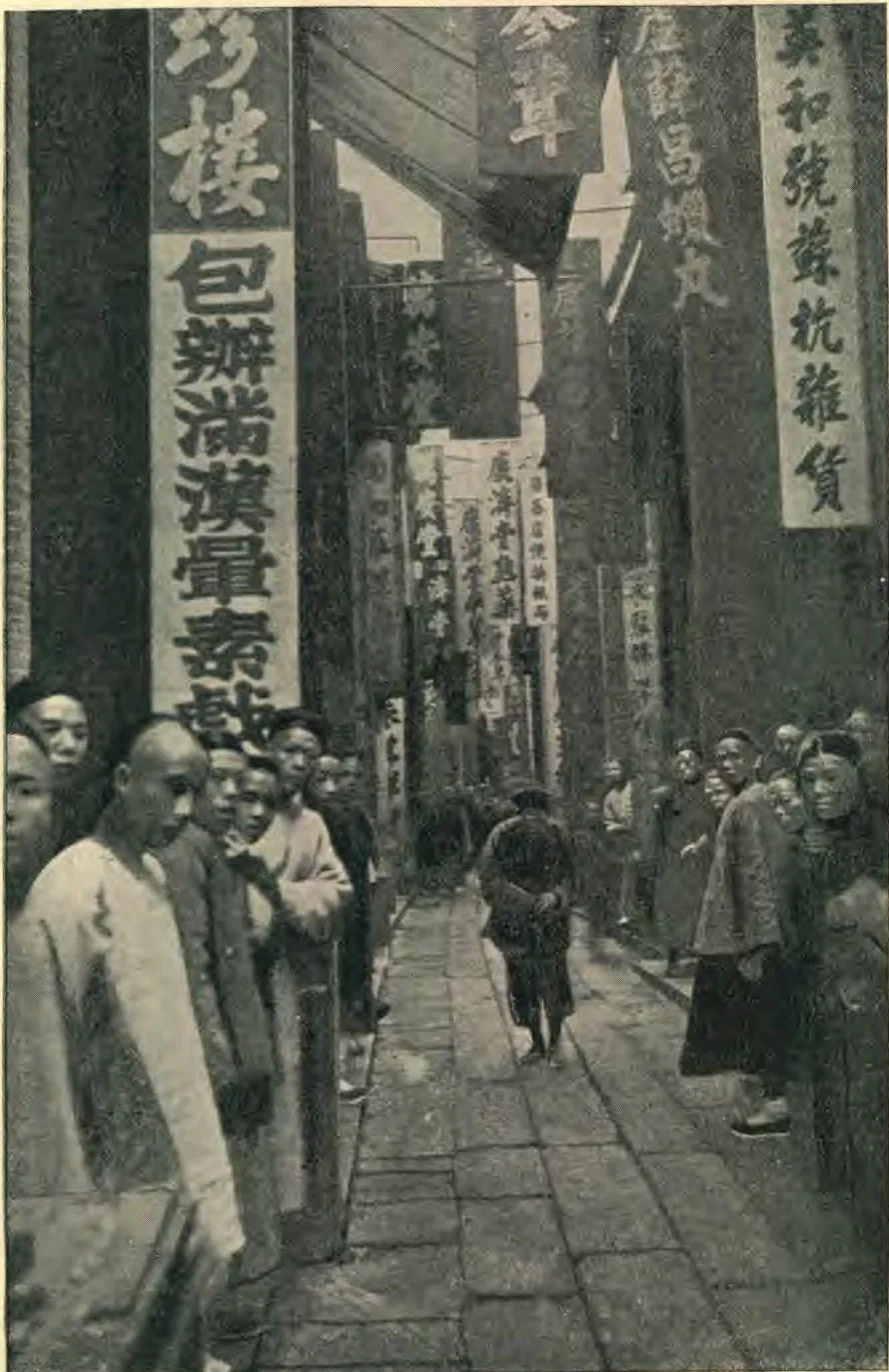
STREET SCENE IN A CHINESE CITY
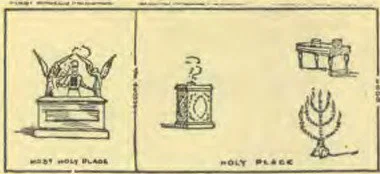
PLAN OF THE TABERNACLE

You have reached the end of this edition.

The Youth’s Instructor · Nov 2, 1915