The Youth’s Instructor, Vol. 36, No. 33.

A REAL LAKE OF FIRE

The Youth’s Instructor

Aug 15, 1888

S. D. A. Publishing Association · Battle Creek, Mich. · Aug 15, 1888

A REAL LAKE OF FIRE.
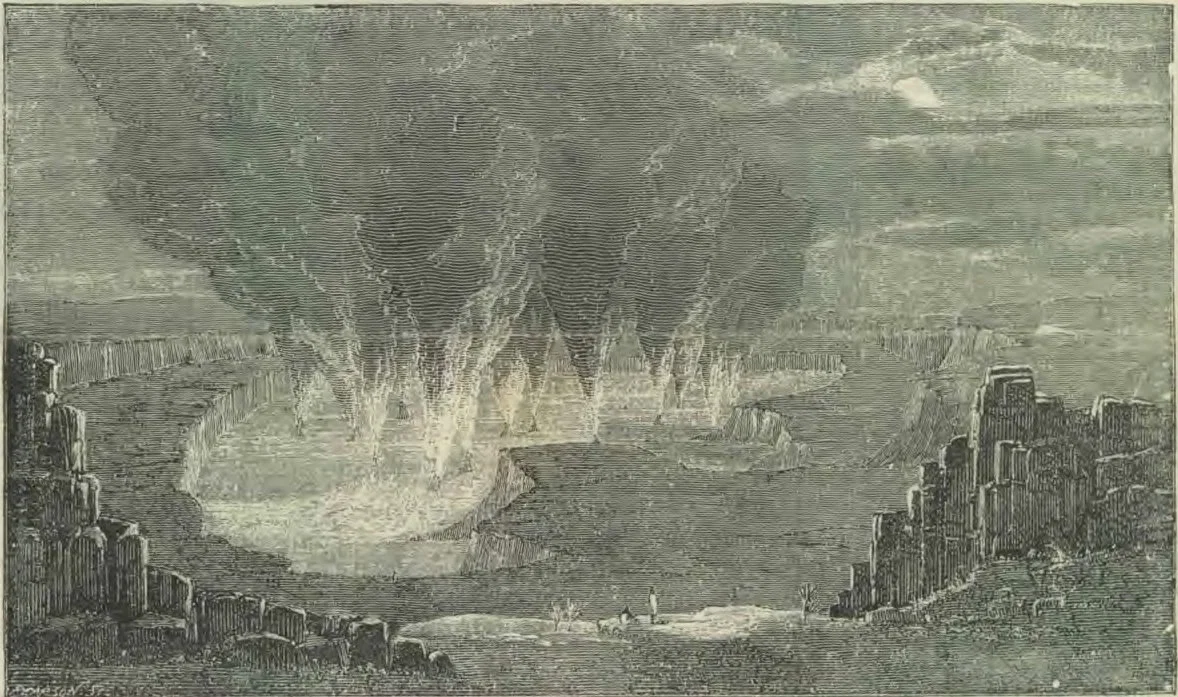
THE very first objects which meet one's sight on nearing the Hawaiian, or, as they are familiarly called, the Sandwich Islands, are two lofty peaks, Mauna Kea, and Mauna Loa, each rising to the height of 14,000 feet, or about two and one-half miles. They are both located on the island named Hawaii, and one of them is capped with perpetual snow.
Situated on the eastern side of Mauna Loa, and about 4,000 feet above its base, is the great volcano Kilauea. This has the largest active crater of any volcano in the world, it being about three and a half miles long, and two and a half wide, or nine miles in circumference, and nearly 1,000 feet in depth. This inclosure is an immense cauldron of burning lava, a veritable lake of fire. It never emits smoke, and is therefore not seen at a distance only at its seasons of rarer violence, when the lava is thrown to a great height, and rolls down the mountain side, destroying everything in its path. At such times the fiery track of the lava may be seen a great way off, as it lights up the surrounding country.
Fortunately this monster does not often become angry, and vomit its fire. But for over two years, from the middle of 1856, rivers of lava rolled down through the forests, and over the precipices, destroying the gardens of the natives, and driving them from their homes. In January, 1859, another eruption occurred, when the fire rose 250 feet above the crater, sometimes in the form of a cone, at others in that of spurting jets, resembling a display of artificial fireworks.
Ordinarily, a thin vapor arises from the mouth of the volcano, and hangs above it like a little silvery cloud. The varying effects of this at different periods are said to be very beautiful. A Mr. Hill, who had opportunity of exploring the country in that vicinity, says that as the day declined, the cloud seemed denser, and was tinged with a faint light. As darkness increased, the light assumed the appearance of the Aurora Borealis in its most fixed condition, and in the darkness of night the glare was like that of a forest on fire.
THE CRATER OF MAUNA LOA.
Some travelers have ventured to descend into the crater, the sides of which are formed of huge pieces of cooled lava, broken and rough. In doing this some have lost their footing, or fallen through the deceitful lava crust, and have been lost. The scene below in the crater is described as one most terrible to contemplate. At a great depth beneath boils the fiery lake, while on all the sides of the place is frightful desolation.
Prof. Alexander, of the Panahou College, with some companions occupied several days exploring this wonderful crater, at the time of its great eruption in 1859. They followed one stream of the lava to the point where it issued from the mountain. Its appearance there was like a pool of blood, boiling up like a spring, and spouting up thick, clotted masses to the height of ten or twenty feet. Lower down the mountain, the lava appeared almost as fluid as water, and ran with a velocity which the eye could scarcely follow. The stream was from twenty to fifty feet wide.
“To describe the scene,” says the professor, “is impossible. For the first time we saw actual waves, and actual spray of liquid lava. As its surges rolled back from the inclosing walls of rock, they curled over and broke like combers on the reef. There was, besides, an endless variety in its forms. Now we passed a cascade; then a smooth, majestic river; then a series of rapids, tossing their waves like a stormy sea; now rolling into lurid caverns, the roofs of which were hung with red-hot stalactites; and then under arches, which it had thrown over itself in sportive triumph.”
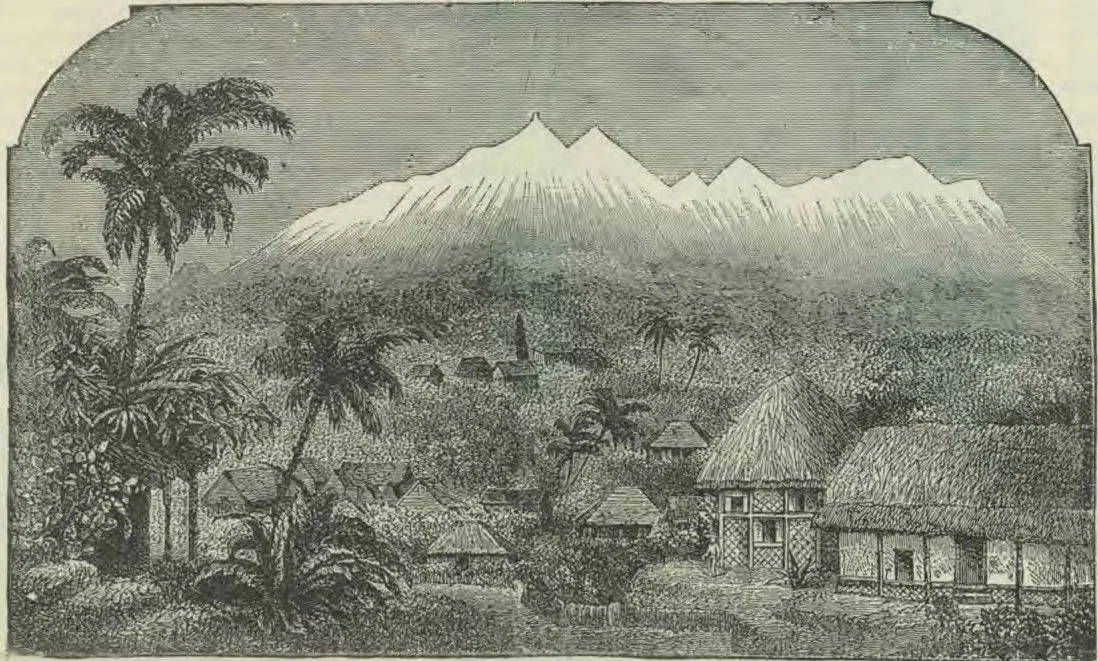
This stream of lava found its way into the ocean, and filled up a bay, forming a promontory instead. The native village of Waiohinu, now nestled at the base of the mountain in a forest of orange, fig, and guava trees, looks very pleasant as seen in the picture on the next page. But should the lava flow in that direction at any time, the beautiful spot would become a desolate, forsaken place in a few hours. This illustrates how one's fondest earthly hope may be overthrown. When we think we are well on the road to the accomplishment of some cherished plan, it is suddenly overturned by an unforeseen circumstance. So uncertain is human happiness. How much better to place one's affections on things above, and not on things on the earth; for the things which are seen are temporal, but the things which are not seen are eternal. J. O. CORLISS.

THAT OLD HAIR-TRUNK.

“It’s just—too mean—for anything!” sobbed Mollie, with her face hidden in the pillow. “Just now, too—and—I thought!”—
“What?”
Aunt Sue had a fashion of happening round at the most unexpected times, and Mollie ought not to have been surprised; but she was.
“I—didn’t mean anything—I mean I didn’t mean to have any one hear, but!”—and again the pink bordered handkerchief hid a doleful face.
“Tell me about it.”
Aunt Sue’s looks were sympathetic, while the voice invited confidence, and consequently Mollie told.
“Have you told Jesus?”
“Why, Aunt Sue!”
“Yes, dear.”
“But—told him! Why, auntie, it would seem so—so!”—
“No, it wouldn’t,” Mrs. Stuart said understandingly; “it would not seem a bit sacrilegious to tell him. ‘Casting all your cares on him, for he careth for you.’ Don’t you remember?”
“But—trunks, auntie! Tell him about that?”
Aunt Sue nodded.
“Tell him how you so want a new trunk to take away to school with you that it seems as though you can’t enjoy yourself unless you do have a new one instead of that old-fashioned one. Then ask him to give it to you if it is best; but, if it is not best, to give you a contented spirit. Will you ask him, Mollie?”
“Yes,” said Mollie, briefly; and Aunt Sue disappeared to seek for some one else to help, for it was always one of her strong points to be helping some one.
Mollie Stuart looked wistfully after her as the door closed between them.
“She’s the best woman!” she cried enthusiastically. “And perhaps I shall get the trunk after all; there’s such a nice Saratoga for only seven dollars down at Winely’s; and I should feel so ashamed to take this old ark affair away to school. Why, I should die of mortification, I know. But then, I shall not have to, for I’ve got the faith to believe I shall have a new one, so of course I shall. I’m going to ask now if God will give me my desires. What was that, though, Aunt Sue said about ‘if it were best?’ Of course it’s best. ‘But if not best, give a contented spirit!’ Oh, dear! And I promised to ask for that if I couldn’t have the trunk!”
And Mollie almost whistled in her dilemma.
“‘A contented spirit!’ H’m! Mollie Stuart, I’m ashamed of you. You know you don’t want a contented spirit! You’d rather scold and grumble and make yourself miserable about it. You’re just like the old woman that never was happy unless she was miserable. Fie, Mollie Stuart! I—oh, I am ashamed of you; but what can I do? Yes; I can, I will ask him for what I want, and will tell him that I don’t want a contented spirit, but that I want to want it.”
It was a happy-faced little damsel that came downstairs an hour later to set the table for Aunt Sue.
“Auntie,” she found time to say confidentially, “at first I had the faith to believe that I should have the trunk. Now I have the faith to believe that God will do what is best for me; but I really think he will send me that new trunk.”
Aunt Sue smiled and kissed her lovingly.
But the days went by without giving poor Mollie her heart’s desire, and at last, on the morning of the fifth of September, Papa Stuart carried the despised hair-trunk to the depot.
“I’m sorry, daughter,” he said kindly, “but I could not afford to purchase a new trunk for you. You don’t care about it as much as you did, though, I dare say; for you haven’t teased me so much of late.”
And Mollie, with a suspicious quiver of her dimpled chin, smiled half-sadly, half-gladly, at Aunt Sue.
After all, it was something to have Papa Stuart notice the change, even if he did attribute it to not caring.
Well, although a few thoughtless ones among the seminary girls “wondered whether Mother Noah had the trunk made to order before starting out upon her voyage, or whether Ham, Shem, or Japheth made it in the ark,” I don’t think Miss Mollie was really unhappy. Indeed, forty-one weeks later, sitting at Aunt Sue’s feet, her face hidden in that lady’s lap, she said with quiet gravity:—
“Aunt Sue, I didn’t even think of crying when I packed my trunk yesterday; instead, I actually kissed the cover. I did, auntie, for oh, that trunk, ‘that old hair-trunk,’ has been a chariot of the Lord to me. Whenever I prayed for anything, I couldn’t help thinking of the first time I prayed for a contented spirit; and then I’d pray for that again. And sometimes I felt like grumbling—there are lots of chances to grumble when one has a mind to, auntie—and then I thought of the hair-trunk. And, auntie, you don’t know it,—for of course people pray for things when they are not Christians, and I suppose you think that is what I have been doing, but it isn’t,—when I prayed that day for a new trunk or a contented spirit, I said, ‘Not my will, but thine.’ And his way is best; auntie. And so it is because of what you said, together with that old hair-trunk, that I am a Christian.”—Well-Spring.

A STORY OF JENNIE LIND.

God gives great gifts to men to be bestowed On others. Makes men stewards, not of gold alone, But of love, and truth, and talents, rare and varied. And when they are given to the lowly in heart, Men give again to God the gift he gave.
A tender story goes about the world Of Jennie Lind, the peerless Highland singer, Great in heart was she, as sweet her voice, And lowly as a lily of the field.
One day beneath the changing skies of spring, She took her way beyond the city's hum, Rejoicing in the happy breeze and bloom. But suddenly the skies were overcast, And from the pelting tempest and the rain She sought a shelter 'neath a humble roof.
The old house-wife lay weak and ill within, But bade her enter. Then, with gentle tact And noble sympathy, akin to His Who loved the poor and lowly, she drew forth The woes and sorrows of the wrinkled dame.
“And do ye ken,” the wife said, eagerly, “That Jennie Lind, the peer of singers, sings The night in oor ain city? Lang I've wished To hear her bonny voice,—but noo I shall na hear her till we meet beyond.”
The tears grew thick in her poor voice; when lo! The lady at her side began to sing, Strain after strain of notes more sweet than joy, More tender than the voice of consolation.
The dame lay tranced, as if the gate had oped, And she had caught the voice of some high angel. The humble roof throbbed with the music Of the singer's voice. The birds outside were hushed With heads this way and that. And Jennie Lind Rejoiced in heart, with joy more full and glad Than when assembled thousands clapped her praise. Then, bending down, she kissed the old dame's cheeks, And whispered softly, “I am Jennie Lind.”
No song like that will fail to be recorded In Heaven's remembrance; and no deed so lowly done To one so lowly, but the Lord will say, “As ye have done it to the least of mine, Ye've done it unto me, the king of heaven.”
FANNIE BOLTON.

HOW DIAMONDS ARE STOLEN.

In the early days of diamond mining in South Africa, great loss was realized by mine owners through the immense quantity of diamonds which was stolen by the diggers. More stones were stolen than were turned over to the legitimate owners.
On account of this serious trouble, which threatened to bankrupt the mine owners, very rigid, and almost unjust, laws were enforced. These laws are still obligatory. Any person found in possession of an unregistered diamond, is subject to imprisonment for not less than five years, and oftener eight years. A very heavy fine is also liable to be attached.
WAIOHINU VILLAGE, NEAR MAUNA LOA.
All diamonds found in the vicinity of the Diamond Fields, are, according to the present law, the property of the mine owners. Only five per cent of the value of any diamonds found outside of the mines is allowed to the finder. That is, suppose when strolling in the field, along the road, or elsewhere, you chance to discover a diamond; in order to comply with the law, you must either hasten quickly to the proper authorities, and reveal the fact of your finding the stone, under what circumstances, where, etc., or pass the law by unheeded. Should you take the former course, you endanger your safety; for before reaching the authorities, you may be accosted with the inquiry, “Have you any diamonds on your person, sir?” and perhaps the result will be imprisonment for five or eight years. Should you be successful in making your hazardous trip, you are only awarded with five per cent of the value of the stone. The man who leaves the diamond as he found it is considered the most sensible. It is a great temptation, but the writer knows of some who withstood it.
Cases are known to have occurred in which innocent persons have been found in possession of one or more diamonds, but were wholly ignorant of the fact; whereupon some one, through envy or spite, put the stones in the pocket of the unfortunate individual, and then reported that such a person was illicitly buying diamonds, and had stones in his possession. This is called “trapping.” It is almost useless for the victim to plead innocence, as it is impossible for him to prove how he came into possession of the stones. He is therefore obliged to abide the consequence, which with few exceptions is imprisonment with hard labor for five or more years. It is stated, by good authority, that at the present time some innocent victims are serving a term in the Cape Government prison. In this respect the law is defective.
But those who are employed in the mines attempt, and very often succeed, in concealing diamonds. As every workman, but more especially the native man, is thoroughly searched at the close of his day's labor, much skill is required in order successfully to hide a stone. There is no opportunity to conceal diamonds in the clothing, as every article of apparel is left in the “Searching Office,” and other clothing is worn during the stay in the mine.
You wonder how it can be accomplished then. One of the many devices employed, and the most common, is that of swallowing diamonds. This is, however, a dangerous method physically, as the following incident shows. A short time since, a Kafir who was in the employ of the “Kimberley Mine,” was taken seriously ill. Medical aid was called, but nothing, it seemed, could be done to relieve the poor sufferer, and death ensued. A post mortem examination re- vealed the fact that death was caused by a deposit of diamonds found in the man's stomach! This man's sad fate has not checked this method of concealment, however, for it is at the present time practiced.
Another place of concealment is the nose. Some seclude small stones under the eyelids. Others actually cut holes in different parts of the body, and insert diamonds.
Parties who buy stones of such persons are termed “I. D. B's,” which signifies Illicit Diamond Buyers. A large force of detectives are constantly on the outlook for these I. D. B's., but in spite of the severe laws, the strong detective force, and the great risk implied, thousands of pounds' worth of diamonds are stolen yearly.
How men will hazard their lives for such things, but care not to make any effort to obtain “true riches”! How eagerly they search for the hidden gem! Denials, deprivations, inconveniences, are counted nothing, and all for what?—Only that they may become rich in this world's goods, which, like the morning dew, endure but for a moment. Oh, that the hidden treasures in the Word of God were thus sought for! “What shall it profit a man if he shall gain the whole world, and lose his own soul?”
R. S. ANTHONY.
South Africa.

MECHANIC AND MUSICIAN.

It seems that Ole Bull and Ericsson the inventor were friends in early life, but drifted apart, and did not meet again until each had become famous. Bull had charmed the ears of admiring thousands all over the civilized world, while the part the great mechanician played in naval warfare during the war, roused the North to enthusiasm, and startled the world.
When taking his leave, Bull invited Ericsson to attend his concert that night. Ericsson, however, declined, saying he had no time to waste. Their acquaintance being thus renewed, Bull continued to call on his old friend when visiting New York, and usually, when taking his leave, would ask Ericsson to attend his concert; but Ericsson always declined the invitation.
Upon one occasion, Bull pressed him earnestly, and said:—
“If you do not come, I shall bring my violin here and play in your shop.”
“If you bring the thing here, I shall smash it.”
Here were two men the very opposite of each other: Bull, an impulsive, romantic dreamer; Ericsson, stern, thoughtful, practical, improving every moment with mathematical precision.
Bull’s curiosity was aroused to know what effect music would have upon the grim, matter-of-fact man of squares and circles. So, taking his violin with him, he went to Ericsson’s shop. He had removed the strings, screws, and apron. Noticing a displeased expression on Ericsson’s face, Bull called his attention to certain defects in the instrument, and, speaking of its construction, asked Ericsson about the scientific and acoustic properties in the grain of certain woods. From this he passed on to a discussion of sound-waves, semitones, etc.
To illustrate his meaning, he replaced the strings, and, improvising a few chords, drifted into a rich melody. The workmen, charmed, dropped their tools, and stood in silent wonder. He played on and on; and when finally he ceased, Ericsson raised his bowed head, and with moist eyes, said, “Do not stop. Go on! Go on! I never knew until now what there was lacking in my life.”—Christian Union.

Every Man's Existence Is a Biography

Every man's existence is a biography, written chapter by chapter, line by line, by God himself.

THOUGHTS FOR THE BOYS.

It is manliness that tells in this world and the next, and a person is not going to be manly when he is forty, unless the beginnings of it show themselves in him when he is ten. And then a boy who has got his little growing kernel of manliness in him will show it in his home.
There is only one time to begin to be a man, and that is before you get to be a man. You will be and do, after you get grown up, just what you begin to be and do, before you are grown up.—Dr. Parkhurst.

THE THIRD ANGEL'S MESSAGE.

LESSON 9.—THE MAKING OF THE IMAGE TO THE BEAST.

(Concluded.)
1. If the influence of the Protestant churches, the Prohibition party, the W. C. T. U., the Workingmen, and the Catholic church, were heartily united in favor of one measure, could not that measure be carried, whatever it might be?
2. Is there now any question upon which all these are united in sentiment, and upon which they are fast uniting in action? Ans.—There is.
3. What is it? Ans.—The enforcement of Sunday-keeping by the State.
4. Who are the sole leaders in this movement? Ans.—The leaders in the churches.
5. To what extent are they working it? Ans.—They are “working” and lobbying almost every State Legislature in the Union, and the National Legislature also.
6. What do they ask the State to do? Ans.—To stop all Sunday trains, abolish all Sunday papers, and stop all manner of work on Sunday.
7. For what? Ans.—So that their “devotion may not be hindered.”
8. What is there about the Sunday train that hinders the devotion of the church-members? Ans.—“They get a great many passengers, and so break up a great many congregations.”—Elgin, Ill., Sunday-law Convention, November, 1887. “This railroad [the Chicago and Rock Island] has been running excursion trains from Des Moines to Colfax Springs on the Sabbath for some time, and ministers complain that their members go on these excursions, . . . We need Sabbath [Sunday] law that will bind the government and the corporation as well as the individual.”—M. A. Gault, in Christian Statesman, September 25, 1884.
9. What is there about the Sunday newspaper that hinders their devotion? Ans.—“The laboring classes are apt to rise late on Sunday morning, read the Sunday papers, and allow the hour of worship to go by unheeded.”—Elgin Convention.
10. What was it that hindered the devotion of the church-members in the fourth century? Ans.—Sunday games and theaters.
11. How? Ans.—They got a great many spectators “and so broke up a great many congregations;” the church-members would go to the games and theaters, and would “let the hour of worship go by unheeded,” and so their devotion was “greatly hindered.”
12. Who were they whose devotion was thus especially disturbed? Ans.—Those “whose Christianity was the least an affair of the life and of the heart.”
13. What then did they do? Ans.—As they had not enough conscience, nor love of right, to do what they considered to be right, they demanded that the State should take away from them all opportunity to do that which they deemed to be wrong.
14. How is the matter worked now? Ans.—The same way precisely.
15. Was the papacy content with State laws stopping games and closing theaters? Ans.—No; all manner of work must be stopped.
16. Will the image of the papacy be content with laws stopping Sunday trains and abolishing Sunday newspapers? Ans.—“Let a man be what he may—Jew, seventh-day observer of some other denomination, or those who do not believe in the Christian Sabbath—let the law apply to every one, that there shall be no public desecration of the first day of the week, the Christian Sabbath, the day of rest for the nation. They may hold any other day of the week as sacred, and observe it; but that day which is the one day in seven for the nation at large, let that not be publicly desecrated by any one, by officer in the Government, or by private citizen, high or low, rich or poor.”—Dr. McAllister, editor Christian Statesman.
17. Why do they want to compel all people to keep Sunday? Ans.—Because “he who does not keep the Sabbath [Sunday] does not worship God.”—Elgin Convention.
18. Then what is the purpose of all their Sunday laws? Ans.—To compel all men to worship.
19. What is it in reality that they will compel men, by this means, to worship? Rev. 13:12.
20. What grew out of the Sunday-law movement in the fourth century? Ans.—The beast.
21. What will just as surely grow out of this Sunday-law movement in our day? Ans.—The image of the beast.
22. What did the beast do? Ans.—He made war with the saints. Rev. 13:7; Dan. 7:21, 25.
23. What will the image of the beast do? Rev. 13:16, 17.
“Resolved, That we give our patronage to such business men, manufacturers, and laborers as observe the Sabbath [Sunday].”—Elgin Sunday-law Convention.
24. What further will the image of the beast endeavor to do? Rev. 13:15.
25. Is it in the minds of these National Reformers to do this?
At the Lakeside National Reform Convention, 1887, a certain person said of the enforcement of Sunday-laws, “There is a law in the State of Arkansas enforcing Sunday observance upon the people, and the result has been that many good persons have not only been imprisoned, but have lost their property and even their lives.”
And Dr. McAllister replied: “It is better that a few should suffer than that the whole nation should lose its Sabbath.”
26. Under what plea did the chief priests and Pharisees justify themselves in killing the Saviour? Ans.—“It is expedient for us, that one man should die for the people, and that the whole nation perish not.” “Then from that day forth they took counsel together for to put him to death.” John 11:50, 53.
27. Will these in our day accomplish their purpose upon those who refuse to worship the beast and his image? Rev. 15:2.

NOTE.

In the Christian Nation, December 14, 1887, Rev. W. T. McConnell, a representative National Reformer, published an “open letter” to the American Sentinel, in which he said:—
“You look for trouble in this land in the future, if these principles are applied. I think it will come to you if you maintain your present position. The foolhardy fellow who persists in standing on a railroad track may well anticipate trouble when he hears the rumble of the coming train. If he shall read the signs of the times in the screaming whistle and flaming head-light, he may change his position and avoid the danger; but if he won't be influenced by these, his most gloomy forebodings of trouble will be realized when the express strikes him. So you, neighbor, if, through prejudice or the enmity of unregenerate hearts, you have determined to oppose the progress of this nation in fulfilling its vocation as an instrument in the divine work of regenerating human society, may rightly expect trouble. It will be sure to come to you.”

LONG SESSIONS OF CONGRESS.

Congress meets each year on the first Monday in December. Every alternate year the session must end not later than noon on the 4th of March, because the term for which the Representatives and one-third of the Senators were chosen terminates at that time. But in the other years—in each year whose number is evenly divisible by two—Congress may remain in session until any day which may be fixed by concurrent vote of the two Houses for adjournment. This year, 1888, is such a year, and at the time we write, no time has been set, or even suggested, for a final adjournment.
Inasmuch as the fiftieth Congress met on the 5th of December, its present session will have completed two hundred and thirty-five days on the day this issue of the Companion is published, and already it ranks as one of the long sessions, for it has been exceeded in length only fifteen times in a hundred years. Moreover, it will almost certainly last fifteen days longer, and six sessions only have been protracted beyond two hundred and fifty-one days. Should the session last until September 1, it will complete two hundred and seventy-one days, and but two sessions have been longer than that.
Of course, it is when a great national or political contest is waging, that sessions tend to be longest. Thus the most protracted session in the first twenty years under the Constitution was one of two hundred and forty-six days in 1797, at the beginning of John Adams's administration, when the country was in imminent peril of war with France, on account of the Jay treaty with England.
The next long session was one of two hundred and forty-five days in 1811 and 1812, during which war was declared with Great Britain. Almost thirty years then elapsed before there was another session so long as that of 1811-12. But the political turmoil which resulted from the accession of Mr. Tyler, in 1841, caused the session which began in December of that year to last until the end of the following August, two hundred and sixty-nine days.
The longest session ever held was that which began December 3, 1849, and ended September 30, 1850—three hundred and two days. That was the year when controversy over slavery was active, when California was admitted,—the year, in short, of the famous “compromise measures of 1850,” and of Daniel Webster's “Seventh of March speech,” by which he forfeited the support of many who had previously been his staunch friends and admirers.
Two years afterward, the thirty-second Congress held the next to the longest session, two hundred and seventy-five days. Long sessions were then not unusual, for the shortest first session of any Congress, from 1845 until 1856, lasted two hundred and forty-six days, which time has been exceeded only four times in the last thirty-two years.
Possibly the fact that members of Congress were at that period paid per diem, and that a short session meant smaller compensation, had something to do with the length of sessions about that time; for since the system of annual salary has been introduced, the sessions have been much shorter,—and were shorter even during the Civil War than they were between 1845 and 1856.
That which protracts the present session of Congress is the contest over the tariff. Upon the disposition to be made of that measure depends, to some extent, the result of the impending election of a President; and each party desires to place itself right before the people. The House of Representatives stands for the Democratic doctrine, the Senate for the Republican. The people of the country are expected to decide by their votes on what principle they wish the tariff laws to rest,—and the Senators and Representatives are expected to endure the heat of Washington during the summer, in order that the people may have presented to them in proper form the facts upon which they are to base their decision.—Youth's Companion for July 26.

ODD TENURES.

Common lands in many parts of England have been held, and are held still in some instances, by the fulfillment of somewhat curious pledges. The sheriffs of the county of Norfolk held at one time, and we presume they still hold, thirty acres of land, forming part of a certain manor in the county, on consideration of their presenting to the king, whenever he should be in England at the time of the first catch of herrings every season, four-and-twenty of the best of the fish. Yarmouth had a charter conferred upon it on condition that it should send to these same sheriffs annually a hundred herrings baked in flour, and twenty pasties, the sheriffs having to pass them on to the lord of the manor of East Charlton. Alnwick freemen to this day, it is stated, enjoy the right of pasturing their cattle upon certain common lands on very whimsical conditions indeed. It is said that King John was once traveling by night in the town on horseback, and, owing to the deplorable state of the roads, his majesty floundered into a pond. He was so incensed that he made it a condition of the charter he granted to the town that every freeman should go through that pond. Accordingly every inhabitant of Alnwick who proposes to take up his freedom must wade through this water and make the round of the common. This ceremony is performed—or, at all events, used to be performed—by several together, all mounted on horseback, dressed in white, and wearing swords by their sides.—S. S. Classmate.

HOW TO MEASURE THE CHEST.

Every boy should develop his chest if he wishes to grow up into a strong and healthy man. Every boy should also know how to measure his chest, from time to time, so as to keep a record of his development, and here is the only accurate system, which is in use in all the recruiting offices of the United States Army:—
Strip to the waist. Hold your arms above your head, the tips of the fingers touching. Have the measurer put a tape around your chest under the arm-pits. Inhale and exhale naturally. Let your arms fall easily by your side. The tape will slip down to the maximum girth of the chest. This is the mean chest. Exhale all you can, still keeping your arms by your side. This is the minimum chest. Inhale and inflate all you can, in the same position. This is the maximum chest. The difference between the minimum and maximum chests is called the mobility. A mobility of over three inches in a man of medium height is considered good, below two and one-half inches it is poor. Artificial movements of the arms or muscles interfere with proper measurements.
Having made the above measurements, record them in your diary, and then repeat the measurements on the first of each month, for one year. By that means you may keep an accurate and instructive record of your muscular progress.—Golden Days.

HOW A HORSE SLEEPS.

It is a fact not generally known that at least four out of every ten horses do not lie down to sleep. The horse that sleeps in a standing position rests one leg at a time, depending on the other three to sustain the weight of his body. The habit is a very dangerous one for the equine as well as the human somnambulist. Only last week a fine horse in the stables of a big manufacturing concern in this city went to sleep while standing in his stall and fell heavily to the floor, breaking one of his legs. A great many horses are permanently injured as a result of somnambulism, and there is no way of curing them of the disease.—Horseman, in Globe Democrat.

Anaxagoras: The First Martyr to Scientific Truth

THE proto-martyr in the cause of science, or rather the first man known to have been sentenced to die for teaching a scientific truth, was Anaxagoras, in the time of Pericles, his friend, who saved his life by banishment. He denied that the sun was a god. Strange as it may seem, he who first taught, among the Greeks, that one supreme intelligence ruled the universe, was called an Atheist.

DOCTOR'S VISIT.

LITTLE MAMMA WITH A SICK DOLL.

Come and see my baby dear; Doctor, she is ill, I fear; Yesterday, do what I would, She would touch no kind of food, And she tosses, moans, and cries. Doctor, what do you advise?
DOCTOR.
Hum! ha! Good madam, tell me, pray, What have you offered her to-day? Ah, yes, I see—a piece of cake; The worst thing you could make her take. Just let me taste. Yes, yes, I fear Too many plums and currants here; But stop! I will just taste again, So as to make the matter plain.
LITTLE MAMMA.
But doctor, pray excuse me; oh, You've eaten all my cake up now! I thank you kindly for your care, But do you think 'twas hardly fair?
DOCTOR.
Oh, dear me! Did I eat the cake? Well, it was for dear baby's sake. But keep her in her bed, well warm, And you will see she'll take no harm. At night and morning use, once more, Her drink and powder as before. And she must not be over-fed, But may just have a piece of bread! To-morrow then, I dare to say, She'll be quite right. Good day! Good day!
Continue reading: VACATION DAYS