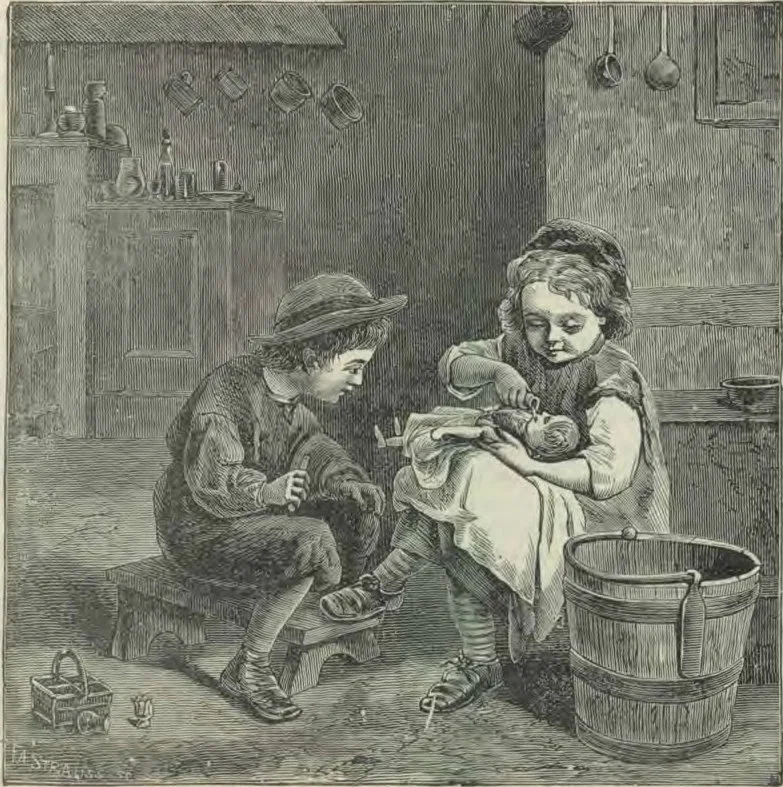
“The brightest days in all the year are the summer vacation days,” so say the little boys and girls who have been shut in the school room with their books during the long winter and spring terms of school. They love their school days and books in their time; but nature’s good law of rest after labor, pleases them best when “green things are growing,” and the world looks so beautiful.
Your friends agree with you in this, dear children,—that you need the change. Should you continue your studies the year round, with no seasons of rest and pleasure, you would grow up with dwarfed and sickly bodies, to say the least. You cannot develop into perfect men and women without using your muscles freely in the fresh air and sunshine.
And so it is best that you should have free, happy times in the fields and woods, a part of the year, engaging in such sports and pastimes as parents and guardians think proper.
However, we don’t say, Play all the time. There are other kinds of exercise that have as good effect upon the body, if done cheerfully. There is the lighter work at home, which many of you can, and some of you do, perform so well, making you very helpful.
But what we want most to say is, you who have a true missionary spirit can find opportunities for earning a dime here, and a nickel there, to help swell the mission funds. And the doing of it will make the vacation days doubly bright, and if faithfully done bring you great reward, besides giving light to the heathen, who sit in darkness.
Since writing the above, we have been reading about the sacrifices heathen children make for others after the light of the gospel reaches them. Could we catch some of their spirit, may be we would find greater pleasure in doing for them. It is a missionary teacher in China who writes. She says:—
“Most of the girls in the boarding-school are very poor, and have no spending money except what they can lay aside by denying themselves meat and dainties upon certain days.
“Beside this there is a small sum distributed among them once a year as a reward for work in the sewing class. This sum, this year, was less than one dollar and fifty cents for twenty-six girls. The largest sum received by any of them was one hundred cash—less than ten cents of our money.
“Not more than four hours after I gave them the money, the girls handed in their names with the sum affixed which they wished to give to the Lord’s work.
“I was astonished to find the amount returned greater than the sum distributed. One dear girl, who is too poor to buy herself a single ornament, not only gave the one hundred cash she had received as a reward, but had added one hundred, which had been paid her for a little embroidery done during vacation.
“Another poor girl, whose mother is a widow, and who has nothing beyond the sum saved by denying herself food, gave fifty cash. Another poor little girl of thirteen gave forty cash.
“These sums would be to our Ningpo girls what the same number of cents would be to our poorest children in the home churches, and this is their annual offering. They rarely fail to give a weekly offering in the Lord’s house.”
How long would it take our Sabbath-schools to raise the sum needed for the London mission if the members of the several schools labored and gave in proportion as the Ningpo girls did? Will you not profit by their example, and begin this vacation, while you have the opportunity? M. J. C.
LITTLE WORKERS.
Lucy's mother was shelling peas. Lucy was lying on the floor, wishing she had something to do.
“Come and help me shell peas,” said mamma; so Lucy jumped up, and came over to her mother.
“First you must go into the bath-room,” said her mother, “and wash your hands very clean.”
So Lucy went and washed her hands till they looked like two pieces of pink cotton. Then her mother went into the pantry, and got a green wooden bowl and a bright tin basin, and put them on Lucy's little table. She put some peas into the wooden bowl, and said, “Now, Lucy, when you shell them, put them into the basin, and throw the pods into this basket. Let me show you how to do it.”
So Lucy did just as her mother said, and out popped the little peas, and went rolling about in the basin. It was great fun to see them hop out of the pod. Lucy worked a few minutes, and then said she was tired. A big yellow butterfly flew by the door just then, and Lucy said, “I want to go and play now; I must catch that butterfly.”
But mamma said: “No; when a little girl begins a piece of work, she must finish it. Shell all the peas in your bowl, then you may go.”
I am sorry to tell you that a scowl came right between Lucy's brown eyes then, and she said, “Flutterbies and kitties play all the time. Wish I was ’em.”
“Finish your work like a good girl,” said mamma; “then we will go and see if we can find any little people who work out-of-doors.”
Soon the work was done, and mamma and Lucy started.
The first thing they saw was a honey bee buzzing about the flowers.
“Here is a little worker,” said mamma; “he is getting something to make our honey of, like that we had last night for tea. Busy bee is the name of this fellow.”
Just then a bird flew by with a straw in his mouth. He went into the maple-tree over their heads.
“Hush,” said mamma; “don't make a noise. Look up and you will see another bird-worker. Here is a mother-bird making a house.”
They kept quite still, and watched the bird tuck the straw in nicely, then away he flew for another one.
“Now look down at your feet,” said mamma.
There was a big ant-hill, and every little ant was coming up the hill tugging a grain of sand.
“Oh! how funny,” said Lucy. “What are they doing?”
“They are building a house, too. If such little creatures can work so hard, can't my little girl help her mother?”
Lucy hung down her head then, and twisted her bonnet strings. She was a-s-h-a-m-e-d.—From the Pansy.
Letter Budget.
HARRY F. and IDA A. LEONARD send letters from Kingsbury Co., Dakota. Harry says: “I have read so many letters in the Budget that I thought I would like to see one from Spring Lake. I am ten years old, and with my parents have been keeping the Sabbath some three years. I go to Sabbath-school regularly when the weather is good; but here in Dakota we have some severe storms and cold weather, so we can't get out. I study in Book No. 1. I have been to four camp-meetings; two last year and two this year. I earned some money, and gave most of it to the South African Mission. When I get older, I will try to do more than I can now. I help do chores, and papa let me plough three days last fall. I hope to meet the INSTRUCTOR family when Jesus comes.”
Ida says: “Papa was writing for Harry, so I thought I would like to have a letter written for me, too. I am almost eight years old, but I cannot write. I can read some. Harry can read and write too, but not well enough to send to the Budget. We have a bird and two ducks. We call our bird Pete, and our ducks, Nellie and Bob. Ma says I am good to help her, but sometimes a little noisy. I will try to be good all the time. I like to have ma read the letters in the Budget for me.”
Then we have two letters from Hill Co., Texas, written by CALLIE and ALICE TUCKER. Callie says: “I am ten years old. I love to read the letters in the Budget. I am trying to live right. With one of my older brothers, I was baptized last spring. I want to be a real missionary for Christ. I have given several papers to little children. We have a large Sabbath-school. I study in Book No. 3. We want to have a good denominational day school this fall and winter. We have a good place for a school. I send ten cents to the London mission. I want to be remembered in your prayers.”
Alice says: “As my sister is writing, I want to say a word, too. I am only eight years old. I can't write, so I get mamma to write for me. I go to Sabbath-school nearly every Sabbath, and study in Book No. 3. We live away out in the Lone Star State, where they raise cotton. I sometimes hoe cotton for my papa. But I can wash dishes too, and milk, and churn, and mind baby, and a great many other little things. I have two pet rabbits, which I love very much. My papa is going to take us all out on the Brazos River fishing. I think it will be such a nice treat for us little folks. I want you all to pray for me.”
LEONARD BEAMER writes from Johnson Co., Mo. He says: “Inclosed find one dollar to pay for the INSTRUCTOR a year and four months. I have been without it for quite awhile, and I miss it very much. I hope all who read it think as much of it as I do. I was baptized last year at camp-meeting. I ask you to pray that I may be faithful.”
WINNIE THOMPSON, of Sedgwick Co., Kan., writes: “We have a good Sabbath-school. I study in Book No. 3. My brother and sister study in the INSTRUCTOR. The Sabbath-school is at our house. My mamma teaches the infant class, and my sister is secretary of the school. I do missionary work. I am nine years old.”
WM. R. SMITH, of Ada Co., Idaho, writes: “I am a little boy eleven years old. I go to Sabbath-school, and study in Book No. 2. I have seven brothers, and two sisters. My oldest brother is gathering up horses to take to the white sage, where they will stay and do well. Stock will not eat white sage in the summer, but they get fat on it in the winter.”