The very countenance of a man of much prayer will often bear witness to his acquaintedness with the mountain height. It will show a softened spiritual beauty that in his prayerless days it never had. But whether or not the face bears witness to the mountain top, the whole life and character will. There is sure to be seen in his whole tone an elevation of feeling showing clearly that he is accustomed to be often very near to God; and thus his high fellowship with God will bring about a high life before men. If any Christian finds that his soul is not sufficiently raised above the down-dragging influence of earthly things, and his life not transformed, gradually but surely, into the beauty of holiness, it is only because he does not often enough climb the hill of secret communion with God, nor linger long enough there to catch its heavenly glow. We need to be much in the company of God if we are to understand God, to sympathize with God, to feel as God feels, to resemble God. Two human hearts that are constantly together, dwelling in the same house, sharing the same house, sharing the same table, talking with each other, finding each other's presence a daily joy, get in time wonderfully to resemble each other in all their habits of life, in their way of looking at life, in all their feelings about life, even in the very tones of the voice. It is this kind of intimacy with God that we need to cultivate; an intimacy that will enable us to understand God in all the ways of his divine love, and will prevent us from misunderstanding him when his love is a little concealed; an intimacy that will gradually make us resemble God too, lifting us into a region purer and loftier than other men know anything of.
“When one that holds communion with
the skies
Has filled his urn where these pure
waters rise,
And once more mingles with earth's
meaner things,
’Tis even as if an angel shook his
wings:
Immortal fragrance fills the circuit
wide;
And tells us whence his treasures are
supplied.”
— Rev. G. H. Knight.
Seeking Blessings for Others
“No man ever sought a blessing for another without getting one himself.”
God of Hosts
For the beauty of the earth,
For the beauty of the skies,
For the love which from our birth
Over and around us lies:
Christ, our God, to thee we raise
This, our sacrifice of praise.
For the beauty of each hour
Of the day and of the night,
Hill and vale, and tree and flower,
Sun and moon and stars of light,
Christ, our God, to thee we raise
This, our sacrifice of praise.
For each perfect gift of thine
To our race so freely given,
Graces, human and divine,
Flowers of earth, and birds of heaven,
Christ, our God, to thee we raise
This, our sacrifice of praise.
For thy church that evermore
Lifteth holy hands above,
Offering up on every shore
Its pure sacrifice of love;
Christ, our God, to thee we raise
This, our sacrifice of praise.
—Church Hymnary.
Why Abstain from Meat?
By D. H. Kress
D. H. KRESS, M. D.
“It was because the Lord desired to make the children of Israel his representatives that he provided them with a special bill of fare. They were placed under careful restrictions in regard to their diet. The people were to be holy, and the Lord knew that the use of flesh-meat would be a hindrance to their advancement in the spiritual life. The food provided for them was of a nature to promote physical, mental, and moral strength. If the Israelites had been given the diet to which they had been accustomed while in Egypt, they would have exhibited the unmanageable spirit exhibited by the world about them. The human family as it is to-day, is an illustration of what the children of Israel would have been, if God had allowed them to eat the food and follow the habits and customs of the Egyptians.”
In these days, just as truly as in the olden time, God desires a people who will represent him to the world. To bring this about, he must again provide for them a special and separate bill of fare. God knows that flesh eating proves a hindrance to advancement in spiritual life, therefore he has called the attention of his people to the need of reform in eating and drinking. Should they continue to eat the food to which they were accustomed while in the world, they would soon again exhibit the same unmanageable spirit that the world is exhibiting. It is being fully demonstrated in the world to-day, that the food God provided for man at the beginning and for Israel in the wilderness, was of a nature to promote physical, mental, and moral strength. Athletes are calling the attention of the athletic world to the fact that simple foods are best on which to acquire physical strength. Men of mental and intellectual strength who have accomplished much through the adoption of food reform are speaking with no uncertain voice to the intellectual world in favor of the simple foods.
Men of spiritual and moral strength in the past and present testify by precept and example that the acquirement of Christian virtues is made easier by the adoption of simple, non-stimulating foods. Daniel and his three companions, men of both intellectual and moral worth, though dead, still speak in favor of these reforms. Moses, Caleb, and Joshua, men in whom dwelt an excellent spirit, fully co-operated with God in urging upon a rebellious people the need of abandoning the flesh of animals as food. The leading doctors, physiologists, and scientists of to-day are calling the attention of the scientific world to the advantages, physically, mentally, and morally, of a fleshless diet. Their convictions are based on science, personal experience, and laboratory experiments.
Sir Henry Thompson, M. D., F. R. C. S., says: “It is a vulgar error to regard meat in any form as necessary to life. All that is necessary to the human body can be supplied by the vegetable kingdom. I know how much of the prevailing meat diet is not merely a wasteful extravagance, but a source of serious evil to the consumer.”
Alex. Haig, M. D., F. R. C. P., says: “That it is easily possible to sustain life on the products of the vegetable kingdom needs no demonstration for physiologists, even if a majority of the human race were not constantly engaged in demonstrating it, and my researches show not only that it is possible, but that it is infinitely preferable in every way, and produces superior powers both of mind and body.”
Rev. Henry Ward Beecher, in one of his sermons said: “I have known men who prayed for the grace of good temper in vain until their physicians told them to stop eating meat; for they were of a peculiar temperament that could not endure such stimulation. As long as they ate animal food, they could not control themselves, they were so irritable; but as soon as they began living on a diet of grains and fruits, they were able to keep their temper. They sought in prayer relief from their irritableness; their physician, by the aid of science, revealed to them the cause of that irritableness, and their prayer was answered. They were not unwise in praying, but they were wise when to prayer they added medical advice.”
Professor Gauthier, a noted French authority from his laboratory observations of the influence of flesh on animals says: “A flesh diet is a more important factor in determining a savage or violent disposition in any individual than the race to which he belongs. It is well known that the white rats of our laboratories, as long as they are fed on bread and grains, are very gentle, but when given flesh to eat, become quarrelsome and destructive.”
And Dr. Baron Liebig, another world-recognized authority says: “The ingestion of flesh produces in the carnivorous races a ferocious and quarrelsome disposition which distinguishes them from herb eaters.”
From these statements it will be seen that God had the physical and spiritual good of his people in view in withholding from them flesh-meats. He heard their prayers while in Egypt, and desired to save them from Egypt’s diseases and immorality. He could do so only by saving them from the habits which were responsible for them.
For he himself established for the good of mankind the relation that exists between cause and effect. The effects are logical, the causes are wrong. The effects are permitted to call attention to the causes. Our great burden therefore should not be to seek the removal of effects, but to ascertain and seek the removal of the causes which produce the effects.
The people to-day, as anciently, desire and seek God’s blessing of physical and spiritual health, but too often they are unwilling to co-operate with him in the removal of the obstacles which hold these good things from them.
The history of Israel has been written especially for the benefit of those upon whom the ends of the world are come, that they should not lust after evil things as they also lusted, and were, as a result, overthrown in the wilderness.
The Kitchen-Garden
The kitchen-garden has been somewhere designated as an adjunct of the kitchen itself, and belonging to the domain of the housewife. It should not necessarily follow that she is to do all the labor in the garden, but merely do the planning, and exercise an intelligent management over it. The head of the house is quite apt to depreciate the value of a garden and to insist that it does not pay, because it seems such pottering work in the busy season of the year; but well-cared-for gardens do pay in pleasure, and, if the effort is made, will pay handsomely in money.
Being related to the kitchen, the garden should be located near that part of the house. It should be fenced about to keep out the chickens. The soil should be fed with an abundance of fertilizer13(because gardening is intensive culture) and worked fine. “Fine the soil” was the emphatic and oft-repeated injunction of one of the most successful truck raisers and seedsmen.
An intelligent rotation should be observed in the garden as well as in the field. Root crops should not always be grown on the same place, nor leaf crops, like lettuce or cabbage.
It is an economy to plant the seeds in long rows, rather than in beds, as this method permits the use of a horse cultivator or a wheel hoe, and eliminates the back-breaking hand-work in weeding and stirring of the soil. The rows should run in a northerly-southerly direction, to best secure the benefits of the sun’s rays. Grape-vines, berry and currant bushes, asparagus bed, rhubarb, and such plants which are biennial or perennial, are better placed around the borders, or together at one side of the garden.
A half-acre garden is sufficient to grow all the vegetables and small fruits for an ordinary family and make a profit through sales. An acre on Long Island has been known to yield one thousand dollars in garden-truck, which, of course, requires extra diligence on the part of the proprietor and a proximity to the city market, but aside from the financial profit, the healthful pleasure of tilling the ground is a satisfaction.—The Circle.
The Child's Counselor and Friend
Too much emphasis can not be placed upon the importance of a close intimacy between mother and child. The creation of this intimacy depends altogether upon the mother, for it should be started during the child's infancy and grow, as the child grows, just as a matter of course. It is the mother's part to see that the confidence on the part of the child is not lessened as it grows older.
If the child is taught at a very early age that mother is always a sympathetic listener to the heartaches and worries incident to childhood, as the child grows in years the same confidence will be observed if the mother has not relaxed her interest.
The wonderful work that is being done by Judge Ben. G. Lindsey, of Kansas, in rescuing children from depraved conditions, must appeal directly to mothers, and will undoubtedly go far toward creating a closer relationship between mothers and children in American homes. Through the exposition of the sad cases brought to Judge Lindsey's notice, many mothers will be led to question themselves closely as to how well they are observing their duty toward their children in this matter of confidence.
If the cases under observation were from tenement districts, they would be just as sad but less startling, because the conditions of such districts are not conducive to a high state of morals; but when they are found to come from the very flower of our civilization, the cultured and apparently refined American homes, the situation is serious indeed, and the mothers of our land must and will call a halt and commune with themselves on this subject. The result will be pure-minded children, who will not hesitate to go to their mothers with whatever questions they wish to ask; and pure-minded mothers, who will have no false ideas of modesty about imparting, delicately and freely, to their children, that knowledge which will protect the inquisitive, youthful minds from pollution when thrown in contact with grosser minds.—The Circle.
Beware of Pride
By Chas. G. Finney
ARE you going to walk in the street? Take care how you dress. What is that on your head? What does that gaudy ribbon and those ornaments on your dress say to every one who meets you? It gives the impression that you wish to be thought pretty. Take care! You might as well write on your clothes, “No truth in religion.” It says, “Give me dress, give me flattery, and I am happy.” The world understands this testimony as you walk the streets. You are living epistles, known and read of all men.
If you show pride, levity, bad temper, and the like, it is opening the wounds of the Saviour. How Christ might weep to see professors of religion going about hanging up his cause in contempt at the corners of streets!
Only let the “women adorn themselves in modest apparel, with shamefacedness and sobriety; not with broidered hair, or gold, or pearls, or costly array; but (which becometh women professing godliness) with good works”—only let them act consistently, and their conduct will tell on the world; heaven will rejoice at their influence.
But, O, let them display vanity, try to be pretty, bow down to the goddess of fashion, fill their ears with ornaments and their fingers with rings; let them put feathers in their hats, and clasps on their arms, lace themselves up until they can hardly breathe; let them put on their “round tires,” and walk “mincing as they go,” and their influence is reversed. Heaven puts on the robe of mourning, and hell may hold a jubilee. — Chas. G. Finney.
A Father's Lesson
The Sunday School Times contains the following choice editorial:— “It is the child who sends his parents to school—not so much the parents who send the child. And every disciple of the Master Teacher, whether parent or not, must go to school to the child if he would learn the ways of the kingdom. A father sat by his little boy's bedside at night, trying to soothe into quiet a wakeful and restless mind, busy with a hundred child-interests that the night did not seem to shut out. Suddenly the little fellow disclosed the deeper cause of his troubled thought. ‘Father,’ he said, with a sob, ‘I'm afraid to tell you things sometimes, because you speak so quickly!’ ‘Why, what do you mean, little boy? I don't intend to speak quickly to you, and I never want you to be afraid to tell me anything you please,’ was the earnest response. ‘Yes, father, but you do speak quickly sometimes, and you say “No,” so that I am afraid, and don't ask you lots of things I want to ask.’ That father was in school, and a hard schooling it was. He came to his knees beside the bed then, and he made some promises to the boy which are to be kept. But when the father was alone, this lesson began to come out of the schooling: ‘What if my Father in heaven should answer me quickly, and say “No,” so that I should be afraid to ask him lots of things I want to ask? If he can be so patient as he is with my questionings, what right have I to be other than that with a child's questions?’ The little boy had not been wakeful in vain.”—Home Herald.
The Heaven-Filled Heart
A WRITER in the Holton (Kan.) Signal once witnessed a demonstration which was touching and beautiful. In the upper waiting-room of the Union Station at Kansas City, a tired, bedraggled mother of several small children, including a wailing baby of five or six months, was vainly endeavoring to quiet and entertain them. A woman, simply but richly dressed, with a beautiful face and commanding figure, left her seat and approached the dissatisfied little group. From her satchel she produced a veritable fairyland for those children. There were games, books, and toys; there were blunt scissors and pictures to cut out, and even tiny sugar pills, which, she explained to the mother, were unmedicated, and in trying to pick them up and convey them to his mouth the baby found occupation and the peace of mind which goes with it. Later, in conversation with the writer, this most charming woman modestly admitted that she never traveled without a satchel full of things with which to amuse and entertain children, as in her early life she had lost the one child she had ever possessed, and all children appealed to her. She certainly had the kingdom of heaven in her own heart, and so much sunshine that it simply had to reach out and touch all with whom she came in contact.—Selected.
The Chief Bar to the Holy Spirit
By Cardinal Manning
FOR thirty-five years I have been priest and bishop in London, and I now approach my eightieth year, and have learned some lessons, and the first is this: The chief bar to the working of the Holy Spirit of God in the souls of men and women is intoxicating drink. I know of no antagonist to that good Spirit more subtle, more stealthy, more ubiquitous than intoxicating drink. Though I have known men and women destroyed for all manner of reasons, yet I know of no cause that affects man, woman, child, and home with such universality of power as intoxicating drink. — Cardinal Manning.
The Needs of India Considered at the General Meeting
By G. B. THOMPSON
G. B. THOMPSON
We had much clear evidence at this meeting that the Lord is preparing to do a quick work in this land. From a feeble beginning a few years ago, the work has grown until we now have over fifty earnest laborers in different parts of the field engaged in various lines of effort, and believers are being gathered from the various languages among the Indian people. A good beginning has already been made among the Burmese, Bengalis, and Santals. The Lord led us at this meeting, and helped us to lay some broad plans, which, when carried into effect, will greatly lengthen the cords and strengthen the stakes of our missionary operations in India.
India is a land of superstition, ignorance, idols, and systems of false religion. All these have done their baneful work for centuries. Three hundred million souls, or one fifth of the population of the globe, live here, in the shackles of caste and idolatry. The land swarms with human beings, and not more than five millions of these speak the English language. To sit down in the midst of these millions and plan a campaign which will carry the message of the third angel to them in this generation, means much. But this was the key-note of this conference from beginning to end. Not a doubt was expressed that the message we carry is the truth, and that God will finish his work for man in this generation. In many respects this was the greatest missionary convention I ever attended. My own heart was greatly stirred.
In order to accomplish the great work before us in this heathen land, we must study the languages. We must speak to the people in their own tongue. Scores of young workers of good education must be speedily sent to this land, who can study the languages, and do pioneer work in the various vernaculars. There are several hundred languages and dialects. The Hindi is the most widely used, but there are many other tongues which are spoken by millions, and into which the Bible has been translated, thus preparing the way for the last message.
As stated, a substantial beginning has been made in some of these languages, and some literature has been prepared. Brother and Sister Burgess, who have recently returned here to labor, have just gotten out an excellent pamphlet in Hindi, on several points of our faith. This will be circulated.
In locating the workers, it was decided that Brother J. S. James and family go to southern India, and while forwarding the message in that field, study the Tamil language. This means much more than placing a laborer in some part of a local conference. There are sixteen millions who speak the Tamil, or one fifth of the population of the United States. It is practically opening a new mission field, where as yet we have not a single missionary who speaks the language. The Lord is already at work in this field. Some in attendance at the conference told us that in the extreme south of India there are between five hundred and a thousand of the Tamil-speaking people, who are keeping the Sabbath. Elder Owen has talked with some of them, and they have asked that we come and teach them. The Catholics have sought to turn them from the faith, but in vain. They are said to have also some knowledge of the nature of man, and the coming of the Lord. Though they still have some heathen customs, no doubt this part of India will be a fruitful field of labor. It is surely time some one was preparing to give them the truth. There are also other languages in southern India spoken by millions, which should be pioneered by some one.
In the Bombay district the Marathi is spoken by eighteen millions. We felt burdened to see a beginning made among this people and endeavored to place some workers in this vernacular, but were not able to secure suitable persons. Plans are under way, however, for a competent laborer to pioneer such an effort.
Brother Cook and his wife were sent to labor among the Santals and learn the language. There are more than two millions who speak Santali. These are said to make the most substantial Christians of any of the Indian people. Caste does not prevail among them. Brother Barlow, has made a beginning there, and some literature has been prepared. This is being widely circulated, and some have already embraced the Sabbath.
A number of the Bengalis have accepted the Sabbath, and considerable literature has been circulated. There are about forty-five millions who speak this language, and arrangements were made by which other laborers could take up work in this tongue. It was recommended that Sister Della Burroway and Brother A. G. Watson, who already have a limited knowledge of this language, plan to devote their whole time to it. They will begin in Kora, a native village of several thousand inhabitants a few miles from Karmatar. In addition, Brother and Sister Burgess will give their entire time to preparing literature and pushing out among the Hindi-speaking people.
Pioneering among all these vernaculars is a stupendous task. Besides the languages mentioned above, there are the Gujerati, spoken by ten millions, the Telugu, by over twenty millions; the Punjabi, by seventeen millions; the Rajasthani, by eleven millions; and the Kanarese, by ten millions; and others. What shall be done among these millions? Not yet have we a single voice speaking to them. We believe we should begin among these languages at once. Our prayer is that God will raise up consecrated laborers to pioneer the way. Taking up the study of these languages means giving the life to the message in India. All felt greatly cheered that we were able to take such advanced steps in the vernacular work at this meeting.
The effort in Burma was also strengthened. Brother and Sister Votaw are getting the language. Dr. Ollie Oberholzer was sent to this field, and will get hold of one of the languages of Burma, while carrying on her work. Sister Ruoff and others will push the sale of our English literature.
The administrative staff in the field has been strengthened. While Elder J. L. Shaw is director, Elder W. W. Miller, who has so faithfully carried the responsibilities the past two years, is assistant director, and will share the burdens, which are necessarily heavy in a large mission field like India. Dr. Menkel was chosen medical secretary, and other departmental secretaries will be arranged for by the board, as our operations demand.
What a wonderful message God has given to us! With mighty, irresistible power it is pressing its way in the darkest places of the earth, and when received, it rejoices the heart of the most benighted Hindu as it does that of the most enlightened European. Speedily the Lord is stationing his messengers in all places, and preparing the way, that, under the outpouring of the Holy Spirit in the latter rain, he can cut short his work in righteousness, and bring the long-looked-for end. India is waiting for the message, and we saw clear indications in our meeting just closed that the Lord is preparing to do a great work in this land. The brethren and sisters separated for their fields of labor with thankful hearts for the blessings received, and with courage to labor for the advancement of this truth as never before. Let all remember them in prayer.
General Meeting for Japan and Korea
By F. W. Field
F. W. FIELD
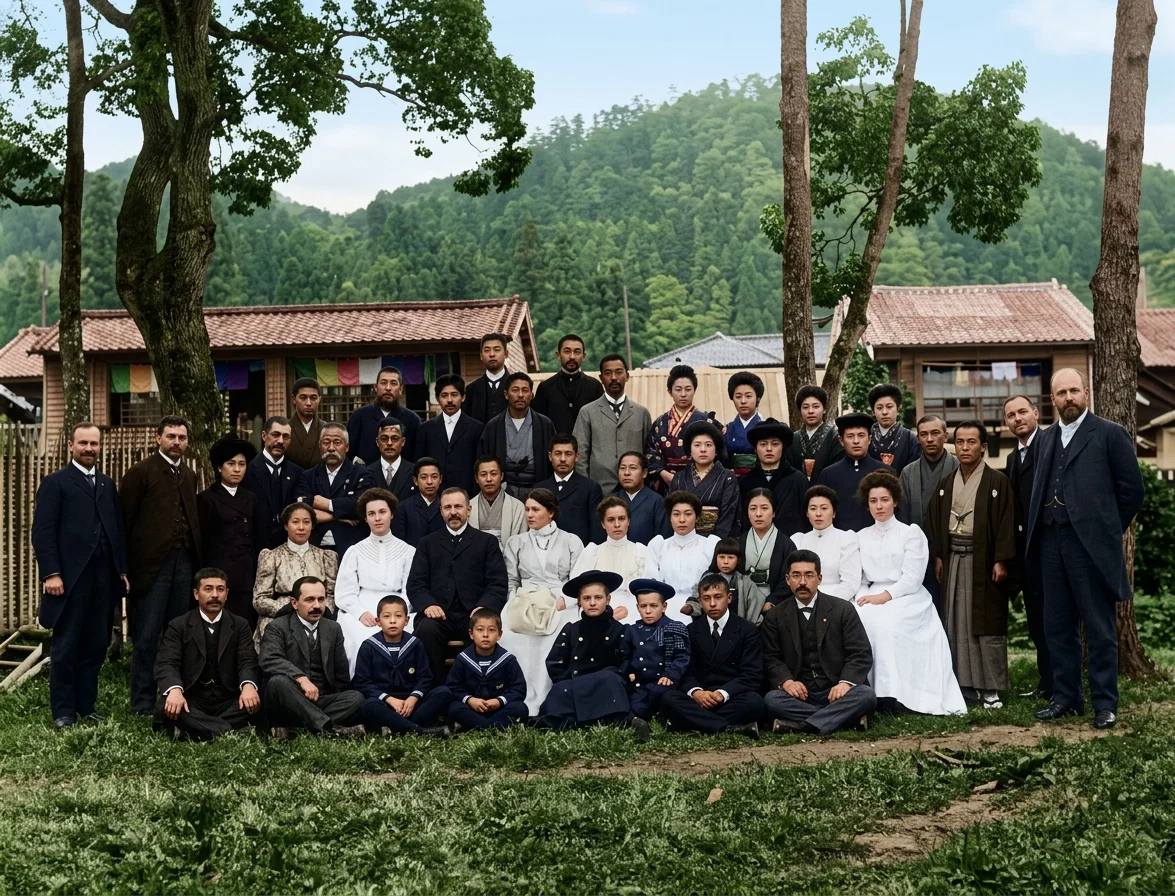
For the first time in the history of the Japan Mission, we recently enjoyed the privileges of a general meeting. The occasion was the visit of Elder W. W. Prescott to the far East. The meeting was held at Kobe, and was appointed to begin on the first day of the new year. All but one of the workers in Japan, natives and foreigners, were present; and Brother and Sister Smith and two of the Korean workers came from their field of labor. The members of the Kobe church also seemed to appreciate the privileges offered by the meetings.15
The meetings for Bible study were a very important and valuable part of the program. A prayer service at an early hour was followed by a Bible study in English, conducted by Brother Prescott. Our Japanese brethren who understand English attended these studies with us, and each day's lesson was given in Japanese the following morning at an earlier hour, for the benefit of those who do not understand English. Every evening a general service was held at the church. At these meetings the sermons were interpreted into Japanese.
These seasons for Bible study were a source of strength and encouragement for all our workers. "The everlasting gospel" was the great theme in every study. The evening services were well attended, and a deep interest was shown. The believers were encouraged and edified, backsliders were reclaimed, and outsiders became deeply interested. During the meetings several took their stand for the truth.
GROUP OF OUR WORKERS AT THE TOKYO GENERAL MEETING
Each afternoon a general business meeting was held at the church, after the manner of regular conference meetings. Committees were appointed to study the needs of the work, and to formulate plans for its advancement. The reports of these committees were freely discussed, and adopted with remarkable unanimity.
There seemed to be quite a general feeling that the time has come for a decided forward movement in all departments of our work. In some lines we have not yet made even a beginning. A training-school for workers is an urgent necessity. We need such a school for the further development of the workers now engaged, and for the training of new workers, both for Japan and Korea. Plans for the advancement of the medical missionary work were also considered. The Kobe Sanitarium for foreign patients, and the Eisei-in for Japanese patients, have both practically outgrown their present quarters; and so the present seems to be an opportune time to unite these two lines of work, and also to secure a rural location, where the congestion and the high rents of the city may be avoided. The advancement of our evangelical work also received attention, and a strong recommendation was brought in urging that the work be strengthened by materially increasing our force of workers from the home field. The publishing work also was not forgotten, but was given full consideration in our plans.
The present position of Japan in the far East, makes this the opportune time to lay broad plans, and to push ahead in the work, both in Japan and Korea. These plans for the enlargement of the work will require considerable outlay, both in men and means; so the recommendations adopted at our general meeting were embodied in a memorial addressed to the General Conference Council, which meets in Europe next May. We shall await with deep interest the decisions of the brethren at this important gathering. The work in Japan has advanced very slowly heretofore. It is now over ten years since the work was begun in this field, and we still have but few workers and a small constituency. But if the field is difficult and results come slowly, there is all the more need of increased effort to push the work.
Sabbath, January 5, was rich in blessings. There was a good attendance at the regular forenoon services; and in the afternoon a special service was held, when Brethren T. H. Okohira and H. Kuniya were ordained to the gospel ministry. The time till the close of the Sabbath was then filled with earnest testimonies from the brethren and sisters.
We had planned to continue our meeting over the following Sabbath, but much to our regret, Brother Prescott found it necessary to cut short his stay in Japan, in order to meet appointments in other fields. So on Tuesday morning, January 8, in company with Brother and Sister Smith and Sister Mimi Scharffenberg, he left for Korea. We shall long remember this visit, and trust that we shall soon be remembered again in a similar way by our brethren of the Mission Board. Sister Scharffenberg goes to Korea to prepare for Bible work among the women of that country.
We continued our meetings after Brother Prescott's departure, most of those in attendance remaining till after the Sabbath. The presence of the Lord was with us till the close, and I trust went with each one as we returned to our several fields of labor. We feel hopeful and of good courage as we look forward; and in His strength we shall go forward.
Tokyo, Japan.
Mission Notes
By W. H. Wakeham
A PHYSICIAN from any good medical school has no difficulty in getting practise in Egypt. American, English, or German physicians can go there and qualify immediately, by simply presenting their diplomas or papers before the Medical Association Board, and obtain a license. Cairo would be a good place in which to open treatment rooms. There are many Europeans in that city who would gladly welcome a physician from America or Europe.
ONE of the first places which the apostle Paul visited on his first missionary tour was Cyprus. We now have two brethren on this island, who within the past two years have begun the observance of the Sabbath. One of these came to Alexandria, and I met him and had a very interesting conversation with him, holding several Bible readings, through an interpreter. Though he is an Armenian, yet he does not know that language, but speaks the Turkish. He was much interested in the different points of our faith, and expressed himself as in harmony with them. After passing through a great deal of persecution, he had finally begun to think of the truths he had heard, and kept the Sabbath twelve years after first hearing the message from Brother Baharian. He runs a little merchandise wagon throughout the country, and preaches the truth as he goes.—W. H. Wakeham.
Korea
By W. R. Smith
SUNAN.—We have been in Korea thirteen months. While we realize that we have come far short of doing what we should have done, yet we have labored hard for the advancement of the message, under very adverse circumstances.
A year ago last November we went to Seoul, and were allowed to move into a house belonging to a Korean nobleman. In the early spring the house was bought by a wealthy Englishman, so we had to seek a home elsewhere. Then we went to Chinnampo, to be near the Korean brethren. After living there for about six weeks, putting in our time studying the language and visiting among the churches, our baby was taken sick.
In the meantime an influential Korean, living at Sunan, a village in the interior, on the railroad, had learned of the truth, accepted it, and taught it to a number of his countrymen, and was very urgent in his request for us to make his village our home. And as it was a much more central, as well as healthful, location than Chinnampo, we complied with his request.
But our little child had already contracted the malaria, and at best we could get only a rude Korean hut in which to live. So, after battling with the disease for one month, during which time I was very sick myself and came near dying, we took the baby to the Kobe Sanitarium. In going from here to that place, one must be on the road three days and four nights. Mrs. Smith and the baby remained at the sanitarium during the summer months. I returned to Korea, where I spent my time visiting the Koreans, studying the language, and securing some land on which to build a house for ourselves.
Mrs. Smith and the baby returned about September 14. We thought the baby strong and well, but the malaria came back. By this time we were starting to build our house, upon a hill in a clean place. Part of the time we had twenty-nine men working on it. You will understand that the work had all to be done by Koreans, who did not know one word of English, with no experience in building this kind of house. When we moved into it, the house was only partly finished. The baby seemed to regain her health rapidly. But the germs of malaria seemed to cling to her, and she contracted diphtheria, and died November 24.
And now, although our hearts are very sad and lonely, yet we are of good courage. We are very glad to learn that another worker is on her way to Korea. We shall be pleased to meet Elder Prescott, also. When will a doctor come to Korea?
As to the language, about the only way which we have of judging of the progress we are making is by what we can do with it. In ordinary conversation I get along fairly well, and can give Bible readings to some extent.
The work is still moving forward here, and new ones are accepting the truth. Elder Field and Brother Burden have recently returned from visiting this part of the field. W. R. SMITH.
Publishing Work in China
By E. H. Wilbur
A SMALL beginning has been made in the publication of literature on present truth in Chinese, both in Hunan and at Canton. That which has been printed by our brethren in Hunan is nearly all in the Mandarin dialect, while that printed in Canton is all in the book language. Thus far we have published no literature in the Cantonese dialect, one reason being that we have so little Chinese literature that we felt that that which we did publish should be in a form that could be understood by any person of fair education in any part of the empire, regardless of what his spoken dialect might be. The colloquial books could no doubt be more easily understood, yet the average non-Christian reader in this part of China would not wish to read a book published in a colloquial language.
During the year 1906 we have had the following tracts printed in Canton: “Know Thy Creator,” two editions of 5,000 each; “The Law of God,” 5,000; “God’s Love for Man,” and “The Sinner’s Need of Christ” (from “Steps to Christ”), 5,000 each; besides 2,000 Sabbath tracts, and 5,000 Sabbath calendars, making a total of 32,000. The demand for Chinese tracts is increasing. We have some new tracts, on the second coming of Christ, and other subjects, all translated ready to print, but there is no money in the treasury to pay for printing them.
The Hakka brethren who were baptized here in June thought at first that they could not sell tracts, but after some urging they took up the work. One of these brethren alone sold twelve hundred tracts during October, and all of them together have sold several thousand copies up to the present time. There is a great demand for new literature in China now, and this is our opportunity to spread a knowledge of the truth. Who is willing to help us in this work? We are here on the field ready to fight, but, brethren, we must have ammunition. Any one desiring to help in this work should send his contributions through the Mission Board treasurer, specifying the object for which it is donated.